Welcome, Guest
You have to register before you can post on our site.

Username
  

Password


Search Forums

(Advanced Search)

Forum Statistics
» Members: 20,946
» Latest member: blackopsdlc
» Forum threads: 22,001
» Forum posts: 22,968

Full Statistics

Online Users
There are currently 1190 online users.
» 0 Member(s) | 1185 Guest(s)
Applebot, Baidu, Bing, Facebook, Google

Latest Threads
[WoW Retail News] Comment...
Forum: World of Warcraft
Last Post: xSicKxBot

» Replies: 0
» Views: 4
How to unlock Maya Aguina...
Forum: PC Discussion
Last Post: xSicKxBot

» Replies: 0
» Views: 14
[Steam Release] The Unive...
Forum: New Game Releases
Last Post: xSicKxBot

» Replies: 0
» Views: 16
[DevBlog MS] Creating a m...
Forum: C#, Visual Basic, & .Net Frameworks
Last Post: xSicKxBot

» Replies: 0
» Views: 17
[WoW Retail News] Fixed C...
Forum: World of Warcraft
Last Post: xSicKxBot

» Replies: 0
» Views: 19
[PS.Blog] Fading Echo mak...
Forum: Sony Discussion
Last Post: xSicKxBot

» Replies: 0
» Views: 18
[Steam Release] Cowbots a...
Forum: New Game Releases
Last Post: xSicKxBot

» Replies: 0
» Views: 20
[Dev News] September Free...
Forum: Game Development
Last Post: xSicKxBot

» Replies: 0
» Views: 17
Marvel Rivals Venom guide...
Forum: PC Discussion
Last Post: xSicKxBot

» Replies: 0
» Views: 23
[WoW Retail News] Midnigh...
Forum: World of Warcraft
Last Post: xSicKxBot

» Replies: 0
» Views: 26

 
  [Tut] Before After Image in Plotly Dash
Posted by: xSicKxBot - 07-23-2022, 03:56 PM - Forum: Python - No Replies

Before After Image in Plotly Dash

5/5 – (1 vote)

? This article will show you how to use the BeforeAfter image component in your Plotly Dash project.


Dash book author Ann just created the following stunning web project visualizing before/after galaxy images from the James Webb Space Telescope in a simple and straightforward Dash app using the BeforeAfter component of the dash-extensions library.

pip install dash-extensions

Before we dive into the code, here’s a screenshot of the stunning interactive dashboard visualization created in the project:


Feel free to visit the live app showing different exciting images from the Hubble and Webb telescopes here:

? Interactive Live App: https://dash-webb-compare.herokuapp.com/

It’s fun to play with it for 5-minutes—the pics from the Universe are stunning! ?


You can find the source code here:

? Full Source Code: https://github.com/AnnMarieW/webb-compare

The code to produce this easy app can be packed in only ~40 lines Python!

I highlighted the necessary code to create the BeforeAfter component from the dash-extensions package:

from dash import Dash, html
from dash_extensions import BeforeAfter
import dash_mantine_components as dmc app = Dash(__name__) header = html.Div( [ dmc.Title("James Webb Space Telescope", order=1), dmc.Text("First Images -- Before and After -- Hubble vs Webb"), dmc.Space(h="md"), ],
) def make_before_after(before, after): return html.Div( [ dmc.Space(h=40), dmc.Group( [dmc.Text("Hubble"), dmc.Text("Webb")], position="apart", style={"width": 1000}, ), BeforeAfter(before=before, after=after, height=800, width=1000), ], ) tabs = dmc.Tabs( [ dmc.Tab(make_before_after("/assets/webb_deep_field.jpg", "/assets/deep_field.jpg"), label="Galaxy Cluster SMACS 0723"), dmc.Tab(make_before_after("/assets/webb_stephans_quintet.jpg", "/assets/stephans_quintet.jpg"), label="Stephans Quintet"), dmc.Tab(make_before_after("assets/webb_carina.jpg", "/assets/carina.png"), label="Carina Nebula"), dmc.Tab(make_before_after("assets/webb_southern_nebula.jpg", "assets/southern_nebula.jpg"), label="Southern Ring Nebula"), ],
) app.layout = dmc.MantineProvider( dmc.Container([header, tabs]), theme={"colorScheme": "dark"}, withGlobalStyles=True
) if __name__ == "__main__": app.run()

It makes use of the BeforeAfter component and the dash_mantine_components from Plotly Dash.

Adam’s video greatly explains the Before After Image Slider — feel free to watch it and leave a like in the video for his effort educating the Dash community for free with outstanding content:


You can find a tutorial on how to install dash here.

You can find our full book on Python Dash here:

Book Python Dash


If you’re interested in learning more about how to create beautiful dashboard applications in Python, check out our new book Python Dash.


You’ve seen dashboards before; think election result visualizations you can update in real-time, or population maps you can filter by demographic.

With the Python Dash library, you’ll create analytic dashboards that present data in effective, usable, elegant ways in just a few lines of code.

Get the book on NoStarch or Amazon!


https://www.sickgaming.net/blog/2022/07/...otly-dash/

Print this item

  PC - Legends of Kingdom Rush
Posted by: xSicKxBot - 07-23-2022, 03:56 PM - Forum: New Game Releases - No Replies

Legends of Kingdom Rush


An extraplanar menace of unprecedented proportions is attacking the realm! Lead a party of heroes to stop this foe in a highly engaging combat system that is easy to learn but hard to master.

5 Legendary Heroes, like the mighty paladin Gerald Lightseeker or the cunning shadow assassin Asra Daggerfall, will be awaiting your command.

11 Companion Heroes, with different skills and powers, like the resourceful forest ranger, the volatile dwarven bombardier, or the menacing dark knight will follow your Legends to victory!

Embark on an epic journey through the medieval fantasy world of Kingdom Rush in this amazing RPG game with roguelike elements!

Publisher: Ironhide Game Studio

Release Date: Jul 14, 2022


https://www.metacritic.com/game/pc/legen...ngdom-rush

Print this item

  News - Get A Lifetime VPN Subscription And Firewall For $60
Posted by: xSicKxBot - 07-23-2022, 03:56 PM - Forum: Lounge - No Replies

Get A Lifetime VPN Subscription And Firewall For $60

Improving your PC security doesn’t have to cost a fortune. In fact, you can get a lifetime subscription to both the Ivacy VPN and Firewall for just $60 right now. Both products are compatible with a wide range of electronics, making this an easy way to upgrade your setup without ruining your budget or messing around with monthly payments.

The VPN is bundled with the Ivacy NAT Firewall Add-On--again offered as a lifetime subscription. This will scan requests to access your computer and block anything that looks suspicious. It’s also easy to set up across all your devices without needing to manually reconfigure any settings.

Ivacy VPN is supported by Windows, Mac, Linux, and most iOS and Android devices. It can even be used with Kindle, Roku, and gaming consoles. This bundle is a great option for shoppers on a budget, although it’s worth checking out our best VPN roundup to compare Ivacy with the competition before making a purchase.

Continue Reading at GameSpot

https://www.gamespot.com/articles/get-a-...01-10abi2f

Print this item

  [Oracle Blog] JavaOne Update Series: Part 2
Posted by: xSicKxBot - 07-22-2022, 10:33 PM - Forum: Java Language, JVM, and the JRE - No Replies

JavaOne Update Series: Part 2

Of the hundreds of sessions that you will find at JavaOne, almost 40% of them are being led by members of the community. The content catalog might not be updated with all of the sessions and speaker information yet, but it will be soon and you can verify this for yourself. Let’s take a sneak peak at a couple of these.

https://blogs.oracle.com/java/post/javao...ies-part-2

Print this item

  [Tut] How to Increment a Dictionary Value
Posted by: xSicKxBot - 07-22-2022, 10:33 PM - Forum: Python - No Replies

How to Increment a Dictionary Value

5/5 – (1 vote)

Problem Formulation and Solution Overview


In this article, you’ll learn how to increment a dictionary value in Python.

To make it more fun, we have the following running scenario:

Trinity Bank keeps track of its latest mortgage rates in a Dictionary format. Recently there has been a steady increase in rates. How would Trinity Bank increment/increase the Dictionary value of a selected rate?


mtg_rates = {'30-Year-Fixed': 5.625,
'20-Year-Fixed': 5.250,
'10-Year-Variable': 5.125,
'7-Year-Variable': 5.011,
'5-Year-Variable': 4.625}

? Question: How would we write code to increment a Dictionary value in Python?

We can accomplish this task by one of the following options:


Method 1: Use Dictionary Key Name


This method passes an existing Dictionary Key Name to access and increment the appropriate Value.

mtg_rates['30-Year-Fixed'] += 1
print(mtg_rates['30-Year-Fixed'])

In this example, the 30-Year-Fixed mortgage rate is referenced by name (mtg_rates['30-Year-Fixed']) and its value is incremented by one (1).

Then, this updated value is saved back to mtg_rates['30-Year-Fixed'] and output to the terminal.


6.625


Method 2: Use Dictionary.get()


This method uses the Dictionary.get() method and passes a Dictionary Key as an argument to retrieve and increment the corresponding Value.

mtg_rates['20-Year-Fixed'] = mtg_rates.get('20-Year-Fixed') + 2
print(mtg_rates['20-Year-Fixed'])

In this example, the 20 Year Fixed mortgage rate is referenced and accessed using (mtg_rates.get('20-Year-Fixed')). This value is then incremented by two (2).

Then, this updated value is saved back to mtg_rates['20-Year-Fixed'] and output to the terminal.


7.25


Method 3: Use Dictionary.update()


This method uses Dictionary.update() to reference the appropriate Key and increment the Value.

new_rate = mtg_rates['10-Year-Variable'] + 3
mtg_rates.update({'10-Year-Variable': new_rate})
print(mtg_rates['10-Year-Variable'])

In this example, the current value of a 10 Year Variable mortgage rate is retrieved, incremented by three (3) and saved to new_rate.

Next, the appropriate Key for the key:value pair is accessed, and the Value is updated to reflect the contents of new_rate and output to the terminal.


8.125


Method 4: Use Unpacking


This method uses Unpacking to increment the Value of a key:value pair.

mtg_rates = {**mtg_rates, '7-Year-Variable': 9.011}
print(mtg_rates)

Above, accesses the 7 Year Variable mortgage rate, increments the rate to the amount indicated (9.011), and outputs it to the terminal.


9.011


Method 5: Use Dictionary Comprehension


This method increments all Mortgage Rates in one fell swoop using Dictionary Comprehension.

new_rates = dict(((key, round(value*1.10, 3)) for key, value in mtg_rates.items()))
print(new_rates)

Above, accesses each mortgage rate in the mtg_rates Dictionary and increments the rate by 1.10. Then, round() is called to round the results down to three (3) decimal places. The result saves to new_rates and output to the terminal.


{'30-Year-Fixed': 6.188, '20-Year-Fixed': 5.775, '10-Year-Variable': 5.638, '7-Year-Variable': 5.512, '5-Year-Variable': 5.088}


Summary


These methods of incrementing a Dictionary Value should give you enough information to select the best one for your coding requirements.

Good Luck & Happy Coding!


Regex Humor


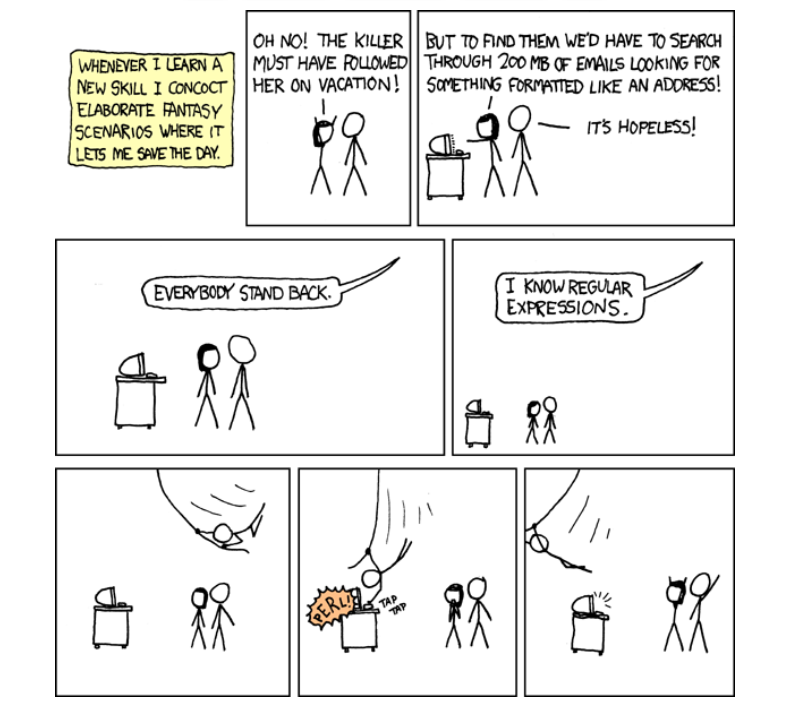
Wait, forgot to escape a space. Wheeeeee[taptaptap]eeeeee. (source)


https://www.sickgaming.net/blog/2022/07/...ary-value/

Print this item

  (Indie Deal) FREE Larry 5, VR Hope Bundle, Mega Man Deal
Posted by: xSicKxBot - 07-22-2022, 10:32 PM - Forum: Deals or Specials - No Replies

FREE Larry 5, VR Hope Bundle, Mega Man Deal

Leisure Suit Larry 5 - Passionate Patti Does a Little Undercover Work
[freebies.indiegala.com]
Passionate Patti Does a Little Undercover Work! is (despite the number) the fourth game in Al Lowe's Leisure Suit Larry series.

VR Hope Bundle | 6 VR Steam Games | 93% OFF
[www.indiegala.com]
Where's hope, there's life...virtual life. Enter a whole new reality with a whole new VR bundle including: The Great C, HOPE VR: Progressive Meditation, Dark Threads, VR Walking Simulator, Legendary Hunter VR & Dodo Adventures.

Deal Ending Soon: The Quarry[www.indiegala.com]
https://www.youtube.com/watch?v=Zh2K7SxRHmo
Mega Man Deal & more Sales
[www.indiegala.com]

https://www.youtube.com/watch?v=JtJ_8Aj52co
Stay Inside, Stay Safe and Enjoy Good Games.
Check out IndieGala on Twitter, YouTube & Facebook[www.facebook.com]


https://steamcommunity.com/groups/indieg...0805054150

Print this item

  PC - Eyes in the Dark: The Curious Case of One Victoria Bloom
Posted by: xSicKxBot - 07-22-2022, 10:32 PM - Forum: New Game Releases - No Replies

Eyes in the Dark: The Curious Case of One Victoria Bloom


Fight with light against the dark in this "roguelight" platformer starring Victoria Bloom. Drive back the darkness that's overrun Bloom Manor and conquer swarms of creatures as you discover powerful new items to upgrade your arsenal. Are you ready to enter the ever-changing manor?

Publisher: Gearbox Publishing

Release Date: Jul 14, 2022


https://www.metacritic.com/game/pc/eyes-...oria-bloom

Print this item

  News - Call Of Duty: Warzone How To Complete The Cursed Ground Event
Posted by: xSicKxBot - 07-22-2022, 10:32 PM - Forum: Lounge - No Replies

Call Of Duty: Warzone How To Complete The Cursed Ground Event

Call of Duty Season 4 has added the new "Cursed Ground" public event to Warzone's Fortune's Keep map, and while it's very much optional, completing it will give you valuable rewards to use in your match. Here we break down everything you need to know about the Cursed Ground event.

What is the Cursed Ground event

Several "cursed chests" have been hidden around Fortune Keep's island. These special chests contain power-ups and high-quality items, but they can only be unlocked by completing the Cursed Ground zombie-killing event.

Finding and activating Cursed Chests

Cursed Chest on Fortune's Keep

The Cursed Chests on Fortune's Keep will spawn at one or more places each map. These locations are random, so you likely won't find a chest in the same spot for each match. The chest locations won't appear on the Tac Map right away, but they'll mark on the map as a white skull icon once you're in close proximity.

Continue Reading at GameSpot

https://www.gamespot.com/articles/call-o...01-10abi2f

Print this item

  [Tut] How to Check ‘future’ Package Version in Python?
Posted by: xSicKxBot - 07-21-2022, 08:40 PM - Forum: Python - No Replies

How to Check ‘future’ Package Version in Python?

5/5 – (2 votes)

In this article, I’ll show you:

? How to check the version of the Python module (package, library) future? And how to check if future is installed anyways?

These are the eight best ways to check the installed version of the Python module future:

  • Method 1: pip show future
  • Method 2: pip list
  • Method 3: pip list | findstr future
  • Method 4: library.__version__
  • Method 5: importlib.metadata.version
  • Method 6: conda list
  • Method 7: pip freeze
  • Method 8: pip freeze | grep future

Before we go into these ways to check your future version, let’s first quickly understand how versioning works in Python—you’ll be thankful to have spent a few seconds on this topic, believe me!

A Note on Python Version Numbering


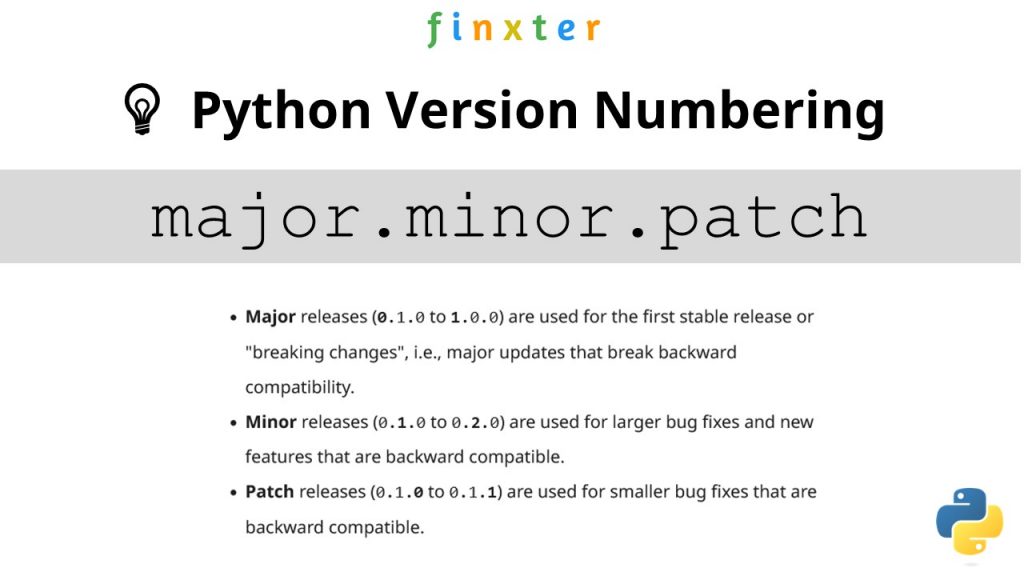
?Python versioning adds a unique identifier to different package versions using semantic versioning. Semantic versioning consists of three numerical units of versioning information in the format major.minor.patch.

Python Version Numbering

In this tutorial, we’ll use the shorthand general version abbreviation like so:

x.y.z

Practical examples would use numerical values for x, y, and z:

  • 1.2.3
  • 4.1.4
  • 1.0.0

This is shorthand for

major.minor.patch
  • Major releases (0.1.0 to 1.0.0) are used for the first stable release or “breaking changes”, i.e., major updates that break backward compatibility.
  • Minor releases (0.1.0 to 0.2.0) are used for larger bug fixes and new features that are backward compatible.
  • Patch releases (0.1.0 to 0.1.1) are used for smaller bug fixes that are backward compatible.

Let’s dive into the meat of this article:

? Question: How to check the (major, minor, patch) version of future in your current Python environment?

Method 1: pip show


To check which version of the Python library future is installed, run pip show future or pip3 show future in your CMD/Powershell (Windows), or terminal (macOS/Linux/Ubuntu).

This will work if your pip installation is version 1.3 or higher—which is likely to hold in your case because pip 1.3 was released a decade ago in 2013!!

Here’s an example in my Windows Powershell: I’ve highlighted the line that shows that my package version is a.b.c:

PS C:\Users\xcent> pip show future
Name: future
Version: a.b.c
Summary: ...
Home-page: ...
Author: ...
Author-email: ...
License: ...
Location: ...
Requires: ...
Required-by: ...

In some instances, this will not work—depending on your environment. In this case, try those commands before giving up:

python -m pip show future
python3 -m pip show future
py -m pip show future
pip3 show future

Next, we’ll dive into more ways to check your future version.


But before we move on, I’m excited to present you my new Python book Python One-Liners (Amazon Link).

If you like one-liners, you’ll LOVE the book. It’ll teach you everything there is to know about a single line of Python code. But it’s also an introduction to computer science, data science, machine learning, and algorithms. The universe in a single line of Python!


The book was released in 2020 with the world-class programming book publisher NoStarch Press (San Francisco).

Link: https://nostarch.com/pythononeliners

Method 2: pip list


To check the versions of all installed packages, use pip list and locate the version of future in the output list of package versions sorted alphabetically.

This will work if your pip installation is version 1.3 or higher.

Here’s a simplified example for Windows Powershell, I’ve highlighted the line that shows the package version is 1.2.3:

PS C:\Users\xcent> pip list
Package Version
--------------- ---------
aaa 1.2.3
...
future 1.2.3
...
zzz 1.2.3

In some instances, this will not work—depending on your environment. Then try those commands before giving up:

python -m pip list
python3 -m pip list
py -m pip list
pip3 list

Method 3: pip list + findstr on Windows


To check the versions of a single package on Windows, you can chain pip list with findstr future using the CMD or Powershell command: pip3 list | findstr future to locate the version of future in the output list of package versions automatically.

Here’s an example for future:

pip3 list | findstr future 1.2.3

Method 4: Module __version__ Attribute


To check which version is installed of a given library, you can use the library.__version__ attribute after importing the library (package, module) with import library.

Here’s the code:

import my_library
print(my_library.__version__)
# x.y.z for your version output

Here’s an excerpt from the PEP 8 docs mentioning the __version__ attribute.

PEP 8 describes the use of a module attribute called __version__ for recording “Subversion, CVS, or RCS” version strings using keyword expansion. In the PEP author’s own email archives, the earliest example of the use of an __version__ module attribute by independent module developers dates back to 1995.”

You can also use the following one-liner snippet to run this from your terminal (macOS, Linux, Ubuntu) or CMD/Powershell (Windows):

python3 -c "import my_library; print(my_library.__version__)"

However, this method doesn’t work for all libraries, so while simple, I don’t recommend it as a general approach for that reason.

Method 5: importlib.metadata.version


The importlib.metadata library provides a general way to check the package version in your Python script via importlib.metadata.version('future') for library future. This returns a string representation of the specific version such as 1.2.3 depending on the concrete version in your environment.

Here’s the code:

import importlib.metadata
print(importlib.metadata.version('future'))
# 1.2.3

Method 6: conda list


If you have created your Python environment with Anaconda, you can use conda list to list all packages installed in your (virtual) environment. Optionally, you can add a regular expression using the syntax conda list regex to list only packages matching a certain pattern.

How to list all packages in the current environment?

conda list

How to list all packages installed into the environment 'xyz'?

conda list -n xyz

Regex: How to list all packages starting with 'future'?

conda list '^future'

Method 7: pip freeze


The pip freeze command without any option lists all installed Python packages in your environment in alphabetically order (ignoring UPPERCASE or lowercase). You can spot your specific package future if it is installed in the environment.

pip freeze

Output example (depending on your concrete environment/installation):

PS C:\Users\xcent> pip freeze
aaa==1.2.3
...
future==1.2.3
...
zzz==1.2.3

You can modify or exclude specific packages using the options provided in this screenshot:

Method 8: pip freeze + grep on Linux/Ubuntu/macOS


To check the versions of a single package on Linux/Ubuntu/macOS, you can chain pip freeze with grep future using the CMD or Powershell command: pip freeze | grep future to programmatically locate the version of your particular package future in the output list of package versions.

Here’s an example for future:

pip freeze | grep future
future==1.2.3

Related Questions


Check future Installed Python


How to check if future is installed in your Python script?

To check if future is installed in your Python script, you can run import future in your Python shell and surround it by a try/except to catch a potential ModuleNotFoundError.

try: import future print("Module future installed")
except ModuleNotFoundError: print("Module future not installed")

Check future Version Python


How to check the package version of future in Python?

To check which version of future is installed, use pip show future or pip3 show future in your CMD/Powershell (Windows), or terminal (macOS/Linux/Ubuntu) to obtain the output major.minor.patch.

pip show future # or pip3 show future
# 1.2.3

Check future Version Linux


How to check my future version in Linux?

To check which version of future is installed, use pip show future or pip3 show future in your Linux terminal.

pip show future # or pip3 show future
# 1.2.3

Check future Version Ubuntu


How to check my future version in Ubuntu?

To check which version of future is installed, use pip show future or pip3 show future in your Ubuntu terminal.

pip show future # or pip3 show future
# 1.2.3

Check future Version Windows


How to check my future version on Windows?

To check which version of future is installed, use pip show future or pip3 show future in your Windows CMD, command line, or PowerShell.

pip show future # or pip3 show future
# 1.2.3

Check future Version Mac


How to check my future version on macOS?

To check which version of future is installed, use pip show future or pip3 show future in your macOS terminal.

pip show future # or pip3 show future
# 1.2.3

Check future Version Jupyter Notebook


How to check my future version in my Jupyter Notebook?

To check which version of future is installed, add the line !pip show future to your notebook cell where you want to check. Notice the exclamation mark prefix ! that allows you to run commands in your Python script cell.

!pip show future

Output: The following is an example on how this looks for future in a Jupyter Notebook cell:

Package Version
--------------- ---------
aaa 1.2.3
...
future 1.2.3
...
zzz 1.2.3

Check future Version Conda/Anaconda


How to check the future version in my conda installation?

Use conda list 'future' to list version information about the specific package installed in your (virtual) environment.

conda list 'future'

Check future Version with PIP


How to check the future version with pip?

You can use multiple commands to check the future version with PIP such as pip show future, pip list, pip freeze, and pip list.

pip show future
pip list
pip freeze
pip list

The former will output the specific version of future. The remaining will output the version information of all installed packages and you have to locate future first.

Check Package Version in VSCode or PyCharm


How to check the future version in VSCode or PyCharm?

Integrated Development Environments (IDEs) such as VSCode or PyCharm provide a built-in terminal where you can run pip show future to check the current version of future in the specific environment you’re running the command in.

pip show future
pip3 show future pip list
pip3 list pip freeze
pip3 freeze

You can type any of those commands in your IDE terminal like so:

pip IDE check package version

Summary


In this article, you’ve learned those best ways to check a Python package version:

  • Method 1: pip show future
  • Method 2: pip list
  • Method 3: pip list | findstr future
  • Method 4: library.__version__
  • Method 5: importlib.metadata.version
  • Method 6: conda list
  • Method 7: pip freeze
  • Method 8: pip freeze | grep future

Thanks for giving us your valued attention — we’re grateful to have you here! ?


Programmer Humor


There are only 10 kinds of people in this world: those who know binary and those who don’t.
??‍♂️
~~~

There are 10 types of people in the world. Those who understand trinary, those who don’t, and those who mistake it for binary.
??‍♂️?‍♀️

Related Tutorials


https://www.sickgaming.net/blog/2022/07/...in-python/

Print this item

  (Indie Deal) Japanese Indies Bundle, NMS Update
Posted by: xSicKxBot - 07-21-2022, 08:40 PM - Forum: Deals or Specials - No Replies

Japanese Indies Bundle, NMS Update

Japanese Indies Bundle | 95% OFF
[indiegala.com]
Save 95% on a vast selection of 15 Steam games (and 3 DLCs), filled with pretty anime girls and captivating challenges, for the fans of games & Japanese culture alike! + a special BONUS: Get 5% cashback. (final chance)

https://youtu.be/JSvwcneTNu4
https://www.youtube.com/watch?v=QCL22fo3p_Y
Happy Hour: Evil Village Bundle
[www.indiegala.com]


https://steamcommunity.com/groups/indieg...0800870597

Print this item