The Satechi Multimedia Pro Dock is a Thunderbolt 4 dock that brings out the most in your Mac or iPad for all creatives and professionals.
Not all docks are created equal, and it’s clear that Thunderbolt 4 docks have their strengths. Faster speeds, better connection between your devices, and more ports make them an easy choice for people with a lot of accessories in their setup.
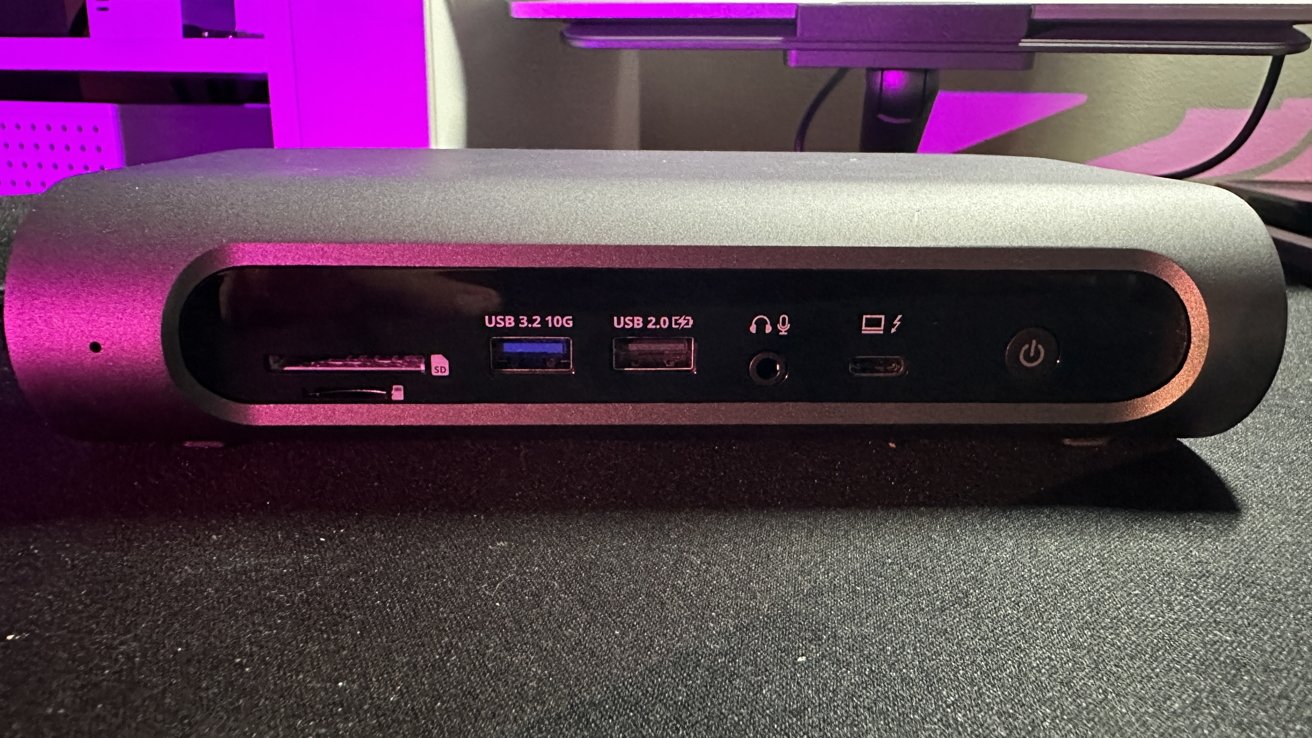
Built with creatives in mind, the Satechi Multimedia Pro Dock has sixteen different ports. It helps connect your computer to four monitors at 4K 60Hz, charge two devices, connect to ethernet, and much more.
Satechi has been making USB-C and Thunderbolt docks for years and covers various price ranges and needs. The Multimedia Pro Dock is a high-cost and high-powered dock for people with plenty of monitors and peripherals.
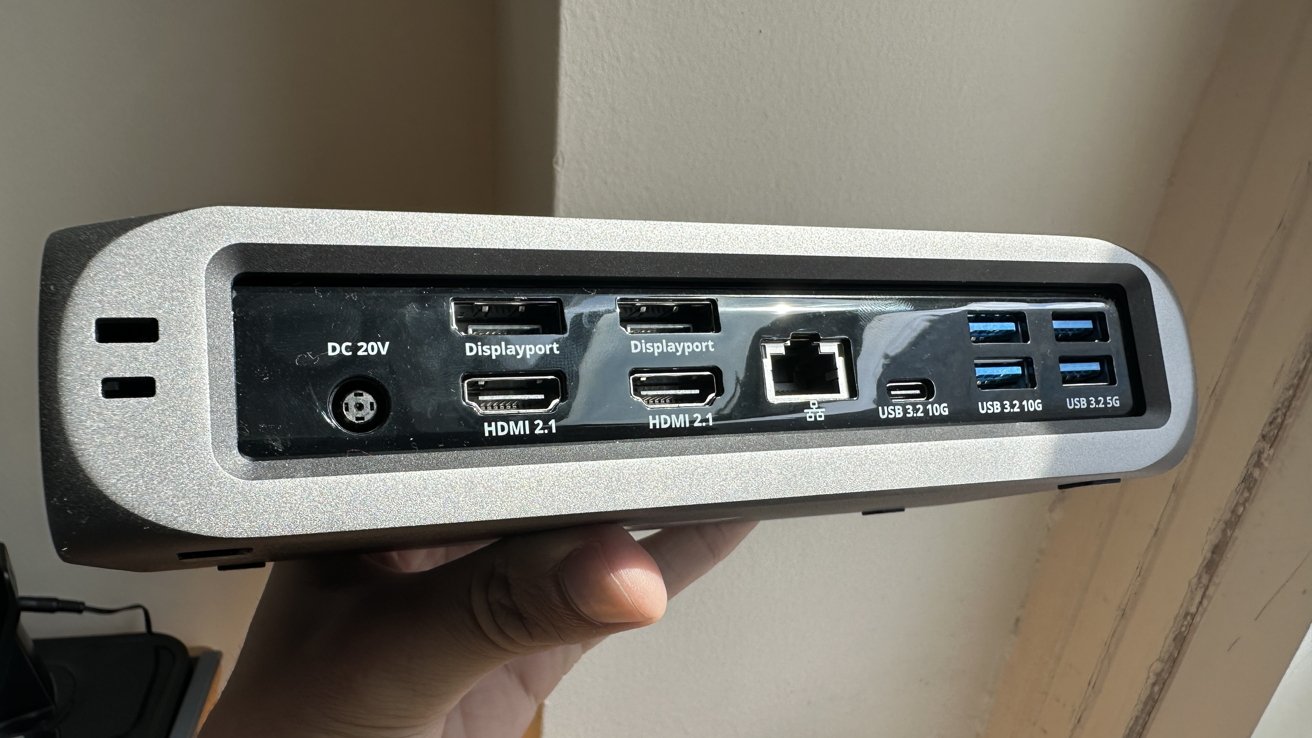
2x DisplayPort
2x HDMI 2.1
1x Thunderbolt 4 to host
1x USB-C 3.2 10Gbps
5x USB-A 3.2 10-Gbps
1x USB-A 2.0 for charging up to 7.5W
1x SD card slot
1x Micro SD / TF card slot
1x 3.5mm audio jack in/out
1x Ethernet 2.56Gbps
1x Kensington Lock
1x DC/20V Port with a 135W power supply
Notably, there’s no downstream Thunderbolt port. This isn’t a deal-breaker though for most.
Not many people may have use for sixteen different ports, but the Pro Dock serves as a good way to future-proof your home or office setup. Connecting mice, keyboards, and headphones is simple, and the SD and Micro SD speeds allow for quick transfers of information.
Even under heavy use, the dock doesn’t warm up considerably due to its large size and aluminum chassis. The charging speed is good, bringing an iPhone from 30% to 80% in an hour with the USB-A port on the front.
The power supply brings 96W to your host device, keeping it powered or charging it after a day of use outside.
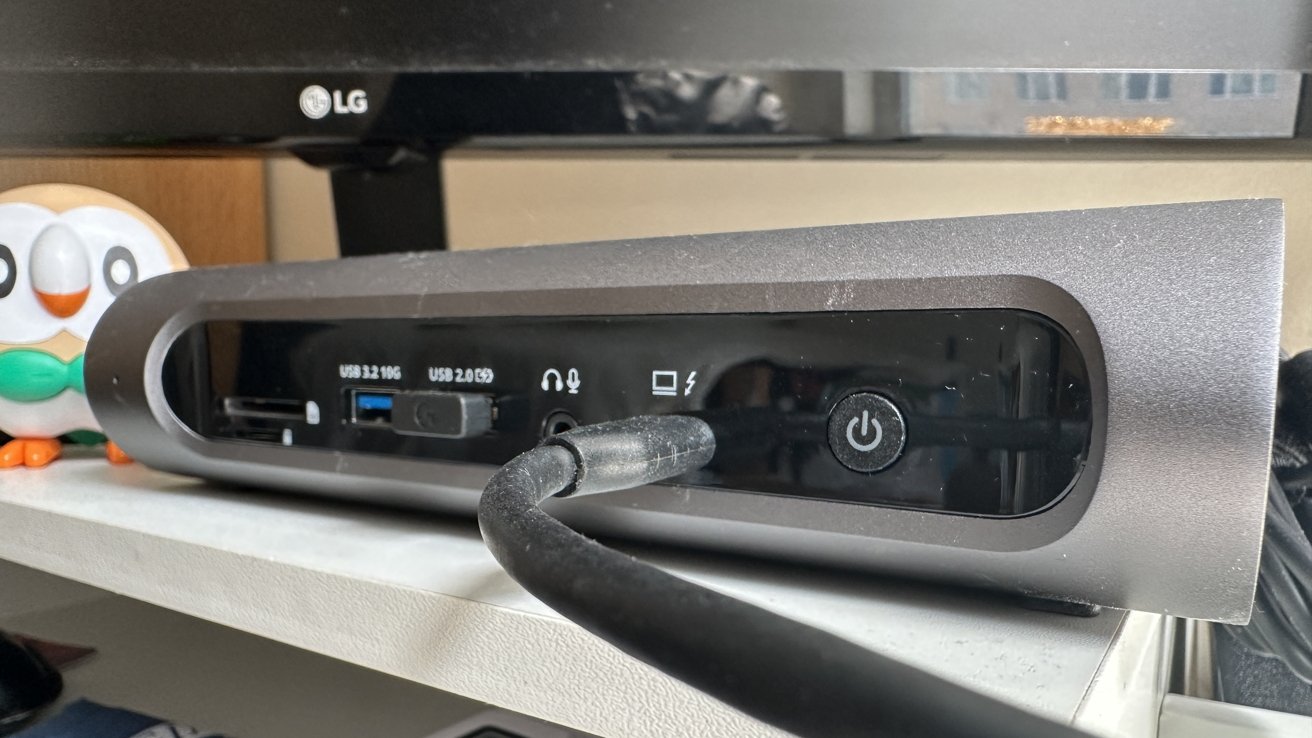
The split between ports in the front and back is also convenient, with SD/TF, two USB-A ports, and the audio jack in the front for easy access. Most USB and HDMI/DisplayPort are in the back for better wire management.
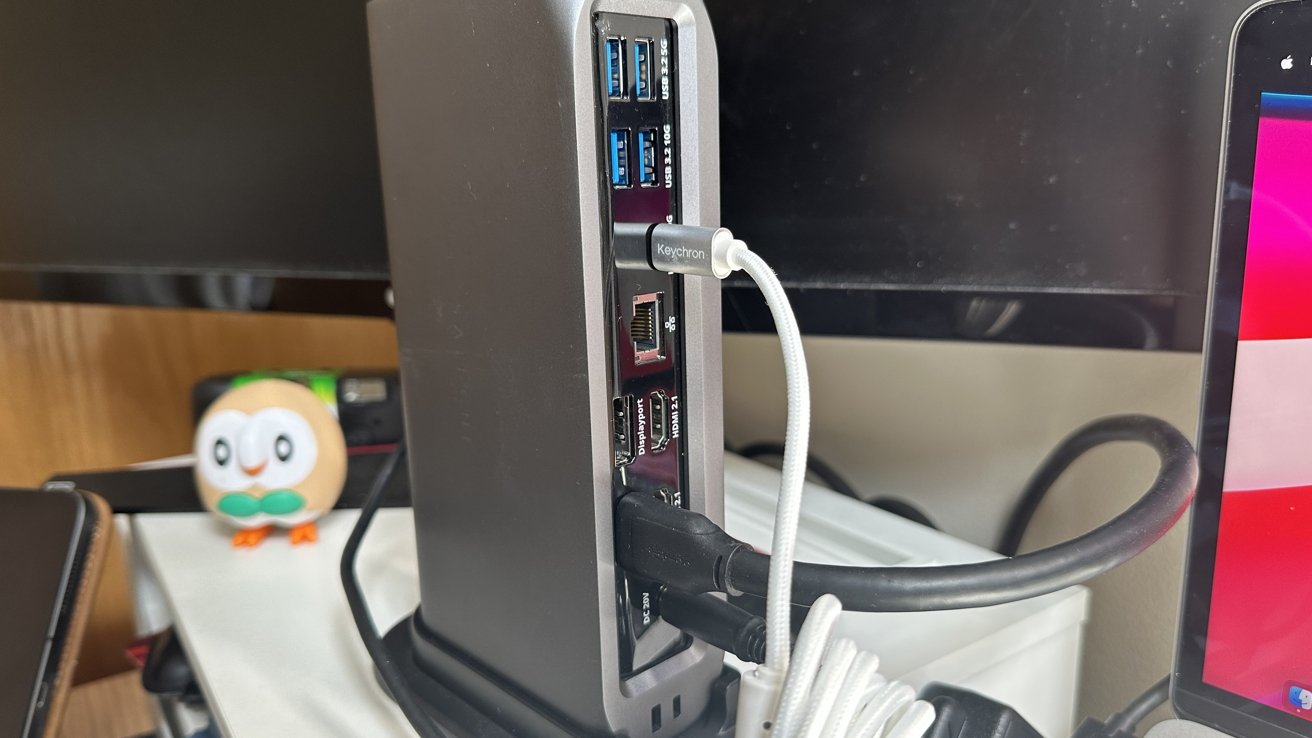
As for the design, the dock blends in well with most setups, complimenting a silver or space grey Mac or iPad. The rubber feet and stand allow you to position the dock in either landscape or portrait, depending on how much desk space you have.
This is not a portable dock, but the claimed aircraft-grade aluminum helps us keep peace of mind when transporting it.
The Multimedia Pro Dock is a great way for photographers, musicians, and other creators to connect all their accessories to one dock and do their work without distractions.
People with many accessories and peripherals are familiar with the experience of having to unplug and replug devices to make their setup work. A large-sized Thunderbolt dock does away with that entirely, making it easy to plug in your computer and start your next task.
We also think the average creative doesn’t need sixteen high-powered ports to do their job or conduct their hobby. However, this might be the next dock for you for those who struggle even with ten and twelve-port USB-C or Thunderbolt docks.
The Multimedia Pro Dock provides an abundance of ports and information-transferring capabilities while also charging and optimizing your setup. At over $300, many people would prefer to choose a smaller USB-C hub for their needs.
Abundance of ports
Versatile orientation for multiple kinds of setups
Durable and spreads heat efficiently under strain
Overkill and pricey for some
No downstream Thunderbolt port
Limited appeal due to smaller and cheaper alternatives
Rating: 3.5 out of 5
The Satechi Thunderbolt 4 Multimedia Pro Dock is available on Amazon for $297.49 (15% off), and on the Satechi store for $349.99.
It has been an entire year since Splatoon 3 was released (don’t worry, we’re just as shocked as you are) so, naturally, our minds are beginning to drift towards what comes next.
The correct answer is that mysterious ‘Side Order‘ DLC — which is meant to show what would’ve happened if Team Order had beaten Team Chaos. But what about after that? The third entry in the splat-and-swim series was a huge success on launch and with the Inklings now popping up in Smash Bros. and Mario Kart, we think it’s fair to say that the series is here for the long run.
Despite Splatoon’s popularity, however, the three games we have seen so far have stuck to the one formula. Sure, there have been some additions on the Story Mode front and Splatfests now involve three teams (whadda concept!), but overall we have seen much of the same.
So, what does Nintendo have to do to stop this ink from drying up in Splatoon 4 (assuming that there will be one)? A group of our writers have come together to share some thoughts on what we think could mix the formula up — have a read through and see if anything sounds up your street.
Jim Norman, Staff Writer – Storytime
Image: Nintendo
When Splatoon 3 came out, I was so deep in the Splatsville trenches that its similarities to the first two games didn’t bother me that much — Nintendo is onto a winner here and if it ain’t broke, don’t ink it.
That being said, the one thing that I really appreciated in this third entry was the single-player story mode. Splatoon 2 had me on board in this respect, but 3 felt like I suddenly had so much more to do with challenges to complete, new weapons to try, and collectables to, uhh, collect. What’s more, we know that the upcoming ‘Side Order’ DLC will bring yet another helping of it our way so there’s even more to enjoy.
Importantly, I was not alone in this camp one year ago — everyone seemed eager for a little bit of story. This is what I think Splatoon 4 will capitalise on (should one be in the works, that is). An expanded single-player campaign seems like an open goal. The Turf War battles and Splatfests need to stay — it has to still be uniquely Splatoon-y after all — so why not expand the other attraction and pull in players for longer as a result? Online play is great, but we’ve peaked in that department, I’d say. Next up: storytime.
Ollie Reynolds, Staff Writer – A Giant Leap For Squid-kind
Image: Nintendo
I loved the first two games and from what I’ve seen from Splatoon 3 at a distance, it looks like Nintendo has well and truly nailed the fundamentals of the franchise at this stage. So with that in mind, I’d love the fourth entry to really take a few leaps and gambles with the core formula and hopefully evolve it into something that feels completely new.
Just look at some of Nintendo’s other core IPs: Super Mario World, Link’s Awakening, Mario Kart: Double Dash… These were all the fourth major instalments in their respective franchises, and whether you happen to enjoy them or not, there’s no denying that they all demonstrate significant improvements and evolutions from their older siblings. With Splatoon, I feel Nintendo has played it a touch too safe so far, so I’d like to see it take some huge swings with the fourth game.
Alana Hagues, Deputy Editor – Ink Independently
Image: Nintendo
“What would Splatoon 4 look like?” is a pretty good question. Even as a casual Splatoon enjoyer — mostly for the aesthetics and music — I don’t really see Nintendo straying from the formula too much.
But I do think Splatoon could let players be even more creative. I’m sort of amazed there isn’t some kind of stage or level editor yet, and I think players could have so much creating their own stages to share with friends or use to play online. You could even share them like you can in Super Smash Bros. Ultimate. Getting them to work online might prove challenging, though. Let people create their own music, too — perhaps the “idol group” in Splatoon 4 is your player character and some friends or something.
Outside of that, I think it’s about time a new playable race got added to the games. Something based on sharks, or maybe even playing as a salmonid. Imagine a salmonid with a roller!
Gavin Lane, Editor – Sink or Swim
Image: Nintendo
It would be neat to go underwater. It always felt weird that squid and octopi couldn’t survive falling into the drink.
Obviously, that would necessitate changing up the gameplay (as ink guns aren’t going to splat the same beneath the waves), but there’s potential there for a different mode of team-based shooting. Maybe with darts or ninja starfish, and ejections of ink to enable a stealthy getaway or distract your enemies. A new race of Crustacean Atlanteans (or something) that come on land to do battle and then take you down to their realm.
As someone who dived headfirst into the first game, dried up on the second, and never dipped a toe in the ink of the third, Splatoon 4 will have to introduce something truly new if it’s going to capture my attention and justify another trip to the inkwell beyond the benefits to Nintendo’s balance books. As Ollie said, big swings, please.
Or maybe vehicles. If in doubt, throw a Warthog in there, Chief.
Do any of our ideas sound like a winner to you? Ink the following poll to let us know what you hope to see and then swim down to the comments to share any other thoughts you have on the future of the franchise.
What would you like to see in Splatoon 4? (556 votes)
More single-player story29%
Stage creator mode8%
New playable race5%
Diving into a new location3%
Vehicles4%
Anything, so long as it’s a big swing20%
Eh, do we really need a fourth one?20%
I’ve never played a Splatoon game, how should I know?3%
Ever found yourself scratching your head, trying to figure out why someone would invest in ether (ETH) instead of just using it on the Ethereum network? Let’s look at Fidelity’s recent report on Ethereum’s Investment Thesis.
Ethereum vs Ether
Ethereum vs. Ether: Picture Ethereum as a bustling digital city, and ether (ETH) as the currency people use within that city. While the city’s infrastructure might be booming, it doesn’t always mean the currency’s value is skyrocketing. Similarly, a digital network and its native token don’t always rise and fall together.
The relationship between a digital asset network and its native token is intricate, and their successes don’t always mirror each other. Some networks can offer significant utility, processing numerous intricate transactions daily, without necessarily enhancing the value for their token holders.
Conversely, some networks exhibit a more direct connection between the network’s activity and the value of its token. This dynamic is often referred to as “tokenomics,” a contraction of “token economics.” Tokenomics delves into how a network or application’s structure can generate economic benefits for its token holders.
Over recent years, the Ethereum network has experienced transformative changes that have reshaped its tokenomics. One notable change was the decision to burn a segment of transaction fees, termed the base fee, introduced in August 2021 through the Ethereum Improvement Proposal 1559 (EIP-1559).
When ether is burned, it’s essentially removed from existence, meaning every transaction on Ethereum reduces the total ether in circulation. Moreover, the shift from proof-of-work to proof-of-stake in September 2022 reduced the rate at which new tokens are introduced and introduced staking.
This staking process permits participants to earn returns in the form of tips, new token issuance, and maximal extractable value (MEV). These pivotal updates have redefined ether’s tokenomics, prompting a reevaluation of the bond between Ethereum and its native token, ether.
Understanding Tokenomics: The Value Dynamics of Ether
Ether’s value is intrinsically tied to its tokenomics, which can be broken down into three primary mechanisms that convert usage into value. Here’s how it works:
Transaction Fees: When users transact on Ethereum, they incur two types of fees: a base fee and a priority fee (also known as a tip). Additionally, transactions can create value opportunities for others through MEV (Maximum Extractable Value). This represents the maximum value a validator can gain by manipulating the sequence or selection of transactions during block creation.
Base Fee Dynamics: The base fee, which is paid in ether, is “burned” or permanently removed from circulation once it’s included in a block (a collection of transactions). This act of burning reduces the overall ether supply, creating a deflationary effect.
Priority Fee and MEV: The priority fee, or tip, is a reward given to validators, the entities or individuals tasked with updating the blockchain and ensuring its integrity. When validators create blocks, they’re motivated to prioritize transactions offering higher tips since this becomes a primary source of their earnings. Additionally, MEV opportunities, often arising from arbitrage, are typically introduced by users. In the current ecosystem, the majority of this MEV value is channeled to validators through competitive MEV markets.
These value-generating mechanisms can be likened to various revenue streams for the network. The burning of the base fee acts as a deflationary force, benefiting existing token holders by potentially increasing the value of their holdings.
On the other hand, the priority fee and MEV serve as compensation for validators, rewarding them for their crucial role in the network. In essence, as platform activity rises, so does the amount of ether burned and the rewards for validators, illustrating the dynamic relationship between usage and value in Ether’s tokenomics.
Bitcoin is often framed as an emerging form of digital money. This naturally prompts the question: Can ether be seen in the same light?
While some might argue in favor, ether faces more challenges than bitcoin in its journey to be universally recognized as money.
Although ether shares many monetary characteristics with bitcoin and traditional currencies, its scarcity model and historical trajectory differ. Unlike bitcoin’s fixed supply, ether’s supply is dynamic, influenced by factors like validator count and the amount burned.
Additionally, Ethereum’s frequent network upgrades mean its code is constantly evolving, requiring time and scrutiny to establish a robust track record. This continuous evolution, while beneficial for innovation, can be a hurdle in building unwavering trust among stakeholders.
Also, many would argue that Ether is more security-like than Bitcoin in that it is more controlled by a few highly interested parties than Bitcoin. The Ethereum foundation (EF) is controlled by a handful of people. If the EF proposes protocol upgrades, even hard forks, these upgrades have a high chance of going through. The decentralization in terms of number of nodes and distribution of nodes globally is much less than Bitcoin.
Bitcoin, for many, represents the pinnacle of digital money due to its security, decentralization, and sound monetary principles. Any attempt to “better” it would involve compromises. However, the dominance of bitcoin as a digital monetary standard doesn’t preclude the existence of other forms of digital money tailored for specific markets, use cases, or communities.
Ethereum, for instance, offers functionalities not present in Bitcoin (at least on the base layer, although many functionalities, such as smart contracts and executing complex transactions, are already being implemented on Bitcoin layer 2s).
Mainstream applications built on Ethereum could naturally boost demand for ether, positioning it as a potential alternative form of money. Several real-world integrations with Ethereum are already evident:
MakerDAO, an Ethereum-based project, invested in $500 million worth of Treasuries and bonds.
A U.S. house was sold on Ethereum as a non-fungible token (NFT).
The European Investment Bank issued bonds directly on the blockchain.
Franklin Templeton’s money market fund leveraged Ethereum via Polygon for transaction processing and share ownership recording.
While these integrations are promising, widespread adoption of Ethereum for mainstream transactions might still be years away, requiring enhancements, regulatory clarity, and public education. Until then, ether might remain a specialized form of money.
In a way, Ethereum currently doesn’t have use cases beyond trading digital assets as can be seen in the current “Burn Leaderboard” on Ultrasound Money:
I’m not a huge proponent of “trading applications” because I believe it goes more in the direction of a zero-sum game. Where’s the value of swapping tokens on Uniswap or NFTs on OpenSea? Yet, I understand you could use similar arguments for much of the “real world” industry with banks, online marketplaces, and financial services providers.
Regulation is a significant concern for Ethereum’s future. Given that many major centralized exchanges holding and staking ether are U.S.-based, regulatory decisions in this jurisdiction could profoundly impact Ethereum’s valuation and overall health. Recent regulatory actions and shutdowns of crypto services in the U.S. underscore the gravity of this risk.
Ether’s Dual Monetary Roles: Store of Value and Medium of Exchange
Store of Value: A reliable store of value demands scarcity. While Bitcoin’s fixed supply of 21 million is well-established, ether’s issuance is more fluid, influenced by factors like validator activity and burn rates.
Future Ethereum upgrades could further complicate predictions about ether’s supply. Despite these complexities, current structures ensure ether’s annual inflation remains below 1.5%, assuming no transactions occur. With transaction revenue, Ethereum can even remain deflationary, meaning more ETH is burned than paid out to stakers each year.
However, the potential for future changes to ether’s supply dynamics contrasts sharply with Bitcoin’s steadfast supply narrative.
Means of Payment: Ether is already used for payments, especially for digital assets. Seemingly, Ethereum’s faster transaction finality compared to Bitcoin makes it an appealing payment option.
In reality, however, all payments will be made on second and third layers, such as Bitcoin lightning or Ethereum Polygon, which reduces practical transaction costs for even small payments to almost zero.
As more physical and digital assets integrate with blockchain ecosystems, ether, along with other tokens and stablecoins, could become more prevalent for payments, especially if transaction fees decrease due to the increasing infrastructure of the network application ecosystems.
Valuing Ether Based on Demand
Ether’s value could rise with increased Ethereum network adoption due to basic supply-demand principles. As Ethereum scales, understanding where new users originate and their sought-after use cases can provide insights into potential value trajectories.
Current data suggests that Ethereum’s base layer continues to attract consistent value, even as layer 2 solutions gain traction. However, ether’s value might be more influenced by network usage than mere asset holding.
In a recent article, I analyzed Bitcoin’s price based on Metcalfe’s Law and network effects and found there’s a positive relationship:
A similar study has been done by Fidelity that found more evidence of Bitcoin’s price scaling exponentially with the number of addresses than Ethereum’s price. But the relationship is still there for both monetary networks (source):
Super Mario Bros. Wonder will continue the trend of simultaneous multiplayer platforming in the world of Super Mario and this time it’s rolling with quite possibly the biggest roster ever, made up of not only Mario and co, but also a number of extras.
Nintendo recently asked fans on social media what character they would be picking first in this new Switch exclusive when it arrives next month, so we thought we would ask a similar question to our community here on Nintendo Life, and add a poll while we’re at it to see who might even end up being the most popular character.
Keep in mind the “Yoshis and Nabbit won’t take damage, but they also don’t transform with power-ups”. Daisy is also properly playable. So tell us who you’ll be playing as in Super Mario Bros. Wonder in our poll and why in the comments below.
Who will be your main pick in Super Mario Bros. Wonder? (2,590 votes)
So, you’ve picked up Fae Farm — a game that combines the farming stuff that you love with the combat and mining that you also love. Lucky you!
Fae Farm has a ton of systems, mechanics, and other things to learn along the way, and not all of them are immediately obvious. We’ve put together a little starter guide for you to hit the ground running.
And if you’re looking for tips on how to upgrade tools — check out our tool-specific guide!
Beginner’s Tips
Finish Chapter 4 ASAP
Image: Kate Gray
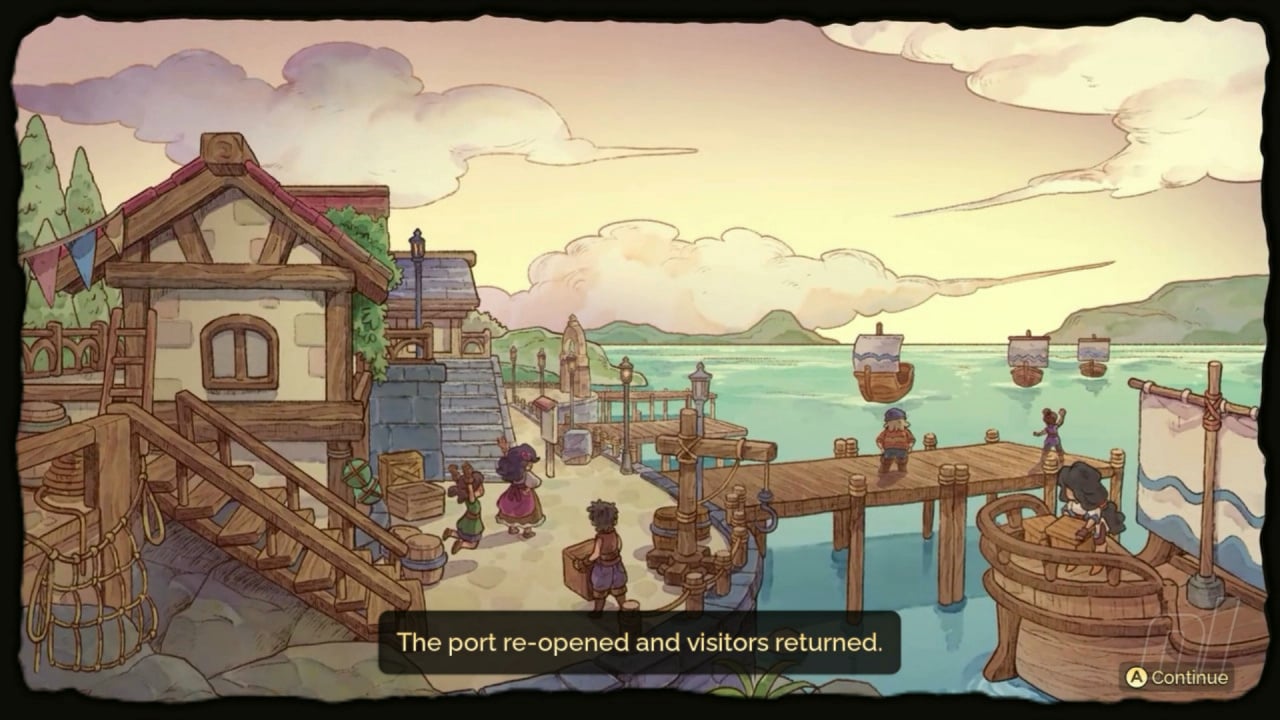
The first few chapters might seem surprisingly dull, and you’ll probably find yourself wondering why this relatively normal farming game has the word “fae” in the title at all. This will be made clearer once you finish the first four chapters, which open up the world much more than before.
It’s a bit of a pain, but that means you’ll have to reach the bottom of the Saltwater Mines as quickly as possible. Make that your main goal for a while, even at the cost of investing in crops and animals, and you’ll find the game gets much more interesting, with magical powers, a new jump ability, a new world to explore, and more characters unlocked, too!
Making money
Image: Kate Gray
While we don’t have a guide to making money just yet, we can give you a few simple tips. The real dosh isn’t in crops, meals, animals, or crafts — it’s in the mines. Specifically, it’s in the gems in the mines, which you can polish using the Gem Polisher workbench to net a nice profit. Level up your pickaxe and your mining skills, or supplement it with food that increases mining skill, and each gem node will drop even more gems, racking up a tidy profit. Gems that are further down in the mines, or in harder mines that unlock through the story, are worth even more.
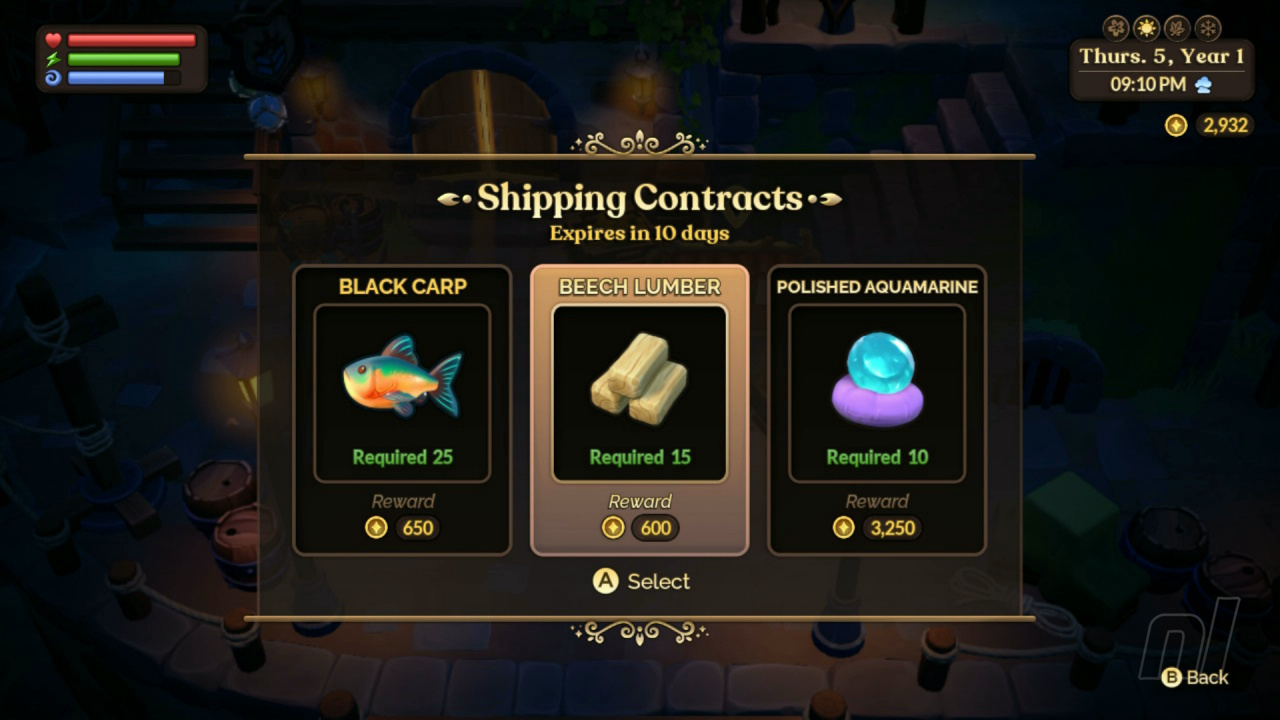
Shipping Contracts are a good way to make more profit off your items… that is, if they work. We could only get them to work about half the time. But the profit margin on the items that the Shipping Contracts ask for is higher than just selling them normally, and saves you space in the market, too. You’ll unlock the Shipping Contracts after finishing the Saltwater Mines, and they can be found just south-west of town.
Image: Kate Gray
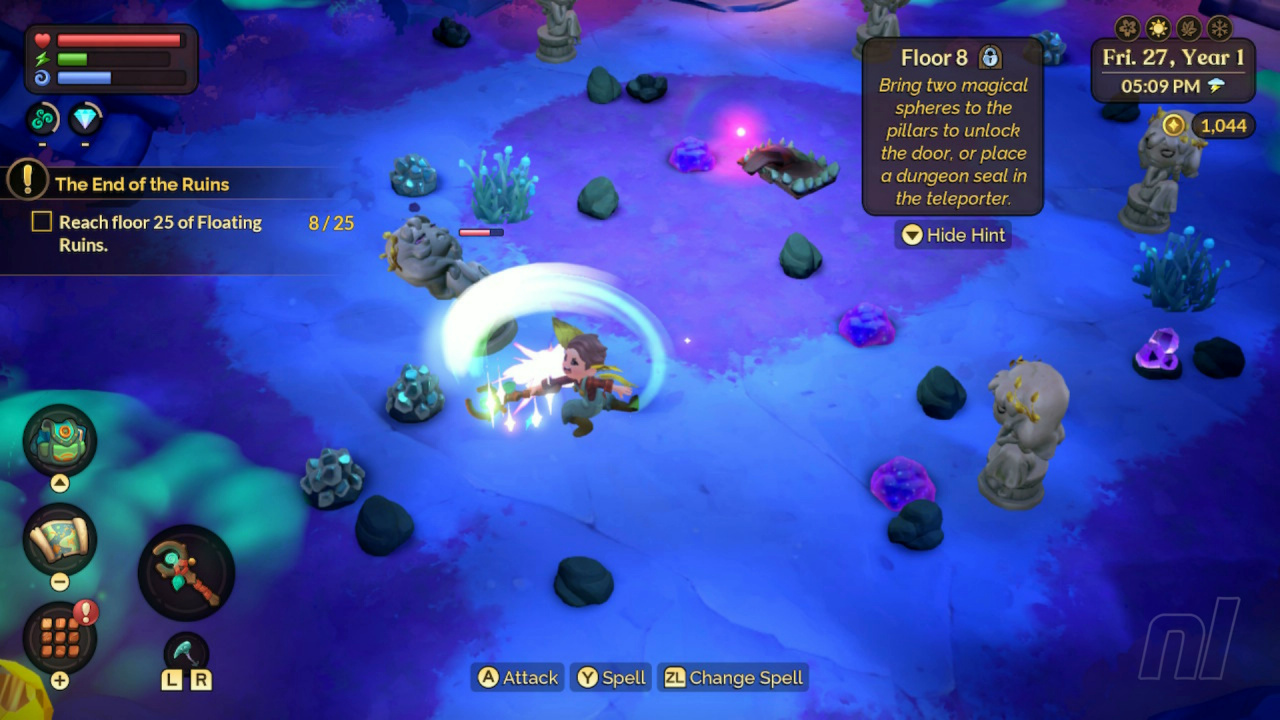
Because your sell slots are limited, you generally want to sell stuff that costs a lot individually. In the early game, eggs, wool, and critter drops are not too bad, but it really will benefit you to unlock the Floating Ruins ASAP (by finishing Chapter 4), or at the very least, having an easy warp down to the lower levels of Saltwater Mines. And on that note…
Invest in fast travel
Image: Kate Gray
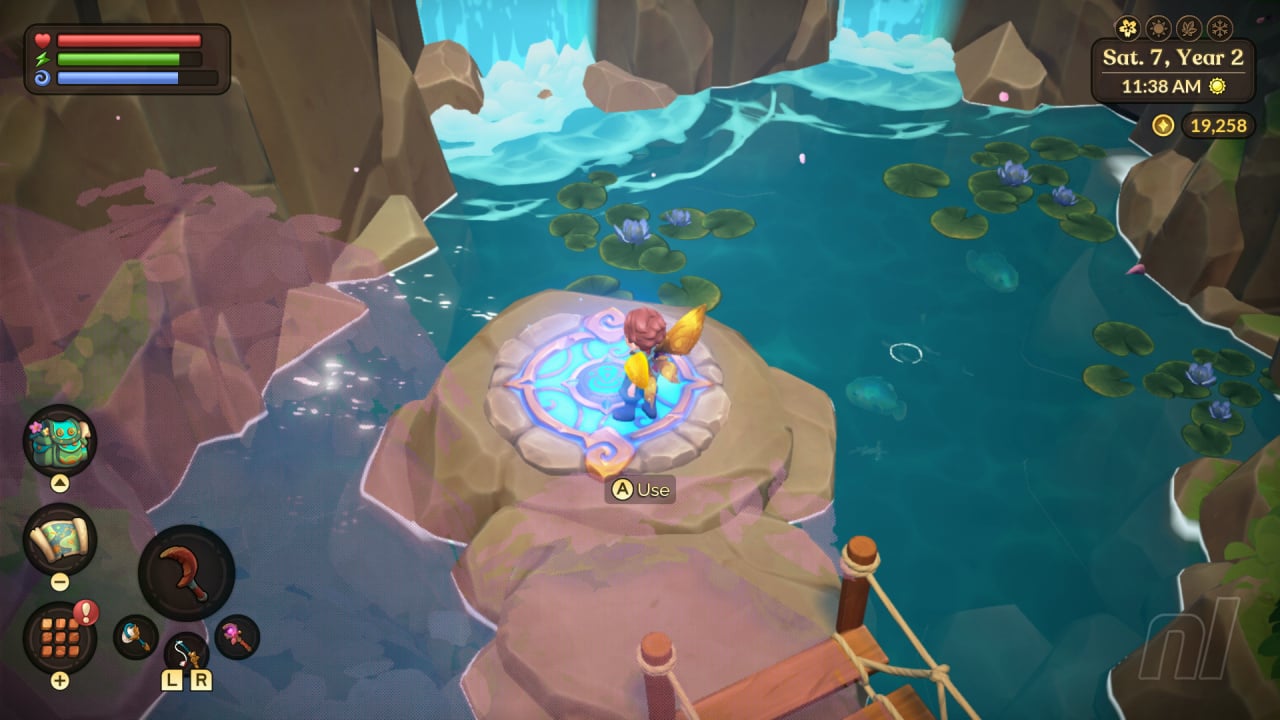
Fae Farm’s fast travel system requires seals, which can be crafted at the Seal Crafting Station. Each seal will take a few bits of ore and a few gems, which are found in the mines, usually at about the depth that starts to get hard for your current level.
The Wayshrines are easy enough to unlock with one-off seals, but the mines themselves feature a fast-travel system between floors that allow you to skip to where you were before. These seals are harder to craft, and you’ll need to know exactly how many you need of each kind before heading into the mine, lest you end up seal-less. The Saltwater Mines tend to require 6 of each seal, but later mines are different, so keep an eye on what each floor requires!
And trust us: these seals are worth investing in before anything else that requires ore and gems. Fast travel will save you a hell of a headache, especially because the fast-travel menu tells you the likelihood of encountering a given material on each floor.
Use that map
Image: Kate Gray
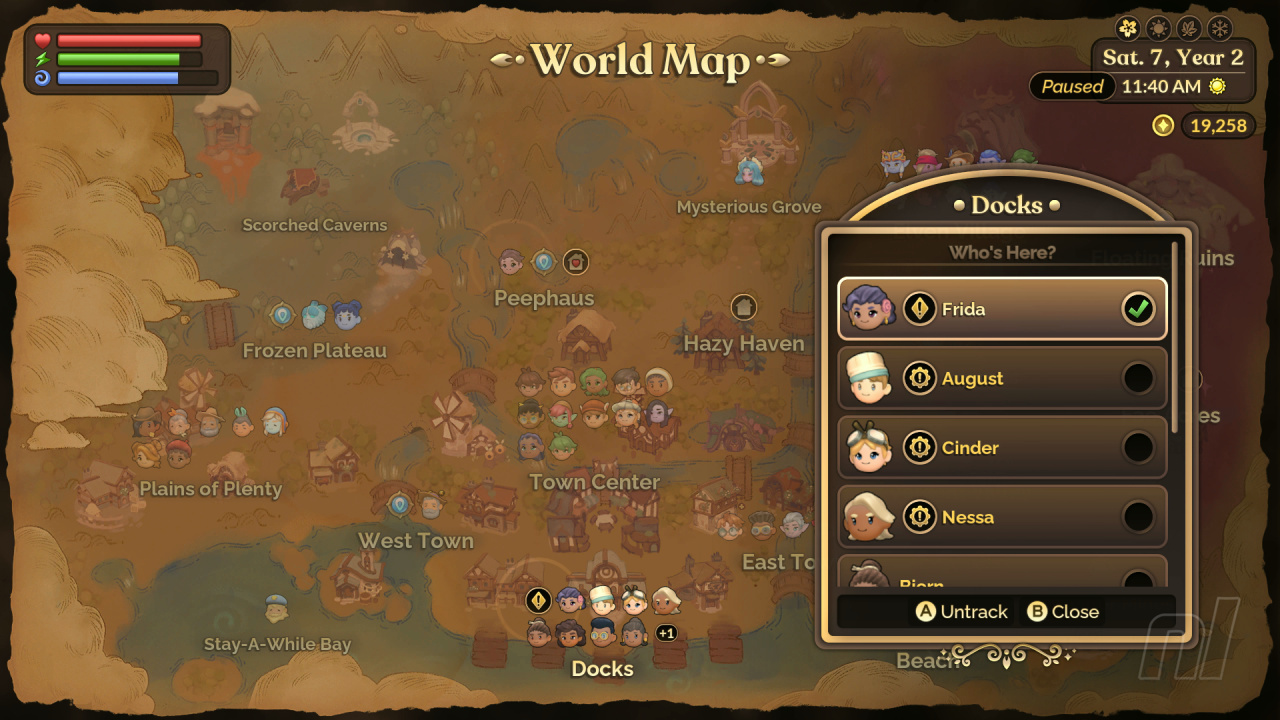
You can open your map and select any NPC to get a tracker arrow that will lead you directly to them. From the map, you can also see if they have a quest for you — although most of these will be friendship and romance quests, or job quests. Main quests and festival quests appear as a diamond with an exclamation mark inside, so check up on those as soon as you see them!
Make the most of your time
Image: Kate Gray
The time in Fae Farm is pretty generous — we’d estimate a day takes about 20-30 minutes — but if you’re not careful, you could end up wasting a ton of that time in menus. The clock will only pause some of the time, and you need to keep an eye on it to make sure you know when those times are.
For example, opening the main menu pauses the clock, but your inventory doesn’t. In fact, you can still be hit by enemies with your inventory open, so if you need to take potions or eat food, make sure you’re out of range first. Talking to people and shopping pauses the menu, but going into buildings and selling items at the market doesn’t. Using crafting tables also doesn’t pause the menu, and neither does building on your farm, decorating your house, or having the decor menus open.
A trick we found in the later game was crafting Zoom Potions, which let you move around faster, and we recommend using the main menu to pause whenever you need to.
Sorting storage woes
Image: Kate Gray
Why can’t games get storage systems right? We just want a bottomless cupboard, accessible at all times, with smart sorting, player-friendly UI, and free tea and biscuits on request. Is that so hard?
Fae Farm’s storage system does not have all those things, but it’s still pretty darn good — you just have to know how to use it. Your best friends in terms of the storage UI are going to be these three things:
1. Sorting
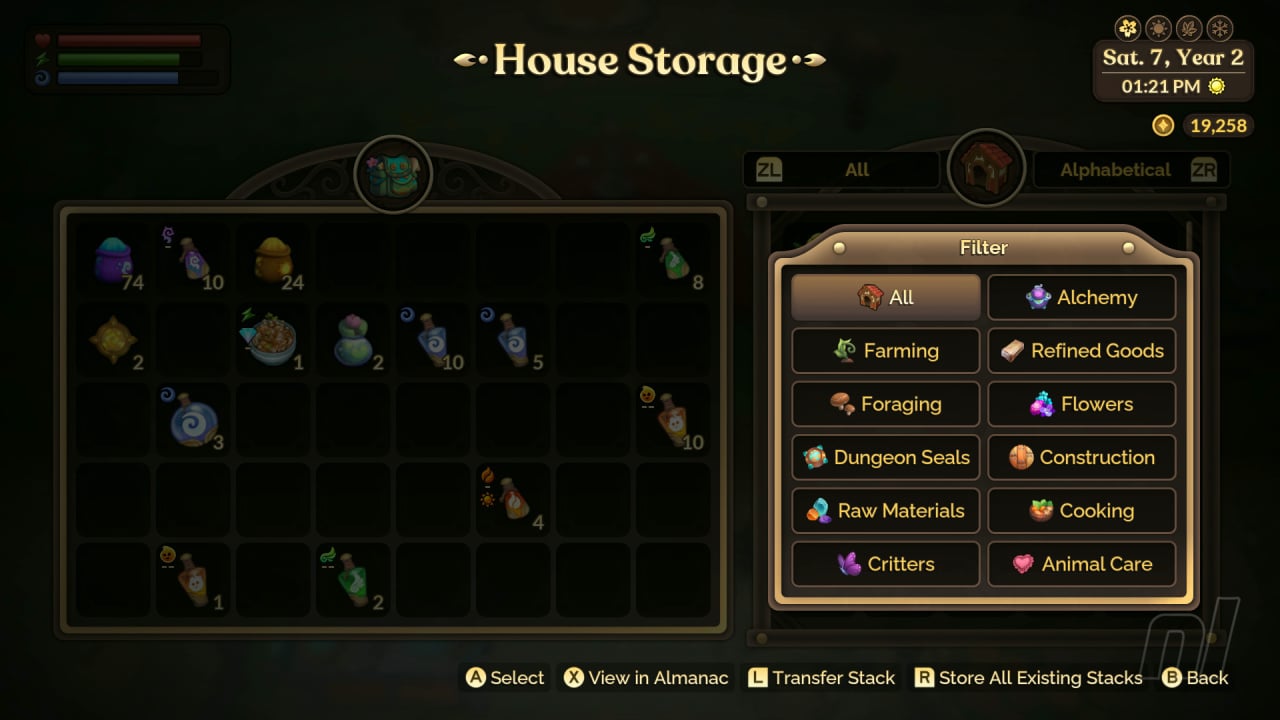
Figure out the ZL and ZR menus in the storage interface and you’ll be well on your way to always finding the object you need in your gigantic pile of stuff.
ZR sorts by either type, or alphabetically — useful in some situations, but usually not a massive help if you don’t know the name of something, or can’t remember your ABCs without singing the little song. ZL, on the other hand, allows you to filter by category. These include things like farming (seeds, crops, and fertilizer); alchemy (potions & ingredients); foraging (anything you picked up off the ground); and refined goods (ingots, cloth, but NOT lumber — that’s in raw materials instead).
Unfortunately, you can’t sort your inventory. If it bothers you that your items are all over the place, you can drop them and pick them up again, which will put them back in the top slots, or select individual items and choose “move” to put them somewhere tidier.
2. Storing
Press RB to store everything in your inventory that already has at least one counterpart in your storage. This makes it super easy to drop off everything from mines, fishing, or general adventures in one go. You can use LB to store individual stacks as well.
3. Shortcuts
You don’t have to go into the menu to access your inventory — just press up on the D-pad to open your pockets immediately. Simple!
Breed, baby, breed!
Image: Kate Gray
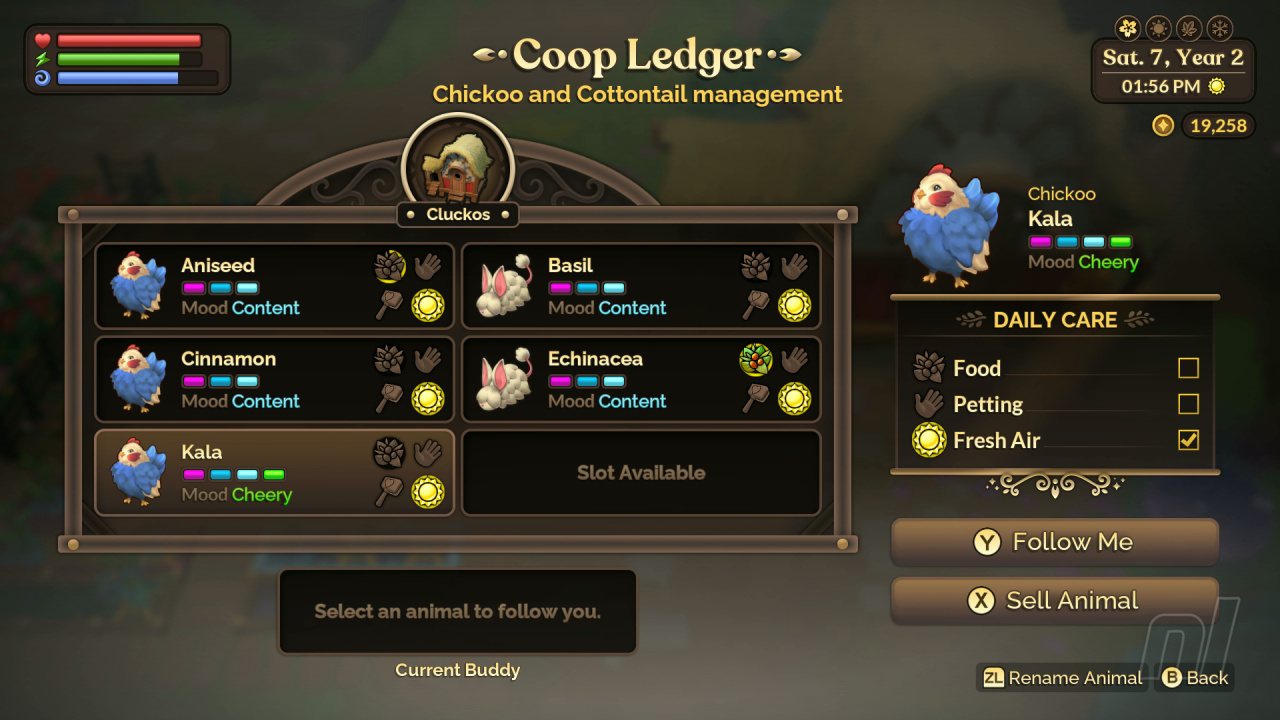
Breeding in Fae Farm is simple, but time-consuming. Buy an animal at one of the farms west of town, register it at home, and then bring it back to the same farm to get it bred.
Why? Because an animal bred from your own animals will have a larger happiness meter, allowing you to reach higher heights by taking care of it. Which… we think… makes them drop more resources. But it might not. The animal raising aspect of the game is a little confusing.
Pay attention to the seasons
Image: Kate Gray
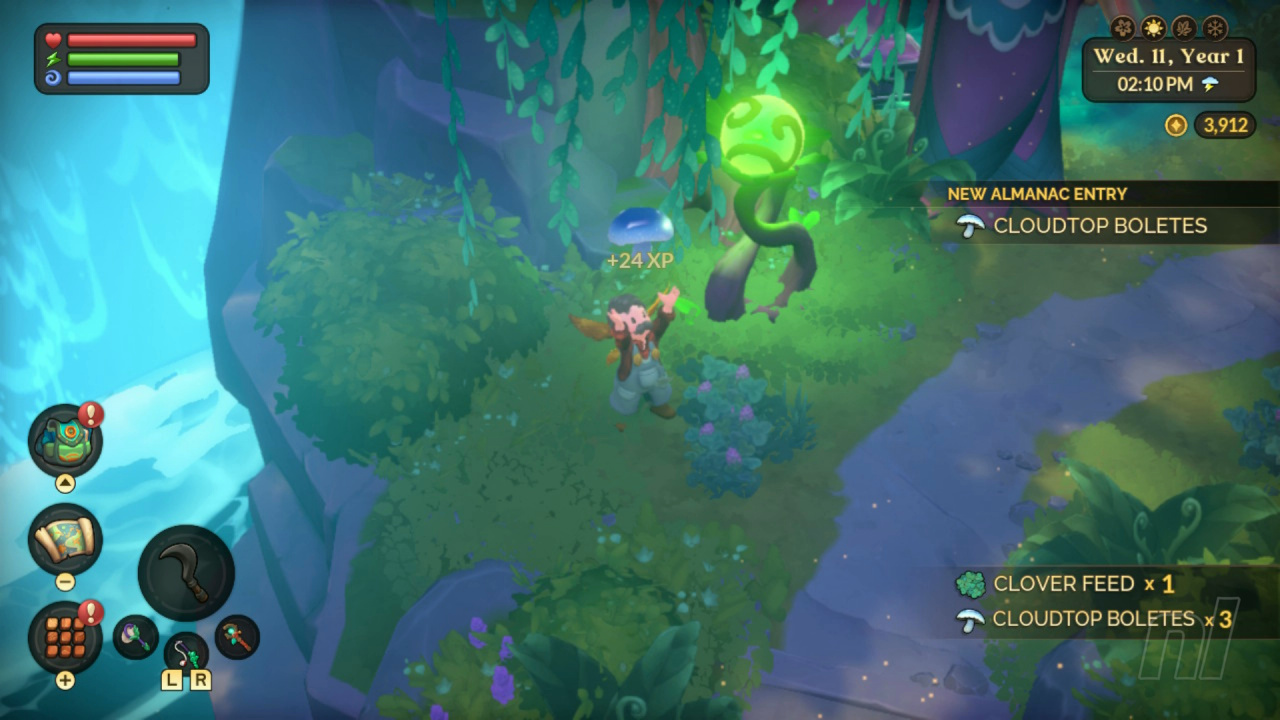
There are four seasons in Fae Farm — spring, summer, autumn, winter — and each one brings with it new critters, new fish, new forageables, and new crops. The game doesn’t do a fantastic job of telling you this, so we’re telling you this now.
For example, each season has its own wild greens. Spring has arugula, summer has dandelion, autumn has red chard, and winter, collard greens. These greens are all basically the same when it comes to cooking, but they appear differently, and you’ll need to pick them all to fill out your almanac, if that’s important to you.
The mushrooms and nuts that appear in the Spooky Forest are the same, as well as the shellfish in the Saltwater Mines, the berries on bushes, and the forageables in the fae and winter areas later in the game. Make sure to check back to unlock them all in the almanac!
The weekend has once again rolled around and that means that it is time for another edition of What Are You Playing!
Before we dive into our plans, though, let’s first take a look at some of the highlights from Nintendo Life this week. Kicking things off with the Nintendo big boys, we learnt from Eiji Aonuma that there are no plans for Tears of the Kingdom DLC (though that didn’t stop us from discussing what we’d like to have seen), and we finally got to see the promised Miyamoto and Charles Martinet’s video message — though it was hardly stuffed with new information…
Now we are ready to finally play some games. Check out what our writers are planning on playing to this weekend and then take to the comments to share what’s next on your list.
Jim Norman, Staff Writer
I have been loving every minute of Sea of Stars so far despite the fact that I am only just around the six-hour mark. This game has so much to offer and I cannot wait to see what other surprises it throws my way over the next couple of days.
Away from the Switch (because apparently other consoles exist), I have just picked up Star Wars Jedi: Fallen Order on the PS5 and am playing it through for the first time. I am such a big fan of the goings on in a galaxy far, far away, so it is crazy that it has taken all these years for me to get around to it. There are a few bugs here and there, but I am really enjoying the ride so far.
Alana Hagues, Deputy Editor
I’ll be capping off Sea of Stars this weekend by going for the true ending. What a satisfying, tightly-knit adventure it’s been, and I’ve experienced some of my favourite RPG dungeons ever in this game – I’m excited for that planned DLC, let’s just say.
Beating Sea of Stars has inspired me to revisit The Messenger, which I liked on my initial playthrough but didn’t absolutely adore. Time to see whether those little connections between the two games will help. It’s also time to return to Blasphemous, which I keep starting and putting down. This time, I mean to go all-in.
PJ O’Reilly, Staff Writer
I’ll be spending the vast majority of my time on a certain space game this weekend, but I will also be making time to boot up my Switch to dig into the Teenage Mutant Ninja Turtles: Shredder’s Revenge DLC Dimension Shellshock.
I absolutely loved the base game, love how Tribute Games handled keeping things retro whilst gently modernizing them, and so I’m really looking forward to digging in here and seeing some new areas and characters. Have a good weekend!
Gavin Lane, Editor
It’s September and with a couple of packed months ahead (and assuming there’s more unannounced goodness that’ll drop in the coming weeks), I’m already eyeing my prospective GOTY backlog and perspiring a little. I need to get back to Sea of Stars after getting distracted by the excellent Making of Karateka this week before polishing off my third temple in TOTK.
I’m also eyeing a recent release called The Many Pieces of Mr. Coo, a “surreal point & click adventure” that had me the moment I watched the glorious animation in its launch trailer. I’d love to investigate that further if I get the chance.
Zion Grassl, Senior Video Producer
Just a few weeks ago, I managed to wrap up the story in Zelda: Tears of the Kingdom, and ever since it’s felt like a weight’s been lifted off my chest. Putting nearly two hundred hours into a single game in a few months time isn’t an easy feat for me, and somehow I’m still feeling the urge to boot it back up to explore some more.
It feels like I haven’t played much else though since May rolled around though. I did make my way through a good chunk of Bomb Rush Cyberfunk and its ripping soundtrack and cool tricks have me wanting to jump back in before aligning my time for Sea of Stars. I backed the game during its Kickstarter days and am excited to see how it’s all turned out!
Do your weekend gaming plans match any of ours? Drop the game that you will be maining in the poll above and then take to the comments to let us know what else you have on the cards.
GameStop has revealed Super Mario Bros. Wonder pre-orders in the US will come with an exclusive sticker sheet containing characters and power-ups from the game. This offer will be available while stock lasts.
Original article [Thu 7th Sep, 2023 03:35 BST]:
As we get closer to the release of Super Mario Bros. Wonder next month on the Nintendo Switch, more retailers are beginning to reveal some additional goodies you can get if you’re willing to hand over some coin for a pre-order.
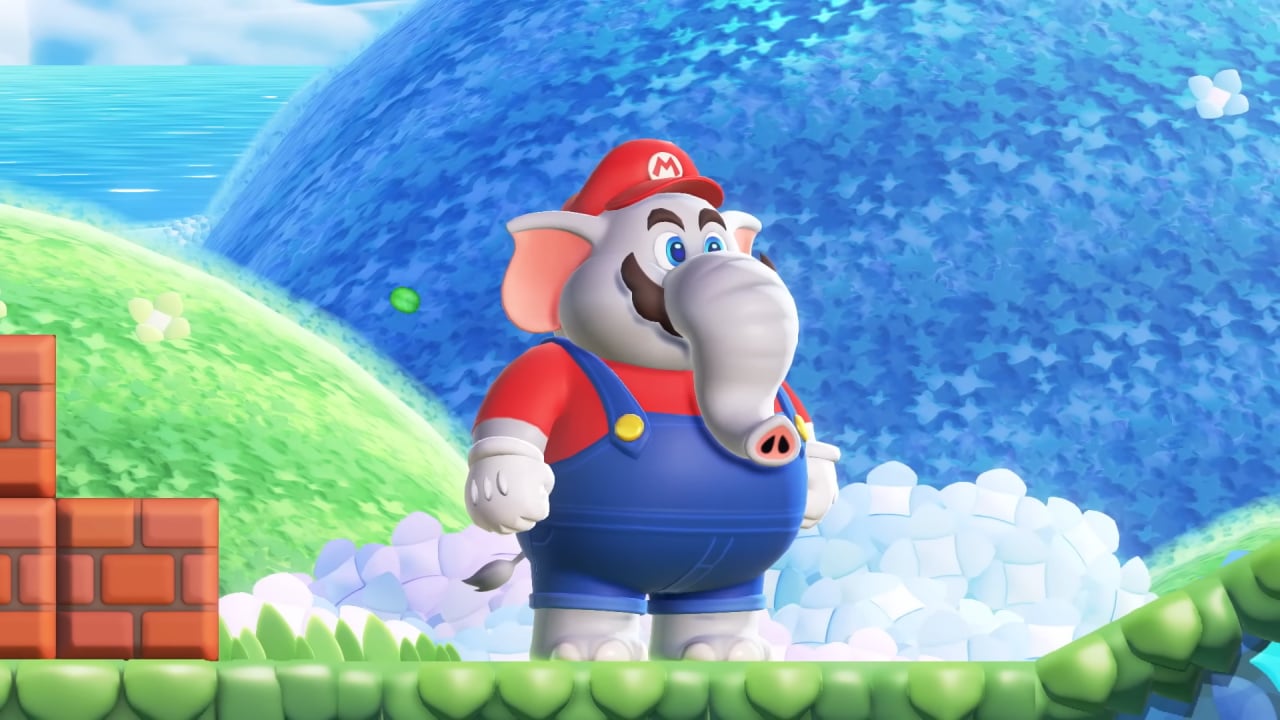
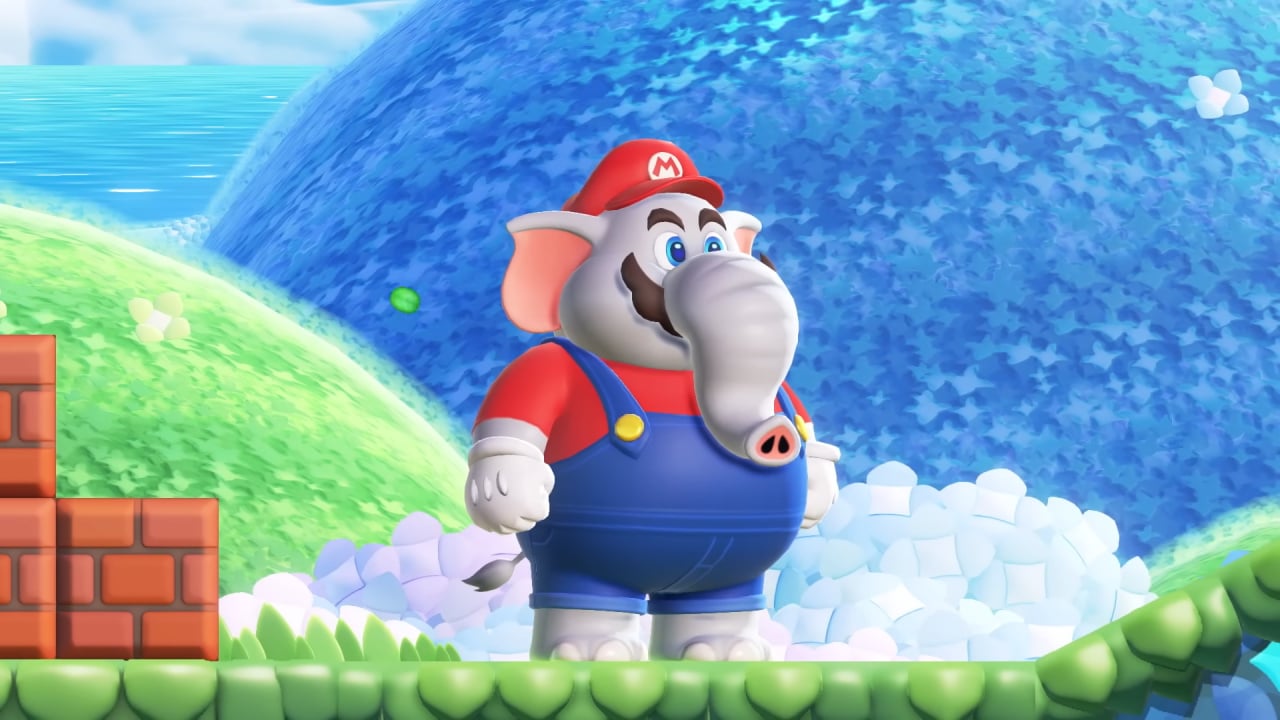
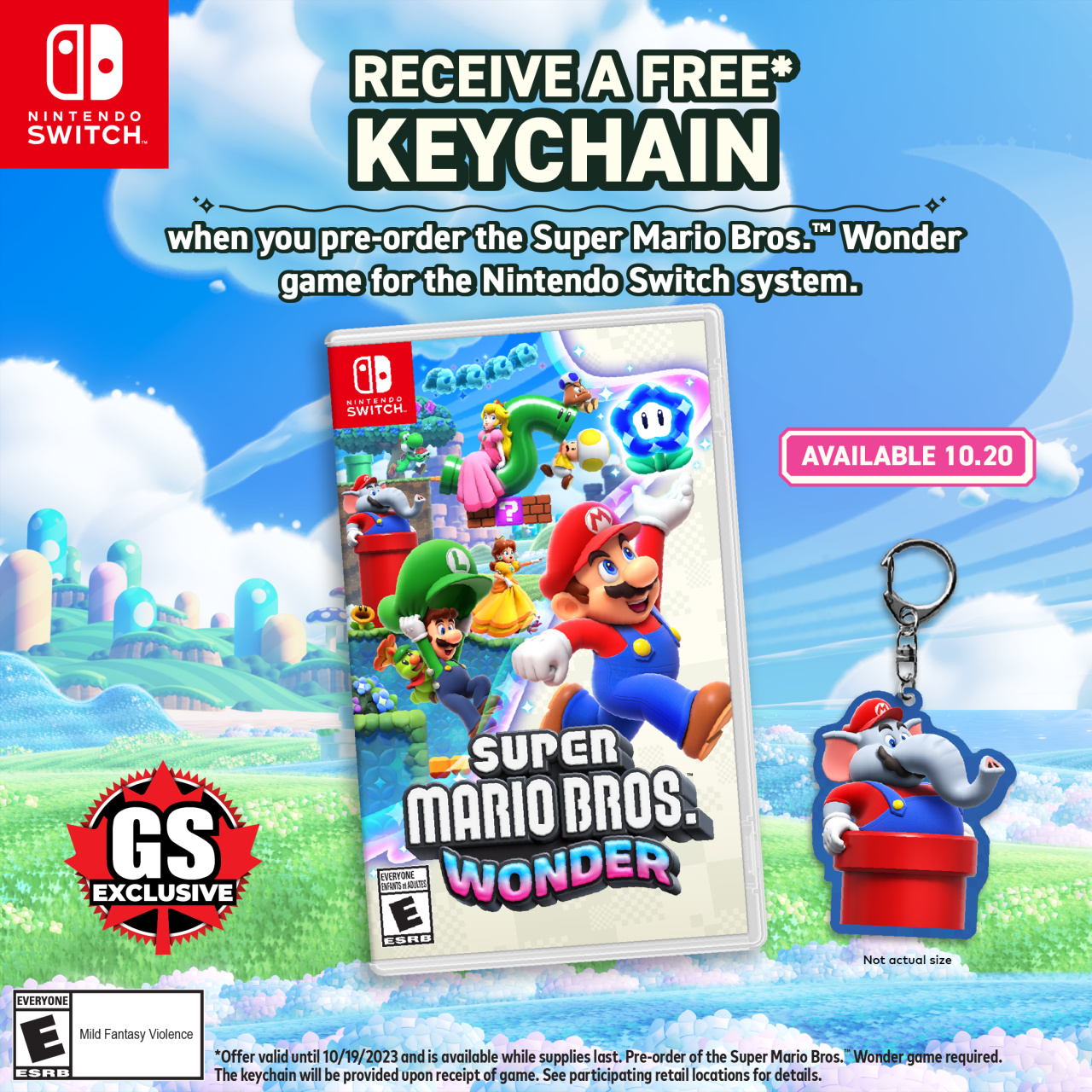
In Canada, GameStop will be offering anyone who pre-orders the game for $79.99 a free keychain. As you can see, it’s based on the new power-up in the game that transforms Mario and friends into an elephant.
It’s not entirely clear how big it will be in the promotional shot below, but we do know it will be based on Mario’s transformation:
Image: GameStop
As mentioned in the fine print above, this offer is valid until 19th October and will be available while supplies last.
There doesn’t appear to be any similar deal being offered at GameStop in the US, but if we hear any updates, we’ll let you know. Yesterday, we also heard how Wonder had already topped the charts on Amazon’s “best sellers” list. Check our Nintendo Life guide for more information about Wonder pre-orders:
Will you be pre-ordering this game? Any interest in an elephant Mario keychain? Comment below.
Procreate, maker of its eponymous digital illustration software, has announced its upcoming iPad animation app Procreate Dreams.
Procreate has long been popular with illustrators as it set the standard when it came to creating digital art on the iPad. Now, the company is gearing up to revolutionize 2D animation with its newly announced iPad app, Procreate Dreams.
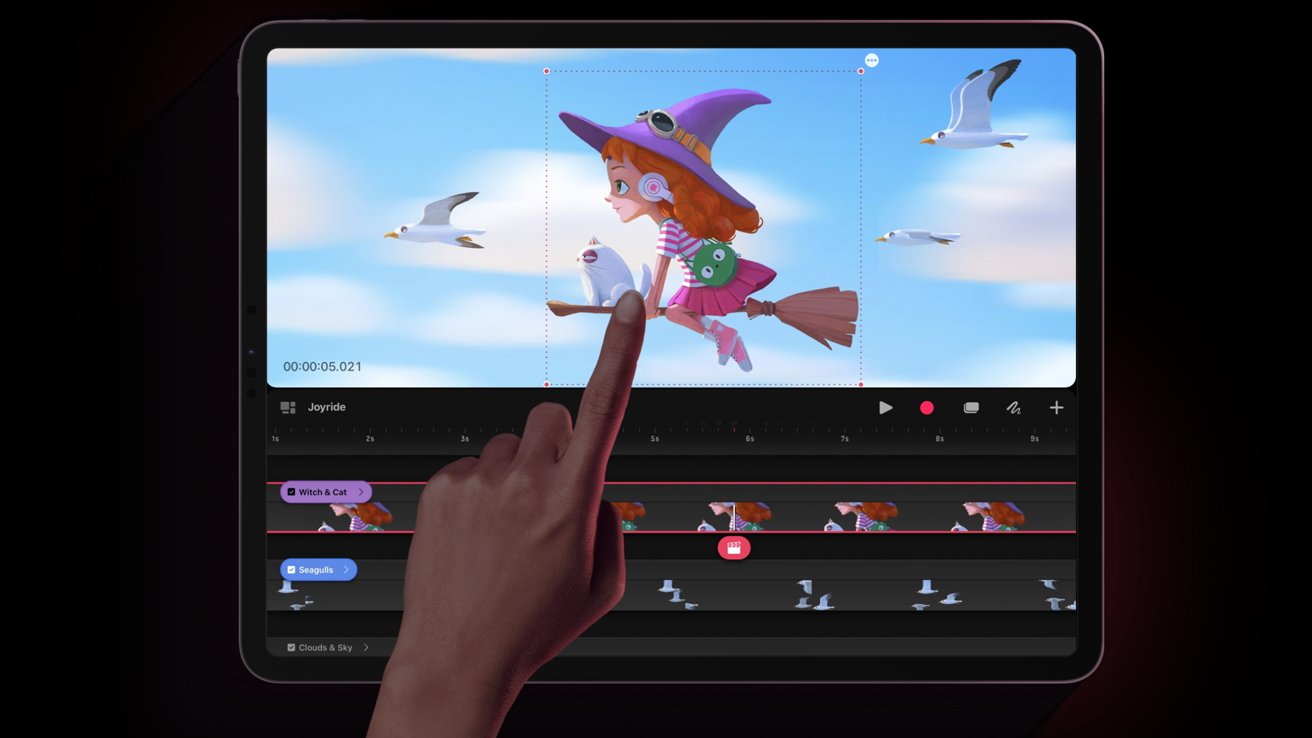
Procreate Dreams aims to make animation faster and easier with fluid gestures and intuitive tools like its multi-touch timeline. Onion skins can be customized to help animators create fluid animations effortlessly. A Flipbook tool helps pare down an interface for a more traditional animation experience.
It’s compatible with Procreate brushes, perfect for artists who have been collecting assets over the years.
Real-time rendering allows artists to instantly play back their animations as they make movies. A new audio engine gives animators tools for music, voice-overs, and sound effects.
Procreate Dreams will also feature iCloud support, allowing artists to back up their work automatically via iCloud synchronization. A new file format, the “dreams” format, allows artists to open files up to 1TB to be opened instantly with no loading, saving, or export time.
Like Procreate, Procreate Dreams will be available for a one-time purchase rather than a monthly subscription model. The company says it will be available on November 22 for $19.99.
Fedora test days are events where anyone can help make sure changes in Fedora Linux work well in an upcoming release. Fedora community members often participate, and the public is welcome at these events. If you’ve never contributed to Fedora Linux before, this is a perfect way to get started.
There are several test periods in the upcoming weeks. Here are the first two:
Sunday 10 Sept through Sunday 17 Sept , is to test Kernel 6.5.
Thursday 14 Sept focuses on testing Toolbx .
Kernel 6.5
The kernel team is working on final integration for Linux kernel 6.5. This recently released version, will arrive soon in Fedora Linux. As a result, the Fedora Linux kernel and QA teams have organized a test week from Sunday, Sept 10, 2023 to Sunday, Sept 17, 2023. This wiki page contains links to the test images you’ll need to participate. This is also going to be the release Kernel for Fedora 39 and any help testing regression for this Kernel will be very helpful.
A test day is an event where anyone can help make sure changes in Fedora Linux work well in an upcoming release. Fedora community members often participate, and the public is welcome at these events. If you’ve never contributed before, this is a perfect way to get started.
To contribute, you only need to be able to download test materials (which include some large files) and then read and follow directions step by step.
Detailed information about all the test days is available on the wiki pages mentioned above. If you’re available on or around the days of the events, please do some testing and report your results. All the test day pages receive some final touches which complete about 24 hrs before the test day begins. We urge you to be patient about resources that are, in most cases, uploaded hours before the test day starts.
Come and test with us to make the upcoming Fedora Linux 39 even better.
Those who have grown up with the Pokémon animated series, prepare to feel old. Today marks 25 years since the show’s pilot was first broadcast in North America. Yes, twenty. Five. Years.
On 8th September 1998, the US was first treated to episode one, ‘Pokémon – I Choose You!’, which would go on to introduce us all to Ash Ketchum, Pikachu and a number of other familiar faces that we have grown accustomed to over the ensuing two and a half decades.
Strangely, thanks to the joys of regional release times, the series’ 15th episode, ‘Battle Aboard the St. Anne’ was actually the first to be broadcast in the States (premiering a day earlier on the 7th September 1998), though today marks the official beginning of the journey, which is surely more worthy of acknowledgement, right?
The anniversary this year is all the more bittersweet given the fact that we now know Ash Ketchum’s journey has come to an end. The face of the franchise was announced to be stepping down late last year and his final episodes have since gone on to air in Japan as the follow-up series, Pokémon Horizons, gets underway.
Fittingly, Ash’s final episodes of the latest series, Pokémon: To Be A Pokémon Master, are available to watch on Netflix in the US as of today — seems like the best way to celebrate the anniversary, if you ask us.
So, let’s raise a glass of Pecha Berry juice to 25 years of the Pokémon anime out West — here’s to 25 more (albeit with some different faces at the helm).
Do you remember first watching the Pokémon anime pilot? Share your memories with us in the comments below.







 Recommended:


 Recommended: