Fedora test days are events where anyone can help make sure changes in Fedora Linux work well in an upcoming release. Fedora community members often participate, and the public is welcome at these events. If you’ve never contributed to Fedora Linux before, this is a perfect way to get started.
There are several test periods in the upcoming weeks. Here are the first two:
Sunday 10 Sept through Sunday 17 Sept , is to test Kernel 6.5.
Thursday 14 Sept focuses on testing Toolbx .
Kernel 6.5
The kernel team is working on final integration for Linux kernel 6.5. This recently released version, will arrive soon in Fedora Linux. As a result, the Fedora Linux kernel and QA teams have organized a test week from Sunday, Sept 10, 2023 to Sunday, Sept 17, 2023. This wiki page contains links to the test images you’ll need to participate. This is also going to be the release Kernel for Fedora 39 and any help testing regression for this Kernel will be very helpful.
A test day is an event where anyone can help make sure changes in Fedora Linux work well in an upcoming release. Fedora community members often participate, and the public is welcome at these events. If you’ve never contributed before, this is a perfect way to get started.
To contribute, you only need to be able to download test materials (which include some large files) and then read and follow directions step by step.
Detailed information about all the test days is available on the wiki pages mentioned above. If you’re available on or around the days of the events, please do some testing and report your results. All the test day pages receive some final touches which complete about 24 hrs before the test day begins. We urge you to be patient about resources that are, in most cases, uploaded hours before the test day starts.
Come and test with us to make the upcoming Fedora Linux 39 even better.
Those who have grown up with the Pokémon animated series, prepare to feel old. Today marks 25 years since the show’s pilot was first broadcast in North America. Yes, twenty. Five. Years.
On 8th September 1998, the US was first treated to episode one, ‘Pokémon – I Choose You!’, which would go on to introduce us all to Ash Ketchum, Pikachu and a number of other familiar faces that we have grown accustomed to over the ensuing two and a half decades.
Strangely, thanks to the joys of regional release times, the series’ 15th episode, ‘Battle Aboard the St. Anne’ was actually the first to be broadcast in the States (premiering a day earlier on the 7th September 1998), though today marks the official beginning of the journey, which is surely more worthy of acknowledgement, right?
The anniversary this year is all the more bittersweet given the fact that we now know Ash Ketchum’s journey has come to an end. The face of the franchise was announced to be stepping down late last year and his final episodes have since gone on to air in Japan as the follow-up series, Pokémon Horizons, gets underway.
Fittingly, Ash’s final episodes of the latest series, Pokémon: To Be A Pokémon Master, are available to watch on Netflix in the US as of today — seems like the best way to celebrate the anniversary, if you ask us.
So, let’s raise a glass of Pecha Berry juice to 25 years of the Pokémon anime out West — here’s to 25 more (albeit with some different faces at the helm).
Do you remember first watching the Pokémon anime pilot? Share your memories with us in the comments below.
If you’ve ever had the oddly specific dream of rising through the ranks of a toy-based wrestling world, then you’re in luck. WrestleQuest enters the ring with a deadly combo of late-’80s wrestling nostalgia and mid-’90s JRPG mechanics, celebrating both while not quite managing to deliver the three-count at the end. However, if you grew up in those very specific eras, you should find enough here to power through to the championship fight.
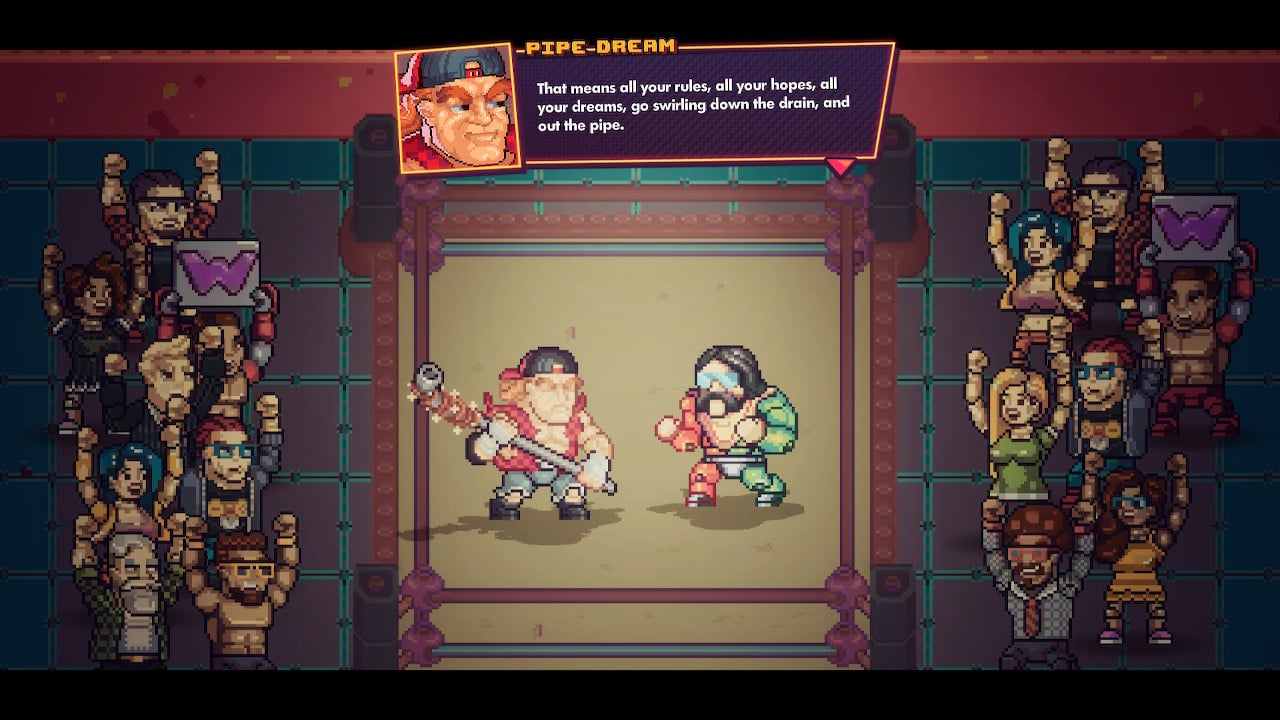
Mega Cat Studio’s latest offering builds a fascinating world right from the start. The populace of a children’s toy box has become obsessed with professional wrestling, idolising the likes of Macho Man Randy Savage and Jake the Snake. Life in the toy box revolves around wrestling and every conflict is settled in the ring with flashy moves and high-stakes action.
Aside from a few inconsistencies, such as not everyone realising that wrestling is – spoilers – fake, the world is the best thing about WrestleQuest. There is a wholesomeness to it, as if a child with a handful of official wrestling action figures is bringing the rest of their toys into the ring. The writers clearly know and love their wrestling and terminology; there are ample heel-turns and babyfaces to contend with. At times, WrestleQuest feels more like Toy Story than a wrestling game, with bright and colourful visuals and characters that feel stiff and plastic yet strangely full of life.
Captured on Nintendo Switch (Handheld/Undocked)
The story follows two main toys on their journey to greatness. Muchacho Man has, like many kids of the era, based his entire personality on the larger-than-life antics of Randy Savage and is trying to rise through the ranks to take on his idol in the ring. Meanwhile, in a winter-themed area of the toy box, is Brink Logan — a more subtle but still recognisable send-up of Bret “The Hitman” Hart — who struggles to balance his loyalty to his family and his own dreams for stardom.
Neither storyline is particularly compelling, though Logan’s quest has a touch more depth to it. The paper-thin plot mostly consists of going to a new area filled with enemies until you reach the inevitable boss fight. You can see the influence of games like Chrono Trigger in WrestleQuest. There aren’t any random encounters; you can see the enemies on the screen before they approach you. Once they do, your party is transported to a wrestling ring where the real action takes place.
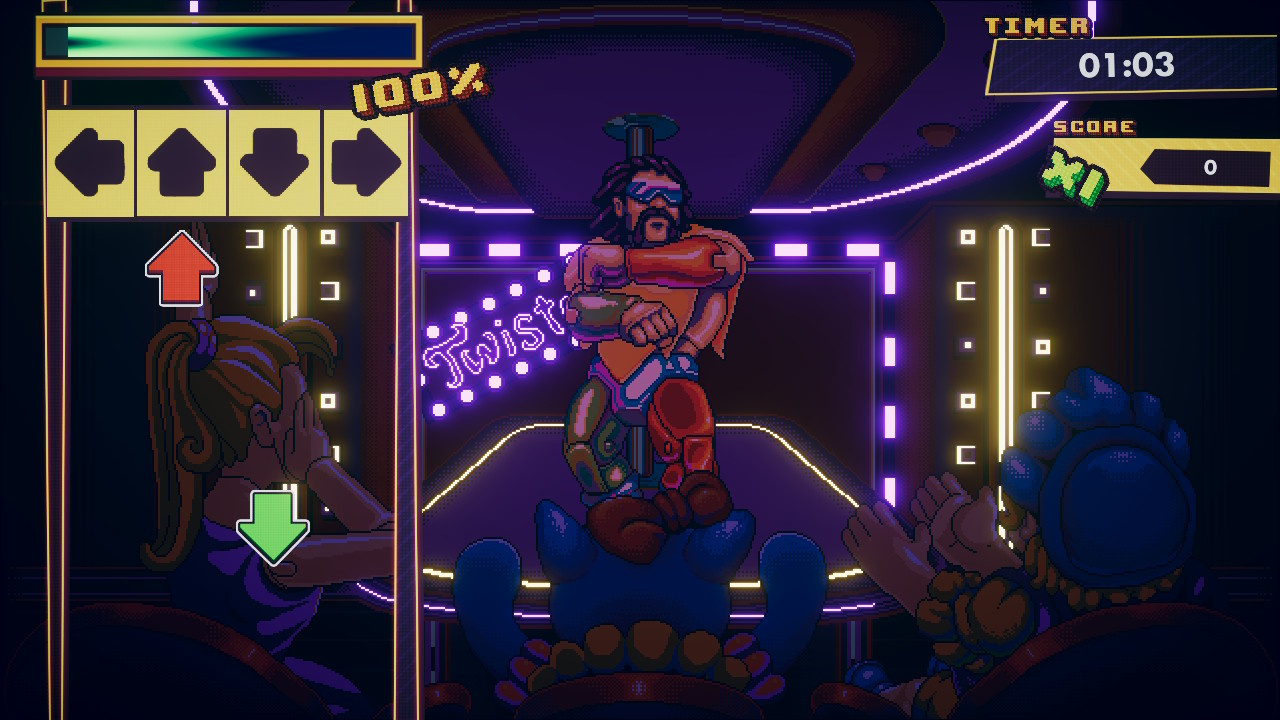
Combat is both very simple and needlessly complex at the same time. Even basic attacks require a timed input to do maximum damage or to avoid an occasional counterattack from the enemy, which means you can’t switch off at any point during a fight. Even the special moves, called Gimmicks, sometimes use this mechanic but will do a significant amount of damage anyway. Early fights won’t require you to use these Gimmicks very often but by the mid-game battles, you’ll find you rely on them almost entirely.
Captured on Nintendo Switch (Handheld/Undocked)
Each fight features a Hype Meter, which shows who the crowd is cheering for. Gain hype and you’ll deal more damage and earn more money, but let the momentum shift to your opponent and they’ll reap those rewards instead. It is a good way to hammer home the wrestling theme even further, but it seldom becomes important enough to focus on.
The biggest downside to WrestleQuest’s combat is a lack of balance. There is a pretty significant difficulty spike around ten hours into the game that feels like it should require a touch of grinding to get through, but, because the enemies don’t respawn, you won’t have the opportunity to do so. This is particularly problematic since new characters join your party at level one and are easily overwhelmed. This makes it unlikely you’ll want to swap out your core roster of wrestlers for fresh faces, especially once you’ve built up a solid synergy of double and triple tag-team techniques.
In its effort to pay homage to old-school RPG mechanics, Mad Cat Studio doesn’t give itself the chance to make WrestleQuest something unique and special. Mid-to-late-game fights drag on far too long, with each battle becoming predictable outside of the boss fights that punctuate each story arc. The world map feels too large, requiring you to traverse big, empty areas to get to the next signposted objective on your list. Things just feel a bit barren, which doesn’t encourage you to explore for hidden gems, which is usually one of the best parts of any RPG of this type.
Captured on Nintendo Switch (Handheld/Undocked)
There are also a handful of bugs that cropped up during our playthrough, and we didn’t start the game until a long-awaited launch patch was applied. The game crashed occasionally while moving to the next section of the map. Thankfully, we didn’t lose much progress but it was certainly a source of frustration. Character health bars didn’t refill during combat even when you had healed them, meaning you lost the visual cue to patch them up that every RPG has always given you. Neither of these issues were game-breaking but were certainly noticeable when they reared their heads. Hopefully they will disappear with future patches.
The result of this genre mash, then, is a flashy, competent RPG held back by some balance issues and combat that quickly becomes a slog at higher levels. If you’re a fan of both old-school wrestling and RPGs, you’ll probably find enough here to keep you going through the 30-ish hours it will take to complete WrestleQuest’s story, but otherwise it might struggle to keep you engaged.
Conclusion
WrestleQuest is a surprisingly wholesome game that is laser-focused on appealing to a specific demographic and will likely fail to capture the attention of anyone else. If you grew up watching the likes of Randy Savage, Hulk Hogan, and Ric Flair throw each other around the ring and you also happen to love 16-bit RPGs, you’ll probably be charmed enough to overlook the repetitive combat and empty world. We certainly fall into the target demographic here, but the concept is better than its execution.
The times are a-changin’ for Nintendo, it seems. Nobody would doubt that the company has been video game-focused for the past few decades, but with theme parks, movies, and mobile apps popping up all over the place, it seems that the Big-N is moving in a slightly different direction.
This was echoed by Nintendo of America president Doug Bowser in a recent interview with the Washington Post, in which he stated that Nintendo is now “evolving into being an entertainment company with gaming as a nucleus of the overall business model.” This will come as no surprise to many of us — you can’t walk through town without seeing Mario DVDs, toys, and LEGO sets at the moment — and having put all of its hardware eggs in one basket by uniting its handheld and home console lines with Switch, diversification into arenas beyond the creation of video game systems and software makes sense.
But the question is, hasn’t Nintendo always been an entertainment company? Are the firm’s recent shenanigans of buying up animation studios and expressing a desire to make more movies really all that surprising? Remember, this is the company that started out life making playing cards before moving into toys and running love hotels, after all…
Being an ‘entertainment’ company doesn’t necessarily mean having your financial fingers in many production pies. It’s true, Nintendo’s main focus since the ’80s has been video games, but the figurehead of Mario has long transcended the titles in which he has appeared — much like people recognise Mickey Mouse without having ever watched Steamboat Willie.
Doug Bowser is gesturing towards Nintendo’s move towards becoming a Disney-like powerhouse whose reach extends far beyond its main product, but it is nonetheless interesting to consider just how we have all perceived the company for all these years.
So, what do you reckon? Has Nintendo always been in the larger ‘entertainment’ business, or is this a sign of a bold new direction? Fill in the following poll to let us know which side you fall on, and then take to the comments to share your thoughts.
Has Nintendo always been an ‘entertainment’ company? (1,750 votes)
Yep, it’s always been about more than just video games41%
Hmm, sorta, though I’ve always though of it as video games only39%
Nope, it’s been a video game company that does other marketing stuff for decades now20%
An autoencoder is a neural network that learns to compress and reconstruct unlabeled data. It has two parts: an encoder that processes the input, and a decoder that reproduces it. While the original transformer model was an autoencoder with both encoder and decoder, OpenAI’s GPT series uses only a decoder. In a way, transformers are a technique to improve autoencoders, not a separate entity, so comparing them directly may not make a lot of sense.
We’ll still try in this article.
Transformers such as large language models (LLMs) have become wildly popular, particularly in natural language processing tasks. They are known for their self-attention mechanism, which allows them to capture relationships between words in a given input. This enables transformers to excel in tasks like machine translation, text summarization, and more.
Autoencoders, such as Variational Autoencoders (VAEs), focus on encoding input data into a compact, latent representation and then decoding it back to a reconstructed output. This makes them suitable for applications like data compression, dimensionality reduction, and generative modeling.
Autoencoders are a type of neural network that you can use for unsupervised learning tasks. They are designed to copy their input to their output, effectively learning an efficient representation of the given data. By doing this, autoencoders discover underlying correlations among the data and represent it in a smaller dimension, known as the latent space.
A Variational Autoencoder (VAE) is an extension of regular autoencoders, providing a probabilistic approach to describe an observation in latent space. VAEs can generate new data by regularizing the encoding distribution during training. This regularization ensures that the latent space of the VAE has favorable properties, making it well-suited for tasks like data generation and anomaly detection.
Variational autoencoders (VAEs) are a type of autoencoder that excels at representation learning by combining deep learning with statistical inference in encoded representations. In NLP tasks, VAEs can be coupled with Transformers to create informative language encodings.
Representation learning is a critical aspect of autoencoders. It involves encoding input data into a lower-dimensional latent representation and then decoding it back to its original form. This process allows autoencoders to compress data and extract meaningful features from it.
The latent space is an essential concept in autoencoders. It represents the compressed data, which is the output of the encoding stage. In VAEs, the latent space is governed by a probability distribution, making it possible to generate new data by sampling from this distribution.
Probabilistic methods, such as those used in VAEs, offer increased flexibility and expressiveness compared to deterministic methods. This is because they can model complex, real-world data with more accuracy and capture the inherent uncertainty present in such data.
VAEs are particularly useful for tasks like anomaly detection due to their ability to learn a probability distribution over the data. By comparing the likelihood of a new data point with the learned distribution, you can determine if the point is an outlier, and thus, an anomaly.
In summary, autoencoders and VAEs are powerful neural network-based models for unsupervised representation learning. They allow you to compress high-dimensional data into a lower-dimensional latent space, which can be useful for tasks like data generation, feature extraction, and anomaly detection.
Demystifying Transformers
Transformers are a powerful and flexible type of neural network, widely used for different natural language processing (NLP) tasks such as translation, summarization, and question answering. They were introduced by Vaswani et al. in the groundbreaking paper titled Attention is All You Need. Since their introduction, Transformers have become the go-to architecture for NLP tasks, surpassing their RNN and LSTM-based counterparts.
Transformers make use of the attention mechanism that enables them to process and capture crucial aspects of the input data. They do this without relying on recurrent neural networks (RNNs) like LSTMs or gated recurrent units (GRUs). This allows for parallel processing, resulting in faster training times compared to sequential approaches in RNNs.
A key aspect that differentiates Transformers from traditional neural networks is the self-attention mechanism. This mechanism allows the model to weigh the importance of each input element with respect to all the other elements in the sequence. As a result, Transformers can effectively handle the complex relationships between words in a sentence, leading to better performance in language understanding and generation tasks.
The Transformer architecture comprises an encoder and a decoder, which can be used separately or in combination as an encoder-decoder model. The encoder is an autoencoder (AE) model that encodes input sequences into latent representations. The decoder, on the other hand, is an autoregressive (AR) model that generates output sequences based on the input representations. In a sequence-to-sequence scenario, these two components are trained together to perform tasks like machine translation and summarization.
Some popular Transformer-based models include BERT, GPT, and their successors like GPT-4. BERT (Bidirectional Encoder Representations from Transformers) employs the Transformer encoder for tasks like classification and question answering. In contrast, GPT (Generative Pre-trained Transformer) uses a Transformer decoder for generating text and is well-suited for tasks like Natural Language Generation (NLG).
Both BERT and GPT utilize multiple layers of self-attention for improved performance. Recently, GPT-4 has gained prominence for its ability to produce highly coherent and contextually relevant text.
When discussing representation learning in the context of machine learning, two popular models you might come across are autoencoders and transformers.
Autoencoders are a type of unsupervised learning model primarily used for dimensionality reduction and feature learning. An autoencoder consists of three components: an encoder, which learns to represent input features as a vector in latent space; a code, which is the compressed representation of the input data; and a decoder, which reconstructs the input from the latent vector representation. The objective of an autoencoder is to have the output layer be exactly the same as the input layer, allowing it to learn a more compact representation of input data. Autoencoders have seen applications in areas such as image processing, where they can be used for denoising and feature extraction.
Transformers, on the other hand, have gained significant attention in the field of natural language processing (NLP) and sequence-to-sequence tasks. Unlike autoencoders, transformers are a type of supervised learning model that have been successful in tasks such as text classification, language translation, and sentence-level understanding. Transformers employ the attention mechanism to process input sequences in parallel, as opposed to the sequential processing approach used in traditional recurrent neural networks (RNNs).
While autoencoders focus more on reconstructing input data, transformers aim to leverage contextual information in their learning process. This allows them to better capture long-range dependencies that may exist in sequential data, which is particularly important when working with NLP and sequence-to-sequence tasks.
In summary, autoencoders and transformers each serve distinct purposes within machine learning. While autoencoders are more suitable for unsupervised learning tasks like dimensionality reduction, transformers excel at supervised learning tasks with sequential data.
Applications of Autoencoders
Autoencoders are versatile neural network-based models that serve various purposes in the field of machine learning and data science. They excel in unsupervised learning tasks, where their main applications lie in dimensionality reduction, feature extraction, and information retrieval.
One of the key applications of autoencoders is dimensionality reduction. By learning to represent data in a smaller dimensional space, autoencoders make it easier for you to analyze and visualize high-dimensional data. This ability enables them to perform tasks such as image compression, where they can efficiently encode and decode images, reducing the storage space required while retaining the essential information.
Feature extraction is another essential application, where autoencoders learn to extract salient features from input data. By identifying the underlying relationships in your data, autoencoders can be used for tasks such as image search, where they enable efficient retrieval of visually similar images based on the learned compact representations.
Variational autoencoders (VAEs) are an extension of the autoencoder framework that provides a probabilistic approach to describe an observation in the latent space. VAEs regularize the encoding distribution during training to guarantee good latent space properties, making it possible to generate new data that resembles the input data.
One popular use for autoencoders in data analysis is anomaly detection. By learning a compact representation of normal data points, autoencoders can efficiently detect outliers or unusual patterns that may indicate fraud, equipment failure, or other exceptional events. An autoencoder’s ability to identify deviations from regular patterns allows it to serve as a valuable tool in anomaly detection tasks across various sectors.
In addition to these applications, autoencoders play a crucial role in tasks involving noise filtering and missing value imputation. Their noise-filtering capacity is especially useful in tasks like image denoising, where autoencoders learn to remove random noise from input images while retaining the essential features.
One prominent application of transformers is in machine translation. With their ability to process and generate text in parallel rather than sequentially, transformers have led to significant improvements in translation quality. By capturing long-range dependencies and context, they produce more natural, coherent translations.
Transformers also shine in text classification tasks. By learning contextual representations of words and sentences, they can help you efficiently classify documents, articles, and other text materials according to predefined categories. This usefulness extends to sentiment analysis, where transformers can determine the sentiment behind a given text by analyzing the context and specific words used.
Text summarization is another area where transformers have made an impact. By understanding the key points and context of a document, they can generate concise, coherent summaries without losing essential information. This capability enables you to condense large amounts of text into a shorter, more digestible form.
In the realm of question-answering systems, transformers play a crucial role in providing accurate results. They analyze the context and semantics of both the question and the potential answers, making it possible to return the most relevant response to a user query.
Moreover, transformers are at the core of natural language generation (NLG) systems. By learning the underlying structure, grammar, and style of text data, they can create human-like, contextually relevant text from scratch or based on given constraints. This makes them an invaluable tool for tasks such as chatbot development and creative text generation.
Lastly, in tasks involving conditional distributions, transformers have proven effective. They model the joint distribution of inputs and outputs, allowing for controlled text generation or predictions.
Differences in Architectures
First, let’s discuss Autoencoders. Autoencoders are a type of artificial neural network that learn to compress and recreate the input data. They generally consist of an encoder and a decoder. The encoder compresses the input data into a lower-dimensional representation, while the decoder reconstructs the input data from this compressed representation. Autoencoders are widely used for dimensionality reduction, denoising, and feature learning. A notable variant is the Variational Autoencoder (VAE), which introduces a probabilistic layer to generate new data samples source.
On the other hand, Transformers are a modern neural network architecture designed to handle sequence-based tasks, such as natural language processing and time series analysis. Unlike traditional Recurrent Neural Networks (RNNs) or Convolutional Neural Networks (CNNs), Transformers do not rely on recurrent or convolutional layers. Instead, they use a combination of self-attention and cross-attention layers to model the dependencies between elements in a sequence. These attention mechanisms allow Transformers to process sequences more efficiently than RNNs, making them well-suited for large-scale training and parallelization source.
The following points highlight some of the key architectural differences between Autoencoders and Transformers:
Autoencoders typically have a symmetric architecture with an encoder and decoder, while Transformers have an asymmetric architecture with separate encoder and decoder stacks.
Autoencoders use a simple 3-layer architecture in which the output units are directly connected back to the input units, whereas Transformers use multiple layers of self-attention and cross-attention mechanisms source.
Autoencoders are mainly used for unsupervised learning tasks, such as dimensionality reduction and denoising, while Transformers are more commonly employed in supervised tasks like machine translation, text classification, and regression tasks.
The attention mechanisms in Transformers allow for efficient parallel processing, while the recurrent nature of RNNs—often used in sequence-based tasks—leads to slower, sequential processing.
Conclusion
In this article, you have explored the differences between Transformers and Autoencoders, specifically Variational Autoencoders (VAEs).
Transformers, as mentioned in this GitHub article, have become the state-of-the-art solution for a wide variety of language and text-related tasks. They have replaced LSTMs and RNNs, offering better performance and scalability. With their innovative attention mechanism, they enable parallel processing and long-term dependencies handling.
On the other hand, VAEs have proven to be an efficient generative model, as mentioned in this MDPI article. They combine deep learning with statistical inference in encoded representations, making them useful in unsupervised learning and representation learning. VAEs facilitate generating new data by leveraging the learned probabilistic latent space.
These two techniques can also be combined, as demonstrated by a Transformer-based Conditional Variational Autoencoder, which allows controllable story generation. By understanding the strengths and limitations of Transformers and Autoencoders, you can make informed decisions when selecting the best method for your machine learning projects.
Frequently Asked Questions
How do transformers compare to autoencoders in performance?
When comparing transformers and autoencoders, it’s crucial to consider the specific task. Transformers typically perform better in natural language processing tasks, whereas autoencoders excel in tasks such as dimensionality reduction and data compression. The performance of each model depends on your choice of architecture and the nature of your data.
What are the key differences between variational autoencoders and transformers?
Variational autoencoders (VAEs) focus on generating new data by learning a probabilistic latent space representation of the input data. In contrast, transformers are designed for sequence-to-sequence tasks, like translation or text summarization, and often have self-attention mechanisms for effective context understanding. You can find more information about the differences here.
How does the vision transformer autoencoder differ from traditional autoencoders?
Traditional autoencoders are neural networks used primarily for dimensionality reduction and data compression. Vision transformer autoencoders adapt the transformer architecture for image-specific tasks such as image classification or segmentation. Transformers leverage self-attention mechanisms, enabling them to capture complex latent features and contextual relationships, thus differing from traditional autoencoders in terms of both architecture and capabilities.
In what scenarios should one choose a transformer over an autoregressive model?
You should choose a transformer over an autoregressive model when the task at hand requires capturing long-range dependencies, understanding context, or solving complex sequence-to-sequence problems. Transformers are well-suited for natural language processing tasks, such as translation, summarization, and text generation. Autoregressive models are often better suited in scenarios where generating or predicting the next element of a sequence is essential.
How can BERT be utilized as an autoencoder?
BERT can be considered a masked autoencoder because it is trained using the masked language model objective. By masking a portion of the input tokens and predicting the masked tokens, BERT learns contextual representations of the input. Although not a traditional autoencoder, BERT’s training strategy effectively allows it to capture high-quality representations in a similar fashion.
What advantages do transformers offer compared to RNNs in sequence modeling?
Transformers offer several advantages over RNNs, including parallel computation, better handling of long-range dependencies, and a robust self-attention mechanism. Transformers can process multiple elements in a sequence simultaneously, enabling faster computation. Additionally, transformers efficiently handle long-range dependencies, whereas RNNs may struggle with vanishing gradient issues. The self-attention mechanism within transformers allows them to capture complex contextual relationships in the given data, boosting their performance in tasks such as language modeling and translation.
Following the arrival of LEGO 2K Drive on the Switch earlier this year, 2K Games has now rolled out a free demo on the Switch eShop in the US and UK.
According to Nintendo’s socials, players will be able to cruise around Turbo Acres – the introductory biome of Bricklandia.
When LEGO 2K Drive launched on the Switch earlier this year, we called it a fun and colourful racer but didn’t feel this version was quite as good in terms of optimisation. If you are curious to see what it’s like yourself though, you can now give it a go!
“The foundations of a really great arcade racer are here, but poor optimisation in this Switch version and certain design decisions mean it’s unlikely to overtake the competition.”
Please note that some external links on this page are affiliate links, which means if you click them and make a purchase we may receive a small percentage of the sale. Please read our FTC Disclosure for more information.
Will you be downloading this demo? Already played the full game? Tell us in the comments.
Ahead of the game’s release, the first “hands-on” previews have now been released and so we’ve decided to round up as many as possible into a single post to give you an idea about this latest entry in the mystery-solving adventure series.
Starting off with IGN, the game appears to pack all the charm of the original but falls short when it comes to visuals:
“The place where Detective Pikachu Returns leaves a lot to be desired is in the visual department. While it doesn’t perform as poorly as Pokémon Scarlet & Violet, many of the textures and character models still look closer to a 3DS game than a new Nintendo Switch game coming out in 2023. It doesn’t necessarily look bad, it just all looks very… Simple…Still, Detective Pikachu Returns packs in the charm of the original, and you’ll probably want to keep playing just to see what the adorable hero says or does next. As a bonus, the kid-friendly nature of the puzzle-solving and story could make it a great entry point for younger players to get into the mystery genre.”
Comicbook.com mentioned how it will no doubt interest returning fans but anyone who didn’t enjoy the 3DS game might want to “steer clear”:
“In our brief time with the game, it feels like the game will maintain a lot of the charms of the original Detective Pikachu, while also adding some new features, as well as new mysteries to uncover. One of the highlights of the original game was getting to see and interact with Pokemon in a very different setting, and getting to learn their thoughts through Pikachu. Those elements were on full display in our preview, and it was interesting to see how the developers are using these games to further flesh out the Pokemon world. Players that didn’t enjoy the 3DS game will likely want to steer clear, but it already seems like returning fans will find plenty to enjoy when Detective Pikachu Returns arrives next month.”
Game Informer mentioned how they enjoyed the interactions with Pokémon the most:
“interactions, where you truly get a sense of the personalities of the various Pokémon of Ryme City, were the highlights…Though my time in Ryme City was brief, I enjoyed interacting with the various Pokémon that coexist with the humans in this unique subseries. The case-solving mechanics feel fairly basic at this point, but it’s also worth remembering that I was playing in the first chapter, so that’s to be expected.”
GameSpot thought the sequel was shaping up to be a much bigger Pokémon adventure than the first game:
“Nintendo Switch hardware has allowed the team to build a livelier Ryme City. The explorable areas are noticeably bigger and the number of Pokemon that fill the environment has increased. While these improvements may seem superficial, they could expand cases and add some complexity by giving players more ground to cover and more witnesses to question.”
“I think Pokemon fans could be in for a fun adventure that builds off the groundwork of the original 3DS game.”
And Inverse thinks this game could be something special, even if the graphics aren’t “exceptionally impressive”. You also get an added perspective with Pikachu now:
“The major new feature of the sequel fleshes out this idea even more, by letting you directly control Pikachu during investigations. While you control Tim, you’ll be able to talk to humans and have Pikachu interpret for Pokémon. Playing as Pikachu lets you actually talk to those same Pokémon, seeing more of their unfiltered personalities.”
“Graphically, Detective Pikachu Returns isn’t exceptionally impressive, but there’s a bright color palette the game uses that injects a bit of personality. Despite its simplicity the first Detective Pikachu still managed to shine by having quirky characters and an interesting story, and getting hands-on with the sequel gave me hope it’ll manage to hit that sweet spot again.”
Please note that some external links on this page are affiliate links, which means if you click them and make a purchase we may receive a small percentage of the sale. Please read our FTC Disclosure for more information.
Detective Pikachu Returns launches on Nintendo Switch on 6th October. What do you make of these early previews? Comment below.
“The gory and gothic adventures of the Castlevania franchise continue with an exciting new setting and their highest stakes yet. A gripping story of love and loss, Nocturne marks an evolution to the original fan-favorite Castlevania Netflix Series. Featuring a never before seen origin story of Richter Belmont (gaming icon, and one of the Franchise’s most beloved characters). Bandana included.”
Just a word of warning, this latest trailer contains violence and some swearing. You can learn more about this show and the original Castlevania Netflix series in our previous coverage here on Nintendo Life:
Castlevania: Nocturne will get a special digital premiere a day early on 27th September via Twitch and YouTube, and arrives on Netflix on 28th September.
Will you be watching this latest animation from Netflix? Comment below.
When he’s not paying off a loan to Tom Nook, Liam likes to report on the latest Nintendo news and admire his library of video games. His favourite Nintendo character used to be a guitar-playing dog, but nowadays he prefers to hang out with Judd the cat.
Image: First We Feast – Hot Ones (via YouTube) / NetherRealm Studios, Warner Bros.
Ahead of the launch of Mortal Kombat 1 later this month, series co-creator Ed Boon has been doing the press rounds to promote this new entry. Surprisingly, he’s shown up on the YouTube show ‘Hot Ones’, where guests do a hot sauce challenge while answering questions about a particular subject.
As part of this appearance, Mortal Kombat fans have been given a “first look” at the Jean-Claude Van Damme skin for Johnny Cage. Boon notes how it’s the “absolute full circle moment” for the Mortal Kombat series to be able to get this famous martial artist and actor in the game:
Ed Boon: “When we made the very first game our original intention was to make Van Damme the arcade game, we actually wanted to see Van Damme, and again Bloodsport was big and Universal Soldier I think it was, so we called his people and we’re like we want to make a game based on Van Damme, and I don’t know if he declined or it just never got to him or something like that but again this a couple of 20 something-year-old kids who wanted to make a video game, I could see how Van Damme would go “no, no we’re not doing this”… so we tried a number of times going back and forth with him, this time we hit the lottery and we got him and we actually have his voice and he’s gonna be the Johnny Cage character…”
Boon’s appearance on Hot Ones follows yesterday’s reveal of Megan Fox as the Outworld vampire Nitara. You can learn more about this returning character and Megan’s involvement in Mortal Kombat 1 in our previous coverage here on Nintendo Life:
Are you excited to see Jean-Claude Van Damme as Johnny Cage in Mortal Kombat 1? What do you think of the roster so far in the new game? Let us know in the comments.










 Variational autoencoders (VAEs) are a type of autoencoder that excels at representation learning by combining deep learning with statistical inference in encoded representations. In NLP tasks, VAEs can be coupled with Transformers to create


 Recommended:
 Recommended: