A rumored “Silo” spinoff could keep Apple TV’s dystopian franchise alive beyond its planned finale, but the books’ author is pushing back on the claim.
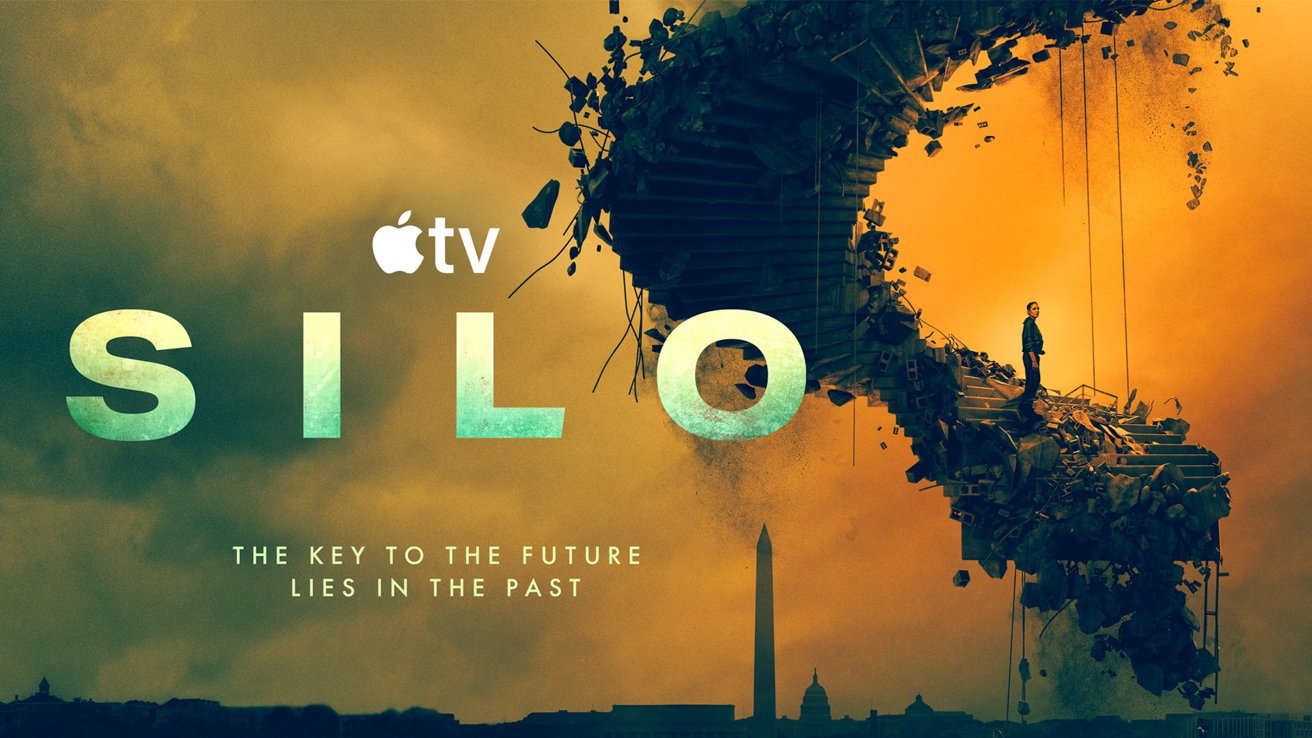
“Silo” is a dystopian science-fiction drama about a society living underground after humanity has been driven from the surface. The Apple TV series is based on the bestselling “Silo” trilogy, “Wool,” “Shift,” and “Dust,” by Hugh Howey.
While it was well liked, Apple TV had told the creators that the series would end after the fourth season. The third season just returned to the small screen in July, with the fourth season anticipated to release in Summer 2027.
Even though the series is facing down its inevitable end, it may not be time to say goodbye just yet.
Allegedly, there’s a chance “Silo” may be getting its own spinoff, set to begin pre-production in late 2026. It is expected to tie into Hugh Howey’s upcoming “Silo 40” trilogy, which is set to release in 2027.
This tantalizing tidbit was shared by Apple TV enthusiast Sigmund Judge on Threads.
One minute later, however, a very significant figure refuted the claim. Speaking up was the “Silo” author, Hugh Howey.
“Yo, this is news to me,” Howey says in the replies. “So probably not true.”
“I appreciate you wanting to keep a surprise,” Judge says in response. “Love everything you do.”
Judge says that he’s got some further evidence in response to “a denial,” presumably Howey’s. Judge says that hires for the upcoming project have begun, and that the main sets used for “Silo” have remained, even after production on the fourth season wrapped in March.
Recently, Framework announced their new Laptop 12, which optionally comes with the KDE Edition of Fedora Linux pre-installed. Framework’s modular hardware has long captured the hearts of tinkerers, and many Framework users were already running Fedora Linux. Giving community members the option to unbox a hardware-validated, pre-installed Fedora KDE system is the culmination of months of effort from both Framework and dedicated Fedora community members. I’d like to take a moment to reflect on the hard work of the Fedora community that’s made this possible
The Perfect Match: Fedora KDE Plasma & Convertible Hardware
The Framework Laptop 12 is a 12.2” 2-in-1 convertible laptop complete with a touchscreen and stylus support. Delivering a seamless experience on a form factor like this requires an interface that excels across traditional, touch, and pen modes.
Enter Fedora KDE Plasma Desktop.
Over recent release cycles, the Fedora KDE Special Interest Group (SIG) and upstream KDE contributors have poured immense effort into refining the user interface. This includes touch navigation, gesture support, virtual keyboards, and digital pen input under Wayland. Combined with the brand-new Intel Core Series 3 architecture, Thunderbolt 4, Wi-Fi 7, and options for a backlit keyboard and fingerprint reader, the hardware and software form a cohesive unit.
“The Fedora KDE Plasma Desktop contributors work hard to make the Fedora KDE Plasma Desktop edition the premier KDE experience for users. It’s great to see Framework customers have the choice to have it pre-installed.”
— Jef Spaleta, Fedora Project Lead
Community Collaboration at its Finest
Bringing a brand-new hardware platform with bleeding-edge components (like Intel’s Core Series 3 chips and BE213 Wi-Fi 7 modules) to pre-built availability doesn’t happen by accident. It takes rigorous testing, community bug hunting, and close collaboration.
Long before today’s announcement, Framework provided pre-release hardware to Fedora QA and SIG contributors to ensure day-one hardware enablement:
Kernel 7.1 Integration: Core Series 3 and Wi-Fi 7 R2 radios rely on recent upstream kernel drivers. Fedora contributors verified boot stability, power states, and Wi-Fi throughput on early builds to ensure seamless out-of-the-box performance.
Fingerprint Sensor Support via libfprint: The new power-button fingerprint reader required driver verification and early integration into libfprint. This work allows users to instantly set up biometrics during the initial Plasma setup wizard.
Display, Touch, and Stylus Calibration: Fedora QA and KDE community testers ran extensive Test Day scenarios to validate palm rejection, active stylus pressure sensitivity, and automatic screen rotation when flipping the device into tablet mode.
Open-Source Firmware (ZMK): The updated backlit keyboard uses a reprogrammable controller running open-source ZMK firmware. This firmware aligns perfectly with Fedora’s “Four Foundations” (Features, Friends, Freedom, First).
What This Means for the Linux Desktop
Starting at $699 USD for the Fedora pre-built configuration, the Framework Laptop 12 demonstrates that a fully modular, repairable, open-source-friendly laptop can be accessible, performant, and ready to go from day one.
Thank you to every member of the Fedora Quality Assurance team, the Fedora KDE SIG, and the broader upstream community who submitted test reports, verified kernel patches, and helped make this launch a massive success!
Disclosure: We used generative AI to outline and draft this post, but real humans shaped, verified, and reviewed it.
In 2020, we introduced Apple silicon for Mac computers, providing Rosetta as a translation layer during the transition period. As announced at WWDC last year, we’re now concluding this transition.
What this means for developers who have macOS apps:
macOS 26.4 or later: Users may receive a system notification when launching apps that rely on Rosetta, alerting them to update to an Apple silicon native version.
macOS 27: Final release to support Rosetta — Intel-only apps will no longer run on Mac computers with Apple silicon after this update.
Please note that Rosetta functionality for older, unmaintained gaming titles that rely on Intel-based frameworks will continue to be supported.
What you need to do:
To ensure your apps remain available and your users aren’t interrupted by system notifications, add Apple silicon support to your apps now.
If you haven’t updated your app yet: Begin the transition immediately. Build and distribute your app as a universal binary, which runs natively on both Apple silicon and Intel-based Mac computers.
If you already offer an Apple silicon version: Reach out to your users directly. Encourage them to download and install your latest native version to avoid the notifications on macOS 26.4 or later and ensure the app runs when macOS 27 ships this fall.
Dark romance has taken over BookTok lately. Writers are scrambling to keep up with the demand.
I’ve spent a lot of time testing AI tools to see which ones can actually handle the genre without turning everything into a generic love story.
The best AI dark romance writers can hold onto morally complex characters, slow-burn tension, and messy power dynamics across an actual story instead of forgetting what happened three chapters ago.
Some platforms can even take you from a rough idea to a complete manuscript with chapters, dialogue, and a cover.
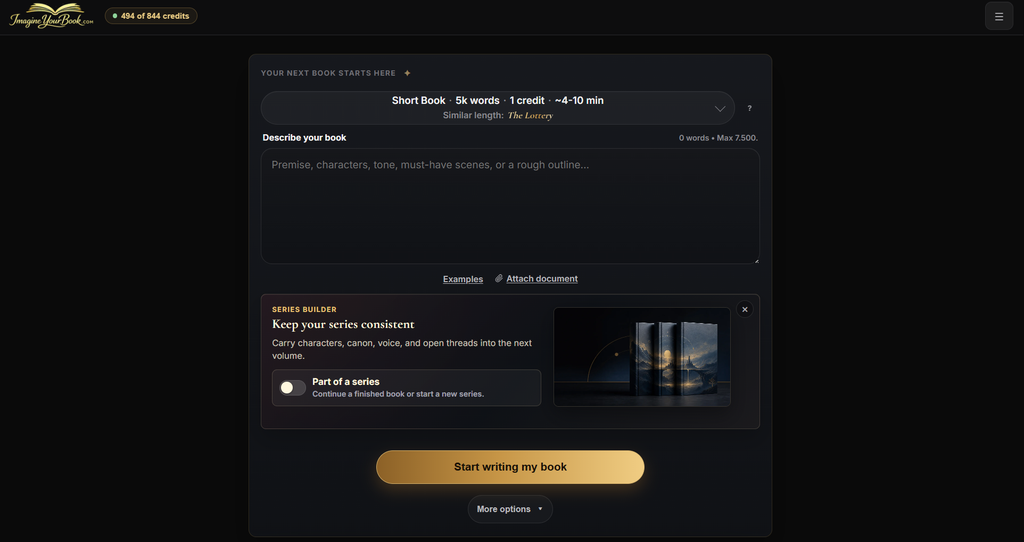
ImagineYourBook.com is my first pick if I want the AI to actually finish the book.
A lot of AI writing tools are really assistants. They’ll help with an outline, write a scene, or give you five ways to rewrite the same paragraph.
ImagineYourBook is built around the whole book instead.
You can start with one sentence or bring in a detailed outline. Then you can spell out the things that actually matter for dark romance: POV, pacing, character dynamics, tropes, boundaries, the ending you want, and details the story shouldn’t forget.
That’s a bigger deal than it sounds.
If I ask for a slow-burn romance with a morally grey hero, enemies-to-lovers tension, dual POV, no cheating, and a specific emotional payoff, I don’t want the story deciding halfway through that it’s actually a sweet workplace romance.
ImagineYourBook’s state-of-the-art Muse engine plans the book and writes it chapter by chapter while carrying the book’s context forward.
It also goes much longer than the short outputs you get from normal chatbots. You can create books from 5,000 words all the way up to 120,000 words, depending on the plan and book size.
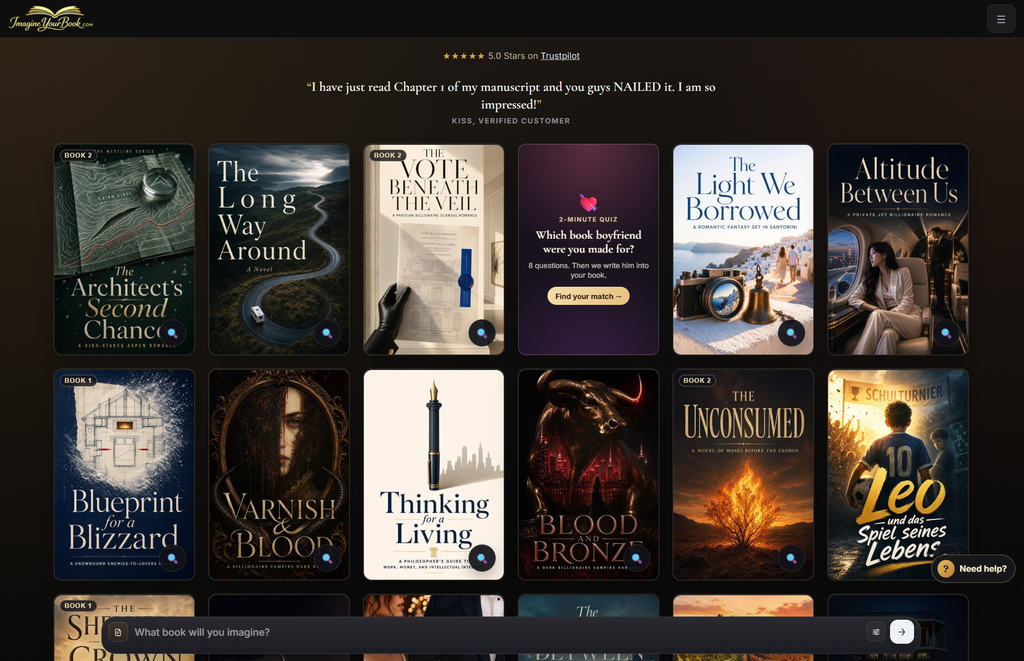
It even recommends new books or series ideas based on your previous ideas so you never run out of good books to write:
For dark romance, I think that whole-book approach is the main advantage.
A possessive character only works if his behavior in chapter 22 makes sense with what happened in chapter four. A betrayal needs setup. A slow burn needs to actually stay slow. And if you’re writing a series, you don’t want book two acting like book one never happened.
ImagineYourBook has a series system that carries characters, canon, open plot threads, world rules, and previous-book context into the next book.
You also get a generated cover, and finished books can be exported as Word or EPUB files so you can edit the manuscript afterward.
I wouldn’t skip that editing step. AI can get you past the blank page incredibly fast, but a generated draft still needs a human reading it for voice, repetition, continuity, and scenes you want to push further.
The nice part is that you can test the actual workflow rather than a tiny demo. The 7-day trial includes one complete 10,000-word book, so I’d use a real dark romance idea and see what it does with it.
For me, that’s the easiest way to judge an AI book writer.
Don’t ask whether it can produce three impressive paragraphs.
Ask whether you still want to keep reading at chapter ten.
2) NovelCrafter
I like NovelCrafter for one big reason: it remembers what I wrote earlier.
That matters a lot in dark romance, where a hero’s backstory or a slow-burn thread can fall apart if the tool forgets chapter three.
You can start with 10,000 free words, which is enough to test whether the voice works for your story.
The setup is simple. I write, the AI helps, and my story details stay in one place instead of scattered across a dozen chat windows.
Now, a quick note to avoid confusion. There’s also Novelcrafter, a separate tool with a similar name that helps writers outline and draft with AI support.
Both show up in searches, so double-check the site before you sign up.
For dark romance, that model choice matters. Some models push back on heavier themes more than others.
I’d pick NovelCrafter over ImagineYourBook if I wanted to spend a lot of time inside the writing process and control the AI setup myself.
If I mainly wanted to turn the idea into a complete draft, I’d still start with ImagineYourBook.
3) Squibler AI Novel Writer
I like Squibler because it doesn’t just spit out a few paragraphs and call it a day.
It’s built for long-form work, so you can go from a rough idea to a full manuscript with chapters and scenes.
The AI Novel Writer is the main draw here. You chat with it, describe your story, and it helps you outline, draft, and build out characters as you go.
For dark romance specifically, Squibler has a romance-focused version of the tool. It’s aimed at writers working on love stories, whether that’s your first book or your tenth.
What helped me most was the subgenre support. The romance story generator can handle contemporary, fantasy romance, dark romance, and rom-com, and it tries to stick to what readers expect from each one.
You can also write chapter by chapter instead of dumping everything at once.
That gives you more control over pacing, which matters a lot when you’re building tension between two characters.
There’s a free option to try, so you can test it before paying for anything.
4) BookNova
I like BookNova when I want a full book, not just a few chapters.
For dark romance specifically, it builds your hero and heroine, picks tropes like enemies-to-lovers or fake dating, and writes dual-POV chapters with slow-burn pacing.
Each one has its own rules, so that range matters if you write in more than one lane.
I’d say the main draw here is speed plus structure. You’re not staring at a blank page trying to figure out where the third act turn goes.
If whole-book generation is what you’re after, I’d compare this directly with ImagineYourBook.com.
I prefer ImagineYourBook overall because of how much information I can give it about the book before it writes and how that context carries through the manuscript and into sequels.
But BookNova is still worth testing if you like its KDP-focused workflow.
5) Plot Factory
Plot Factory is less of a “write my book for me” button and more of a workspace.
I think of it as a place to keep my story organized while I draft.
The tool lets me build character profiles, track locations, and keep notes on my world.
For dark romance, that matters. Trauma backstories, power dynamics, and shifting loyalties get messy fast when you’re 60,000 words deep.
It also has a text-to-speech feature, so I can listen to my chapters read out loud.
Hearing a tense scene helped me catch dialogue that sounded stiff.
The AI writing help isn’t as strong as tools built specifically around generating fiction prose.
For dark romance, that flexibility matters. My stories usually mix genres, so a tool that can swing from a tense chase scene to a slow-burn confession is helpful.
DreamGen also doesn’t sanitize your prompts the way many mainstream tools do.
It’s often grouped with NovelAI as an option for writers who want mature or unconventional themes without the AI backing off.
That means I can write a possessive love interest or a morally grey villain without rewriting my prompt five times.
That’s handy when you want a starting point but don’t want the usual sweet meet-cute setup.
You’re also not stuck in one lane.
The AI story generator works across romance, fantasy, sci-fi, and mystery, so you can blend a dark romance with a fantasy world without fighting the tool.
I mostly use it for idea generation.
If I’m stuck on a morally grey love interest or a messy backstory, I’ll run a few prompts and see what sticks.
It’s worth noting that Talefy shows up on roundups of romance story generators, so it’s not some unknown tool.
For me, it’s better for sparking ideas and short interactive pieces than drafting a full 80,000-word novel.
But for brainstorming, it does the job fast.
8) AI Dungeon
AI Dungeon started out as a text adventure game, not a book writing tool.
You type what your character does, and the AI responds with what happens next.
That setup makes it a strange but interesting pick for dark romance.
I use it when I’m stuck on a scene and want to see where a character might go.
Here’s how I approach it.
I set up a scenario with two characters, give the AI some background on their relationship, and then play out the tension line by line.
The output isn’t polished prose. You’ll get repetition, and sometimes the story wanders off in a direction you didn’t ask for.
But that’s kind of the point.
I treat it like a brainstorming partner, not a ghostwriter.
If what you actually want is a finished manuscript, you’re better off with a whole-book AI writer like ImagineYourBook that’s built to carry the premise across chapters.
AI Dungeon won’t hand you chapters with a clean structure.
There’s a free tier, plus paid plans that unlock better models and longer memory.
I’d say try it if you like discovery writing.
Skip it if you need a tool that keeps track of your plot for you.
9) Dabble Writer
Dabble is the tool I reach for when my dark romance draft starts falling apart.
It’s built around organization more than raw AI generation, and that’s why I like it.
The plot grid is the standout feature for me.
I can see every scene laid out in columns, so tracking a slow-burn corruption arc across 40 chapters stops feeling impossible.
Its AI features are lighter than what you get from a dedicated AI book writer that generates full prose.
Dabble offers brainstorming help and editing suggestions, not a machine that writes the whole kidnapping plot for you.
I actually see that as a plus.
My voice stays mine, and I just get help when I’m stuck on a chapter title or a character’s motive.
Everything syncs across my laptop, phone, and browser.
I’ve written morally grey villain monologues on my phone in a parking lot. Weird flex, but it’s handy.
Pricing sits in the middle range, with a free trial to test it out.
If you want a tool that plans and drafts alongside you rather than replacing the blank page with a full manuscript, Dabble earns a spot on this list.
10) Jasper Creative Writing
Jasper started out as a marketing tool, and you can still feel that in how it works.
It’s built for brand copy, blog posts, and ads first, with fiction as more of a side feature.
I’d only pick Jasper if I already used it for other work and wanted one subscription instead of two.
If I were signing up specifically because I wanted AI to turn a dark romance idea into a novel, I’d pick ImagineYourBook before Jasper.
How AI Is Changing Dark Romance Storytelling
I’ve watched AI shift from a tool that constantly loses the thread to one that can hold increasingly complicated character relationships across much longer stories.
That change shows up in the tropes writers lean on and in the questions they have to ask themselves before hitting publish.
Common Themes and Tropes in AI-Assisted Dark Romance
The tricky part is that a generic prompt gives you generic output.
If you just type “romance,” you’ll get a meet-cute and a wedding, not necessarily the morally grey mess readers actually want.
So I load my prompts with specifics.
The tropes I see AI handle well include:
Captor and captive dynamics with shifting power
Enemies to lovers with real stakes, not banter
Mafia and organized crime settings
Obsession and possessive behavior from the love interest
Forced proximity in isolated places
Pacing matters too.
One guide on dark romance structure suggests using the first few chapters to set up the power imbalance.
Then, let small human moments from the dark character show up around chapters four through eight.
This is also why I care so much about whole-book context.
A chatbot can write a convincing isolated scene.
The harder problem is remembering that the first kiss isn’t supposed to happen until the relationship has earned it, that a character still doesn’t know a certain secret, or that a betrayal you’ve been foreshadowing for ten chapters hasn’t happened yet.
Tools designed around the entire manuscript, like ImagineYourBook, have an advantage there over starting a fresh chat every few chapters.
Ethical Considerations for AI-Generated Fiction
Here’s where I slow down.
Fiction that includes coercion or violence isn’t the same as endorsing it, but I still think about how the material reads to someone who’s lived it.
A few things I keep in mind:
Disclosure. Some platforms and retailers ask you to say whether AI helped write your book. Check the rules before you list.
Content warnings. Dark romance readers expect them. Skipping them to be edgy just annoys your audience.
Consent on the page. Some tools, like ones that focus on boundary-aware character conflict, let you write tension without losing track of how consent is handled in the story.
Your voice. AI drafts fast. That’s the appeal, and it’s also the risk if you never edit it into something that sounds like you.
That last point applies even to the tool I ranked first.
If ImagineYourBook hands me a complete manuscript, that gives me something substantial to work with. It doesn’t mean I upload the file without reading it.
I still want to change lines, strengthen scenes, fix things the AI interpreted differently than I intended, and make the final book feel like mine.
I also don’t hand a full manuscript to AI and call it done.
Running it through manuscript-level analysis tools can catch consistency problems that sentence-level grammar checkers miss.
Choosing Dark Romance Books That Match Your Comfort Level
Dark romance covers a huge range, from mild suspense to stuff that will genuinely upset some readers.
I always check the content warnings first, and I keep a clear line in my head between what I enjoy reading and what I’d accept in real life.
Understanding Content Warnings
Content warnings are lists of the heavy themes a book contains.
Most dark romance authors put them in the front matter, on their website, or in the book’s description.
Common ones include kidnapping, stalking, dubious consent, graphic violence, and on-page assault.
Some AI-assisted writers skip this step entirely, so I check reader reviews before I buy.
If a book starts feeling less like a fantasy and more like something that sticks with you in a bad way, put it down.
There’s no rule saying you have to finish it.
Frequently Asked Questions
I get a lot of the same questions about dark romance and AI writing tools, so I pulled together the ones that come up most often.
Below you’ll find answers about AI book writers, popular authors, legal publishing rules, spotting AI-written prose, and the content warnings worth checking before you start a book.
What is the best AI tool for writing a dark romance novel?
If I want the AI to turn the idea into the actual book, I’d start with ImagineYourBook.com.
The biggest reason is that it’s built around complete books rather than isolated pieces of text.
I can give it the premise, characters, POV, pacing, tropes, boundaries, ending, or even a full outline, and it carries those instructions through the manuscript.
It can create anything from shorter 5,000-word books to full 80,000- or 120,000-word novels.
For dark romance specifically, that matters because the genre depends so much on pacing and continuity.
You don’t just need a good kiss scene or a convincing morally grey character.
You need the relationship to evolve across tens of thousands of words without the AI forgetting why the characters hated each other in the first place.
The 7-day trial includes a complete 10,000-word book, so that’s where I’d start.
Use a real idea rather than a throwaway test prompt.
You’ll know pretty quickly whether you want to keep reading.
Who are the best dark romance authors to read right now?
If you’re new to the genre, I’d start with the names that keep showing up on bestseller lists.
Penelope Douglas, Ana Huang, H.D. Carlton, and Rina Kent are all solid entry points.
Pepper Winters and C.J. Roberts helped shape the modern version of this genre, so their older books are worth reading too.
For mafia-heavy stories, a lot of readers point to Cora Reilly and Rina Kent.
Tarryn Fisher and Colleen Hoover write darker contemporary stories that lean more psychological than violent.
Your best bet is to pick one subgenre first, then branch out.
Which romance authors are known for using AI in their writing process?
Most traditionally published authors don’t advertise this.
Publishing contracts can restrict AI use, and readers can react strongly to it.
Where you do see open AI use is in indie and self-publishing circles.
Some indie authors talk publicly about using tools for brainstorming, outlining, first drafts, editing, and even generating complete manuscripts that they then revise themselves.
One writer shared that they made about €1,092 from seven dark romance books after switching from sci-fi, using the same tools for both.
The whole workflow is becoming much more accessible.
A writer can now go from an idea to a full draft, cover, Word file, and EPUB without stitching together half a dozen different tools.
That’s a big part of why I think AI-assisted indie publishing is going to keep growing.
What are the top dark romance books for adults?
Here are titles that come up over and over in reader recommendations:
Haunting Adeline by H.D. Carlton — stalker romance, very heavy content
Credence by Penelope Douglas — isolated cabin setting, taboo themes
Twisted Love by Ana Huang — brother’s best friend, morally grey lead
Captive in the Dark by C.J. Roberts — one of the older genre-defining books
Corrupt by Penelope Douglas — revenge plot with a group dynamic
Bound by Honor by Cora Reilly — arranged marriage mafia story
I’d say check the content warnings on every single one of these.
They’re not gentle books.
Are AI-written romance books legal to publish?
Yes, you can publish them.
But there are rules you need to know.
In the U.S., purely AI-generated material generally doesn’t receive copyright protection by itself. Human-authored expression in a work can still be protected, which is another reason meaningful human editing and creative input matter.
Amazon KDP also asks publishers to disclose AI-generated content during the publishing process.
Other retailers have their own policies, and those rules can change, so check the current requirements before you upload.
And if you’re under contract with a publisher, read that contract carefully first.
How can you tell if a dark romance novel was written with AI?
There’s no reliable test, and AI detection tools produce a lot of false positives.
That said, there are patterns I notice.
Repeated sentence structures are a big one.
So is dialogue where every character sounds the same, or emotional beats that get described instead of shown.
AI drafts can also fall into repetitive emotional rhythms.
A character clenches their jaw. Someone’s breath catches. A pulse jumps. Then the same sequence happens twenty pages later with slightly different words.
Long-form continuity is another giveaway when the draft hasn’t been edited.
Names, scars, dates, motivations, or previous conversations suddenly change.
That’s one reason I prefer book-writing systems that carry story context forward, but no system makes editing optional.
A well-edited AI-assisted book can be extremely difficult to identify as AI-assisted.
The editing is what makes the difference.
What trigger warnings should I look for in dark romance books?
This genre goes to places other romance doesn’t, so I always check warnings first.
Common ones include:
Non-consent and dubious consent
Kidnapping and captivity
Stalking
Physical violence and torture
Sexual assault
Self-harm and suicidal ideation
Substance abuse
Death of a family member
Most dark romance authors put warnings in the front matter now.
If a book skips them, Goodreads reviews or StoryGraph content warnings usually fill in the blanks.
The term “dark romance” covers a pretty wide range.
Some books just have morally grey love interests, while others get graphic and violent—so the label alone won’t always clue you in.
Note that we’re affiliated with no tool here except ImagineYourBook and are proud to be part of such an outstanding book engine that we use ourselves almost daily.
The PHP development team announces the immediate availability of PHP 8.2.33. This is a security release. All PHP 8.2 users are advised to upgrade to this version. For source downloads of PHP 8.2.33 please visit our downloads page.
Windows binaries can be found on the PHP for Windows site.
The list of changes is recorded in the ChangeLog. Release Announcement: <https://php.net/releases/8_2_33.php>
Downloads: <https://php.net/downloads>
Windows downloads: <https://www.php.net/downloads.php?os=windows&version=8.2>
Changelog: <https://php.net/ChangeLog-8.php#8.2.33>
Release Manifest: <https://gist.github.com/saundefined/68ef63f3608373b939005f4bed504832> Many thanks to all the contributors and supporters! Pierrick Charron, Sergey Panteleev & Ben Ramsey php-8.2.33.tar.bz2
SHA256 hash: 5362f2a7a0e7168ce722fea0048b1a1d28e0f7cc265c417df670c65670695018
PGP signature:
-----BEGIN PGP SIGNATURE----- iQIzBAABCAAdFiEE5gkT5N8gmQfY4w2WZZqXyc8qeVoFAmpogjgACgkQZZqXyc8q
eVrVUA//XGdv2a9uwKEYbALWhG1lfhjkUYcUHYbprbGWFxDeqtVdTEvDyAEOvG0j
HhmKL8/Lq5uzbBxjWvVd2YoDElFG3KW9Go0Xsa/X7T4EGe/JYV7AWafXbKyMFrW6
wjUiXIzUnjC/7VI5b7qd1MSivN+6XqY3AF6TbF1SQYnCU7rO7oiS6jWFX7ZMwJ2C
t0wLtrvSsKshGWPr/QkKYRmexVHCOgBhiG1XR5CupDci+zh4c4F0bXsCBgofK7mK
YA9CY4m9mnUnO7vVF7n9Haheg3MBSrhkwsL5w176fZmxgRHqHcXtR6ygAKuAT9dN
/n5okJXfy/Iai/ZLt0uNDw8v+r1ekPPXz/QnxY8w2p1nKp2I/m02bXvm0afLdKvu
8GcpzWRAJq+s681p61QeIpkNzxFQ6k/fcvQ6wNXa4rAFRi9oUDpItmWlEorL33Pa
k1kFErrlyL7Bqc59FXLe2hD/GuBrL15POWVq9DArMHUzDI7U7W/tGPYmUmPzbibE
Xx+guQEPWm9H/X3RomeVPrOhcNtfwaSSABRmIU4BSOMZkTdRHlAkN0vUdTmgleQC
wbo+Msv2t138/7iY1SzhmkGNtOS2rvkAt5wL6FW7AZ7VxiU/riC8hciUyuCrY4/n
OFB2Luf2iwME9TWYEDbvziB6oVbWYbWiVe8zlCntyfKvaWCjZcc=
=nM+5
-----END PGP SIGNATURE----- php-8.2.33.tar.gz
SHA256 hash: 9a525d4db1237ede408e454b46f5a93b9e45d83d71753592e3f921903d917e07
PGP signature:
-----BEGIN PGP SIGNATURE----- iQIzBAABCAAdFiEE5gkT5N8gmQfY4w2WZZqXyc8qeVoFAmpogj8ACgkQZZqXyc8q
eVpOAA//Uuu5S5amdIyWAITJg01GUqO4ka8frqgdna27Nm1Ya0lbdY4f1fxxSGkH
Ps3WU8C3iLTv5EbxSZ0eCc7wRibQ/vFPKFXgwHpwWllvZy1cuageXwLpmQjx9GjP
rtF1GbXlCWvHDA9vvOU6g6JYRgKkUNFfijXfzI4770+AVIRam3pzz7T32xK7fiDg
UMj1OAG/Y5F54NM4rNOvu1HZb8nBUdIGWe/NlvTmA62FJoMDStKPe6aadTWV98pR
Sy63LFIX/WmwL8csgN0M4o+wPjzH4munhAyAkhCMdXQp2pJ/ntOpOp9aBjy6LFyA
78QS51605Gyo8tGplmfEn3mPQQExNI5CGoDd5yRMDRCaZW3DJFP3d5kjF0WhymPU
u+MYK1JPTJGwMK53hvl7Y+d4RT2rYf55eI5L+Xcdl1fKPH10HzX29rccjRdsIVn6
rAgdS4LuY1G54yi8XEsBD1PSF0RtvNxeRj2XrZ2bAeXXYl1bXgZJ39mLRYg6apk8
rH/3z8nbkPJlI10eJ72gk0rLdMpkwCh2FCB4j2tM2QUkHhzz9yFznw+dOfnIX3ZL
VM9zFTIDDxem6m1sx893PIWQ9SOy32qQFBFG72JyzXajNz+r/Iy8313ONRT8vEqB
dyE6VsgD2VREmcwVEqm2dskJCWSrqhZ5GUABnMwW8uApOtOhyPA=
=woaV
-----END PGP SIGNATURE----- php-8.2.33.tar.xz
SHA256 hash: fbdeace9b38220436a4c8fd79b900df92878151db145e641750743a283b514c1
PGP signature:
-----BEGIN PGP SIGNATURE----- iQIzBAABCAAdFiEE5gkT5N8gmQfY4w2WZZqXyc8qeVoFAmpogkAACgkQZZqXyc8q
eVqmUQ//cw6ZWso1xaodTbTcXBVpdjy9f7s7irmm5ZEmK6KG1ksA/c/dLLPAGsmp
QuyoCUU62wZJFg2qXMslG4X5KS65+2q5pjp+WgV8L6QWZU4tupEJpEpEO1hiF6uL
bVbu+8vcWTNO/ZnuLh0xWdtqV5mcX9UDN0pG4fOqb+manWQVRgk3w4LnEE9hWMK0
C2ZUW7IE1LFLMawDEvMOPmphp+1mhIAAT6bLiiSzlVHUv975kPaVVw7Ou6CnHpaF
tv4Dvi5pKbOiSGba3nNEMQwQE8uLWo4CVvD5eA0kATRws5wdRz46EPrdcuXCOxZC
k1myAqeI7Tp3Ve+21zEMlm5dyOMmGJJlzI/OT05GTcNqomCJex4bLJrA5Utb4Htl
Hi9dchIEP5SPUF/IXJPvET4MQhFqdwf552tSHkpEb1jDMfnmDC8K33bJvHnVddOV
sRoWwtgfJA5lMR9fckek+6bZt7et+hNGhbzAfu9GwT+p5o6M0Vu8/3xLMGKHaL4A
7MsC+VhVvDG97mxOxibp44dJGajaR3VA+LmHg9xi7Dgja5it7apk21Vydf5zY6FU
LgB5ha/o91rltwpN3+IM0JUa3ratcTFJrB61lgqYPJ0Lkd0cQb9u+349n7RDRGJ+
hFLcspl4MUrKvv6FBCgs8ag55SHyViwuDTN64VouygH4z1g4AWw=
=VzAX
-----END PGP SIGNATURE-----
The Masimo trial ultimately failed to get a permanent ban on Apple Watch sales or use of the blood oxygen sensor, but the final verdict will have Apple pay $634M to Masimo’s new owner Danaher after the appeal was rejected.
Apple Watch users have been able to take advantage of the blood oxygen sensor in Apple Watch since a software update in January 2024 successfully bypassed a sales ban. Masimo’s attempts to reinstate a ban failed, and all that was left in the case for Apple to pay a fine.
Apple appealed the merits of the jury’s findings based on the definition of a “patient monitor.” According to a report from Law360, U.S. District Judge James V. Selna turned down Apple’s request.
That means Apple must pay the $634 million fine. There doesn’t appear to be any other path for appeal or recourse, as the judge rejected both requests for either a new judgement or trial.
Given the complexity of the United States legal system, don’t put it past Apple to find some other avenue for appeal. The money owed to Masimo is a paltry sum for the multi-trillion-dollar company, but Apple will always appeal where it can.
At least the lawyers got paid
In the end, Masimo didn’t succeed in getting the Apple Watch banned or fundamentally redesigned. It won an empty victory with the funds it will be paid, and the patents affecting the lawsuit will expire in 2028 and 2029 anyway.
Masimo isn’t a patent troll in the traditional sense of the word, as it does build products with its patents. However, it isn’t clear why the CEO pursued this lawsuit with such vehemence when the end result cost a lot of time and money.
As usual with these lawsuits, the real loser is the customer. At the least, it seems we may finally be able to put the Masimo saga to bed.
Masimo was purchased by the technology company Danaher on June 10, 2026 for $9.9 billion. It isn’t clear if the new parent company will care about the lawsuit or the patents in question.
That acquisition did tell us one thing — Danaher expects Masimo to generate EBITDA of more than $530 million in 2027. So, Apple’s $634M payment will be quite the boon for the new owners.
Time will tell if this Masimo case is somehow brought back from the dead.
Apple is expanding its presence in Sunnyvale once again by leasing a 125,800-square-foot building. If history repeats itself, Apple will buy it within a year.
Companies with a massive workforce are always on the lookout for more office space. In the case of Apple, it will be adding one more location to its roster in Sunnyvale.
According to sources of the Mercury News, Apple has agreed to lease a building located at 580 North Mary Avenue in Sunnyvale. The property, which weighs in at 125,800 square foot of office space, is being leased from the Bay Area real estate firm Peery Arrillaga.
The terms of the lease have not been leaked yet, but it will certainly cost Apple millions per year to occupy.
A building buying spree
While the property is being leased for the moment, Apple has the potential to buy it at a later time. This has become a habit of the company, choosing to lease before acquiring it fully.
Apple’s June purchase of office space in June demonstrates this perfectly.
After leasing the office building at 684 W. Maude Avenue in Peery Park, Sunnyvale in 2025, Apple waited until later in the year to close the deal to purchase it. That 194,624 square foot property cost Apple $162.2 million, which was a considerable discount from its $222 million sale price in 2022.
Its Silicon Valley real estate moves in the area has also included a 2025 acquisition of a two-building campus in North Mathilda for $350 million. That was closely followed by another four-building Mathilda campus just next door for $365 million.
The same year, Apple paid $160 million for a 220,700-square-foot building in the Tantau office complex, close to Apple Park.
In this week’s Sunday Reboot, Apple’s AI model-shrinking talk could have massive benefits, with a chance of also being a billion-dollar deal if it plays its cards right.
Sunday Reboot is a weekly column covering some of the lighter stories within the Apple reality distortion field from the past seven days. All to get the next week underway with a good first step.
Small AI models, big pricing
Back on July 9, a startup in the AI world gained a lot of attention. PrismML used the mythical power of mathematics and science to somehow cut down the size of large language models (LLMs) by a considerable amount.
The process resulted in models like the 54GB Qwen 3.6 being compressed down to an astoundingly tiny 4GB. That’s a 27 billion-parameter model being smushed down to a size that would fit on some promotional USB thumb drives from back in the day.
While there was some suspicion that Apple was looking at the startup, it was confirmed by PrismML itself on July 14. In an interview, PrismML CEO Babak Hassibi said that Apple and other companies were evaluating the work of its technology.
Hassibi’s public confirmation was an interesting one, especially since Apple has a tendency to NDA everything it does with other companies. While it is unknown if Apple did the same with PrismML, Hassibi seems confident enough in the tech to ignore the possible ire from a potentially massive client.
I say “client” because this sort of important thing in the current AI-centric market warrants acquisition talks. It’s something that, if one company buys PrismML and makes the tech exclusive to it, the buyer then has a serious advantage over the rest of the industry.
An acquisition is entirely a possibility for Apple, based on the July 15 report about the reign of John Ternus is believed that Apple is showing signs of changing its acquisition tactics, from spending hundreds of millions on a single company to spending billions.
It’s an extremely small change. What’s an extra decimal place between friends?
This sort of advantage could well be valued at the billion-dollar level to Apple, if it does acquire the startup. That said, it would also require the startup to be willing to be purchased, too.
Hassibi’s interview doesn’t really seem like someone willing to sell up. It feels more like he’s trying to get more attention from other AI firms to create a bidding war, if the company does want to be sold.
The alternative is that he’s trying to secure as many lucrative licensing agreements as possible from AI companies in general. All while remaining independent.
Either route seems like a win for PrismML.
On-device advantage
For Apple, if the technology is sound, it has big benefits, specifically for its aim of increasing the amount of on-device processing.
Apple’s current problem is that iPhones don’t have massive amounts of memory, nor do most entry-level consumer devices. While some AI-related tasks can be performed with on-device processing, it can get offloaded to a cloud server.
The remote processing can perform much bigger tasks and workloads than a smartphone. Partly because of the higher amount of processing capability, but mostly because the server can have massive amounts of memory to handle the sizable models in the first place.
Siri on the iPhone is better under iOS 27 and macOS 27 Golden Gate.
Apple has managed to use a process of distillation and training to recreate some of Google Gemini’s functionality in a smaller iPhone-friendly model. But something like PrismML could be a force multiplier.
Not only could the big models potentially work entirely on an iPhone in the first place, but these distilled models could get even smaller. That frees up more memory for processing the tasks that use these distilled models.
Add in the continuing improvements in AI processing that are coming down the line, and a future iPhone could be an absolute beast.
Better AI on more hardware
There’s also the possibility of Apple doing something completely unexpected: expanding Apple Intelligence’s reach.
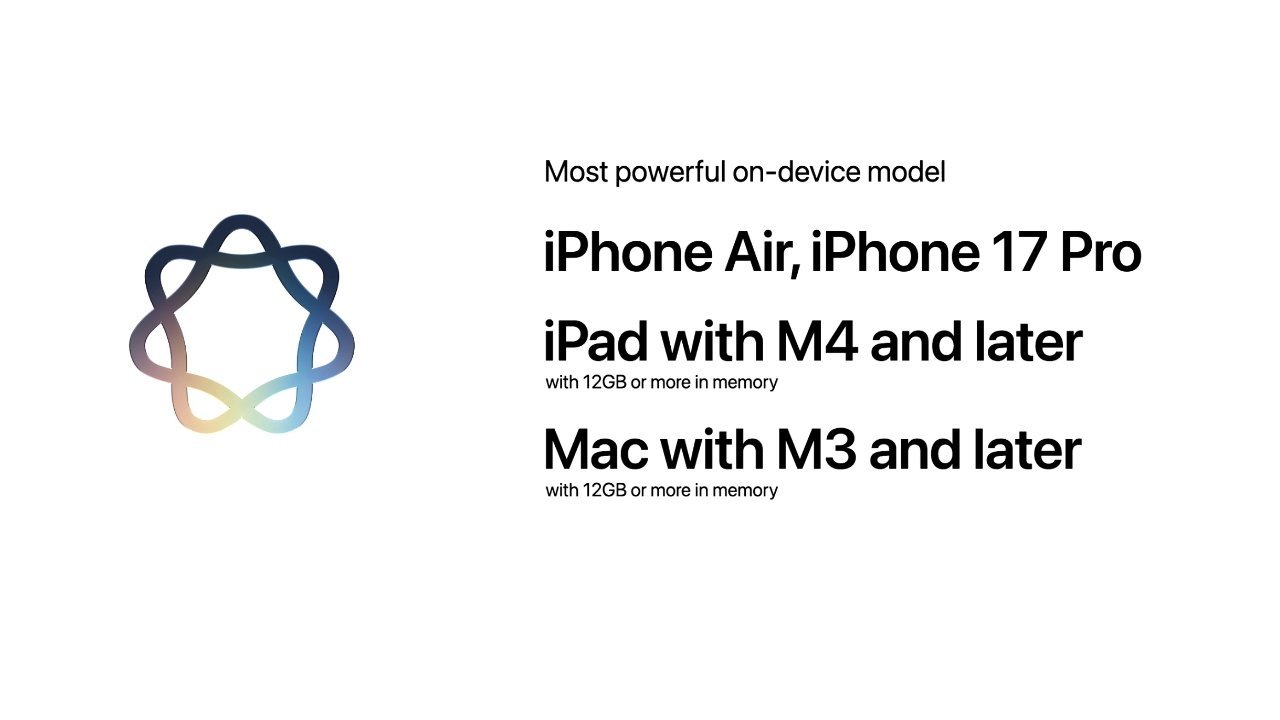
During WWDC, Apple said that the most powerful on-device models would be available only on specific iPhone and Mac models. That includes the iPhone Air and iPhone 17 Pro with 12GB of memory, the M4iPad also with 12GB of memory, and an M3 Mac with the same memory or better.
Apple says the most powerful on-device AI models will not be on all devices – image credit: Apple
While processing is a factor, memory is certainly going to be another. It’s not hard to imagine Apple using the PrismML tech to cut the size of that “most powerful on-device model” to fit into the smaller memory allowances of earlier models.
Extrapolating that further, maybe Apple could expand the availability of Apple Intelligence to older, lower-specification devices.
Sure, there are some tradeoffs, such as much slower processing of tasks. Owners of older hardware would probably be fine with that.
PrismML is a prime opportunity for Apple to take a massive leap when it comes to AI.
If it wants to dominate the field when it comes to on-device processing, it has a chance to take a very major step toward that goal.
Last week’s Sunday Reboot talked about the iPhone 17 Pro Max going into a time capsule for 250 years, and pondered if it will emerge in one piece.
Apple has continued to put the prices up for its online services, with iCloud+ rising in cost in a number of territories.
Over the course of a few days, Apple has been increasing the prices of its various online services. Not to be left behind, iCloud+ has now upped its prices to join the rest of the roster.
The change, revealed by Apple’s iCloud+ pricing support page, doesn’t outright say what countries are affected by the pricing. However, comparisons with previous pricing, including via the Wayback Machine, shows it affects eight countries in total.
The affected countries, seeing higher iCloud pricing, include:
Egypt
Indonesia
Japan
New Zealand
Nigeria
Philippines
Turkiye
Vietnam
The price increases vary between territories, but fall in the range of 17% to 30%. For example, the 50GB plan was 150 yen per month but is now 180 yen, up 20%.
Pricing in other markets, including the United States and United Kingdom, remains unchanged. The perks of iCloud+ also hasn’t changed, including Hide My Email, iCloud Private Relay, a custom email domain, and HomeKit Secure Video support.
While Apple hasn’t explained why the prices have changed, it is most likely the company periodically accounting for changes in currency conversion.
Apple stock ended trading on Friday as the world’s most valuable publicly traded company, overtaking Nvidia for the first time since April 2025 after a sustained recovery for the iPhone maker met a sharp selloff in chip stocks.
Apple shares closed at $333.74, leaving the company with a market capitalization of approximately $4.88 CAP trillion. Nvidia ended down about 3.5% on the day, with a value of about $4.86 trillion.
The distinction is largely symbolic, and a lead this narrow could disappear during the next trading session, if not in after-hours trading over the weekend. Still, Apple’s return to the top caps a striking reversal from the tariff, China, and artificial intelligence concerns that weighed on its shares the last time it held the position.
Apple took a difficult route back to the top
Apple entered the spring of 2025 facing doubts about whether its first Apple Intelligence rollout could drive meaningful upgrades. The company confirmed on March 7 that its more personalized Siri features were taking longer than expected.
Tariff fears added a more immediate financial threat. Apple shares lost about 15% during the first half of 2025 as investors considered the company’s reliance on Asian manufacturing.
At the time, Tim Cook warned that tariffs could add about $900 million in costs during the June quarter. It ultimately paid $800 million, but has filed for a refund of those, which Apple says will be used to expand US manufacturing.
Nvidia moved in the opposite direction. Surging demand for AI processors carried the chipmaker back to the top of the market in June 2025, past $4 trillion the following month, and briefly beyond $5 trillion in October.
Apple’s underlying business nevertheless began producing results that were difficult for Wall Street to dismiss. Revenue rose 10% to $94 billion during the June 2025 quarter, followed by an 8% increase to $102.5 billion during the September quarter.
Strong early demand for the iPhone 17 helped Apple reach a $4 trillion valuation in October. Services continued producing record revenue and substantially higher margins than the company’s hardware divisions.
Apple shares lost about 15% during the first half of 2025
Momentum accelerated during fiscal 2026. Apple reported an all-time record of $143.8 billion for the holiday period, up 16%, followed by a March-quarter record of $111.2 billion, up 17%.
The March quarter set records for total revenue, iPhone revenue, earnings per share, and Services. Greater China returned to strong growth despite earlier concerns over local competition and delayed Apple Intelligence features.
Wall Street changed how it views Apple’s AI strategy
Apple previewed Siri AI at WWDC in June, demonstrating the personal context, onscreen awareness, app control, and conversational features promised in 2024. The technology is due with the fall operating-system updates and is already available to beta testers.
The launch reinforced Apple’s strategy of adding AI to products and services without matching the massive infrastructure spending of Microsoft, Alphabet, Amazon, and Meta. As investors question those returns, Apple can leave much of the model and data-center expense to partners while distributing AI features across more than two billion active devices.
The March quarter set records for total revenue, iPhone revenue, earnings per share, and Services
Apple is also nearing its first CEO transition since 2011. Tim Cook will become executive chairman on September 1, with hardware engineering chief John Ternus succeeding him, but the planned handoff has done little to slow the stock’s rise.
Nvidia’s decline helped Apple finish the job
Apple didn’t retake the top position because of a single announcement or earnings report. Its valuation recovered over more than a year, while Nvidia’s decline on Friday erased enough market value to allow Apple to move ahead.
Nvidia’s role in the AI industry hasn’t diminished. Its processors remain central to the data-center expansion that pushed the company past Apple, and even a modest rebound could reverse their positions again.
Apple’s return instead suggests Wall Street no longer sees massive AI spending as the only credible path to growth.
After spending much of 2025 as the industry’s most conspicuous AI laggard, record iPhone sales, Services growth, a China recovery, and a tangible Siri roadmap have made Apple’s restraint look more like strategy than failure.



 The nice part is that you can test the actual workflow rather than a tiny demo. The