Posted on Leave a comment

Sealed Fedora Atomic Desktop bootable container images

I’m happy to announce that we have sealed bootable container images ready for testing for the Fedora Atomic Desktops!

What are sealed bootable container images?

Sealed bootable container images include all the components needed to create a fully verified boot chain, from the firmware to the operating system composefs image. This relies on Secure Boot and thus only supports system booting with UEFI on x86_64 & aarch64.

The components are:

  • systemd-boot as bootloader
  • a Unified Kernel Image (UKI) which includes the Linux kernel, an initrd and the kernel command line
  • a composefs repository with fs-verity enabled. This is managed by bootc.

Both systemd-boot and the UKI are signed for Secure Boot. The images are test images so the components are not signed with the official keys from Fedora.

The main direct benefit that we will get from this support is that we will be able to enable passwordless disk unlocking using the TPM in a way that will be reasonably secure by default.

How do I test those images?

See the instructions at github.com/travier/fedora-atomic-desktops-sealed on how to give the pre-built container and disk images a try and how to build your own.

We welcome testing and feedback! Please see the list of known issues and report new issue at github.com/travier/fedora-atomic-desktops-sealed. We’ll redirect them as needed to the right upstream projects.

Beware, those are testing images. The root account does not have a password set and sshd is enabled, by default, to make debugging easier. The UKI and systemd-boot are signed for Secure Boot but, since those are test images, they are not signed with the official keys from Fedora. Don’t use those images in production.

Where can I get more details about how this works?

If you want to know more about how sealed images work (i.e. how we make bootable containers, UKI and composefs work together to create a verified boot chain), see the following presentations and documentation:

Thanks to all the contributors that made this possible, notably (but non exhaustively) from the following projects: bootc & bcvk, composefs & composefs-rs, chunkah, podman & buildah and systemd.

Posted on Leave a comment

What’s New for Fedora Atomic Desktops in Fedora Linux 44

Fedora Linux 44 has been released! 🎉 So, let’s see what is included in this new release for the Fedora Atomic Desktop variants (Silverblue, Kinoite, Sway Atomic, Budgie Atomic and COSMIC Atomic).
Changes for all Atomic Desktops

Issue tracker moved to the new Fedora forge

We have moved the cross-variants issue tracker to the new Fedora forge. This is the best place to file issues that impacts all variants or to coordinate work between all of them. If you have issues specific to a given desktop environment then we usually prefer to track them in each respective SIG trackers. These are available on the README for the atomic-desktops organization.

Unified documentation, hosted on the new forge

The unified documentation for all Atomic Desktops is finally live! Unfortunately the translations have not been migrated so we will need help to re-translate everything again, once the translation setup is ready with the new forge. It should be mostly copy/paste from the previous docs and this time we will only have to translate the docs once and not for every (new) variant.

See the tracking issue atomic-desktops#10.

Removal of FUSE version 2 libraries

FUSE version 2 has been deprecated and unmaintained for a while so we have removed it from the images. In practice, this means two things:

  • If you are using AppImages, some of them may not work anymore.
  • If you are using legacy backends with Plasma Vault on Kinoite, you need to migrate your data.

See the Fedora Change and the tracking issue atomic-desktops#50. The implications are detailed below.

AppImages and the FUSE 2 libraries

Some AppImages are still using an old AppImage runtime that relies on FUSE 2 libraries being available on the host. See the Discussion thread for examples on how to check the runtime of an AppImage.

If some of your AppImages do not work on Fedora Atomic Desktops 44, we recommend:

  • Looking for a Flatpak for the application and giving it another try. Consider helping upstream package their application as a Flatpak.
  • Reporting the issue upstream so that they are aware that they should use a newer runtime. Consider helping upstream with this as well.

EncFS or CryFS backends for Plasma Vaults are removed

KDE upstream no longer recommends using the EncFS nor CryFS backends for Plasma Vaults, notably because they rely on the FUSE 2 libraries. If you are using one of those backends, you should migrate your data to a new vault using the only maintained backend (gocryptfs). Ideally this should occur before the update to Fedora Linux 44. If you have already updated to Fedora Linux 44 and need access to your data, you can layer the needed packages (cryfs or fuse-encfs) using rpm-ostree install <package>, then migrate your data and finally reset the layers with rpm-ostree reset.

Dropping compatibility for pkla Polkit rules

Support for the legacy pkla Polkit rules format has been removed. It is unlikely that you were relying on support for those rules as most of the ecosystem has moved on to the new JavaScript based format.

See the Fedora Change and the tracking issue atomic-desktops#102.

What’s New in Silverblue

GNOME 50

Fedora Silverblue comes with the latest GNOME 50 release. For more details about the changes that occur alongside GNOME 50, see What’s New in Fedora Workstation 44 on the Fedora Magazine.

What’s New in Kinoite

KDE Plasma 6.6

Fedora Kinoite ships with Plasma 6.6, Frameworks 6.24 and Gear 25.12.

See also What’s New in Fedora KDE Plasma Desktop 44 in the Fedora Magazine.

KDE Plasma Login Manager replaces SDDM

The brand new Plasma Login Manager replaces SDDM to provide a more integrated experience with systemd and the KDE Plasma session.

See the Fedora Change.

Unified out of the box experience with KDE Plasma Setup (OEM installation)

Thanks to the new Plasma Setup, it is now possible to install the system with Anaconda with minimal configuration and then complete the installation on the first boot by creating a new user and selecting the timezone. This is great when you want to install Fedora Kinoite on a computer and don’t want to setup a user in advance.

See the Fedora Change.

What’s New in Sway Atomic

Nothing specific for this release.

What’s New in Budgie Atomic

Fedora Budgie Atomic comes with the latest 10.10.2 Budgie release. This release brings Wayland support to Budgie Atomic. See the 10.10 release announcement for more details.

What’s New in COSMIC Atomic

Fedora COSMIC Atomic comes with the latest 1.0.8 release of the COSMIC desktop. This is now considered stable.

Universal Blue, Bluefin, Bazzite and Aurora

Our friends in the Universal Blue project (Bazzite, Bluefin, Aurora) have prepared the update to Fedora Linux 44. Look for upcoming announcements in their Discourse.

As always, I heavily recommend checking them out, especially if you feel like some things are missing from the Fedora Atomic Desktops and you depend on them (NVIDIA drivers, extra media codec, out of tree kernel drivers, etc.).

What’s Next

Helping us with a few nasty bugs

If you have an interest in contributing to Fedora Atomic Desktops, here are some bugs that we will have to fix in the short term. We would greatly appreciate help with:

  • Fixing root mount options (atomic-desktops#72): This is a long standing and mostly invisible bug that impacts performance.
  • Moving away from nss-altfiles (atomic-desktops#108): This is another long standing source of issues that new users regularly face.

Sealed Fedora Atomic Desktop bootable container images

Sealed images are now ready for testing! See the other article for all the details.

Road map to Bootable Containers

A lot of work is happening to make the transition to Bootable Containers as smooth as possible for our existing users. You can look at the road map for this transition at atomic-desktops#26.

One of the tasks is to move away from our unmaintained installation ISO building scripts to the new image-builder tooling. This is planned for Fedora Linux 45 for the ostree variants and support for Bootable Container will follow right after.

Another task is to start building the Fedora Atomic Desktops Bootable Container images using the Fedora Konflux instance.

Where to reach us

We are looking for contributors to help us make the Fedora Atomic Desktops the best experience for Fedora users.

Posted on Leave a comment

Customize Fedora Linux Workstation with Extension Manager

What are GNOME Shell extensions?

Imagine that Fedora Workstation is your desk, and GNOME Shell extensions are small accessories you add to make it feel more personal. It’s like placing a pencil case on the right side, a lamp that helps you focus, or a small cabinet to keep your things from getting scattered. It’s the same desk—GNOME stays clean and minimal—but a few additions can make your routine more comfortable.

Extensions work on the GNOME interface: the top panel, the way you open applications, how notifications appear, and small details that usually stay hidden. These simple changes can be enough to make your Fedora Workstation feel different. With just one extension, you can make Fedora feel more “you.”

But like any accessories, choose only what truly helps—don’t install everything. Too many extensions can clutter your desktop or make things feel unstable. The goal isn’t to chase excitement, but to find a few small add-ons that better fit the way you work in Fedora Workstation.

Why use Extension Manager?

Once you see extensions as small “accessories” for GNOME, a question comes up fast: how do you install them without the hassle? This is where Extension Manager helps.

Instead of opening many browser tabs, you can do everything in one place. You can browse extensions. You can search for what you need. You can also read a short description before installing. As a result, the whole process feels calmer and more familiar.

More importantly, Extension Manager makes it easier to experiment safely. For example, you can try one extension to make the top panel more useful. If it doesn’t feel right, you can simply turn it off. Or you can uninstall it in seconds. That way, you stay in control.

Also, you’re not “modding” your whole system. You’re only adding small features. And if you change your mind, you can always go back to GNOME’s clean default look.

In short, Extension Manager is like a small drawer on your desk. It keeps your extensions in one spot. So they’re easy to find, easy to try, and easy to tidy up again.

Install Extension Manager

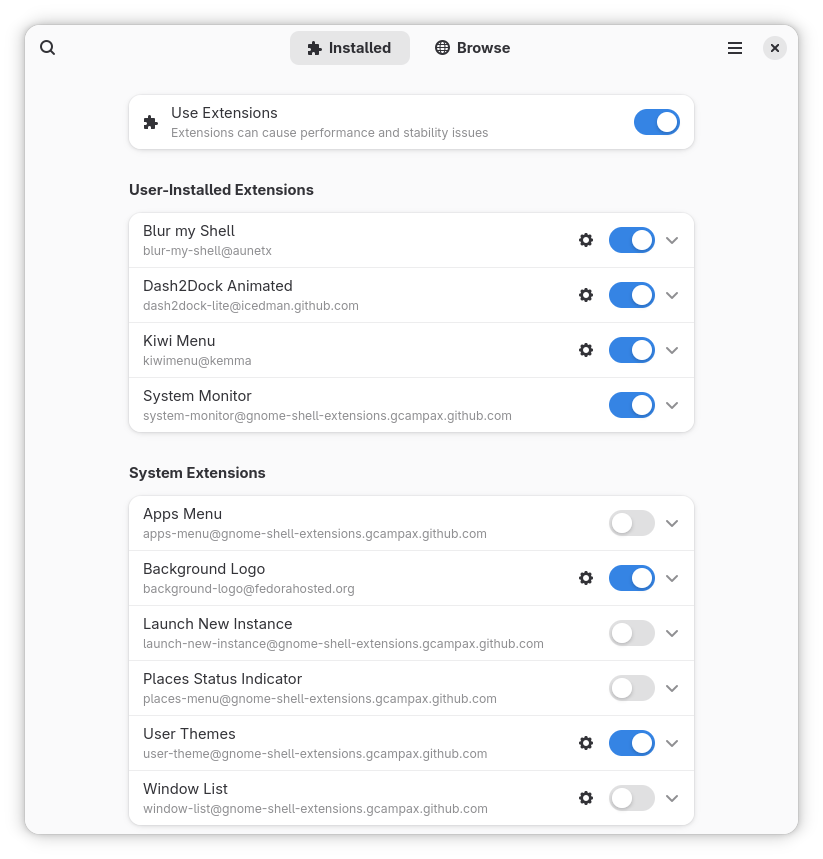
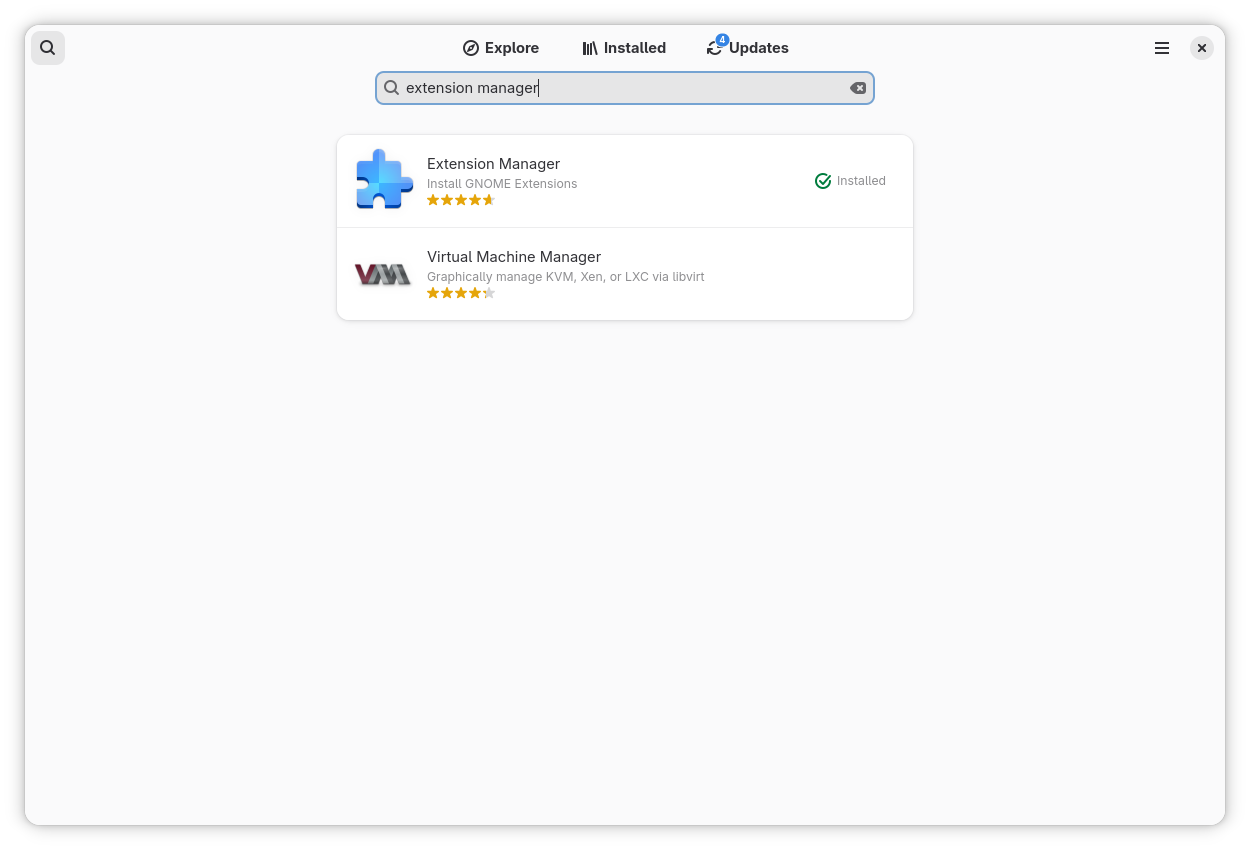
Let’s move to the easiest part: installing Extension Manager with just a few clicks. Open the Software app on Fedora Workstation, then search for Extension Manager using the search bar. Select the app and click Install. That’s it.

Once the installation is complete, open it from the app menu—look for Extension Manager. Now you’re ready to customize. Start slowly: try one extension first, then see if it fits your daily routine.

Find and Install an Extension

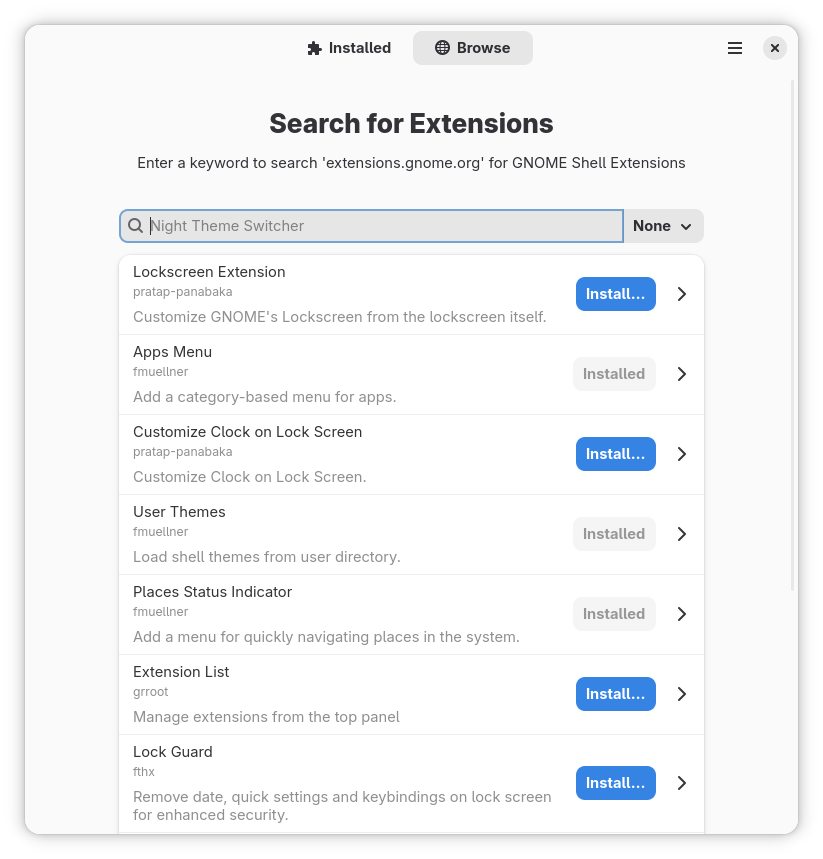
After you open Extension Manager, it can feel like opening an “accessories shop” for your Fedora Workstation. There are many options, from small tweaks to extensions that can change how you work.

Start with the search bar. Think about what you most often need in your day-to-day routine. For example, you might want quicker access to apps, tray icons for indicators, or a more informative top panel. When you find an extension that looks interesting, open its page for a moment. Read the short description, look at the screenshots, and then ask yourself whether it will really help your work flow.

If you’re sure, just click Install. In a few seconds, it will be installed, and you’ll notice the change right away. However, if it doesn’t feel right, don’t hesitate to uninstall it. At this stage, you’re simply trying things out—like picking the accessories that best fit your desk.

Enable/disable and adjust settings

After you install a few extensions, you don’t have to stick with all of them. Sometimes an extension is useful, but you don’t need it all the time. That’s the nice thing about Extension Manager: you can enable or disable extensions at any time, without any drama.

Think of it like accessories on your desk. Some days you need a desk lamp to help you focus. On other days, you want your desk to stay clean and simple. Extensions work the same way. You can turn one on when you need it, and turn it off when you’re done.

If an extension has options, you’ll usually see a Settings or Preferences button. From there, you can tweak small details to match your style—icon placement, button behaviour, panel appearance, and more. This is what makes extensions feel personal. You’re not just installing something and forgetting it; you’re shaping it around your workflow.

And if one day your Fedora starts to feel too crowded, don’t panic. Just open the list of installed extensions and disable the ones you don’t need. Take it slow. The best customization isn’t about how many extensions you have, but how well they fit your daily activities.

Keep it safe: a few practical tips

At this point, you might start thinking, “Wow, there are so many things I can change.” And that’s true. However, if you want Fedora Workstation to stay light and comfortable, there are a few simple habits worth keeping in mind.

First, install extensions the same way you choose tools: only when you truly need them. If you stop using an extension after a few days, it’s better to disable it or remove it. A comfortable desktop isn’t the most crowded one—it’s the one with fewer distractions.

Second, try extensions one by one. If you install many at once, it’s hard to tell which one causes a problem. On the other hand, if you take it slowly, you can quickly feel what fits and what doesn’t.

Finally, remember that GNOME keeps evolving. Sometimes after a major update, an extension may not be ready yet. If something feels odd after an update, the safest move is simple: open Extension Manager and disable the extension you suspect. Once things are back to normal, you can wait for an update or choose an alternative.

In the end, Extension Manager isn’t a ticket to customize without limits. It’s more like a clean toolbox. If you use it with care and focus on what you really need, customization can stay enjoyable—without losing the clean, stable feel of Fedora Workstation.

Wrapping up: share your favorite extensions

Now you know how to customize your Fedora Workstation with Extension Manager. You’ve learned how to install the app, try a few extensions, and adjust their settings. And here’s the fun part: everyone ends up with a different mix of extensions, because we all have different needs and work styles.

If you have a favorite extension, share it. Which one do you rely on most, and what do you use it for? Maybe it helps you stay focused during presentations. Or maybe it makes the top panel more informative, brings back tray icons, or simply speeds up your work flow. Tell us why you like it, so others can picture the benefit.

Who knows—your list might inspire someone else. And you might also discover a new extension that fits your daily routine even better.

Posted on Leave a comment

Contribute to Fedora 44 KDE and GNOME Test Days

test days

Fedora test days are events where anyone can help make certain that changes in Fedora Linux work well in an upcoming release. Fedora community members often participate, and the public is welcome at these events. If you’ve never contributed to Fedora before, this is a perfect way to get started.

There are two test periods occurring in the coming days:

  • Monday February 2 through February 9 is to test the KDE Plasma 6.6.
  • Wednesday February 11 through February 13 is to test GNOME 50 Desktop.

Come and test with us to make Fedora 44 even better. Read more below on how to do it.

KDE Plasma 6.6

Our Test Day focus on making KDE work better on all your devices. We are improving core features for both Desktop and Mobile, starting with Plasma Setup, a new and easy way to install the system. This update also introduces the Plasma Login Manager to startup experience feel smoother, along with Plasma Keyboard—a smart on-screen keyboard made for tablets and 2-in-1s so you can type easily without a physical keyboard.

GNOME 50 Desktop

Our next Test Day focuses on GNOME 50 in Fedora 44 Workstation. We will check the main desktop and the most important apps to make sure everything works well. We also want you to try out the new apps added in this version. Please explore the system and use it as you normally would for your daily work to see how it acts during real use.

What do I need to do?

  • Make sure you have a Fedora Account (FAS).
  • Download test materials in advance where applicable, which may include some large files.
  • Follow the steps on the wiki test page one by one.
  • Send us your results through the app.

KDE Plasma 6.6 Test Day begins February 2nd: https://fedoraproject.org/wiki/Test_Day:2026-02-02_KDE_Plasma_6.6

GNOME 50 Test Day begins February 11th: https://fedoraproject.org/wiki/Test_Day:2026-02-11_GNOME_50_Desktop

Thank you for taking part in the testing of Fedora Linux 44!

Posted on Leave a comment

Fedora Linux Flatpak cool apps to try for September

This article introduces projects available in Flathub with installation instructions.

Flathub is the place to get and distribute apps for all of Linux. It is powered by Flatpak, allowing Flathub apps to run on almost any Linux distribution.

Please read “Getting started with Flatpak“. In order to enable flathub as your flatpak provider, use the instructions on the flatpak site.

Flatseal

Flatseal is a graphical utility to review and modify permissions from your Flatpak applications. This is one of the most used apps in the flatpak world, it allows you to improve security on flatpak applications. However, it needs to be used with caution because you can make your permissions be too open.

It’s very simple to use: Simply launch Flatseal, select an application, and modify its permissions. Restart the application after making the changes. If anything goes wrong just press the reset button.

You can install “Flatseal” by clicking the install button on the web site or manually using this command:

flatpak install flathub com.github.tchx84.Flatseal

Also available as rpm on fedora’s repositories

Reco

Reco is an audio recording app that helps you recall and listen to things you listened to earlier.

Some of the features include:

  • Recording sounds from both your microphone and system at the same time.
  • Support formats like ALAC, FLAC, MP3, Ogg Vorbis, Opus, and WAV
  • Timed recording.
  • Autosaving or always-ask-where-to-save workflow.
  • Saving recording when the app quits.

I used it a lot to help me record interviews for the Fedora Podcast

You can install “Reco” by clicking the install button on the web site or manually using this command:

flatpak install flathub com.github.ryonakano.reco

Mini Text

Mini Text is a very small and minimalistic text viewer with minimal editing capabilities. It’s meant as a place to edit text to be pasted, it doesn’t have saving capabilities. It uses GTK4 and it’s interface integrates nicely with GNOME.

I found this to be very useful just to keep data that I want to paste anywhere, it doesn’t have unwanted and/or unneeded rich text capabilities, just plain text with minimal editing features.

You can install “Mini Text” by clicking the install button on the web site or manually using this command:

flatpak install flathub io.github.nokse22.minitext

Tagger

Tagger is a tag editor for those of us that still save the music locally.

Some of the features are:

  • Edit tags and album art of multiple files, even across subfolders, all at once
  • Support for multiple music file types (mp3, ogg, flac, wma, and wav)
  • Convert filenames to tags and tags to filenames with ease

You can install “Tagger” by clicking the install button on the web site or manually using this command:

flatpak install flathub org.nickvision.tagger
Posted on Leave a comment

Fedora Linux Flatpak cool apps to try for August

This article introduces projects available in Flathub with installation instructions.

Flathub is the place to get and distribute apps for all of Linux. It is powered by Flatpak, allowing Flathub apps to run on almost any Linux distribution.

Please read “Getting started with Flatpak“. In order to enable flathub as your flatpak provider, use the instructions on the flatpak site.

Authenticator

Authenticator is a simple app that allows you to generate Two-Factor authentication codes. It has a very simple and elegant interface with support for a a lot of algorithms and methods. Some of its features are:

  • Time-based/Counter-based/Steam methods support
  • SHA-1/SHA-256/SHA-512 algorithms support
  • QR code scanner using a camera or from a screenshot
  • Lock the application with a password
  • Backup/Restore from/into known applications like FreeOTP+, Aegis (encrypted / plain-text), andOTP, Google Authenticator

You can install “Authenticator” by clicking the install button on the site or manually using this command:

flatpak install flathub com.belmoussaoui.Authenticator

Secrets

Secrets is a password manager that integrates with GNOME. It’s easy to use and uses the KeyPass file format. Some of its features are:

  • Supported Encryption Algorithms:
    • AES 256-bit
    • Twofish 256-bit
    • ChaCha20 256-bit
  • Supported Derivation algorithms:
    • Argon2 KDBX4
    • Argon2id KDBX4
    • AES-KDF KDBX 3.1
  • Create or import KeePass safes
  • Add attachments to your encrypted database
  • Generate cryptographically strong passwords
  • Quickly search your favorite entries
  • Automatic database lock during inactivity
  • Support for two-factor authentication

You can install “Secrets” by clicking the install button on the site or manually using this command:

flatpak install flathub org.gnome.World.Secrets

Flatsweep

Flatsweep is a simple app to remove residual files after a flatpak is unistalled. It uses GTK4 and Libadwaita to provide a coherent user interface that integrates nicely with GNOME, but you can use it on any desktop environment.

You can install “Flatsweep” by clicking the install button on the site or manually using this command:

flatpak install flathub io.github.giantpinkrobots.flatsweep

Solanum

Solanum is a time tracking app that uses the pomodoro technique. It uses GTK4 and it’s interface integrates nicely with GNOME.

You can install “Solanum” by clicking the install button on the site or manually using this command:

flatpak install flathub org.gnome.Solanum
Posted on Leave a comment

How to rebase to Fedora Linux 38 on Silverblue

Fedora Silverblue is an operating system for your desktop built on Fedora Linux. It’s excellent for daily use, development, and container-based workflows. It offers numerous advantages such as being able to roll back in case of any problems. If you want to update or rebase to Fedora Linux 38 on your Fedora Silverblue system (these instructions are similar for Fedora Kinoite), this article tells you how. It not only shows you what to do, but also how to revert things if something unforeseen happens.

Update your existing system

Prior to actually doing the rebase to Fedora Linux 38, you should apply any pending updates. Enter the following in the terminal:

$ rpm-ostree update

or install updates through GNOME Software and reboot.

Rebasing using GNOME Software

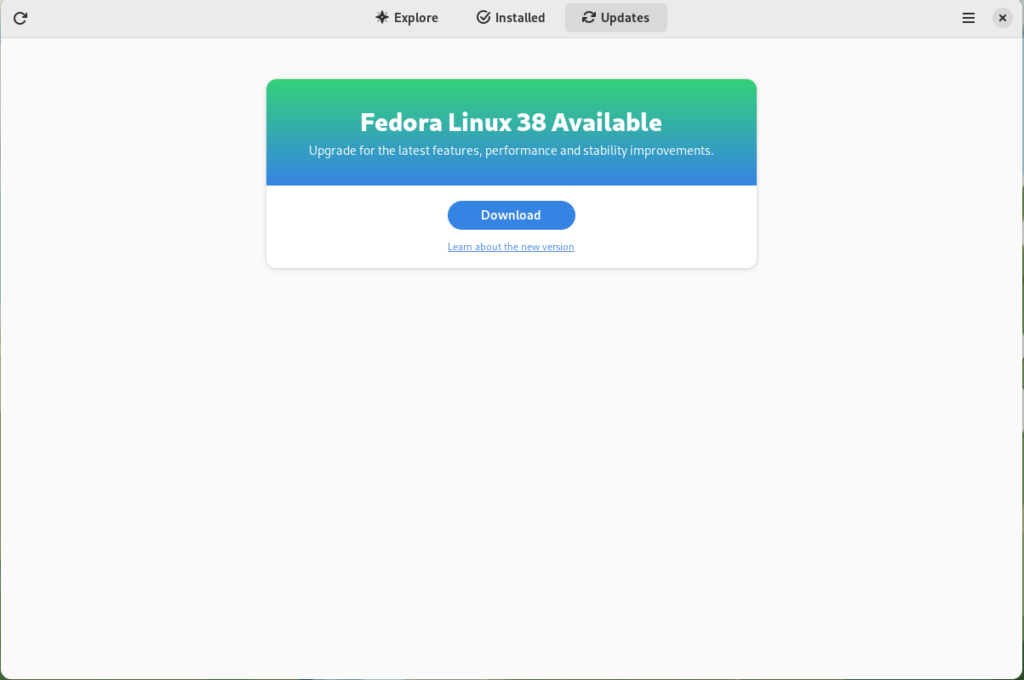
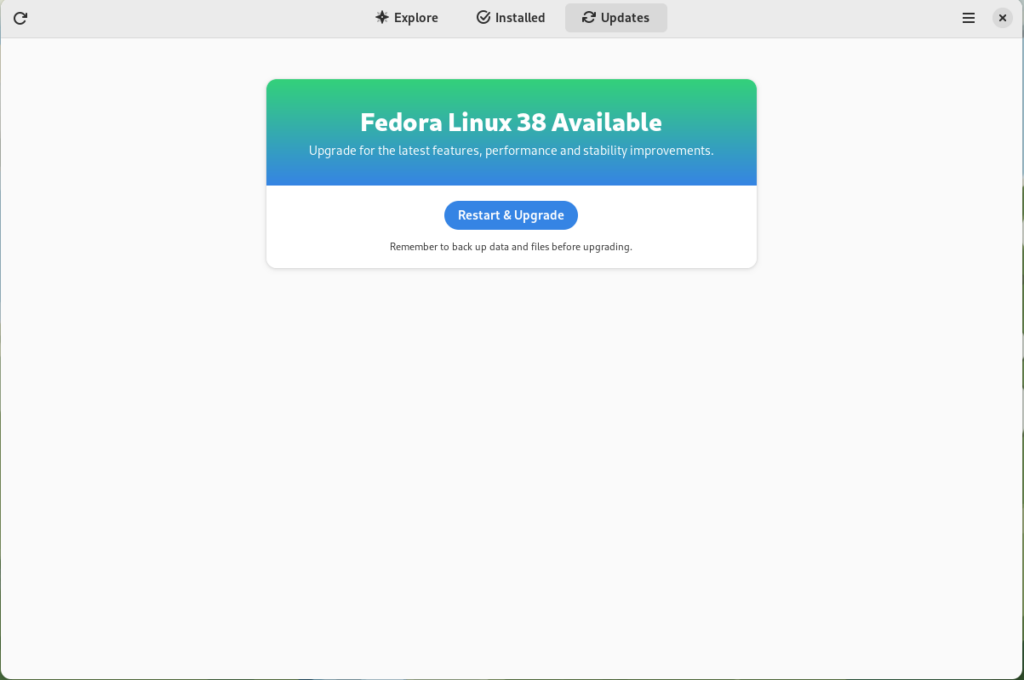
GNOME Software shows you that there is new version of Fedora Linux available on the Updates screen.

Fedora 38 update available

First thing you need to do is download the new image, so click on the Download button. This will take some time. When it’s done you will see that the update is ready to install.

Fedora 38 update ready to install

Click on the Restart & Upgrade button. This step will take only a few moments and the computer will be restarted when the update is completed. After the restart you will end up in new and shiny release of Fedora Linux 38. Easy, isn’t it?

Rebasing using terminal

If you prefer to do everything in a terminal, then this part of the guide is for you.

Rebasing to Fedora Linux 38 using the terminal is easy. First, check if the 38 branch is available:

$ ostree remote refs fedora

You should see the following in the output:

fedora:fedora/38/x86_64/silverblue

If you want to pin the current deployment (meaning that this deployment will stay as an option in GRUB until you remove it), you can do it by running:

# 0 is entry position in rpm-ostree status
$ sudo ostree admin pin 0

To remove the pinned deployment use the following command:

# 2 is entry position in rpm-ostree status
$ sudo ostree admin pin --unpin 2

Next, rebase your system to the Fedora Linux 38 branch.

$ rpm-ostree rebase fedora:fedora/38/x86_64/silverblue

Finally, the last thing to do is restart your computer and boot to Fedora Linux 38.

How to roll back

If anything bad happens—for instance, if you can’t boot to Fedora Linux 38 at all—it’s easy to go back. At boot time, pick the entry in the GRUB menu for the version prior to Fedora Linux 38 and your system will start in that previous version rather than Fedora Linux 38. If you don’t see the GRUB menu, try to press ESC during boot. To make the change to the previous version permanent, use the following command:

$ rpm-ostree rollback

That’s it. Now you know how to rebase Fedora Silverblue to Fedora Linux 38 and roll back. So why not do it today?

FAQ

Because there are similar questions in comments for each article about rebasing to newer version of Silverblue I will try to answer them in this section.

Question: Can I skip versions during rebase of Fedora? For example from Fedora 36 Silverblue to Fedora 38 Silverblue?

Answer: Although it could be sometimes possible to skip versions during rebase, it is not recommended. You should always update to one version above (37->38 for example) to avoid unnecessary errors.

Question: I have rpm-fusion layered and I got errors during rebase. How should I do the rebase?

Answer: If you have rpm-fusion layered on your Silverblue installation, you should do the following before rebase:

rpm-ostree update –uninstall rpmfusion-free-release –uninstall rpmfusion-nonfree-release –install rpmfusion-free-release –install rpmfusion-nonfree-release
Posted on Leave a comment

How to rebase to Fedora Linux 37 on Silverblue

Fedora Silverblue is an operating system for your desktop built on Fedora Linux. It’s excellent for daily use, development, and container-based workflows. It offers numerous advantages such as being able to roll back in case of any problems. If you want to update or rebase to Fedora Linux 37 on your Fedora Silverblue system (these instructions are similar for Fedora Kinoite), this article tells you how. It not only shows you what to do, but also how to revert things if something unforeseen happens.

Prior to actually doing the rebase to Fedora Linux 37, you should apply any pending updates. Enter the following in the terminal:

$ rpm-ostree update

or install updates through GNOME Software and reboot.

Rebasing using GNOME Software

GNOME Software shows you that there is new version of Fedora Linux available on the Updates screen.

Fedora 37 update available

First thing you need to do is download the new image, so click on the Download button. This will take some time. When it’s done you will see that the update is ready to install.

Fedora 37 update ready to install

Click on the Restart & Upgrade button. This step will take only a few moments and the computer will be restarted at the end. After restart you will end up in new and shiny release of Fedora Linux 37. Easy, isn’t it?

Rebasing using terminal

If you prefer to do everything in a terminal, then this part of the guide is for you.

Rebasing to Fedora Linux 37 using the terminal is easy. First, check if the 37 branch is available:

$ ostree remote refs fedora

You should see the following in the output:

fedora:fedora/37/x86_64/silverblue

If you want to pin the current deployment (this deployment will stay as option in GRUB until you remove it), you can do it by running:

# 0 is entry position in rpm-ostree status
$ sudo ostree admin pin 0

To remove the pinned deployment use the following command:

# 2 is entry position in rpm-ostree status
$ sudo ostree admin pin --unpin 2

where 2 is the position in the rpm-ostree status.

Next, rebase your system to the Fedora Linux 37 branch.

$ rpm-ostree rebase fedora:fedora/37/x86_64/silverblue

Finally, the last thing to do is restart your computer and boot to Fedora Linux 37.

How to roll back

If anything bad happens—for instance, if you can’t boot to Fedora Linux 37 at all—it’s easy to go back. Pick the previous entry in the GRUB menu at boot (if you don’t see it, try to press ESC during boot), and your system will start in its previous state before switching to Fedora Linux 37. To make this change permanent, use the following command:

$ rpm-ostree rollback

That’s it. Now you know how to rebase Fedora Silverblue to Fedora Linux 37 and roll back. So why not do it today?

Posted on Leave a comment

How to rebase to Fedora Linux 36 on Silverblue

Fedora Silverblue is an operating system for your desktop built on Fedora Linux. It’s excellent for daily use, development, and container-based workflows. It offers numerous advantages such as being able to roll back in case of any problems. If you want to update or rebase to Fedora Linux 36 on your Fedora Silverblue system (these instructions are similar for Fedora Kinoite), this article tells you how. It not only shows you what to do, but also how to revert things if something unforeseen happens.

Prior to actually doing the rebase to Fedora Linux 36, you should apply any pending updates. Enter the following in the terminal:

$ rpm-ostree update

or install updates through GNOME Software and reboot.

Rebasing using GNOME Software

GNOME Software shows you that there is new version of Fedora Linux available on the Updates screen.

Fedora 36 update available

First thing you need to do is download the new image, so click on the Download button. This will take some time. When it’s done you will see that the update is ready to install.

Fedora 36 update ready to install

Click on the Restart & Upgrade button. This step will take only a few moments and the computer will be restarted at the end. After restart you will end up in new and shiny release of Fedora Linux 36. Easy, isn’t it?

Rebasing using terminal

If you prefer to do everything in a terminal, then this part of the guide is for you.

Rebasing to Fedora Linux 36 using the terminal is easy. First, check if the 36 branch is available:

$ ostree remote refs fedora

You should see the following in the output:

fedora:fedora/36/x86_64/silverblue

If you want to pin the current deployment (this deployment will stay as option in GRUB until you remove it), you can do it by running:

$ sudo ostree admin pin 0

To remove the pinned deployment use the following command:

$ sudo ostree admin pin --unpin 2

where 2 is the position in the $rpm-ostree status

Next, rebase your system to the Fedora Linux 36 branch.

$ rpm-ostree rebase fedora:fedora/36/x86_64/silverblue

Finally, the last thing to do is restart your computer and boot to Fedora Linux 36.

How to roll back

If anything bad happens—for instance, if you can’t boot to Fedora Linux 36 at all—it’s easy to go back. Pick the previous entry in the GRUB menu at boot (if you don’t see it, try to press ESC during boot), and your system will start in its previous state before switching to Fedora Linux 36. To make this change permanent, use the following command:

$ rpm-ostree rollback

That’s it. Now you know how to rebase Fedora Silverblue to Fedora Linux 36 and roll back. So why not do it today?

Posted on Leave a comment

An introduction to USB Device Emulation and how to take advantage of it

Introduction

Nowadays, the number of devices is getting bigger and bigger, and modern operating systems must try to support all types and several of them with every integration, with every release. Maintaining a large number of devices is difficult, expensive and also hard to test, specially for plug-and-play devices, like USB devices.

Therefore, it is necessary to create a mechanism to facilitate the maintenance and testing of old and new USB devices. And this is where USB device emulation comes in. In that way, a complete framework including a big bunch of emulated and validated USB devices will allow easier integration and release. The area of application would be very wide: earlier bug search/detection even during development, automatic tests, continuous integration, etc.

How to emulate USB devices

USB/IP project allows sharing the USB devices connected to a local machine so that they can be managed by another machine connected to the network by means of a TCP/IP connection.

Then USB/IP project consists of two parts:

  • local device support (host) to allow remote access to every necessary control events and data
  • remote control that catches every necessary control event and data to process like a normal driver

The procedure is valid for Linux and Windows, here I will focus only on Linux.

The idea behind emulation is to replace the remote device support with an application that behaves in the same way. In this way we can emulate devices with software applications that follow the commented USB/IP protocol specification.

In the following points I will describe how to configure and run the remote support and how to connect to our USB emulated device.

Remote support

Remote support is divided in two parts:

  • kernel space to control a remote device as it was local, that is, to be probed by the normal driver.
  • user space application to configure access to remote devices.

At this point, it is important to remark that the device emulators, after configuration by user space application, will communicate directly with the kernel space.

Local support has a very similar structure, but the focus of this article is device emulation.

Let’s analyze every part of remote support.

Kernel space

First of all, in order to get the functionality we need to compile the Linux Kernel with the following options:

CONFIG_USBIP_CORE=m
CONFIG_USBIP_VHCI_HCD=m

These options enable the USB/IP virtual host controller driver, which is run on the remote machine.

Normal USB drivers need to be also included because they will be probed and configured in the same way from virtual host controller drivers.

Besides there are other important configuration options:

CONFIG_USBIP_VHCI_HC_PORTS=8
CONFIG_USBIP_VHCI_NR_HCS=1

These options define the number of ports per USB/IP virtual host controller and the number of USB/IP virtual host controllers as if adding physical host controllers. These are the default values if CONFIG_USBIP_VHCI_HCD is enabled, increase if necessary.

The commented options and kernel modules are already included in some Linux distributions like Fedora Linux.

Let’s see an example of available virtual USB buses and ports that we will use later.

Default and real resources in example equipment:

$ lsusb 
Bus 002 Device 001: ID 1d6b:0003 Linux Foundation 3.0 root hub
Bus 001 Device 002: ID 0627:0001 Adomax Technology Co., Ltd
Bus 001 Device 001: ID 1d6b:0002 Linux Foundation 2.0 root hub
$ lsusb -t
/: Bus 02.Port 1: Dev 1, Class=root_hub, Driver=xhci_hcd/15p, 5000M
/: Bus 01.Port 1: Dev 1, Class=root_hub, Driver=xhci_hcd/15p, 480M
|__ Port 1: Dev 2, If 0, Class=Human Interface Device, Driver=usbhid, 480M
$

Now, we will load the module vhci-hcd into the system (default configuration for CONFIG_USBIP_VHCI_HC_PORTS and CONFIG_USBIP_VHCI_NR_HCS):

$ sudo modprobe vhci-hcd 
$ lsusb
Bus 004 Device 001: ID 1d6b:0003 Linux Foundation 3.0 root hub
Bus 003 Device 001: ID 1d6b:0002 Linux Foundation 2.0 root hub
Bus 002 Device 001: ID 1d6b:0003 Linux Foundation 3.0 root hub
Bus 001 Device 002: ID 0627:0001 Adomax Technology Co., Ltd
Bus 001 Device 001: ID 1d6b:0002 Linux Foundation 2.0 root hub
$ lsusb -t
/: Bus 04.Port 1: Dev 1, Class=root_hub, Driver=vhci_hcd/8p, 5000M
/: Bus 03.Port 1: Dev 1, Class=root_hub, Driver=vhci_hcd/8p, 480M
/: Bus 02.Port 1: Dev 1, Class=root_hub, Driver=xhci_hcd/15p, 5000M
/: Bus 01.Port 1: Dev 1, Class=root_hub, Driver=xhci_hcd/15p, 480M
|__ Port 1: Dev 2, If 0, Class=Human Interface Device, Driver=usbhid, 480M
$

The remote USB/IP virtual host controller driver will only use the configured virtualized resources. Of course, emulated devices will work in the same way.

User space

The other necessary part in the USB/IP project is the user space tool usbip and needs to be used to configure the referred kernel space on both sides, although, in the same way, we only focus on the remote side, since the local side will be represented by the emulator.

That is, usbip tool will configure the USB/IP virtual controller (tcp client) in kernel space to connect to the device emulator (tcp server) in order to establish a direct connection between them for USB configuration, events, data, etc. exchange.

The tool is independent of the type of device and is able to provide information about available and reserved resources (see more information in the examples below).

The local USB/IP virtual host controller needs to specify the pair bus-port that will used for remote access, it will be the same for emulated devices, but in this case, this pair can be anything because there is no real device and resource reservation is not necessary.

This tool is found on the Linux Kernel repository in order to be totally synchronized with it.

Location of the tool on the Linux Kernel repository: ./tools/usb/usbip

In some distribution like Fedora Linux, the usbip utility can be installed by means of usbip package from repositories. If usbip utility or related package can not be found, follow the instruction in the available README file to compile and install. Suitable rpm package can also be generated from the usbip-emulator repository:

$ git clone https://github.com/jtornosm/USBIP-Virtual-USB-Device.git $ cd USBIP-Virtual-USB-Device/usbip $ make rpm ...
$

How to emulate USB devices

Emulators are generated in Python and C. I have started with C development (I will focus on this part), but the same could be done in Python.

For C development, compile emulation tools from the usbip-emulator repository:

$ git clone https://github.com/jtornosm/USBIP-Virtual-USB-Device.git $ cd USBIP-Virtual-USB-Device/c $ make ...
$

All the supported devices emulated at this moment will be generated:

  • hid-keyboard
  • hid-mouse
  • cdc-adm
  • hso
  • cdc-ether
  • bt

rpm package (usbip-emulator) can be also generated with:

$ make rpm ...
$

As examples, Vendor and Product IDs are hardcoded in the code.

Following three examples to show how emulation works. We are using the same equipment for the emulator and remote USB/IP but they could run in different equipment. Besides, we are reserving different resources so all the devices could be emulated at the same time.

Example 1: hso

From one terminal, let’s emulate the hso device:

(“1-1” is the pair bus-port for the USB device on the local machine, as we are emulating, it could be anything. It is only important because usbip tool will have to use the same name to request the emulated device)

$ hso -p 3241 -b 1-1 hso started.... server usbip tcp port: 3241 Bus-Port: 3-0:1.0 ...

From another terminal, connect to the emulator:

(localhost because emulator is running in the same equipment and the same name for pair bus-port as the emulator)

$ sudo modprobe vhci-hcd 
$ sudo usbip --tcp-port 3241 attach -r 127.0.0.1 -b 1-1
usbip: info: using port 3241 ("3241")
$

Now we can check that the new device is present:

(As we saw previously, for this example machine, bus 3 is virtualized)

$ ip addr show dev hso
0 3: hso0: <POINTOPOINT,MULTICAST,NOARP> mtu 1486 qdisc noop state DOWN group default qlen 10 link/none $ rfkill list 0: hso-0: Wireless WAN Soft blocked: no Hard blocked: no ...
$ lsusb ... Bus 003 Device 002: ID 0af0:6711 Option GlobeTrotter Express 7.2 v2 ... $ lsusb -t ...
/: Bus 03.Port 1: Dev 1, Class=root_hub, Driver=vhci_hcd/8p, 480M |__ Port 1: Dev 2, If 0, Class=Vendor Specific Class, Driver=hso, 12M ...
$

In order to release resources:

$ sudo usbip port 
Imported USB devices
====================
Port 00: <Port in Use> at Full Speed(12Mbps)
Option : GlobeTrotter Express 7.2 v2 (0af0:6711)
3-1 -> usbip://127.0.0.1:3241/1-1
-> remote bus/dev 001/002
$ sudo usbip detach -p 00
usbip: info: Port 0 is now detached!
$

And we can check that the device is released:

$ ip addr show dev hso0 Device "hso0" does not exist. $ rfkill list ...
$ lsusb ... $

After this, we can emulate again or stop the emulated device from the first terminal (i.e. with Ctrl-C).

Example 2: cdc-ether

From one terminal, let’s emulate the cdc-ether device (root permission is required because raw socket needs to bind to specified interface for data plane):

(“1-1” is the pair bus-port for the USB device on the local machine, as we are emulating, it could be anything. It is only important because usbip tool will have to use the same name to request the emulated device)

$ sudo cdc-ether -e 88:00:66:99:5b:aa -i enp1s0 -p 3242 -b 1-1 cdc-ether started.... server usbip tcp port: 3242 Bus-Port: 1-1 Ethernet address: 88:00:66:99:5b:aa Manufacturer: Temium Network interface to bind: enp1s0 ...

From another terminal connect to the emulator:

(localhost because emulator is running in the same equipment and the same name for pair bus-port as the emulator)

$ sudo modprobe vhci-hcd 
$ sudo usbip --tcp-port 3242 attach -r 127.0.0.1 -b 1-1
usbip: info: using port 3242 ("3242")
$

Now we can check that the new device is present:

(As we saw previously, for this example machine, bus 3 is virtualized)

$ ip addr show dev eth0 4: eth0: <BROADCAST,MULTICAST,UP,LOWER_UP> mtu 1500 qdisc fq_codel state UNKNOWN group default qlen 1000 link/ether 88:00:66:99:5b:aa brd ff:ff:ff:ff:ff:ff $ sudo ethtool eth0 ...
Link detected: yes $ lsusb ... Bus 003 Device 003: ID 0fe6:9900 ICS Advent ... $ lsusb -t ...
/: Bus 03.Port 1: Dev 1, Class=root_hub, Driver=vhci_hcd/8p, 480M |__ Port 2: Dev 3, If 0, Class=Communications, Driver=cdc_ether, 480M |__ Port 2: Dev 3, If 1, Class=CDC Data, Driver=cdc_ether, 480M ...
$

For this example, we can also test the data plane.

(IP forwarding is disabled in both sides)

First, we can configure the IP address in the emulated device:

$ sudo ip addr add 10.0.0.1/24 dev eth0 
$ ip addr show dev eth0
4: eth0: <BROADCAST,MULTICAST,UP,LOWER_UP> mtu 1500 qdisc fq_codel state UNKNOWN group default qlen 1000
link/ether 88:00:66:99:5b:aa brd ff:ff:ff:ff:ff:ff
inet 10.0.0.1/24 scope global eth0
valid_lft forever preferred_lft forever
$

Second, for example, from other directly Ethernet connected machine (real or virtual) we can configure a macvlan interface in the same subnet to send/receive traffic (ping, iperf, etc.):

$ sudo ip link add macvlan0 link enp1s0 type macvlan mode bridge $ sudo ip addr add 10.0.0.2/24 dev macvlan0 $ sudo ip link set macvlan0 up $ ip addr show dev macvlan0 3: macvlan0@enp1s0: <BROADCAST,MULTICAST,UP,LOWER_UP> mtu 1500 qdisc noqueue state UP group default qlen 1000 link/ether d6:f1:cd:f1:cc:02 brd ff:ff:ff:ff:ff:ff inet 10.0.0.2/24 scope global macvlan0 valid_lft forever preferred_lft forever inet6 fe80::d4f1:cdff:fef1:cc02/64 scope link valid_lft forever preferred_lft forever $ ping 10.0.0.1 PING 10.0.0.1 (10.0.0.1) 56(84) bytes of data. 64 bytes from 10.0.0.1: icmp_seq=1 ttl=64 time=55.6 ms 64 bytes from 10.0.0.1: icmp_seq=2 ttl=64 time=2.19 ms 64 bytes from 10.0.0.1: icmp_seq=3 ttl=64 time=1.74 ms 64 bytes from 10.0.0.1: icmp_seq=4 ttl=64 time=1.76 ms 64 bytes from 10.0.0.1: icmp_seq=5 ttl=64 time=1.93 ms 64 bytes from 10.0.0.1: icmp_seq=6 ttl=64 time=1.65 ms ...

In order to release resources:

$ sudo usbip port Imported USB devices ==================== ...
Port 01: <Port in Use> at High Speed(480Mbps) ICS Advent : unknown product (0fe6:9900) 3-2 -> usbip://127.0.0.1:3245/1-1 -> remote bus/dev 001/003 $ sudo usbip detach -p 01 usbip: info: Port 1 is now detached! $

And we can check that the device is released:

$ ip addr show dev eth0 
Device "eth0" does not exist.
$ lsusb
...
$

And of course, traffic from the other machine is not working:

From 10.0.0.2 icmp_seq=167 Destination Host Unreachable From 10.0.0.2 icmp_seq=168 Destination Host Unreachable From 10.0.0.2 icmp_seq=169 Destination Host Unreachable From 10.0.0.2 icmp_seq=170 Destination Host Unreachable ...

After this, we can emulate again or stop the emulated device from the first terminal (i.e. with Ctrl-C).

Example 3: bt

From one terminal, let’s emulate the Bluetooth device:

(“1-1” is the pair bus-port for the USB device on the local machine, as we are emulating, it could be anything. It is only important because usbip tool will have to use the same name to request the emulated device)

$ bt -a aa:bb:cc:dd:ee:11 -p 3243 -b 1-1 bt started.... server usbip tcp port: 3243 Bus-Port: 1-1 BD address: aa:bb:cc:dd:ee:11 Manufacturer: Trust ...

From another terminal connect to the emulator:

(localhost because emulator is running in the same equipment and the same name for pair bus-port as the emulator)

$ sudo modprobe vhci-hcd 
$ sudo usbip --tcp-port 3243 attach -r 127.0.0.1 -b 1-1
usbip: info: using port 3243 ("3243")
$

Now we can check that the new device is present:

(As we saw previously, for this example machine, bus 3 is virtualized)

$ hciconfig -a hci0: Type: Primary Bus: USB BD Address: AA:BB:CC:DD:EE:11 ACL MTU: 310:10 SCO MTU: 64:8 UP RUNNING PSCAN ISCAN INQUIRY RX bytes:1451 acl:0 sco:0 events:80 errors:0 TX bytes:1115 acl:0 sco:0 commands:73 errors:0 Features: 0xff 0xff 0x8f 0xfe 0xdb 0xff 0x5b 0x87 Packet type: DM1 DM3 DM5 DH1 DH3 DH5 HV1 HV2 HV3 Link policy: RSWITCH HOLD SNIFF PARK Link mode: SLAVE ACCEPT Name: 'BT USB TEST - CSR8510 A10' Class: 0x000000 Service Classes: Unspecified Device Class: Miscellaneous, HCI Version: 4.0 (0x6) Revision: 0x22bb LMP Version: 3.0 (0x5) Subversion: 0x22bb Manufacturer: Cambridge Silicon Radio (10) $ rfkill list ...
1: hci0: Bluetooth Soft blocked: no Hard blocked: no $ lsusb ...
Bus 003 Device 004: ID 0a12:0001 Cambridge Silicon Radio, Ltd Bluetooth Dongle (HCI mode) ...
$ lsusb -t ...
/: Bus 03.Port 1: Dev 1, Class=root_hub, Driver=vhci_hcd/8p, 480M |__ Port 3: Dev 4, If 0, Class=Wireless, Driver=btusb, 12M |__ Port 3: Dev 4, If 1, Class=Wireless, Driver=btusb, 12M ...
$

And we can turn off and turn on the emulated Bluetooth device, detecting several fake Bluetooth devices:

(At this moment, fake Bluetooth devices are not emulated/simulated so we can not set up)

Turn Bluetooth off
Turn Bluetooth on

In order to release resources:

$ sudo usbip port Imported USB devices ==================== ...
Port 02: <Port in Use> at Full Speed(12Mbps) Cambridge Silicon Radio, Ltd : Bluetooth Dongle (HCI mode) (0a12:0001) 3-3 -> usbip://127.0.0.1:3243/1-1 -> remote bus/dev 001/002 $ sudo usbip detach -p 02 usbip: info: Port 2 is now detached! $

And we can check that the device is released:

$ hciconfig $ rfkill list ...
$ lsusb ... $

And of course, device is not detected (as before emulation):

Bluetooth is not found

After this, we can emulate again or stop the emulated device from the first terminal (i.e. with Ctrl-C).

Emulated vs real USB devices

When the real hardware and/or final device is not used to test, we can always feel insecure about the results, and this is the biggest hurdle that we will have to overcome to check the correct operation of the devices by means of emulation.

So, in order to be confident, emulation must be as close as possible to the real hardware and in order to get the most real emulation every aspect of the device must be covered (or at least the necessary ones if they are not related with other aspects). In fact, for a correct test, we must not modify the driver, that is, we must only emulate the physical layer, so that the driver is not able to know if the device is real or emulated.

Starting to test with the real hardware device is a very good idea to get a reference to build the emulator with the same features. For the case of USB devices, the device emulator building is easier because of the existing procedure to get remote control that complies with all the characteristics mentioned above.

Conclusion

USB device emulation is the best way to integrate and test the related features in an efficient, automatic and easy way. But, in order to be confident about the emulation procedure, device emulators need to be previously validated to confirm that they work in the same way as real hardware.

Of course, the USB device emulator is not the same as the real hardware device, but the commented method, thanks to the tested procedure to get remote control of the device, it’s very close to the real scenario and can help a lot to improve our release and testing processes.

Finally, I would like to comment that one of the best advantages of using software emulators is that we will be able to cause specific behaviors, in a simple way, that would be very difficult to reproduce with real hardware, and this could help to find issues and be more robust.