In this guide, I’ve compiled the top 7 freelancing niches I found highly profitable based on my experience working as a business owner and freelancer myself, hiring hundreds of freelance developers for my company, and teaching thousands of freelancing students through our books and courses.
Each niche is presented with a video where I show you how to make money in this particular niche. This guide is not meant to be watched from the first to the last video.
Instead, feel free to check out the table of contents and choose the niche video that interests you most:
Niche 1: Dashboard Apps
$30 to $185 per Hour Creating Dashboard Apps on Upwork
Niche 2: Tableau
$100/h+ Tableau Freelancers on Upwork
Tableau Revisited – Data Viz Gigs That Pay $400
Niche 3 – Streamlit
Bar Charts — Learning Streamlit with Bar Charts
Niche 4 – Cryptolancer
A Quick Cryptolancer Market Overview on Upwork
This Crypto Gig on Upwork Shows How to Scale as a Freelance Coder
Niche 5 – Financial Python
Financial Python Coders: $70 to $125 per Hour on Upwork
$400/day as a trading bot developer on Upwork
Niche 6 – Solidity and Smart Contracts
10 Solidity Freelancers Making $60/h on Upwork
Smart Contract Developers Make $120,000 per Year on Upwork
This Niche Continues to Make $100/h for Freelance Devs on Upwork
Niche 7 – General Python
$70/h as a Python Coder on Upwork
10 Python Freelancers on Upwork Making $60/h and More … to Len
Niche 8 – Data Science
Simple Data Science Freelancer on Upwork ($60/h)
Becoming a NumPy & Pandas Data Science Freelancer on Upwork
When to Start Freelancing? $5/hr to $250/hr as a DATA SCIENTIST on Upwork
$85 per Hour as an Upwork Data Scientist to Crunch Customer Data
Niche 9 – Spark and Graph Analytics
Freelance Apache Spark Developer
Niche – GraphX (Spark) Freelancer on Upwork
Neo4j and GraphDB freelance coders make $65/h on Upwork
Niche 10 – Writing Technical and Crypto Content
WWW: Writing Web3 Whitepapers as a Cryptolancer
Upwork for Introverts – Writing Crypto Whitepapers for $100+ per Hour
Niche 11 – Machine Learning
$70/h as a TensorFlow Deep Learning Engineer on Upwork
Are TensorFlow and OpenCV still Six-Figure Opportunities on Upwork?
From Keras to $65/h+ on Upwork
Niche 12 – Web3
The Web3 Transformation on Upwork
Niche 13 – Web Developer
Monetizing Your JavaScript Skills for $80/h on Upwork as a Top-Rated Freelance Developer
$120/h on Upwork as a Backend Web Developer
Niche 14 – Creating Decentralized Apps (dApps)
Can dApp Developer make $100/h on Upwork?
Niche 15 – Web Scraping
How Rüdiger Makes $157/h as a Web Scraping Expert on Upwork!
$200/h Web Scraping LinkedIn as a Pro [Upwork Gig]
Where to Go From Here?
Enough theory. Let’s get some practice!
Coders get paid six figures and more because they can solve problems more effectively using machine intelligence and automation.
To become more successful in coding, solve more real problems for real people. That’s how you polish the skills you really need in practice. After all, what’s the use of learning theory that nobody ever needs?
You build high-value coding skills by working on practical coding projects!
Do you want to stop learning with toy projects and focus on practical code projects that earn you money and solve real problems for people?
If your answer is YES!, consider becoming a Python freelance developer! It’s the best way of approaching the task of improving your Python skills—even if you are a complete beginner.
If you just want to learn about the freelancing opportunity, feel free to watch my free webinar “How to Build Your High-Income Skill Python” and learn how I grew my coding business online and how you can, too—from the comfort of your own home.
Problem Formulation: Given a float number. How to round the float down in Python?
Here are some examples of what you want to accomplish:
42.52 --> 42
21.99999 --> 22
-0.1 --> -1
-2 --> -2
Solution: If you have little time, here’s the most straightforward answer:
To round a positive or negative number x down in Python, apply integer division// to x and divide by 1. Specifically, the expression x//1 will first perform normal float division and then throw away the remainder—effectively “rounding x down”.
In general, there are multiple ways to round a float number x down in Python:
Vanilla Python: The expression x//1 will first perform normal division and then skip the remainder—effectively “rounding x down”.
Round down: The math.floor(x) function rounds number x down to the next full integer.
Round down (float representation): Alternatively, numpy.floor(x) rounds down and returns a float representation of the next full integer (e.g., 2.0 instead of 2).
Round up: The math.ceil(x) function rounds number x up to the next full integer.
Round up and down: The Python built-in round(x) function rounds x up and down to the closest full integer.
Let’s dive into each of those and more options in the remaining article. I guarantee you’ll get out of it having learned at least a few new Python tricks in the process!
Method 1: Integer Division (x//1)
The most straightforward way to round a positive or negative number x down in Python is to use integer division// by 1. The expression x//1 will first perform normal division and then skip the remainder—effectively “rounding x down”.
For example:
42.52//1 == 42
21.99//1 == 21
-0.1//1 == -1
-2//1 == -2
This trick works for positive and negative numbers—beautiful isn’t it?
Info: The double-backslash // operator performs integer division and the single-backslash / operator performs float division. An example for integer division is 40//11 = 3. An example for float division is 40/11 = 3.6363636363636362.
Feel free to watch the following video for some repetition or learning:
Method 2: math.floor()
To round a number down in Python, import the math library with import math, and call math.floor(number).
The function returns the floor of the specified number that is defined as the largest integer less than or equal to number.
Note: The math.floor() function correctly rounds down floats to the next-smaller full integer for positive and negative integers.
Here’s a code example that rounds our five numbers down to the next-smaller full integer:
Both math.floor() and np.floor() round down to the next full integer. The difference between math.floor() and np.floor() is that the former returns an integer and the latter returns a float value.
Method 4: int(x)
Use the int(x) function to round a positive number x>0 down to the next integer. For example, int(42.99) rounds 42.99 down to the answer 42.
Here’s an example for positive numbers where int() will round down:
print(int(42.52))
# 42 print(int(21.99999))
# 21
However, if the number is negative, the function int() will round up! Here’s an example for negative numbers:
print(int(-0.1))
# 0 print(int(-2))
# -2
Before I show you how to overcome this limitation for negative numbers, feel free to watch my explainer video on this function here:
Method 5: int(x) – bool(x%1)
You can also use the following vanilla Python snippet to round a number x down to the next full integer:
If x is positive, round down by calling int(x).
If x is negative, round up by calling int(x) - bool(x%1).
Explanation: Any non-zero expression passed into the bool() function will yield True which is represented by integer 1.
The modulo expression x%1 returns the decimal part of x.
If it is non-zero, we subtract bool(x%1) == 1, i.e., we round down.
If it is zero (for whole numbers), we subtract bool(x%1) == 0, i.e., we’re already done.
Here’s what this looks like in a simple Python function:
Alternatively, you can use the following slight variation of the function definition:
def round_down(x): if x<0: return int(x) - int(x)!=x return int(x)
Method 6: round()
This method is probably not exactly what you want because it rounds a number up and down, depending on whether the number is closer to the smaller or larger next full integer. However, I’ll still mention it for comprehensibility.
Python’s built-in round() function takes two input arguments:
a number and
an optional precision in decimal digits.
It rounds the number to the given precision and returns the result. The return value has the same type as the input number—or integer if the precision argument is omitted.
Per default, the precision is set to 0 digits, so round(3.14) results in 3.
Here are three examples using the round() function—that show that it doesn’t exactly solve our problem.
Again, we have a video on the round() function — feel free to watch for maximum learning!
Python One-Liners Book: Master the Single Line First!
Python programmers will improve their computer science skills with these useful one-liners.
Python One-Linerswill teach you how to read and write “one-liners”: concise statements of useful functionality packed into a single line of code. You’ll learn how to systematically unpack and understand any line of Python code, and write eloquent, powerfully compressed Python like an expert.
The book’s five chapters cover (1) tips and tricks, (2) regular expressions, (3) machine learning, (4) core data science topics, and (5) useful algorithms.
Detailed explanations of one-liners introduce key computer science concepts and boost your coding and analytical skills. You’ll learn about advanced Python features such as list comprehension, slicing, lambda functions, regular expressions, map and reduce functions, and slice assignments.
You’ll also learn how to:
Leverage data structures to solve real-world problems, like using Boolean indexing to find cities with above-average pollution
Use NumPy basics such as array, shape, axis, type, broadcasting, advanced indexing, slicing, sorting, searching, aggregating, and statistics
Calculate basic statistics of multidimensional data arrays and the K-Means algorithms for unsupervised learning
Create more advanced regular expressions using grouping and named groups, negative lookaheads, escaped characters, whitespaces, character sets (and negative characters sets), and greedy/nongreedy operators
Understand a wide range of computer science topics, including anagrams, palindromes, supersets, permutations, factorials, prime numbers, Fibonacci numbers, obfuscation, searching, and algorithmic sorting
By the end of the book, you’ll know how to write Python at its most refined, and create concise, beautiful pieces of “Python art” in merely a single line.
In this article, you’ll learn how to create a Dictionary from two (2) Lists in Python.
To make it more fun, we have the following running scenario:
Biogenix, a Lab Supplies company, needs to determine the best element from the Periodic Table for producing a new product. They have two (2) lists. The Element Name, the other Atomic Mass. They would prefer this in a Dictionary format.
For simplicity, this article uses 10 of the 118 elements in the Periodic Table.
Question: How would we create a Dictionary from two (2) Lists?
We can accomplish this task by one of the following options:
Lines [1-2] create two (2) lists containing the Element Name (el_name) and corresponding Atomic Mass (el_atom), respectively.
Line [3] merges the two (2) lists using zip() and converts them into an iterable object. The results save to merge_lists.
Line [4] converts merge_lists into a Dictionary (dict()). The results save to new_dict as key:value pairs.
Line [5] instantiates a For loop to return the key:value pairs from new_dict.
Each iteration outputs the key:value pair in a column format to the terminal.
Code (snippet)
Meitnerium
277.154
Darmstadtium
282.166
Roentgenium
282.169
Copernicium
286.179
Nihonium
286.182
Method 2: Use Dictionary Comprehension
This method uses Dictionary Comprehension to merge two (2) lists into an iterable object and convert it into a Dictionary as key:value pairs. A great one-liner!
el_name = ['Meitnerium', 'Darmstadtium', 'Roentgenium', 'Copernicium', 'Nihonium', 'Flerovium', 'Moscovium', 'Livermorium', 'Tennessine', 'Oganesson']
el_atom = [277.154, 282.166, 282.169, 286.179, 286.182, 290.192, 290.196, 293.205, 294.211, 295.216]
new_dict = {el_name[i]: el_atom[i] for i in range(len(el_name))} for k, v in new_dict.items(): print ("{:<20} {:<15}".format(k, v))
Lines [1-2] create two (2) lists containing the Element Name (el_name) and the corresponding Atomic Mass (el_atom), respectively.
Line [3] merges the lists as key:value pairs and converts them into a Dictionary. The results save to new_dict.
Line [4] instantiates a For loop to return the key:value pairs from new_dict.
Each iteration outputs the key:value pair in a column format to the terminal.
Code (snippet)
Meitnerium
277.154
Darmstadtium
282.166
Roentgenium
282.169
Copernicium
286.179
Nihonium
286.182
Method 3: Use Generator Expression with zip() and dict()
This method uses a Generator Expression to merge two (2) lists into an iterable object (zip()) and convert it into a Dictionary (dict()) as key:value pairs.
el_name = ['Meitnerium', 'Darmstadtium', 'Roentgenium', 'Copernicium', 'Nihonium', 'Flerovium', 'Moscovium', 'Livermorium', 'Tennessine', 'Oganesson']
el_atom = [277.154, 282.166, 282.169, 286.179, 286.182, 290.192, 290.196, 293.205, 294.211, 295.216]
gen_exp = dict(((k, v) for k, v in zip(el_name, el_atom))) for k, v in new_dict.items(): print ("{:<20} {:<15}".format(k, v))
Lines [1-2] create two (2) lists containing the Element Name (el_name) and the corresponding Atomic Mass (el_atom) respectively.
Line [3] uses a Generator Expression to merge the lists (zip()) and create an iterable object. The object converts into a Dictionary (dict()) and saves back to gen_exp.
Line [5] instantiates a For loop to return the key:value pairs from new_dict.
Each iteration outputs the key:value pair in a column format to the terminal.
Code (snippet)
Meitnerium
277.154
Darmstadtium
282.166
Roentgenium
282.169
Copernicium
286.179
Nihonium
286.182
Method 4: Use a Lambda
This method uses a Lambda to merge two (2) lists into an iterable object (zip()) and convert it into a Dictionary (dict()) as key:value pairs.
el_name = ['Meitnerium', 'Darmstadtium', 'Roentgenium', 'Copernicium', 'Nihonium', 'Flerovium', 'Moscovium', 'Livermorium', 'Tennessine', 'Oganesson']
el_atom = [277.154, 282.166, 282.169, 286.179, 286.182, 290.192, 290.196, 293.205, 294.211, 295.216]
new_dict = dict((lambda n, a: {name: el_atom for name, el_atom in zip(n, a)})(el_name, el_atom)) for k, v in new_dict.items(): print ("{:<20} {:<15}".format(k, v))
Lines [1-2] create two (2) lists containing the Element Name (el_name) and the corresponding Atomic Mass (el_atom) respectively.
Line [3] uses a lambda to merge the lists (zip()) and create an iterable object. The results save to a Dictionary new_dict as key:value pairs.
Line [4] instantiates a For loop to return the key:value pairs from new_dict.
Each iteration outputs the key:value pair in a column format to the terminal.
Code (snippet)
Meitnerium
277.154
Darmstadtium
282.166
Roentgenium
282.169
Copernicium
286.179
Nihonium
286.182
Summary
After reviewing the above methods, we decide that Method 2 is best suited: minimal overhead and no additional functions required.
In this article, you’ll learn how to read an XML file and format the output in Python.
To make it more fun, we have the following running scenario:
Arman, a Music Appreciation student at the Royal Conservatory of Music, has been given course materials in an XML file format. Arman needs to purchase these books immediately. He’s into music, not computers. He needs you to format the output into a readable format.
Navigate to the Appendix Data section and download the XML file to follow along. Then, move this file to the current working directory.
Question: How would we read in ax XML file and format the output?
We can accomplish this task by one of the following options:
Before any data manipulation can occur, two (2) new libraries will require installation.
The Pandaslibrary enables access to/from a DataFrame.
The Beautiful Soup library enables the parsing of XML and HTML files.
To install these libraries, navigate to an IDE terminal. At the command prompt ($), execute the code below. For the terminal used in this example, the command prompt is a dollar sign ($). Your terminal prompt may be different.
$ pip install pandas
Hit the <Enter> key on the keyboard to start the installation process.
$ pip install bs4
Hit the <Enter> key on the keyboard to start the installation process.
If the installations were successful, a message displays in the terminal indicating the same.
Feel free to view the PyCharm installation guide for the required libraries.
The ElementTree library is built-in to Python and contains functions to read and parse XML and XML-like data structures. The hierarchical data format is based on a tree structure: a root representing the tree and elements representing the nodes.
all_books = ET.parse('books.xml').getroot() for b in all_books.findall('book'): print ("{:<20} {:<30} {:<30}".format(b.find('isbn').text, b.find('title').text, b.find('price').text))
The books.xml file is read in and parsed using the eTree parse() function. The results are saved to all_books.
Next, a For loop is instantiated. It traverses through each book in all_books.
Each book’s details are formatted into columns and output to the terminal.
Output (snippet)
978-0393050714
Johann Sebastian Bach
$5.99
978-1721260522
Ludwig van Beethoven
$9.99
978-0679745822
Johannes Brahms
$7.99
979-8653086533
Frederic Chopin
$7.99
978-1580469036
Claude Debussy
$13.99
Method 3: Use minidom
Minidom is a smaller version of DOM and comes with an API similar to other programming languages. However, feedback indicates this method is slow and a memory hogger.
with open("books.xml",'r') as fp: data = fp.read() i = 0
all_books = xml.dom.minidom.parseString(data)
for book in all_books.getElementsByTagName('book'): isbn = all_books.getElementsByTagName('isbn')[i].firstChild.nodeValue title = all_books.getElementsByTagName('title')[i].firstChild.nodeValue price = all_books.getElementsByTagName('price')[i].firstChild.nodeValue print ("{:<20} {:<25} {:<20}".format(isbn, title, price)) i +=1
The books.xml file is opened, and a file object, fp is created.
The contents of this file are read in and saved to data.
A counter variable i is created to loop through all_books and is assigned the value 0.
Then data is read and parsed. The results save to all_books.
A For loop is instantiated. It traverses through each book in all_books.
Four (4) variables are used to locate and save the appropriate values.
They are formatted and output to the terminal in columns.
The counter variable is increased by one (1).
Output (snippet)
978-0393050714
Johann Sebastian Bach
$5.99
978-1721260522
Ludwig van Beethoven
$9.99
978-0679745822
Johannes Brahms
$7.99
979-8653086533
Frederic Chopin
$7.99
978-1580469036
Claude Debussy
$13.99
Method 4: Use Pandas read_xml()
The Pandas library has an option to read in an XML file and convert it to a DataFrame in one easy step.
df = pd.read_xml('books.xml')
print(df)
The books.xml file is read in and saved to the DataFrame df.
The output automatically formats into columns (including a header row) and is output to the terminal.
Before we learn about the money, let’s get this question out of the way:
What Is a Front-end Web Developer?
A web developer is a programmer who specializes in the development of websites or applications viewed on web browsers, mobile devices, and large desktop screens that are transported over private or public networks such as the Internet.
A front-end web developer focuses on the graphical user interface (GUI) of the website using HTML, CSS, and JavaScript with the goal of setting up the whole technology stack to enable users to view and interact with the website.
This video nicely explains some of the most important technologies and skills you need as a front-end web developer:
Who Do Front-end Web Developers Work For?
Front-end web developers either work independently as freelancers or as employees for companies, government organizations, or non-profits.
Lately, many front-end web developers have started to work for decentralized autonomous organizations (DAOs) in the crypto ecosystem due to their expertise in native web technologies and philosophies.
In fact, you don’t need to have significant crypto skills as a front-end web3 developer because almost all decentralized projects (including Ethereum) only focus on decentralized back-end development whereas the front-ends run on a centralized infrastructure!
That’s why decentralized web3 apps still require front-end skills such as HTML, CSS, and JavaScript.
Now that you know about what it is, let’s have a look at what it earns next!
Annual Income
How much does a Web Developer make per year?
The average annual income of a Front-end Web Developer in the United States is between $61,194 and $119,224 with an average income of $89,683 and a median income of $90,499 per year according to our meta-study of 8 aggregated data sources such as Glassdoor and Indeed.
The following graphic shows the individual data sources, as well as the average and median income level of a web developer in the US:
Figure: Average Income of a Front-End Web Developer in the US by Source. [1]
Interestingly, there is no statistically significant difference in both the median and the average income of a front-end web developer versus a general web developer.
Front-end web developers make on average $89,683 (median: $90,499) per year whereas web developers make $88,054 (median: $90,000) per year.
This is not surprising because all front-end web developers are web developers and most web developers are also front-end web developers.
Here’s the income of a general web developer for comparison:
Figure: Average Income of a Web Developer in the US by Source.
If you need the raw data for the income of a front-end web developer in the US, this is it:
If you decide to go the route as a freelance Front-end Web Developer, you can expect to make between $30 and $70 per hour on Upwork (source). Assuming an annual workload of 2000 hours, you can expect to make between $60,000 and $140,000 per year.
Note: Do you want to create your own thriving coding business online? Feel free to check out our freelance developer course — the world’s #1 best-selling freelance developer course that specifically shows you how to succeed on Upwork and Fiverr!
As in any market, if there is high demand for a resource with low supply, prices of this resource tend to increase. That’s why it can be a super lucrative decision to become a freelance frontend web developer in the 2020s and 2030s and beyond.
Learning Path, Skills, and Education Requirements
Do you want to become a Front-end Web Developer?
Here’s a step-by-step learning path I’d propose to get started with the most crucial front-end web developments tools:
But don’t wait too long to acquire practical experience!
Even if you have few skills, it’s best to get started as a freelance developer and learn as you work on real projects for clients — earning income as you learn and gaining motivation through real-world feedback.
Tip: An excellent start to turbo-charge your freelancing career (earning more in less time) is our Finxter Freelancer Course. The goal of the course is to pay for itself!
Crypto + Front-end Web Developer Videos
You can find more job descriptions for coders, programmers, and computer scientists in our detailed overview guide:
A web developer creates the core functionality of a website whereas a web designer is a graphic artist responsible for designing the layout, usability, and visual appearance of a website. A successful web designer often has outstanding skills in creativity, graphic design, and technical understanding.
The average income of a web developer in the US is $88,054 per year.
The average income of a web designer in the US is $60,000 per year.
web developer vs front-end developer
A web developer creates the core functionality of a website whereas a front-end developer is concerned with the functionality of the user interface on the browser. Compared to a web designer, a front-end developer is more concerned with the functionality and user experience (e.g., implementing buttons and user inputs functionality rather than designing them).
The average income of a web developer in the US is $88,054 per year.
The average income of a front-end developer in the US is $89,683 per year.
web developer vs software developer (programmer, software engineer)
A web developer specializes in web applications such as websites, e-commerce, and mobile apps, whereas a software developer (engineer) specializes in creating software for the underlying operating system, network, or platform.
All web developers are software developers but not all software developers are web developers!
The average income of a web developer in the US is $88,054 per year.
The average income of a software developer in the US is $110,140 per year.
web developer vs ux designer
Web developers focus more on the technicalities of running and scaling a web application to Internet-scale whereas UX designers focus on the engineering of the user experience which often involves a deep understanding of the users’ needs and psychological motivations when using the website or web app.
The average income of a web developer in the US is $88,054 per year.
The average income of a UX designer in the US is $90,000 per year.
web developer vs data analyst
Web developers create websites and web apps for companies whereas data scientists (data analysts) draw insights from structured and unstructured data using a multitude of tools such as machine learning, visualization, and statistical analysis.
The average income of a web developer in the US is $88,054 per year.
The average income of a data scientist in the US is $122,700 per year.
Related Income of Professional Developers
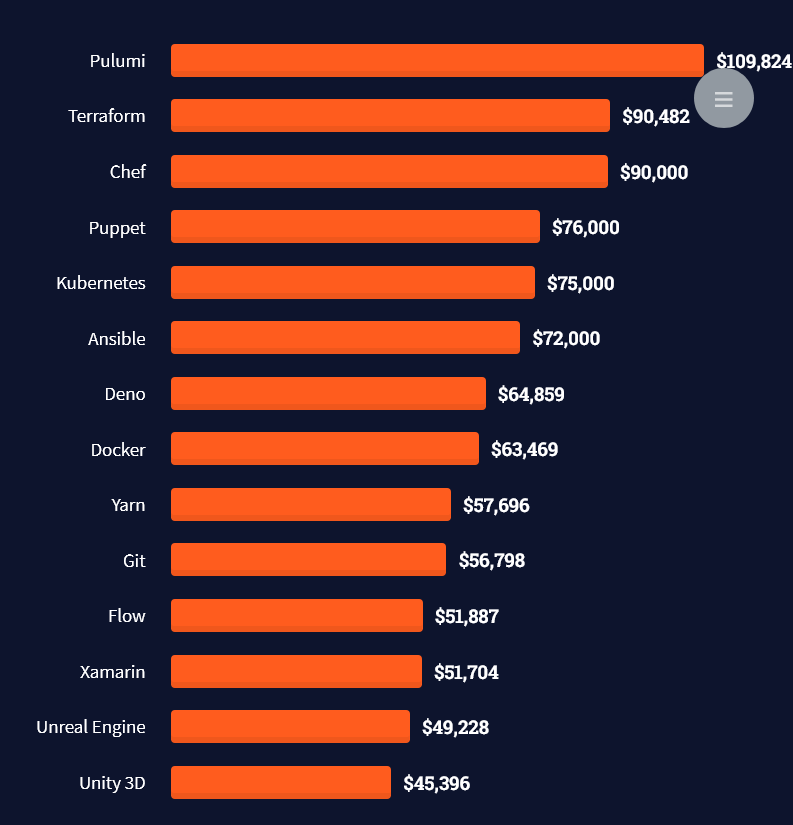
The following statistic shows the self-reported income from 9,649 US-based professional developers (source).
The average annual income of professional developers in the US is between $70,000 and $177,500 for various programming languages.
Question: What is your current total compensation (salary, bonuses, and perks, before taxes and deductions)? Please enter a whole number in the box below, without any punctuation. If you are paid hourly, please estimate an equivalent weekly, monthly, or yearly salary. (source)
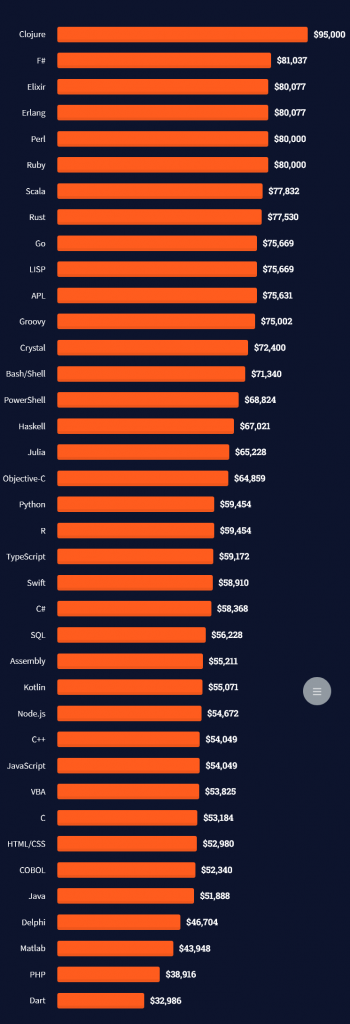
The following statistic compares the self-reported income from 46,693 professional programmers as conducted by StackOverflow.
The average annual income of professional developers worldwide (US and non-US) is between $33,000 and $95,000 for various programming languages.
Here’s a screenshot of a more detailed overview of each programming language considered in the report:
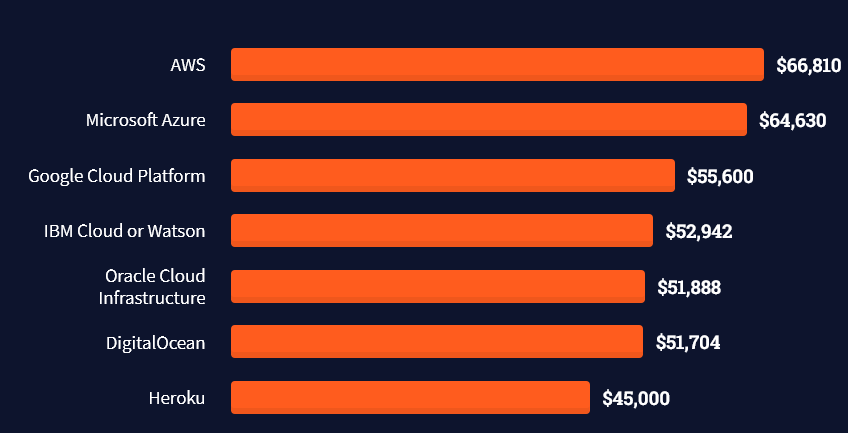
Here’s what different database professionals earn:
Here’s an overview of different cloud solutions experts:
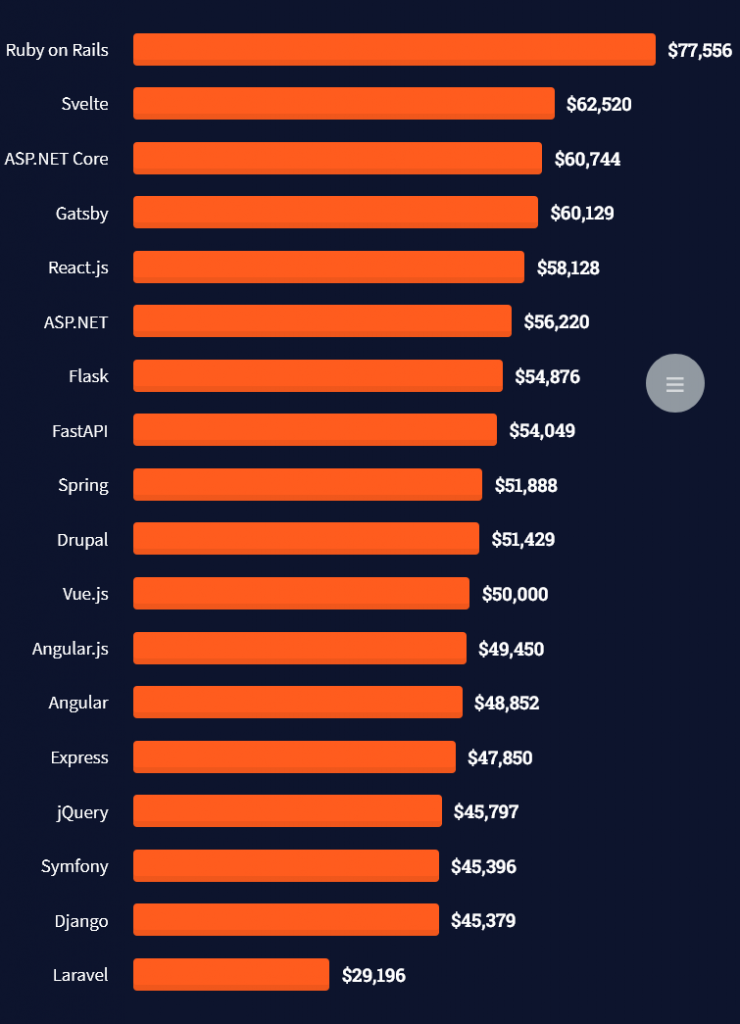
Here’s what professionals in web frameworks earn:
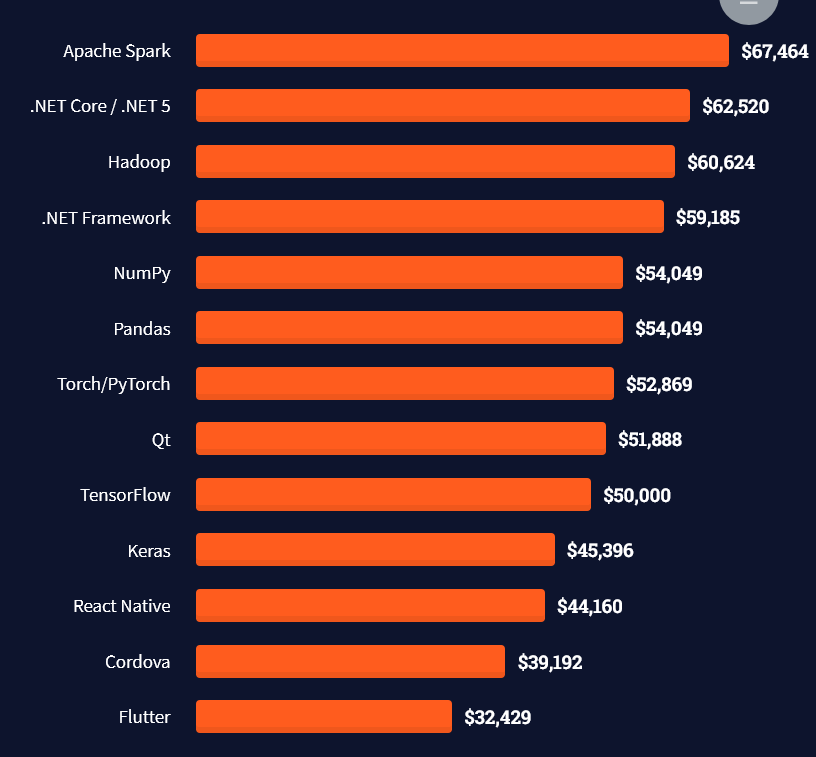
There are many other interesting frameworks—that pay well!
Look at those tools:
Okay, but what do you need to do to get there? What are the skill requirements and qualifications to make you become a professional developer in the area you desire?
Let’s find out next!
General Qualifications of Professionals
StackOverflow performs an annual survey asking professionals, coders, developers, researchers, and engineers various questions about their background and job satisfaction on their website.
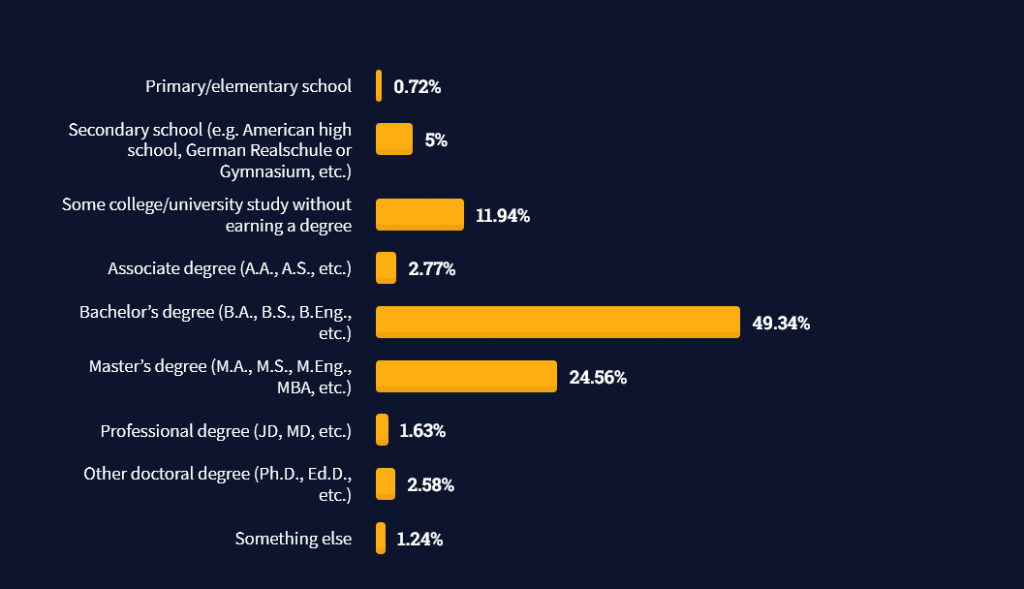
Interestingly, when aggregating the data of the developers’ educational background, a good three quarters have an academic background.
Here’s the question asked by StackOverflow (source):
Which of the following best describes the highest level of formal education that you’ve completed?
However, if you don’t have a formal degree, don’t fear! Many of the respondents with degrees don’t have a degree in their field—so it may not be of much value for their coding careers anyways.
Also, about one out of four don’t have a formal degree and still succeeds in their field! You certainly don’t need a degree if you’re committed to your own success!
Freelancing vs Employment Status
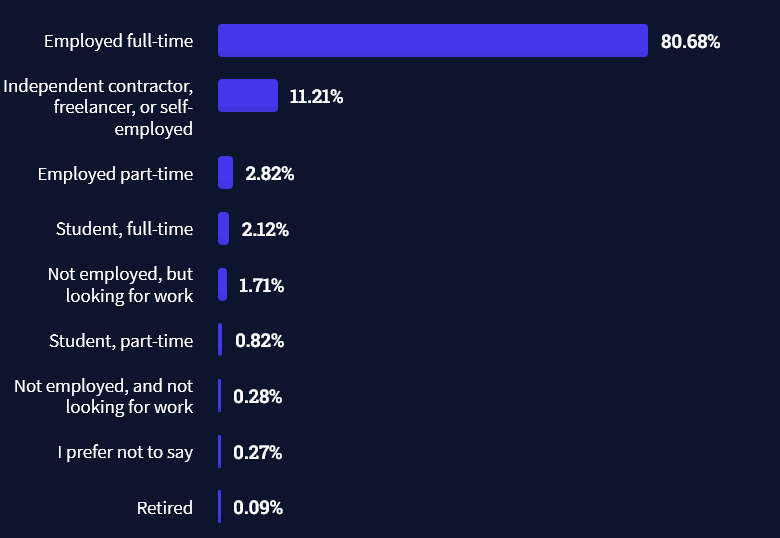
The percentage of freelance developers increases steadily. The fraction of freelance developers has already reached 11.21%!
This indicates that more and more work will be done in a more flexible work environment—and fewer and fewer companies and clients want to hire inflexible talent.
Here are the stats from the StackOverflow developer survey (source):
Do you want to become a professional freelance developer and earn some money on the side or as your primary source of income?
Resource: Check out our freelance developer course—it’s the best freelance developer course in the world with the highest student success rate in the industry!
Other Programming Languages Used by Professional Developers
The StackOverflow developer survey collected 58000 responses about the following question (source):
Which programming, scripting, and markup languages have you done extensive development work in over the past year, and which do you want to work in over the next year?
These are the languages you want to focus on when starting out as a coder:
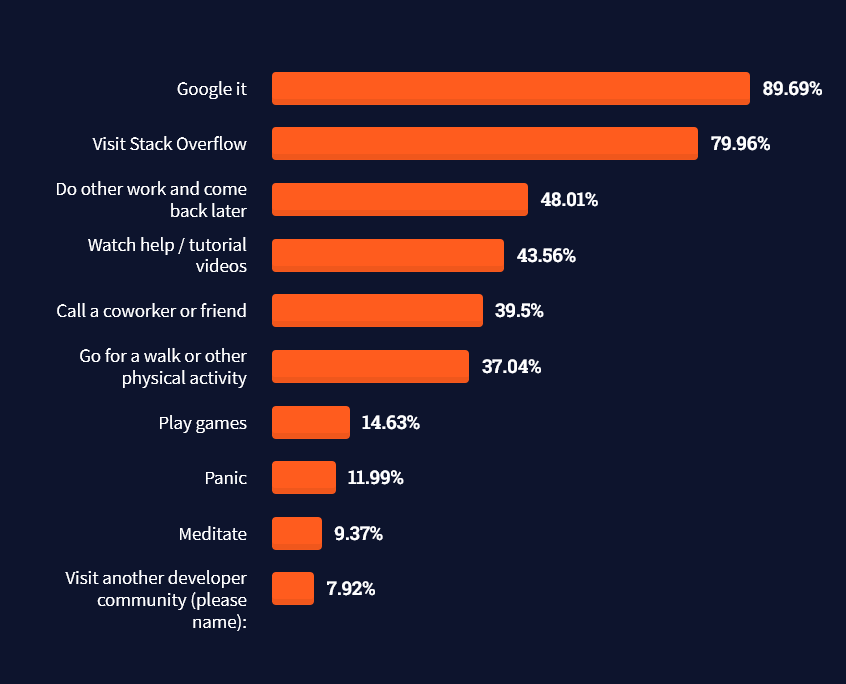
And don’t worry—if you feel stuck or struggle with a nasty bug. We all go through it. Here’s what SO survey respondents and professional developers do when they’re stuck:
What do you do when you get stuck on a problem? Select all that apply. (source)
Related Tutorials
To get started with some of the fundamentals and industry concepts, feel free to check out these articles:
Coders get paid six figures and more because they can solve problems more effectively using machine intelligence and automation.
To become more successful in coding, solve more real problems for real people. That’s how you polish the skills you really need in practice. After all, what’s the use of learning theory that nobody ever needs?
You build high-value coding skills by working on practical coding projects!
Do you want to stop learning with toy projects and focus on practical code projects that earn you money and solve real problems for people?
If your answer is YES!, consider becoming a Python freelance developer! It’s the best way of approaching the task of improving your Python skills—even if you are a complete beginner.
If you just want to learn about the freelancing opportunity, feel free to watch my free webinar “How to Build Your High-Income Skill Python” and learn how I grew my coding business online and how you can, too—from the comfort of your own home.
Before we learn about the money, let’s get this question out of the way:
What Is a Web Developer?
A web developer is a programmer who specializes in the development of websites or applications viewed on web browsers, mobile devices, and large desktop screens that are transported over private or public networks such as the Internet.
This video nicely explains some of the most recent trends in web developments including Web3 and Blockchain:
Who Do Web Developers Work For?
Web developers either work independently as freelancers or as employees for companies, government organizations, or non-profits.
Lately, many web developers have started to work for decentralized autonomous organizations (DAOs) in the crypto ecosystem due to their expertise in native web technologies and philosophies.
Now that you know about what it is, let’s have a look at what it earns next!
Annual Income
How much does a Web Developer make per year?
The average annual income of a Web Developer in the United States is between $68,732 and $110,438 with an average income of $88,054 and a median income of $90,000 per year according to our meta-study of 11 aggregated data sources such as Glassdoor and Indeed.
The following graphic shows the individual data sources, as well as the average and median income level of a web developer in the US:
Figure: Average Income of a Web Developer in the US by Source. [1]
If you decide to go the route as a freelance Web Developer, you can expect to make between $30 and $50 per hour on Upwork (source). Assuming an annual workload of 2000 hours, you can expect to make between $60,000 and $100,000 per year.
Note: Do you want to create your own thriving coding business online? Feel free to check out our freelance developer course — the world’s #1 best-selling freelance developer course that specifically shows you how to succeed on Upwork and Fiverr!
But is there enough demand? Let’s have a look at Google trends to find out how interest evolves over time (source):
This graphic shows that the supply of people interested in learning web development has declined from its peak in 2005-2007 and has remained steady since 2013.
However, if you look at the demand for web developers—it has only increased over the last two decades!
As in any market, if there is high demand for a resource with low supply, prices of this resource tend to increase. That’s why it can be a super lucrative decision to become a freelance web developer in the 2020s and 2030s and beyond.
Learning Path, Skills, and Education Requirements
Do you want to become a Web Developer? Here’s a step-by-step learning path I’d propose to get started with Web :
But don’t wait too long to acquire practical experience!
Even if you have little skills, it’s best to get started as a freelance developer and learn as you work on real projects for clients — earning income as you learn and gaining motivation through real-world feedback.
Tip: An excellent start to turbo-charge your freelancing career (earning more in less time) is our Finxter Freelancer Course. The goal of the course is to pay for itself!
Related Video
You can find more job descriptions for coders, programmers, and computer scientists in our detailed overview guide:
A web developer creates the core functionality of a website whereas a web designer is a graphic artist responsible for designing the layout, usability, and visual appearance of a website. A successful web designer often has outstanding skills in creativity, graphic design, and technical understanding.
The average income of a web developer in the US is $88,054 per year.
The average income of a web designer in the US is $60,000 per year.
web developer vs front-end developer
A web developer creates the core functionality of a website whereas a front-end developer is concerned with the functionality of the user interface on the browser. Compared to a web designer, a front-end developer is more concerned with the functionality and user experience (e.g., implementing buttons and user inputs functionality rather than designing them).
The average income of a web developer in the US is $88,054 per year.
The average income of a front-end developer in the US is $105,224 per year.
web developer vs software developer (programmer, software engineer)
A web developer specializes in web applications such as websites, e-commerce, and mobile apps, whereas a software developer (engineer) specializes in creating software for the underlying operating system, network, or platform.
All web developers are software developers but not all software developers are web developers!
The average income of a web developer in the US is $88,054 per year.
The average income of a software developer in the US is $110,140 per year.
web developer vs ux designer
Web developers focus more on the technicalities of running and scaling a web application to Internet-scale whereas UX designers focus on the engineering of the user experience which often involves a deep understanding of the users’ needs and psychological motivations when using the website or web app.
The average income of a web developer in the US is $88,054 per year.
The average income of a UX designer in the US is $90,000 per year.
web developer vs data analyst
Web developers create websites and web apps for companies whereas data scientists (data analysts) draw insights from structured and unstructured data using a multitude of tools such as machine learning, visualization, and statistical analysis.
The average income of a web developer in the US is $88,054 per year.
The average income of a data scientist in the US is $122,700 per year.
Related Income of Professional Developers
The following statistic shows the self-reported income from 9,649 US-based professional developers (source).
The average annual income of professional developers in the US is between $70,000 and $177,500 for various programming languages.
Question: What is your current total compensation (salary, bonuses, and perks, before taxes and deductions)? Please enter a whole number in the box below, without any punctuation. If you are paid hourly, please estimate an equivalent weekly, monthly, or yearly salary. (source)
The following statistic compares the self-reported income from 46,693 professional programmers as conducted by StackOverflow.
The average annual income of professional developers worldwide (US and non-US) is between $33,000 and $95,000 for various programming languages.
Here’s a screenshot of a more detailed overview of each programming language considered in the report:
Here’s what different database professionals earn:
Here’s an overview of different cloud solutions experts:
Here’s what professionals in web frameworks earn:
There are many other interesting frameworks—that pay well!
Look at those tools:
Okay, but what do you need to do to get there? What are the skill requirements and qualifications to make you become a professional developer in the area you desire?
Let’s find out next!
General Qualifications of Professionals
StackOverflow performs an annual survey asking professionals, coders, developers, researchers, and engineers various questions about their background and job satisfaction on their website.
Interestingly, when aggregating the data of the developers’ educational background, a good three quarters have an academic background.
Here’s the question asked by StackOverflow (source):
Which of the following best describes the highest level of formal education that you’ve completed?
However, if you don’t have a formal degree, don’t fear! Many of the respondents with degrees don’t have a degree in their field—so it may not be of much value for their coding careers anyways.
Also, about one out of four don’t have a formal degree and still succeeds in their field! You certainly don’t need a degree if you’re committed to your own success!
Freelancing vs Employment Status
The percentage of freelance developers increases steadily. The fraction of freelance developers has already reached 11.21%!
This indicates that more and more work will be done in a more flexible work environment—and fewer and fewer companies and clients want to hire inflexible talent.
Here are the stats from the StackOverflow developer survey (source):
Do you want to become a professional freelance developer and earn some money on the side or as your primary source of income?
Resource: Check out our freelance developer course—it’s the best freelance developer course in the world with the highest student success rate in the industry!
Other Programming Languages Used by Professional Developers
The StackOverflow developer survey collected 58000 responses about the following question (source):
Which programming, scripting, and markup languages have you done extensive development work in over the past year, and which do you want to work in over the next year?
These are the languages you want to focus on when starting out as a coder:
And don’t worry—if you feel stuck or struggle with a nasty bug. We all go through it. Here’s what SO survey respondents and professional developers do when they’re stuck:
What do you do when you get stuck on a problem? Select all that apply. (source)
Related Tutorials
To get started with some of the fundamentals and industry concepts, feel free to check out these articles:
Coders get paid six figures and more because they can solve problems more effectively using machine intelligence and automation.
To become more successful in coding, solve more real problems for real people. That’s how you polish the skills you really need in practice. After all, what’s the use of learning theory that nobody ever needs?
You build high-value coding skills by working on practical coding projects!
Do you want to stop learning with toy projects and focus on practical code projects that earn you money and solve real problems for people?
If your answer is YES!, consider becoming a Python freelance developer! It’s the best way of approaching the task of improving your Python skills—even if you are a complete beginner.
If you just want to learn about the freelancing opportunity, feel free to watch my free webinar “How to Build Your High-Income Skill Python” and learn how I grew my coding business online and how you can, too—from the comfort of your own home.
Before we learn about the money, let’s get this question out of the way:
What Is a Computer Network ?
Let’s have a look at the definition from the lecture notes of University of South Florida (highlights and changes by me):
A network consists of two or more connected computers that communicate with each other (e.g., chat apps), share resources (e.g., printing devices), exchange data (e.g., files or digital assets such as Bitcoin).
There are many ways for computers to speak with each other, e.g., via cables, telephone lines, radio waves, satellites, or infrared light beams.
What Is a Network Engineer?
Definition Network Engineer: A network engineer plans, supervises, debugs, installs, and implements computer networks. The required skill set of a network engineer includes a profound understanding of basic networking protocols such as TCP/IP and UDP, as well as basic hardware configurations such as Ethernet switches and routers.
Network Engineer Job Description
The job description of a network engineer is to configure and install network hardware devices such as switches and routers, network software applications such as firewalls and load balancers, and set up security and network interfaces and protocols such as VPN, TCP/IP, and Wifi. A network engineer also maintains and optimizes existing computer networks or telecommunication networks and keeps them secure and updated.
Now that you know about what it is, let’s have a look at what it earns next!
Annual Income
How much does a Network Engineer make per year?
The average annual income of a Network Engineer in the United States is between $68,000 and $104,000 with a median income of $87,000 per year according to multiple sources including Indeed, Glassdoor, and Talent.com.
Figure: Average income of a network engineer in the US by source. [1]
Here’s the data used to generate this graphic in table form:
If you decide to go the route as a freelance Network Engineer, you can expect to make between $49 and $145 per hour on Upwork (source). Assuming an annual workload of 2000 hours, you can expect to make between $98,000 and $290,000 per year.
Note: Do you want to create your own thriving coding business online? Feel free to check out our freelance developer course — the world’s #1 best-selling freelance developer course that specifically shows you how to succeed on Upwork and Fiverr!
But don’t wait too long to acquire practical experience!
Even if you have few skills, it’s best to get started as a freelance developer and learn as you work on real projects for clients — earning income as you learn and gaining motivation through real-world feedback.
Tip: An excellent start to turbo-charge your freelancing career (earning more in less time) is our Finxter Freelancer Course. The goal of the course is to pay for itself!
Related Video
You can find more job descriptions for coders, programmers, and computer scientists in our detailed overview guide:
The following statistic shows the self-reported income from 9,649 US-based professional developers (source).
The average annual income of professional developers in the US is between $70,000 and $177,500 for various programming languages.
Question: What is your current total compensation (salary, bonuses, and perks, before taxes and deductions)? Please enter a whole number in the box below, without any punctuation. If you are paid hourly, please estimate an equivalent weekly, monthly, or yearly salary. (source)
The following statistic compares the self-reported income from 46,693 professional programmers as conducted by StackOverflow.
The average annual income of professional developers worldwide (US and non-US) is between $33,000 and $95,000 for various programming languages.
Here’s a screenshot of a more detailed overview of each programming language considered in the report:
Here’s what different database professionals earn:
Here’s an overview of different cloud solutions experts:
Here’s what professionals in web frameworks earn:
There are many other interesting frameworks—that pay well!
Look at those tools:
Okay, but what do you need to do to get there? What are the skill requirements and qualifications to make you become a professional developer in the area you desire?
Let’s find out next!
General Qualifications of Professionals
StackOverflow performs an annual survey asking professionals, coders, developers, researchers, and engineers various questions about their background and job satisfaction on their website.
Interestingly, when aggregating the data of the developers’ educational background, a good three quarters have an academic background.
Here’s the question asked by StackOverflow (source):
Which of the following best describes the highest level of formal education that you’ve completed?
However, if you don’t have a formal degree, don’t fear! Many of the respondents with degrees don’t have a degree in their field—so it may not be of much value for their coding careers anyways.
Also, about one out of four don’t have a formal degree and still succeeds in their field! You certainly don’t need a degree if you’re committed to your own success!
Freelancing vs Employment Status
The percentage of freelance developers increases steadily. The fraction of freelance developers has already reached 11.21%!
This indicates that more and more work will be done in a more flexible work environment—and fewer and fewer companies and clients want to hire inflexible talent.
Here are the stats from the StackOverflow developer survey (source):
Do you want to become a professional freelance developer and earn some money on the side or as your primary source of income?
Resource: Check out our freelance developer course—it’s the best freelance developer course in the world with the highest student success rate in the industry!
Other Programming Languages Used by Professional Developers
The StackOverflow developer survey collected 58000 responses about the following question (source):
Which programming, scripting, and markup languages have you done extensive development work in over the past year, and which do you want to work in over the next year?
These are the languages you want to focus on when starting out as a coder:
And don’t worry—if you feel stuck or struggle with a nasty bug. We all go through it. Here’s what SO survey respondents and professional developers do when they’re stuck:
What do you do when you get stuck on a problem? Select all that apply. (source)
Related Tutorials
To get started with some of the fundamentals and industry concepts, feel free to check out these articles:
Coders get paid six figures and more because they can solve problems more effectively using machine intelligence and automation.
To become more successful in coding, solve more real problems for real people. That’s how you polish the skills you really need in practice. After all, what’s the use of learning theory that nobody ever needs?
You build high-value coding skills by working on practical coding projects!
Do you want to stop learning with toy projects and focus on practical code projects that earn you money and solve real problems for people?
If your answer is YES!, consider becoming a Python freelance developer! It’s the best way of approaching the task of improving your Python skills—even if you are a complete beginner.
If you just want to learn about the freelancing opportunity, feel free to watch my free webinar “How to Build Your High-Income Skill Python” and learn how I grew my coding business online and how you can, too—from the comfort of your own home.
Before we learn about the money, let’s get this question out of the way:
What Is DevOps ?
Let’s have a look at the definition from TechTarget:
A DevOps engineer/specialist works with engineers, software developers, system operators (SysOps) and administrators (SysAdmins), and other production IT professionals to release and deploy code in the real world.
Now that you know about what it is, let’s have a look at what it earns next!
Annual Income
How much does a DevOps Specialist make per year?
The average annual income of a DevOps Specialist in the United States is between $92,000 and $143,000 with a median of $120,000 per year according to our collection of data sources such as Glassdoor, ZipRecruiter, and Salary.com.
Here’s the raw data about DevOps engineers income levels from various sources:
If you decide to go the route as a freelance DevOps Specialist, you can expect to make between $20 and $80 per hour on Upwork (source). Assuming an annual workload of 2000 hours, you can expect to make between $40,000 and $160,000 per year.
Note: Do you want to create your own thriving coding business online? Feel free to check out our freelance developer course — the world’s #1 best-selling freelance developer course that specifically shows you how to succeed on Upwork and Fiverr!
All skills presented previously must be learned but you don’t need to formally master all of them before diving in and gaining practical experience. You’ll learn as you earn over the years!
Even if you have little skills, it’s best to get started as a freelance developer and learn as you work on real projects for clients — earning income as you learn and gaining motivation through real-world feedback.
Tip: An excellent start to turbo-charge your freelancing career (earning more in less time) is our Finxter Freelancer Course. The goal of the course is to pay for itself!
Related Video
You can find more job descriptions for coders, programmers, and computer scientists in our detailed overview guide:
The following statistic shows the self-reported income from 9,649 US-based professional developers (source).
The average annual income of professional developers in the US is between $70,000 and $177,500 for various programming languages.
Question: What is your current total compensation (salary, bonuses, and perks, before taxes and deductions)? Please enter a whole number in the box below, without any punctuation. If you are paid hourly, please estimate an equivalent weekly, monthly, or yearly salary. (source)
The following statistic compares the self-reported income from 46,693 professional programmers as conducted by StackOverflow.
The average annual income of professional developers worldwide (US and non-US) is between $33,000 and $95,000 for various programming languages.
Here’s a screenshot of a more detailed overview of each programming language considered in the report:
Here’s what different database professionals earn:
Here’s an overview of different cloud solutions experts:
Here’s what professionals in web frameworks earn:
There are many other interesting frameworks—that pay well!
Look at those tools:
Okay, but what do you need to do to get there? What are the skill requirements and qualifications to make you become a professional developer in the area you desire?
Let’s find out next!
General Qualifications of Professionals
StackOverflow performs an annual survey asking professionals, coders, developers, researchers, and engineers various questions about their background and job satisfaction on their website.
Interestingly, when aggregating the data of the developers’ educational background, a good three quarters have an academic background.
Here’s the question asked by StackOverflow (source):
Which of the following best describes the highest level of formal education that you’ve completed?
However, if you don’t have a formal degree, don’t fear! Many of the respondents with degrees don’t have a degree in their field—so it may not be of much value for their coding careers anyways.
Also, about one out of four don’t have a formal degree and still succeeds in their field! You certainly don’t need a degree if you’re committed to your own success!
Freelancing vs Employment Status
The percentage of freelance developers increases steadily. The fraction of freelance developers has already reached 11.21%!
This indicates that more and more work will be done in a more flexible work environment—and fewer and fewer companies and clients want to hire inflexible talent.
Here are the stats from the StackOverflow developer survey (source):
Do you want to become a professional freelance developer and earn some money on the side or as your primary source of income?
Resource: Check out our freelance developer course—it’s the best freelance developer course in the world with the highest student success rate in the industry!
Other Programming Languages Used by Professional Developers
The StackOverflow developer survey collected 58000 responses about the following question (source):
Which programming, scripting, and markup languages have you done extensive development work in over the past year, and which do you want to work in over the next year?
These are the languages you want to focus on when starting out as a coder:
And don’t worry—if you feel stuck or struggle with a nasty bug. We all go through it. Here’s what SO survey respondents and professional developers do when they’re stuck:
What do you do when you get stuck on a problem? Select all that apply. (source)
Related Tutorials
To get started with some of the fundamentals and industry concepts, feel free to check out these articles:
Coders get paid six figures and more because they can solve problems more effectively using machine intelligence and automation.
To become more successful in coding, solve more real problems for real people. That’s how you polish the skills you really need in practice. After all, what’s the use of learning theory that nobody ever needs?
You build high-value coding skills by working on practical coding projects!
Do you want to stop learning with toy projects and focus on practical code projects that earn you money and solve real problems for people?
If your answer is YES!, consider becoming a Python freelance developer! It’s the best way of approaching the task of improving your Python skills—even if you are a complete beginner.
If you just want to learn about the freelancing opportunity, feel free to watch my free webinar “How to Build Your High-Income Skill Python” and learn how I grew my coding business online and how you can, too—from the comfort of your own home.
Here is Cazny a project management tool for freelancers and am happy to share it with you. It is a feature-packed, hosted, and ready-to-use software. It enables you to better project management and saves your precious time.
It is an exclusive tool for freelancers to manage the full lifecycle of a project. The proposal, contract, client CRM, project, task, timesheet, invoices, and payment are the broad areas catered to.
Among all the good things Cazny has, one thing that I wish to highlight is the UI/UX design. All it will take is just 5 minutes to start using it to the fullest of its capability.
A spreadsheet will not help you to scale your business. You start as a freelancer, progress to creating a tiny team, then you graduate to become a freelance agency. You need an all-in-one tool and that is Cazny.
You definitely need a good tool to embark and succeed on this journey. Cazny will be a trustable subordinate for you. It will not be an overhead definitely.
It is brought to you with ritually followed design principles. Best-in-class security, ease of use, and analytical information are core features of Cazny.
Why Cazny?
If you answer “Yes” to any of the below questions, then Cazny is an option for you. If you say “Yes”, multiple times, then it is high time you start using Cazny.
Are you expecting to manage projects, clients, invoices, and payments in a single place?
Are you looking for a real-time connector that relates your freelancer’s projects, clients, invoices, and payments?
Do you expect to hire a flawless assistant to manage your running projects and tasks?
Do you have all your business data spread over assorted spreadsheets?
Do you frequently smash your head to get basic stats about the currently running projects?
Do you still use the age-old practice of unorganized email threads to manage projects?
Do you depend on anybody to know the open tasks of your projects?
Does it take an hour to get your income for the financial year?
Are you looking for a graphical presentation of your payment statistics?
Are you using multiple online software for client records, project-task management, invoicing, etc?
All the above questions have one magic answer, that is, Cazny. Go deeper into this article to see what is Cazny and how it is going to play a major role in your business.
How did it evolve?
When there is a boom in the number of running projects, management itself becomes a big project. My freelancing business is getting better by every day. As a freelancer, I struggled to deal with management work in parallel with the development and delivery.
We built software to help manage my day-to-day administrative activities. It got me out of this management struggle and saved me precious billable hours. It not only has relieved but also helped to scale up my freelance business.
Before Cazny I used to accept only a couple of projects in parallel. Now I have a team and do 10+ projects in parallel. See, what my clients are saying about my work. It became possible with the help of Cazny.
What is inside Cazny?
I have written more than 100 ‘what is inside’ tables of content for different products and projects. But here it will be a huge list if I add bullets for everything inside Cazny.
Let me present you a shrunk version of the list with key functionality.
Key features
One unified software for all the needs of a freelancer for management
Cazny allows you to signup for free with unlimited access to all features.
Members can subscribe at any moment within the trial period.
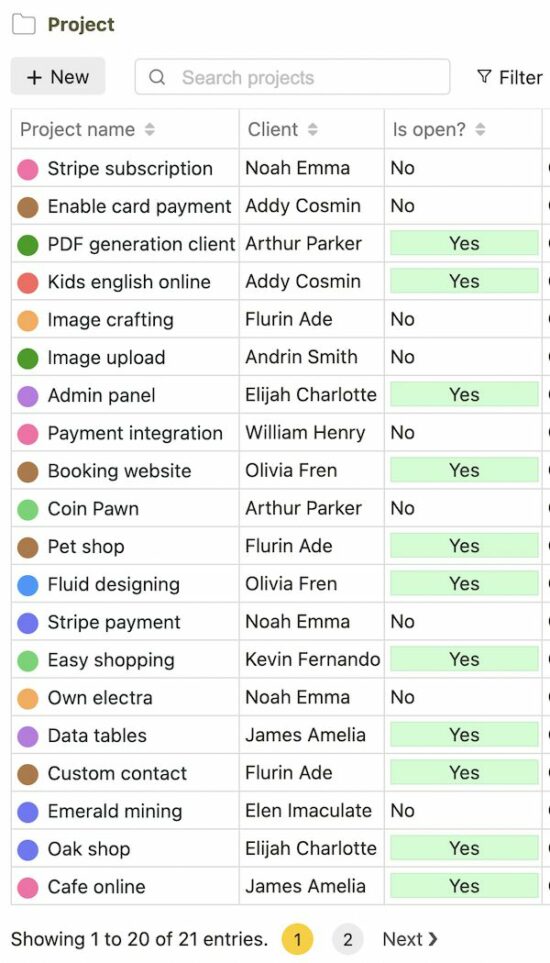
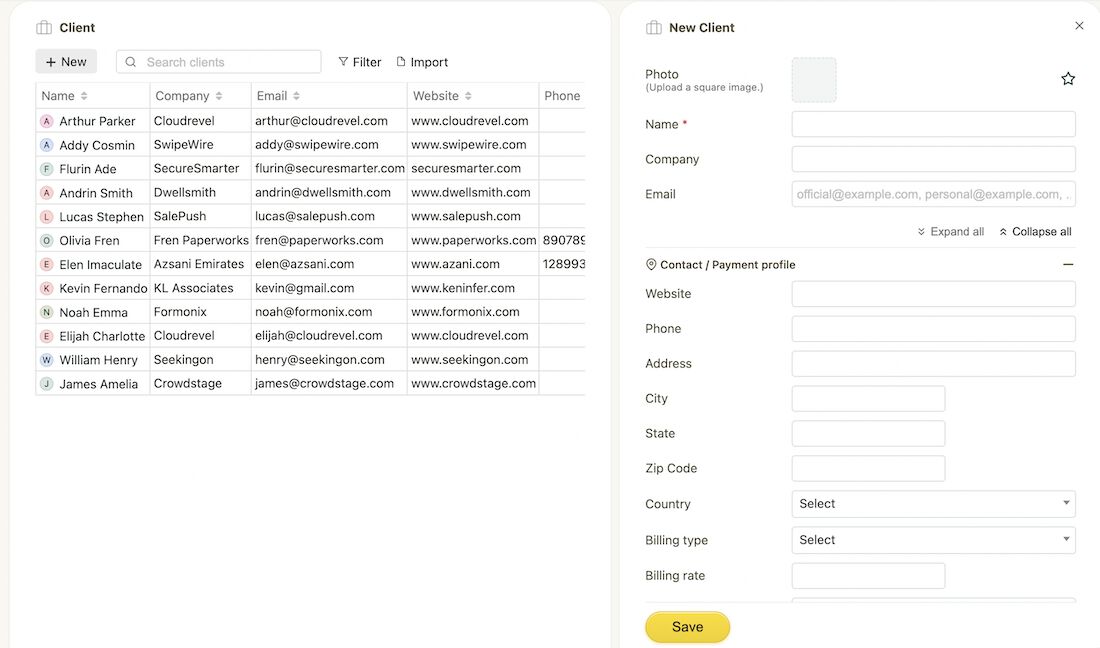
Project management with client CRM and tasks
This section describes the heart of this project management tool.
The complete tool goes around with these three core entities client, project, and task. The other entities of the project management tool are dependent on these primary assets.
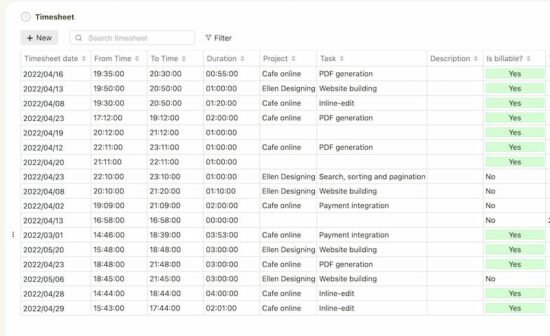
Project scheduling with timesheet
Timesheet log is a critical component of a freelancer’s earnings. In my earlier days of being a freelancer, I lost income because of unorganized timesheet records.
All we need is a good tool and basic discipline. Cazny’s timesheet module is intuitive and easy to record task activities.
Invoice for payments
As a freelancer, you can survive without a management tool for all the features but one. A professional invoice is a key to building your brand as a freelancer and continuing business with a client.
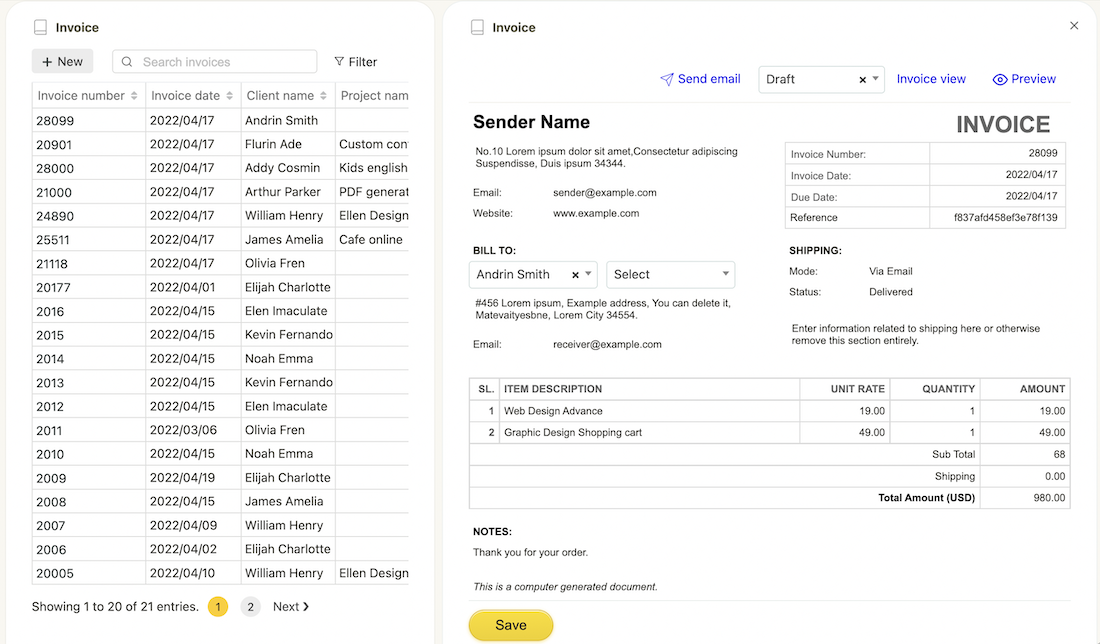
Cazny has an intuitive, WYSIWYG editor for generating invoices. It populates and drops down the dependent client/project data to generate data.
It is highly customizable to suit your business. It has more options that are too user-friendly in the context of invoice generation. Example,
Preview invoice.
Generate and download PDF.
Share invoice to a client with just a click of a button.
Email invoice from within the tool.
Sales automation and payment tracking
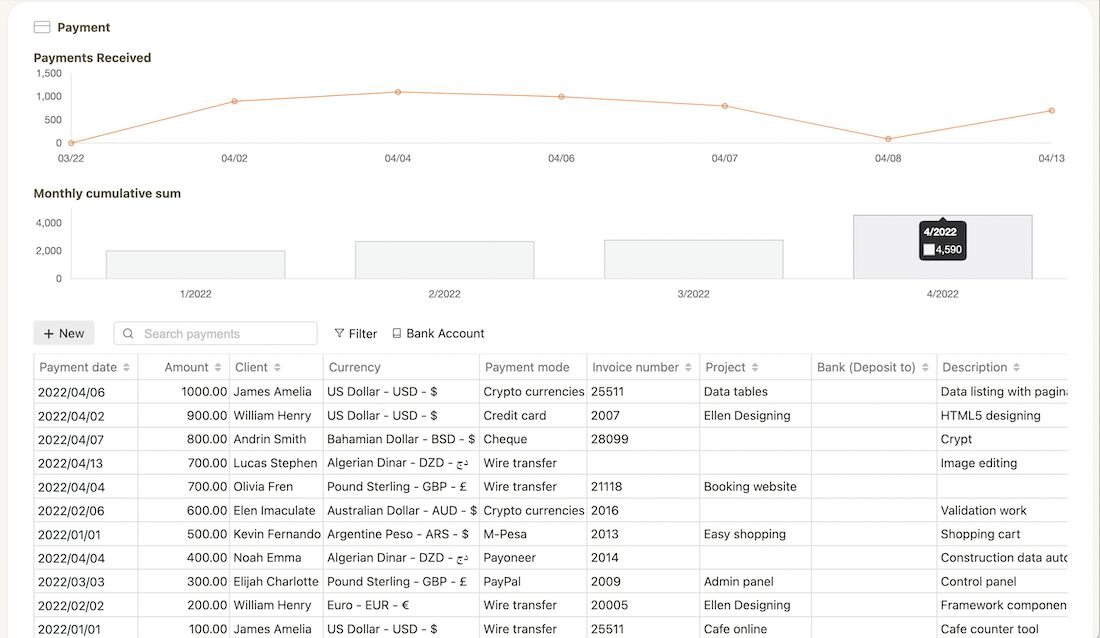
Payments tracking at their best with Cazny both by data tables and graphs. Comparatively, the payment graph view helps freelancers to have a quick bird’s eye view of the income.
This is one of my long-time issues of searching for payment data manually on emails to calculate the income at the stage. Combined with filter, data table and charts, income analysis is just a breeze with Cazny.
More features of Cazny
All functionality uses rich features to provide a good user experience.
Custom fields
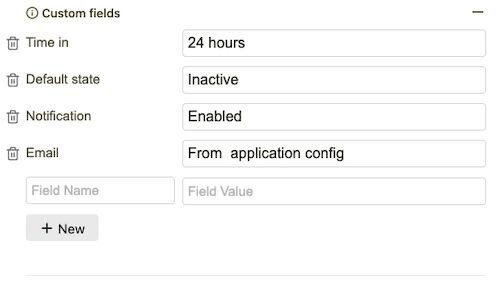
For each freelancer, the client, project, and task have unique columns. This project management tool is designed with minimal and most wanted fields.
If you need additional fields, this feature helps you to add more. It contains add, edit, and remove options on each entity.
Multi-language implementation
The multi-language implementation is made across the site. It is configurable by every member to suit your preference. For public pages, the language can be specified by choosing the option in the header dropdown.
The member can choose their language on the account settings page. Based on this selection, the application framework loads the content. Now you can manage your projects in your own native language.
Common search and criteria based filter
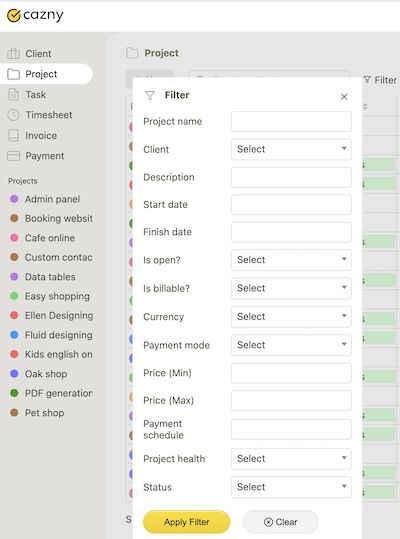
Cazny provides an efficient search feature. It has two types of filters to search among the project management tool.
A simple keyword-based common search filter.
A Field-specific criteria-based filter form.
Search is very quick and seamless.
Connecting entities for relevancy
It is all about loading relevant data based on the parent entity. This is to load,
Clients by member
Projects by clients
Tasks by projects
Timesheet by tasks
Invoice to clients
Payments by project, invoices
Data security
It assures for security and protection of member-submitted data. It follows global norms and state-of-the-art tech to protect your data. Architected and developed be members with good experience. Also, a third-party security audit is conducted to ascertain the quality of the software.
Conclusion
As a seasoned freelancer with an agency, we built Cazny for our internal purposes. This has helped us to scale up our business by freeing up our valuable time from administrative activities.
We are launching the tool to you in the belief that it will save your precious time and allow you to focus more on billable hours. Please leave your feedback in the comments section.
Site reliability engineering applies software engineering principles to infrastructure and operations to create scalable and highly reliable software systems. It is closely related to DevOps in that it helps delivering value to customers focusing more on operations rather than creation of the software system.
I found this video does a great job explaining Site Reliability Engineering (SRE):
Now that you know about what it is, let’s have a look at what it earns next!
Annual Income
How much does a Site Reliability Engineer make per year?
The average annual income of a Site Reliability Engineer in the United States is between $124,000 and $150,000 per year according to multiple sources such as Indeed, PayScale, and Ziprecruiter.
The following table shows how much SREs make per year in the US:
If you decide to go the route as a freelance Site Reliability Engineer, you can expect to make between $35 and $150 per hour on Upwork (source). Assuming an annual workload of 2000 hours, you can expect to make between $70,000 and $300,000 per year.
Note: Do you want to create your own thriving coding business online? Feel free to check out our freelance developer course — the world’s #1 best-selling freelance developer course that specifically shows you how to succeed on Upwork and Fiverr!
But is there enough demand? Let’s have a look at Google trends to find out how interest evolves over time (source):
SRE definitely is an interesting and growing niche! In the last 18 years between 2004 and 2022, the interest in SRE grew by factor 10x, i.e., by 1000% cumulatively.
Learning Path, Skills, and Education Requirements
Do you want to become a Site Reliability Engineer? Here’s a step-by-step learning path I’d propose to get started with Site Reliability :
But don’t wait too long to acquire practical experience!
Even if you have little skills, it’s best to get started as a freelance developer and learn as you work on real projects for clients — earning income as you learn and gaining motivation through real-world feedback.
Tip: An excellent start to turbo-charge your freelancing career (earning more in less time) is our Finxter Freelancer Course. The goal of the course is to pay for itself!
Related Video
You can find more job descriptions for coders, programmers, and computer scientists in our detailed overview guide:
The following statistic shows the self-reported income from 9,649 US-based professional developers (source).
The average annual income of professional developers in the US is between $70,000 and $177,500 for various programming languages.
Question: What is your current total compensation (salary, bonuses, and perks, before taxes and deductions)? Please enter a whole number in the box below, without any punctuation. If you are paid hourly, please estimate an equivalent weekly, monthly, or yearly salary. (source)
The following statistic compares the self-reported income from 46,693 professional programmers as conducted by StackOverflow.
The average annual income of professional developers worldwide (US and non-US) is between $33,000 and $95,000 for various programming languages.
Here’s a screenshot of a more detailed overview of each programming language considered in the report:
Here’s what different database professionals earn:
Here’s an overview of different cloud solutions experts:
Here’s what professionals in web frameworks earn:
There are many other interesting frameworks—that pay well!
Look at those tools:
Okay, but what do you need to do to get there? What are the skill requirements and qualifications to make you become a professional developer in the area you desire?
Let’s find out next!
General Qualifications of Professionals
StackOverflow performs an annual survey asking professionals, coders, developers, researchers, and engineers various questions about their background and job satisfaction on their website.
Interestingly, when aggregating the data of the developers’ educational background, a good three quarters have an academic background.
Here’s the question asked by StackOverflow (source):
Which of the following best describes the highest level of formal education that you’ve completed?
However, if you don’t have a formal degree, don’t fear! Many of the respondents with degrees don’t have a degree in their field—so it may not be of much value for their coding careers anyways.
Also, about one out of four don’t have a formal degree and still succeeds in their field! You certainly don’t need a degree if you’re committed to your own success!
Freelancing vs Employment Status
The percentage of freelance developers increases steadily. The fraction of freelance developers has already reached 11.21%!
This indicates that more and more work will be done in a more flexible work environment—and fewer and fewer companies and clients want to hire inflexible talent.
Here are the stats from the StackOverflow developer survey (source):
Do you want to become a professional freelance developer and earn some money on the side or as your primary source of income?
Resource: Check out our freelance developer course—it’s the best freelance developer course in the world with the highest student success rate in the industry!
Other Programming Languages Used by Professional Developers
The StackOverflow developer survey collected 58000 responses about the following question (source):
Which programming, scripting, and markup languages have you done extensive development work in over the past year, and which do you want to work in over the next year?
These are the languages you want to focus on when starting out as a coder:
And don’t worry—if you feel stuck or struggle with a nasty bug. We all go through it. Here’s what SO survey respondents and professional developers do when they’re stuck:
What do you do when you get stuck on a problem? Select all that apply. (source)
Related Tutorials
To get started with some of the fundamentals and industry concepts, feel free to check out these articles:
Coders get paid six figures and more because they can solve problems more effectively using machine intelligence and automation.
To become more successful in coding, solve more real problems for real people. That’s how you polish the skills you really need in practice. After all, what’s the use of learning theory that nobody ever needs?
You build high-value coding skills by working on practical coding projects!
Do you want to stop learning with toy projects and focus on practical code projects that earn you money and solve real problems for people?
If your answer is YES!, consider becoming a Python freelance developer! It’s the best way of approaching the task of improving your Python skills—even if you are a complete beginner.
If you just want to learn about the freelancing opportunity, feel free to watch my free webinar “How to Build Your High-Income Skill Python” and learn how I grew my coding business online and how you can, too—from the comfort of your own home.

 If your answer is YES!, consider becoming a Python freelance developer! It’s the best way of approaching the task of improving your Python skills—even if you are a complete beginner.
 Info: The double-backslash
  Note: The
 Question: How would we create a Dictionary from two (2) Lists?


 Note: Do you want to create your own thriving coding business online? Feel free to check out our