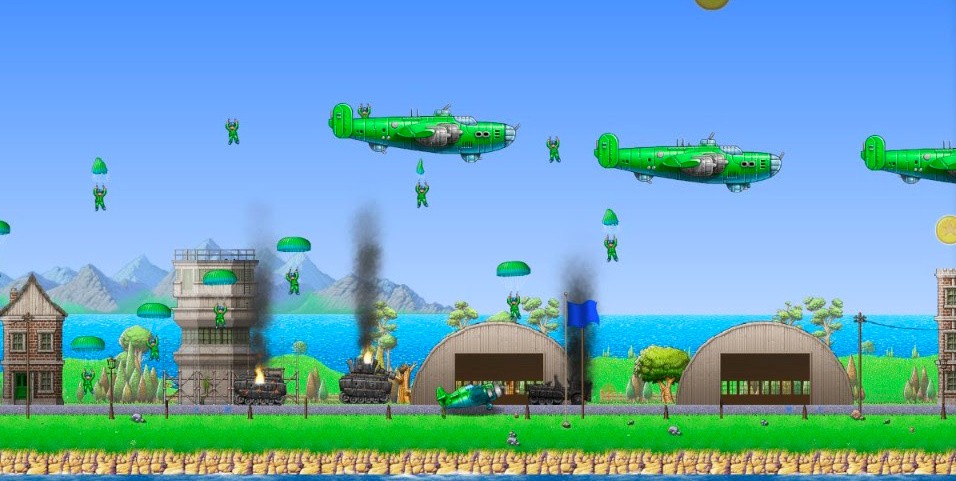
Curve Digital is teaming up with Infinite State Games to publish Rogue Aces on the Switch eShop next month.
Showcasing procedurally generated levels, Rogue Aces is also coming to the PlayStation 4 and PlayStation Vita. All three versions launch on April 12th, costing £9.99/€12.99/$12.99.
Here’s a wee helping of PR:
Rogue Aces asks players to turn the tide of the war as they battle for supremacy across the air, sea and ground over 100 increasingly challenging procedurally generated missions. Using one analogue stick to control the direction of the propeller plane while the other controls the throttle, combat is frantic but graceful, encouraging daring acrobatic manoeuvres. Each plane carries a finite amount of fuel to capture enemy bases and destroy enemy forces making strategic planning, replenishing and repairs a must across its colourful 1940s styled levels.
Mike Daw, Creative Director at Infinite State Games, had this to say:
Rogue Aces’ gameplay is perfectly suited for pick up and play sessions. Its short, frenetic levels are great if you’ve got a spare 5, 15 or even 50 minutes. And while Rogue Aces’ aerial combat might initially appear simple our controls and mechanics keep the proceedings super fun and deep.
Jason Perkins, Managing Director of Curve Digital, added:
Rogue Aces looks fantastic and we’re extremely excited to announce that Infinite State Games is becoming part of the Curve family. As a team of handheld devotees, we can’t wait for players around the world to experience Rogue Aces’ portable pick up and play fun.
Is this one in your sights? Let us know by posting a comment.
If Flinthook and Shantae And The Pirate’s Curse have taught us anything, it’s that there’s no life quite like a pirate’s life. And while the likes of Sea Of Thieves won’t be gracing Nintendo Switch’s waters anytime soon, a new sea-faring adventure could be setting sail for Ninty’s handheld port. Say hello to Of Ships & Scoundrels.
German developer Korion Games is hoping to bring its once-browser based turn-based strategy title to PC and consoles – including Switch, naturally – and it’s taking to Kickstarter to help complete development. With plenty of procedurally-generated maps you can build a kingdom of islands, upgrade and enhance your ships, cannons and buildings and take on pirates, local forces and even the occasional monster of the deep.
With its top-down perspective and a mixture of real-time sailing and turn-based combat there’s a real Sid Meier’s Pirates! feel about this little indie, and we’re certainly on-board for more adventures on the virtual high seas. The developer has confirmed the game will eventually make it to consoles once it arrives on PC, but the stretch goal will ensure it hits all platforms simultaneously.
What do you make of Of Ships & Scoundrels? Do you think it has potential to be something special, or is it a bit too rough around the edges for Switch? Share your thoughts with us below…
Soapbox features enable our individual writers to voice their own opinions on hot topics, opinions that may not necessarily be the voice of the site. In today’s article, editor Dom tackles a subject very close to his heart – his rabid love for a certain seminal platformer from Rare, and how the time is right to bring the bear and bird home to Nintendo…
I’ll preface this editorial piece with a claim that will surprise very few of you: I love Banjo-Kazooie. Scratch that, adore it. Not because I’m expected to as the editor of the best Nintendo games media site in all the land, but because it meant so much to a much smaller (and far less beardy) version of myself.
Whether Nintendo 64 was your first console or, like me, the first one you properly cherished with an almost fanatical devotion, its games play an incredibly important part in both Nintendo’s evolution in the ‘90s and in the way it shaped so many of our views on gaming as a whole. Banjo-Kazooie, and its equally brilliant sequel, played an integral role in that magical era – just as Ocarina Of Time, Mario Kart 64 or F-Zero X did around the same time.
Super Mario 64 opened our eyes to what a 3D platformer could truly be, but Banjo-Kazooie took the flag the mustachioed plumber had driven into the summit of 64-bit gaming and, somehow, took it even higher up the mountain. And, of course, it would be Rare that made this happen. The same legendary British studio redefined what a first-person shooter could be with Goldeneye 007, took destruction physics to a whole new dimension in Blast Corps and went full R-rated with Conker’s Bad Fur Day.
To a young 12-year-old Dom in 1998, Banjo-Kazooie (along with Spyro The Dragon on PS1 – yes, a PlayStation game, get over it) connected with me in a way few other games had up until that point. Everything from Grant Kirkhope’s instantly recognisable soundtrack to the endlessly replayable litany of worlds became something I loved dearly. Sitting and watching my eight-year-old son playing it on my Xbox One only this past weekend might have even brought a tiny tear to my eye.
But there’s the rub; that little detail that’s never quite sat well with me: Banjo’s now long-running association with Microsoft. The Big M bought Rare back in 2002 after all, and with it came most of its home-grown IP, including the bear and bird combo deal. There was, thankfully, a silver lining of sorts since we got to experience Banjo and its sequel on Xbox 360, without needing to rely on rubbish emulators that felt icky and hollow to use.
Rare was even afforded the chance to do a Banjo-Kazooie 3 in the form of 2008’s Banjo-Kazooie: Nuts & Bolts. That contemporary attempt to make Banjo relevant again was, arguably, a ‘rare’ misstep for the British studio as it buried much of the series’ charm beneath a frighteningly deep vehicle building mechanic. I’ll be honest, I quite enjoyed Nuts & Bolts when it released nine-and-a-half-years ago, but it was proof positive Rare had outgrown the platforming duo, and that Banjo and co really needed a new steward.
Ever since, those iconic animal heroes have gradually faded into the background as Rare focused on new ventures (remember the Kinect era? Dark times, indeed). Even the Rare Replay collection only contained a re-release of the aforementioned Xbox 360 port. And as for that appearance in Sonic & All Stars Racing? Just get it out of my sight.
Microsoft has, in the past, tried to do right by a once hugely influential property, but it’s long been a forgotten quantity that’s been left to gather dust in room filled with failed IP and elder franchise statesman. But Rare’s great platforming hope deserves better than that; it did in 2008 and it still does now. And what better place for it to shine than back on a Nintendo console, where it arguably belongs?
Phil Spencer, the affable face of Xbox’s global brand, has often stated he’s open to the idea of Microsoft IP appearing on rival systems; the company already releases its major games on PC as well as the Xbox One, so it’s not too much of a stretch to believe that Microsoft could become a more platform-agnostic firm in the future. Furthermore, Spencer even stated on Twitter that he’d like to see Banjo and Kazooie appear in Super Smash Bros, so we know Nintendo isn’t a no-go area for Microsoft. And while the thought of using Kazooie to peck Inklings off the side of stage fills me with a worryingly powerful sense of glee, I still want to see my beloved furry/feathered friends back in true platforming form on a Nintendo console.
The other interesting part of this puzzle is Rare studio head Craig Duncan’s admission that he’d be happy for third parties to tackle its famous IP. So to whom should Rare and Microsoft pass that creative torch? Well, there’s an argument to made that the licence could be handed to a new studio, with fresh ideas and a creative energy informed by childhoods spent exploring Treasure Trove Cove and Freezeezy Peak. We’ve seen iconic franchises go to new developers and feel revitalised once more as a result, but there’s no denying it’s a risky move (and one that would need a significant financial backing to make it happen because, hey, this is Banjo and it deserves a proper development cycle with a team large enough to make it happen properly).
Microsoft could look to a studio with a little more experience. A studio that may have something of a background when it comes to 3D platformers. In fact, there’s a UK-based team that knows Banjo-Kazooie very well… because many of its key members helped make it back in the ‘90s! Yes, of course I’m talking about the very talented developer that is Playtonic Games.
Now, here’s the thing. I enjoyed Yooka-Laylee last year. I was a backer, way back when, and I was sold immediately on the idea of a 3D platformer that cut away all fat to make a game that could recapture that lightning in a bottle that made Rare’s ‘90s output so incredible. But Yooka-Laylee wasn’t that game, it was an approximation of something greater, but it was still an impressive feat for a team that started out so tiny and with a budget far smaller than Rare is working with now.
Yooka-Laylee wasn’t the best platformer the collective talent at Playtonic has ever made, but it was a taster for what it could truly achieve, given the right kind of cash and timescale. If Microsoft could strike a deal with Playtonic – and bring Nintendo on board as well – imagine what could come it? And it’s not like this kind of thing hasn’t happened before – in fact, we had not one but two Banjo titles on the Game Boy Advance after Microsoft’s purchase of Rare, so there’s no reason why the duo couldn’t return to Nintendo again. Nintendo and Microsoft both know Banjo still has plenty of brand appeal, and it’s a licence that’s going to strike a chord with any generation, whether they’ve played the original games or never heard of them before.
Playtonic is the ideal choice for Banjo’s future on Switch and beyond. It knows the console intimately and produced a Switch port of Yooka-Laylee that ran surprisingly well considering the obvious technical limitations. With the likes of Chris Sutherland, Gavin Price and Steve Mayles on board – who are just some of the veterans who worked on the original games – the bear and bird could finally have a new adventure, built from the ground up, with all the lessons from Yooka-Laylee learned and implemented, poised for a new lease of life on Nintendo Switch. In fact, I’d dare say that Banjo-Kazooie on Switch makes infinitely more commercial sense than Banjo-Kazooie on the Xbox One, and Microsoft should hopefully be aware of that.
It’s time for Banjo-Kazooie to come home, so let’s get those important conversations going…
So there’s Dom’s impassioned take on the potential future of Banjo-Kazooie. Now we want to hear what you think? Is the time right for Banjo to return? Is Playtonic the right choice of developer? Share your hot (and tepid) takes below…
Some guys are just made for Switch, even if – technically – they’re yet to appear on the platform or have an official release announced. Such is the case for 2D platformer Iconoclasts, an indie title that’s been praised for its poignant storytelling and platforming gameplay that harks back to the glory days of SEGA Mega Drive/Genesis.
In a recent interview with Game Informer, developer Joakim Sandberg was posed the question of whether he’d considered bringing his indie hit to a platform so well suited to it. “That would be very fun,” he replies. “I have a publisher for distribution, so I can’t talk about just anything.” That sounds rather promising to us, and considering how well the game has been received on PC – and has already made the jump to PS4 and PS Vita – a jump to a console with such a pro-indie community seems an ideal fit.
You can check out the full interview in the link below, just watch out for spoilers if you haven’t played the game yet. Oh, and here’s a trailer from the PC release:
So there you have it. No official word, but a subtle wink towards a potential future port nevertheless. We’ve loved playing Iconoclasts on Steam so we really hope it gets the chance to shine again on the Switch eShop. Let us know what you think of Iconoclasts below…
UK high street retailer GAME has announced increased revenue for the past financial year, but has also reported that profits are down.
Revenue was £517.4 million, but profit before tax fell from £16.5 million in 2016/2017 to £12.3 million in 2017/2018. This drop-off has been attributed to the firm’s retail arm, which saw a drop from £22.1 million in 2016/2017 to just £9.7 million in 2017/2018.
According to GamesIndustry.biz, this decline is down to decreasing margins, as well as a dip in pre-owned sales – a major part of GAME’s retail approach. Store savings of £5 million have helped lessen the impact of this drop, although this has also resulted in a decline in GAME’s overall console market share.
Despite the doom and gloom, there are some positive points to pick up on. GAME’s “Gross Transactional Value” is up 3.8 percent to £586.8 million, thanks to a 24.7 percent rise in hardware value, a 3.3 percent increase in physical software and a 31.5 percent jump in events and digital sales. The company is planning on opening 100 of its “Belong” stores within the next three years, including concessional outlets in UK retail giant Sports Direct, which has a 50 percent stake in the Belong brand.
CEO Martyn Gibbs had this to say:
During the period important strategic progress was achieved, helping us to better position the Group for our development in the rapidly growing esports market with our unique and high margin concept traded under the Belong banner.
This is further facilitated by entering into a new and exciting collaboration with Sports Direct that will allow us to accelerate our expansion and help develop a larger scale experience based gaming business than previously planned and steadily reposition our retail offering. The traditional retail landscape is under increasing pressure and we have developed a strong growth strategy to utilise the valuable components of our core business in building our new experience based gaming offer.
We also delivered a strong sales performance in the first half of the financial year, driven by our ability to capitalise on strong customer demand for consoles – particularly Nintendo Switch – a stronger line up of new software releases and the further development of the Group’s gaming experiences and events offering.
Furthermore, during the period UK Retail delivered cost savings of £5 million as we continued to re-shape and right size the business. We continue to negotiate property savings and, where appropriate, close stores, rationalise retail working hours and deliver further operational and procurement benefits as well as focus on our core retail opportunities including a large array of new software releases particularly during the final quarter of the 2018 calendar year.
It would seem that despite coming through some tough times, GAME is in good shape for the future, and is aware of the shifting sands of the games industry. Hopefully it can shape a business which is nimble enough to avoid falling into the kind of problems that so nearly sank it not so long ago.
But will the game ever get a physical release at retail? The question was put to Suda51 during an interview with Siliconera, who – in true Suda51 style – left things tentatively open, saying: “Maybe. Grasshopper Manufacture is handling publishing for this title.” Sounds like Suda is more concerned with getting the game right than worrying about special editions and physical boxes. But still, there’s hope if you’re a collector.
Would you want to see Travis Strikes Again: No More Heroes at retail? Or would you be fine with an eShop release only? Let us know what your take is…
UK publisher Bitmap Books has confirmed that its next “Visual Compendium” will switch focus to Nintendo’s rival, Sega.
Bitmap’s last two compendiums focused on the NES and SNES, and showcased loads of lovely screenshots, artwork, features and exclusive interviews. The next book will highlight the talents of the Master System, Sega’s 8-bit rival to the NES.
As before, Bitmap will be launching a Kickstarter campaign to fund production of the book. It begins on Monday, 7th May at 7am BST.
After covering such internationally successful consoles as the NES and SNES, it will be interesting to see what Bitmap can pull out of the bag for the Master System, which has to rank as one of the most underrated platforms of recent memory.
In 2015, Atlus published The Legend of Legacy, a 3DS JRPG produced by a dream team of veteran developers with credits on classics like SaGa, Final Fantasy, and Chrono Trigger. The game was met with mostly positive reviews, but at the time, another game was in development from the same team. This game came to be The Alliance Alive, which is something of a spiritual successor to The Legend of Legacy. Boasting of a new setting, an improved battle system, and a deep cast of characters, The Alliance Alive has proven itself to be a more than worthy follow up, building on its predecessor in notable ways.
It’s clear that the developers wanted to respond to the complaints about the lacking story of Legend of Legecy, and the narrative that’s been crafted here is far stronger. The story — penned by Yoshitaka Murayama, the creator of the beloved Suikoden series — begins one thousand years prior to the events of the game, when the human world was taken over by the Daemon race and divided up into regions by what came to be known as The Great Barrier. The sky was blackened and Daemonkind established an oppressive government over the people, enforcing their rule through another race called Beastfolk. It’s an interesting premise to be sure, and the nuance and detail of the world is brilliantly realised as you constantly delve deeper into new regions.
You first take control of Galil and Azura — two freedom fighters living in the Rain Realm — and set out in search of a fabled ship that can supposedly cross between the realms, but there really isn’t a main protagonist in The Alliance Alive; this is very much an ensemble affair. Whether it be a feisty engineer and professor named Tiggy, or an air-headed daughter of Daemon royalty named Vivian, each character in the main cast of nine has a pleasing amount of charm and depth. There’s a great mixture of humour and seriousness, and the 40(ish) hour storyline is filled with plenty of surprises and plot twists that’ll keep you pushing onward. If we were to name one flaw, however, it’d be that there are points early on where it can become rather easy to lose one’s way.
Though the game limits your freedom in the opening hours to a relatively linear path, The Alliance Alive has a surprisingly deep and expansive open world that frequently rewards the player who travels off the beaten path. Every region is filled to the brim with things to do, from towns to trade goods and rest in to secret caves that house powerful, optional boss fights in their depths to side dungeons that can give you new building locations for guild towers. There’s always something more you can be doing, always another place to explore or conquer, and we occasionally were surprised by the depth of the world.
In battle, you can have up to five party members on the field at once, and a series of preset “Formations” will dictate where they stand and what role they have. There are three roles available: Attack, Guard, and Support, each of which offers distinct stat buffs for certain commands. On top of this, there are three rows on each side of the battle field, and where you place your characters will dictate the effectiveness of certain attacks, and the likelihood of being targeted by enemies.
The best part about this battle set up is the endless amounts of depth and flexibility that it offers in how to best maximize your party’s effectiveness. One enemy encounter may be quickly wiped out by putting everyone on the front line in Attack roles, while another may require you to do something more advanced, like putting a shield up front to tank attacks while attackers poke from behind as they’re being buffed by a mage in the back. Though there’s a series of preset roles to begin with, you can tweak these to your liking and even create entirely new ones that suit your needs. All of this comes together to make for a battle system that favours fluidity and foresight; plotting out effective formations and swapping them on the fly is as satisfying as it is engaging.
The progression system of The Alliance Alive was designed by Kyoji Koizumi — of SaGa fame — and it borrows heavily from that series of games, focusing on unconventional yet refreshing means of building your characters. There’s 11 classes of weapons and just about every character can wield just about every kind of weapon. Just handing a character an axe doesn’t mean that they’ll be able to fully use it right away, however, as everyone starts with just a handful of basic “Arts” for a weapon type.
By frequently using a weapon in battle, characters will occasionally trigger an “Awakening” that unlocks a new Art for them to use. Seeing as how Awakenings are triggered at a random (yet reliable) rate, it’s always surprising and exciting when a new Art is unlocked. New Arts aren’t just more powerful versions of previous ones, either; they often come with bonuses, like a wider area of attack or additional damage against certain enemy types.
It doesn’t stop there, though, because Arts themselves can be individually leveled up to get even more combat potential. Each Art has three level bars corresponding to each of the three roles, and using an Art frequently will increase its effectiveness in the role you use it in. For example, an attack art that’s repeatedly used in the Attack role will begin doing more damage there than if it’s used in the Guard role. Considering the massive amount of Arts that become available to any given character, this gives you plenty of control over how specialised your characters can be.
Amazingly enough, it still doesn’t stop there, as you can also “Seal” Arts later on in the game. This is done from the main menu, and it allows you to block off the ability to use certain Arts in battle in exchange for the remaining Arts receiving a boost in power. This proves to be a very welcome inclusion, as you have quite a long list of Arts to pick from once you unlock this ability, and many of them can sit there unused. The inclusion of Sealing arts just goes to show how well thought out the combat system is; it’s clear that the developers thought through the natural pitfalls of the battle system and added in features like this to compensate.
Kicking the standard of JRPGs, characters don’t gain levels or experience; once battle is finished, party members will sometimes receive either HP or SP boosts at what seems to be a random rate. Even so, the character growth seldom feels like it’s too far behind (or ahead) of the difficulty at any given point in the story, and more challenging enemy encounters seem to trigger increases at a higher rate. The nice part about this opaque system is how it keeps things interesting when it comes to grinding and growing characters; it’s not a matter of defeating X number of enemies before your stats see a marginal jump, but rather, an ongoing question of whether your characters will improve after the current enemy encounter.
Though character growth is primarily handled through that randomised system, The Alliance Alive has introduced the concept of “Talents” for those who still want the feeling of obtaining XP. Each enemy encounter will give you a certain amount of talents, which can then be invested in skills for each character. Just about every character has access to the same skills, which essentially act as buffs to make it easier to define roles and play to each character’s strengths. You can invest points in things like making Arts with certain weapon types cost less SP, or increasing the rate at which your character gets an HP bump, and this gives you quite a lot of agency in how to skew your characters’ growth. Buying any skill costs a lot of Talents, which means that you need to be thoughtful in how you invest points and focus on building characters for specialised purposes.
Another, more passive form of growth can be found in the Guild System, which centres around supporting your party in their adventuring efforts. After a certain point in the game, you can build new locations to house one of five support organisations with a plethora of services ranging from weapon development to enemy research. New guild members can be recruited in towns and assigned to different guilds, which will level up and expand their usefulness as more members are added. Building new towers and networking them has the effect of giving you greater support in battle, as each guild will have a chance of helping you out with things like a blanket shield for the team or support fire from a nearby cannon. The guild system adds an extra layer of strategy and depth to your performance both in and out of battle, and it’s nice how the guilds aren’t forced on you. If you don’t want to waste time hunting down recruits and scouting out new tower locations, you can almost completely ignore this subsystem. It’s encouraged that you don’t, however, as the guilds greatly added to our enjoyment of the game and helped give a more tangible manifestation of the titular alliance that the game is centred around.
From a presentation perspective, The Alliance Alive doesn’t amaze, but it certainly gets the job done. The graphical style takes after the pseudo-chibi look of Bravely Default, and presents a colourful, storybook-like world with plenty of diversity, from the rain-soaked forests and fields of the Rain Realm to the fog-covered, creepy locales of the Caged Realm. Though The Alliance Alive gets points for these thematic differences, it by no means is the kind of game that pushes the 3DS to its limits; there’s little here in the way of “Wow” moments of fantastic visual flair, and it mostly omits usage of the stereoscopic 3D feature. Still, the graphics are by no means poorly done, and the watercolour-like art style is rather charming in many places.
The soundtrack was composed by Masashi Hamauzu of Final Fantasy fame, and the quality of his musical direction is evident in the brilliant soundtrack. Music ranges from goofy to melancholy, ominous to adrenaline-pumping and it masterfully captures emotion through a mixture of genres and styles that suit the situation. The somewhat jazzy guitar track of the Burning Realm sounds quite different from the synthesizers and tambourines of the Rain Realm, but it all fits together somehow and creates a musical experience that’s just as in-depth as the gameplay.
You’ll soon get the chance to bump into the Mythical Psychic-Type Pokémon Mew on your travels in Pokémon GO, it has been revealed today.
Niantic and The Pokémon Company have confirmed that trainers will begin receiving “research tasks” this week which add “new activities and challenges that can be completed for in-game rewards”.
Some of these rewards will grant access to “unique storylines”, one of which involves “discovering the mystery behind the Mythical Pokémon Mew”.
It will be possible to complete multiple “Field Research” tasks each day, “with more challenging tasks offering greater rewards”. You’ll earn one stamp per day by completing at least one Field Research task, and when you’ve collected seven, you will achieve a “Research Breakthrough” to gain even greater rewards – such as an encounter with a Legendary Pokémon.
Let us know if you’re excited about this update to Pokémon GO by posting a comment.