Posted on Leave a comment

Blog: Growing the conversation on game design

The following blog post, unless otherwise noted, was written by a member of Gamasutra’s community.
The thoughts and opinions expressed are those of the writer and not Gamasutra or its parent company.


This past year has been great in reaching out beyond just the audience here to people in my local community about videogames and game design. However, the study of game design continues to be a mystifying art for some, and it hasn’t gotten any better since I started Game-Wisdom 7 years ago. With the growth of the industry and being accepted worldwide, there really needs to be more than just a handful of discussions about game design.

The Low Bar:

The last time we had this discussion, I drew my line in the sand about how I feel about the state of Game Journalism. I find that the majority of “coverage” out there—from youtubers and streamers to major sites to be irrelevant.

For someone wanting to learn about game design, the majority of information out there is useless. Youtubers making rant videos about companies “killing games” or “being against gamers” is just tabloid trash. While the “professional pieces” on major sites tend to fall between someone just reporting what someone else said, and fluff pieces that don’t really educate anyone on design or the game in question. To continue getting myself into trouble, I do question many people who write and talk about the game industry on their knowledge of game design.

If you want to learn about game development and what it means to work in this industry, the majority of sites, youtubers, and streamers out there will not help you. One of the reasons why I can talk about game design these days is the very fact that I’ve interviewed over 400 developers about design; not PR, but actual game development.

[youtube https://www.youtube.com/watch?v=oOHO_iZa_3M]

Some days I feel that I’m five to ten years ahead of everyone else when it comes to these discussions. Frequently, when I want to write a piece on a concept or design theory, I’m still either the top or near the top link when searching for it on Google. Several concepts I’ve talked about when it comes to game design, consumers don’t think about, let alone people who make games for a living.

I can’t wait to see the reception of my second book covering a genre that is over 30 years old that no one else has ever taken the time or thought to explore from a design and educational perceptive.

Game development is very hard to put into words, and why most people don’t cover it; however, that difficulty also brings me to another problem.

Bringing it Down to Earth:

Game development is a topic I feel that hasn’t gotten enough credit as a field of study. If we’re talking about the time that videogames became accepted in pop culture (around the early 00’s), then the industry from that point of view is not even 20 years old.

Too many people, from inside and out of the industry, treat design as this mythical creature that can’t be understood or tamed. When something goes wrong, they’ll chalk it up to hindsight, when people who understand development can see the writing on the wall. We’ve said this many times over: What you don’t know about how games work can hurt your chances of succeeding.

When I examine titles, it’s easy for me to see how a game compares to other titles in the genre from a playability point of view. Too often for my tastes, I see games from indie developers that play like they have either never touched a game from the genre, or willingly chose to ignore all design sensibilities from it.

This continues to be a great encapsulation of gamedev

The problem with trying to learn game design is that just saying the phrase “game design” and trying to teach it is akin to saying “craftsman” or “engineer” — it is a multifaceted topic across multiple disciplines.

Just because you built a game of one genre doesn’t automatically make you an expert in another; similar to the differences in metalworking vs. woodworking. More importantly, even if you made an amazing strategy game or FPS, that doesn’t mean you’re going to be good at making an RPG or platformer.

The number of topics that go into game design is staggering, and I should know; besides writing about game design, I have three years’ worth of videos examining single topics, and I’m nowhere close to covering it all.

This makes it very difficult to explain even the basics about game design to people, because there’s never just one thing. Good UI design may be universal, but there’s a difference between the UI for a puzzle game, a strategy game, platformers, and so on. Someone who wants to learn about FPS design may not care about RPG development.

When trying to make videos or posts related to game design, the field in of itself is very niche, but then we drill down into the individual topic makes it even harder for people to find out about it. Outside of common phrases like “How do I build a videogame?” “what is game design?” most people aren’t typing in specific questions.

Is it Getting Better?

The real positive I’ve seen about the growth of game design has not come from game designers or members of the industry, but from the schools and libraries. We are seeing a push to bring videogames to education and the study of game design.

At the end of the day, game design is both an art and science (and why it’s in the tagline for game-wisdom). There are many people who only focus on the art and chose to downplay or ignore the science part. If you can’t learn the fundamentals of what it means to design a videogame, then chances are you are going to end up with a bad game no matter how much work you put into it.

I see this from a lot of indie developers who put their heart and soul into a project and wonder why no one is buying it or it’s getting bad reviews, to only find major UI and design issues that should have been caught within 10 minutes of play. I know there are indie developers who don’t like the word “bad”, but guess what? If you actively ignore negative reviews and comments about your game, then you are never going to improve.

[youtube https://www.youtube.com/watch?v=7ItwsmTPGC4]It’s very easy to look at the structure of a game or genre and write it off as someone telling you what to do, but that kind of thinking is akin to someone designing a car without brakes because you wanted to think outside the box. While game design isn’t rocket science, it still requires research and work to get right. Messing up on UI design and playability are no longer valid excuses when there are dozens of games being released daily.

There should be a greater respect for game design across all areas of the game industry, because it doesn’t matter how pretty or thought provoking your game is if no one wants to play it.


Posted on Leave a comment

Dota 2 Update – January 10th, 2019

* Fixed a bug that caused Quickbuy items to disappear when multiple identical items were queued and the first item was completed.
* Fixed a bug that caused player profile information (such as Ranked Medals) to not update in some cases.
* The highlighted items at the Secret and Side shop now include items that can be completed with what’s available in your inventory, and what’s available at the shop you are near.

Posted on Leave a comment

Two Mario games continue Nintendo Switch and Nintendo 3DS momentum into 2019

Two Mario games continue Nintendo Switch and Nintendo 3DS momentum into 2019

Two of Mario’s most beloved adventures are back – and this time with fresh new content perfect for new players and longtime fans. The New Super Mario Bros. U Deluxe and Mario & Luigi: Bowser’s Inside Story + Bowser Jr.’s Journey games are both now available for the Nintendo Switch system and the Nintendo 3DS family of systems*, respectively.

“After a strong 2018, both Nintendo Switch and Nintendo 3DS add to their large and diverse libraries with two solid games starring Mario and friends,” said Doug Bowser, Nintendo of America’s Senior Vice President of Sales and Marketing. “Nintendo is giving fans on both platforms good options to kick off their entertainment in 2019.”

New Super Mario Bros. U Deluxe contains New Super Mario Bros. U and the more challenging New Super Luigi U – two full games with a ton of high-quality content. While you can play as iconic characters Mario, Luigi, Toad and Nabbit, a new character also joins the mix – Toadette. Younger or less-experienced players will love playing as Nabbit and Toadette, as they offer extra assistance during play.

When Toadette picks up a Super Crown, she turns into Peachette and can double jump, float slowly during freefall and boost back up when she falls in a pit. When playing as Nabbit, you won’t be hurt by enemies and can earn extra 1UPs at the end of stages.

New Super Mario Bros. U Deluxe is a classic side-scrolling Super Mario experience in the vein of the original games. With 164 levels and numerous hidden secrets, it’s the ideal game to play at home or on the go. There is a wide variety of additional game modes to entertain players of all skill levels, and with up to four player multiplayer**, you and your friends and family members can all play together.

New Super Mario Bros. U Deluxe is now available on Nintendo Switch at a suggested retail price of $59.99. For more information about the game, visit http://newsupermariobrosu.nintendo.com/.

Mario & Luigi: Bowser’s Inside Story is one of the most acclaimed entries in the beloved Mario & Luigi RPG series. This new version for Nintendo 3DS includes all of the original’s hilarious and captivating content, with revamped graphics and refined gameplay. It also includes an original new mode starring everyone’s favorite son of the famous Koopa King, Bowser Jr., as he gathers an army, creates formations, supports his allies with an arsenal of moves and generally causes chaos (in the best way possible).

Mario & Luigi: Bowser’s Inside Story + Bowser Jr.’s Journey is now available at a suggested retail price of $39.99 and can be played on the entire Nintendo 3DS family of systems*, including Nintendo 2DS and New Nintendo 2DS XL. For more information about the game, visit https://marioandluigibowsersinsidestory.nintendo.com/.

Remember that Nintendo Switch and the Nintendo 3DS family of systems feature parental controls that let adults manage the content their children can access. For more information about other features, visit https://www.nintendo.com/switch/ or https://www.nintendo.com/3ds/.

*Mario & Luigi: Bowser’s Inside Story + Bowser Jr.’s Journey is playable only in 2D.

**Additional accessories may be required for multiplayer mode. Sold separately.

Posted on Leave a comment

Begin your adventure in Tales of Vesperia: Definitive Edition

Begin your adventure in Tales of Vesperia: Definitive Edition

A power struggle begins in a civilization dependent on an ancient technology, the blastia, and the Empire that controls it. Follow Yuri, a former Imperial Knight, whose seemingly simple mission pushes him into the middle of a nefarious plot that threatens the entire planet.

Celebrating its 10th anniversary, Tales of Vesperia is one of the most beloved entries in the ‘Tales of’ series and returns with remastered full HD graphics, never before seen characters, expanded story, and much more!

Features

  • Upgrades: Tales of Vesperia: Definitive Edition features updated graphics and an expanded story.
  • Bonus content: Additional playable characters, scenarios, locations, brand-new music tracks, and costumes that have not been available outside of Japan.
  • Adjusted Combat: This edition uses a specialized version of the Linear Motion Battle System. Players control a single party member in real-time combat, while the other three members are controlled by customized A.I. commands. Assemble your favorite team and enjoy exciting real-time battles with all new Mystic Artes and skills!

If you would like to purchase the game, please visit https://www.nintendo.com/games/detail/tales-of-vesperia-definitive-edition-switch.


Alcohol Reference
Blood
Fantasy Violence
Mild Language
Simulated Gambling
Suggestive Themes

Posted on Leave a comment

Daily Deal – Sonic Franchise Advertising App, 75 – 85 % Off

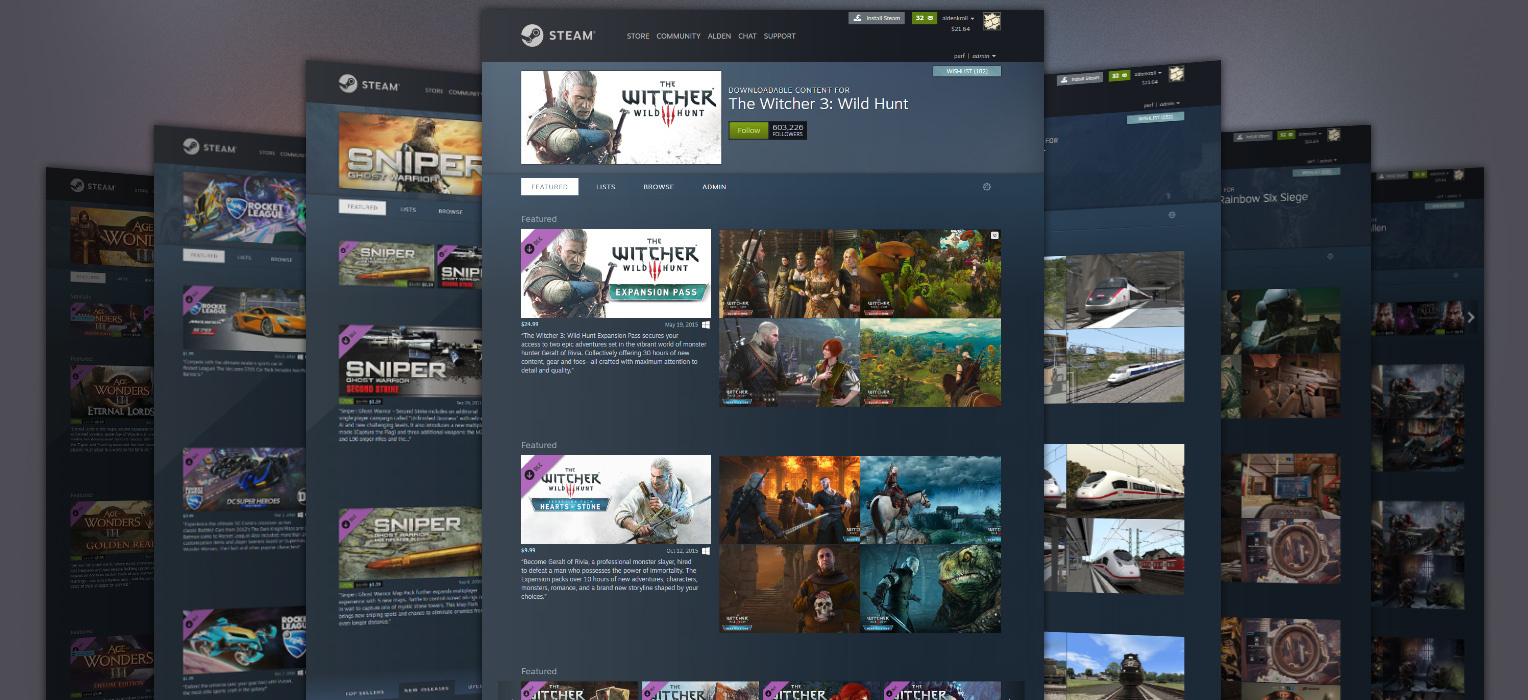
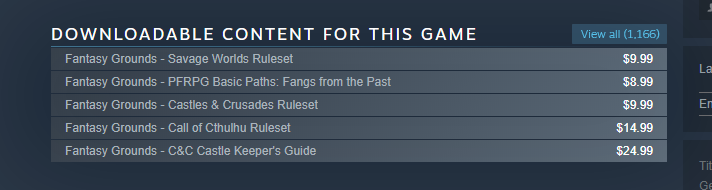
We’ve just rolled out an update that makes it easier to find downloadable content for your favorite games. Any game that offers DLC will now have a sortable, featured page of all of its DLC in one place. Furthermore, (and especially for games that have a tons of DLC) we’re providing ways for developers to customize how these pages by creating lists, adding branding and specifying which titles to feature.

Here are a few examples: Fantasy Grounds (1,166 DLC), Train Simulator 2019 (586 DLC), Microsoft Flight Simulator X: Steam Edition (272 DLC), and Rocket League (28 DLC)

To find these new pages, visit the store page for any game with DLC and click the new ‘View all’ button in the DLC area.

Let us know if you run into any issues or have feedback on these new pages.

-The Steam Team

Posted on Leave a comment

SpatialOS For Unity Shut Down By ToS Change

Earlier today Improbable released the following statement regarding their cloud based networking service SpatialOS:

Today we must regretfully inform our community of the following developments.

  • Unity’s block of SpatialOS: The game engine provider Unity recently changed (Dec 5) and then clarified directly to us (9 Jan) their terms of service to specifically disallow services like Improbable’s to function with their engine. This was previously freely possible in their terms, as with other major engines.
  • What this means: Unity has clarified to us that this change effectively makes it a breach of terms to operate or create SpatialOS games using Unity, including in development and production games.
  • Ongoing negotiation: Worryingly, this change occurred during an open commercial negotiation with the company to find a way to do more together.
  • Revoked Unity license: In addition, Unity has revoked our ability to continue working with the engine for breaching the newly changed terms of service in an unspecified way.  This will affect our ability to support games.
  • Continuing service for all other engines: Users of all other engines remain completely unaffected and we are working with other engine providers to see if they can help support engine transitions for customers hit by this change.

The updated Terms of Service section 2.4 from Unity now reads:

2.4 Streaming and Cloud Gaming Restrictions.

You may not directly or indirectly distribute the Unity Software, including the runtime portion of the Unity Software (the “Unity Runtime”), or your Project Content (if it incorporates the Unity Runtime) by means of streaming or broadcasting so that any portion of the Unity Software is primarily executed on or simulated by the cloud or a remote server and transmitted over the Internet or other network to end user devices without a separate license or authorization from Unity. Without limiting the foregoing, you may not use a managed service running on cloud infrastructure (a “Managed Service”) or a specific integration of a binary add-on (for example, a plugin or SDK) or source code to be integrated in the Unity Software or Your Project Content incorporating the Unity Runtime (an “SDK Integration”) to install or execute the Unity Runtime on the cloud or a remote server, unless such use of the Managed Service or SDK Integration has been specifically authorized by Unity.  Additionally, you may not integrate the Unity Runtime with a Managed Service or  SDK Integration and offer that integration to third parties for the purpose of installing or using the Unity Runtime on the cloud or a remote server. For a list of Unity authorized streaming platforms, Managed Services and SDK Integrations, click here.This restriction does not prevent end users from remotely accessing your Project Content from an end user device that is running on another end user device.  You may not use a third party to directly or indirectly distribute or make available, stream, broadcast (through simulation or otherwise) any portion of the Unity Software unless that third party is authorized by Unity to provide such services.

In a nutshell, the new ToS seem to prevent running any portion of the Unity runtime on a cloud based install without prior licensing of the cloud hosting company and Unity directly.  The timing of this is quite interesting following on the heels of a partnership between Unity and Google to provide cloud based networking services.

In the meantime, developers that built their game around Unity and SpatialOS are going through a bit of a rollercoaster ride of emotions right now, such as Spilt Milk Studio:

image

Followed by:

image

Unity have not yet released a public content although their forums are quite… lively.

UPDATE: Tim Sweeney, founder and owner of Epic Games was quick to comment upon Unity’s gaff here and to reassure Unreal Engine developers that this wont happen to them:

image

[youtube https://www.youtube.com/watch?v=8h6Vg3iCA3k&w=1280&h=720]

GameDev News


Posted on Leave a comment

Blog: A look at the virtual cities of Grim Fandango

The following blog post, unless otherwise noted, was written by a member of Gamasutra’s community.
The thoughts and opinions expressed are those of the writer and not Gamasutra or its parent company.


[An excerpt from the forthcoming Virtual Cities atlas of video game cities by game urbanist Konstantinos Dimopoulos, and artist Maria Kallikaki.]

You haven’t died until you’ve visited Rubacava. The liveliest, most vibrant place throughout the Mesoamerican Hades. The town that never died. An extravagant, cheerful yet forlorn city where heartbroken lovers await their soulmates, and the ancient dead dance wildly through countless nights. Rubacava: a city of long shadows, papier-mâché skeletons, bright lights and unexpected fogs, where the biggest of the bone bands play the finest bebop tunes, and where jazz and mariachi get married to andean melodies. This is the great post mortem melting pot. The town where lost souls are bound to be found, and hardened criminals can watch the occasional saint embark the Nada Mañana cruises towards a restful afterlife.

This high-life port town of the Land of the Dead is located on the coast of the Sea of Lament, and thus serves as a crucial waystation on the four year journey to the Ninth Underworld and eternal rest. Reaching it means braving the Petrified Forest, and then, upon arrival, buying passage across the ocean as quickly as possible; yet somehow this almost transient place keeps on growing. Souls tend to linger here in waiting, after losing hope in a better hereafter, or by being swept away by this breathtaking urbanistic embodiment of Mayan, Aztec, Toltec and Mexican metaphysical beliefs.

Rubacava, not being a theologically detailed location, didn’t always exist, but is far older than anyone remembers. Its turbulent history has a palpable weight to it as the dead refusing to leave the afterlife behind are always the more intriguing ones, and their city, teetering between a full on mob-town and a revolutionary hub, could never be anything but fascinating. The moon of Rubacava has definitely seen much as the tiny transit town by the sea grew to become today’s metropolis, and geographers have long argued whether nostalgia or allure is the main centrifugal force boosting its population.

Sense of loss aside though, this is an undeniably stunning, intoxicating city. The sea laps mesmerizingly against lofty bridges, sublime bas-relief decorations can be discovered in the most unexpected of places, the shadows of emphatic buildings hold countless secrets and drinking holes, and sudden explosions of scale and spectacle regularly impress. Add in the blimps’ sky-traffic, the gargantuan cat racing track, an unrivaled nightlife, eye catching sky-signs, the lively masses of the dead and a thousand promises, and the city’s gravitational pull makes absolute sense. The sights are countless, the colours dizzying, the music perfect, the scope awe inspiring, and the aesthetic experience of getting lost worth dying for. One path might lead to an abandoned lighthouse, another to a forgotten pier, and a third to a cliff-carved elevator towards a new section of town complete with massive casino.

Rubacavan life isn’t confined to savouring spatial delights, holding a job, or playing the kitties. Things often get exciting, dangerous, and even hopeless in this city of the poor masquerading as the cosmopolitan town of the rich. Demonic bouncers abound, skeletal birds mock, and betrayal, passion, and passionate betrayal are as common as tensions and stark divisions. Shattered illusions, shady schemes, the occasional miracle, an unashamedly corrupt police force, and the popular desire for post mortem justice make for an explosive mix that only temporarily abates during the Day of the Dead. The single day of the year when shows, clubs, and slot machines stand abandoned, and when the overworked masses are allowed a moment of respite.

Walking the streets on any other day reveals a staggering menagerie of characters. Posh lawyers, hip club owners, exhausted or defiant workers, gangsters, agents of the Department of Death, artists, sailors and gamblers roam the shadows of emblematic skyscrapers, and gather around stepped pyramids and vast plazas. Rarely, the occasional former florists researching the forensic side of botany can also be glimpsed. Second death by sprouting is a notoriously flowery and complex affair apparently; one only florists can analyze, and only mob bosses can turn into macabre gardens.

It is in the harbour district though, in the oldest part of town, where the vibrancy of unlife truly explodes. The gigantic Feline Meadows race track effortlessly dominates the area and sets the tone, even if locals know that the old town can offer more than bets and transit. Hidden in an old Scrimshaw tank, for example, lies the infamous Toto’s tattoo parlour where liquid nitrogen and drills are used to create stunning tattoos on bare bone, whereas up on the magnificent bridge connecting the two harbour clifftops, under the statue of Justice, hides a morgue. A steep climb down to sea level reveals the beautiful, golden and blue, Art Nouveau Blue Casket club owned by Olivia Ofrenda; the very heart of beatnik Rubacava, and the spot to discuss revolution, drink coffin shooters, and recite poetry in a building nurturing defiance, and standing out in an Art Deco modernist city of gleaming towers.

It’s not just architecture that alludes to 20th century modernism. As the city grew past its initial waterfront core it was almost certainly influenced by functionalist ideals, possibly even by Le Corbusier’s Radiant City plans, and adapted a predominantly gridiron structure with regularly spaced diagonal avenues to its needs. Wide boulevards now allow unreasonably powerful demon-driven cars to achieve ludicrous speeds, and connect pastoral suburbs with a bustling downtown that’s developed both vertically and horizontally. Activities have been modestly organized, though, admittedly, the sheer fluidity of death’s reality had to lead to haphazard implementations, unfinished avenues, labyrinthine alleys and clashing functions. Adding to the confusion, Rubacava’s recent civic explosion has been driven more by speculation and money laundering than planning forethought, allowing for odd configurations and even unnaturally big crocodiles in badly maintained sewers.

With the exception of the few newer industrial areas, the labyrinthine harbour and its surrounding leisure district remain the city’s core economic hub. Gambling and entertainment are soaking up the cash produced by the hardy Sea Bees working on ships suspended in thin air, while gazing at the well kept docks where opulent ocean liners await their lucky passengers.

Just as the harbour is divided between extravagant pleasures and hard toil, so is the rest of the city. Death wasn’t the great leveler after all, class lines are being drawn, and tensions rise as the rich keep on exploiting the poor. Even the pious seem capable of suffering in this cynical economy when the Chief of Police is a notorious, bribable gambler, and upstanding crime lords like Hector LeMans can seemingly do as they please. The police are only interested in running protection schemes and arresting striking union members, inadvertently fuelling the flames of the fledgling resistance. And as the Sea Bees, the workers’ vanguard, come closer to the incendiary ideas of the beatniks, and the name of almost mythical revolutionary leader Salvador Limones keeps on inspiring defiance, it is evident that a revolution is brewing; just as the mob moves on to take over the town.

Posted on Leave a comment

Blog: Direction tools for writing in-game dialogue

The following blog post, unless otherwise noted, was written by a member of Gamasutra’s community.
The thoughts and opinions expressed are those of the writer and not Gamasutra or its parent company.


Following the research done for “Videogame Dialogues: Writing Tools And Design Ideas” (a quite popular Gamasutra post on game dialogue’s user interfaces written by Daniele Giardini and myself) when I had the chance to get back to developing the narrative part of Football Drama I decided to create further layout tools for the writer, building upon the research done then.

One of the observations of the linked post was how mature and feature rich are dialogues in contemporary comics with respect to today’s games, as in the examples below.Comic sample layout

Comic layouts.

Our dialogues in Football Drama were more or less in this format:

Early Football Drama dialogue layout

From that Pino Panzarella and I started designing possible evolutions, like in this draft:

New Football Drama alternative dialogue layouts

An obvious fact that makes evolving the design of dialogues in games not that easy is that dialogues are generally at least partially generative (and so is the case for our Football Drama game), so its normal that the dialogues are generated by structures like these:

Aaa

This is our internal dialogue editor, Outspoken (developed in Unity by Daniele Giardini). What would be great would be to have the possibility to (1) configure single nodes’ balloon appearance and (2) configure alternative layouts of sequences of nodes.\

(1) For single speech balloons, we opted for having four classic layouts: thought, scream, speech, whisper.

Football Drama speech balloons layouts.

(2) For the alternative layouts, we have three cases,

  • A full-screen layer that sends some message before or between dialogue exchanges

  • A node with a question and then choices (as the first column in the draft illustration below).

  • A couple of dialogue nodes where in the second node we want to zoom in the character (second and third columns in the draft)

Alternative layouts.

You can see our solution in action for both cases (1) and (2) in the following video:

[youtube https://www.youtube.com/watch?v=FUwDxyILWBw]

So I hope this gives you some inspiration in designing tools for your game dialogue’s layouts.

You can follow me on twitter here.

Posted on Leave a comment

Rebel Inc. Tips & Tricks

By Dick Page 10 Jan 2019

One of the great things about Rebel, Inc. is that while gameplay is relatively light on interaction, its systems hide a surprising amount of depth. Later maps and higher difficulty levels can provide a huge challenge to even the most seasoned player.

On the surface, Rebel, Inc. looks a lot like a military strategy game, but the most important things are going on behind the scenes. It’s easy to get distracted by chasing insurgents around zones trying to trap them when your real mission is to build up support with the local population. Zones with high levels of support and especially those already secured are very difficult for rebels to pop up in. Make sure to take some time to pause the game and check on your levels of corruption and stability and make sure you are adding new developments continuously.

Rebel Inc 3 1

Here are some of the more advanced secrets to putting down an insurgency that may have slipped by you:

Location Location Location

The first thing to do is make sure your operation has an amusingly incongruous name, like Volcano Tornado. Then, at the beginning of any map, base location is vital. There are three things to consider. Firstly, you’re going to want a lot of infrastructure and connected cities.

This speeds up deployment of your developments, since they spread outward from your main base. Sticking your base right in a corner means development can only spread in one direction, which slows you down in building support with the population overall. For controlling insurgents, however, being pretty close to a corner can be a big benefit. If they appear in that area, you can easily wipe them out. Additionally, quickly controlling one side of the map reduces the likelihood of insurgents catching you in the middle and forcing you to split up your military forces.

Rebel Inc Services

Services

Initially, you’re going to want to start with providing basic Services that have fast roll-outs and do well with hostile population: education and healthcare. But don’t get Core Health or any vaccinations right away, because you can get a big support boost by immediately responding when people complain in an event later. A few government improvements also have a stronger effect at the beginning of the game:

  • PR will multiply your support gains.
  • Effective Procurement will keep each of your following improvements from generating too much corruption.
  • District Representatives will speed up intel collection.

Once some basic Services are in place, Developments will solidify your hold on provinces where you have a positive reputation, making it difficult for insurgent groups to rise up there.

Watch your inflation level and notice when it makes prices rise. When the difference is only one dollar, it’s usually better to go ahead and implement the policy to get its benefits started earlier. After that, prices will spiral out of control, hurting your ability to respond to emergencies. It only takes a few months for things to settle down, so then it’s better to wait.

COIN

With military action, your goal should be to keep the insurgents on the run, since you start losing reputation as they take hold of regions. Don’t spend too much on units to try to trap them early in the game–better to build local support and make it harder for insurgent groups to appear. A well-supported unit that can push insurgents out before they take hold is better than two units that get bogged down and let the insurgents grab more territory.

Rebel Inc Attack

Early military improvements (translators and the ghoulishly-named ‘Human Terrain System’) should help gather Intel and gain support of the locals, since your units will be operating in more distant locations. After that, garrisons are easily the most effective military advancement once you’ve started recruiting your first National soldiers. Once purchased, they will pop up regularly, usually in a useful province, essentially giving you a cheap and instantaneous stationary support army.

Drones should also not be underestimated. Before a military unit can engage the enemy, they have to gather intelligence about the region, which slows them down massively and lets rebels spread quickly beyond your capabilities. Drones also help you find insurgent bases and are necessary on Brutal difficulty. Speaking of which…

Brutality

Brutal mode makes the game more difficult by increasing the rate of appearance and strength of the insurgents. Your first instinct might be to rapidly deploy Coalition soldiers to try and corner the rebels. This strategy works well at standard difficulty and can clear maps very quickly, but on Brutal you’ll have to play a longer game. There are simply too many rebels to successfully defeat them purely through tactics.

As a result, you’ll need to focus your development on improvements that will also help your soldiers or undercut the insurgents from the very beginning. Local Representatives and the Census will improve intelligence-gathering. Dirt Roads will let soldiers move more quickly into rural areas. Requesting help from an NGO, taken as cash delivered over time, serves as an investment that can pay off later when money is tight. Security improvements will make it more difficult for rebels to take hold of a province. On Brutal, directly building support becomes less important than keeping the support you have from being lost due to rebel activity.

Rebel Inc Base

One of the biggest differences in Brutal mode is the higher rate of insurgent bases appearing. These need to be taken out as quickly as possible because they will spawn new insurgent groups and give bonuses to the ones that are already out and around. On Brutal, don’t be shy about using drones and airstrikes freely to take out those bases–they will also help defeat insurgent groups.

Peace in Our Time

When you get the opportunity to negotiate with the rebels you are in the endgame. Keep in mind any territory they still hold will hit your reputation hard, so it is often better to take a small reputation hit in negotiations if you have a better military position so you can focus on pushing them back. In a very strong military position, it’s better to not enter negotiations, since it’s likely to cause more insurgents to spawn, and you can win the game by stabilizing all regions without declaring peace.

Hope this helps your mission to bring stability to [unnamed country]! Has a different strategy worked better for you? Let us know in the comments!