Posted on Leave a comment

Mental health support made accessible using AI-powered chat

The duration of untreated illness and psychosis sometimes last years. Nguyen hopes the platform can fill the gap between realizing that care is needed and actually seeking care.  

“The impact that this texting program could have on the population at large is incalculable,” says an anonymous user of the program. “I know I would benefit from it and I am sure that thousands of others would, too. A lot of young adults and teenagers suffer from mental health issues because, well, frankly, the world sucks, and anything that is well-researched and proven to be beneficial, things such as this texting program will definitely impact my peers for the better.” 

The decision to get care can be overwhelming. Finding a provider that you relate with can be difficult. 

“It’s hard to find a provider period, right? Let alone someone you trust,” Theresa said. 

When signing up for the texting platform, users will be able to agree to a privacy policy and all identifiable information is encrypted to prevent tampering. No identifiable information will be saved so users can trust that their privacy is protected. For those seeking help, it may be their first time sharing personal information about trauma. For others, it could be their first time speaking about navigating a mental illness. The platform intends to provide users with knowledge and skills before their first visit, so they can move forward to more help when they feel comfortable. Theresa calls it setting users up for success.  

The texting platform’s constant presence is reassuring, especially at a time when healthcare providers are facing burn out due to increasing demands for their service. “What’s nice about the asynchronous bot is it’s not going to be burnt out,” Nguyen said. The team is experimenting with crowdsourcing user-generated advice and words of affirmation to provide a community aspect to the platform.  

Interviewees who have tested the platform indicated that the tool helped them to feel validated, experiment with new skills and activities for their mental health, and find commonalities with others. An anonymous user added their thoughts on building a community, “There are so many different people with so many different values and ideas on what solutions we could come up with. And I really enjoyed that, seeing that there were so many people. We’re all different, but at the same time, we’re all facing similar issues. It really helps.” 

Posted on Leave a comment

Qubit Engineering Inc. uses Azure Quantum to optimize wind farm energy production

Qubit Engineering is using quantum-inspired capabilities available on the Azure Quantum platform to optimize wind farm layouts and, in doing so, capture more available energy with the same physical wind farm assets. 

A constructed wind farm in operation.
A constructed wind farm in operation

Wind farms have achieved tremendous efficiency gains over the last two decades through hardware innovation. Software innovation, in the form of turbine layout optimization, can now further amplify these efficiencies.

Wind farm layout optimization is considered a key profit driver for developers and owners. And, as layouts become increasingly optimized, wind power becomes even more attractive as an alternative to fossil fuels, thus helping reduce the carbon footprint for consumers and businesses. 

Optimizing wind farm layouts is challenging because individual turbine positions are highly correlated. Moving the position of a turbine even a couple of meters in the design process has the potential to affect the energy production of the entire farm over its more than 20-year lifetime.

To illustrate the complexity of the optimization, a modest wind farm with 50 turbines and 100 suitable locations yields an astronomical number of possible configurations:

                                    100C50= 100,891,344,545,564,193,334,812,497,256

Qubit Engineering, a quantum algorithms startup collaborating with Azure Quantum on industry solutions, takes an entirely novel approach by converting a complex optimization problem into a new format adapted to quantum-inspired optimization (QIO). Azure Quantum QIO enables Qubit Engineering to employ quantum-inspired techniques that combine classical algorithms and classical compute hardware while leveraging the scale of the Azure cloud. They combine all the constraints and equations describing the dynamics of a problem into a Quadratic Binary formulation. The problem is then cast into a large matrix with thousands of variables and millions of values—not practical to tackle using traditional techniques—but solvable using Azure Quantum QIO.

Optimized wind farm layout by Qubit Engineering using Azure Quantum.
Optimized wind farm layout by Qubit Engineering using Azure Quantum

This approach demonstrably performs 1 percent to 3 percent better than the traditional next best approach in the industry, confirmed by multiple leading turbine manufacturers and wind farm developers, including RES, the world’s largest independent renewable energy company. This 1 percent to 3 percent improvement translates to megawatts of energy which in turn can power hundreds of additional households over the lifetime of a wind farm—at no additional capital expense.

“RES have been working successfully with Qubit Engineering to improve wind farm energy yields. We look forward to seeing the improvements produced by their latest developments with Azure Quantum, which should help us to further increase the value of wind energy projects across our global portfolio” says Tom Young, Senior R&D Specialist at RES.

Building off this success, the Qubit Engineering and Azure Quantum teams are now working together to address a truly pioneering problem: showcasing the impact of optimization on a large 1,000-turbine wind farm. This requires grappling with tens of thousands of variables and billions of values.

”Such a large problem is simply intractable using traditional optimization techniques,”  says Qubit Engineering CEO Marouane Salhi. “The complexity of it makes it incredibly interesting from both an energy and computational perspective. We’re leveraging both quantum-inspired algorithms and the cloud-scale offered by Azure Quantum to solve a relevant problem to today’s wind energy industry, against the backdrop of an accelerating need to develop larger and larger wind farms.”

The additional energy that could be generated by optimizing large wind farms with smarter layouts could be in the tens of megawatts per individual wind farm, collectively powering thousands of additional households with no change in physical assets. It’s easy to extrapolate the cumulative potential benefit applied to multiple wind farms.

For Qubit Engineering and Azure Quantum, this work is just scratching the surface of what is possible. Qubit Engineering is researching how to expand to other areas of renewable energy system optimization, while Azure Quantum continues to develop and share with its solution partners a cutting-edge technology platform on which these impactful applications can thrive.  

We are excited to showcase the pioneering work of Qubit Engineering as an example of our community of quantum solution partners. If your enterprise is interested in exploring quantum computing, quantum-inspired optimization, and Azure cloud services for renewable energy solutions optimization, you can express your interest today.

Posted on Leave a comment

Accelerate sustainability progress and business growth with Microsoft Cloud for Sustainability — starting June 1

It’s a moment we’ve been building toward — new capabilities from Microsoft Cloud for Sustainability that will enable faster, broader transformation for organizations at varying stages of their sustainability journey. We are pleased to announce the general availability of Cloud for Sustainability on June 1.

Now, a growing set of ESG (environmental, social and governance) capabilities from Microsoft and our global ecosystem of partners will give organizations the opportunity to accelerate their progress and business growth.

Watch the video.

Turning sustainability commitments into action with better data intelligence

To stabilize our future and build more quickly toward a global net-zero carbon economy, organizations of all types, sizes and sectors are facing the need to transform common practices. This includes more effectively managing their environmental footprint, embedding sustainability through their organizations and value chains, and making strategic business investments that drive value. And this starts with solving a data problem.

Organizations need more accessible, centralized data intelligence to make the high-stakes decisions that are required right now to address complex issues, weighing both business and ESG criteria to direct capital toward investment opportunities that balance growth and impact.

Wherever organizations are in their sustainability journey, together, we can accelerate progress to reach our collective goals.

Microsoft is energized about helping our customers accelerate their progress. Microsoft Cloud for Sustainability solutions will provide the intelligence and data management capabilities organizations need to respond to changes with agility and confidence.

Building on more than a decade of work on sustainability

Our own sustainability journey began when we set our first carbon goal more than a decade ago. This led us to better organize our data and realign our company’s vision and strategy with our sustainability goals. We continue to build on our commitments to innovate and invest in technologies that address environmental sustainability and to transparently share our achievements and setbacks so that we can all learn together. We’re also considering how to deliver on our ESG commitments while continuing to grow our business and drive shareholder value — not an easy challenge!

Now, with the release of Microsoft Cloud for Sustainability, we’re bringing together powerful capabilities delivered by Microsoft and our partners to help organizations:

Unify data intelligence. To effectively drive sustainability reporting, sustainability efforts, and business transformation, organizations need better visibility into activities across their enterprise and value chain. Collecting and connecting IoT data from devices using sensors — combined with rich services at the edge or in the cloud — provides the basis to monitor and measure activities at scale. And now, Microsoft Sustainability Manager will empower organizations to more easily record, report and reduce their environmental impact through increasingly automated data connections that deliver actionable insights.

This extensible Microsoft Cloud for Sustainability solution centralizes previously disparate data in a common data format and offers organizations an increasingly comprehensive view into the emissions impact of their entire operations and value chain.

Sustainability Manager is available for a free test drive or to purchase June 1.

Build more enduring IT infrastructures. Organizations can reduce their environmental impact and increase business value when they replace tools, systems, or activities with more efficient options. Moving workloads to the cloud, for example, can increase both carbon and energy efficiencies. Emissions Impact Dashboard applications provide Microsoft customers with transparency into emissions produced from their use of Microsoft cloud services. Devices also contribute to an organization’s environmental footprint. Surface devices maximize sustainability of materials and extend product life while minimizing product carbon footprint and energy consumption.

Reduce the environmental impact of operations. With digital solutions delivered through Microsoft and our growing partner ecosystem, we’re already helping organizations maximize asset and production efficiencies, reduce the environmental impact of their buildings and spaces, and advance their transition to clean energy.

Create more sustainable value chains. Digital technologies are also helping organizations facilitate greater transparency and accountability through their value chain, from raw materials to product creation to distribution. A data-first approach can help organizations achieve data integrity and gain the visibility they need to drive efficiencies, reduce emissions and design out waste.

Learn more about how we’re helping organizations achieve positive impact on Microsoft.com/sustainability.

Global partners, a critical piece to extending impact

Much of this important work is being achieved through collaboration with our global ecosystem of partners who have helped us land our ambitions and transform our business. Today, they’re also pivotal to helping customers advance sustainability through robust, innovative solutions powered by the Microsoft Cloud.

Microsoft Cloud for Sustainability partner solutions span industries, from transportation to real estate to manufacturing, such as these early solutions that are already in market:

There are many more solutions coming. Our sustainability partner ecosystem also includes trusted advisers like these, who are actively helping organizations plan, design and implement strategies to enable sustainable growth:

Learn more about breakthrough work being done by our sustainability partners on Microsoft AppSource.

What’s next?
Microsoft Cloud for Sustainability availability coincides with Hannover Messe 2022. Watch for news and announcements around this keystone industry event — and stay tuned for additional solutions and capabilities.

Tags: , ,

Posted on Leave a comment

With GitHub, Canadian company TELUS aims to bring ‘focus, flow and joy’ to developers

Katie Peters could have used an advocate as she embarked on her tech career.

In her first year at the University of British Columbia, Peters’ computer science classes were split almost evenly along gender lines. But most of her female classmates soon switched majors, and by Peters’ final year there were typically only two or three women in those classes. She felt increasingly isolated and was uncomfortable asking for help.

After graduating with a computer science degree in 2012, Peters took a job as a software developer for TELUS, a Canadian telecommunications company. Joining an organization with more than 90,000 employees, Peters initially found it challenging to make her way around its procedures and structure. So when the position of staff developer opened on TELUS’ new engineering productivity team last fall, Peters jumped at the opportunity.

“I wanted to be the person that I wish could have helped me,” says Peters, who started in the role last October. “There are so many complicated processes in a company as large as TELUS and it’s really difficult to navigate. You end up feeling stupid a lot of the time and you have to ask lots of questions. I don’t want other people to have to experience that. I want to make that better.”

Katie Peters, staff developer for TELUS, sitting at a conference desk in the company’s headquarters, sky and mountains reflected in the desk’s glossy surface.
Peters is ‘a brilliant developer and a brilliant technologist,’ says Justin Watts, head of TELUS’ engineering productivity team.

Peters is now helping lead an initiative aimed at changing TELUS’ culture to better empower its developers. Much of that effort is focused on encouraging widespread adoption of Microsoft’s code-hosting platform GitHub to help automate software development at TELUS and make it easier for the company’s roughly 4,000 developers to collaborate. TELUS recently made GitHub available companywide and signed an agreement with Microsoft to help manage its enterprise-level use of the platform and provide GitHub training to developers.

Justin Watts, head of developer experience for TELUS, says Peters’ experience as both a developer and a previous member of TELUS’ enterprise architecture team makes her ideally suited to help redefine the company’s approach to software development.

“This is all being driven by Katie and the vision she has,” says Watts, who heads the engineering productivity team. “Katie is great at capturing that relationship with the developer and what our goals are. She is a brilliant developer and a brilliant technologist.

“She’s seen as a really senior, influential mind in the company.”

Justin Watts, head of the engineering productivity team at TELUS.
Justin Watts.

Peters is already shaking things up. Drawing inspiration from “The Unicorn Project,” a 2019 novel by Gene Kim about a group of renegade developers seeking to overthrow the existing order and make work more fulfilling, Peters has replaced the usual staid presentation decks with ones featuring swirling designs, pink and purple tones and cartoon unicorns, and adopted the book’s mantra of bringing “focus, flow and joy” to developers.

Transform recently chatted with Peters over Microsoft Teams from her home in Vancouver, where she lives with her husband and 2-year-old daughter. The interview has been condensed for clarity and length.

TRANSFORM: Why was the engineering productivity team formed and what is its mission?

PETERS: We’ve been transitioning to the cloud for software development for a while, but it’s challenging. It greatly simplifies very complicated operations activities and turns those things into code. So instead of needing an ops professional to manually create a bespoke server for the developer to host their application, the definition of that server is standardized and codified in a way that can be stored and managed alongside the application code.

That makes it easier for a developer to manage it themselves, but they’re now expected to own that server definition, where sometimes they’ve never previously had exposure to the ops side of software development. That’s a really difficult transition for people. And a lot of legacy processes haven’t caught up to cloud development yet. We’re giving developers a lot more freedom, but it’s also a lot more responsibility in different areas than they might not have had experience in before. So we have to make that not a burden for them.

Our team exists to help developers make that cloud transition and to update all of that legacy process baggage to align with the new cloud paradigm.

TRANSFORM: Why did TELUS see a need to change how software development is done?

PETERS: We need to stay innovative and creative. We need to be able to react quickly to the market, and if we want to be able to do that, we need to give developers the time and the space and the safety to do that while also making sure that what they’re building is secure and reliable.

Streetscape photo showing the exterior of TELUS' headquarters in Vancouver, B.C.
TELUS’ headquarters in downtown Vancouver, British Columbia.

To enable us to move quickly without sacrificing security and reliability, we need to really make that developer experience our focus. I treat it as the developers are my customers, and what experiences can I give them so that they are inspired to keep pushing and keep innovating, and just unblock them as much as I can, to make it as simple and fast as I can so that they can keep innovating.

TRANSFORM: What role can GitHub play in helping developers shift to this new cloud paradigm?

PETERS: GitHub used to be just for storing the source code, but now it has a lot of other features. When you’re writing code, for example, you need to be able to plan that work and distribute it to people. We can use GitHub projects for that.

After you’ve developed code, there are tools you can use to tell you if there are problems with how you’ve written it. In the past, we would wait until we were trying to release that code to our customers before we would run those tests. So when things went wrong, it was really costly. Now, developers can push their code back to the public repository on GitHub for the rest of the team to see. Then we can run all of these automated tests and security scans, so it’s easier to make fixes right then, whereas in the old world, it was potentially months later they would get that feedback.

With GitHub taking over that developer lifecycle, that allows us to build in a lot of automation so we have end-to-end visibility on where developers are spending their time and what they’re doing. That’s good for metrics on how we can improve that experience and make it better for people.

TRANSFORM: GitHub is ultimately a tool. What other components are you thinking about in driving this cultural shift at TELUS?

PETERS: As a big company, TELUS can be a little formal. It’s hard for people to ask for help. We really wanted to change that culture. We wanted to be open and approachable and let people vent to us in a psychologically safe place to share their problems. That way, we can understand all the little things that add up to so much toil.

Photo of Katie Peters working at a computer in TELUS' headquarters and showing a slide with a unicorn from one of her signature presentation decks.
Peters draws inspiration from ‘The Unicorn Project,’ a novel about a group of renegade developers.

We have a lot of really creative people at TELUS, a lot of talented developers, and they come up with really interesting ways to deal with the status quo that don’t actually fix the problem for anyone else — it’s just a workaround that they’ve developed. We need people to feel safe coming to us with their problems and trust that we can help them solve them, so that we can then bring that to everybody and drive that improvement across the board.

TRANSFORM: How did your interest in computers start?

PETERS: My parents really wanted me to be interested in computers, so they bought me my own computer when I was a kid. They got me into robot building camps and software development camps and all sorts of stuff.

I started playing video games when I was 4 years old. I played Putt-Putt Goes to the Moon and Fatty Bear’s Birthday Surprise. I loved all sorts of video games. Morrowind was another big game for me. They had a modding community, and I learned a lot about computers in general by participating in that community. (Modding refers to the practice of altering content or creating new content for video games.)

I wanted to work in the video game industry, but when I was applying for co-op placements during university, I got into Sierra Wireless (a Canadian IoT solutions provider). As I was exposed to that industry, I liked the consistency and stability of the telco industry and the feeling that you’re contributing to something important. Providing internet to people is really important.

TRANSFORM: You said you felt at times like you have imposter syndrome. Did you feel that way particularly as a female developer?

PETERS: I’ve always had a lot of imposter syndrome, which I think is true for a lot of software developers. I’m not unique in that way. I do think it’s worse as a woman, but I think it’s just common in software development to have those kinds of feelings. The industry is kind of steeped in this mythology of like, really smart geeks who live and breathe computer science and build Google or Microsoft in their basement, and they’re all geniuses and always know everything about everything.

Photo taken at TELUS headquarters in Vancouver, B.C., showing two interior offices with chairs grouped around tables and views out windows.
TELUS, which employs around 4,000 developers, is using GitHub to transform its approach to software development.

There are really high expectations in the software industry in general, and I think everybody experiences that, but I think it’s amplified for a woman. Because the expectation, I think, at least when I started in the industry, was that I don’t actually know what I’m doing. I’m a poseur and I just got my place because I’m a woman. So I had to work really hard to appear extra smart. 

TRANSFORM: Is it important to you, as a woman in this role, to attract more female developers to the field? 

PETERS: Absolutely. When you’re the only woman, it can be really challenging. And when you have one or two women in a large group, sometimes you can be forced into this weird sense of competition with them. People are always comparing you to the other women.

But when there’s a critical mass of women, you really get to be comfortable working with other women who typically come from the same kinds of experiences. You get to open up a little bit in a way that you might not have been able to otherwise. Most women I encounter in computer science are so supportive and friendly.

It always makes me happy to see more women in the industry. Any opportunity I have to try to make that easier for somebody or to help somebody go in that direction, I’m very happy to be able to do that.

Top photo: Katie Peters stands on a deck at TELUS’ headquarters in Vancouver, B.C. (Justin Watts photo courtesy of Justin Watts; all other photos by Jennifer Gauthier)

Posted on Leave a comment

May is Mental Health Month: How tech is making a difference

During Mental Health Awareness Month, I can’t help but reflect on the impact COVID-19 has had on mental health and frontline worker burnout. Each year millions of people around the world face the reality of living with a mental illness, but during COVID-19 we saw many people overwhelmed by loneliness due to extreme isolation, grief over the loss of loved ones, and anxiety due to COVID-19 related factors. According to a World Health Organization report, the prevalence of anxiety and depression increased by 25 percent globally during the first year of COVID-19, with women and young people most profoundly impacted. Research published last year by the Boston University School of Public Health found that nearly one in three Americans are struggling with depression. Surveys1 show between 20 percent and 30 percent of frontline healthcare workers in the United States are considering leaving the profession, and there is a projected shortage2 of 18 million frontline healthcare workers worldwide by 2030. Many experts believe that we could be feeling the impacts of COVID-19 and the trauma it caused for a generation. It is critical that we make every effort to decrease barriers and stressors and increase collaboration and a sense of community at every touchpoint of healthcare delivery.

Mental health is an incredibly important part of a person’s overall health, especially how psychological and physical well-being play a role in every aspect of wellness. With a growing number of individuals experiencing mental health symptoms, technology can play a role to support patients, encouraging those with potential mental issues to seek professional help, and someday could help to reduce the stigma associated with mental health.   

Improving patient experiences through virtual health

Driven by the COVID-19 crisis, the healthcare sector has had to quickly find new ways of safely providing quality care to patients. For many, the solution was to go digital—typically in the form of virtual health services, like virtual appointments or utilizing AI-powered chat assistants. Recent research has reflected the virtual trend as well: a RAND study found that the significant rise in telehealth use during the height of COVID-19 was driven more by people looking for mental health services than care for physical conditions. During COVID-19, Calgary Counselling Centre’s (CCC) needed a secure, easy-to-use solution to help them continue serving high-quality care to their patients. When in-office consultations were ruled out, staff already had ideas for best practices that could help keep services available, especially in light of heightened demand during these difficult times. The organization deployed Microsoft Teams Virtual Visits as an easy tool for clients and counselors from all cultural and economic backgrounds to use. Now a key tool in the Centre’s counseling and education practice, Teams helps CCC achieve successful treatment rates—higher than those measured during its pre-pandemic, in-person practice.

On March 23, 2020, the United Kingdom government announced a lockdown in response to COVID-19. The need to limit face-to-face contact for infection prevention and control was uppermost in the minds of senior leaders at Greater Manchester Mental Health NHS Foundation Trust (GMMH). Yet the needs of service users had to be met. Psychological therapy (IAPT) is GMMH’s largest service and it was most eager for remote working capabilities. It delivers talking therapy support for people with mild, moderate, and moderate to severe symptoms of anxiety or depression. Around 5,000 people were accessing face-to-face IAPT meetings in March when, almost overnight, the Trust found itself no longer able to offer those services. They moved from 10,000 in-person appointments per month to holding them all remotely via Microsoft Teams in two weeks. Even today, the Trust is able to offer more choices to its clients. The ability to access care without having to traverse the busy city region to reach a clinical location will make accessing support more comfortable for many service users battling anxiety-related issues, avoidance, or depression. 

AI has the ability to increase equity and access to mental health services, eliminating barriers to convenience, access, or privacy. This allows healthcare systems to offer services available every day on demand, on different platforms and gives patients the space to have sensitive conversations—even more so for ones that might not feel comfortable having out loud in a face-to-face environment.  

The rise of digital mental healthcare has also brought up the use of AI to triage patients, broaden access to, and availability of mental health services. If there is one chief benefit of using AI in clinical care, it’s the technology’s ability to obtain insights from massive amounts of data. Austrian mental health provider Anima Mentis has developed a ground-breaking solution that uses data and AI to prevent and treat mental illnesses. The idea is that by studying how a person reacts to different events and occasions, it’s possible to anticipate how they’ll react to similar events in the future—and therefore prepare them for any circumstance. Anima Mentis is doing this by collecting a broad range of biometric, medical, and contextual data both at and outside its center. With the help of innovation service provider Zühlke Austria, the organization is realizing a cloud-based AI platform that analyzes information to produce tailored recommendations for patients, who can use them to avoid burnout and train their mental strength. 

Burnout and mental health among frontline healthcare workers 

Workplace surveys and reports from the United States Bureau of Labor Statistics continue to signal a burnout-fueled professional exodus from healthcare.3 Frontline healthcare worker burnout has swelled to impact 55 percent of frontline healthcare workers at any given point in time.4 A recent survey5 found that nearly a third of frontline healthcare workers in the United States are now considering not simply moving on from their institution, but leaving the field altogether. But if the pandemic has overwhelmed these workers, it has also spurred a wealth of research into the causes of burnout and the ensuing fallout, from mental health impacts to national turnover rates clinicians. These studies and surveys also point toward concrete solutions—positive ways that the smart implementation of technology can help reduce clinician burnout.

Integrating AI and machine learning into the healthcare frontline processes allows for a variety of benefits, including easing workflows, and analyzing large data sets to deliver better healthcare faster, and at a lower cost. But it also has the power to help significantly reduce the overwhelming burden of administrative tasks that have made it so difficult for healthcare workers to do what inspired them to go into medicine in the first place. 

The frontline healthcare worker “great resignation” and clinician burnout epidemic are two of the biggest challenges we have faced as an industry this decade. In collaboration with our trusted electronic healthcare record (EHR) partners and the broader healthcare ecosystem, Microsoft and Nuance will continue to bring the most advanced capabilities into the workflow of clinicians and frontline workers to help reduce the overwhelming burden of administrative tasks that have made it so difficult for them to do what inspired them to go into medicine in the first place.

The right tools can centralize communication, surface insights, facilitate file sharing, streamline workforce management, and integrate partner applications. And the right purpose-built devices can streamline engagement and boost productivity, keeping teams connected whether they’re several feet or many miles apart, and even track and support wellbeing.

Looking ahead

Mental Health Awareness Month is an observance meant to bring awareness to mental health issues and bring awareness to the issues faced by so many. While mental health will continue to be an evolving crisis, one thing remains true: mental health and well-being are about people caring for people. While technology may not be able to solve every problem, we can help ease the burden on the people who provide such vital care for patients and find new ways to extend mental health care to the people who need it most. If technology is going to make a difference, it will only be through deep partnerships across the care ecosystem, and by earning their trust and the trust of the people they serve. As part of our ongoing commitment to health and well-being, I know that every solution and advancement we bring to the market will be designed to create better experiences, insights, and care for all.

Resources


1Covid has made it harder to be a health-care worker. Now, many are thinking of quitting, CNBC.

2There is a global shortage of nurses. COVID-19 is making it worse, Clinton Health Access.

3Why health-care workers are quitting in droves, The Atlantic.

KFF/The Washington Post Frontline Health Care Workers Survey, Kaiser Family Foundation

5The Toll Of The Coronavirus Pandemic On Health Care Workers, KFF.

Posted on Leave a comment

How twin brothers use Windows 11 in their mission to diversify STEM education

Twins Miles and Malik George are almost always in sync.

They graduated at the top of their high school class as co-valedictorians.

At MIT, these bioengineering students embraced and expanded upon their love of science. They were also in multiple diverse groups on campus such as Nu Delta Fraternity, The Standard, and Laureates and Leaders.

This last program is dedicated to helping under-represented students get Ph.D.s or M.D./Ph.D.s and has a selective entry process. The two fondly remembered the program as instrumental in shaping their academic careers.

They worked with MIT Admissions as Admissions Ambassadors to increase the number of underrepresented students that apply to and attend the university. On campus and virtually, they worked in several biological engineering labs. They’re about to graduate and will be pursuing Ph.D.s in Biological Engineering at MIT.

They’re both passionate about bringing STEM (science, technology, engineering and math) to under-served communities through hundreds of funny and informative lessons posted to TikTok and other social media. Their mix of memes, dances and trivia reach all kinds of audiences. They teach what they find exciting about science.

“The more curious you are about one subject, the more you learn about that subject, the more curious you become about everything else,” Miles says. “Curiosity is the reason why people keep innovating. And so as long as people are curious, people will keep learning.”

“Curiosity leads to solutions, you know?” Malik adds.

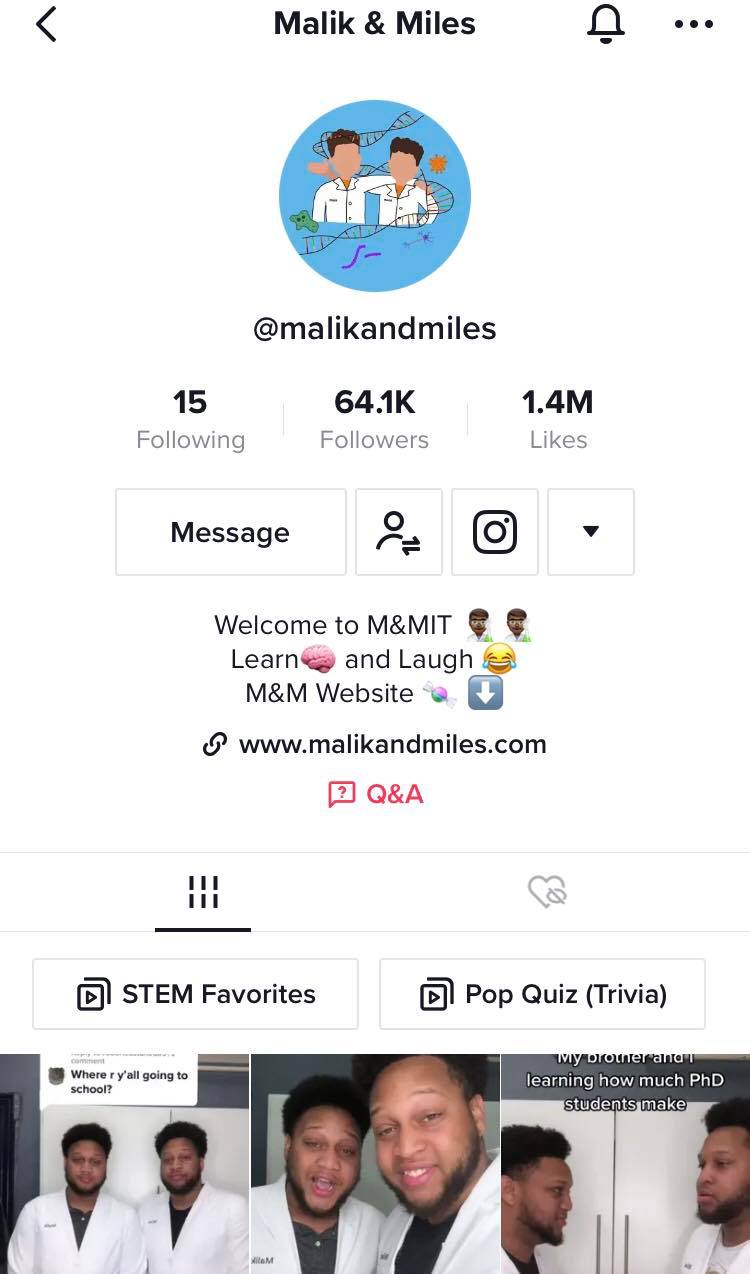
Tik Tok profile page

The brothers will host a private virtual education event for students May 17 in partnership with Microsoft Stores. This session will reach 10,000 students and will feature an inspirational fireside chat, STEM demonstration and interactive Q&A.

The twins strive to be role models for the next generation, to inspire them to follow their dreams.

“In high school we did a lot of science fairs. Being able to count on your hand how many people look like you in a room of over a hundred people, it’s pretty sad,” Malik says. “As we became involved in science ourselves, we wanted to make sure that people saw there are people that look like us in the field and that they can and should feel welcome to do so as well.”

They’re both PC gamers who enjoy comic book universes and socializing with their many friends.

They are part of a tight-knit family, helping their parents with gardening and jigsaw puzzles, watching movies together and doting on the senior Shih-tzu (who is the fifth member of their household).

Two men in lab coats peering through a microscope

But they are also individuals.

Malik is the “explainer.” As his brother shares, “He’s going make sure that if he’s telling you about something, you know everything that there is about the topic and he’s going make sure you understand it at the end of the day.”

“If I’m the explainer, then Miles is the convincer,” says Malik. “You know, he can summarize any topic – no matter how advanced – in a couple sentences to any age group and they’ll understand it.”

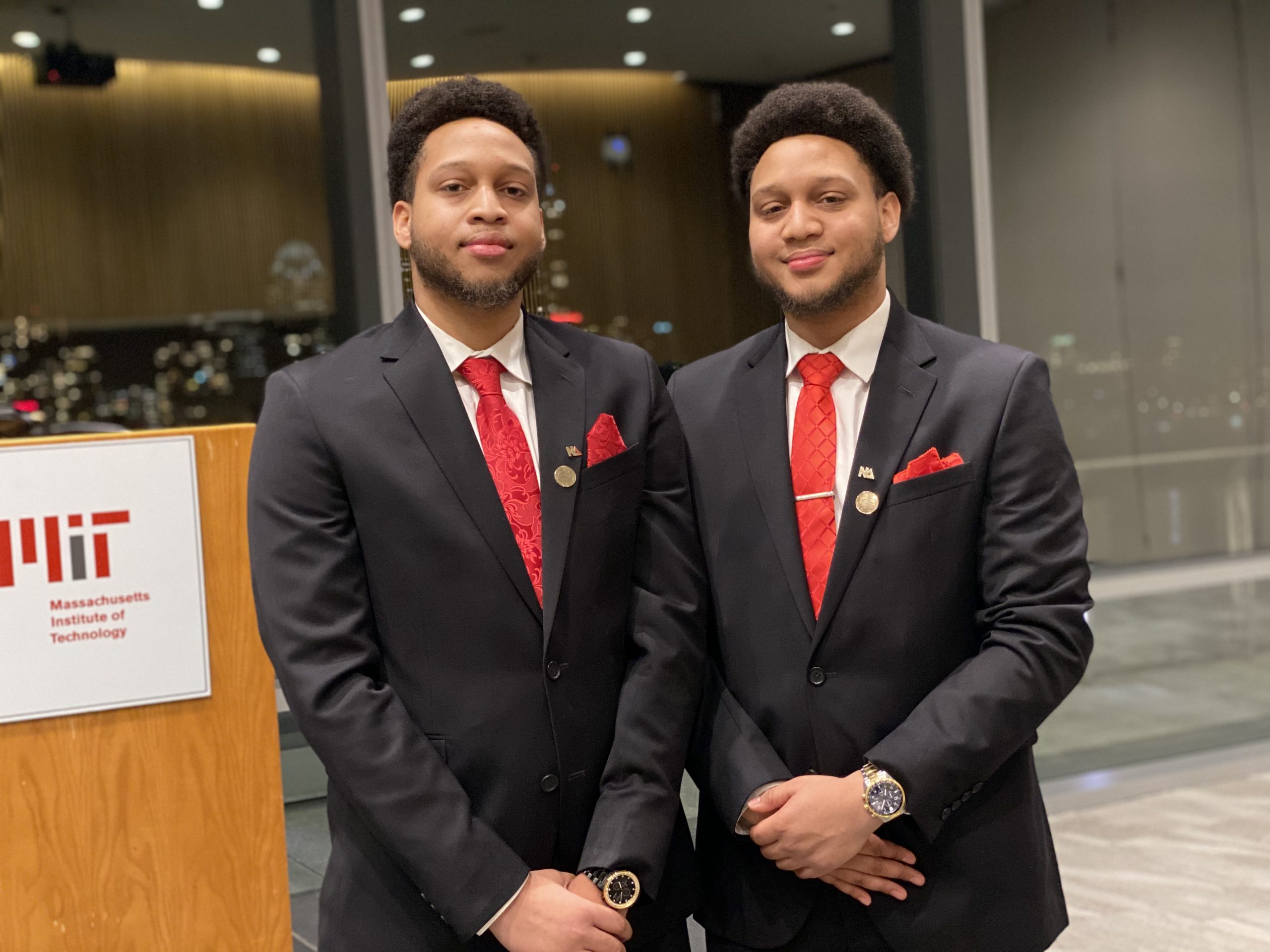
Two men in suits next to each other

This works well when they’re doing presentations, which have reached more than 1,000 students remotely (ranging in age from late elementary school to high school seniors) since January 2021. They’ve been getting more interest about K-12 presentations and plan to continue those.

“I’ll do the intro. He does methods and results. I do the conclusion. He gives you the scientific know-how, how to learn. Then I bring it back at the end,” Miles says.

They also have different work styles – though both are also lifetime PC users. For as long as they can remember, they’ve always been on Windows, starting from their childhood.

“If you were to look at my desktop, you will see at least three applications open at once. If you look at Miles’ desktop, you’ll see one application open, but he’ll have three desktops that he’ll switch between,” Malik says.

Multiple desktops are one of Miles’ favorite Windows 11 features.

“I have one program that I’m focused on. When I’m done focusing on it, I’ll switch to another desktop and that’s what I’m working on then,” he says. “Each assignment gets its own desktop, and I will get to it when I get to it.”

Two men in lab coats sitting next to each other outside

They’ve discovered other Windows 11 features that make them even more efficient.

“As a student, I am constantly searching through emails, especially through keyword search,” Malik says. “I globally search by who sent it or a keyword and it will just show up right there. And I can read it or I can click it and reply from the same place. Windows 11 really takes away flipping back and forth between things. And then anything that you don’t have open, you can also just go through the Start menu.”

They also make great use of Snap Assist.

“I can have an essay snap to the right on Word. I can have some internet research article on the left,” Malik says. “And then if I need to check my email, it would just pop up in the center and I don’t have to cover what I was already working on.”

They like that they can tailor Windows 11 to what works best for each of them.

“It really feels like a personalized experience when I’m online. And it really visually is a much better experience than what I’m used to,” Miles says. “As a researcher, I’m used to a lot of diagrams, a lot of graphs. It really combines multitasking with this beautiful element of note taking and annotating directly on the screen.”

Posted on Leave a comment

Hannover Messe 2022 coming May 30-June 2: Learn how to manufacture a resilient and sustainable future with Microsoft

It’s been a long three years since we last invited you to join us at the manufacturer’s primary showcase event Hannover Messe in Germany, where we last mingled in person in 2019 with 220,000 of our manufacturing colleagues from around the world to share and explore the leadership and innovations on display.

In those three years, we’ve seen manufacturing leaders accelerate their digital transformation journeys as they strive with Microsoft and our industrial ecosystem to manufacture a more resilient and sustainable future for us all. So it’s fitting that as we converge on the home of Industry 4.0 in Hannover Germany, we’re pleased to be joining a community of around 2,200 industry exhibitors to showcase customer, partner, and Microsoft Cloud for Manufacturing solutions for this year’s key theme of “Digitalization and Sustainability.” 

Engage with Microsoft at Hannover Messe 2022 

So, what does Microsoft have in store for you at Hannover Messe 2022, from May 30 to June 2, 2022? Here are five things to put on your calendar and to-do list: 

1. Register for Hannover Messe and visit the Microsoft booth Hall 4 Stand E34, where you can join guided tours, and book meetings with Microsoft executives and manufacturing experts on hand to discuss how Microsoft Cloud for Manufacturing brings together Microsoft Azure, Microsoft 365, Microsoft Dynamics 365, and Microsoft Power Platform capabilities that help: 

  • Build more agile factories. 
  • Transform your workforce. 
  • Engage customers in new ways. 
  • Create more resilient supply chains. 
  • Unlock innovation and new services. 
  • Secure manufacturing solutions from edge to cloud. 
  • Accelerate your sustainability journey.

Sign-up to tour the Microsoft booth.

2. Learn about the “Oscar for the manufacturing industry,” the Microsoft Intelligent Manufacturing Award (MIMA), and meet with MIMA 2021 winners at the Microsoft booth. 

3. Join us at WomenPower on day four. Manufacturing is undergoing a huge transformation. And that transformation is opening a wealth of new opportunities to bring diversity to the industry. Learn why manufacturing is the place to be for diverse talent, and join our workshop session at WomenPower featuring women leaders from Microsoft, customers, and partners. 

4. Meet Microsoft’s co-innovation partners. Addressing the industry’s need for a platform that enables co-innovation and collaboration, our incredible ecosystem of industry partners expands the value of the Microsoft Cloud for Manufacturing with additional solutions to address today’s most pressing challenges.   

Joining us at Hannover Messe in 2022 are ABB, Ansys, Accenture, Avanade, AVEVA, Blue Yonder, Cognite, C3.ai, ICONICS, o9 Solutions, PwC, PROS, PTC, Rockwell Automation, Sight Machine, TCS, and Tulip. 

5. Accelerate your sustainability journey. Join us at the Microsoft booth to learn how to manufacture a resilient and sustainable future. We’ll be showcasing how the Microsoft Cloud for Sustainability empowers manufacturers to accelerate sustainability progress and business growth. We’re partnering with our customers to advance their progress by bringing together a set of environmental, social, and governance capabilities across the Microsoft cloud portfolio in addition to providing solutions from our global ecosystem of partners, such as ABB, AVEVA, TCS, and Wienerberger, the MIMA winner for sustainability. These integrated capabilities allow manufacturers to gain the transparency and insights they need to manage their environmental footprint, embed sustainability throughout their organization and value chain, and create new value in a transforming landscape.  

Our booth features several customers and partners advancing their sustainability efforts. We’ll also feature Microsoft Circular Centers’ use of the Microsoft Cloud for Sustainability and demonstrate how manufacturers can:

  • Unify data intelligence: Gain the visibility required to effectively drive sustainability reporting, sustainability efforts, and business transformation. 
  • Build a sustainable IT infrastructure: Identify opportunities to replace tools, systems, or activities with cleaner options and add business value. 
  • Reduce the environmental impact of operations: Minimize the environmental footprint of your operational systems and processes. 
  • Create sustainable value chains: Facilitate greater transparency and accountability through your value chain, from sourcing materials through the end of use.  

And if you can’t make it to Hannover Messe in person, visit the Microsoft Hannover Messe virtual booth where you can explore on-demand videos, showing how Microsoft is helping manufacturers create a more resilient and sustainable future with Microsoft Cloud for Manufacturing solutions. 

Join us in person at Hannover Messe 2022 

Register for Hannover Messe today. 

Follow us on social and visit our website to stay informed about Microsoft Cloud for Manufacturing to learn how you can help manufacture a more resilient and sustainable future. 

Posted on Leave a comment

Microsoft, NASA and students code for the cosmos

Microsoft, NASA, and students from two HBCUs in the Reston/DC area have completed the maiden mission of a new Microsoft/NASA partnership, STEM Educational Project: AI looking for new Earths.

Using methodology developed by The Microsoft Garage over years of running hackathons, in just one month – and while completing their final exams – the student hackers learned and deployed several new technologies, and quite literally reached the stars by showing they could deploy code to the International Space Station.

According to Piali Ghose, Director of The Garage Reston/DC and host of the event, “This hackathon amplifies the cultural priorities closest to our hearts here at Microsoft and at The Garage because it allows us to continue fulfilling our stated commitments to making a difference, seeking diversity and being inclusive in our work, bringing multiple teams together as ‘One Microsoft’ while collaborating with federal and academic partners, and doing all of this with a growth mindset.”

Planning the mission

The partnership emerged from a shared goal of fostering the future STEM workforce by exposing university students to science, tools, and expertise “at the intersection of Space + Cloud.” By structuring the project as a month-long hackathon, participating students learned how real data scientists work as a team to ideate, develop, and validate their work with a proof of concept.

“Microsoft is in Reston to increase our ability to support government and commercial customers in the region,” Dr. Steve Scallen, Director of University Engagement at The Garage, explained. “The Garage Reston/DC programming creates opportunities for Reston employees to leverage their creativity and encourage collaboration with government customers, local communities, the broader DC tech industry, civic organizations, and education groups and institutions [like HBCUs].”

Microsoft provided “mission control” in the form of volunteer mentors from both the Azure Space and Data and AI teams, and students were also given access to experts at NASA, including Dr. Aprille Ericsson, Dr. Rebekah Hounsell, and Dr. Jon Jenkins. The whole mission was coordinated by The Garage Reston/DC, one of more than a dozen Garage locations at Microsoft campuses around the world, where Ghose worked with Azure Space’s Steve Kitay and Juan Carlos Lopez (formerly a NASA employee himself) to select students and design the mission.

Hackers and mentors from the NASA/Azure Space hackathon meet at NASA's Goddard Space Flight Center. From left: Sr. Azure Specialist Jamal Wade; crew members Demario Asquitt and Mubarek Abdela; The Garage Principle PM Piali Ghose; crew members Getaante Yilma, Anu Uphadhya, and Hridweek Karki; Azure Space Sr. Director Stephen Kitay, Sr. Software Engineer Kevin Mack, Sr. Programming Manager Juan Carlos Lopez; NASA Research Scientist Rebekah Hounsell
Hackers and mentors from the NASA/Azure Space hackathon meet at NASA’s Goddard Space Flight Center. From left: Sr. Azure Specialist Jamal Wade; crew members Demario Asquitt and Mubarek Abdela; The Garage Director Piali Ghose; crew members Getaante Yilma, Anu Upadhyaya, and Hridweek Karki; Azure Space Sr. Director Stephen Kitay, Sr. Software Engineer Kevin Mack, Sr. Programming Manager Juan Carlos Lopez; UMBC’s Asst. Research Scientist Rebekah Hounsell

Kitay, Senior Director of Azure Space, praised the mission in a recent LinkedIn post and said using Microsoft technologies to do work in space is a natural extension of the company’s mission statement. “Microsoft’s mission is to ‘empower every person and organization on the planet to achieve more,’ and [the Azure Space team] has expanded that to empowering every person and organization on and off the planet to achieve more. That’s the purpose of Azure Space: being able to connect to the next generation and helping them be part of the excitement and the industry that we get to be part of, which is bringing space and cloud computing and new technologies together in innovative ways and sharing that with people – particularly people that might not otherwise have the opportunity.”

For Lopez, a Senior Software Engineer, it was also about paying it forward. As the first generation of his family to go to college, he said opportunities like this made a big difference in his own career trajectory. “I’m with Microsoft Azure Space but previously I worked at NASA for a number of years because of a student program similar to this one. So, to me it was about taking my new world at Microsoft and my old community at NASA and bringing them together to create opportunities for students in the same way that I was given those opportunities.”

Packing for the mission and determining launch window

Since 2018, NASA has been operating the Transiting Exoplanet Survey Satellite (TESS), charged with looking for earth-sized planets (exoplanets) orbiting bright stars outside the solar system. The Azure Space team realized that with access to some NASA data and SMEs, they had everything they needed to join the hunt for potential exoplanets, and to bring a few talented students along. Lopez joked that if they do find a planet, “Maybe we’ll call it Planet Azure.”

Dr. Ericsson acted as a mentor to the crew on the NASA side. She said the hackathon was a way not only to learn new skills, but also to learn about the space science industry in general. “I love TESS because it’s a terrestrial planet finder – what cool stuff, right? I think the students got excited about this data and how it fits into the NASA themes. They really are learning a lot more than just a programming application – they’re learning about the larger goals of our organizations.”

TESS observes from an elliptical high earth orbit to produce unobstructed, precise, and continuous measurements of the brightness of a star called lightcurves.
TESS observes from an elliptical high earth orbit to produce unobstructed, precise, and continuous measurements of the brightness of a star called lightcurves. About NASA’s TESS Mission: The Transiting Exoplanet Survey Satellite (TESS) is looking for earth-sized planets (exoplanets) orbiting bright stars outside the solar system. The mission will survey 200,000 of the brightest stars near the sun to search for these transiting exoplanets. TESS was launched in April 2018 aboard a SpaceX Falcon 9 rocket.

Mission control was comprised of Data and AI mentor Taylor Corbett, and Azure Space mentors David Weinstein, Steve Kitay, Kevin Mack, Brad Armstrong, and Tatyana Pearson. This team provided day-to-day and task-by-task guidance by way of regular checkpoints on Microsoft Teams, recorded for any crew members (students) who may have had a conflict with their studies. They also made themselves available after hours when necessary to accommodate the hackers’ school schedules.

Weinstein, the Azure Space team’s Principal Software Engineering Manager, said the space industry is on the verge of massive growth that will require a whole new cohort of computer scientists and other professionals to fill its ranks, both on Earth and in space. That wasn’t the case when he was a student. “In my generation, space was always on my mind, but it was not really a viable career for many people. But with this generation, with the space revolution that’s going on right now, there really is a solid opportunity for a much larger boom and many more career opportunities directly related to the space industry. That’s not on a lot of college students’ radar yet.”

Mack, a Senior Software Engineer with Azure Space, said TESS was a perfect choice for the hackathon format. “We wanted something interesting and compelling for the situation and for the space station, while also looking at something that was very achievable for [the students] in the timespan. The whole goal of this was to empower the students to succeed and empower them to literally reach the stars, so we wanted to make sure that it was something relevant to space, but also something that was attainable and doable.”

Armstrong, also a Senior Software Engineer, agreed, adding that all the data they were interested in is open source and accessible to the public from even a basic laptop. “This problem of trying to find exoplanets is something where the science is already fairly well established and the toolset around that is pretty performant, there’s simply a lot of data that has not been processed yet.”

Mission control pauses for a selfie. Clockwise from left: Lopez, Kitay, Wade, Pearson, Mack, Azure Space Sr. Data Scientist Taylor Corbett; Ghose; Azure Space Principal Software Engineering Manager David Weinstein.
Mission control pauses for a selfie. (Left photo) clockwise from left: Lopez, Kitay, Wade, Pearson, Mack, Azure Space Sr. Data Scientist Taylor Corbett; Ghose; Azure Space Principal Software Engineering Manager David Weinstein. (Right photo) from left: Piali Ghose, Juan Carlos Lopez, Steve Kitay, Dr. Rebekah Hounsell, Dr. Aprille Ericsson

Corbett, a Senior Data Scientist, said the hackathon was exactly the kind of thing he would have been interested in when he was a college student, or even before that. “I’ve been a space nerd my entire life. I still have photos of me at space camp in 6th grade and things like that, so the idea of being able to be part of something where conceivably we could find a new planet, like, who gets to do that?!” he said. “The amazing thing is that [the students] are working with data, models, and methods that weren’t around when I was born. And now here they are working with Microsoft, deploying code onto the cloud and onto the International Space Station.”

Lift-off!

Working with Dr. JiaJun Xu at University of the District of Columbia (UDC) and Dr. Michaela Amoo at Howard University, The Garage set out to identify students with a desire to “Participate in a student project combining Microsoft’s Azure Artificial Intelligence and data from NASA to explore the universe.” All that was required to apply was an intermediate knowledge of some basic coding languages (C#, Python, and Linux) and, of course, the spirit of an explorer.

Five students were selected as “crew members” for the hackathon: Anu Upadhyaya and Hridweek Karki from Howard; and Demario Asquitt, Mubarek Abdela, and Getaante Yilma from UDC.

While the students they selected all study at HBCUs in Washington, D.C., they all come originally from outside the U.S.

Upadhyaya, from Nepal, is a sophomore major in computer engineering at Howard who aspires to be a computer engineer. She was responsible for deploying the mock space station and equipping it with simulated constraints to mirror the environment in space. This included adding bandwidth and latency limits.

“Before this hackathon I had no experience with GitHub, and only a little experience with Python, so for me everything was really new – I learned so many things! We learned how to work with docker containers to create environments where our apps could work in any machine, and we learned about lightcurves and how to use the lightcurve data to create things like Target Pixel Files, periodograms, plots, BLS algorithms, and more. It showed me how things are actually done at NASA. I’m still exploring what I really want to do in my future, which is why I was so excited when Dr. Amoo came with this opportunity.”

By the time they got to their final presentation, however, they were all talking like space scientists. “Once we got the data downloaded and processed from Target Pixel Files to lightcurves, we use the BLS algorithm to transform and fold the lightcurves so they make sense to scientists, allowing them to conclude if a planet exists in a specific area,” said Asquitt, a computer science major in his last year at UDC, originally from Jamaica. “If there’s an inverted parabolic shape in the periodogram, the scientists can be pretty sure there’s a planet there. Basically, we wanted to mimic the environment in space, so we created a virtual machine in Azure that functions as our ground station for processing data sent from the mock space station to our ground station. As soon as we had access to both stations, I could start to run code.”

Yilma, from Ethiopia, is a senior in computer science at UDC and an aspiring software engineer. Part of his contribution was to write scripts to download lightcurve files and transform the data into various formats. He also defined the docker file for the container and deployed the container to the mock ground and space stations using scripts provided in the GitHub repo.

“It was great to learn the hard skills like lightcurve, but one of my biggest takeaways from this hackathon was learning how to take a big problem and break it into smaller chunks. It gave me exposure to what is possible with Azure and this kind of computing – it was a great experience,” Yilma said.

Crew members present their solution to mission control at the hackathon closing ceremony. From left: Demario Asquitt, Hridweek Karki, Anu Uphadhya, Mubarek Abdela, Getaante Yilma
Crew members present their solution to mission control at the hackathon closing ceremony. From left: Demario Asquitt, Hridweek Karki, Anu Upadhyaya, Mubarek Abdela, Getaante Yilma

Measuring success and coming in for a landing

According to Mack, the crew completed their mission the moment they proved they could deploy their own code to a space station. “One of the goals of the [Azure] Space team is really to democratize space and make it easier for people to get there. And to me, there’s a big check box there of a student getting code to space – that is an example of how we’re making it easier and pushing the ‘art of the possible.’ Not only do we think it’s possible, but it didn’t take 16 PhDs to do it. It took five students that are about to graduate.”

Karki is originally from Nepal and studies computer engineering at Howard. Before this hackathon, he had been a member of his high school astronomy club but that’s as close as he had gotten to NASA, or to learning from working space scientists.

He summarized the experience and the crew’s learnings like this: “The hackathon really made a big impact on all of us, and definitely raised our interest about future opportunities in space. We now all have a knowledge base and a better understanding of the possibilities for us in astrophysics, TESS/Kepler data, and finding exoplanets or even life beyond Earth. It was really exciting to learn the science behind what we were doing, like why we were folding these lightcurves. The other big thing I learned from this was when to ask questions, and what to look for when you get stuck. This also gave me a greater appreciation of mentorship, so I want to thank [mission control] for being there for us.”

It wasn’t all smooth sailing – the crew had difficulty initially in setting up the virtual environments, connecting to the virtual machines, and in one case, finding that their downloaded target pixel files were corrupted.

Abdela, a senior computer science student at the University of DC also originally from Ethiopia, said it best: “We want to thank everyone that supported us through this journey. For providing us this opportunity in the first place, but also for making sure that we were supported every step of the way. And that also meant a lot of hours, even hours outside of working time. Kevin, Brad, and the whole team are just so amazing. They were able to meet us where we were, explaining a lot of complex things in a very simple way which is helpful for people that are just starting out. Being just a text away for any issues that we face – we really, really appreciated that.”

Lopez said he hopes the students will keep in touch, whether they are planning for a career at Microsoft, NASA, or elsewhere. “This is not a goodbye. We already have the Space Act agreement with NASA, so this is just the first of many hackathons that we’re going to run together. I would love for you all to come back next year as mentors for the students that will come after you so that you can continue your relationships and continue being connected.” All of the students were encouraged to connect and continue their discussions on LinkedIn, where Lopez also shared a post to mark the finale.

Ghose closed by inviting the students back to The Garage Reston/DC for its grand opening next month. You can see more of her thoughts about the hackathon on LinkedIn. She also thanked the many groups at Microsoft that coalesced to make the event a success behind the scenes, including Blacks at Microsoft (BAM), members of the Federal Accounts team, and Microsoft’s legal team.

Congratulations to the crew on a successful mission, and huge thanks to mission control and the countless mentors and support staff at both Microsoft and NASA that came together to make it possible for them to send code to the cosmos and reach the stars.

More about Microsoft and NASA partnerships:

Posted on Leave a comment

Meet Graham, a 12-year-old boy who has some new tricks for excelling at school

Meet Graham, a 12-year old with a neurological condition that makes him unable to read or write. With the help of Microsoft features like Windows text-to-speech and Immersive Reader, Graham went from being dependent on others to taking control of his education. He’s even running his own business.

Learn more about Graham and some of the ways teachers are using technology to help address inequity in the classroom on Microsoft Stories.

Posted on Leave a comment

How accessibility tools can help kids do more in school

Meet Graham, a 12-year old with a neurological condition that makes him unable to read or write. With the help of Microsoft features like Windows text-to-speech and Immersive Reader, Graham went from being dependent on others to taking control of his education. He’s even running his own business.

Learn more about Graham and some of the ways teachers are using technology to help address inequity in the classroom on Microsoft Stories.