Posted on Leave a comment

Fedora Hummingbird: Taking the Hummingbird model to the full operating system

At Red Hat Summit 2026, we’re announcing Fedora Hummingbird — a new container-based rolling Fedora Linux distribution. This distribution provides access to the latest software as soon as it’s available upstream, which ensures that it’s up to date and secure.

Fedora Hummingbird primarily utilizes an image-based workflow, similar to containers, but also runs in virtual machines and even on bare metal. If you’ve been following Project Hummingbird‘s work on container images, or Project Bluefin’s work on the operating system, you already know the model. Fedora Hummingbird applies this model all the way down to the host OS.

The foundation for Fedora Hummingbird already ships today from the Hummingbird containers repository. You can pull and boot it right now.

What is Project Hummingbird?

The central goal of Project Hummingbird is to get as close to zero CVE reports as possible in every container image it ships, and to stay there continuously. The team made every architectural decision, including distroless images, minimal package footprints, hermetic builds, and the degree of pipeline automation, in service of that goal. “Distroless” means no package manager, no shell, just the application and what it strictly needs to run.

Why does this matter? When you pull a third-party container image today, you inherit its vulnerabilities and you’re on the hook for managing them. Pull a Hummingbird image and the team’s pipeline has already done the CVE triage, the patching, and the rebuild – you get to skip CVE hell. (If you’re curious, current CVE status across all images and variants is published live at the Hummingbird catalog).

Over the past eight months, the team has built a catalog of 49 unique minimal, hardened, distroless container images (that’s 157 variants including FIPS and multi-arch) covering Python, Go, Node.js, Rust, Ruby, OpenJDK, .NET, PostgreSQL, nginx, and dozens more. Distroless means no package manager, no shell, just the application and what it strictly needs to run.

How it’s built

The infrastructure behind this is a Konflux-based pipeline. It uses fully isolated, reproducible builds from pinned package lists, efficient incremental updates via chunkah (a tool the Hummingbird team built to ensure the system re-downloads only changed parts of an image), and continuous vulnerability scanning via Syft and Grype. When a vulnerability is patched upstream, the pipeline finds it, rebuilds, tests, and ships.

95%+ of the packages in every Hummingbird image come straight from Fedora Rawhide, unmodified. The build system pulls the remaining packages directly from upstream when Rawhide doesn’t yet carry them or isn’t new enough, and the team contributes changes back into Fedora. If that sounds like Fedora CoreOS, that’s because it’s a related idea, but serving a different use case. CoreOS is a minimal host for orchestrated workloads. Hummingbird serves developers who need to deploy multiple versions of runtimes (Python 3.11–3.14, Go 1.25–1.26, Node.js 20–25) in parallel and manage each version’s lifecycle independently.

The Hummingbird factory independently builds packages so they carry their own identity. This means each package can have a separate life cycle, patching policy, and CVE feed (specifically, a vulnerability feed that Red Hat’s Product Security team maintains). Every package ships with machine-readable vulnerability data that tells you not just which CVEs exist, but which ones actually affect your workload.

The OS as a container image

The challenges that Project Hummingbird seeks to address in userspace exist at the OS level as well, so we want to apply the same approach to addressing those challenges. This is where Fedora Hummingbird comes in. This image is already live at https://quay.io/repository/hummingbird-community/bootc-os. The team delivers this full Linux OS as an OCI image, and they build it using the same Konflux pipeline and hermetic RPM-locking approach as the rest of the Hummingbird catalog. Multi-arch: x86_64 and aarch64.

Under the hood, Fedora Hummingbird will use the ARK kernel (Always Ready Kernel) from the CKI project (already running in Fedora today) which tracks Linus’ mainline directly. The benefit of leveraging the CKI project is the curated kernel configuration and elaborate engineering framework that includes extensive testing around a fast-moving kernel stream.

The Fedora bootable containers initiative laid out the groundwork for all of this. The idea is that the OS is an OCI image, built and distributed like any other container, and updated atomically with rollback built in. No partial update states. No configuration drift. The root filesystem is read-only. Any writeable state lives in /var and /etc, cleanly separated from the OS content.

The Hummingbird bootc OS image boots today. What’s still in progress is the integration work. The image is currently a mix of Hummingbird-built RPMs and Fedora packages, and we’re working out how to bring the two closer together. That’s exactly the kind of work we’d love to collaborate on.

Hummingbird in the Fedora community

Many members of the Hummingbird team are already Fedora contributors and package maintainers – maintainers of Podman, and other container tools that Fedora and the broader Linux ecosystem depend on, as well as maintainers of Fedora CoreOS. Members of the Fedora community contributed the bootable containers work that underpins Fedora Hummingbird. Now those members are continuing the work as part of Hummingbird. Moving forward, we’d like to make Hummingbird a part of the Fedora Project so that it can benefit and grow within that same community.

The Hummingbird pipeline already builds and publishes a set of container images based entirely on Fedora Rawhide at quay.io/organization/hummingbird-rawhide. The team has already started bringing improvements back to Fedora. These include container-specific optimizations, bugs found in .spec files, and more. The vulnerability feed that ships with Hummingbird packages is something we think could benefit the broader Fedora ecosystem too.

Getting started

Here are some quick-start instructions for getting a virtual machine up and running:

1. Create the image

sudo podman run --rm --privileged --pull=newer \ --security-opt label=type:unconfined_t \ -v /tmp/bib-config.toml:/config.toml:ro \ -v /var/lib/libvirt/images:/output \ -v /var/lib/containers/storage:/var/lib/containers/storage \ quay.io/centos-bootc/bootc-image-builder:latest \ --type qcow2 --rootfs ext4 \ quay.io/hummingbird-community/bootc-os:latest

2. Rename the image

sudo mv /var/lib/libvirt/images/qcow2/disk.qcow2 \ /var/lib/libvirt/images/fedora-hummingbird.dc2.crunchtools.com \ && sudo rmdir /var/lib/libvirt/images/qcow2

3. Create a virtual machine

sudo virt-install --connect qemu:///system \ --name fedora-hummingbird.dc2.crunchtools.com \ --memory 4096 --vcpus 2 \ --disk /var/lib/libvirt/images/fedora-hummingbird.dc2.crunchtools.com,format=qcow2 \ --import --os-variant fedora-unknown \ --network network=default,model=virtio \ --graphics vnc --noautoconsole

Get involved

When you’re ready to try it, there’s no registration form, no subscription-manager, no entitlements required. The code is already there and the pipeline is already running — we’d love more eyes on it. Here’s how to jump in:

  • Try the image: You can find instructions on using the image on Quay
  • File issues and feedback: anything broken, missing, or surprising is worth reporting at this stage
  • Contribute: the project currently lives at gitlab.com/redhat/hummingbird/containers — establishing a home in Fedora’s own infrastructure is part of the work ahead
  • Join the conversation: visit the SIG page for info on our getting-started sessions.

Fedora has always been where the community proves out new Linux ideas before they matter everywhere else. Fedora Hummingbird is an experiment for image-based, continuously-maintained operating systems, and we think it’s ready for the community to kick the tires.

Posted on Leave a comment

Intel Inside and out: Apple’s four decade long relationship

Apple relationship with Intel goes far beyond ads mocking the chipmaker, and a high-profile CPU shift in 2006. Here are all the ups and downs in Apple and Intel’s relationship going back over 40 years.

Apple is currently in the middle of its Apple Silicon era, using its own-designed chips in its Mac lineup and other products. Before Apple Silicon, it relied on Intel to provide processors for its Macs.

There’s a chance that it could happen again.

That was a relationship that spanned multiple decades, from Apple’s 68000-series processor days, through PowerPC, all the way to the release of the first M1 chip under Apple Silicon.

It was one that was profitable for both sides, but also turbulent at times. Ultimately, directly or indirectly, Intel is one of the reasons why Apple’s Mac lineup is the powerhouse that it is now in May 2026.

Early fumbles

The Apple-Intel story starts back in 1985. After co-founder Steve Jobs had left the company, there was a proposal to shift Apple away from the Motorola 68000 series, and onto Intel chips.

Apple leadership shot that down. Instead, it was an idea that stuck around in the background, waiting to resurface. The next effort didn’t wait 40 years to 2026.

That next time turned out to be just a few years later, in 1992, with the wildly popular release of Microsoft Windows 3.1. The operating system was a serious threat to Apple and Novell, with the latter fearing potential issues with NetWare.

For Apple, Windows served as a different danger. Windows PCs were cheaper for corporate customers and consumers to buy versus Macs. And, a WYSIWYG graphical interface changed everything for users who were still shifting away from Linotype typesetting machines, and typewriters.

Novell’s initial response was to modernize Digital Research’s GEM, a GUI for the Atari ST, and to make it a rival operating system to Windows. That project was canned due to what they saw as a risk of being sued by Apple.

Darrell Miller, Novell’s VP of marketing, then proposed to Apple CEO John Sculley that Mac OS could be ported to work on Intel’s chip architecture. Sculley took the bait, since making Apple a software company had the potential to be profitable, especially when turning away from the relatively expensive hardware side.

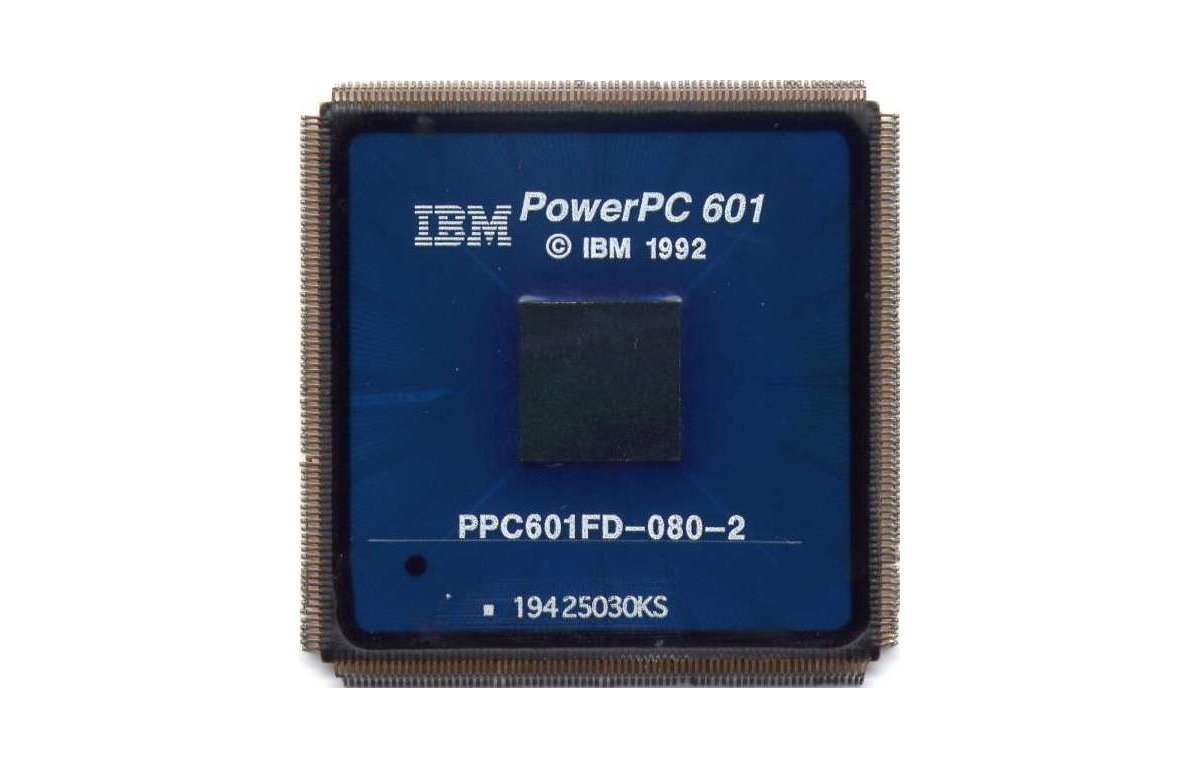
Square IBM PowerPC 601 microprocessor from 1992, blue top with central black chip area and white labeling, surrounded by fine metallic pins along all four edges

IBM’s PowerPC 601 CPU – the first PowerPC CPU used in Macs.

The project started on Valentine’s Day, 1992. It was codenamed “Star Trek,” with the goal of porting Mac OS to Intel’s 486 architecture. Even Intel CEO Andy Grove was interested, since it could cut Microsoft’s dominant power in the PC market.

The engineers working on the project had a tough time, since a lot of Mac OS was written in 680×0 assembly code, and had to be rewritten to work on the 486. There was also the problem of Mac OS relying on ROMs for Macs, which were too cost-prohibitive to recreate on PC.

Eventually, this was done by recreating the ROMs in software. They got it to work then, and then dusted off again as part of the 1998 iMac.

For “Star Trek,” there was an initial deadline of October 31, 1992, to get the project working as a prototype. They didn’t quite make that deadline. By December 1, 1992, the team had completed a functional demo and even ported QuickDraw GX and QuickTime, too.

Despite the seeming success of the team, the project was put on hold. By then, Sculley was out and Michael Spindler was in as CEO, and decided to instead put Apple’s resources into System 7.

“Star Trek” worked. Apple execs said no.

The second attempt

The transition picked up again following the acquisition of NeXT by Apple. The 1997 purchase heralded a number of changes at Apple, including the return of Steve Jobs, but also Apple’s sudden ownership of the NeXT operating system, NeXTSTEP.

While Apple hadn’t ported Mac OS to Intel at the time, it did have NeXTSTEP on hand, which it started to turn into the successor of Mac OS.

At the time, Jobs had pitched PC maker Dell on the concept of making a Dell Intel PC that would run Mac OS. While Dell was receptive to the idea of paying a license fee for every PC sold with the Mac OS, Jobs decided that it would be better to install both Windows and Mac OS everywhere, and for licenses to be bought for every single PC sold by Dell.

Dell declined. This, and killing off clones, prodded Apple into reworking the Mac lineup. This effort culminated in the brightly-colored Mac lineup that launched in 1998.

This didn’t stop Apple from continuing to iterate the concept, including talking to Sony in 2001 about its Vaio line.

The work to embrace Intel intensified in 2002. Engineers started working on project “Marklar,” to improve the internal Mac OS X builds compatible with X86 architecture.

Bunny People and snails

This was all against the backdrop of Intel intensifying its marketing campaigns against Apple. This included stunts like marketing to Apple users in MacWorld and other publications for years. However, Intel struck gold in 1997 with the Bunny People.
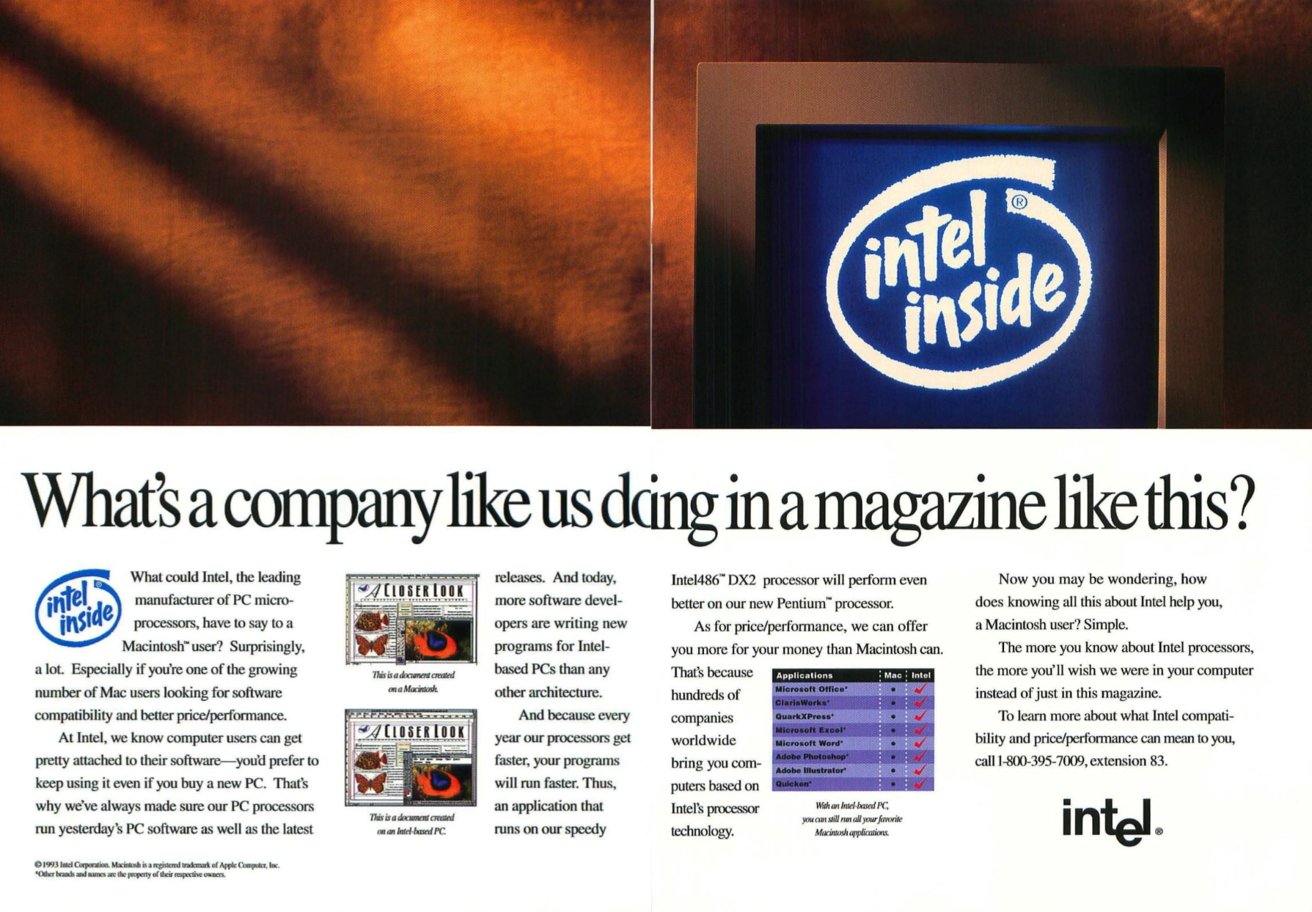
Vintage Intel advertisement showing large

An Intel ad in MacWorld, December 1993

The colorful clean suit-wearers became a major marketing tool for the chip maker for years, thanks to its impactful Super Bowl ad. It led to mountains of ads, showing dancing wafer handlers promoting the Pentium chip range.

Apple took on this advertising juggernaut with its own parody. The “Toasted Bunny” ad from 1998 used a smoldering version of the Intel character, declaring its Power Mac G3 was twice the speed of Intel’s Pentium II chip.

This ad aired during ABC’s prime time and was made by TBWA Chiat/Day, the same people behind the famous 1984 commercial.

This wasn’t the only attempt at attacking Intel’s Pentium II launch with retaliatory advertising. A second “Intel Snail” spot also made by TBWA Chiat/Day had, predictably, a snail wearing the Pentium II as a visual representation of how slow the chip was versus the G3.

While Apple took aim with the Bunny People to attack Intel, it wasn’t the last time either. Years later, an ad reused them to promote Intel chips in Macs, albeit in a much more serious and less colorful fashion.

Finally, a transition to Intel chips

It was around this time that rumors floated about Apple making the transition over to Intel for its own hardware. Apple held off, but eventually made the announcement in June 2005 at WWDC.

In announcing the change, Jobs was clear about reservations he had about PowerPC’s pipeline. Instead, he praised the product roadmap Intel had. It was very much a play to try and get the Apple faithful to accept the change, despite Intel’s inherent closeness to Microsoft and Windows.
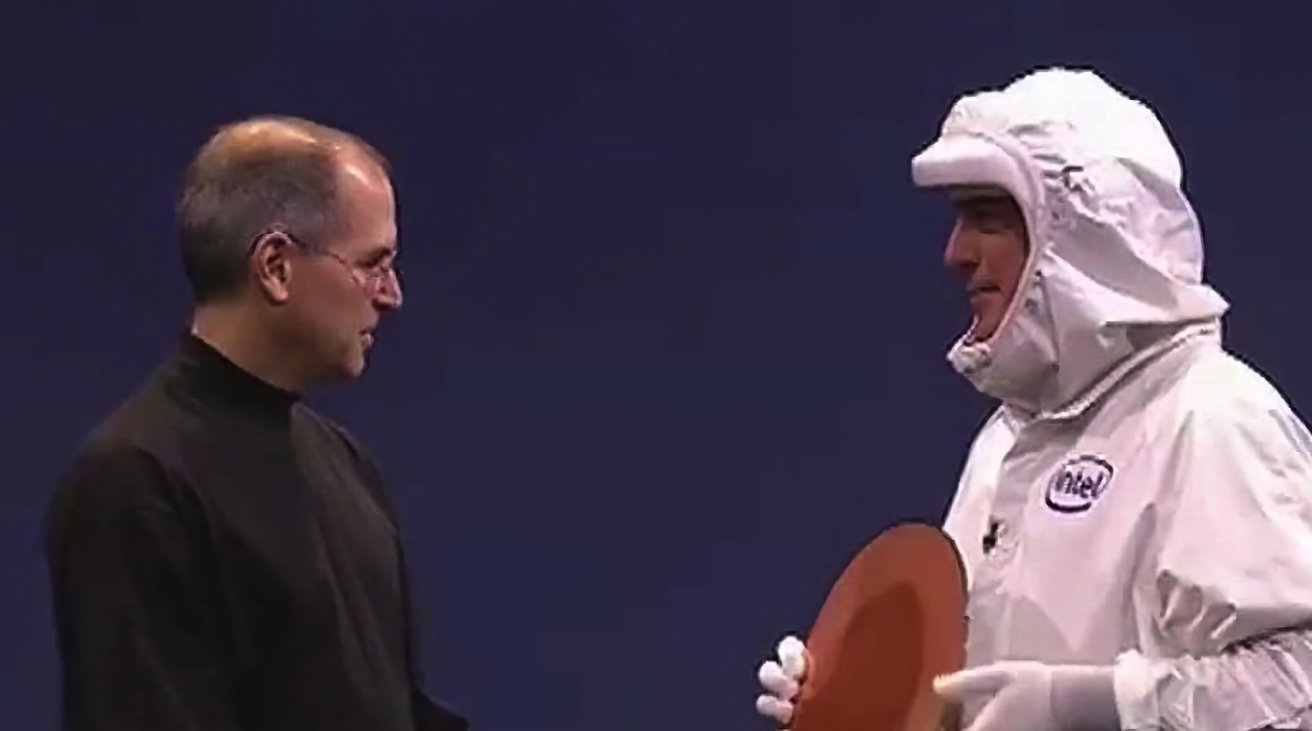
Two men on stage: one in a black turtleneck, the other in a white Intel cleanroom suit holding a large circular silicon wafer against a plain dark background

Steve Jobs announcing the Intel switch in 2005

The transition took place over two years, and started with Apple introducing a Developer Transition Kit. This included a prototype Mac with an Intel chip and initial versions of Mac OS X Tiger.

The kit was accompanied in 2005 by Rosetta, a translation tool that could run PowerPC apps on Intel Macs without recompilation. Initially, Rosetta didn’t match PowerPC performance, but that only lasted about two years, until Core 2 Duo machines advanced.

There were some issues with the transition. Without delving too deeply into them, there were some Endian issues that caused some early incompatibility issues and some developer workload in porting PowerPC software to the Intel version of macOS. Also, the Core Duo processor was 32-bit, when the G5 was 64-bit until that Core 2 Duo shipped.

Over 2006, Apple rapidly brought out versions of its hardware using Intel chips, including an iMac, 15-inch MacBook Pro, Mac mini, and a 17-inch MacBook Pro.

There was also the April 2006 introduction of Boot Camp, software that allowed owners of Intel Macs to install Windows on their devices.

Despite the speed of the transition, Apple didn’t give up on PowerPC for a while. Three years after the end of the transition in 2009, Apple released Mac OS X Snow Leopard, which required an Intel Mac to function.

By the release of Mac OS X Lion in July 2011, Apple removed Rosetta support, forcing current-gen Mac users to fully embrace the architecture.

Turbulence and rumors

In the following years, the Intel-Apple relationship went reasonably well, with Apple regularly including Intel’s new chips in its Mac lineup. It was enough to help Intel recover from the dot-com crash and give the chip maker more strength in the market.

It even benefited enough to make a $1.4 billion acquisition of Infineon’s wireless division. The deal made Intel a component supplier for the iPhone, though Apple later shifted its baseband supplies to Qualcomm not long after.

It was also around the time when Intel had issues with its Sandy Bridge chips, which also affected shipments to Apple for use in its Mac lineup.

In 2011, the relationship deepened with Apple deciding to adopt Thunderbolt, Intel’s cable-based communications technology that boasted massive amounts of bandwidth. That was a connection that Apple has since continued to use in its products.
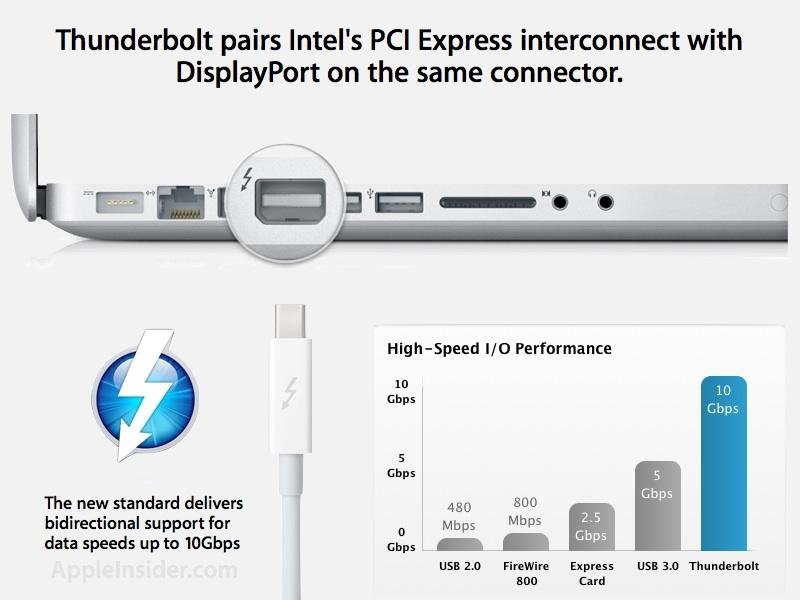
Apple laptop side view highlighting a Thunderbolt port and cable, with text and chart comparing highspeed I/O performance, emphasizing Thunderbolt's 10 Gbps bidirectional data transfer advantage over USB and FireWire

An early promotional image for Thunderbolt

That same year, there were the fvery first rumors that Apple was considering a move to ARM-based chips instead of using Intel processors. Its mobile A-series chips were impressive enough on iPhone, but it wasn’t the time for Apple to switch chip tech again.

This happened around the same time as Apple found the power consumption of Intel’s chips to be too much. Apple told Intel that power usage had to be cut, or else Apple would look elsewhere for its chips. And, then there was the massive heat issues, exacerbated by Apple’s need for thinner and quieter hardware.

The following year saw Intel field more complaints, including claims from ARM that Intel’s Atom chips were underwhelmingfor mobile use.

Early in that year, CEO Tim Cook hinted that Apple wasn’t happy with its Intel partnership, and that moving to ARM CPUs on Mac was a possibility. The same chips as used in the iPad and iPhone at the time.

This prompted Intel into declaring it would make mobile chips that Apple simply “can’t ignore.” It wanted to compete against the A-series chips Apple was using in the iPad, which was rising in popularity at the time.

It wasn’t enough to quell the rumors that Apple deliberated moving away from Intel, though. A change was viewed as “inevitable” by analysts, but was still far away from becoming a reality.

As the years rolled on, Intel insisted it was getting closer to Apple and the relationship was positive. It was also pushing to try and gain orders for baseband chips from Apple, but the Qualcomm connection was too great.

By 2015, Ming-Chi Kuo was forecasting Apple could ship A-series Macs within two years. That was a prediction that was a little bit optimistic, and both too early and four years later than the first rumors, but did eventually come true.

Intel CEO Brian Krzanich responded by reiterating the “strong” relationship and that Intel would retain Apple’s custom by innovating. All to a backdrop of massive billion-dollar mobile losses on Intel’s side, which it hid by changing how it reported its financials.

While the rumors of Apple jumping ship were well-grounded speculation, Intel couldn’t cover up a series of problems towards the end of the relationship.

This included switching from its famous tick-tock development strategy to a tick-tock-tock version, optimizing the chip production process so generations could last for longer.

And frankly, tick-tock-tock was optimistic.
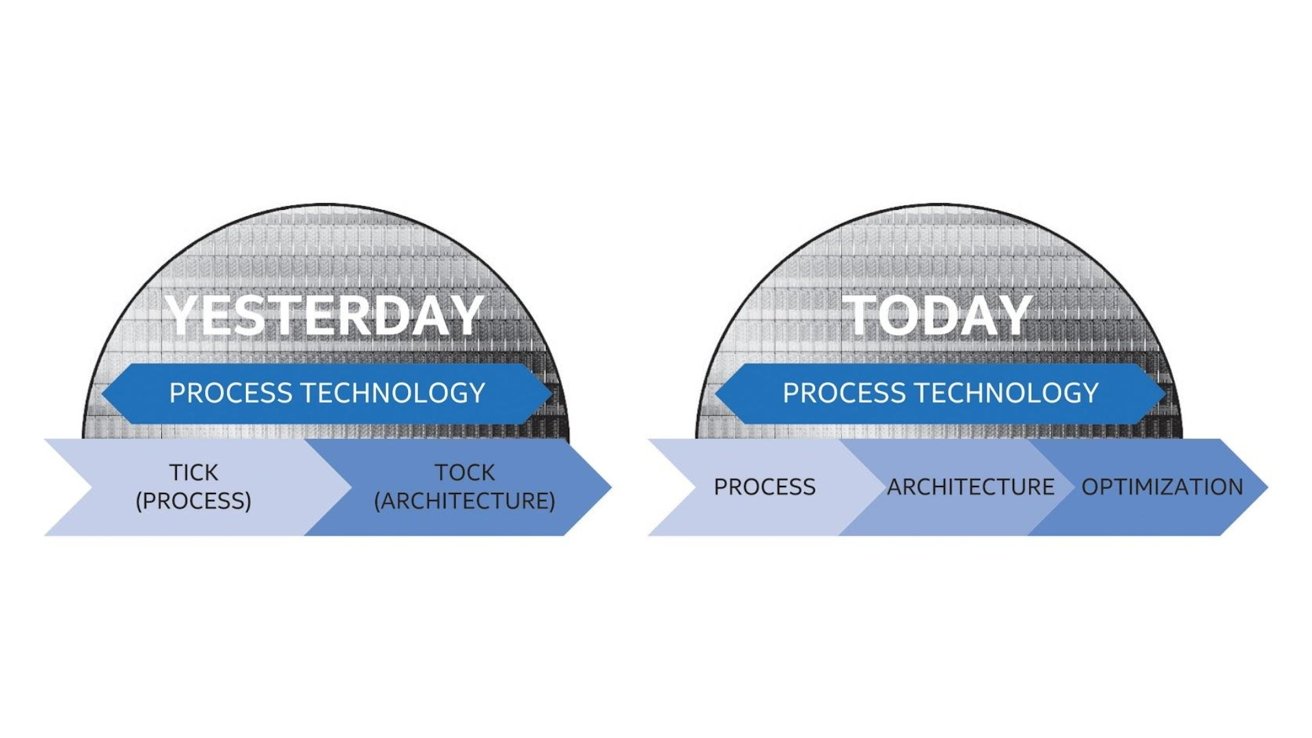
Sidebyside comparison of Intel chip development: left labeled Yesterday with Tick Process and Tock Architecture; right labeled Today with stages Process, Architecture, Optimization under Process Technology.

Tick-Tock disappeared in favor of Tick-Tock-Tock for Intel’s architectures.

Later on, there was the infamous delays of Cannon Lake, Intel’s 10nm generation. This was an issue for Apple, as it harmed its plans to sell a MacBook Pro with 32GB of memory, without needing a dedicated memory controller.

It did eventually ship in 2019.

That was followed by the 2018 chip kernel flaw, which required Apple and others to make an OS-level fix, affecting the performance of all Macs. More flaws were later found, making the situation even worse for Intel.

However, by early 2019, even Intel had admitted that the writing was on the wall. Officials believed that ARM Macs were destined to arrive as soon as 2020, and there was little Intel could do about it.

That year also saw yet another chip vulnerability that Apple had to mitigate, forming another nail in the coffin.

It was also around this time that Apple made a considerable acquisition from Intel. After repeatedly trying to convince Apple to buy its modems for the iPhone, Intel effectively gave up and sold its modem arm to Apple for $1 billion.

The purchase was a massive change for Apple, which has slowly been bringing the design of its important components in-house. The fruits of Apple’s labor would take years to emerge.

Apple Silicon and a rumored return

The introduction of Apple Silicon and the two-year transition in WWDC 2020 was not quite the death knell for Intel’s work with Apple. While Apple was moving over to Apple Silicon, Intel insisted it would still be friendly to Apple throughout the period.

The actual process of rolling out Apple Silicon closely echoed the introduction of Intel Macs. This included Apple rapidly bringing out models that used its new chips, gradually replacing Intel counterparts on the roster.
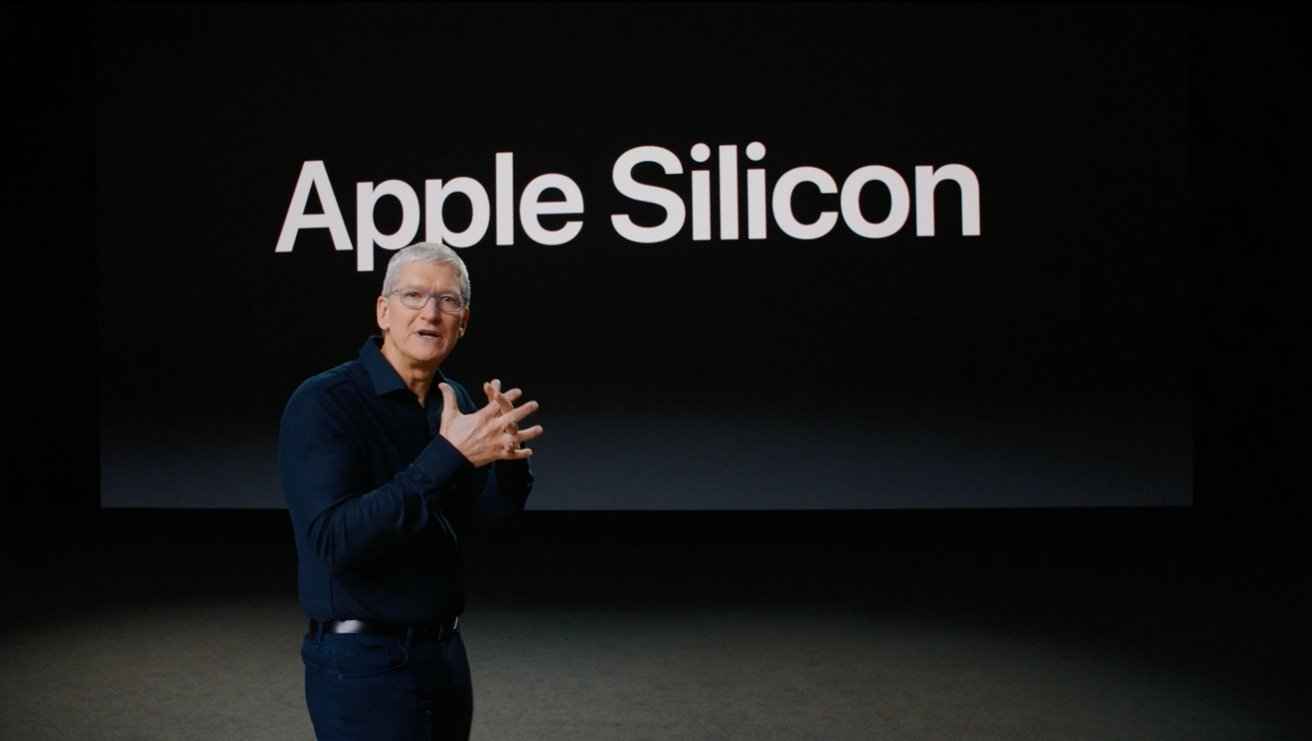
Man in dark clothing speaking onstage in front of a large black screen displaying the white text Apple Silicon

Apple CEO Tim Cook introducing Apple Silicon in WWDC 2020

There was also the Developer Transition Kit that included an A12Z chip inside a Mac mini. There was also Rosetta 2, which was used to allow apps made for Intel Macs to run on Apple Silicon, which will be going away in 2027.

The Mac Pro was the last Intel Mac on the roster, and eventually that left in favor of a short-lived Apple Silicon counterpart.

Losing Apple and changes in the market in general, including Microsoft making noises about making its own chips, forced Intel to consider alternative pathways beyond selling its own chips.

Of course, this introspection wasn’t just internal. It also involved public attempts to win back Apple by saying it can do better.

In January 2021, just after the first public Apple Silicon releases, Intel CEO Pat Gelsinger declared to employees that the company had to do better with its own chips than “a lifestyle company in Cupertino.”

What followed were attempts to smear the well-received Apple Silicon, including releasing presentation slides with carefully-chosen benchmarks showing that Intel was better in very specific ways.

There was also the odd “You’re not on a Mac” advertising campaign, which also roped in Justin Long.

Despite the public tantrum, Intel was still working on a way to compete with chip foundry rivals like TSMC, which was Apple’s chief partner. Intel created a Foundry Services arm in 2021 to produce chips designed by others, under a $20 billion investment.

This was obviously a play to secure business from Apple. If it can’t sell chips of its own design, Intel would instead make what Apple creates.

Intel first got business from Qualcomm and Amazon, which was a healthy start.

Of course, while it was trying to court Apple, Intel couldn’t help but to deliver potshots with a weird “social experiment.” All while CEO Gelsinger insisted it could win Apple back with a “better chip.”

Along with a plan to build a $20 billion chip factory in Ohio, Intel was still so keen to make things for Apple that leadership said it would “never stop trying to get Apple to be a customer again.”

By 2025, rumors were circulating that it was actually happening, including murmurs of a joint venture between TSMC and Intel in the United States. Apple was also tipped by Ming-Chi Kuo to be tapping Apple for the M7 chip in one late 2025 forecast.

There was even talk of Intel’s foundry producing A-series chips for the iPhone, as Apple considered spreading the risk instead of sticking to just TSMC.

This became more of a reality at the start of 2026. The demand for chips by the AI industry meant that foundries like TSMC were fully booked up, limiting the capacity for Apple’s chip production runs.

It forced Apple into looking elsewhere, and to seriously consider using Intel’s services once again. This time on its own chip designs.

With a greater push for U.S.-based manufacturing, as well as the U.S. government buying a 10% stake in Intel for $9 billion, the terms are more attractive for Apple to take up Intel’s offer.

Sure, there’s the very real prospect of having Intel-fabricated chips in Macs once again. But for the first time, it certainly won’t be using Intel’s chip design.


Posted on Leave a comment

Review: Indiana Jones And The Great Circle (Switch 2) – An Authentic Indy Adventure Arrives In Fine Form

Indiana Jones is a multi-generational icon, and the weight of developing a new entry in the franchise must be as intimidating as a rolling boulder. He’s a character that has permeated every facet of media since he first found the Ark of the Covenant back in 1981.

The impact of his legacy in video games cannot be understated, either. After all, medium-defining icon Lara Croft and her tomb-raiding contemporaries would not exist without Henry Jones Jr. setting the standard. Indy’s own videogame outings have been mixed, with plenty of misfires (I’m looking at you, Staff of Kings) and at least one classic in 1992’s Fate of Atlantis. Now, MachineGames has a (whip) crack at the character, bringing the cinematic storytelling and brutal action it honed with its Wolfenstein cycle, to create a genuine blockbuster of a game.

Indiana Jones and the Great Circle Review - Screenshot 1 of 5
Captured on Nintendo Switch 2 (Docked)

Indiana Jones and the Great Circle perfectly embodies the old-fashioned adventuring spirit that makes the series such an enduring cultural presence. Following its Xbox debut in 2024 and PS5 port in 2025, thankfully, it arrives on Switch 2 in a state as handsome as ’80s-era Harrison Ford, complete with the odd scar or two.

After a tutorial that lovingly recreates the iconic opening of Raiders of the Lost Ark, we rejoin Indiana Jones in 1937 as he investigates a break-in at Marshall College. A mysterious symbol worn by an imposingly large thief (played by the late, great Tony Todd) sends him to Vatican City. There, he teams up with Journalist Gina Lombardi and uncovers a secret conspiracy to protect a geographical phenomenon known as the Great Circle.

This being 1937, you can bet the Nazis want to harness the supernatural power behind these interconnected sites of intrigue. From Rome, Indy travels to Egypt, Siam, Iraq, and several other locations around the globe, attempting to protect the secret of the Great Circle from a villainous archaeologist and his swastika-wearing buddies.

A first-person adventure, the main campaign is big in every sense of the word, with a good balance of exploration, combat, and archaeological puzzling. There’s a surprising amount of visually diverse locales filled with side quests and collectibles. MachineGames builds on the semi-open-world design it experimented with in its previous titles, making each location Indy visits a hub of activity and discovery. Every level has a clear identity, right down to the local delicacies that give Indy a boost of health and stamina.

Indiana Jones and the Great Circle Review - Screenshot 2 of 5
Captured on Nintendo Switch 2 (Handheld/Undocked)

Progressing the story is required to fully unlock these areas, but plundering each map for everything it has will significantly extend the game’s lifespan beyond the 15-20 hour main adventure (“it ain’t the years, honey, it’s the mileage”). It’s also worth noting that the Order Of The Giants DLC is available (though not included) at launch and brings a five-hour story that has Indy exploring Roman catacombs.

These beautiful locations are not just populated by opulent buildings and diverse wildlife; they are crawling with enemies. Disguises help Indy move through areas safely, but there will be times when you need to poke around areas you shouldn’t. Professor Jones can either sneak around or confront bad guys head-on.

Sneaking is usually the smarter option, as raising an alarm will send a battalion of jackboots swarming his position. Indy is not BJ Blazkowicz; he cannot dual-wield automatic weapons, and ammo is usually not plentiful on Egyptian dig sites.

When stealth fails, melee combat becomes your go-to for dispatching enemies. This is where Indiana Jones and the Great Circle really sings. The loud crash of a fist impacting someone’s face will be familiar to anyone who has enjoyed Indy’s cinematic adventures. Then there’s the satisfying crack of his trusty whip as it disarms an enemy, leaving them open to attack with anything handy lying around.

There is such a diverse collection of items you can use to hit someone that half the fun of a combat encounter is deciding which comical weapon to use. Bottles, hammers, guitars, flyswatters – the list goes on. Of all the things I expected from an Indiana Jones game, beating a man half to death with a paintbrush was not one of them.

There are guns, of course, and they feel just as good to shoot as Indy’s fists feel to throw, but resources are scarce enough that mowing down Nazis with a Winchester 1887 is a rare treat.

In addition to the brilliant sound design, bolstered by a gorgeous musical score that makes great use of John Williams’ themes, I can’t get through this review without calling attention to Troy Baker, who manages to transcend mere impression with his performance as Indy. Baker nails the world-weary confidence of the title character and his voice is essential to the overall authenticity of the experience. Special mention must also go to Mario Gavrilis as the oddball main antagonist, Emerich Voss.

Indiana Jones and the Great Circle Review - Screenshot 3 of 5
Captured on Nintendo Switch 2 (Docked)

It’s not all fortune and glory, though; archaeology is a messy business. Combat can be frustrating at times, thanks in no small part to an item selection system that will have you mashing the D-pad to try and bandage yourself up mid-fight and accidentally eating a prickly pear.

There are plenty of upgrades and perks to increase survivability (like reviving by donning Indy’s hat), but on the higher end of the game’s four difficulty levels, getting into a fight can be a slog. Thankfully, there are some nice accessibility options, like auto parry, that can stop Indiana taking such a pummelling.

One thing that doesn’t take a beating is the Switch 2, which handles this huge, stunning game with enthusiasm. Alongside the surprising presence of both gyro and mouse controls, the devs have taken great care in not compromising the spectacle of this adventure. An obvious performance caveat is the 30fps lock, with MachineGames choosing the lower frame tradeoff to preserve overall visual quality.

Indiana Jones and the Great Circle Review - Screenshot 4 of 5
Captured on Nintendo Switch 2 (Handheld/Undocked)

The devs state that resolution is 1080p docked and 720p handheld, with DLSS on hand as usual to pick up the slack. Despite the lower frame rate, this version stands up surprisingly well. Frames remained stable throughout my playthrough and the only visual hiccup was some occasional texture pop-in when running through open areas. It’s extremely impressive to play a game like this in handheld mode, and while the visuals are noticeably downgraded out of the dock, it still looks and sounds great.

Conclusion

A globe-trotting adventure with compelling exploration, crunchy melee, and tomb-raiding puzzles. With a great story and sky-high production value, Indiana Jones and the Great Circle is an authentic new franchise entry with a capable lead in Troy Baker. And despite taking the odd hit, the Switch 2 port holds its own admirably.

Posted on Leave a comment

Review: Indiana Jones And The Great Circle (Switch 2) – An Authentic Indy Adventure Arrives In Fine Form

Indiana Jones is a multi-generational icon, and the weight of developing a new entry in the franchise must be as intimidating as a rolling boulder. He’s a character that has permeated every facet of media since he first found the Ark of the Covenant back in 1981.

The impact of his legacy in video games cannot be understated, either. After all, medium-defining icon Lara Croft and her tomb-raiding contemporaries would not exist without Henry Jones Jr. setting the standard. Indy’s own videogame outings have been mixed, with plenty of misfires (I’m looking at you, Staff of Kings) and at least one classic in 1992’s Fate of Atlantis. Now, MachineGames has a (whip) crack at the character, bringing the cinematic storytelling and brutal action it honed with its Wolfenstein cycle, to create a genuine blockbuster of a game.

Indiana Jones and the Great Circle Review - Screenshot 1 of 5
Captured on Nintendo Switch 2 (Docked)

Indiana Jones and the Great Circle perfectly embodies the old-fashioned adventuring spirit that makes the series such an enduring cultural presence. Following its Xbox debut in 2024 and PS5 port in 2025, thankfully, it arrives on Switch 2 in a state as handsome as ’80s-era Harrison Ford, complete with the odd scar or two.

After a tutorial that lovingly recreates the iconic opening of Raiders of the Lost Ark, we rejoin Indiana Jones in 1937 as he investigates a break-in at Marshall College. A mysterious symbol worn by an imposingly large thief (played by the late, great Tony Todd) sends him to Vatican City. There, he teams up with Journalist Gina Lombardi and uncovers a secret conspiracy to protect a geographical phenomenon known as the Great Circle.

This being 1937, you can bet the Nazis want to harness the supernatural power behind these interconnected sites of intrigue. From Rome, Indy travels to Egypt, Siam, Iraq, and several other locations around the globe, attempting to protect the secret of the Great Circle from a villainous archaeologist and his swastika-wearing buddies.

A first-person adventure, the main campaign is big in every sense of the word, with a good balance of exploration, combat, and archaeological puzzling. There’s a surprising amount of visually diverse locales filled with side quests and collectibles. MachineGames builds on the semi-open-world design it experimented with in its previous titles, making each location Indy visits a hub of activity and discovery. Every level has a clear identity, right down to the local delicacies that give Indy a boost of health and stamina.

Indiana Jones and the Great Circle Review - Screenshot 2 of 5
Captured on Nintendo Switch 2 (Handheld/Undocked)

Progressing the story is required to fully unlock these areas, but plundering each map for everything it has will significantly extend the game’s lifespan beyond the 15-20 hour main adventure (“it ain’t the years, honey, it’s the mileage”). It’s also worth noting that the Order Of The Giants DLC is available (though not included) at launch and brings a five-hour story that has Indy exploring Roman catacombs.

These beautiful locations are not just populated by opulent buildings and diverse wildlife; they are crawling with enemies. Disguises help Indy move through areas safely, but there will be times when you need to poke around areas you shouldn’t. Professor Jones can either sneak around or confront bad guys head-on.

Sneaking is usually the smarter option, as raising an alarm will send a battalion of jackboots swarming his position. Indy is not BJ Blazkowicz; he cannot dual-wield automatic weapons, and ammo is usually not plentiful on Egyptian dig sites.

When stealth fails, melee combat becomes your go-to for dispatching enemies. This is where Indiana Jones and the Great Circle really sings. The loud crash of a fist impacting someone’s face will be familiar to anyone who has enjoyed Indy’s cinematic adventures. Then there’s the satisfying crack of his trusty whip as it disarms an enemy, leaving them open to attack with anything handy lying around.

There is such a diverse collection of items you can use to hit someone that half the fun of a combat encounter is deciding which comical weapon to use. Bottles, hammers, guitars, flyswatters – the list goes on. Of all the things I expected from an Indiana Jones game, beating a man half to death with a paintbrush was not one of them.

There are guns, of course, and they feel just as good to shoot as Indy’s fists feel to throw, but resources are scarce enough that mowing down Nazis with a Winchester 1887 is a rare treat.

In addition to the brilliant sound design, bolstered by a gorgeous musical score that makes great use of John Williams’ themes, I can’t get through this review without calling attention to Troy Baker, who manages to transcend mere impression with his performance as Indy. Baker nails the world-weary confidence of the title character and his voice is essential to the overall authenticity of the experience. Special mention must also go to Mario Gavrilis as the oddball main antagonist, Emerich Voss.

Indiana Jones and the Great Circle Review - Screenshot 3 of 5
Captured on Nintendo Switch 2 (Docked)

It’s not all fortune and glory, though; archaeology is a messy business. Combat can be frustrating at times, thanks in no small part to an item selection system that will have you mashing the D-pad to try and bandage yourself up mid-fight and accidentally eating a prickly pear.

There are plenty of upgrades and perks to increase survivability (like reviving by donning Indy’s hat), but on the higher end of the game’s four difficulty levels, getting into a fight can be a slog. Thankfully, there are some nice accessibility options, like auto parry, that can stop Indiana taking such a pummelling.

One thing that doesn’t take a beating is the Switch 2, which handles this huge, stunning game with enthusiasm. Alongside the surprising presence of both gyro and mouse controls, the devs have taken great care in not compromising the spectacle of this adventure. An obvious performance caveat is the 30fps lock, with MachineGames choosing the lower frame tradeoff to preserve overall visual quality.

Indiana Jones and the Great Circle Review - Screenshot 4 of 5
Captured on Nintendo Switch 2 (Handheld/Undocked)

The devs state that resolution is 1080p docked and 720p handheld, with DLSS on hand as usual to pick up the slack. Despite the lower frame rate, this version stands up surprisingly well. Frames remained stable throughout my playthrough and the only visual hiccup was some occasional texture pop-in when running through open areas. It’s extremely impressive to play a game like this in handheld mode, and while the visuals are noticeably downgraded out of the dock, it still looks and sounds great.

Conclusion

A globe-trotting adventure with compelling exploration, crunchy melee, and tomb-raiding puzzles. With a great story and sky-high production value, Indiana Jones and the Great Circle is an authentic new franchise entry with a capable lead in Troy Baker. And despite taking the odd hit, the Switch 2 port holds its own admirably.

Posted on Leave a comment

Pocketpair Continues To Defy Nintendo With New Palworld Trademark

Palworld
Image: Pocketpair

Pocketpair, the Japanese developer behind the controversial yet popular title Palworld, has filed a new trademark as its legal battle with Nintendo continues.

As reported by Gematsu, the trademark for ‘Palworld Online’ was submitted on 24th April 2026 in South Korea and 27th April 2026 in the US. Now, we know what you’re probably thinking: the game already features online play in the form of 4-player co-op play or via 32-player dedicated servers, right?

Yes, and so it’s likely that Palworld Online will be the official name for the game’s multiplayer mode when it leaves early access later this year for its big 1.0 update. Of course, if it’s anything more – like a completely separate game – then we’ll be sure to let you know.

In the meantime, Nintendo continues to face hurdles in its efforts to create patents to seemingly undermine Pocketpair and Palworld. Just recently, the US Patent Office rejected Nintendo’s ‘summon character and let it fight’ patent after director John Squires ordered it to be re-examined.

Nintendo still has time to respond and appeal, but it’s yet another indication that the company had perhaps overestimated its ability to monopolise game mechanics.

We’ll bring you more details on the Nintendo vs. Pocketpair debacle as soon as we hear more.

What do you make of this? Is Palworld destined to succeed against Nintendo’s ongoing efforts? Let us know with a comment.

Posted on Leave a comment

Pocketpair Continues To Defy Nintendo With New Palworld Trademark

Palworld
Image: Pocketpair

Pocketpair, the Japanese developer behind the controversial yet popular title Palworld, has filed a new trademark as its legal battle with Nintendo continues.

As reported by Gematsu, the trademark for ‘Palworld Online’ was submitted on 24th April 2026 in South Korea and 27th April 2026 in the US. Now, we know what you’re probably thinking: the game already features online play in the form of 4-player co-op play or via 32-player dedicated servers, right?

Yes, and so it’s likely that Palworld Online will be the official name for the game’s multiplayer mode when it leaves early access later this year for its big 1.0 update. Of course, if it’s anything more – like a completely separate game – then we’ll be sure to let you know.

In the meantime, Nintendo continues to face hurdles in its efforts to create patents to seemingly undermine Pocketpair and Palworld. Just recently, the US Patent Office rejected Nintendo’s ‘summon character and let it fight’ patent after director John Squires ordered it to be re-examined.

Nintendo still has time to respond and appeal, but it’s yet another indication that the company had perhaps overestimated its ability to monopolise game mechanics.

We’ll bring you more details on the Nintendo vs. Pocketpair debacle as soon as we hear more.

What do you make of this? Is Palworld destined to succeed against Nintendo’s ongoing efforts? Let us know with a comment.

Posted on Leave a comment

Don’t Worry, Sega Is Still Reviving Multiple Legacy Franchises

JET SET RADIO
Image: SEGA

Although Sega has officially axed its “Super Game”, according to Sega Sammy’s latest financial results presentation, its new titles and revival projects are still in the pipeline.

The slide presentation for fiscal year ended March 2026, confirms Sega still has “upcoming plans” for multiple classic IP. This includes games for Crazy Taxi, Golden Axe, Jet Set Radio and Streets of Rage – with official titles and release dates to be revealed in the future.

Along with this, it confirmed the “New” Virtua Fighter Project is arriving at some point in the future, and it’s being joined by the Persona 4 Revival, Alien: Isolation, two Total War announcements, and Stranger Than Heaven, which is due out this Winter.

SEGA SAMMY
Image: Sega Sammy

A bunch of movie and animation plans are also listed. Apart from Sonic the Hedgehog 4 (due out March 2027), it’s currently got Golden Axe, Shinobi, Streets of Rage, Eternal Champions, The House of the Dead and OutRun planned.

So far, Sega has released a new Shinobi game on Switch and given fans an early look at the revival of IP such as Jet Set Radio.

Are you looking forward to Sega bringing back this classic IP? What other Sega franchises would you like to see make a return? Let us know in the comments.

Posted on Leave a comment

Don’t Worry, Sega Is Still Reviving Multiple Legacy Franchises

JET SET RADIO
Image: SEGA

Although Sega has officially axed its “Super Game”, according to Sega Sammy’s latest financial results presentation, its new titles and revival projects are still in the pipeline.

The slide presentation for fiscal year ended March 2026, confirms Sega still has “upcoming plans” for multiple classic IP. This includes games for Crazy Taxi, Golden Axe, Jet Set Radio and Streets of Rage – with official titles and release dates to be revealed in the future.

Along with this, it confirmed the “New” Virtua Fighter Project is arriving at some point in the future, and it’s being joined by the Persona 4 Revival, Alien: Isolation, two Total War announcements, and Stranger Than Heaven, which is due out this Winter.

SEGA SAMMY
Image: Sega Sammy

A bunch of movie and animation plans are also listed. Apart from Sonic the Hedgehog 4 (due out March 2027), it’s currently got Golden Axe, Shinobi, Streets of Rage, Eternal Champions, The House of the Dead and OutRun planned.

So far, Sega has released a new Shinobi game on Switch and given fans an early look at the revival of IP such as Jet Set Radio.

Are you looking forward to Sega bringing back this classic IP? What other Sega franchises would you like to see make a return? Let us know in the comments.

Posted on Leave a comment

Sega Has Officially Cancelled Its “Super Game”

SEGA
Image: SEGA

As you might recall, Sega has been busy working on a “Super Game”, which was targeting a release this year. However, in Sega Sammy’s latest financial results presentation, it appears the project has now been officially cancelled.

In the latest lot of presentation slides, you can see there’s confirmation that a decision has been made to cancel this project. It’s noted in fine print how there were apparently “no additional costs associated with the cancellation”.

This decision stems from the recent performance of the company’s free-to-play and “Games-as-a-Service” titles, with the firm calling out Sonic Rumble Party after its “weak performance”. The plan now is to shift this focus and “over 100 people” to full game development, with “lowered priority of F2P” development.

SEGA
Image: Sega Sammy

The Super Game was previously described as a “major title” that would scale globally, aim to stand on “head and shoulders” above normal titles, and would be able to attract the “entire gaming ecosystem” – from players and streamers, to viewers. Sega’s CEO also believed it could potentially bank beyond 100 billion yen in its lifetime.

Although this project has been axed, Sega has reconfirmed it is still on track reviving multiple classic franchises from Crazy Taxi to Jet Set Radio.

What are your thoughts about Sega axing its super game? Let us know in the comments.

Posted on Leave a comment

Sega Has Officially Cancelled Its “Super Game”

SEGA
Image: SEGA

As you might recall, Sega has been busy working on a “Super Game”, which was targeting a release this year. However, in Sega Sammy’s latest financial results presentation, it appears the project has now been officially cancelled.

In the latest lot of presentation slides, you can see there’s confirmation that a decision has been made to cancel this project. It’s noted in fine print how there were apparently “no additional costs associated with the cancellation”.

This decision stems from the recent performance of the company’s free-to-play and “Games-as-a-Service” titles, with the firm calling out Sonic Rumble Party after its “weak performance”. The plan now is to shift this focus and “over 100 people” to full game development, with “lowered priority of F2P” development.

SEGA
Image: Sega Sammy

The Super Game was previously described as a “major title” that would scale globally, aim to stand on “head and shoulders” above normal titles, and would be able to attract the “entire gaming ecosystem” – from players and streamers, to viewers. Sega’s CEO also believed it could potentially bank beyond 100 billion yen in its lifetime.

Although this project has been axed, Sega has reconfirmed it is still on track reviving multiple classic franchises from Crazy Taxi to Jet Set Radio.

What are your thoughts about Sega axing its super game? Let us know in the comments.