Black Future ’88 Brings An Alternate Past To Switch This Year
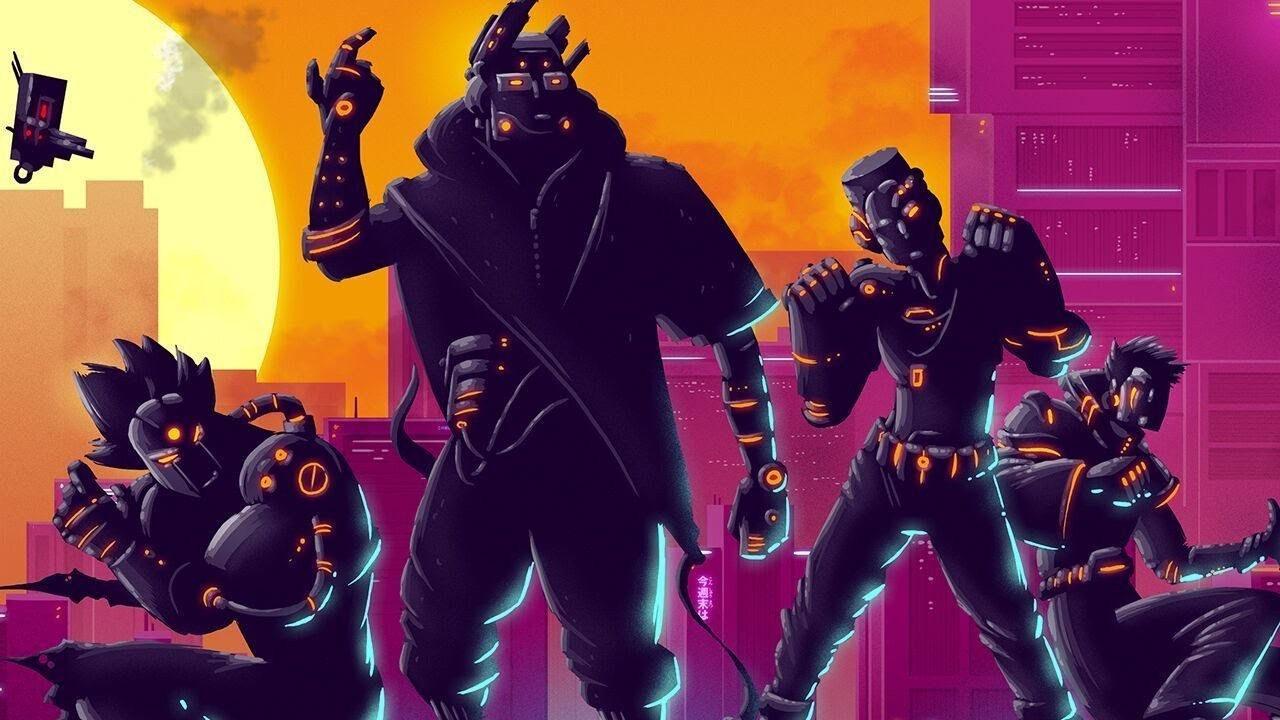
Coming to Switch and PC later this year, self-described ‘roguelike action shooter’ Black Future ’88 is set in an alternate reality where, it appears, it’s always 1988.
Presumably this is an alternate 1988 after Biff stole the Sports Almanac and gifted it to his past self because things don’t look too rosey. On the positive side, you’ve survived a nuclear event – yay! – but unfortunately it seems that almost everything in the world, robotic or otherwise, is trying to put an end to you.
Your job is to climb procedurally generated towers while avoiding the usual obstacles (lasers, murderous robots and the like) in order to reach the tower’s architect, Duncan – the man responsible for this apocalypse – and give him a taste of justice from a big gun or a beam sword.
If that’s not a tall enough order, it seems you’re suffering from some sort of Crank-like medical condition meaning your heart will explode if you don’t get a move on. If it’s not one thing, it’s another, eh?
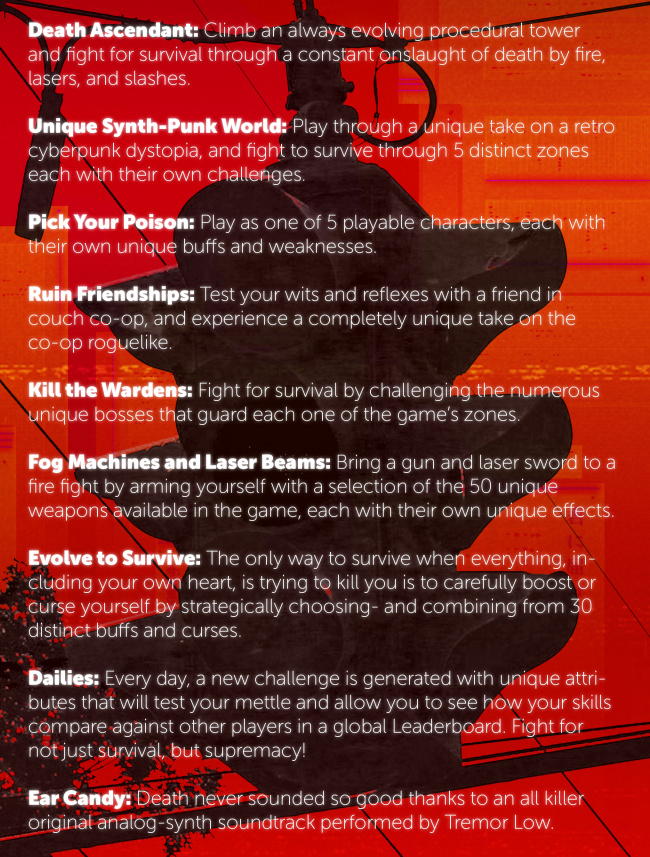
With a plethora of weapons, powers, buffs and curses to employ, there’s also local co-op if you fancy bringing a friend along, plus daily challenges enabling you to climb up a global leaderboard if you don’t have any friends, or if they just don’t fancy a jaunt to a deadly neon dystopia. Here are a few more details from the official ‘factsheet’:
It all looks very stylish and we’ll find out more when it releases later this year, barring any cataclysmic events in the real world.
Like the look of this dirty neon shooter? Do you think it’ll have enough to set it apart from the countless other video game dystopias? Let us know with a comment.
Apple rolls out third public beta versions of iOS 12.2, tvOS 12.2
By Malcolm Owen Wednesday, February 20, 2019, 10:24 am PT (01:24 pm ET)
Made available just one day after the developer beta, participants of Apple’s public beta program are now able to update their iPhones, iPads, and iPod touch to a new third beta build of iOS 12.2, and the fourth generation Apple TV and Apple TV 4K to tvOS 12.2.
Four new Animoji are included in the iOS 12.2 beta
The betas are provided to everyone registered to Apple’s Beta Software Program, with the latest build downloadable as an over-the-air update directly to enrolled devices. The contents of the public beta are typically the same as the developer beta that precedes it, in this case one that was issued just one day in advance.
The third beta of iOS 12.2 makes a number of changes to what was seen in the second build, including a redesigned Remote widget in Control Center that makes the buttons at the bottom of the display larger as well as introducing a guide to the trackpad. The About page in Settings has also been rearranged, with the top section including the software version, model name, model number, and serial number of the device along with its set name, bringing the important details together instead of making users search for it elsewhere.
The Wallet app gains an updated UI for recent transactions, as well as a refinement to the Apple Pay Cash card. The News app has a new “Apple News” logo above the date. The update also includes fixes, with the lock screen issue that perpetually showed the battery percentage reverted to show the current date below the time, and the reenabling of Group FaceTime.
AppleInsider, and Apple itself, strongly recommend users don’t install the betas on to “mission-critical” or primary devices, as there is the remote possibility of data loss or other issues. Instead, testers should install betas onto secondary or non-essential devices, and to make sure there are sufficient backups of important data before updating.
Monster Energy Supercross: The Official Videogame 2
All the thrills of the Monster Energy AMA Supercross 2018 Championship. Live the life of a pro, put yourself to the test in the Compound, tackle challenges, manage your events and attract new sponsors to earn fame and unlock new content.
Get ready for an electrifying mix between a bullet hell and a typing game! Dodge bullets while typing exorcisms at the very same time: turn on both sides of your brain and jump into the adventure of Ray Bibbia.
DiRT Rally 2.0 dares you to carve your way through a selection of iconic rally locations from across the globe, in the most powerful off-road vehicles ever made, knowing that the smallest mistake could end your stage. You will need to rely on your instincts with the most immersive and truly focused off-road experience yet, including a new authentic handling model, tyre choice and surface deformation.
Power your rally car through real-life off-road environments in New Zealand, Argentina, Spain, Poland, Australia and the USA, with only your co-driver and instincts to guide you. Race on eight official circuits from the FIA World Rallycross championship, complete with licensed Supercars and support series. Develop your team and cars around race strategies, and progress through a varied selection of Events and Championships in both a single player Career Campaign and a competitive online environment.
Opus Magnum has players creating machines for developing potions and poisons, tinkering with parts and mechanisms to refine perfect alchemical devices.
This machine-building process earned Opus Magnum nominations for Excellence in Design and the Seumas McNally Grand Prize in the 2019 IGF. Gamasutra sat down with Zach Barth and Matthew Burns, developers of this puzzling game of mechanical perfection, to talk about giving players room to find creative solutions, the joy of fiddling with processes, and the beauty of mechanisms in motion.
Designers of Alchemical Machines
So, we are Zach Barth and Matthew Burns. Barth was the lead designer and creative director, and Burns wrote the story and composed the music. We’re speaking jointly on behalf of Zachtronics.
Barth started making games in college, putting them on the internet for free. SpaceChem (2011) was his first commercial game. Burns has worked in games for a while and joined Zachtronics full-time in 2016.
Refining a decades-old concept
Opus Magnum is a refinement of ideas first explored in one of Zach’s early Flash games from over ten years ago, The Bureau of Alchemical Engineering. Both the world and the mechanics are developed from the original ideas in that game.
The tools to create magical machines
The engine itself is built with C#, SDL, and DirectX or OpenGL (depending on the platform). The art was painted in Photoshop and Flash(!) and the music was created in Logic Pro.
Creating a certain beauty of motion in Opus Magnum
Most Zachtronics games are about making machines do things. In each case, there’s a certain limited toolset provided to transform inputs into outputs. This one happens to have a greater focus on physical movement of components using arms, so there’s a lot of circular motion that results in designs reminiscent of clockwork. It was a natural outcome of the design space we were in.
A lot of Zachtronics games are about creating a system that manufactures something. It’s satisfying to watch factories work, and especially so when it’s one of your own design. And the game’s animated GIF export feature helps players share their unique solutions easily.
On developing the components to create varied machines
In general, the idea is to try to create a certain minimum set of tools that create emergent properties when used together and balance them with cost so that players can optimize for that if they like.
Building for creative solutions
We don’t design with specific optimal strategies already in mind — in our experience, as long as the tool set is expressive and the problem is open-ended, we will see creative solutions from players, including optimizations we hadn’t really dreamed of before. There are different metrics to optimize for, such as cost, area, or cycles, and some solutions can be particularly nice-looking, like symmetrical ones.
On how to encourage players to tinker with their machines
One way is through the leaderboards. You finish a puzzle and see your friend completed it in fewer cycles, so you see if maybe you could shave off a few cycles yourself. But some players aren’t interested in the leaderboards, and are more interested in simply challenging themselves on their own terms. We deliberately don’t offer any kind of in-game rewards for optimization, so the players who do are often more intrinsically motivated.
The appeal of alchemy and fantastical science
Our games are usually built around fake interpretations of systems like chemistry or electrical engineering. In this sense, alchemy is no different; it’s another system of knowledge that happens to be a little more undefined than the others. Aside from the alchemy, there aren’t actually a lot of fantastical elements in Opus Magnum! The story is pretty grounded, in fact— it’s about the choices you have to make when you work in the service of greater powers.
Wizards of the Coast shares community-building tips at GDC 2019!
The team at Wizards of the Coast have decades of experience building communities around physical (and now digital) games like Magic: The Gathering and Dungeons & Dragons, and they’re coming to the 2019 Game Developers Conference next month to share what they’ve learned!
Specifically, as part of a GDC 2019 GDC Community Management Summit talk on “25 Years of Building Community at Wizards of the Coast” which aims to give you a deeper understanding of how to market your brand for a variety of platforms and how experience in community-building at a local level can be applied to a variety of different purposes in the digital age.
Presented by Wizards’ Aland Failde and Michelle Sutterfield, this is a talk worth seeing because over the past 25 years, Wizards has worked closely with local gaming stores to share knowledge and encourage them to shape/empower their own community. Now the company has translated that same experience into the digital space with online influencers, and this is your chance to see how they succeeded. Don’t miss it!
You can find more details on this talk and many more over on the GDC 2019 Session Scheduler! There you can begin to lay out your GDC 2019, which takes place March 18th through the 22nd at the (newly renovated!) Moscone Center in San Francisco.
Bring your team to GDC! Register a group of 10 or more and save 10 percent on conference passes. Learn more here.
The Evoland Series: From Game Jam Project to Worldwide Success
Hello, time traveler! I’m Nicolas, lead game developer at Shiro Games, a French independent studio. We released Evoland and Evoland 2 on PC few years ago and we’re now introducing the Evoland Legendary Edition on Xbox One which includes both titles!
The initial concept of Evoland was imagined during a Game Jam (Ludum Dare #24). The theme of this Game Jam was evolution. We had the idea of creating a game which would evolve through its structure rather than through its content. From there, we worked on building a full game and because a large part of the team is formed by retro-gaming enthusiasts, Evoland‘s core concept is based on nostalgia, and Evoland 2 allowed us to explore more gameplay mechanics and graphic designs. For this game, we created four different eras, the antiquity (old Gameboy style), the past (NES), the Present (SNES), and the Future (N64).
The games are designed to be fun yet challenging adventures! You’ll find everything that made you love old-school adventure/RPG games (turn-based combat, tactical maps, collectibles, etc..) with a deep and interesting story.
Evoland Legendary Edition takes you on an epic adventure through space and time exploring the history of famous video game genres. As you progress through this epic adventure your game will evolve. You may start in a 2D environment, playing a classic “Final Fantasy-like” RPG and see yourself transported to a 3D shoot-them-up or a side scrolling Double Dragon-type of game!
There is a lot of mystery around the main character himself. Pay attention to the little details of the story, you will be able to pick up bits of information from the very first moment of gameplay to the very end, and try to piece together his real story. There are a few interesting views from various players who have crafted possible theories about our hero’s past, which could even be his future in some cyclic interpretations!
We really appreciate you reading this introduction to the Evoland Legendary Edition! We can’t wait for you to be able to experience this epic adventure on Xbox One. We truly hope you’ll love playing the game as much as we loved making it!
SEGA’s critically-acclaimed entry that started a legend. Become Kazuma Kiryu, an up-and-coming yakuza who takes the fall for the murder of a crime boss, only to emerge from prison ten years later to a changed world. Remastered from the ground up, now in 4K and uncapped framerates on PC.
Get started learning Python with this tutorial from our archives.
The cool thing about Linux and FOSS is also an aggravating thing, which is that sometimes there’s too much of a good thing. There is such an abundance of goodies that it can be overwhelming. So I am here to help you decide which programming language you should learn next, and that is Python. Oh, yes, it is.
Why Python? I like it because it is clean and straightforward. It’s a great introduction to object-oriented languages. The Python world is beginner-friendly and, as a general-purpose language, Python can be used for all sorts of things: quick simple scripts, games, Web development, Raspberry Pi — anything you want. It is also in demand by employers if you’re thinking of a career.
There are numerous excellent Python books and tons of online documentation. I want to show off Python’s coolness for beginners so you will get excited and go “Yes! I too must love Python!”
But what about all the other languages? Don’t worry, they won’t get lonesome, and everything you learn in Python is applicable to many other languages as well.
What Stuff Means
I think most of us learn terminology better with hands-on exercises, but there are four things to know from the start.
The first is Python is strongly typed. As you study Python, you will see this repeated a gazillion times. What does this even mean? Who uses a typewriter? Fortunately, it has nothing to do with typewriters, but rather with how Python handles data types. All computer programs are made of two things: data, and operating on that data. Data comes in different types, and the types determine how your programming language will handle them. Data types include characters or strings, which are literal numbers and letters, like names and addresses; integers and floating point numbers that are used in calculations; Boolean values (true/false); and arrays, which are lists of data of all the same data types.
Python enforces data types and relies on you to define them. Weakly typed languages decide for themselves what your data types are, so the data type can change depending on context.
For example, most any programming language will add the integers 1 + 2 + 3. A weakly typed language may also let you add integers and text strings, for example 5 + helloworld. If you try to do this in Python, your code will fail and you will get an error message. Weakly typed languages don’t do this randomly; this is a feature intended to add speed and flexibility by not requiring you to define your data types.
However, weak typing can lead to strange errors. One of the most common errors involves converting strings of numbers to integers when you really want them to be a literal string, like 221B Baker Street, 10,000 Maniacs, or 23andMe. In my modest opinion, it is better to learn the discipline and structure of a strongly typed language, and then try out weakly typed languages after you have experience and good grounding in the basics.
The second thing to know is what the heck is object oriented programming (OOP)? An object is a clump of data and procedures grouped into a single reusable entity. If you were coding a car racing game you might have a car object, an obstacle object, and a driver object. So, you say, objects are just like functions, right? Yes. If you already understand how to organize code into properly grouped functions and variables, then you already understand OOP. There are finer points to OOP such as classes, inheritance, and polymorphism; again, if you think in terms of sensible organization these things are easier to understand.
Third, white space has meaning in Python. You have to get your white spaces right or your code won’t work.
Fourth, Python is an interpreted language. You don’t have to compile and link your Python programs. If you’re experienced with the Bash shell, then you already know about interpreted languages, how fast they are to code in, and how you can test out your programs interactively before writing them into a script.
The downside to interpreted languages is the overhead of the interpreter. Usually, programs written in compiled languages run faster. However, you can link your Python programs to functions written in many other languages, including C/C++, Lisp, Fortran, Java, and Perl, and many more so you can mix and match to get the results you want.
Try It
Python is included in most Linux distributions, and usually the python package installs the base components and Python command interpreter. The text in bold is what you type.
$ python

Python 2.7.12 (default, Nov 19 2016, 06:48:10) [GCC 5.4.0 20160609] on linux2

Type "help", "copyright", "credits" or "license" for more information.

>>> help() Welcome to Python 2.7! This is the online help utility. If this is your first time using Python, you should definitely check out

the tutorial on the Internet at http://docs.python.org/2.7/tutorial/. Enter the name of any module, keyword, or topic to get help on writing

Python programs and using Python modules. To quit this help utility and

return to the interpreter, just type "quit". To get a list of available modules, keywords, or topics, type "modules", "keywords", or "topics". Each module also comes with a one-line summary

of what it does; to list the modules whose summaries contain a given word

such as "spam", type "modules spam". help> topics Here is a list of available topics. Enter any topic name to get more help. ASSERTION DEBUGGING LITERALS SEQUENCEMETHODS2

ASSIGNMENT DELETION LOOPING SEQUENCES

[...]

help> quit
Of course we must do the traditional Hello World! Strings must be enclosed in single or double quotes.
Let’s go back to the Python interpreter and play with data types.
>>> 2 + 2

4

>>> 2 + foo

Traceback (most recent call last): File "", line 1, in NameError: name 'foo' is not defined

>>> foo = 5

>>> 2 + foo

7
Now try a short interactive script. It asks you to input your age, responds according to the age you type, and checks if your response is in the correct data type. This is a great little script to tweak in different ways. For example, you could limit the acceptable age range, limit the number of incorrect tries, and get creative with your responses. Note that raw_input is for Python 2.x, and 3.x uses input.
Watch your indentation; the indented lines must be four spaces. If you are using a proper code editor, it should take care of this for you.
#!/usr/bin/python while True: try: age = int(raw_input("Please enter your age: ")) except ValueError: print("I'm so very sorry, that does not compute. Please try again.") continue else: break

if age >= 18: print("Very good, you are old enough to know better, but not too old to do it anyway.")

else: print("Sorry, come back when you're 18 and try again.")
Modules and Learning
There are a great number of Python modules, and you can learn to write your own. The key to writing good Python programs and making them do what you want is learning where to find modules. Start at Python.org because of the abundant documentation and good organization. Plan to spend a lot of time here, because it contains the best and authoritative information. It even has an interactive shell you can practice with.
Learn more about Linux through the free “Introduction to Linux” course from The Linux Foundation and edX.