LinkedIn and 3rd parties use essential and non-essential cookies to provide, secure, analyze and improve our Services, and to show you relevant ads (including professional and job ads) on and off LinkedIn. Learn more in our Cookie Policy.
Select Accept to consent or Reject to decline non-essential cookies for this use. You can update your choices at any time in your settings.
It’s a well-known challenge that large language models (LLMs)—growing in popularity thanks to their adaptability across a variety of applications—carry risks. Because they’re trained on large amounts of data from across the internet, they’re capable of generating inappropriate and harmful language based on similar language encountered during training.
Content moderation tools can be deployed to flag or filter such language in some contexts, but unfortunately, datasets available to train these tools often fail to capture the complexities of potentially inappropriate and toxic language, especially hate speech. Specifically, the toxic examples in many existing hate speech datasets tend either to be too hard or too easy for tools to learn from—the too-easy examples contain slurs, profanity, and explicit mentions of minority identity groups; the too-hard examples involve obscure references or inside jokes within the hate speech community. Additionally, the neutral examples in these datasets tend not to contain group mentions. As a result, tools may flag any language that references a minority identity group as hate speech, even when that language is neutral. Alternatively, tools trained on this data fail to detect harmful language when it lacks known or explicit slurs, profanity, or explicit mentions of minority identity groups.
Generating the kind of data needed to strengthen content moderation tools against the above failures and harms is challenging for numerous reasons. In particular, toxic text that is more implicit and that existing machine learning architectures can still learn from or neutral text with group mentions is difficult to collect at scale. Additionally, asking people to write such examples—particularly the toxic ones—can have a negative impact mentally on those assigned the task.
Inspired by the ability of large language models to mimic the tone, style, and vocabulary of prompts they receive—whether toxic or neutral—we set out to create a dataset for training content moderation tools that can be used to better flag implicitly harmful language. In our paper “ToxiGen: A Large-Scale Machine-Generated Dataset for Adversarial and Implicit Hate Speech Detection,” we collected initial examples of neutral statements with group mentions and examples of implicit hate speech across 13 minority identity groups and used a large-scale language model to scale up and guide the generation process. The outcome is the largest implicit hate speech dataset to date that is publicly available: 274,000 examples comprising both neutral and toxic statements. We conducted a human study on the generated dataset to better understand different aspects of harm beyond binary labels of toxic and neutral assigned by content moderation tools. To stress test existing content moderation tools across minority identity groups studied in this work, we also propose an adversarial classifier-in-the-loop decoding approach. The dataset, two content moderation tools trained on the dataset, prompts used as seed data, and the source codes for our proposed adversarial decoding approach are available in the ToxiGen GitHub repo (please see footnote).
Figure 1: The ToxiGen dataset—an implicit hate speech dataset created by using a large-scale language model with both regular and adversarial decoding to scale up and guide the generation process—contains 274,000 examples comprising both neutral and toxic statements across 13 minority identity groups. As illustrated above, mentions of a specific minority identity group in the prompts and mentions of the same minority identity group in the corresponding generated text are proportional.
Demonstration-based prompting for building better datasets
Large Transformer-based language models don’t explicitly encode semantic information; nevertheless, these models can distinguish the statistical interactions of words in different contexts. Through experimentation with the generation of language via one of these large language models, we learned how to utilize careful prompt engineering strategies to create the ToxiGen implicit hate speech dataset.
Our first experiments were to generate examples of hate speech and neutral speech related to the 13 minority identity groups in our work. We started by collecting implicit hate speech prompts from existing datasets and neutral prompts drawn from news articles, opinion pieces, podcast transcripts, and other similar public sources and feeding them into the LLM to create a broader, deeper set of prompts. What we found was that the LLM could generate examples that were qualitatively different depending on the source material. When prompted with bits from different writers on the above topics, in each case, the LLM produced linguistically diverse outputs that were nonetheless similar in style and tone.
Furthermore, we found that through careful cultivation of prompt sets, we could generate a wide variety of text reflecting diverse opinions and thoughts on these topics that weren’t found in our original source materials. We could generate neutral statements about sensitive topics that mentioned the relevant minority identity groups, and we could consistently generate hate speech statements about these minority identity groups that didn’t contain slurs or profanity. And the more we experimented with the source material, the more interesting our dataset became. This is particularly exciting because we hope that other individuals and groups can use these tools to extend our dataset; different disciplinary experts could utilize the same strategies and collect even better prompt sets, resulting in even more subtle and rich examples of neutral speech and hate speech.
We also found that the model often generated examples of speech that we ourselves had trouble labeling. In essence, we were using the LLM as a probe to explore the delicate boundaries between acceptable and offensive speech. As a result, our own understanding of the problem definition itself grew through our interactions with the model.
The first 260,000 examples from our dataset were drawn from this experimental approach.
Figure 2: Examples of statements generated by (De)ToxiGen that fool Google’s Perspective API, HateBERT, OpenAI content filter, AI2 Delphi, and RoBERTa. Five statements are neutral but mention minority identity groups, so the content moderation tools find them hateful. Five are toxic sentences, but the tools find them neutral. The proposed decoding approach, (De)ToxiGen (referred to as ALICE in the paper), can challenge these content moderation tools, allowing developers to increase their coverage by creating adversarial examples.
(De)ToxiGen: An adversarial decoding approach for strengthening content moderation tools
While demonstration-based prompting can facilitate large-scale data generation, it doesn’t generate data targeted specifically to challenge a given content moderation tool, or content classifier. This is important because every content moderation tool has unique vulnerabilities depending on the type of data it has been trained on. To address this, we developed (De)ToxiGen (referred to as ALICE in the paper), an algorithmic mechanism that creates an adversarial set-up between an LLM and a given content moderation tool in which the content classifier is in the loop during decoding.
The proposed approach can increase or decrease the likelihood that a generated statement is classified as hate speech while maintaining the coherence of the generated language. It can generate both false negatives and false positives for a given content moderation tool. For false negatives, toxic prompts are used to elicit toxic responses, and then the tool’s probability of the neutral class is maximized during decoding. Similarly, to generate false positives, neutral prompts are used to generate neutral responses, and then the probability of the toxic class is maximized during decoding. With this approach, we’re essentially trying to reveal weaknesses in a specific content moderation tool by guiding the LLM to produce statements that we know the tool will misidentify. The generated data can then be used to improve the performance and coverage of the targeted content moderation tool. Our ToxiGen dataset includes data generated by both demonstration-based prompting and our proposed adversarial decoding approach. Through empirical study on three existing human-written datasets, we found that starting with an existing content moderation tool and fine-tuning it on ToxiGen can improve the tool’s performance significantly, demonstrating the quality of the machine-generated data in ToxiGen.
Human evaluation: Better understanding the data
Human language is complex, particularly when it comes to harmful statements. To better understand different aspects of the data in ToxiGen—its perceived harmfulness and intent and whether it presents as fact or opinion, for example—we conducted human evaluations on the data generated by both regular decoding (top-k), used in the demonstration-based prompting, and the proposed adversarial decoding. The human evaluation also allowed us to test the quality of the output of these methods and gauge how effective these methods were in guiding the generation of the data we sought.
For the human evaluation, three annotators were used for each statement from a pool of 156 prequalified annotators with prior experience annotating toxic language. About 4,500 samples were randomly selected for each of the decoding methods with coverage across all 13 minority identity groups for each split. We found the following:
For both decoding methods, minority identity group mentions included in the prompt also exist in the generated statements. This means that both data generation methods reliably produce the data they were designed to produce—hateful and neutral statements with explicit reference to the specified minority identity group.
In the neutral case, the label of the prompt matches the generated text more often than in the toxic case, as shown in Figure 3a.
The proposed decoding approach generates a higher percentage of adversarial text compared to regular decoding—that is, it produces data that is more likely to fool a given content moderation tool—as illustrated in Figure 3b.
Figure 3a (left) and 3b (right): Human evaluations on the data generated by regular decoding (top-k) and the proposed adversarial decoding showed that the toxicity labels for the prompt and the generated response match more often for non-toxic prompts compared to toxic ones (left). It was also observed that (De)ToxiGen generates a higher percentage of adversarial text compared to regular decoding (right).
90.5 percent of machine-generated examples were thought to be human-written by the majority of annotators.
Perceived harmfulness with respect to human- or AI-authored text is similar.
Looking ahead: Societal implications and opportunities
As advances continue to be made in large language models, we remain vigilant in our pursuit of AI systems that align with our commitment to technology that benefits society as a whole and empowers everyone to achieve more. We’re beginning to ask better questions to more deeply understand the risks associated with LLMs and build processes and methods for addressing them. Existing content moderation tools tend to be only good at flagging overt inappropriate or harmful language. Our work aims to create data that can better target the challenge. While our work here specifically explores hate speech, our proposed methods could be applied to a variety of content moderation challenges, such as flagging potential misinformation content. By releasing the source codes and prompt seeds for this work, we hope to encourage the research community to contribute to it by, for example, adding prompt seeds and generating data for minority identity groups that aren’t covered in our dataset.
As with many technologies, the solutions we develop to make them stronger, more secure, and less vulnerable also have the potential to be used in unintended ways. While the methods described here may be used to generate inappropriate or harmful language, we believe that they provide far greater value in helping to combat such language, resulting in content moderation tools that can be used alongside human guidance to support fairer, safer, more reliable, and more inclusive AI systems.
Considerations for responsible use
There is still a lot that this dataset is not capturing about what constitutes problematic language, and before utilizing the dataset, its limitations should be acknowledged. Our annotations might not capture the full complexity of these issues, given problematic language is context-dependent, dynamic, and can manifest in different forms and different severities. Content moderation tools aren’t a silver bullet to address harmful online content. Problematic language is fundamentally a human-centric problem. It should be studied in conjunction with human experience, and tools to address this problem should be developed and deployed with human expertise and well-informed regulatory processes and policy. Multidisciplinary work is needed to better understand the aspects of this challenge.
Also, this dataset only captures implicit toxicity (more precisely hate speech) for 13 minority identity groups and due to its large scale can naturally have imperfections. Our goal in this project is to provide the community with means to improve hate speech detection on implicit toxic language for the identified minority identity groups, and there exist limitations to this dataset and models trained on it that can potentially be the subject of future research, for example, including more minority identity groups, a combination of them, and so on that are not covered in our work. Stronger content moderation tools and systems can contribute to mitigating fairness-related harms in AI systems. For example, systems that don’t over-flag neutral statements with minority identity group mentions can help ensure better representation of diverse perspectives and experiences, while systems that can better flag implicit hate speech can support more inclusive technology.
Acknowledgment
This work was conducted by PhD students Thomas Hartvigsen and Saadia Gabriel during their internships at Microsoft Azure and Microsoft Research. Hamid Palangi, Dipankar Ray, Maarten Sap, and Ece Kamar served as advisors on the work. A special thanks to Misha Bilenko from Azure ML for making the compute resources available and to Microsoft Research for supporting our large-scale human study.
Please note: This research, the GitHub repository, and examples from our work included in this blog contain and discuss content that is offensive or upsetting. All materials are intended to support research that improves hate speech detection methods. Included examples of hate speech don’t represent how the authors or sponsors feel about any minority identity groups. Hate speech applies to a range of minority identity groups; for the purposes of this research, we focus on 13 of them (as shown in Figure 1). Content moderation tools are part of larger content moderation systems. These systems also include human expertise and thoughtful policy and regulatory development. Even the most robust content moderation tools and datasets require systems with human supervision.
The power and utilities sector plays a critical role in building a sustainable energy future while providing safe, reliable, affordable, clean energy to homes and businesses. As a technology innovator and partner of the industry, the Microsoft Energy team looks forward to participating in DISTRIBUTECH International in Dallas, Texas, from May 23 to 25, 2022, the leading annual energy transmission and distribution event for North America. We’re energized to connect with the industry, customers, and partners to share innovations and technologies that transform energy, improve operational efficiencies, and advance sustainability goals.
Our team will be on stage and at the Microsoft booth together with our partners and customers to highlight success stories in digital transformation, grid flexibility, renewable energy integration, advanced metering, enhancing system operations and reliability, cybersecurity, carbon tracking, and more. Program highlights featuring the Microsoft Energy team include:
Jon Guidroz, Worldwide Strategy Leader, Energy Industry, will join a panel discussion with Exelon and Itron to share insights on digital partnerships that deliver analytics outcomes. They will describe the growing value of analytics integrated to the meter to support utility outcomes in outage management, customer engagement, distributed energy resources (DER) and electric vehicle (EV) integration, distribution automation, and other applications.
Hanna Grene, Director, Americas Power and Utilities, will host a fireside chat with Exelon’s Senior Vice President and Chief Strategy and Sustainability Officer, Sunny Elebua, to share sustainability initiatives at Exelon as well as other leading decarbonization practices across the industry.
Accelerating digital transformation through collaborative partnerships
As we continue the journey to a net-zero future, Microsoft is proud to announce an expanded partnership with a key partner, Itron. With the enormous energy challenges the world is facing, collaboration has become more important than ever to get to net-zero. Through strategic partnerships, Microsoft continues to extend our global energy partner ecosystem that fosters innovative technology development and enables digital transformation.
Through the expanded partnership, Microsoft and Itron will help accelerate cloud adoption and the next generation of consumer and grid edge solutions for the utility industry. The collaboration uniquely brings together Itron’s leading energy management solutions and Microsoft’s leading cloud solutions to transform how end users view and manage their energy, and how utilities meet the demands of a rapidly changing industry. The collaboration between Itron and Microsoft will enable utilities to take advantage of cloud computing technology—in particular, edge computing—to accelerate advanced metering infrastructure (AMI) 2.0 capabilities including cloud-native analytics, distribution automation, carbon reporting, and an overall more flexible, scalable system to support customer and utility outcomes for a distributed, resilient energy grid.
Together, Microsoft and Itron will partner to develop solutions that deliver insights and benefits for utilities to reach their goals, including grid resilience, decarbonization, consumer engagement, and operational efficiency.
Another key relationship we’re pleased to highlight is with Schneider Electric, which represents a partnership spanning more than 30 years fueled by a shared vision for energy efficiency and sustainability. At the heart of this partnership, Schneider’s solutions are powered by the most advanced evolution of Microsoft Azure and integrate process and energy technologies to deliver the full efficiency and sustainability potential for utility grids, buildings, data centers, industry, and infrastructure. Working together, and with the unique expertise Microsoft and Schneider can bring, we have the ability to accelerate progress and our continued partnership will enable us to get there. Learn more during Schneider’s presentation at the Microsoft booth on Monday, May 23, 2022.
Microsoft’s vision for a net-zero future
Technology will play a larger, more important role in helping the energy industry decarbonize and achieve a net-zero economy by 2050. No matter where companies are on their sustainability journey, Microsoft provides technology solutions that enable an easier, faster, automated way for organizations to collect and record environmental data, report actionable insights, and reduce carbon emissions. To support companies on this critical journey to net-zero, we are pleased to introduce Microsoft Sustainability Manager, available on June 1, 2022.
Our Sustainability Manager, a component of Microsoft Cloud for Sustainability, integrates powerful solutions delivered by Microsoft and our partners to help organizations manage sustainability progress end to end. These solutions offer a more automated and comprehensive view into the emissions impact of their entire operations and value chain by enabling organizations to record and more accurately report their emissions, and continually test and optimize reduction strategies to reach their goals. Microsoft Cloud for Sustainability brings together capabilities that help organizations unify data intelligence and identify opportunities to build a more sustainable IT infrastructure. We encourage you to visit our DISTRIBUTECH booth to meet the Microsoft Sustainability team and experience firsthand how the solution can advance your company’s journey to net-zero.
Join us at DISTRIBUTECH in Dallas, Texas
If you are attending DISTRIBUTECH International 2022, we look forward to seeing you at the show and at the Microsoft booth 1023, where you can meet with the Microsoft Energy team, our partners, and customers and learn how we are working together to power a sustainable future.
Every day, we must do our part to protect our planet from the impacts of climate change, and technology has an important role to play.
This Earth Day, like every Earth Day, I am taking the time to reflect on what we all need to do to protect and sustain Earth’s natural systems. What is unique this year is that I am doing it in person with my team for the first time in a long time.
Collaboration is an essential part of solving our climate crisis: sharing data, creating space for the connections that lead to innovations, and rallying around a common mission and goal. At Microsoft, it is something we are keenly focused on with our employees, our customers, and our partners.
Today, my team is together, and we will take a breath of fresh air, and continue the hard work needed to fulfill our commitments of being carbon negative, water positive and zero waste by 2030 all while protecting more land than we use and building a Planetary Computer.
Every day, we must do our part to protect our planet from the impacts of climate change, and technology has an important role to play.
This Earth Day, like every Earth Day, I am taking the time to reflect on what we all need to do to protect and sustain Earth’s natural systems. What is unique this year is that I am doing it in person with my team for the first time in a long time.
Collaboration is an essential part of solving our climate crisis: sharing data, creating space for the connections that lead to innovations, and rallying around a common mission and goal. At Microsoft, it is something we are keenly focused on with our employees, our customers, and our partners.
Today, my team is together, and we will take a breath of fresh air, and continue the hard work needed to fulfill our commitments of being carbon negative, water positive and zero waste by 2030 all while protecting more land than we use and building a Planetary Computer.
Editor’s Note: This blog was updated after publication.
Today we honor the 11th annual Global Accessibility Awareness Day (GAAD). GAAD is a day of awareness focused on digital access and inclusion for people with disabilities around the world. The pandemic has grown the disability demographic and widened the disability divide. Yet there are the seeds of positive change. As Caroline Casey, Founder & Creator of The Valuable 500 said at the Microsoft Ability Summit last week, “We’re seeing a move since the pandemic… recognition from businesses that accessibility is not a ‘niche’ issue for people with disabilities, it’s an issue that needs to be completely invested in for communication for consumers and employees.” We couldn’t agree more. We’re proud that accessibility is part of our culture here at Microsoft.
Here’s more on our journey to bridge the disability divide in partnership with disability community and accessibility experts around the world.
Technology
Technology has the power to empower. Our responsibility is to raise the bar for what is possible with technology for people with disabilities and deliver on the potential of inclusive design.
This month, Microsoft has introduced several new features and products that deliver on that potential, and many of those ideas came from you. Windows 11 is the most accessible Windows ever. You asked us to make accessibility features easy to find and use, so we flipped the name from ‘Ease of Use’ to ‘Accessibility’ and added a new accessibility pane and human icon to make it easier to use and find accessibility features. Those new features include Live Captions (available online and offline); new Natural voices for screen reader users; Voice Access; and (my new favorite) focus mode, which allows you to turn off notifications.
Accessibility can make content more inclusive, whether or not you know if someone has a disability. The great news is that you’re using those accessibility features more and more. Thanks to better placement and prompts, use of Office Accessibility Checker — our accessibility ‘spellcheck’ — has grown 14-fold in the last year, meaning more content is being checked for accessibility than ever before. And 163,000 people have joined the Xbox Accessibility Insider League (XAIL), an opportunity for anyone who self-identifies as a person with a disability or ally, to provide accessibility feedback directly to Xbox engineering or game development teams. This is powering a new wave of insight to support the more than 400 million players with disabilities across the globe, creating features for deaf gamers such as the inclusion of ASL and BSL on Forza, and a new ASL Twitch channel!
At the Microsoft Ability Summit last week, Microsoft Chief Product Officer Panos Panay revealed our new Adaptive Accessories line — a new mouse and keyboard experience on a PC or phone. Available later this year, the kit also includes a hub to connect these tools to other adaptive devices made by Microsoft or others.
There is far more ahead. Innovating for the future is top of our mind. It’s clearly top of yours. Our Microsoft partner ecosystem is working to build and deliver accessible technology at scale for customers, and partners are innovating solutions with accessibility at the forefront. For example, CityMaaS has developed the Mobility Map platform to provide localized accessibility information around the globe to enable disabled communities to visit businesses and places of interests. (You can find more #BuildFor2030 featured accessibility offerings by Microsoft partners.)
Talent Pipeline
To power that next wave of innovation, we need to empower the talent pipeline and tackle challenges impacting disabled talent. According to the National Council on Disability (NCD), students with disabilities who could not receive necessary services and support during the pandemic have experienced disruption and regression in their behavioral and educational goals. People with disabilities have historically been underrepresented in the workforce; the pandemic exacerbated the long-standing problem.
Youth and adults with mental health disabilities that predate the pandemic have experienced measurable deterioration over its course.
A new study from Microsoft EDU found that 84% of teachers say it’s impossible to achieve equity in education without accessible learning tools. And 87% agree that accessible technology can help not only level the playing field for students with disabilities but also generate insights that help teachers better understand and support all their students. Four in ten (41%) teachers have seen an increase in mental and/or emotional issues among their students.
Helping to empower students with disabilities is a top priority for us at Microsoft. We are working to support teachers with tools, from training through the new Microsoft Learn Educator Center for Resources and Professional Development to technology, including Immersive Reader and Microsoft Reflect, which helps teachers monitor student well-being and encourage feeling identification, and the new Minecraft: Education Edition.
Workplace
GAAD is a time to double down to open doors to disabled talent into employment. We support the Transformation to Competitive Integrated Employment Act, legislation that addresses subminimum wage, an important step for wage equity for people with disabilities. This includes U.S. Department of Labor grants to states and eligible entities to help transform their business and program models to support people with disabilities.
Employment for people with disabilities takes partnership. With an unemployment/underemployment rate for neurodiverse talent estimated at 80% or higher, it’s crucial that we work together, not compete. Recently, we worked with 30 partners from Neurodiversity @ Work Roundtable, to launch the Neurodiversity Career Connector. This jobs marketplace supports large to small employers to “screen in” neurodivergent job candidates. This is the next chapter in our journey at Microsoft, which started in 2015 with a pilot program to hire autistic talent. We are proud to expand these efforts and partner with 30 companies to open doors to this talent pool and make a dent on those metrics.
Microsoft is also excited to announce the expansion of our relationship with The Valuable 500, an organization working with 500 major companies committed to making workplaces more accessible and inclusive of people with disabilities. This will expand on our partnership with impactful organizations such as Disability:IN and many others.
Microsoft continues to be powered by the insights from the disability community, and is proud to work with some of the best in the industry. This includes our accessibility team, who came together at the new Inclusive Tech Lab at Microsoft HQ this week. It is a journey and I encourage all to explore our Disability Answer Desk and https://blogs.microsoft.com/accessibility/ wherever you are in navigating your work towards a more accessible future for all.
I’m so very proud of Microsoft’s work in this field, working in partnership with so many focused on accelerating accessibility and disability inclusion around the world. Join me in celebrating their work today. And tomorrow, let’s get going on the next chapter. Onwards!
Global Accessibility Awareness Day (GAAD) is a great time to bring visibility to the importance of digital access and inclusion and to celebrate the over 400 million players with disabilities playing and creating across the globe. Today, I am excited to share some of the work Team Xbox has done in partnership with the disability community, to bring the power of play and connection to more people. For it is only when we all come together, are intentional about our focus on accessibility throughout the year, and push for more representation in our games and people creating them, that we can truly make Xbox a place where everyone can have fun and experience the joy of gaming. To us this means,
Foster inclusive communities, connections, and support. Gaming has the power to bring people together and share experiences they may not have otherwise had. We want to make it easy to find and connect with a community, to partner with game creators so you can influence the next game and to provide support on accessibility features.
Enable accessible design and development. Including accessibility and partnering with the disability community from the start of a project results in experiences that more people can enjoy. But sometimes it is hard to know where to start or what resources to consider. We want to make it easy to include and understand gaming accessibility by sharing what we learn, so that we and others can do more.
Continual investment in accessibility. Accessibility features help players with disabilities play, create, and connect in their own way. We are committed to continually innovating and partnering with the community to consistently deliver accessibility features and innovation into our products, games, and services.
Nothing should come between players and the games they love, which is why we are dedicated to finding accessibility solutions that help eliminate barriers to play and make it easier to connect with others. In celebration of Global Accessibility Awareness Day, Xbox is thrilled to share some ways players can connect with the community and creators, new resources for game creators and more accessibility features available for players.
Join us in celebrating GAAD and celebrating the creators and players with disabilities that are part of our community.
Foster Inclusive Communities, Connections, and Support
Minecraft: Education Edition Accessibility
New this month, BuildAbility launches in Minecraft: Education Edition, a new accessibility themed world made in collaboration with the Peel District School Board in Ontario, Canada. Students explore barriers experienced by people with disabilities by meeting an array of characters who reflect our real world and learn how to identify and eliminate accessibility barriers in their school and community. The Minecraft learning experience promotes inclusive design thinking and problem solving rooted in empathy and social emotional learning. Check out full details on the new Minecraft: Education Edition world.
BuildAbility in Minecraft: Education Edition is a new accessibility themed world made in collaboration with the Peel District School Board in Ontario, Canada.
American Sign Language (ASL) Xbox Twitch Channel
We have launched an American Sign Language (ASL) Xbox channel on Twitch at /XboxASL! Every day, the Xbox Plays team goes live on the Xbox Twitch channel, playing the latest and greatest titles from the world of Xbox. In April, they, in partnership with Sorenson, a communications company with the largest interpreter base in the world, launched a new ASL Xbox channel featuring interpretation for approximately 25 hours of livestreams each week. Visit the new channel here and learn more about Xbox’s partnership with Sorenson here.
Xbox Accessibility Insider League (XAIL) + Windows Insider Program partnership
The Xbox Accessibility Insider League (XAIL), which has grown to more than 163K members since its launch last May, is a streamlined way anyone who self-identifies as a person with disability or ally can provide accessibility feedback directly to Xbox engineering or game development teams. The Xbox team is now partnering with the Windows Insider Program to share new accessibility features in Windows 11 preview builds. We encourage XAIL members with Windows 11 to check this out and provide feedback! Get started today by joining XAIL and watch for announcements via the Xbox Insider Hub on Xbox or PC.
Enable Accessible Design and Development
Xbox Accessibility Guidelines (XAGs) 3.0 Update including new mental health guidelines
Based off community and developer feedback, the latest Xbox Accessibility Guidelines (XAGs) update published this month includes a brand new mental health guideline, in addition to guidance on reducing motion sickness, on-screen text legibility, contrast and input guidelines. New examples and implementation details have also been updated in this release.
New Gaming Accessibility Resource Hub
In partnership the Gaming and Disability community and subject matter experts at Unity, Unreal & Coherent, the Gaming Accessibility Resource Hub recently launched providing an extensive resource of gaming accessibility guidance in one spot. Covering training, talks, testing tools, and popular game engines, this resource was created to help game creators in all stages of their game’s accessibility journey. Content will be updated regularly in partnership with the community.
The new Gaming Developer Accessibility Resource Hub provides a single place for developers to start their accessibility journey, with a wealth of resources including testing tools, developer resources, conferences talks and guidelines.
Gaming Accessibility Fundamentals Learning Path
Launched in November 2021, the Gaming Accessibility Fundamentals Learning path is a free 5-module course that introduces a wide array of topics, including basic accessibility fundamentals, how to collaborate with the disability community, assistive hardware and software technologies and best practices for developing gaming hardware. The course was designed for those who are new to learning about game accessibility, and when finished, participants get a badge to celebrate their newfound knowledge. Go earn your badge today and share on social to celebrate GAAD2022!
Continual Investment in Accessibility for Players
Making it easier to find accessible games
Last fall, Xbox announced the addition of Accessibility Feature Tags for games in the Xbox Store, making it easier for players to find games that have one or more of the 20 accessibility tags that were defined in partnership with the disability community and user research. Now with over 400 titles tagged and over 100 with 5 or more tags, we are excited to share players can now search and then filter by one or more tags to find their next game! This feature was based on community feedback, and we look forward to continuing to incorporate suggestions in the future.
The Accessibility Feature Tags were developed specifically to make it easier for players to find games that have one or more of the 20 accessibility features like Custom Volume Controls, No Quick Time Events or Subtitle Options.
Console and platform accessibility features
Console and platform accessibility features make it easier to play by creating customization for your gameplay experience. Over the past few months this has included features like Console Silent UI to mute additional audio, ability to remap the share button to over 22 commands, and ability to increase size and add tooltips for remapping on the Xbox Adaptive Controller, which is especially helpful if a user has shift buttons remapped on the controller.
Forza Horizon 5 – Addition of ASL/BSL and other accessibility features
In partnership with the disability community, Playground Games added American Sign Language (ASL) and British Sign Language (BSL) support into Forza Horizon 5’s in-game cinematics. The team leveraged the Xbox Accessibility Guidelines and feedback from the disability community to incorporate additional accessibility features in Forza Horizon 5 including game speed modifications, high contrast mode, color blindness mode, screen reader narrator, ability to disable moving backgrounds and more. For more information check out the accessibility features in Forza Horizon 5.
Play. Connect. Impact.
Xbox is proud to celebrate Global Accessibility Awareness Day and will continue to support the power of play and make gaming accessible and welcoming to everyone. Today we share one example of how we are supporting the community and how you can too.
Play Forza Horizon 5 to Earn and Donate Microsoft Rewards Points
During the month of May, earn Microsoft Rewards points by unlocking any achievement in Forza Horizon 5. Use the Microsoft Rewards app on Xbox to claim the rewards with the option to donate them to SpecialEffect, an organization that supports people with physical disabilities through the innovative use of technology, and Players Outreach, who empowers hospitalized children through video games.
Each day, teachers and school leaders are faced with the challenge of meeting the needs of a growing audience of diverse learners to help them reach their full potential. Nearly half (46 percent) of teachers work one-on-one with students who require accommodations.1 According to the Centers for Disease Control and Prevention (CDC), one in four adults in the United States have a disability that impacts major life activities.2 At Microsoft, we believe that technology can play an important role in addressing this evolving set of needs across students, teachers, and schools.
Last week, we announced continued investments in accessible technology tools including the newly expanded Inclusive Tech Lab. Today, in celebration of Global Accessibility Awareness Day, we’re building on that work to share new research that speaks to the accessibility needs of today’s classrooms. We surveyed K-12 teachers of different ages and years of experience across the United States to understand how teaching and learning is evolving in today’s education landscape. The data reveals interesting findings on the gaps between what teachers want and need for instruction versus what they have, the broadening of accessibility needs, the pandemic’s widespread impact on teaching, learning challenges and mental health, and how teachers think about accessibility.
Here are the key trends and findings that emerged from the Microsoft Teacher Survey and what we’re doing differently at Microsoft to better support this shift in K-12 education:
Accessible technology allows for more inclusive classrooms for everyone
Accessible technology in the classroom is no longer perceived as only supporting a specific group of students. The data shows that 84 percent of teachers say it’s impossible to achieve equity in education without accessible learning tools. Additionally, 87 percent of teachers agree that accessible technology can help not only level the playing field for students with disabilities but also generate insights that help teachers better understand and support all their students. Thoughtful use of and investments in technology can help to bridge these gaps and make more inclusive learning in classrooms possible for everyone. This makes tools like Microsoft’s Immersive Reader a game changer. The free tool not only supports text decoding for students with learning differences, such as dyslexia, but also enhances reading and comprehension for all learners. Immersive Reader is great for any learner who needs help with reading, built right into the Microsoft 365 apps and Microsoft Edge browser, and is available to any EdTech company that builds products on Microsoft Azure.
Pandemic effects on classrooms are more widespread than we think
The pandemic has brought into sharp focus the complex challenges impacting the classroom. More than half of teachers, 52 percent, have noticed an increase in the number of students who have fallen behind in reading in the past two years and 39 percent have noticed the same in math. Additionally, 59 percent of teachers say that 25 percent of their students are two or more grade levels below in reading or math. Although the pandemic has had a massive impact on schools, responsibly designed accessible learning tools can support our students in getting back on track. Microsoft is committed to empowering students and providing supportive, accessible technology that helps teachers leverage insights with tools like our student support spotlight card. The new student support spotlight card in Education Insights helps teachers make sense of student engagement signals and identify which of their students may require additional support based on early disengagement. The feature is supported by pedagogical research showing that early intervention of decreased engagement can help students overcome learning obstacles and reduce the risk of falling behind.
Teachers need support to do what they do best
Our world has changed forever, and classroom instruction isn’t exempt from the long-term impacts of the pandemic. The fundamental tools and support needed for teachers to do their best work with students facing obstacles—both academically and emotionally—have drastically changed. We found that four in ten (41 percent) teachers have seen an increase in mental and/or emotional issues among their students. 75 percent of these teachers say there is a great or moderate need to adapt their teaching style to accommodate this challenge. Further, the research shows students with disabilities are at an increased risk of experiencing mental health difficulties. The percentage of teachers saying they have seen an increase in mental and/or emotional issues rises from 41 percent to 63 percent when 10 percent or more of a teachers’ student body has an Individualized Education Program (IEP). Additionally, research shows, teachers note that focusing on student well-being can have a positive effect on academic and life success, workforce readiness, and more.3 Digital tools, like Microsoft’s Reflect, help both teachers monitoring student well-being and students working to identify their own feelings. Regular check-ins give teachers insight into what engages their classes, where individualized support is needed, and highlight how to best provide additional interventions.
Teaching is more demanding than ever before, and we are working to support teachers with tools and opportunities to learn how to leverage accessible technology in meaningful and effective ways. We’ve learned that companies can miss the mark in building accessible technology without also providing manageable, diverse, and easily accessed training for teachers. Nearly half of teachers—46 percent—say they aren’t given enough training to learn how to use technology in the classroom. This need is why we launched the Microsoft Learn Educator Center for Resources and Professional Development. This is a centralized platform provides free support for teachers with training on Microsoft technologies, instructional methods, and more.
School systems need support in designing accessible learning environments
Differentiating instruction for students in both engaging and sustainable ways is difficult. While 70 percent of schools have made an additional investment in technology in the past two years, 70 percent of teachers feel there’s a moderate or massive gap between the resources they need for instruction and what they have, revealing a disconnect and clear sign that technology investments must be intentional. The need for additional support in cultivating accessible learning environments is a pressing issue in classrooms nationwide. Responsibly designed technology can help to bridge this gap. As part of our continued commitment to equitable and accessible learning, Microsoft’s Inclusive Tech Lab created a special classroom to show what’s possible when we normalize accessible technology for every student. This collaboration space provides an opportunity for us, education groups, and other companies to learn and get feedback on making technology more accessible. Additionally, teachers can get comprehensive feedback and recommendations to make their content more accessible for all students, in just three clicks, using Microsoft’s Accessibility Checker available online or offline and built into tools like Microsoft Word, PowerPoint, and Outlook.
You can learn more about updates and new solutions coming to our portfolio of learning tools by visiting the Microsoft Education Blog.
This shift in accessible and inclusive learning is about expanding our understanding of how accessibility shows up in our classrooms, school districts, and beyond. All types of learners benefit when technology is designed with accessibility and inclusion in mind, setting up all students and teachers for success.4 Let’s help to unlock the possibilities for every student.
The $180B gaming market shows no signs of slowing down, and as its steady growth reaches unprecedented heights, diversity remains at the forefront within the space. Latinx are avid video game players, outpacing the general market in usage, purchases, and technology adoption; they are 32% more likely than non-Latinx to consider video games their main source of entertainment and 54% more likely to buy a video game the day it’s released than non-Latinx gamers.
Here are the stories of Fernando Reyes Medina and Danny Peña, two Latinx creators who have successfully turned a lifelong passion for gaming into a career. Xbox has played a role in these individuals’ journeys as game developers, content creators and streamers, and as their followings grow, so has their desire to use their respective platforms to elevate the Latinx community and promote cultural appreciation and representation across the industry.
Gaming has been a part of Danny Peña’s life for as long as he can remember. From his early years in New York City, to the time he’s spent in the Dominican Republic with his extended family over the years, to his life in Los Angeles now, gaming has always been there in one way or another. And since the beginning, Danny knew it was much more than a hobby. He is a pioneer by every definition. He has paved the way not just for Latinx in the gaming space, but for all those who look to gaming as a source of inspiration, creativity, and community. Now, with a career that spans more than two decades, he’s not only a gamer and podcaster, he’s also an avid public speaker and mentor, whose personal and professional trajectory demonstrates that Latinxs can achieve whatever they set their minds to, and anything is possible. Click here to learn more about Danny and his journey.
Fernando Reyes Medina is a multi-award-winning game designer currently working at 343 Industries, the Microsoft studio that creates Halo games, designing and bringing to life the new multiplayer suite of experiences for the upcoming Halo Infinite. Originally from Mexico, he is the co-founder and the Latin America Director for Latinx in Gaming, a non-profit focused around improving Latinx representation and helping the community be successful in the gaming industry. Fernando has previously been recognized by the British Academy of Film and Television Arts (BAFTA) as part of their Breakthrough USA program, member of the Forbes under 30 Class of 2022, selected as Future Class member by The Game Awards and as a Next Gen Leader by the IGDA.
For him, the future of gaming is one where Latinx creators and those from all over the world are enabled and empowered to develop unique games, telling their own stories with their own voices, showing the true potential of gaming as an art medium and as a storytelling tool. Click here to learn more about Fernando and his career trajectory.


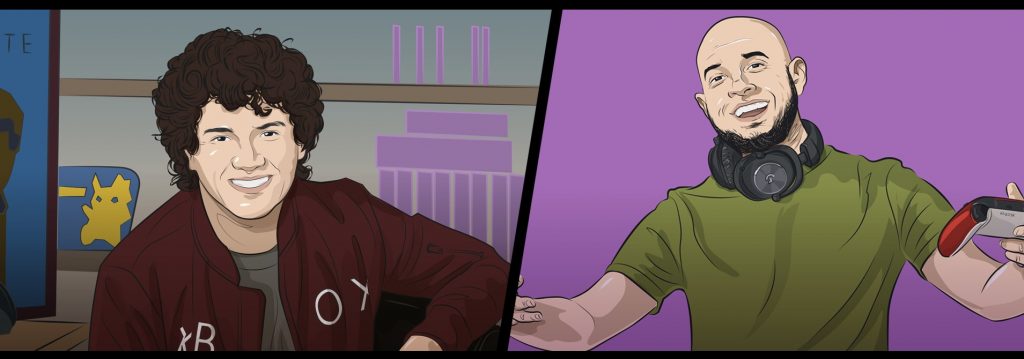
 Gaming has been a part of Danny Peña’s life for as long as he can remember. From his early years in New York City, to the time he’s spent in the Dominican Republic with his extended family over the years, to his life in Los Angeles now, gaming has always been there in one way or another. And since the beginning, Danny knew it was much more than a hobby. He is a pioneer by every definition. He has paved the way not just for Latinx in the gaming space, but for all those who look to gaming as a source of inspiration, creativity, and community. Now, with a career that spans more than two decades, he’s not only a gamer and podcaster, he’s also an avid public speaker and mentor, whose personal and professional trajectory demonstrates that Latinxs can achieve whatever they set their minds to, and anything is possible.
  Fernando Reyes Medina is a multi-award-winning game designer currently working at 343 Industries, the Microsoft studio that creates Halo games, designing and bringing to life the new multiplayer suite of experiences for the upcoming Halo Infinite. Originally from Mexico, he is the co-founder and the Latin America Director for