Posted on Leave a comment

Edit your videos with Pitivi on Fedora

Looking to produce a video of your adventures this weekend? There are many different options for editing videos out there. However, if you are looking for a video editor that is simple to pick up, and also available in the official Fedora Repositories, give Pitivi a go.

Pitivi is an open source, non-linear video editor that uses the GStreamer framework. Out of the box on Fedora, Pitivi supports OGG Video, WebM, and a range of other formats. Additionally, more support for for video formats is available via gstreamer plugins. Pitivi is also tightly integrated with the GNOME Desktop, so the UI will feel at home among the other newer applications on Fedora Workstation.

Installing Pitivi on Fedora

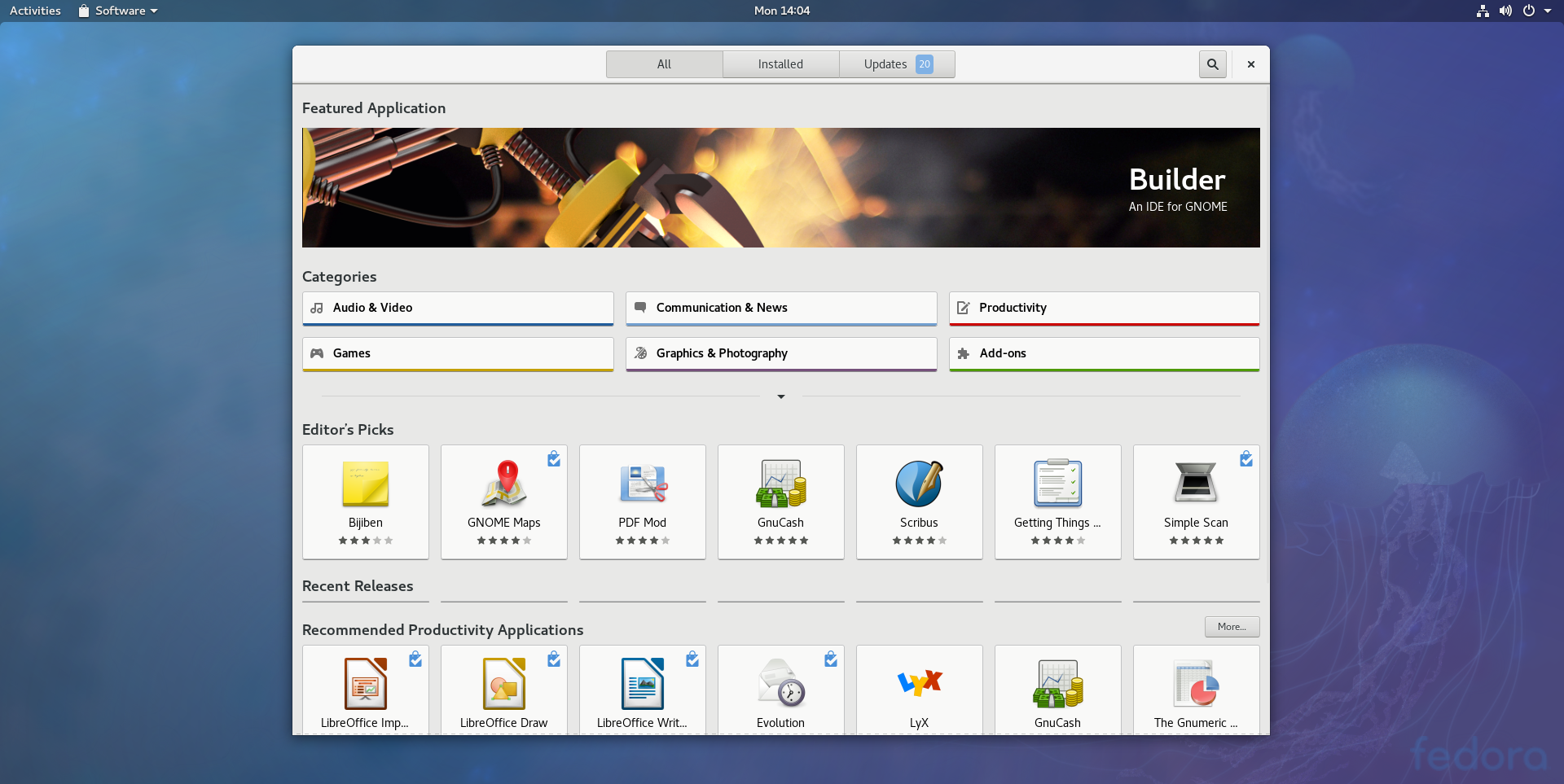
Pitivi is available in the Fedora Repositories. On Fedora Workstation, simply search and install Pitivi from the Software application.

Alternatively, install Pitivi using the following command in the Terminal:

sudo dnf install pitivi

Basic Editing

Pitivi has a wide range of tools built-in to allow quick and effective editing of your clips. Simply import videos, audio, and images into the Pitivi media library, then drag them onto the timeline. Additionally, pitivi allows you to easily split, trim, and group parts of clips together, in addition to simple fade transitions on the timeline.

Transitions and Effects

In addition to a basic fade between two clips, Pitivi also features a range of different transitions and wipes. Additionally, there are over a hundred effects that can be applied to either videos or audio to change how the media elements are played or displayed in your final presentation


Pitivi also features a range of other great features, so be sure to check out the tour on their website for a full description of the features of the awesome Pitivi.

Posted on Leave a comment

Design faster web pages, part 2: Image replacement

Welcome back to this series on building faster web pages. The last article talked about what you can achieve just through image compression. The example started with 1.2MB of browser fat, and reduced down to a weight of 488.9KB. That’s still not fast enough! This article continues the browser diet to lose more fat. You might think that partway through this process things are a bit crazy, but once finished, you’ll understand why.

Preparation

Once again this article starts with an analysis of the web pages. Use the built-in screenshot function of Firefox to make a screenshot of the entire page. You’ll also want to install Inkscape using sudo:

$ sudo dnf install inkscape

If you want to know how to use Inkscape, there are already several articles in Fedora Magazine. This article will only explain some basic tasks for optimizing an SVG for web use.

Analysis

Once again, this example uses the getfedora.org web page.

Getfedora page with graphics marked

Getfedora page with graphics marked

This analysis is better done graphically, which is why it starts with a screenshot. The screenshot above marks all graphical elements of the page. In two cases or better in four cases, the Fedora websites team already used measures to replace images. The icons for social media are glyphs from a font and the language selector is an SVG.

There are several options for replacing:

HTML5 Canvas

Briefly, HTML5 Canvas is an HTML element that allows you to draw with the help of scripts, mostly JavaScript, although it’s not widely used yet. As you draw with the help of scripts, the element can also be animated. Some examples of what you can achieve with HTML Canvas include this triangle pattern, animated wave, and text animation. In this case, though, it seems not to be the right choice.

CSS3

With Cascading Style Sheets you can draw shapes and even animate them. CSS is often used for drawing elements like buttons. However, more complicated graphics via CSS are usually only seen in technical demonstration pages. This is because graphics are still better done visually as with coding.

Fonts

The usage of fonts for styling web pages is another way, and Fontawesome is quiet popular. For instance, you could replace the Flavor and the Spin icons with a font in this example. There is a negative side to using this method, which will be covered in the next part of this series, but it can be done easily.

SVG

This graphics format has existed for a long time and was always supposed to be used in the browser. For a long time not all browsers supported it, but that’s history. So the best way to replace pictures in this example is with SVG.

Optimizing SVG for the web

To optimize an SVG for internet use requires several steps.

SVG is an XML dialect. Components like circle, rectangle, or text paths are described with nodes. Each node is an XML element. To keep the code clean, an SVG should use as few nodes as possible.

The SVG example is a circular icon with a coffee mug on it. You have 3 options to describe it with SVG.

Circle element with the mug on top

<circle style="opacity:1;fill:#717d82;fill-opacity:1;stroke:none;stroke-width:9.51950836;stroke-linecap:round;stroke-linejoin:round;stroke-miterlimit:4;stroke-dasharray:none;stroke-dashoffset:0;stroke-opacity:1;paint-order:markers fill stroke" id="path36" cx="68.414307" cy="130.71523" r="3.7620001" />

Circular path with the mug on top

<path style="opacity:1;fill:#717d82;fill-opacity:1;stroke:none;stroke-width:1.60968435;stroke-linecap:round;stroke-linejoin:round;stroke-miterlimit:4;stroke-dasharray:none;stroke-dashoffset:0;stroke-opacity:1;paint-order:markers fill stroke" d="m 68.414044,126.95318 a 3.7618673,3.7618673 0 0 0 -3.76153,3.76204 3.7618673,3.7618673 0 0 0 3.76153,3.76205 3.7618673,3.7618673 0 0 0 3.76206,-3.76205 3.7618673,3.7618673 0 0 0 -3.76206,-3.76204 z" id="path20" />

single path

<path style="opacity:1;fill:#717d82;fill-opacity:1;stroke:none;stroke-width:1.60968435;stroke-linecap:round;stroke-linejoin:round;stroke-miterlimit:4;stroke-dasharray:none;stroke-dashoffset:0;stroke-opacity:1;paint-order:markers fill stroke" d="m 68.414044,126.95318 a 3.7618673,3.7618673 0 0 0 -3.76153,3.76204 3.7618673,3.7618673 0 0 0 3.76153,3.76205 3.7618673,3.7618673 0 0 0 3.76206,-3.76205 3.7618673,3.7618673 0 0 0 -3.76206,-3.76204 z m -1.21542,0.92656 h 2.40554 c 0.0913,0.21025 0.18256,0.42071 0.27387,0.63097 h 0.47284 v 0.60099 h -0.17984 l -0.1664,1.05989 h 0.24961 l -0.34779,1.96267 -0.21238,-0.003 -0.22326,1.41955 h -2.12492 l -0.22429,-1.41955 -0.22479,0.003 -0.34829,-1.96267 h 0.26304 l -0.16692,-1.05989 h -0.1669 v -0.60099 h 0.44752 c 0.0913,-0.21026 0.18206,-0.42072 0.27336,-0.63097 z m 0.12608,0.19068 c -0.0614,0.14155 -0.12351,0.28323 -0.185,0.42478 h 2.52336 c -0.0614,-0.14155 -0.12248,-0.28323 -0.18397,-0.42478 z m -0.65524,0.63097 v 0.21911 l 0.0594,5.2e-4 h 3.35844 l 0.0724,-5.2e-4 v -0.21911 z m 0.16846,0.41083 0.1669,1.05937 h 2.80603 l 0.16693,-1.05937 -1.57046,0.008 z m -0.061,1.25057 0.27956,1.5782 1.34411,-0.0145 1.34567,0.0145 0.28059,-1.5782 z m 1.62367,1.75441 -1.08519,0.0124 0.19325,1.2299 h 1.79835 l 0.19328,-1.2299 z" id="path2714" inkscape:connector-curvature="0" />

You probably can see the code becomes more complex and needs more characters to describe it. More characters in a file result, of course, in a larger size.

Node cleaning

If you open an example SVG in Inkscape and press F2, that activates the Node tool. You should see something like this:

Inkscape - Node tool activated

Inkscape – Node tool activated

There are 5 nodes that aren’t necessary in this example — the ones in the middle of the lines. To remove them, select them one by one with the activated Node tool and press the Del key. After this, select the nodes which define this lines and make them corners again using the toolbar tool.

Inkscape - Node tool make node a corner

Inkscape – Node tool make node a corner

Without fixing the corners, handles are used that define the curve, which gets saved and will increase file size. You have to do this node cleaning by hand, as it can’t be effectively automated. Now you’re ready for the next stage.

Use the Save as function and choose Optimized svg. A dialogue window opens where you can select what to remove or keep.

Inkscape - Dialog window for save as optimized SVG

Inkscape – Dialog window for save as optimized SVG

Even the little SVG in this example got down from 3.2 KB to 920 bytes, less than a third of its original size.

Back to the getfedora page: The grey voronoi pattern used in the background of the main section, after our optimization from Part 1 of this series, is down to 164.1 KB versus the original 211.12 KB size.

The original SVG it was exported from is 1.9 MB in size. After these SVG optimization steps, it’s only 500.4KB. Too big? Well, the current blue background is 564.98 KB in size. But there’s only a small difference between the SVG and the PNG.

Compressed files

$ ls -lh insgesamt 928K -rw-r--r--. 1 user user 161K 19. Feb 19:44 grey-pattern.png -rw-rw-r--. 1 user user 160K 18. Feb 12:23 grey-pattern.png.gz -rw-r--r--. 1 user user 489K 19. Feb 19:43 greyscale-pattern-opti.svg -rw-rw-r--. 1 user user 112K 19. Feb 19:05 greyscale-pattern-opti.svg.gz

This is the output of a small test I did to visualize this topic. You should probably see that the raster graphic — the PNG — is already compressed and can’t be anymore. The opposite is the SVG, an XML file. This is just text and can compressed, to less then a fourth of its size. As a result it is now around 50 KB smaller in size than the PNG.

Modern browsers can handle compressed files natively. Therefore, a lot of web servers have switched on mod_deflate (Apache) and gzip (nginx). That’s how we save space during delivery. Check out if it’s enabled at your server here.

Tooling for production

First of all, nobody wants to always optimize SVG in Inkscape. You can run Inkscape without a GUI in batch mode, but there’s no option to convert from Inkscape SVG to optimized SVG. You can only export raster graphics this way. But there are alternatives:

  • SVGO (which seems not actively developed)
  • Scour

This example will use scour for optimization. To install it:

$ sudo dnf install scour

To automatically optimize an SVG file, run scour similarly to this:

[user@localhost ]$ scour INPUT.svg OUTPUT.svg -p 3 --create-groups --renderer-workaround --strip-xml-prolog --remove-descriptive-elements --enable-comment-stripping --disable-embed-rasters --no-line-breaks --enable-id-stripping --shorten-ids

This is the end of part two, in which you learned how to replace raster images with SVG and how to optimize it for usage. Stay tuned to the Fedora Magazine for part three, coming soon.

Posted on Leave a comment

Design faster web pages, part 1: Image compression

Lots of web developers want to achieve fast loading web pages. As more page views come from mobile devices, making websites look better on smaller screens using responsive design is just one side of the coin. Browser Calories can make the difference in loading times, which satisfies not just the user but search engines that rank on loading speed. This article series covers how to slim down your web pages with tools Fedora offers.

Preparation

Before you sart to slim down your web pages, you need to identify the core issues. For this, you can use Browserdiet. It’s a browser add-on available for Firefox, Opera and Chrome and other browsers. It analyzes the performance values of the actual open web page, so you know where to start slimming down.

Next you’ll need some pages to work on. The example screenshot shows a test of getfedora.org. At first it looks very simple and responsive.

Browser Diet - values of getfedora.org

Browser Diet – values of getfedora.org

However, BrowserDiet’s page analysis shows there are 1.8MB in files downloaded. Therefore, there’s some work to do!

Web optimization

There are over 281 KB of JavaScript files, 203 KB more in CSS files, and 1.2 MB in images. Start with the biggest issue — the images. The tool set you need for this is GIMP, ImageMagick, and optipng. You can easily install them using the following command:

sudo dnf install gimp imagemagick optipng

For example, take the following file which is 6.4 KB:

First, use the file command to get some basic information about this image:

$ file cinnamon.png cinnamon.png: PNG image data, 60 x 60, 8-bit/color RGBA, non-interlaced 

The image — which is only in grey and white — is saved in 8-bit/color RGBA mode. That’s not as efficient as it could be.

Start GIMP so you can set a more appropriate color mode. Open cinnamon.png in GIMP. Then go to Image>Mode and set it to greyscale. Export the image as PNG with compression factor 9. All other settings in the export dialog should be the default.

$ file cinnamon.png cinnamon.png: PNG image data, 60 x 60, 8-bit gray+alpha, non-interlaced 

The output shows the file’s now in 8bit gray+alpha mode. The file size has shrunk from 6.4 KB to 2.8 KB. That’s already only 43.75% of the original size. But there’s more you can do!

You can also use the ImageMagick tool identify to provide more information about the image.

$ identify cinnamon2.png cinnamon.png PNG 60x60 60x60+0+0 8-bit Grayscale Gray 2831B 0.000u 0:00.000

This tells you the file is 2831 bytes. Jump back into GIMP, and export the file. In the export dialog disable the storing of the time stamp and the alpha channel color values to reduce this a little more. Now the file output shows:

$ identify cinnamon.png cinnamon.png PNG 60x60 60x60+0+0 8-bit Grayscale Gray 2798B 0.000u 0:00.000

Next, use optipng to losslessly optimize your PNG images. There are other tools that do similar things, including advdef (which is part of advancecomp), pngquant and pngcrush.

Run optipng on your file. Note that this will replace your original:

$ optipng -o7 cinnamon.png ** Processing: cinnamon.png 60x60 pixels, 2x8 bits/pixel, grayscale+alpha Reducing image to 8 bits/pixel, grayscale Input IDAT size = 2720 bytes Input file size = 2812 bytes Trying: zc = 9 zm = 8 zs = 0 f = 0 IDAT size = 1922 zc = 9 zm = 8 zs = 1 f = 0 IDAT size = 1920 Selecting parameters: zc = 9 zm = 8 zs = 1 f = 0 IDAT size = 1920 Output IDAT size = 1920 bytes (800 bytes decrease) Output file size = 2012 bytes (800 bytes = 28.45% decrease)

The option -o7 is the slowest to process, but provides the best end results. You’ve knocked 800 more bytes off the file size, which is now 2012 bytes.

To resize all of the PNGs in a directory, use this command:

$ optipng -o7 -dir=<directory> *.png

The option -dir lets you give a target directory for the output. If this option is not used, optipng would overwrite the original images.

Choosing the right file format

When it comes to pictures for the usage in the internet, you have the choice between:

JPG-LS and JPG 2000 are not widely used. Only a few digital cameras support these formats, so they can be ignored. aPNG is an animated PNG, and not widely used either.

You could save a few bytes more through changing the compression rate or choosing another file format. The first option you can’t do in GIMP, as it’s already using the highest compression rate. As there are no alpha channels in the picture, you can choose JPG as file format instead. For now use the default value of 90% quality — you could change it down to 85%, but then alias effects become visible. This saves a few bytes more:

$ identify cinnamon.jpg cinnamon.jpg JPEG 60x60 60x60+0+0 8-bit sRGB 2676B 0.000u 0:00.000 

Alone this conversion to the right color space and choosing JPG as file format brought down the file size from 23 KB to 12.3 KB, a reduction of nearly 50%.

PNG vs. JPG: quality and compression rate

So what about the rest of the images? This method would work for all the other pictures, except the Fedora “flavor” logos and the logos for the four foundations. Those are presented on a white background.

One of the main differences between PNG and JPG is that JPG has no alpha channel. Therefore it can’t handle transparency. If you rework these images by using a JPG on a white background, you can reduce the file size from 40.7 KB to 28.3 KB.

Now there are four more images you can rework: the backgrounds. For the grey background, set the mode to greyscale again. With this bigger picture, the savings also is bigger. It shrinks from 216.2 KB to 51.0 KB — it’s now barely 25% of its original size. All in all, you’ve shrunk 481.1 KB down to 191.5 KB — only 39.8% of the starting size.

Quality vs. Quantity

Another difference between PNG and JPG is the quality. PNG is a lossless compressed raster graphics format. But JPG loses size through compression, and thus affects quality. That doesn’t mean you shouldn’t use JPG, though. But you have to find a balance between file size and quality.

Achievement

This is the end of Part 1. After following the techniques described above, here are the results:

You brought image size down to 488.9 KB versus 1.2MB at the start. That’s only about a third of the size, just through optimizing with optipng. This page can probably be made to load faster still. On the scale from snail to hypersonic, it’s not reached racing car speed yet!

Finally you can check the results in Google Insights, for example:

In the Mobile area the page gathered 10 points on scoring, but is still in the Medium sector. It looks totally different for the Desktop, which has gone from 62/100 to 91/100 and went up to Good. As mentioned before, this test isn’t the be all and end all. Consider scores such as these to help you go in the right direction. Keep in mind you’re optimizing for the user experience, and not for a search engine.

Posted on Leave a comment

Play Windows games on Fedora with Steam Play and Proton

Some weeks ago, Steam announced a new addition to Steam Play with Linux support for Windows games using Proton, a fork from WINE. This capability is still in beta, and not all games work. Here are some more details about Steam and Proton.

According to the Steam website, there are new features in the beta release:

  • Windows games with no Linux version currently available can now be installed and run directly from the Linux Steam client, complete with native Steamworks and OpenVR support.
  • DirectX 11 and 12 implementations are now based on Vulkan, which improves game compatibility and reduces performance impact.
  • Fullscreen support has been improved. Fullscreen games seamlessly stretch to the desired display without interfering with the native monitor resolution or requiring the use of a virtual desktop.
  • Improved game controller support. Games automatically recognize all controllers supported by Steam. Expect more out-of-the-box controller compatibility than even the original version of the game.
  • Performance for multi-threaded games has been greatly improved compared to vanilla WINE.

Installation

If you’re interested in trying Steam with Proton out, just follow these easy steps. (Note that you can ignore the first steps to enable the Steam Beta if you have the latest updated version of Steam installed. In that case you no longer need Steam Beta to use Proton.)

Open up Steam and log in to your account. This example screenshot shows support for only 22 games before enabling Proton.

Now click on Steam option on top of the client. This displays a drop down menu. Then select Settings.

Now the settings window pops up. Select the Account option and next to Beta participation, click on change.

Now change None to Steam Beta Update.

Click on OK and a prompt asks you to restart.

Let Steam download the update. This can take a while depending on your internet speed and computer resources.

After restarting, go back to the Settings window. This time you’ll see a new option. Make sure the check boxes for Enable Steam Play for supported titles, Enable Steam Play for all titles and Use this tool instead of game-specific selections from Steam are enabled. The compatibility tool should be Proton.

The Steam client asks you to restart. Do so, and once you log back into your Steam account, your game library for Linux should be extended.

Installing a Windows game using Steam Play

Now that you have Proton enabled, install a game. Select the title you want and you’ll find the process is similar to installing a normal game on Steam, as shown in these screenshots.

After the game is done downloading and installing, you can play it.

Some games may be affected by the beta nature of Proton. The game in this example, Chantelise, had no audio and a low frame rate. Keep in mind this capability is still in beta and Fedora is not responsible for results. If you’d like to read further, the community has created a Google doc with a list of games that have been tested.

Posted on Leave a comment

Test drive GNOME 3.30 with the Fedora 29 prerelease

Last month, the GNOME project announced the release of GNOME 3.30. The good news is that this new version of GNOME is default in the forthcoming release of Fedora 29 Workstation. GNOME 3.30 includes a range of new features and enhancements, including improvements to Files (nautilus), and the new Podcasts application.

The new Podcasts application in GNOME 3.30

The great news is that you can already give GNOME 3.30 on Fedora a test-drive with a Fedora 29 prerelease version. In fact, there is a Test Day happening this Friday October 5th , 2018.

How do test days work?

A test day is an event where anyone can help make sure that changes in Fedora work well in the upcoming release. Fedora community members often participate and and the public is welcome at these events. The wiki page provides lot of good information on what and how to test.


Posted on Leave a comment

Even better image upscaling with Waifu2x

You may have already seen the article here in the Magazine about upscaling bitmap images with better quality. That article covered a few utilities to achieve good results, but there’s always room for enhancement. Meet Waifu2x, a sophisticated tool that uses deep convolutional neural networks, or machine learning for short. Therefore it benefits from trained model data sets. Read on to see how well it performs to upscale your images, and how to get the same benefits even without an Nvidia card.

Here are some examples. First, a character that will be familiar to Fedora fans:

Making the Beefy Miracle hot dog four times larger keeps it nearly perfect!

Here’s another example:

Upscaling a drawing from an old book delivers really outstanding results.

Because Waifu2x performs the calculations using Nvidia CUDA computing platform, it requires an Nvidia graphics card. This article, however, covers a more portable version called Waifu2x-converter-cpp that runs everywhere.

Waifu2x-converter-cpp doesn’t require a dedicated Nvidia GPU. Instead, it leverages the OpenCV and OpenCL libraries. Although the overall performance is slower compared to the original code, it’s portable and more people are able to use it. And of course it runs on Fedora!

Follow the directions below to give it a spin.

Installing Waifu2x-converter-cpp in Fedora

To build the application from source, first install build dependencies:

sudo dnf install -y gcc-c++ cmake opencv-devel opencl-utils-devel

Then grab the source code, build it and install the files:

git clone https://github.com/DeadSix27/waifu2x-converter-cpp.git cd waifu2x-converter-cpp/build cmake -DLIB_SUFFIX=64 ../ make sudo make install

Tell the dynamic library linker to index the directory with locally installed libraries:

sudo ldconfig /usr/local/lib64

Now everything is ready for upscaling. The example command for processing an image is as follows:

waifu2x-converter-cpp --scale_ratio 2 -i /path/to/input_file -o /path/to/output_file

Don’t miss this very helpful command for extras, such as switching OpenCL on/off, playing with noise level, and so on:

waifu2x-converter-cpp --help

Using a graphical front-end for Waifu2x

Another step forward is to install Qtwaifu2x, a graphical tool that lets you escape Fedora terminal and process images with comfort and convenience.

Practically all you have to do is hit Browse and Start to launch the upscaling task.

Installing Qtwaifu2x in Fedora

First, install the main build dependency:

sudo dnf install -y qt5-qtbase-devel

Then get the code and build it:

git clone https://github.com/cmdrkotori/qtwaifu2x.git cd qtwaifu2x qmake-qt5 && make

To run the application from the current directory:

./qtwaifu2x

The main window has quite a few options, but it’s usually enough to provide the input file and hit the Start button.

Brew yourself a cup of tea and come back in a while to enjoy the perfectly upscaled image!

Posted on Leave a comment

Understand Fedora memory usage with top

Have you used the top utility in a terminal to see memory usage on your Fedora system? If so, you might be surprised to see some of the numbers there. It might look like a lot more memory is consumed than your system has available. This article will explain a little more about memory usage, and how to read these numbers.

Memory usage in real terms

The way the operating system (OS) uses memory may not be self-evident. In fact, some ingenious, behind-the-scenes techniques are at play. They help your OS use memory more efficiently, without involving you.

Most applications are not self contained. Instead, each relies on sets of functions collected in libraries. These libraries are also installed on the system. In Fedora, the RPM packaging system ensures that when you install an app, any libraries on which it relies are installed, too.

When an app runs, the OS doesn’t necessarily load all the information it uses into real memory. Instead, it builds a map to the storage where that code is stored, called virtual memory. The OS then loads only the parts it needs. When it no longer needs portions of memory, it might release or swap them out as appropriate.

This means an app can map a very large amount of virtual memory, while using less real memory on the system at one time. It might even map more RAM than the system has available! In fact, across a whole OS that’s often the case.

In addition, related applications may rely on the same libraries. The Linux kernel in your Fedora system often shares memory between applications. It doesn’t need to load multiple copies of the same library for related apps. This works similarly for separate instances of the same app, too.

Without understanding these details, the output of the top application can be confusing. The following example will clarify this view into memory usage.

Viewing memory usage in top

If you haven’t tried yet, open a terminal and run the top command to see some output. Hit Shift+M to see the list sorted by memory usage. Your display may look slightly different than this example from a running Fedora Workstation:

There are three columns showing memory usage to examine: VIRT, RES, and SHR. The measurements are currently shown in kilobytes (KB).

The VIRT column is the virtual memory mapped for this process. Recall from the earlier description that virtual memory is not actual RAM consumed. For example, the GNOME Shell process gnome-shell is not actually consuming over 3.1 gigabytes of actual RAM. However, it’s built on a number of lower and higher level libraries. The system must map each of those to ensure they can be loaded when necessary.

The RES column shows you how much actual (resident) memory is consumed by the app. In the case of GNOME Shell, that’s about 180788 KB. The example system has roughly 7704 MB of physical memory, which is why the memory usage shows up as 2.3%.

However, of that number, at least 88212 KB is shared memory, shown in the SHR column. This memory might be, for example, library functions that other apps also use. This means the GNOME Shell is using about 92 MB on its own not shared with other processes. Notice that other apps in the example share an even higher percentage of their resident memory. In some apps, the shared portion is the vast majority of the memory usage.

There is a wrinkle here, which is that sometimes processes communicate with each other via memory. That memory is also shared, but can’t necessarily be detected by a utility like top. So yes — even the above clarifications still have some uncertainty!

A note about swap

Your system has another facility it uses to store information, which is swap. Typically this is an area of slower storage (like a hard disk). If the physical memory on the system fills up as needs increase, the OS looks for portions of memory that haven’t been needed in a while. It writes them out to the swap area, where they sit until needed later.

Therefore, prolonged, high swap usage usually means a system is suffering from too little memory for its demands. Sometimes an errant application may be at fault. Or, if you see this often on your system, consider upgrading your machine’s memory, or restricting what you run.


Photo courtesy of Stig Nygaard, via Flickr (CC BY 2.0).

Posted on Leave a comment

How to install more wallpaper packs on Fedora Workstation

Every release, the Fedora Design team creates a new default wallpaper for Fedora. In addition to the default wallpaper, the Fedora repositories also contain a set of extra Supplemental Wallpapers for each release. These older wallpapers are not installed by default, but are easily installed from the Fedora Repositories. If you have just set up a fresh install of Fedora, and want to expand your choices for your desktop wallpaper, the older Fedora wallpapers are a great choice.

This post lists out the older wallpapers available in the Fedora repositories, and how to install them on your current Fedora install. On Fedora Workstation, after you have installed your desired pack, they will show up in the Wallpapers tab in the Background chooser in the Settings.

Note: If you are using a desktop environment other than the default for Fedora Workstation (GNOME), there are also packages tailored to some of the more popular alternative desktops. In most of the examples below, simply change

gnome

in the dnf install line to

kde

or

mate

or

xfce

when installing the package.

Fedora 28 Wallpapers

Fedora 28 Default Wallpaper

To install the Fedora 28 default wallpaper, use the following command in the Terminal:

sudo dnf install f28-backgrounds-gnome

Fedora 28 Supplemental Wallpapers

To install the Fedora 28 supplementary wallpapers, use the following command in the Terminal:

sudo dnf install f28-backgrounds-extras-gnome

Fedora 27 Wallpaper

To install the Fedora 27 default wallpaper, use the following command in the Terminal:

sudo dnf install f27-backgrounds-gnome

Fedora 26 Wallpapers

Fedora 26 Default Wallpaper


To install the Fedora 26 default wallpaper, use the following command in the Terminal:

sudo dnf install f26-backgrounds-gnome

Fedora 26 Supplemental Wallpapers

To install the Fedora 26 supplementary wallpapers, use the following command in the Terminal:

sudo dnf install f26-backgrounds-extras-gnome

Fedora 25 Wallpapers

Fedora 25 Default Wallpaper

To install the Fedora 25 default wallpaper, use the following command in the Terminal:

sudo dnf install f25-backgrounds-gnome

Fedora 25 Supplemental Wallpapers

To install the Fedora 25 supplementary wallpapers, use the following command in the Terminal:

sudo dnf install f25-backgrounds-extras-gnome

Fedora 24 Wallpapers

Fedora 24 Default Wallpaper

To install the Fedora 24 default wallpaper, use the following command in the Terminal:

sudo dnf install f24-backgrounds-gnome


Fedora 24 Supplemental Wallpapers

To install the Fedora 24 supplementary wallpapers, use the following command in the Terminal:

sudo dnf install f24-backgrounds-extras-gnome


Fedora 23 Wallpapers

Fedora 23 Default Wallpaper

To install the Fedora 23 default wallpaper, use the following command in the Terminal:

sudo dnf install f23-backgrounds-gnome

Fedora 23 Supplemental Wallpapers

To install the Fedora 23 supplementary wallpapers, use the following command in the Terminal:

sudo dnf install f23-backgrounds-extras-gnome 

Fedora 22 Wallpapers

Fedora 22 Default Wallpaper

To install the Fedora 22 default wallpaper, use the following command in the Terminal:

sudo dnf install f22-backgrounds-gnome

Fedora 22 Supplemental Wallpapers

To install the Fedora 22 supplementary wallpapers, use the following command in the Terminal:

sudo dnf install f22-backgrounds-extras-gnome


Fedora 21 Wallpapers

Fedora 21 Default Wallpaper

To install the Fedora 21 default wallpaper, use the following command in the Terminal:

sudo dnf install f21-backgrounds-gnome

Fedora 21 Supplemental Wallpapers

To install the Fedora 21 supplementary wallpapers, use the following command in the Terminal:

sudo dnf install f21-backgrounds-extras-gnome


Fedora 20 Wallpapers

Fedora 20 Default Wallpaper

To install the Fedora 20 default wallpaper, use the following command in the Terminal:

sudo dnf install heisenbug-backgrounds-gnome

Fedora 20 Supplemental Wallpapers

To install the Fedora 20 supplementary wallpapers, use the following command in the Terminal:

sudo dnf install heisenbug-backgrounds-extras-gnome


Fedora 19 Wallpapers

Fedora 19 Default Wallpaper

To install the Fedora 19 default wallpaper, use the following command in the Terminal:

sudo dnf install schroedinger-cat-backgrounds-gnome

Fedora 19 Supplemental Wallpapers

To install the Fedora 19 supplementary wallpapers, use the following command in the Terminal:

sudo dnf install schroedinger-cat-backgrounds-extras-gnome


Fedora 18 Wallpapers

Fedora 18 Default Wallpaper

To install the Fedora 18 default wallpaper, use the following command in the Terminal:

sudo dnf install spherical-cow-backgrounds-gnome

Fedora 18 Supplemental Wallpapers

To install the Fedora 18 supplementary wallpapers, use the following command in the Terminal:

sudo dnf install spherical-cow-backgrounds-extras-gnome


Fedora 17 Default Wallpaper

To install the Fedora 17 default wallpaper, use the following command in the Terminal:

sudo dnf install beefy-miracle-backgrounds-gnome


Fedora 16 Wallpapers

Fedora 16 Default Wallpaper

To install the Fedora 16 default wallpaper, use the following command in the Terminal:

sudo dnf install verne-backgrounds-gnome

Fedora 16 Supplemental Wallpapers

To install the Fedora 16 supplementary wallpapers, use the following command in the Terminal:

sudo dnf install verne-backgrounds-extras-gnome


Fedora 15 Wallpapers

Fedora 15 Default Wallpaper

The default wallpaper for Fedora 15 was a remix of the default GNOME wallpaper at the time. To install the Fedora 15 default wallpaper, use the following command in the Terminal:

sudo dnf install lovelock-backgrounds-stripes-gnome

Fedora 15 Alternate Wallpaper

Fedora 15 also shipped with an alternate wallpaper, that was used by default on non-GNOME spins. To get this wallpaper, use the following command in the Terminal:

sudo dnf install lovelock-backgrounds-gnome


Fedora 14 Wallpapers

Fedora 14 Default Wallpaper

To install the Fedora 14 default wallpaper, use the following command in the Terminal:

sudo dnf install laughlin-backgrounds-gnome

Fedora 14 Supplemental Wallpapers

To install the Fedora 14 supplementary wallpapers, use the following command in the Terminal:

sudo dnf install laughlin-backgrounds-extras-gnome 


Fedora 13 Default Wallpaper

To install the Fedora 13 default wallpaper, use the following command in the Terminal:

sudo dnf install goddard-backgrounds-gnome


Fedora 12 Default Wallpaper

To install the Fedora 12 default wallpaper, use the following command in the Terminal:

sudo dnf install constantine-backgrounds


Fedora 11 Default Wallpaper

To install the Fedora 11 default wallpaper, use the following command in the Terminal:

sudo dnf install leonidas-backgrounds-lion


Fedora 10 Default Wallpaper

To install the Fedora 10 default wallpaper, use the following command in the Terminal:

sudo dnf install solar-backgrounds


Fedora 9 Default Wallpaper

To install the Fedora 9 default wallpaper, use the following command in the Terminal:

sudo dnf install desktop-backgrounds-waves


Fedora 8 Default Wallpaper

To install the Fedora 8 default wallpaper, use the following command in the Terminal:

sudo dnf install fedorainfinity-backgrounds
Posted on Leave a comment

How to turn on an LED with Fedora IoT

Do you enjoy running Fedora, containers, and have a Raspberry Pi? What about using all three together to play with LEDs? This article introduces Fedora IoT and shows you how to install a preview image on a Raspberry Pi. You’ll also learn how to interact with GPIO in order to light up an LED.

What is Fedora IoT?

Fedora IoT is one of the current Fedora Project objectives, with a plan to become a full Fedora Edition. The result will be a system that runs on ARM (aarch64 only at the moment) devices such as the Raspberry Pi, as well as on the x86_64 architecture.

Fedora IoT is based on OSTree, like Fedora Silverblue and the former Atomic Host.

Download and install Fedora IoT

The official Fedora IoT images are coming with the Fedora 29 release. However, in the meantime you can download a Fedora 28-based image for this experiment.

You have two options to install the system: either flash the SD card using a dd command, or use a fedora-arm-installer tool. The Fedora Wiki offers more information about setting up a physical device for IoT. Also, remember that you might need to resize the third partition.

Once you insert the SD card into the device, you’ll need to complete the installation by creating a user. This step requires either a serial connection, or a HDMI display with a keyboard to interact with the device.

When the system is installed and ready, the next step is to configure a network connection. Log in to the system with the user you have just created choose one of the following options:

  • If you need to configure your network manually, run a command similar to the following. Remember to use the right addresses for your network:
    $ nmcli connection add con-name cable ipv4.addresses \ 192.168.0.10/24 ipv4.gateway 192.168.0.1 \ connection.autoconnect true ipv4.dns "8.8.8.8,1.1.1.1" \ type ethernet ifname eth0 ipv4.method manual
  • If there’s a DHCP service on your network, run a command like this:
    $ nmcli con add type ethernet con-name cable ifname eth0

The GPIO interface in Fedora

Many tutorials about GPIO on Linux focus on a legacy GPIO sysfis interface. This interface is deprecated, and the upstream Linux kernel community plan to remove it completely, due to security and other issues.

The Fedora kernel is already compiled without this legacy interface, so there’s no /sys/class/gpio on the system. This tutorial uses a new character device /dev/gpiochipN provided by the upstream kernel. This is the current way of interacting with GPIO.

To interact with this new device, you need to use a library and a set of command line interface tools. The common command line tools such as echo or cat won’t work with this device.

You can install the CLI tools by installing the libgpiod-utils package. A corresponding Python library is provided by the python3-libgpiod package.

Creating a container with Podman

Podman is a container runtime with a command line interface similar to Docker. The big advantage of Podman is it doesn’t run any daemon in the background. That’s especially useful for devices with limited resources. Podman also allows you to start containerized services with systemd unit files. Plus, it has many additional features.

We’ll create a container in these two steps:

  1. Create a layered image containing the required packages.
  2. Create a new container starting from our image.

First, create a file Dockerfile with the content below. This tells podman to build an image based on the latest Fedora image available in the registry. Then it updates the system inside and installs some packages:

FROM fedora:latest RUN  dnf -y update RUN  dnf -y install libgpiod-utils python3-libgpiod

You have created a build recipe of a container image based on the latest Fedora with updates, plus packages to interact with GPIO.

Now, run the following command to build your base image:

$ sudo podman build --tag fedora:gpiobase -f ./Dockerfile

You have just created your custom image with all the bits in place. You can play with this base container images as many times as you want without installing the packages every time you run it.

Working with Podman

To verify the image is present, run the following command:

$ sudo podman images REPOSITORY                 TAG        IMAGE ID       CREATED          SIZE localhost/fedora           gpiobase   67a2b2b93b4b   10 minutes ago  488MB docker.io/library/fedora   latest     c18042d7fac6   2 days ago     300MB

Now, start the container and do some actual experiments. Containers are normally isolated and don’t have an access to the host system, including the GPIO interface. Therefore, you need to mount it inside while starting the container. To do this, use the –device option in the following command:

$ sudo podman run -it --name gpioexperiment --device=/dev/gpiochip0 localhost/fedora:gpiobase /bin/bash

You are now inside the running container. Before you move on, here are some more container commands. For now, exit the container by typing exit or pressing Ctrl+D.

To list the the existing containers, including those not currently running, such as the one you just created, run:

$ sudo podman container ls -a CONTAINER ID   IMAGE             COMMAND     CREATED          STATUS                              PORTS   NAMES 64e661d5d4e8   localhost/fedora:gpiobase   /bin/bash 37 seconds ago Exited (0) Less than a second ago           gpioexperiment

To create a new container, run this command:

$ sudo podman run -it --name newexperiment --device=/dev/gpiochip0 localhost/fedora:gpiobase /bin/bash

Delete it with the following command:

$ sudo podman rm newexperiment

Turn on an LED

Now you can use the container you already created. If you exited from the container, start it again with this command:

$ sudo podman start -ia gpioexperiment

As already discussed, you can use the CLI tools provided by the libgpiod-utils package in Fedora. To list the available GPIO chips, run:

$ gpiodetect gpiochip0 [pinctrl-bcm2835] (54 lines)

To get the list of the lines exposed by a specific chip, run:

$ gpioinfo gpiochip0

Notice there’s no correlation between the number of physical pins and the number of lines printed by the previous command. What’s important is the BCM number, as shown on pinout.xyz. It is not advised to play with the lines that don’t have a corresponding BCM number.

Now, connect an LED to the physical pin 40, that is BCM 21. Remember: the shorter leg of the LED (the negative leg, called the cathode) must be connected to a GND pin of the Raspberry Pi with a 330 ohm resistor, and the long leg (the anode) to the physical pin 40.

To turn the LED on, run the following command. It will stay on until you press Ctrl+C:

$ gpioset --mode=wait gpiochip0 21=1

To light it up for a certain period of time, add the -b (run in the background) and -s NUM (how many seconds) parameters, as shown below. For example, to light the LED for 5 seconds, run:

$ gpioset -b -s 5 --mode=time gpiochip0 21=1

Another useful command is gpioget. It gets the status of a pin (high or low), and can be useful to detect buttons and switches.

Closeup of LED connection with GPIO

Conclusion

You can also play with LEDs using Python — there are some examples here. And you can also use the i2c devices inside the container as well. In addition, Podman is not strictly related to this Fedora edition. You can install it on any existing Fedora Edition, or try it on the two new OSTree-based systems in Fedora: Fedora Silverblue and Fedora CoreOS.

Posted on Leave a comment

GNOME 3.30 released & coming to Fedora 29

Today, the GNOME project announced the release of GNOME 3.30.

The release of the GNOME desktop is the default desktop environment in the upcoming release of Fedora 29 Workstation. GNOME 3.30 includes a wide range of enhancements, including:

  • Better performance in the overall desktop and system libraries
  • Numerous improvements to the Files, Web, and Boxes applications
  • A new Podcasts application to help manage and listen to podcasts

The new Podcasts application in GNOME 3.30

Application updates in GNOME 3.30

GNOME 3.30 includes some updates to many standard applications. Files has a combined search and file path bar interface, making searching more prominent and integrated into the navigation experience. Boxes can now connect to Windows Servers over RDP, resulting in a much better remote desktop experience.

Comparison of normal web view and reader mode

Web now includes a content reader mode. When viewing a compatible web page, Web can toggle between the normal view and the clean, minimal reader view. The minimal view strips out all extraneous menus, images, and content not related to the article or document, making for a more pleasant reading experience.

Read more about this release

There are many more changes and enhancements in this major version of GNOME. Check out the release announcement and the release notes from the GNOME Project for more information.


Screenshots in this post are from the GNOME 3.30 release notes and screenshot pack.