Posted on Leave a comment

Contribute at the Test Week for the Anaconda WebUI Installer for Fedora Workstation

The Workstation team is working on the final integration of Anaconda WebUI Installer for Fedora Linux Workstation. As a result, the Fedora Workstation Working Group and QA teams have organized a test week from Monday, Aug 28, 2023 to Monday, Sept 04, 2023. The wiki page in this article contains links to the test images you’ll need to participate. Please continue reading for details.

How does a test week work?

A test week is an event where anyone can help ensure changes in Fedora Linux work well in an upcoming release. Fedora community members often participate, and the public is welcome at these events. If you’ve never contributed before, this is a perfect way to get started.

To contribute, you only need to be able to do the following things:

  • Download test materials, which include some large files
  • Read and follow directions step by step

The wiki page for the Anaconda WebUI test week has a lot of good information on what and how to test. After you’ve done some testing, you can log your results in the test day web application. If you’re available on or around the days of the event, please do some testing and report your results. We have a document which provides all the necessary steps.

Posted on Leave a comment

Contribute at the Fedora Linux Test Week for Kernel 6.4

The kernel team is working on final integration for Linux kernel 6.4. This version was just recently released, and will arrive soon in Fedora Linux. As a result, the Fedora Linux kernel and QA teams have organized a test week from Sunday, July 09, 2023 to Sunday, July 16, 2023. The wiki page in this article contains links to the test images you’ll need to participate. Please continue reading for details.

How does a test week work?

A test week is an event where anyone can help ensure changes in Fedora Linux work well in an upcoming release. Fedora community members often participate, and the public is welcome at these events. If you’ve never contributed before, this is a perfect way to get started.

To contribute, you only need to be able to do the following things:

  • Download test materials, which include some large files
  • Read and follow directions step by step

The wiki page for the kernel test day has a lot of good information on what and how to test. After you’ve done some testing, you can log your results in the test day web application. If you’re available on or around the days of the event, please do some testing and report your results. We have a document which provides all the necessary steps.

Happy testing, and we hope to see you on one of the test days.

Posted on Leave a comment

Contribute at the Fedora Linux Test Week for Kernel 6.3

The kernel team is working on final integration for Linux kernel 6.3. This version was just recently released, and will arrive soon in Fedora Linux. As a result, the Fedora Linux kernel and QA teams have organized a test week from Sunday, May 07, 2023 to Sunday, May 14, 2023. Refer to the wiki page in this article for links to the test images you’ll need to participate. Please continue reading for details.

How does a test week work?

A test week is an event where anyone can help make sure changes in Fedora Linux work well in an upcoming release. Fedora community members often participate, and the public is welcome at these events. If you’ve never contributed before, this is a perfect way to get started.

To contribute, you only need to be able to do the following things:

  • Download test materials, which include some large files
  • Read and follow directions step by step

The wiki page for the kernel test day has a lot of good information on what and how to test. After you’ve done some testing, you can log your results in the test day web application. If you’re available on or around the days of the event, please do some testing and report your results. We have a document which provides all the necessary steps.

Happy testing, and we hope to see you on one of the test days.

Posted on Leave a comment

The Community Platform Engineering F2F 2023 Experience – Part I

20 Mar 2023 – 23 Mar 2023

Barcelona, Spain

Intro

The Community Platform Engineering team is a Red Hat-sponsored team dedicated to the Fedora Project and CentOS Project that contributes to developing limited-scoped projects called initiatives, maintaining the community infrastructure, and helping manage releases of our offerings. As a remote-only team, the members were unable to get many opportunities to strategize the next big thing as a team and to bond with their fellow teammates beyond the scope of the designated work. Owing to the fact that the last team face-to-face meeting took place in Waterford City, Ireland in 2019, it became necessary for the team to meet up again when the travel restrictions started loosening up. After all, the popular saying “absence makes the heart grow fonder” applies to everyone — even to community members and teammates, right?

Barcelona, Spain was selected as the destination for the team face-to-face meeting and the duration was picked to be from 20th March 2023 to 23rd March 2023. As this was going to be one of the first times that people started embarking on travels again after a long spell of inactivity during COVID-19, the management made sure to begin the travel planning and event management well in advance to account for everyone in the team. This was no small feat to achieve considering the fact that the team had grown significantly since the last team face-to-face meeting; both in terms of member counts and scope diversity. The common accommodation point was chosen to be Hotel Abba Balmoral, Barcelona for the entire team, which is located at the very heart of the city and around a walking distance from the nearest Red Hat office.

Day 0

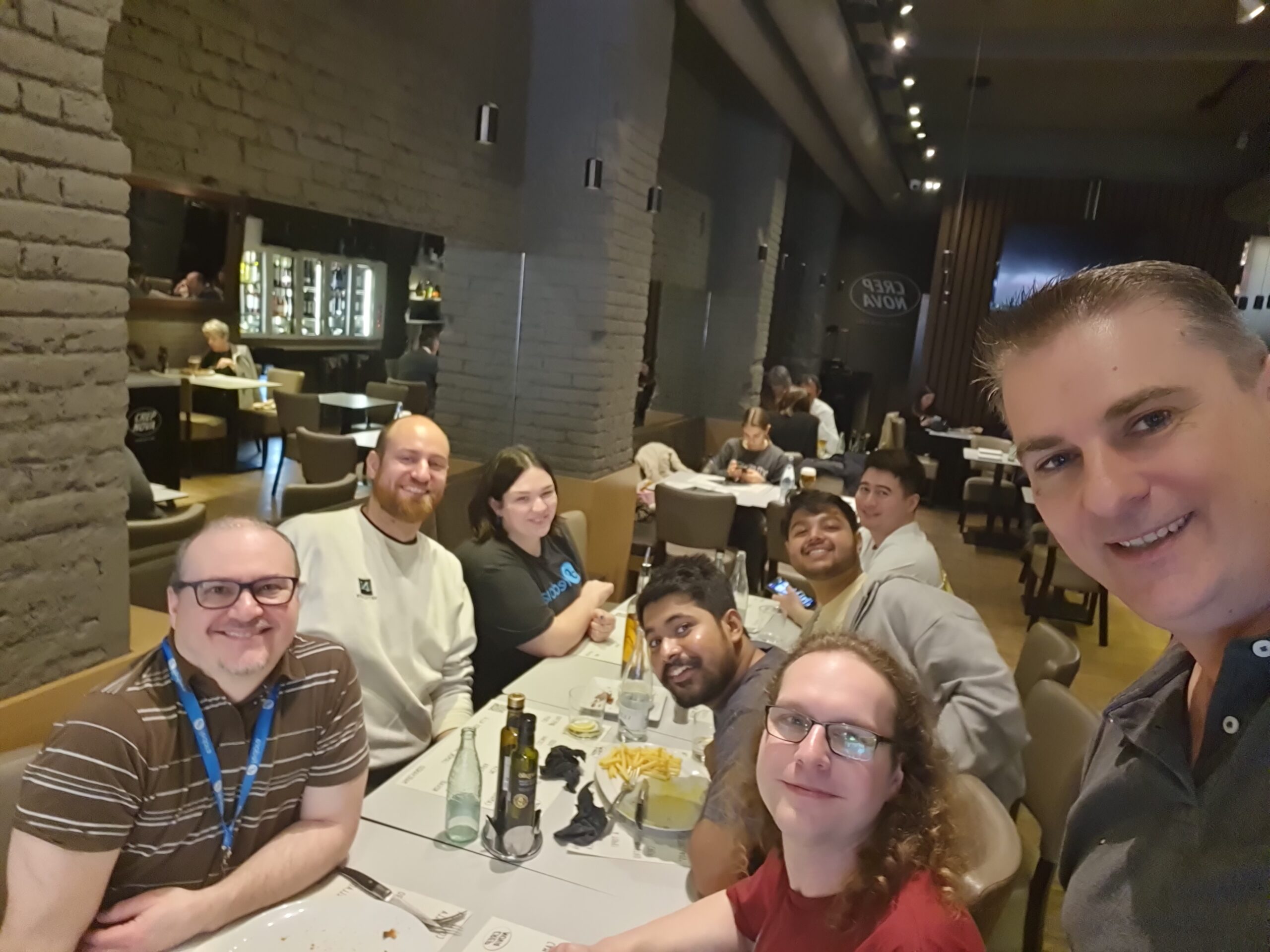
Whilst a few team members flew into Barcelona on Sunday, many flew in throughout the day and took a cab to the hotel on Monday. As nothing was planned on the agenda for the day, it was spent by the teammates mostly getting to know each other, snacking on regional delicacies, and resting after the long flights people had gone through to get here. It was surprising to see just how many team members were getting to meet each other for the first time here and could not before, either because they were new to the team or were working on greatly different things. Some members decided to recce the Red Hat office located close by to the hotel at Travessera de Garcia, Barcelona, and snacking joints while others decided to rest up during the afternoon before heading together to the planned dinner at 1930 in a local Indian restaurant.

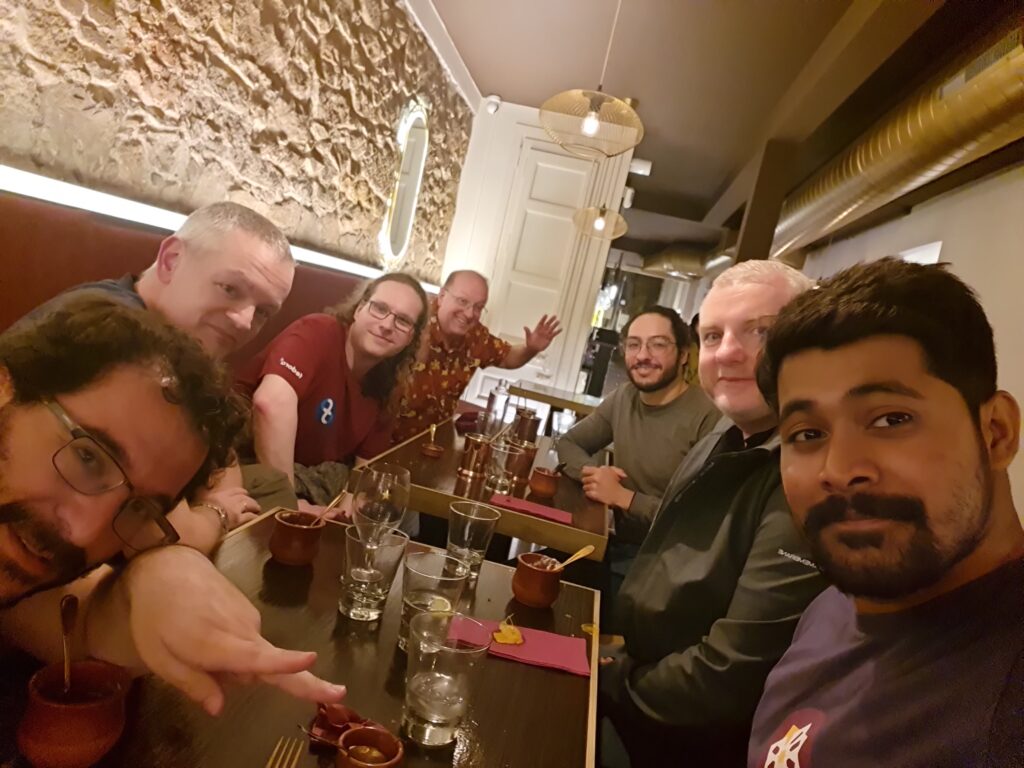
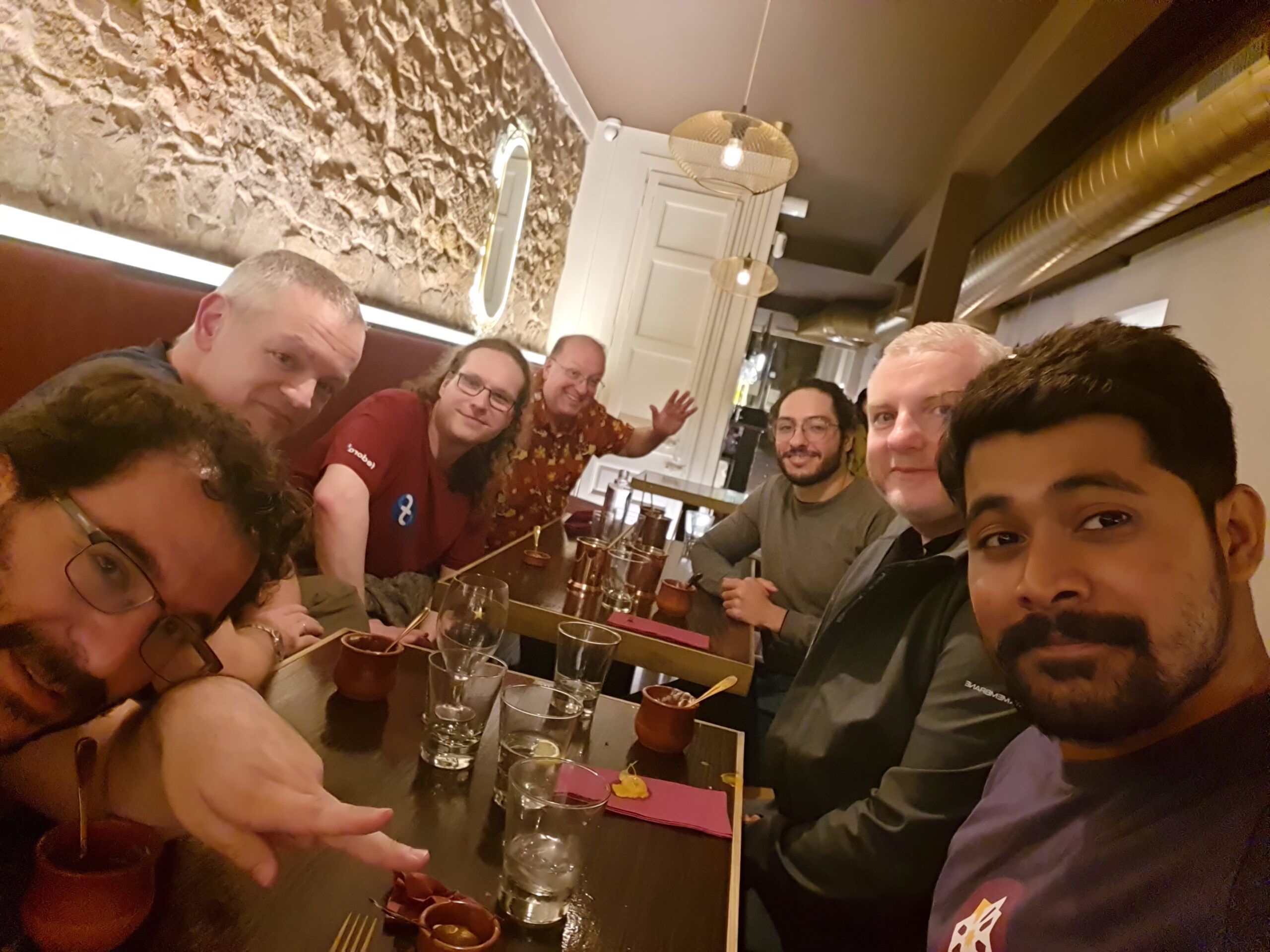
From left to right – Diego Herrera, Nils Philippsen, Michal Konecny, Troy Dawson, Pedro Moura, Stefan Mattejiet, and Akashdeep Dhar

With the evening finding its way into the day, the team united at the hotel lobby at 1900 and started heading over to the authentic Indian restaurant called Bar Bar, which was again a walking distance from the hotel. Being a cuisine that most of the teammates did not try previously, Akashdeep Dhar volunteered to guide folks through the menu – suggesting delicacies to try (or avoid) based on their preferences of flavor. For a team consisting of members hailing from across a variety of time zones and countries, having food and sharing anecdotes was indeed a magically unifying experience. After the dinner got over, some people stayed back to click pictures with the friends they made, some headed off for some more snacks in a nearby cafe and the remaining folks returned back to the hotel to get some much-needed respite.

Day 1

After the team had a joint breakfast from around 0700 to 0900, the members started heading off to the office in small groups to start off with the first (official) day of the event. Once all members settled down in a meeting room, the face-to-face meeting started off with the opening delivered by Stefan Mattejiet, following which a fun session was conducted to understand how well the members know each other by drawing each other’s faces. The next session was conducted by Akashdeep Dhar where he talked about the importance of mentorship within the team as well as in the community and organized an activity where the team, divided into multiple subteams, were asked to enact different scenarios of mentor-mentee interactions. Following that they dispersed into small groups and headed to their preferred places for lunch.

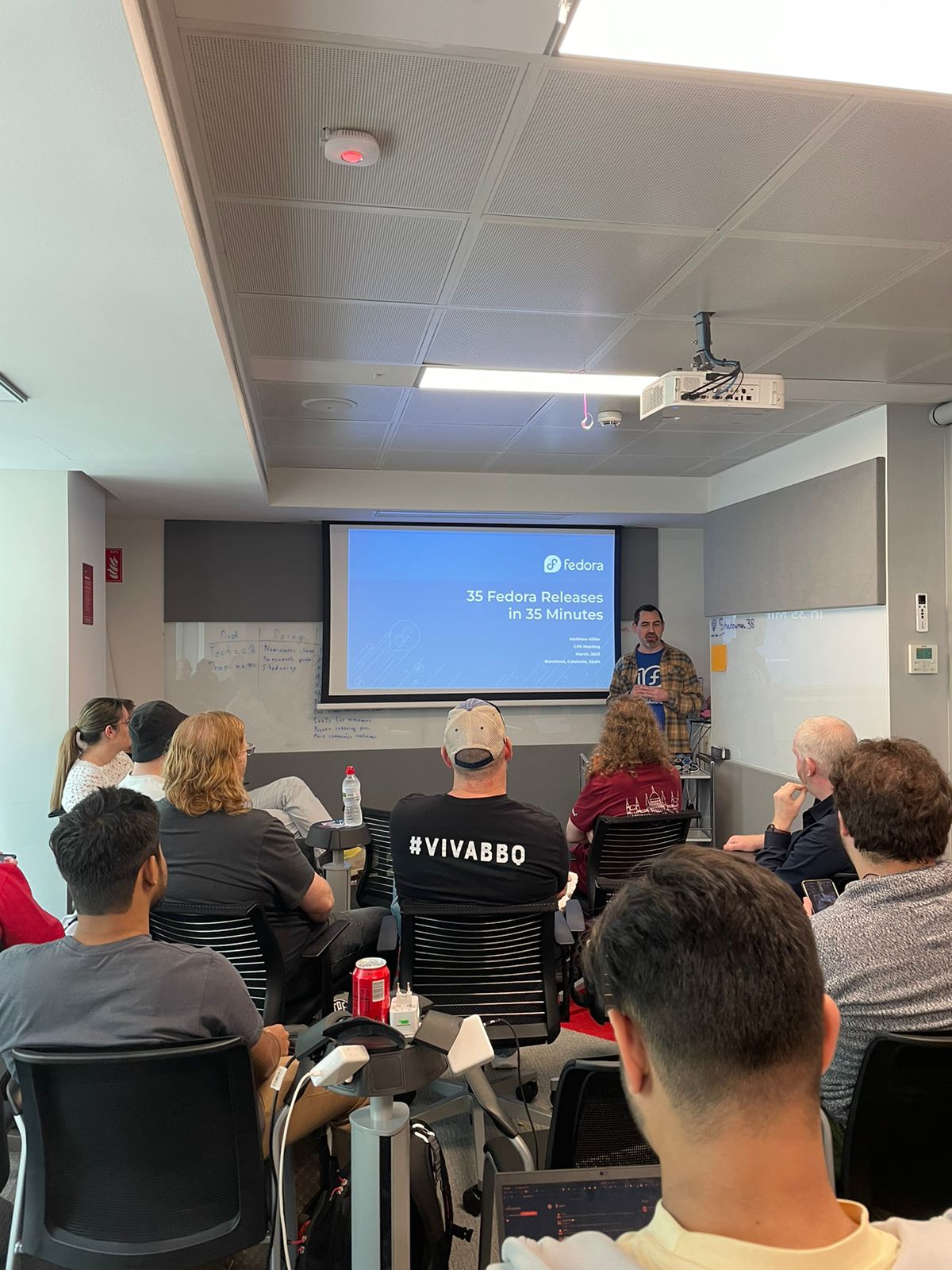
Once the team members were back in the office, Michal Konecny started off the next session about how knowledge can be effectively shared in the team, which proved to be really helpful. This was added to by the next session conducted jointly by Aoife Moloney, Kevin Fenzi, and Julia Bley, around understanding what the team skills are and what their interests lie in. The members were lining up their creative thoughts as sticky notes that were grouped under a certain focus topic. As we moved on to the later parts of the day, Troy Dawson organized a group story session where we came together to come up with fun stories and it was really surprising to see how creative people could get using just one or two words. Finally, Matthew Miller gave us a brief yet interesting run through the history of 35 Fedora Linux releases in around 35 minutes. 

Matthew Miller giving a run-through of 35 releases of Fedora Linux in 35 minutes

With the last talk having been completed, the team members headed back to the hotel for a brief respite before they reunited again for a touring walk at 1630. When the team got to Plaça de Catalunya, the members were divided into two groups and were provided with a couple of tour guides who took them through the famous historical structures of Barcelona. It was an enriching experience to get to know about the history that led to the creation of these fascinating architectural creations and the team members took plenty of photographs to retain the memories. The tour got over by around 1930 after which the team members went to a local restaurant, Taller de Tapas to enjoy regional Spanish cuisine. A wide variety of mouth-watering Tapas delicacies were served with drinks, culminating the first day of the meeting on a high note.

Posted on Leave a comment

Contribute at the Fedora CoreOS, Upgrade, and IoT Test Days

Fedora test days are events where anyone can help make certain that changes in Fedora work well in an upcoming release. Fedora community members often participate, and the public is welcome at these events. If you’ve never contributed to Fedora before, this is a perfect way to get started.

There are five upcoming test days in the next two weeks covering three topics:

  • Tues 28 March through Sunday 02 April, is to test the Fedora CoreOS.
  • Wed March 28th through March 31st , is to test the Upgrade
  • Monday April 03 through April 07 , is to test Fedora IoT .

Come and test with us to make Fedora 38 even better. Read more below on how to do it.

Fedora 38 CoreOS Test Week

The Fedora 38 CoreOS Test Week focuses on testing FCOS based on Fedora 38. The FCOS next stream is already rebased on Fedora 38 content, which will be coming soon to testing and stable. To prepare for the content being promoted to other streams the Fedora CoreOS and QA teams have organized test days on Tues, March 28, 2023 (results accepted through Sun , November 12). Refer to the wiki page for links to the test cases and materials you’ll need to participate. The FCOS and QA team will meet and communicate with the community sync on a Google Meet at the beginning of test week and async over multiple matrix/element channels. Read more about them in this announcement.

Upgrade test day

As we come closer to Fedora Linux 38 release dates, it’s time to test upgrades. This release has a lot of changes and it becomes essential that we test the graphical upgrade methods as well as the command line. As a part of these test days, we will test upgrading from a full updated, F36 and F37 to F38 for all architectures (x86_64, ARM, aarch64) and variants (WS, cloud, server, silverblue, IoT).

IoT test week

For this test week, the focus is all-around; test all the bits that come in a Fedora IoT release as well as validate different hardware. This includes:

  • Basic installation to different media
  • Installing in a VM
  • rpm-ostree upgrades, layering, rebasing
  • Basic container manipulation with Podman.

We welcome all different types of hardware, but have a specific list of target hardware for convenience.

How do test days work?

A test day is an event where anyone can help make certain that changes in Fedora work well in an upcoming release. Fedora community members often participate, and the public is welcome at these events. Test days are the perfect way to start contributing if you not in the past.

The only requirement to get started is the ability to download test materials (which include some large files) and then read and follow directions step by step.

Detailed information about all the test days are on the wiki page links provided above. If you are available on or around the days of the events, please do some testing and report your results.

Posted on Leave a comment

The Fedora Project FOSDEM 23 Experience

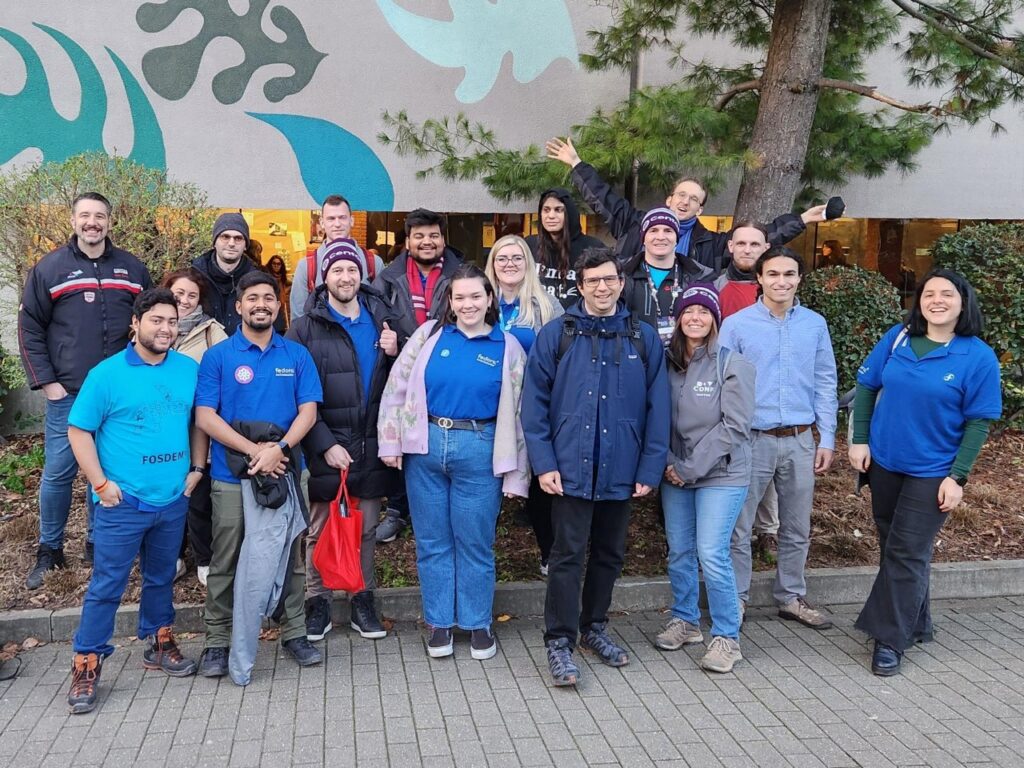
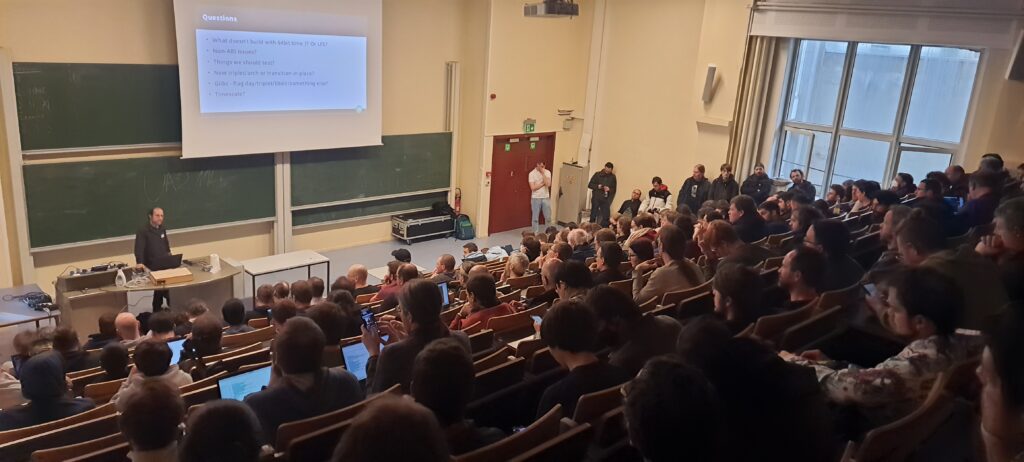
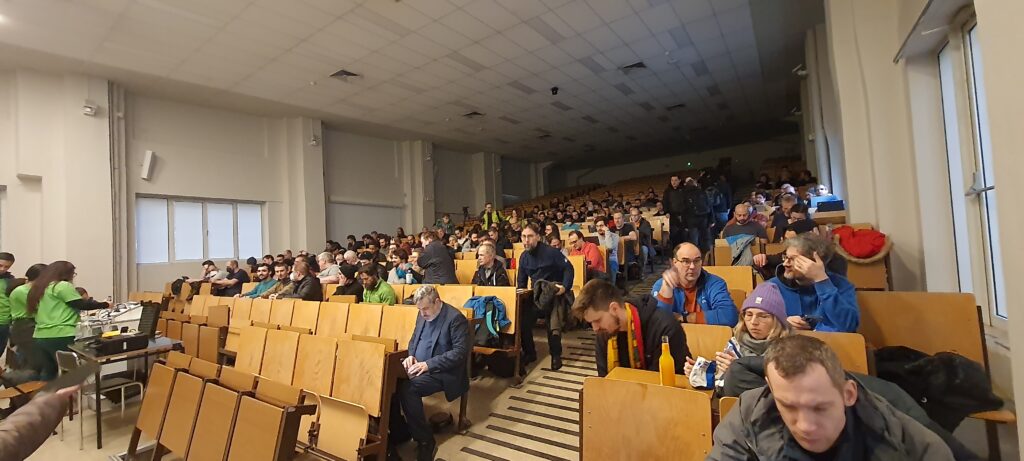
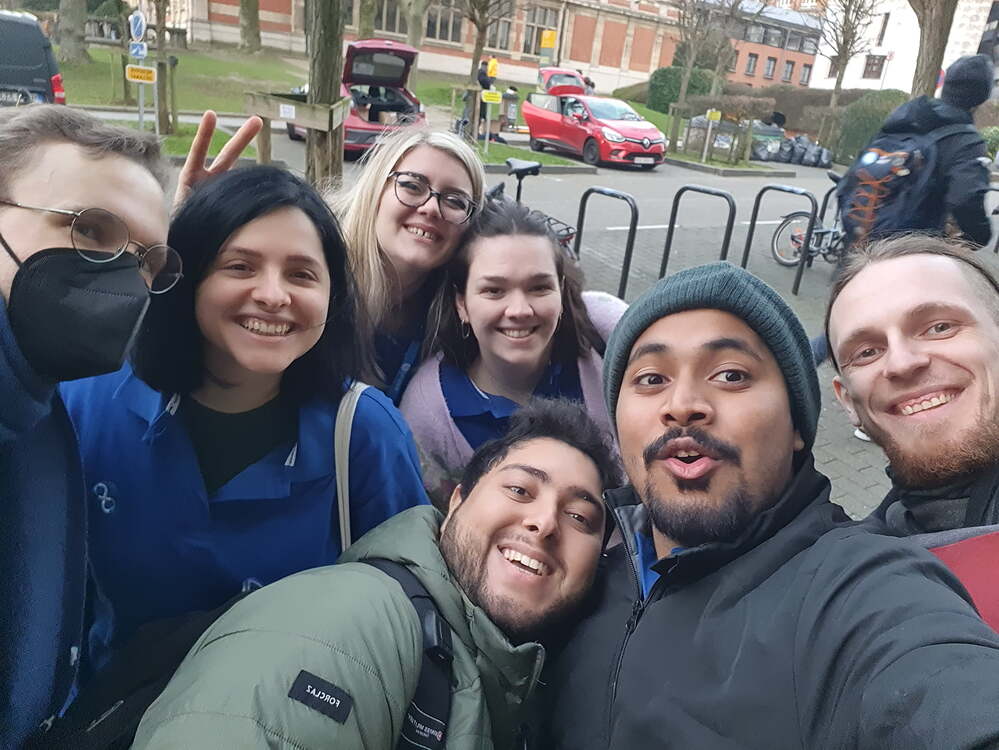
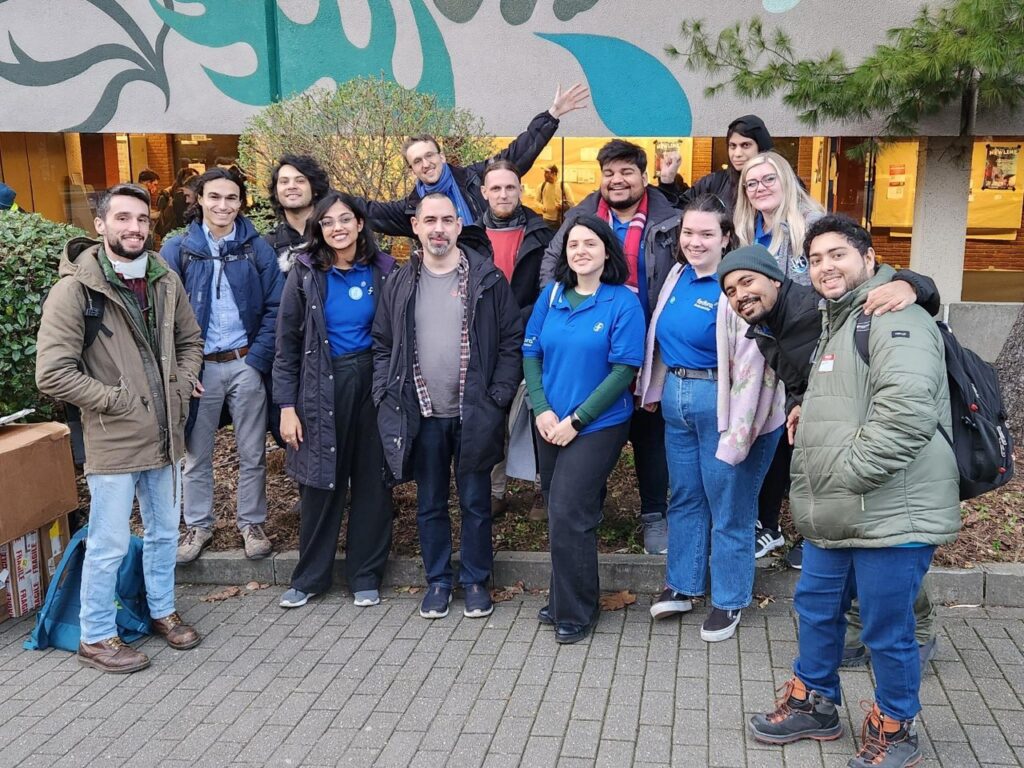
A measure of growth is most apparent when scaled across a span of different times and situations. That applies to folks getting to see you after a long time, to vegetation left alone to spread and of course, to communities having their first meetup after a prolonged spell of online-bound interactions. FOSDEM 23 happened to be one of the first times after around three years that community members from across the world met in person with each other in Brussels, Belgium. With new and old faces alike, their time was well spent representing the community, exhibiting to the wider free and open-source communities the good stuff that they have been keeping themselves busy with and most importantly, bonding with their Fedora friends.

This year FOSDEM took place on 4th February ’23 and 5th February ’23 at Université Libre de Bruxelles, Campus du Solbosch, Avenue F. D. Roosevelt 50, 1050 Bruxelles, Belgium. This free event was participated by over 8000 software engineering enthusiasts from across the world, had around 36 lightning talks and around 771 talks spanning 55 designated devrooms. Contributors from our community did not restrict their participation in the event as just attendees but they also enthusiastically volunteered to be stand keepers in the Fedora Project booth, speakers for a variety of talks and lectures, organizers for a set of devrooms and even as ground staff for making FOSDEM 23 a grand success.

Representation in booth

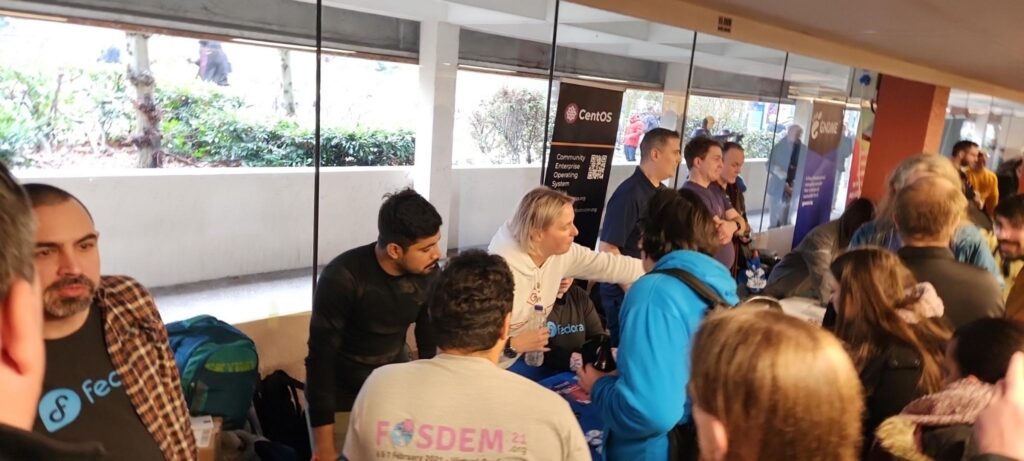
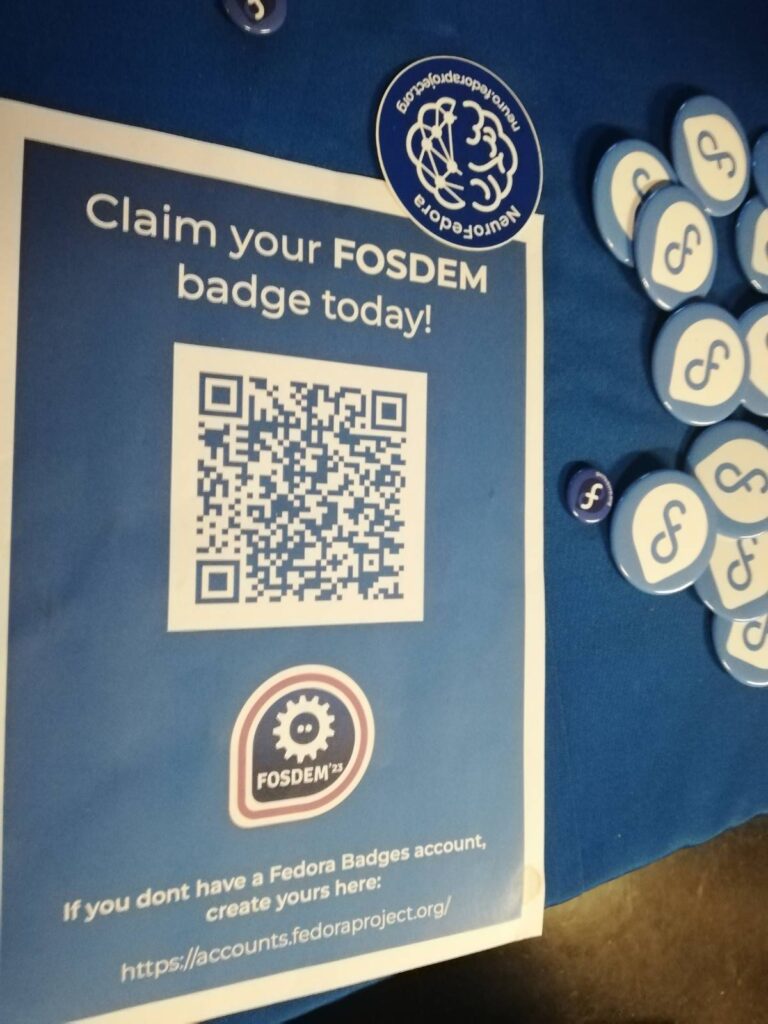
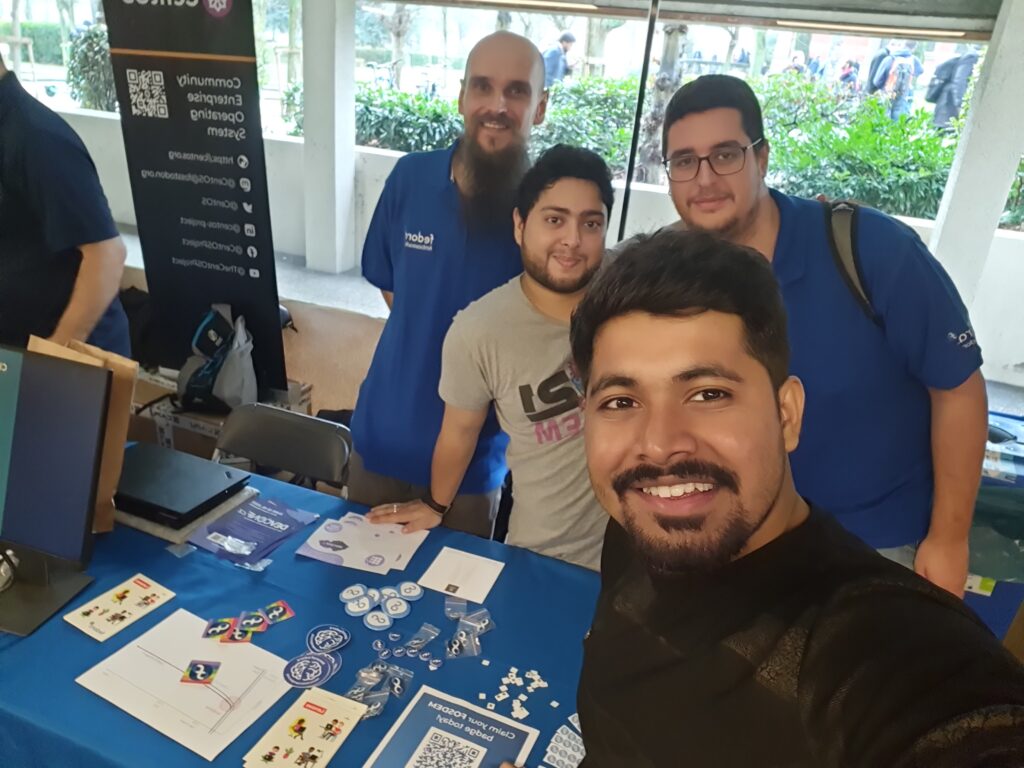
Fedora Project had its official booth in Building H of the Université Libre de Bruxelles campus, near the booths belonging to our friends at CentOS Project and GNOME Project. The desks were set up on time with a display showing the FOSDEM 23 attendee badge QR code and an assorted set of Fedora Project swags for taking (like keycaps with the Fedora logo, USB flash drives with Fedora branding, stickers and clips with the branding of Fedora subteams/SIGs/workgroups like NeuroFedora and Workstation, webcam covers with the Fedora logo and much more). We were also thankfully provided with a jar of jelly bears to offer to our booth attendees and a set of stickers from our friends at the AlmaLinux community.

With a designated booth duty schedule planned beforehand by our community members, the booth was constantly looked after by at least three staff members at any point in time and attended to hundreds of booth visitors throughout the course of the event. The booth visitors were excited to interact with our booth staff members, shared their own fun experiences of using Fedora Linux for a purpose of their choice and asked questions about participating in the community. We also teamed up with our friends from CentOS Project to combine our efforts into managing our booths together and moving our resources to/from the FOSDEM locker room. To sum it up, we really appreciate the community’s participation in our official booth.

Speaking about innovation

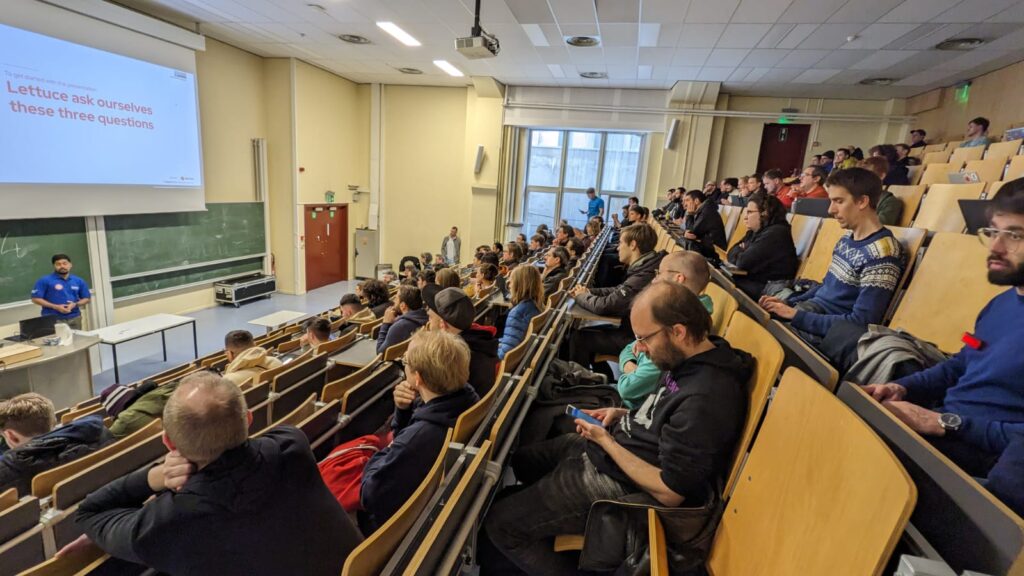
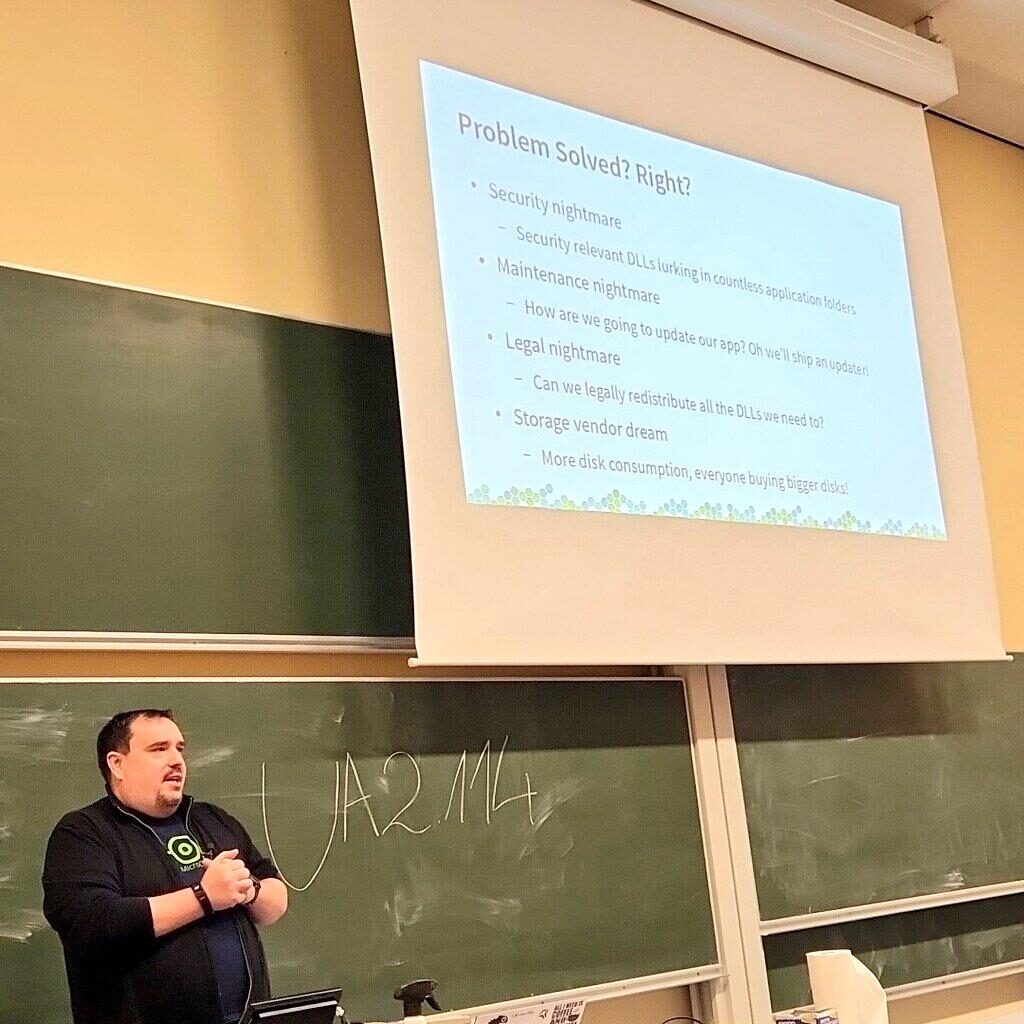
Contributors participating in the Fedora Project community were eager to share what they know about what they have been working and that took place in the form of multiple talks/lectures for a variety of devrooms during FOSDEM 23. Ranging from the latest Fedora Linux remix running on Apple Silicon hardware to improving the experience of video gaming on GNU/Linux distributions, from summing up the helpful outcomes of one of the first open-source creative conferences to building a web-based installer for Fedora Linux, our members were involved in providing a great deal of quality content and were met by wide acclaim from halls filled with enthusiastic attendees.

The delivered talks/lectures were not only useful in letting others know about all the cool things we have been working on but also instrumental in garnering feedback from the wider free and open-source software communities as to how we can do better. The attendees were eager to ask their questions at the end of the respective talks and curious to know about the directions that our projects, activities and developments were headed, thereby helping the speaker establish their network and also, potentially onboarding contributors. The following is the list of talks/lectures associated with the Fedora Project, the links of which can be followed to access the recordings and shared presentation assets.

Helping with devrooms

Being a volunteer-driven conference with only a few people working around the year to make it happen, FOSDEM entirely relies on free and open-source enthusiasts to contribute their efforts to organizing and running a variety of devrooms. FOSDEM has set up internet connectivity and projectors to ensure the teams can meet, discuss, hack and publicly showcase their latest developments in the form of lightning talks, news, discussions, talks and lectures. These devrooms cover a wide range of diverse topics, giving all enthusiasts a platform to show what they have been working on, learn what is current in the field of their interest and benefit from the discussions that take place about their topic.

Ranging from language-specific devrooms to those about community governance, contributors participating in the Fedora Project community got involved in not only delivering talks/lectures in these devrooms but also volunteering to make these a grand success. From running a live microphone for attending to popping up questions to flagging flashcards to show speakers how much time they have left, from setting up the wireless microphone for every new speaker coming to the stage to cleaning up everything after the event is wrapped up – FOSDEM appreciates the community participation and we are all about it. Following is a list of devrooms that were helped by Fedora Community members.

Making FOSDEM successful

Donning the bright orange FOSDEM volunteer tees are our proud force of FOSDEM ground staff who devote their time to making sure that everything goes smoothly while organizing the conference. From introducing speakers before their talk/lecture begins to running cash registers at the counter selling official FOSDEM tee, from attending to the FOSDEM cloakroom containing booth and devroom assets to providing directions to the lost speakers rushing to their devrooms – needless to mention that FOSDEM would not have been possible without them. Here as well, one of our long-time Fedora Project contributors, Bogomil Shopov volunteered during FOSDEM 23 as their official ground staff.

Other events

Beyond FOSDEM 23, the contributors participating in the Fedora Project community participated in a bunch of meetups happening around the same time which further helped enrich the networking opportunities for our members. This not only led to our community spanning far and wide to those of others like OpenSUSE, GNOME etc. but to also learning and adapting from what the other communities do best while collaborating with them. We participated in the day-long CentOS Connect event on 3rd February ’23, Google’s FLOSS Foundations Dinner 2023 on 3rd February ’23, Google’s Mentorship Meetup and Fedora & CentOS Friends Dinner on 4th February ’23, and GitHub’s SustainOSS Meetup on 5th February ’23.

Posted on Leave a comment

Fedora Project at FOSDEM 2023

Fedora Project will be present at FOSDEM 2023. This article describes this gathering and a few of the events on the agenda. I assume if you are reading the Fedora Magazine, you already know what FOSDEM is, but I’ll start with a small intro anyway.

Define FOSDEM

FOSDEM is the biggest event in the known universe for free/libre and open-source developers and enthusiasts.

Many good people from around the world meet and discuss common topics and define the future of F/LOSS. The event is held in Brussels at the beginning of February. Some of us, who are coming from a bit warmer countries, are calling it FrOSDEM, because it’s usually freezing 🙂

Why attend?

If you are a contributor already or you want to start doing good with your skills for the F/LOSS universe, this event is a must. 

I know everyone has their reason for visiting, but I’ll share the most common ones:

  • You meet the people creating and supporting the products that power the Internet that you already use.
  • If you are a contributor already, you have a chance to meet with your team and people using your product.
  • You learn so much new stuff quickly.
  • You enlarge your horizons by looking at something outside your bubble. If you are a fan of Fedora, go and learn more about Security or Javascript.
  • You have a chance to talk to others with the same passion as yours and even become friends for life. A good friend is always a commodity!
  • You achieve your daily steps goal because the ULB campus is enormous, and you will have to move a lot to get to the room you would like to visit.
  • You have a chance to volunteer and help the community if this is what drives you.
  • You attend an event with a great Code of Conduct.

Fedora at FOSDEM 2023

It’s a tradition for the Fedora Project team to be there to present some of our work from the last year and to allow you to share your feedback on what we do well and how we can improve.

Meet, greet, and see our community in action

One of the most extraordinary things at FOSDEM, which I deliberately didn’t mention in the previous section, is the project booths. In almost every building, you will see people behind a branded table, ready to talk to you about their project, its values, and its mission.

People at the Fedora booth looking at something.
Image by Francesco Crippa under Attribution 2.0 Generic (CC BY 2.0)

 I have to mention the goodies here, as well. You will return home with many items from your favorite projects. Be sure to continue supporting them further.  

We at Fedora will be happy to welcome you to our booth as well. You can talk to the community members, give us constructive feedback, and see some of the things we prepared.

Our booth location is in building H, alongside the rest of the Linux Distros.

Map of the ULB campus with a mark of the building H, where the Fedora Project booth will be
Building H, ULB Campus.

Stop by and say hi in your language! We are looking forward to talking to you!

We want to share what makes our work exceptional

At each FOSDEM we have a good number of talks related to what we do at Fedora. I am listing only some of them to make it enjoyable for you to browse the agenda and discover the rest yourself.

1: Fedora CoreOS – Your Next Multiplayer Homelab Distro

Using Fedora CoreOS in a Selfhosted Homelab to setup a Multiplayer Server

Speakers

Akashdeep Dhar
 Objective Lead for Fedora Websites & Apps, Fedora Council
 Software Engineer, Red Hat Community Platform Engineering

Sumantro Mukherjee
 Elected Representative, Fedora Council
 Software Quality Engineer, Red Hat

Intro

Fedora CoreOS is an essential, monolithic, automatically updating operating system optimized for running containers. It focuses on offering the best container host for executing containerized workloads securely and at scale. We will show a case study of setting up Fedora CoreOS as a self-hosted Homelab distribution for globally accessible (using secure network tunneling) multiplayer servers for video games (namely Minecraft, Valheim, etc.).

When and Where

Saturday, Feb-4 at the Containers devroom from 11:30 to 12:00


2: Creative Freedom Summit Retrospective

Speakers

Emma Kidney

Part of Red Hat’s Community Platform Engineering team since 2021. 
Designer at Red Hat’s Community Design Team. 

Jess Chitas 

Part of Red Hat’s Community Platform Engineering team.
Creator of Fedora’s mascot – Colúr, and Fedora Brand Guidelines Booklet.

Intro

The Creative Freedom Summit is a virtual event focused on promoting Open Source tools, spreading knowledge of how to use them, and connecting creatives across the FOSS ecosystem. The summit’s accomplishments and shortcomings will be examined in light of the event’s first year and potential changes for the following years.

When and Where

Sunday, Feb-5 at the Open Source Design Dev Room from 14:30 to 14:55


Where to find more related talks?

Our wiki page is a good start, but FOSDEM’s schedule catalog is even better. One life hack: select a good 30 min slot, go through all the rooms which might get your attention, and create a personal schedule in your favorite calendar app. Make sure you have a backup plan because some rooms might be fully occupied, and you cannot enter.

I want to interest you in a challenge

If you know more than I do about FOSDEM 2023 and have already prepared your schedule, share a single paragraph comment about your FOSDEM plan and list a few of your favorite talks. You will help the community understand the greatness of the event and find more reasons to make the trip to frosty Brussels.

See you there!

Posted on Leave a comment

Anaconda Web UI preview image now public!

We are excited to announce the first public preview image of the new Anaconda web interface!  Our vision is to reimagine and modernize our installer’s user experience (see our blog post “Anaconda is getting a new suit”). We are doing this by redesigning the user experience on all fronts to make it more easy and approachable for everyone to use.

Today, we would like to introduce our plans for the public preview release, as our new project has already reached a point where core code functionality is already developed and the new interface can be used for real installations. 

So, we’re giving you something to play with! 🙂

Installation progress of the preview image

Why public preview image?

By giving you a working ISO as soon as we can, you have the opportunity to help us to define this new UI. This task allows us to rethink what we have and find new ways to overcome the challenges of the UI instead of re-creating what we had already. Please take this opportunity and reach us with your feedback to help us to create the best OS installer ever!

Please let us know what you require from Anaconda. What features are important to you and why are these important? That will allow us to prioritize our focus on development and design. See below for how to contact us.

How to get public preview image?

Download the Anaconda preview image here

Thanks a lot to the Image Builder team for providing us with a way to build ISO with the Fedora 37 Workstation GA content. We are planning to provide additional images with an updated installer to give you the newest features and fixes with the link above. There are no updates to the installation payload (installed system data) yet. We will announce important updates of the ISO image by sending mail to anaconda-devel@lists.fedoraproject.org with CC to devel@lists.fedoraproject.org. Please subscribe to either of these to get information about the news. This way we will be able to iterate on your feedback.

What you will get with the preview ISO

The ISO will allow you to install the system and let you get a taste of the new UI, so you can provide us early feedback. However, it is pretty early in the development cycle. We advise you to not use this ISO to install critical infrastructure or machines where you have important data.

Let’s go to the more interesting part of what you can do with the ISO:

  • Choose installation language
  • Select your disks
  • Automatically partition the disks. BEWARE! This will erase everything on the selected disks.
  • Automatically install Fedora 37 GA Workstation system
  • Basic review screen of your selections
  • Installation progress screen
  • Built-in help (on Installation destination screen only)

Known issues:

  • In the bootloader menu you’ll see “Install Fedora 38”, it’s expected because the installation environment is from Rawhide. However, the content installed will be Fedora 37 GA, so don’t worry.
  • Virtual Box on Mac might have resolution issues. We are working on resolving this issue.
  • Aspect ratio and window handling. We know we need to solve this better, feedback is welcome.

How to provide feedback?

Your feedback is critical to have a project which you and we can be proud of, so please share it with us. To give us feedback:

Please take your time to play with the UI and tell us what you think. What works great, what is not working and what you would like to have. Ideally, follow future updates and tell us if the situation is better or worse. 

We are really counting on your feedback and we are thankful to have you all supporting us in this journey!

Posted on Leave a comment

You’re invited to the Fedora Linux 37 Release Party!

I am pleased to announce we will celebrate the final release of Fedora Linux 37 with a virtual Release Party. The virtual release parties are a great way to learn more about the latest Fedora Linux release. More importantly, they’re a chance to spend time with the wonderful Fedora community. Please register on Hopin and join us on November 4th and 5th for a short program of informational sessions and social activities. Make sure to save the dates, share the registration, and show up to party with Fedora Friends!

The program is still in the works, but we hope to include informational sessions that will feature updates about Fedora CoreOS, the new installer interface preview, and a bunch more current community activities. We’ll also meet our new Fedora Community Action and Impact Coordinator, Justin W. Flory. Last, but certainly not least, we will have social sessions, including hanging out in the Fedora Museum WorkAdventure. Thanks to our amazing community for all your contributions to the latest release of Fedora Linux. Let’s celebrate!

Don’t forget to register for free any time and join us November 4th and 5th.

Posted on Leave a comment

Contribute at the i18n, Release Validation, CrytoPolicy and GNOME 43 Final test weeks for Fedora Linux 37

There are 4 upcoming test days/weeks in the coming weeks. The first is Wed 31 August through Wed 07 Sept. It is to test Pre-Beta Release Validation. The second is Tuesday 6 Sept through Monday 12 Sept. It focuses on testing i18n. The third is Monday 5 Sept the Crypto Policy test day. The fourth is Wed 7 Sept through Wed 14 Sept to test GNOME 43 Final. Please come and test with us to make the upcoming Fedora 37 even better. Read more below on how to participate.

Pre-Beta Release Validation

Fedora Linux is foremost a community-powered distribution. Fedora Linux runs on all sorts of off-the-shelf hardware. The QA team relies on looking at bugs and edge cases coming out of community-owned hardware, so testing pre-release composes is a crucial part of the release process. We try to fix as many of them as we can! Please participate in the pre-beta release validation test week now through 7 September. You can help us catch those bugs at an early stage. A detailed post can be found here

GNOME 43 Final test week

GNOME is the default desktop environment for Fedora Workstation and thus for many Fedora users. As a part of the planned change, the GNOME 43 Final will land on Fedora which then will be shipped with Fedora Linux 37. To ensure that everything works fine The Workstation Working Group and QA team will have this test week Wed 7 Sept through Wed 14 Sept. Refer to the GNOME 43 test week wiki page for links and resources needed to participate.

i18n test week

i18n test week focuses on testing internationalization features in Fedora Linux. The test week is Tuesday 6 Sept through Monday 12 Sept.

StrongCryptoSettings3 test day

This is a new and unconventional test day. The change, however small, will have impacts across many areas and we want our users to spot as many bugs as we possibly can. The advice is to use exotic VPNs, proprietary chat apps, different email providers and even git workflows. These can be tested with some advice which can be found here. This test day is Monday 5 Sept.

How do test days work?

A test day is an event where anyone can help make sure changes in Fedora Linux work well in an upcoming release. Fedora community members often participate, and the public is welcome at these events. If you’ve never contributed before, this is a perfect way to get started.

To contribute, you only need to be able to download test materials (which include some large files) and then read and follow directions step by step.

Detailed information about both test days is available on the wiki pages mentioned above. If you’re available on or around the days of the events, please do some testing and report your results.

Come and test with us to make the upcoming Fedora 37 even better.