Posted on Leave a comment

jQuery AJAX AutoComplete with Create-New Feature

by Vincy. Last modified on July 25th, 2023.

Autocomplete textbox feature shows the suggestion list when the user enters a value. The suggestions are, in a way, related to the entered keyword.

For example, when typing in a Google search box, it displays auto-suggested keywords in a dropdown.

View Demo

This tutorial will show how to add this feature to a website. The code uses the JQuery library with PHP and MySQL to show dynamic auto-suggestions on entering the search key.

It allows typing the start letter of the country name to get suggested with the list of country names accordingly. See the linked code for enabling autocomplete using the jQuery-Ui library.

The specialty of this example is that it also allows adding a new option that is not present in the list of suggestions.

jquery ajax autocomplete create new

On key-up, a function executes the Jquery Autocomplete script. It reads suggestions based on entered value. This event handler is an AJAX function. It requests PHP for the list of related countries from the database.

When submitting a new country, the PHP will update the database. Then, this new option will come from the next time onwards.

Steps to have a autocomplete field with a create-new option

  1. Create HTML with a autocomplete field.
  2. Integrate jQuery library and initialize autocomplete for the field.
  3. Create an external data source (database here) for displaying suggestions.
  4. Fetch the autocomplete suggestions from the database using PHP.
  5. Insert a newly created option into the database.

1. Create HTML with a autocomplete field

This HTML is for creating an autocomplete search field in a form. It is a suggestion box that displays dynamic auto-suggestions via AJAX.

On the key-up event of this input field, the AJAX script sends the request to the PHP.  The PHP search performs database fetch about the entered keyword.

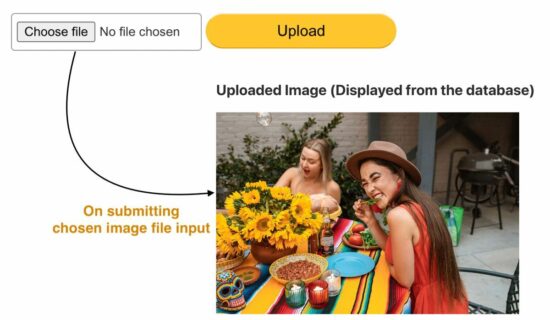
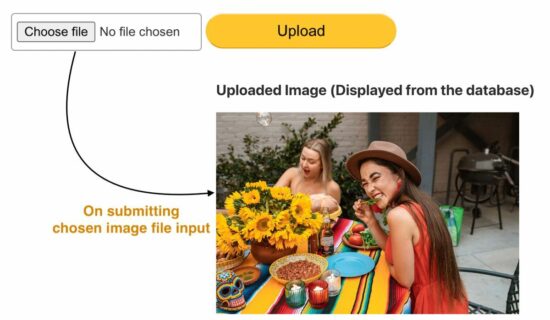
This HTML form also posts data not chosen from the suggestions. This feature allows adding new options to the source of the search suggestions.

index.php

<!DOCTYPE html>
<html>
<head>
<meta name="viewport" content="width=device-width, initial-scale=1">
<link rel="stylesheet" type="text/css" href="style.css" />
</head>
<body> <div class="outer-container"> <div class="row"> <form id="addCountryForm" autocomplete="off" method="post"> <div Class="input-row"> <label for="countryName">Country Name:</label><input type="text" id="countryName" name="countryName" required> <div id="countryList"></div> </div> <input type="submit" class="submit-btn" value="Save Country"> <div id="message"></div> </form> </div> </div>
</body>
</html>

2. Integrate the jQuery library and initialize autocomplete for the field

This code uses AJAX to show the dynamic autocomplete dropdown. This script sends the user input to the PHP endpoint.

In the success callback, the AJAX script captures the response and updates the auto-suggestions in the UI. This happens on the key-up event.

The suggested options are selectable. The input box will be filled with the chosen option on clicking each option.

Then, the form input is posted to the PHP via AJAX on the form-submit event.

This jQuery script shows the fade-in fade-out effect to display and hide the autocomplete dropdown in the UI.

index.php(ajax script)

$(document).ready(function() { $('#countryName').keyup(function() { var query = $(this).val(); if (query != '') { $.ajax({ url: 'searchCountry.php', type: 'POST', data: { query: query }, success: function(response) { $('#countryList').fadeIn(); $('#countryList').html(response); } }); } else { $('#countryList').fadeOut(); $('#countryList').html(''); } }); $(document).on('click', 'li', function() { $('#countryName').val($(this).text()); $('#countryList').fadeOut(); }); $('#addCountryForm').submit(function(event) { event.preventDefault(); var countryName = $('#countryName').val(); $.ajax({ type: 'POST', url: 'addCountry.php', data: { countryName: countryName }, success: function(response) { $('#countryList').hide(); $('#message').html(response).show(); } }); });
});

3. Create an external data source (database here) for displaying suggestions

Import this SQL to create to database structure to save the autocomplete suggestions. It has some initial data that helps to understand the autocomplete code during the execution.

database.sql

CREATE TABLE IF NOT EXISTS `democountries` (
`id` int NOT NULL AUTO_INCREMENT, `countryname` varchar(255) NOT NULL, PRIMARY KEY (id)
); INSERT INTO `democountries` (`countryname`) VALUES
('Afghanistan'),
('Albania'),
('Bahamas'),
('Bahrain'),
('Cambodia'),
('Cameroon'),
('Denmark'),
('Djibouti'),
('East Timor'),
('Ecuador'),
('Falkland Islands (Malvinas)'),
('Faroe Islands'),
('Gabon'),
('Gambia'),
('Haiti'),
('Heard and Mc Donald Islands'),
('Iceland'),
('India'),
('Jamaica'),
('Japan'),
('Kenya'),
('Kiribati'),
('Lao Peoples Democratic Republic'),
('Latvia'),
('Macau'),
('Macedonia');

4. Fetch the autocomplete suggestions from the database using PHP

The PHP code prepares the MySQL select query to fetch suggestions based on the search keyword.

It fetches records by searching for the country names that start with the keyword sent via AJAX.

This endpoint builds the HTML lists of autocomplete suggestions. This HTML response is used to update the UI to render relevant suggestions.

searchCountry.php

<?php
$conn = new mysqli('localhost', 'root', '', 'db_autocomplete'); if (isset($_POST['query'])) { $query = "{$_POST['query']}%"; $stmt = $conn->prepare("SELECT countryname FROM democountries WHERE countryname LIKE ? ORDER BY countryname ASC"); $stmt->bind_param("s", $query); $stmt->execute(); $result = $stmt->get_result(); if ($result->num_rows > 0) { while ($row = $result->fetch_assoc()) { echo '<li>' . $row['countryname'] . '</li>'; } }
}
?>

5. Insert a newly created option into the database

The expected value is not in the database if no result is found for the entered keyword. This code allows you to update the existing source with your new option.

The form submits action calls the below PHP script. It checks if the country name sent by the AJAX form submit is existed in the database. If not, it inserts that new country name.

After this insert, the newly added item can be seen in the suggestion box in the subsequent autocomplete search.

addCountry.php

<?php
$conn = new mysqli('localhost', 'root', '', 'db_autocomplete'); if (isset($_POST['countryName'])) { $countryName = "{$_POST['countryName']}"; $stmt = $conn->prepare("SELECT * FROM democountries WHERE countryname =?"); $stmt->bind_param("s", $countryName); $stmt->execute(); $result = $stmt->get_result(); if ($result->num_rows > 0) { echo '<p>Country Selected: ' . $countryName . '</p>'; } else { $stmt = $conn->prepare("INSERT INTO democountries (countryname) VALUES (?)"); $stmt->bind_param("s", $countryName); $stmt->execute(); $result = $stmt->insert_id; if (! empty($result)) { echo $countryName . ' saved to the country database.</br>'; } else { echo '<p>Error adding ' . $countryName . ' to the database: ' . mysqli_error($conn) . '</p>'; } }
}
?>

Different libraries providing Autocomplete feature

In this script, I give a custom autocomplete solution. But, many libraries are available to provide advanced feature-packed autocomplete util for your application.

  1. The jQueryUI provides autocomplete feature to enable an HTML field.
  2. One more library is the jQuery Autocompleter plugin that captures more data from the options to be chosen.

These libraries give additional features associated with the autocomplete solution.

  1. It allows to select single and multiple values from the autocomplete dropdown.
  2. It reads the option index or the key-value pair of the chosen item from the list.

Advantages of autocomplete

Most of us experience the advantages of the autocomplete feature. But, this list is to mention the pros of this must-needed UI feature intensely.

  1. It’s one of the top time-saving UI utilities that saves users the effort of typing the full option.
  2. It’s easy to search and get your results by shortlisting and narrowing. This is the same as how a search feature of a data table narrows down the result set.
  3. It helps to get relevant searches.

View Demo Download

↑ Back to Top

Posted on Leave a comment

Auto-GPT vs Agent GPT: Who’s Winning in Autonomous LLM Agents?

4/5 – (1 vote)

In the realm of AI agents and artificial general intelligence, Auto-GPT and Agent GPT are making waves as innovative tools built on OpenAI’s API. These language models have become popular choices for AI enthusiasts seeking to leverage the power of artificial intelligence in various tasks. πŸ’‘

Auto-GPT is an experimental, open-source autonomous AI agent based on the GPT-4 language model. It’s designed to chain together tasks autonomously, streamlining the multi-step prompting process commonly found in chatbots like ChatGPT.

Agent GPT boasts a user-friendly interface that makes AI interaction seamless even for individuals without coding experience. πŸ€–

AgentGPT is more expensive as you need to subscribe to a professional plan whereas with Auto-GPT you only need to provide an OpenAI API key without paying a third party.

While Auto-GPT pushes the boundaries of AI autonomy, Agent GPT focuses on a more intuitive user experience.

I created a table that subjectively summarizes the key similarities and differences:

Feature Auto-GPT Agent GPT Similarities Differences
Autonomy Can operate and make decisions on its own Same. From time to time needs human intervention to operate Both are powered by GPT technology Auto-GPT can be fully autonomous. Agent GPT not fully.
User-Friendliness Less user-friendly compared to Agent GPT More user-friendly due to its intuitive UI Both are designed to make AI accessible Auto-GPT more technical. Agent GPT easier and non-technical.
Functionality Designed to function autonomously Can create and deploy autonomous AI agents Both can generate human-like text Both worked the same in my case. Auto-GPT more customizable.
Intended use cases Best suited for individuals with programming or AI expertise More accessible to individuals without programming or AI expertise Both can be used for a range of applications, including chatbots and content creation Auto-GPT for technical users who want more control.
Agent GPT ideal for non-technical users
Pricing OpenAI API pricing ($0.03 per 1000 tokens) $40 per month for a few agents Both are relatively cheap for what they provide AgentGPT free for trial but more expensive than Auto-GPT for non-trivial tasks

Auto-GPT and Agent GPT Overview

In the realm of AI-powered language models, Auto-GPT and Agent GPT are two prominent technologies built on OpenAI’s API for automating tasks and language processing. This section provides a brief overview of both Auto-GPT and Agent GPT, focusing on their fundamentals and applications in various fields.

Auto-GPT Fundamentals

Auto-GPT is an open-source interface to large language models such as GPT-3.5 and GPT-4. It empowers users by self-guiding to complete tasks using a predefined task list. Requiring coding experience to be effectively used, Auto-GPT operates autonomously, making decisions and generating its own prompts πŸ€–.

With core capabilities in natural language processing, Auto-GPT applies to areas like data mining, content creation, and recommendation systems. Its autonomous nature makes it an ideal choice for developers seeking a more hands-off approach to task automation.

πŸ‘©β€πŸ’» Recommended: 30 Creative AutoGPT Use Cases to Make Money Online

Agent GPT Fundamentals

In contrast, Agent GPT is a user-friendly application with a direct browser interface for task input. Eliminating the need for coding expertise, Agent GPT provides an intuitive user experience suited for a broader audience. While it depends on user inputs for prompt generation, it still boasts a powerful language model foundation.

Agent GPT finds applications in various fields, including virtual assistants, chatbots, and educational tools. Its user-friendliness and customizability make it an appealing choice for non-technical users seeking artificial general intelligence (AGI) support in their projects.

Technology Comparison

In this section, we will compare Auto-GPT and AgentGPT, focusing on their Language Models and Processing, Autonomy and Workflow, and User Interface and Accessibility. These AI agents have distinct advantages and offer a range of features for different user needs.πŸ€–

Language Models and Processing

Auto-GPT and AgentGPT both utilize OpenAI’s GPT-3 or GPT-4 API, which handles natural language processing and deep learning tasks. As a result, they can handle complex text-based tasks effectively. The primary difference lies in their implementation and target audience.🎯

Autonomy and Workflow

Auto-GPT is designed to function autonomously by providing a task list and working towards task completion without much user interaction.πŸ€– This is ideal for developers with coding experience looking to automate more technical tasks in their workflow.

In contrast, AgentGPT is more user-friendly, requiring input through a direct browser interface. This makes AgentGPT a better choice for those without programming or AI expertise, as it simplifies the adoption and integration of the AI-powered tool in everyday tasks.πŸ‘©β€πŸ’»

Autonomy of both is similar although you can keep Auto-GPT running much longer in your shell or terminal. Having the browser tab open in Agent GPT will only get you so far… 😒

User Interface and Accessibility

Auto-GPT’s open-source nature means that it requires coding experience to be used effectively. While this may be perfect for developers, it can be a barrier for non-technical users.🚧

πŸ‘‰ Recommended: Setting Up Auto-GPT Any Other Way is Dangerous!

On the other hand, AgentGPT offers a straightforward browser interface, enabling users to input tasks without prior coding knowledge. This increased accessibility makes it a popular choice for individuals seeking AI assistance in a variety of professional settings.πŸ–₯

Key Features

Generative AI and Content Creation

Auto-GPT and AgentGPT are both AI agents used for generating text and content creation, but they have some differences. πŸ€–

Auto-GPT is an open-source project on GitHub made by Toran Bruce Richards. AgentGPT, on the other hand, is designed for user-friendliness and accessibility for those without AI expertise, thus making it perfect for non-programmers.

πŸ‘‰ Recommended: AutoGPT vs BabyAGI: Comparing OpenAI-Based Autonomous Agents

These AI agents employ advanced natural language processing algorithms to generate and structure content efficiently. They are optimized for various tasks, such as writing articles, creating summaries, and generating chatbot responses.

Machine Learning and Data Analysis

Both Auto-GPT and AgentGPT rely on cutting-edge machine learning algorithms to analyze and process data. Auto-GPT utilizes GPT-4 API for its core functionalities, while AgentGPT doesn’t rely on a specific GPT model.

Through their machine learning capabilities, these AI agents can not only create content but also analyze and process it effectively. This makes them perfect for applications like sentiment analysis, recommender systems, and classifications in a wide range of industries, from marketing to healthcare.

To sum up, Auto-GPT and AgentGPT are powerful and similar AI tools with a minor number of distinct features that cater to different needs. They both excel in generative AI and content creation, as well as machine learning and data analysis.

Personally, I found that AgentGPT is more fun! 😁

Pricing and Costs

AI agents like Auto-GPT and AgentGPT have become increasingly popular for automating tasks, but the security concerns surrounding them and their API access need to be taken into account. In this section, we will discuss securing AI integration and obtaining an OpenAI API key for these AI agentsβœ….

AgentGPT is more expensive as you need to subscribe to a professional plan whereas with Auto-GPT you only need to provide an OpenAI API key without paying a third party.

Here’s a screenshot of the product pricing of AgentGPT: πŸ‘‡

The pricing of OpenAI API is very inexpensive, so Auto-GPT will be much cheaper for larger projects:

Use Cases and Industries

This section explores the distinct applications of Auto-GPT and AgentGPT in various industries, focusing on automation, marketing strategy, and customer service. We will examine how these AI agents can streamline tasks and enhance decision-making, contribute to marketing initiatives, and improve customer service through chatbots. πŸ€–

Automate Tasks and Decision-Making

Auto-GPT excels at autonomous operation, making it a powerful choice for automating tasks and decision-making.

Industries like finance, manufacturing, and logistics can benefit from Auto-GPT’s ability to process vast amounts of data, identify patterns, and execute decisions based on predefined goals.

On the other hand, AgentGPT requires a higher amount of human intervention but excels in more user-friendly applications, providing an intuitive interface that non-experts can easily navigate. I have yet to see somebody running Agent GPT for days whereas it’s easy to do with Auto-GPT.

Marketing Strategy

In the realm of marketing, AgentGPT’s intuitive user interface makes it the more suitable choice for strategizing and creating content.

Digital marketers can leverage the language model to develop relevant and engaging materials for various platforms, including social media, email campaigns, and blog posts.

While Auto-GPT can also generate content, its autonomous nature might not be as ideal for crafting customized and targeted marketing messages.

Development and Future Prospects

In the rapidly evolving field of AI, Auto-GPT and Agent GPT are two key players making significant strides. This section explores their open-source interfaces, repositories, and future research involving GPT-4 and beyond, delving into how these developments might shape the future of large language models.

By the way, if you’re interested in open-source developments in the large language models (LLM) space, check out this article on the Finxter blog! πŸ‘‡

πŸš€ 6 New AI Projects Based on LLMs and OpenAI

Open-Source Interfaces and Repositories

In the world of artificial intelligence, open-source interfaces facilitate broader access to cutting-edge technology. Auto-GPT is one such agent, available as an open-source project on GitHub.

Developed by Toran Bruce Richards aka “Significant Gravitas”, its accessibility to those with coding experience helps to foster innovation in AI applications.

On the other hand, Agent GPT is a more expensive and user-friendly platform geared toward a wider audience, requiring less technical know-how for utilization.

GPT-4 and Future Research

As AI research continues, the focus has shifted to larger language modelsβ€”like GPT-4β€”that are expected to outperform their predecessors.

Auto-GPT, as a self-guiding agent capable of task completion via a provided task list, is primed for incorporation with future GPT iterations. Meanwhile, BabyAGI is another emerging language model, developed simultaneously with agents like Auto-GPT and Agent GPT, in response to the growing generative AI domain.

TLDR; Auto-GPT and Agent GPT contribute to a brighter future in AI research, with the former offering a more technical approach that’s inexpensive and highly customizable and the latter catering to a less code-oriented user base that is willing to pay more for the convenience.

The introduction of GPT-4 represents a step toward more advanced and efficient AI applications, ensuring that the race for better language models continues. πŸš€

OpenAI Glossary Cheat Sheet (100% Free PDF Download) πŸ‘‡

Finally, check out our free cheat sheet on OpenAI terminology, many Finxters have told me they love it! β™₯

πŸ’‘ Recommended: OpenAI Terminology Cheat Sheet (Free Download PDF)

References

Posted on Leave a comment

Auto-GPT vs ChatGPT: Key Differences and Best Use Cases

5/5 – (1 vote)

Artificial intelligence has brought us powerful tools to simplify our lives, and among these tools are Auto-GPT and ChatGPT. While they both revolve around the concept of generating text, there are some key differences that set them apart. 🌐

Auto-GPT, an open-source AI project, is built on ChatGPT’s Generative Pre-trained Transformers, giving it the ability to act autonomously without requiring continuous human input. It shines in handling multi-step projects and demands technical expertise for its utilization. 😎

On the other hand, ChatGPT functions as an AI chatbot that provides responses based on human prompts. Although it excels at generating shorter, conversational replies, it lacks the autonomy found in Auto-GPT. πŸ—£

In this article, we’ll dive deeper into the distinctions and possible applications of these two groundbreaking technologies.

Overview of Auto-GPT and ChatGPT

This section provides a brief overview of Auto-GPT and ChatGPT, two AI technologies based on OpenAI’s generative pre-trained transformer (GPT) models. We will discuss the differences between these AI tools and their functionalities.

Auto-GPT πŸ€–

Auto-GPT, an open-source AI project, harnesses the power of GPT-4 to operate autonomously, without requiring human intervention for every action.

Developed by Significant Gravitas and posted on GitHub on March 30, 2023, this Python application is perfect for completing tasks with minimal human oversight. Its primary goal is to create an AI assistant capable of tackling projects independently.

See an example run here (source):

πŸ’‘ Recommended: 10 High-IQ Things GPT-4 Can Do That GPT-3.5 Can’t

This sets it apart from its predecessor, ChatGPT, in terms of autonomy.

ChatGPT πŸ—¨

ChatGPT, built on the GPT-3.5 and GPT-4 models, is a web app designed specifically for chatbot applications and optimized for dialogue. It’s developed by OpenAI, and its primary focus lies in generating human-like text conversationally.

By leveraging GPT’s potential in language understanding, it can perform tasks such as explaining code or composing poetry. ChatGPT mainly relies on AI agents to produce text based on input prompts given by users, unlike Auto-GPT, which operates autonomously.

πŸ’‘ TLDR; While both Auto-GPT and ChatGPT use OpenAI’s large language models, their goals and functionalities differ. Auto-GPT aims for independent task completion, while ChatGPT excels in conversational applications.

Main Features

Auto-GPT and ChatGPT, both AI-driven tools, have distinct features that cater to various applications. Let’s dive into the main features of these two innovative technologies. πŸ˜ƒ

Auto-GPT: Autonomy and Decision-Making

Auto-GPT is an open-source AI project designed for task-oriented conversations.

Its core feature is its ability to act autonomously without requiring constant prompts or input from human agents. This enables Auto-GPT to make decisions on its own and efficiently complete tasks.

It leverages powerful language models like GPT-3.5 and GPT-4 to generate detailed responses, making it ideal for applications where automation and decision-making are crucial.

For more information about Auto-GPT, check out this Finxter article:

πŸ’‘ Recommended: What is AutoGPT and How to Get Started?

ChatGPT: General-Purpose and Conversational

ChatGPT, on the other hand, is an AI tool optimized for generating general-purpose responses in chatbot applications and APIs.

Although it shares some similarities with Auto-GPT, it requires more detailed prompts from human agents to engage in meaningful conversations. ChatGPT uses large language models (LLMs) like GPT-4 to produce accurate and relevant responses in various dialogue contexts.

Its flexibility and vast knowledge base make it an excellent choice for chatbot applications that need a more human-like touch. You can learn more about ChatGPT here.

While both Auto-GPT and ChatGPT offer unique advantages, their applications differ based on users’ needs. Auto-GPT suits those looking for more automation and autonomy, while ChatGPT caters to developers seeking a more interactive and human-like AI tool.

Technical Details

API and API Keys

Auto-GPT and ChatGPT both utilize OpenAI APIs to interact with their respective systems. To access these APIs, users need an OpenAI API key πŸ”‘.

These keys ensure proper usage, security, and authentication for the applications making the requests to the systems. Make sure to obtain the necessary API keys from the service providers to use Auto-GPT or ChatGPT.

Python and Open-Source

Both Auto-GPT and ChatGPT are built on open-source frameworks, making it easier for developers to access and modify the code.

Python is the primary programming language for these projects, as it’s user-friendly and widely adopted in the AI and machine learning community. Using Python enables seamless integration and implementation in various applications.

GitHub and Experimental Projects

For those interested in the cutting-edge developments and experimental projects involving Auto-GPT and ChatGPT, GitHub is the place to go.

Many experimental projects reside on GitHub repositories, allowing users to explore and contribute to the ongoing advancements in these technologies.

Stay curious and engaged to stay ahead in the AI landscape πŸš€. You can do so by following me regular email tech updates focused on exponential technologies such as ChatGPT and LLMs. Simply download our cheat sheets: πŸ‘‡

Architecture and Decision-Making

Auto-GPT and ChatGPT are both built on Generative Pre-trained Transformers (GPT), but there are differences in their decision-making abilities and autonomy levels. This section explores these aspects, showing how these AI models differ in terms of software and potential applications. πŸ€–

Auto-GPT is an open-source AI project focused on task-oriented conversations, with more decision-making powers than ChatGPT πŸ’ͺ. It’s designed to break a goal into smaller tasks and use its decision-making abilities to accomplish the objective. Auto-GPT benefits from using GPT-3.5 and GPT-4 text-generating models, providing it with a higher level of autonomy compared to ChatGPT (source).

ChatGPT, on the other hand, is tailored for generating general-purpose responses in a conversational context πŸ—£. It is trained on extensive text data, including human-to-human conversations, and excels at producing human-like dialogue. ChatGPT relies on GPT architecture, but its focus is more on interaction than decision-making (source).

Auto-GPT’s enhanced decision-making capabilities position it as a possible contender in pursuing artificial general intelligence (AGI) 🧠. Its better memory and ability to construct and remember longer chains of information make it a formidable tool in more complex tasks (source).

Both Auto-GPT and ChatGPT have their unique strengths and areas of focus. Auto-GPT’s edge lies in its decision-making processes and task-oriented nature, while ChatGPT thrives in generating natural-sounding text for general conversation. The right choice depends on the specific application or requirement in hand. βœ…

User Interface and Experience

The user interface and experience allow users to interact with Auto-GPT and ChatGPT more efficiently and effectively. This section covers the various ways users can access and engage with these AI tools to ensure smooth interaction.

Browser Access 🌐

Both Auto-GPT and ChatGPT offer convenient browser-based access, enabling users to use these tools without the need for technical knowledge or any additional software installation.

Yeah, you shouldn’t try to install Auto-GPT on your own machine, frankly. You should access it via a browser-based website – just google “Auto-GPT browser” and take the latest one. πŸ€—

A simple visit to their respective websites allows users to start benefiting from the power of these AI models. Experience smooth and efficient conversation with these AI chatbots right on your browser.

Docker and Mobile Accessibility πŸ“±

For those seeking greater flexibility and customization, Docker containerization is an option.

Docker enables users to deploy and manage both Auto-GPT and ChatGPT more efficiently, meeting individual needs and configuration preferences. IN fact, Docker is the recommended way to install Auto-GPT as shown in my article here:

πŸ’‘ Recommended: Setting Up Auto-GPT Any Other Way is Dangerous!

Additionally, mobile accessibility helps users on the go, with platforms like Google’s Android, ensuring personal assistant services are just a tap away.

User-Friendly Platforms πŸ‘©β€πŸ’»

Understanding the importance of user-friendly interfaces, both Auto-GPT and ChatGPT developers emphasize creating straightforward and easily navigable platforms.

This focus on accessibility helps users, including those with limited technical expertise, to interact with the AI models successfully. Clear instructions, well-organized layouts, and intuitive design elements contribute to the overall positive experience.

Applications and Use Cases

Natural Language Processing and Content Creation

Auto-GPT and ChatGPT both excel in natural language processing tasks, making them powerful tools for content creation πŸ“.

Auto-GPT is designed for multi-step projects and requires programming knowledge, while ChatGPT is more suitable for shorter, conversational prompts, making it a great chatbot solution.

With the help of the Pinecone API, both AI tools can efficiently generate high-quality content for creative and professional needs.

Social Media Management and Multi-Step Projects

In the realm of social media management, AI tools like Auto-GPT can streamline tasks, such as posting updates and engaging with followers πŸ“±.

Its ability to handle multi-step projects makes it an ideal choice for group projects needing assistance with task completion and workflow management.

ChatGPT, on the other hand, works best for fast and natural responses, engaging users and enhancing their experience.

Personal Assistants and Companion Robots

Both Auto-GPT and ChatGPT have the potential to bring personal assistant apps and companion robots to life πŸ€–.

Their language models can be used for password management, credit card information handling, and even Pinecone API key management. While

ChatGPT is driven by human prompts, Auto-GPT’s independence allows it to make decisions and simplify everyday tasks. As AI technology continues to improve, these tools can revolutionize the way we interact with the digital world.

πŸ’‘ Recommended: AutoGPT vs BabyAGI: Comparing OpenAI-Based Autonomous Agents

Pros and Cons of Auto-GPT and ChatGPT

πŸ€– Auto-GPT offers increased autonomy compared to ChatGPT as it doesn’t always require human input. This means it can be more useful for certain tasks where constant human guidance isn’t needed or feasible. However, this autonomy can also lead to an increased likelihood of inaccuracies and mistakes, since there is less human oversight to correct errors (source). Also, it quickly evolves as ChatGPT builds out the plugins functionality.

πŸ’Ό When it comes to complex projects, Auto-GPT has a slight edge as it is designed to handle more complex and multi-stage projects, unlike ChatGPT which is more suited for short projects and mid-length writing assignments (source).

πŸ‘₯ In terms of ease of use, both Auto-GPT and ChatGPT can be user-friendly, but the level of required technical expertise may vary depending on the specific use case or implementation. Users may find one to be more accessible than the other depending on their technical background and familiarity with AI models. Auto-GPT is also way harder to install.

πŸ“‰ As for the technological limitations, both Auto-GPT and ChatGPT share similar constraints as they are both built on GPT-based models. These limitations include potential biases, inaccuracies, hallucinations, and issues that stem from the training data used in their development. The complexity of the autonomous Auto-GPT model also leads to specific technical limitations such as getting stuck in infinite loops.

🌐 Customer satisfaction may vary depending on the implementation and end-user needs. Users may find value in both models, but ultimately, the satisfaction level will depend on the specific requirements and desired outcomes of their AI-powered projects.

πŸ’‘ TLDR;

Auto-GPT and ChatGPT each have their pros and cons related to autonomy, scalability, ease of use, technological limitations, and customer satisfaction.

Auto-GPT builds on GPT and designs prompts, then tries to access information from the internet.

The additional complexity leads to possible issues such as infinite action-feedback loops or high costs but it cannot really be held against them—after all, the additional complexity brings a massive advantage: being able to act autonomously and for a long period of time unlike ChatGPT which needs a human prompt.

πŸ’‘ Recommended: 30 Creative AutoGPT Use Cases to Make Money Online

Posted on Leave a comment

[Fixed] Access Denied – OpenAI Error Reference Number 1020

4/5 – (1 vote)

OpenAI’s Error Reference Number 1020 is a common issue faced by some users when trying to access services like ChatGPT. This error message indicates that access has been denied, which can be quite frustrating for those looking to utilize the capabilities of OpenAI products.

There are several possible reasons behind this error, including site restrictions, security measures, or issues with cookies and extensions. 🚫

To address Error Reference Number 1020 and regain access to OpenAI services, I consider possible causes such as site data and permissions, and disabling problematic extensions or clearing cookies.

πŸ”§ Quick fix: Do you use a VPN service? Turn it off, and try without it because the VPN may be the reason for you not being able to access the OpenAI site.

Understanding OpenAI Error Reference Number 1020

Error Reference Number 1020 can affect users while interacting with OpenAI services like ChatGPT, causing access issues and hindering smooth usage. This section will provide insights into Error Code 1020 and ChatGPT Error Code 1020, helping users identify and troubleshoot them effectively. Let’s dive into these two sub-sections.

Error Code 1020

Error Code 1020 occurs when a user’s request cannot reach OpenAI’s servers or establish a secure connection.

This can be due to various reasons, such as network problems, proxy configurations, SSL certificate issues, or firewall rules πŸ”’. It can be caused by Cloudfare as reported in the forum:

πŸ’‘ Quick Fix Cloudfare Reason: The 1020 error messages are produced by Cloudflare, possibly due to reasons such as using TOR, accessing OpenAI from a blocked domain or country, or using a proxy server or VPN. OpenAI’s current exponential growth may have led to more restrictive Cloudflare settings, potentially causing false flags. Resolving the issue may require further research or even contacting https://help.openai.com/.

To resolve this error, users should check their network settings and ensure they align with OpenAI’s requirements.

ChatGPT Error Code 1020

ChatGPT Error Code 1020, specifically, is an “Access Denied” error that prevents the user from using the ChatGPT service. This error can be caused by using proxies like TOR, misconfigured browser settings, or installed Chrome extensions that conflict with the service 🌐.

To combat this issue, users can clear their browser site data and permissions, ensure they’re not using proxies or TOR, and remove conflicting extensions on Chrome.

Causes of Error 1020

In this section, we will discuss the common causes of Error 1020 with OpenAI ChatGPT.

IP Address Restrictions

One of the primary reasons for encountering Error 1020 is being restricted by the IP address. OpenAI might have blocked certain IP addresses due to security concerns or misuse of their services. Furthermore, Cloudflare might be flagging and blocking access from suspicious IPs, causing the error message πŸ’».

VPN and Proxy Usage

If you’re using a VPN or a proxy server, it might cause Error 1020. Many websites, including OpenAI, sometimes restrict access for VPN users to ensure security and combat potential service abuse πŸ‘©β€πŸ’». Disabling the VPN or proxy might resolve the issue.

DNS Server Configuration

Another potential cause of Error 1020 could be an improperly configured DNS server. Incorrect DNS settings might lead to connectivity issues and trigger the error. Ensuring that your DNS configurations are accurate and up-to-date is essential for seamless access to ChatGPT 🌐.

πŸ‘©β€πŸ’» Recommended: Best 35 Helpful ChatGPT Prompts for Coders (2023)

Cookie and Browsing Data Issues

Error 1020 might also be caused by issues with cookies and browsing data stored by your web browser πŸ”. Clearing ChatGPT-related cookies and browsing data can often resolve the error. To do this, access your browser settings, search for “OpenAI,” and delete any stored cookies or data associated with it.

TLDR; Error 1020 with OpenAI ChatGPT can be due to IP address restrictions, VPN and proxy usage, DNS server configurations, or cookie and browsing data issues. Identifying and resolving the specific problem can help you regain access to ChatGPT services 😊.

Browser Compatibility

When encountering OpenAI error reference number 1020, checking browser compatibility is a crucial step. The following subsections briefly discuss compatibility adjustments for Google Chrome, Mozilla Firefox, Microsoft Edge, and Apple Safari.

Google Chrome 😎

For optimized access to OpenAI services, make sure your Chrome browser is up-to-date and clear any stored ChatGPT cookies. Disable or remove unwanted extensions which may cause compatibility issues with ChatGPT.

Mozilla Firefox 🦊

Firefox users should update their browser to the latest version to reduce compatibility issues. Remove any suspicious or unnecessary add-ons, and clear cache and cookies related to OpenAI.

Microsoft Edge πŸ’»

Ensure that the latest version of Microsoft Edge is installed, and clear browsing data, such as cookies, for OpenAI. Remove potentially problematic extensions to avoid compatibility conflicts.

Apple Safari 🍏

For Safari users, it’s essential to keep the browser up-to-date. Clear any stored cookies related to OpenAI services, and disable or remove any extensions that may create compatibility problems.

Troubleshooting Steps

In this section, we will explore various troubleshooting methods to resolve the OpenAI Error Reference Number 1020. Follow the steps mentioned below for each sub-section.

Managing Browsing Data

Clear your browsing data, including cookies and cache, as they might be causing the issue. In most browsers, press Ctrl+Shift+Del to access the clearing options. Be sure to select the appropriate time range and click on the “Clear data” button. After completing this process, refresh the page and check if the error has been resolved. 😊

Adjusting Browser Extensions and Permissions

Browser extensions and add-ons might interfere with your access to the ChatGPT service. To eliminate this possibility, disable your browser extensions one by one and try reloading the page. If the error persists, check your browser’s site data and permissions for OpenAI, and update them as necessary by navigating to the settings menu. Learn more from this resource on how to fix ChatGPT Error Code 1020. πŸ› 

Configuring DNS Settings

Sometimes, DNS settings can cause connectivity issues. To resolve this, change your DNS server settings to a reliable alternative, such as Google’s public DNS addresses (8.8.8.8 and 8.8.4.4), by accessing the “Properties” of your internet connection in the Control Panel. Input the new DNS addresses and save the changes. Reboot your device and check if the error is still present.

Resetting Network Connections

Lastly, consider resetting your router and Wi-Fi network. Unplug your router from power for at least 30 seconds before plugging it back in. Afterward, reconnect your devices to the Wi-Fi network and try accessing the site again. If the issue persists, you may need to look into other network-related settings or reach out to OpenAI support for further assistance.🌐

Access Denied Scenarios

Daily Limit Usage πŸ“Š

If you encounter the Error 1020 with OpenAI’s ChatGPT, it might be due to the daily limit usage. Each user has a certain quota to stay within, preventing system overloads and maintaining smooth functionality. When the daily limit is exceeded, access to the service is temporarily halted until the next day.

To avoid this issue, monitor your usage and stay within the allocated limits. Upgrading to a higher tier plan could also provide more resources and increase your daily limit, allowing you to avoid the Error 1020 caused by usage restrictions.

πŸ’‘ Recommended: 9 Easy Ways to Fix β€œRate Limit Error” in OpenAI Codex

Restricted Permissions πŸ”’

Another factor contributing to Error 1020 could be restricted permissions. These occur when a user doesn’t have the necessary access rights or their location is blocked for security purposes. Various factors, such as using a VPN or being flagged by Cloudflare, can lead to restricted access. To resolve this problem, you can try:

  1. Disabling any active VPN or proxy services.
  2. Removing suspicious Chrome extensions that might cause conflicts with ChatGPT.
  3. Clearing ChatGPT cookies stored in the browser.

Remember, keeping your system and browser settings up-to-date and avoiding actions that may trigger security measures can help prevent Error 1020 and maintain seamless access to OpenAI’s ChatGPT.

Connection Considerations

Internet Connection Stability

A stable and fast internet connection is crucial for smooth interaction with ChatGPT. If you are experiencing error code 1020, it might be due to an unstable connection πŸ“Ά. Make sure to check and test your connection, and if needed, switch to a wired connection to improve stability.

Checking Wi-Fi Network

If you are connected to a Wi-Fi network πŸ“‘, poor signal or a congested network could be causing issues with ChatGPT. Verify if you have a strong Wi-Fi signal and if possible, move closer to the router, or consider reducing the number of devices connected to your network to improve performance. Additionally, check your proxy configuration to ensure compatibility with OpenAI services.

Remember, a well-functioning internet connection is essential for seamless access to ChatGPT. Always be mindful of your connectivity when using the service. 🌐

πŸ’‘ Recommended: ChatGPT at the Heart – Building a Movie Recommendation Python Web App in 2023 πŸ‘‡

OpenAI Glossary Cheat Sheet (100% Free PDF Download) πŸ‘‡

Finally, check out our free cheat sheet on OpenAI terminology, many Finxters have told me they love it! β™₯

πŸ’‘ Recommended: OpenAI Terminology Cheat Sheet (Free Download PDF)

Posted on Leave a comment

Making $65 per Hour on Upwork with Pandas

4/5 – (1 vote)

Pandas, an open-source data analysis and manipulation library for Python, is a tool of choice for many professionals in data science. Its advanced features and capabilities enable users to manipulate, analyze, and visualize data efficiently.

πŸ‘©β€πŸ’» Recommended: 10 Minutes to Pandas (in 5 Minutes)

YouTube Video

In the above video “Making $65 per Hour on Upwork with Pandas” πŸ‘†, the highlighted strategy is centered on mastering this versatile tool and effectively communicating its benefits to potential clients. A key fact to remember is that Pandas is highly valued in various industries, including finance, retail, healthcare, and technology, where data is abundant and insights are critical.

For a freelancer, proficiency in Pandas can command an hourly rate of $65 or more, even if it’s just a side business to add an additional and independent income stream.

But it’s not just about the tool; it’s about showcasing your ability to drive business value.

πŸ’« Recommended: Python Freelancer Course – How to Create a Thriving Coding Business Online

Highlighting case studies where you’ve used Pandas to extract meaningful insights or solve complex business problems can significantly boost your profile’s appeal.

As for project bidding, understanding the client‘s requirements and tailoring your proposal to highlight how your Pandas expertise can meet those needs is vital. Negotiation, too, plays a critical role in securing a lucrative rate.

Mastering Pandas and marketing this skill effectively can unlock high-paying opportunities on platforms like Upwork, as demonstrated by the impressive $65 per hour rate (for a freelancer with very little practical experience). This reinforces the importance of specialized skills in enhancing your freelancing career.

πŸ’‘ Recommended: What’s the Average Python Developer Salary in the US? Six Figures!

Posted on Leave a comment

Auto-GPT: Command Line Arguments and Usage

4/5 – (1 vote)

This quick guide assumes you have already set up Auto-GPT. If you haven’t, follow our in-depth guide on the Finxter blog.

Use ./run.sh --help (Linux/macOS) or .\run.bat --help (Windows) to list command line arguments. For Docker, substitute docker-compose run --rm auto-gpt in examples.

Common Auto-GPT arguments include: --ai-settings <filename>, --prompt-settings <filename>, and --use-memory <memory-backend>. Short forms such as -m for --use-memory exist. Substitute any angled brackets (<>) with your desired values.

Enable Text-to-Speech using ./run.sh --speak.

πŸ’€ Use continuous mode (potentially hazardous, may run indefinitely) with ./run.sh --continuous. Exit with Ctrl+C.

🚧 Use Self-Feedback mode (increases token usage, costs) by entering S in the input field.

Run GPT-3.5 only mode with ./run.sh --gpt3only or set SMART_LLM_MODEL in .env to gpt-3.5-turbo. For GPT-4 only, use ./run.sh --gpt4only (raises API costs).

Find logs in ./output/logs, debug with ./run.sh --debug.

Disable commands by setting DISABLED_COMMAND_CATEGORIES in .env. For instance, to disable coding features, use:

DISABLED_COMMAND_CATEGORIES=autogpt.commands.analyze_code,autogpt.commands.execute_code,autogpt.commands.gi.


Okay, this was dry, here’s a more fun article: πŸ‘‡

πŸ’‘ Recommended: 30 Creative AutoGPT Use Cases to Make Money Online

Posted on Leave a comment

Choose the Best Open-Source LLM with This Powerful Tool

5/5 – (1 vote)

Open-source LLMs have taken the world by storm in just a little over 2 months, ever since LLaMA’s weights were made available for anyone to tinker and play with. Just less than 2 weeks after the untrained LLaMA model was released by Meta.

πŸ’‘ A model’s weights are the values set to each parameter after training the model on a dataset, with the parameters being various factors (such as token size, number of layers) that allow the model to give more complex answers to what’s input by the user.

This led to a flurry of advancements from dedicated open-source community members. Through just the use of their personal hardware, they were able to make leaps and bounds in their quest to place the most powerful AI in the hands of everyday people.

πŸ‘¨β€πŸ’» Recommended: A Quick and Dirty Dip Into Cutting-Edge Open-Source LLM Research

OpenAI’s leadership seems to have taken quite a notice of these events, because they seem to be planning to release an open-source LLM, according to a report by Reuters. It’s virtually unanimous that OpenAI’s GPT-4 is the best-performing LLM model out there. So an open-source model from them would be no small event, even if it is weaker than GPT-4.

Finding out exactly how an OpenAI foundation model is built would give the open-source community a wealth of knowledge that they can apply to their other projects.

It would also go to show how seriously OpenAI views open source and the community surrounding it. It would show that they’re fully aware that the only chance for them to maintain their LLM dominance is if they allowed the world to improve and iterate on their designs.

Open-source showing such swift and definite progress toward taking the crown away from OpenAI can hardly be a surprise. The law of the wisdom of the crowd was foretelling of that. The insight and understanding of the relative few can never match the capability of the collective knowledge and experience of the tens of millions.

The Ultimate Open-Source LLM Battle – Who Wins?

In a chatbot arena site managed by LYMSYS, visitors are asked to enter a prompt, and two randomly-selected models will each provide a response.

The model that the user chooses as having given the best response is then raised up on the leaderboard while the other gets lowered.

The following models are the top three highest-performing models in that arena, just behind GPT-4 (ELO rating of 1274), Anthropic’s Claude (rating of 1224), and GPT-3.5-Turbo (rating of 1155).

Vicuna-13B

Trained by LYMSYS, an open research organization based in UC Berkeley, it is the most promising model from the LLaMA leak.

πŸ’‘ Recommended: 11 Best ChatGPT Alternatives

It reportedly achieves 90% response quality compared to ChatGPT and Google’s Bard, using a casual evaluation method done through GPT-4. They were able to accomplish this with just a training cost of $300. It has a rating of 1083.

Koala-13B

Coming from BAIR, another group within UC Berkeley, this is a dialogue model meant for academic research. It aims to answer the question of whether open-source models can overcome the massive scale advantage of closed models through better curation of training data. It comes in with a rating of 1022.

RWKV-4-Raven-14B

Impressively, this model was developed by a single person known by the username BlinkDL.

Even more impressively, it’s an RNN LLM (Recurrent Neural Network) rather than the ubiquitous Transformer LLM. The advent of Transformers is what led to the power of GPT-4 being achieved.

People like BlinkDL figuring out ways to optimize more archaic architectures could soon lead to a hybrid architecture that overtakes Transformers in both performance and speed. This model’s rating is a respectable 989.

Civilization-Defining Power Through Artificial General Intelligence

Open-source is a term that can bring out patronizing feelings in people because, after all, a lot of the best programs we know today are closed-source and are chosen by billions of people each year. But that is only due to there being no real reason for the wider community to develop superior open-source alternatives preferred by the wider public.

It’s a much different case with AI.

A few companies holding such immense and civilization-defining power for themselves is not a future that anyone who truly understands the capabilities of AI would want.

Artificial general intelligence is just around the corner, and with it, a complete reimagining of society as we know it. It is a tool that every single person should have equal access to. That reality would bring about a golden age that humanity has never before experienced in all its history.

No matter what anyone says, hoarding any AI knowledge for oneself is a complete disservice to the good of humanity.

Rather than being reserved for the privileged few, a world where AI can be developed and iterated upon by any and all is the only way any sort of utopia can be achieved. Through open-source AI, the dreams and optimism of some of our favorite sci-fi stories will finally be brought to life.

πŸ’‘ Recommended: MiniGPT-4: The Latest Breakthrough in Language Generation Technology

Posted on Leave a comment

Python Get All TXT Files in a Folder

5/5 – (1 vote)

Imagine you have a project that requires you to process tons of text files, and these files are scattered throughout your folder hierarchy. By the time you finish reading this article, you’ll be equipped with the knowledge to efficiently fetch all the .txt files in any folder using Python.

Method 1: The Os Module

The os module can be used to interact effectively with the file system. The method os.listdir() lists all files and directories in your target folder. You’ll use this method along with a for loop and the endswith() method to filter .txt files specifically.

Here’s the code snippet:

import os directory = './your_folder/'
txt_files = [] for file in os.listdir(directory): if file.endswith('.txt'): txt_files.append(file) print(txt_files)

This code imports the os module, sets the target directory, and initializes an empty list.

The for loop iterates through all the files and checks for the .txt extension using the endswith() method. Matching files are added to the list, which is printed at the end.

Method 2: The Glob Module (My Fav πŸ’«)

Another solution involves using the glob module, which allows you to find all the file paths in a directory that match a specific pattern. You can use the glob.glob() function to list all .txt files.

Here’s how you can do it:

import glob directory = './your_folder/'
txt_files = glob.glob(f'{directory}*.txt') print(txt_files)

This method imports the glob module, sets the target directory, and retrieves the list of text files using the glob.glob() function that filters file paths based on the given pattern (*.txt). The list of .txt files is then printed.

Method 3: os.listdir() and List Comprehension

The os.listdir() is a simple method to use when listing all files in a directory. You can iterate over all files obtain with this method using a simple list comprehension statement such as [file for file in os.listdir(dir_path) if file.endswith(".txt")].

See this example:

import os dir_path = "your_directory_path"
all_files = os.listdir(dir_path)
txt_files = [file for file in all_files if file.endswith(".txt")] print(txt_files)

This code will list all the text files in the specified directory using os.listdir function.πŸ“ƒ

Method 4: Using os.scandir()

The os.scandir() method can provide more information about each file. Extracting the files from this more information-rich representation is a bit less concise but works just fine in this list comprehension [entry.name for entry in os.scandir(dir_path) if entry.name.endswith(".txt") and entry.is_file()].

For instance, use the following code:

import os dir_path = "your_directory_path"
txt_files = [entry.name for entry in os.scandir(dir_path) if entry.name.endswith(".txt") and entry.is_file()] print(txt_files)

Method 5: Using glob.glob()

For a more concise solution, try the glob.glob() function from the glob library. Here’s the code snippet to list text files:

import glob dir_path = "your_directory_path"
txt_files = glob.glob(f"{dir_path}/*.txt") print(txt_files)

The glob.glob() function returns a list of all text files with the specified pattern (in this case, *.txt).✨

Method 6: Using pathlib.Path.iterdir()

Finally, the pathlib.Path.iterdir method offers another way to list text files in a directory. To use this method, simply import the pathlib library and write the following code:

from pathlib import Path dir_path = Path("your_directory_path")
txt_files = [file.name for file in dir_path.iterdir() if file.is_file() and file.name.endswith(".txt")] print(txt_files)

In this code, pathlib.Path.iterdir is iterator over the files in the directory and, when combined with list comprehensions, can efficiently list all text files.πŸŽ‰

Iterating Through Directories

In this section, you’ll learn how to iterate through directories using Python and get all the .txt files in a folder.

We’ll cover three methods: using the for loop method, working with the os.walk() function, and recursively traversing directories with a custom recursive function. πŸ“

Using the For Loop Method

To get started, we’ll use the os.listdir() function with a for loop. This approach allows you to iterate over all files in a directory and filter by their extension.

This code lists all the .txt files in the specified directory using a simple for loop. πŸ‘

import os directory = 'your_directory_path'
for filename in os.listdir(directory): if filename.endswith('.txt'): print(os.path.join(directory, filename))

Working with the os.walk() Function

The os.walk() function is another powerful tool for iterating over files in directories. It enables you to traverse a directory tree and retrieve all files with a specific extension:

import os root_dir = 'your_directory_path'
for root, dirs, files in os.walk(root_dir): for file in files: if file.endswith('.txt'): print(os.path.join(root, file))

This code explores the entire directory tree, including subdirectories, and prints out the full paths of .txt files. 🌳

In fact, we have written a detailed article with a video on the function, feel free to check it out! πŸ‘‡

YouTube Video

πŸ§‘β€πŸ’» Recommended: Python os.walk() – A Simple Illustrated Guide

Recursively Traversing Directories with a Recursive Function

Lastly, you could create a custom recursive function to traverse directories and collect .txt files. This method is particularly useful when working with different operating systems, like Windows and Unix:

from pathlib import Path def find_txt_files(path: Path): txt_files = [] for item in path.iterdir(): if item.is_dir(): txt_files.extend(find_txt_files(item)) elif item.name.endswith('.txt'): txt_files.append(item) return txt_files directory = Path('your_directory_path')
txt_files = find_txt_files(directory)
print(txt_files)

This recursive function explores directories and subdirectories and returns a list of .txt files. This approach is more versatile as it leverages Python 3’s pathlib module. πŸ”

Filtering Based on File Extension and Size

To get all the .txt files in a folder, you can use the glob module in Python, which provides an easy way to find files matching a specific pattern.

Here’s a simple code snippet to get started:

import glob txt_files = glob.glob('path/to/your/folder/*.txt')
print(txt_files)

This code will provide the absolute paths of all the .txt files within the specified folder. πŸ“

Now that you have the .txt files, you might want to filter them based on their size. To achieve this, you can use the os module.

Here’s an example of how to filter .txt files by size:

import os
import glob min_size = 1000 # Replace with your desired minimum file size in bytes txt_files = glob.glob('path/to/your/folder/*.txt')
filtered_files = [file for file in txt_files if os.path.getsize(file) >= min_size] print(filtered_files)

In this code, min_size represents the minimum file size in bytes that you wish to retrieve. By using a list comprehension with a condition, you can filter out the files that don’t meet your size requirements. πŸ“

If you want to find .txt files not only in the target folder but also within its subdirectories, you can use the ** pattern along with the recursive parameter:

txt_files = glob.glob('path/to/your/folder/**/*.txt', recursive=True)

Using this approach, you can easily tailor your search to retrieve specific .txt files based on their size and location. With these tools at hand, you should be able to efficiently filter files in your Python projects. 🐍

Operating System Compatibility

Python works well across different operating systems, including Unix and Windows. Thanks to its compatibility 🀝, you can consistently use your code on different platforms. For this task, both the os and glob libraries are compatible with Unix and Windows systems, so you don’t have to worry about your text file retrieval code failing on either OS.

To get all the text files in a folder using Python, you can use the os and glob libraries. This works for all operating systems, i.e., Linux, Windows, Ubuntu, macOS.

Here’s a code snippet to achieve this:

import os
import glob os.chdir("your_directory_path")
txt_files = glob.glob('*.txt')
print(txt_files)

Replace “your_directory_path” with the path of your folder containing the txt files.

Recommended Video

YouTube Video
Posted on Leave a comment

Life, Enhanced: My GPT-4 Story

4/5 – (1 vote)

This article explores the power of OpenAI’s GPT-4 as a tool for individual creativity and innovation.

I’ll discuss how GPT-4 catalyzes personal growth, boosts productivity, and streamlines complex tasks. Challenging conventional wisdom, I argue for the benefits of independent work with GPT-4 over corporate structures.

By showcasing practical case studies, I aim to inspire individuals to harness AI-powered innovation.

A small quote will be enough to communicate the idea of inspiring freedom that can be unlocked by large language models (LLMs):

πŸ§‘β€πŸ’» “Whenever I have a new idea, I ask GPT-4 to write the most basic version, I provide feedback, it apologizes, and we iterate until we reach the 1.0 version I have in mind.

I use up my GPT-4 quota (25 entries/3 hours) multiple times a day. With the support of GPT-4, I feel unstoppable.

The overnight surge in productivity is intoxicating, not for making money or starting a business, but for the sheer joy of continuously creating ideas from my mind, which feels like happiness.”

Ke Fang

Understanding GPT-4: The Game-Changer in AI

GPT-4, OpenAI’s newest marvel, is not just a text generator. It’s your creative ally, language translator, coding guru, and productivity dynamo! πŸš€πŸ‘©β€πŸ’»

This self-learning model, built on the internet’s vast text, crafts human-like content with an eye for context and creativity. It outdoes its predecessor, GPT-3, and peers, excelling in translation, summarization, content generation, and coding aid.

πŸ§‘β€πŸ’» Recommended: 10 High-IQ Things GPT-4 Can Do That GPT-3.5 Can’t

But GPT-4 isn’t just about wordsβ€”it’s a key to your creative vault, productivity boost, and turning dreams into reality. The following sections explore these, offering a guide on making GPT-4 your catalyst for personal growth and innovation.

Personal Growth and Innovation with GPT-4

How can you use it to scale your productivity by an order of magnitude?

GPT-4 can assist in many creative tasks, from content creation to idea generation and problem-solving. With its ability to generate text coherently and contextually accurately, it can help you draft blog posts, create fictional stories, write code, or even compose poetry.

🀯 It’s like having a brainstorming partner that never runs out of ideas.

Moreover, GPT-4 can be your personal tutor, assisting you in learning new skills or enhancing your existing ones. πŸ‘‡

Want to learn a new programming language? GPT-4 can provide examples, answer your queries, and guide you through the process.

Want to learn a new human language? GPT-4 can be your friend you can talk to learn and gain proficiency. You can ask it any words if you struggle in the beginning.

Want to understand complex scientific concepts? GPT-4 is proficient enough to be able to teach you the basics of almost any field in philosophy, history, economics, and many more.

More than just fostering creativity and knowledge, GPT-4 encourages innovation by enabling you to take on projects beyond your current abilities. It’s like a co-pilot, guiding you through tasks you’ve never done beforeβ€”be it developing a web application, creating a podcast, or launching a startup.

With GPT-4 by your side, the potential for personal growth and innovation is boundless.

10X Your Productivity with GPT-4

One key advantage of GPT-4 is its ability to handle tasks traditionally requiring specialized knowledge, thus freeing you to focus on other aspects of your work.

For instance, GPT-4 can write interfaces based on documentation and APIs, enabling even non-programmers to create software.

πŸ’‘ ChatGPT is the ultimate “No Code Tool” – a recent hype term on Twitter.

Similarly, it can generate accurate translations, aiding in quick and efficient product localization.

GPT-4 also shines in automation. With the ability to generate responses, GPT-4 can serve as a personal assistant, automating your emails, calendar appointments, and even customer service responses. That is if you know how to use ChatGPT Plugins.

Moreover, GPT-4 can quickly sift through large volumes of data and summarize key information, aiding in research tasks, market analysis, and decision-making.

By leveraging GPT-4, you can significantly increase your productivity, freeing up time for strategic thinking, creative ideation, and skill enhancement. GPT-4 is not just a tool, but a virtual collaborator driving efficiency and productivity.

Being Alone with GPT-4 Beats a Corporate Team

The conventional wisdom of a structured, corporate environment as the best place for career growth is being challenged by the potential of independent work amplified by AI tools like GPT-4.

πŸ’‘ Independence with GPT-4 can often prove more fruitful than being part of a large corporation.

The power of GPT-4 lies in its ability to augment individual abilities, acting as a multiplier of your skills and creativity. In a corporate setting, the focus is often on specialized roles, and the potential of a tool like GPT-4 can be diluted by bureaucracy, poor code, or lack of agility.

On the other hand, as an independent worker, the capabilities of GPT-4 can be fully harnessed. It can assist you in diverse tasks, enable rapid prototyping, and facilitate quick iterations of your ideas.

In effect, it can act as your personal team of specialists, available round the clock, without the constraints of a traditional office environment.

Moreover, working independently with GPT-4 promotes lifelong learning, forcing you to continually adapt and grow. It provides the opportunity to step out of your comfort zone, try new things, and even take risks that might be impossible within a corporate structure.

Don’t underestimate the power of being forced to learn and adapt in our rapidly changing times. The last thing you want to do is sleep through the tech developments during the next decade, which will be the most disruptive decade in the history of humanity!

Feel free to join the Finxter email newsletter to stay updated on the most profound trends and tools in AIs and LLMs.

Embracing independence with GPT-4 may not be the path of least resistance, but for those ready to navigate the uncharted waters of AI-driven innovation, it promises exciting opportunities and immense personal growth.

Real-World Examples: Harnessing GPT-4 for Individual Success

It’s one thing to talk about the potential of GPT-4 in abstract terms, but real-world examples truly illustrate its power.

Here are a few instances where individuals have harnessed GPT-4 to achieve remarkable success.

Case Study 1 – Building a Podcast Search Website: One individual with no prior experience in front-end coding was able to build a podcast search website after just 48 hours of conversation with GPT-4. This case study highlights GPT-4’s ability to provide step-by-step instructions, breaking down complex tasks into manageable actions, and facilitating the creation of a fully functional web application.

Case Study 2 – Developing a Chrome Extension: Another example is of an individual who developed a Chrome extension to skip certain timestamps when watching videos on web pages. GPT-4 guided the creation process, and within 15 minutes, a new tool was born. This showcases GPT-4’s proficiency in coding assistance and its potential to speed up development tasks significantly.

Case Study 3 – Launching Multiple Apps: Perhaps one of the most impressive examples is how this single developer, within five months, single-handedly launched five iOS apps. This underlines GPT-4’s capacity as a versatile partner capable of assisting in complex, multifaceted projects.

These case studies demonstrate GPT-4’s potential as an extraordinary tool for individuals. They serve as tangible proof that with the power of GPT-4, individuals can achieve their ideas and dream bigger than ever before.

“Many people may not be aware of the leverage GPT-4 offers to individuals and may not have considered the endless possibilities it enables. What I am doing is simply informing them of these aspects. I hope this is useful to the 0.01% of readers.”Ke Fang

Where to Go From Here: The Journey Towards Mastery with Finxter Academy

You’ve seen the transformative power of GPT-4 and the immense opportunities it presents. But the question is – how do you acquire the skills to leverage this extraordinary tool effectively?

This is where Finxter Academy comes in:

At Finxter Academy, we’ve tailored our courses to help you harness exponential technologies like Python, machine learning, ChatGPT, and blockchain development. We aim to provide you with the knowledge and practical skills to master these technologies and create your path to success.

Python Courses: Python is the cornerstone of many AI-related projects. It is the language behind GPT-4 and other large language models. Mastering Python can enable you to interact more efficiently with GPT-4, customize its functionalities, and even build AI-powered applications.

Machine Learning Courses: Our courses in machine learning are designed to demystify the principles behind AI models like GPT-4. You’ll gain insights into how these models learn, their underlying algorithms, and how you can use machine learning for your innovative projects.

ChatGPT Courses: Given the central role of GPT-4 in the future of personal growth and innovation, we’ve developed dedicated courses on ChatGPT. These will provide in-depth knowledge on using GPT-4 effectively, enabling you to unlock its full potential.

Blockchain Development Courses: The future is not just AI; it’s a blend of multiple exponential technologies. Our blockchain development courses will empower you to delve into this revolutionary technology, opening up new avenues for innovation.

The potential of GPT-4 for individual growth and innovation is undeniable. By equipping yourself with the right skills at Finxter Academy, you can ensure you are fully prepared to harness this potential. We invite you to embark on this journey of lifelong learning and relentless innovation. Let’s set sail into the vast ocean of AI-powered possibilities together.

Join Finxter Academy today.

Posted on Leave a comment

MPT-7B: A Free Open-Source Large Language Model (LLM)

5/5 – (1 vote)

MPT-7B is a large language model (LLM) standard developed by MosaicML, for open-source, commercially usable LLMs and a groundbreaking innovation in natural language processing technology.

With nearly 7 billion parameters, MPT-7B offers impressive performance and has been trained on a diverse dataset of 1 trillion tokens, including text and code. As a part of the MosaicPretrainedTransformer (MPT) family, it utilizes a modified transformer architecture, optimized for efficient training and inference, setting a new standard for open-source, commercially usable language models.

MosaicML achieved an impressive feat by training MPT-7B on their platform in just 9.5 days, with zero human intervention, at a cost of around $200,000. This model not only offers unparalleled quality but also mirrors the performance of Meta’s LLaMA-7B while maintaining an open-source status, making it ideal for commercial use.

MPT-7B’s lineup includes various specialized models like MPT-7B-Instruct, MPT-7B-Chat, and MPT-7B-StoryWriter-65k+, each catering to different use cases. By offering powerful performance and extensive functionality, MPT-7B emerges as a leading contender in the global LLM landscape.

MPT-7B Huggingface

MPT-7B is a large language model developed by MosaicML and available on Hugging Face for easy usage. It is designed for efficient training and inference, suitable for commercial use and outperforms other models in various benchmarks.

LLM

As a large language model (LLM), MPT-7B is trained from scratch on 1T tokens of text and code. It utilizes a modified transformer architecture for better efficiency and matches the quality of other LLMs while being open-source.

Comparison to Other LLMs

The MPT-7B is an impressive language learning model (LLM) that demonstrates performance comparable to the LLaMA-7B model, and even outpaces other open-source models ranging from 7B to 20B parameters in terms of standard academic tasks. (source)

Quality evaluations involving a compilation of 11 open-source benchmarks commonly used for in-context learning (ICL), in addition to a self-curated Jeopardy benchmark to test factual accuracy in responses, demonstrate the robust performance of MPT-7B.

Remarkably, zero-shot accuracy comparisons between MPT-7B, LLaMA-7B, and other open-source models revealed that MPT-7B and LLaMA-7B share a similar level of quality across all tasks, with each model earning the highest scores on 6 out of the 12 tasks.

Despite their comparable performance, MPT-7B and LLaMA-7B noticeably surpass other open-source language models, including those with substantially larger parameter counts.

These results, made possible through the MosaicML LLM Foundry’s ICL evaluation framework, are of particular importance as they were achieved under fair and consistent conditions without the use of prompt strings or prompt tuning.

Furthermore, this evaluation suite brings with it an invitation to the community to engage in model evaluations and contribute additional datasets and ICL task types for continued advancements in the evaluation process.

I also find a nice video on the model, check it out right here:

YouTube Video

Commercial Use and Licences

MPT-7B is released under the Apache 2.0, CC-By-SA-3.0, and CC-By-SA-4.0 licenses on Huggingface, not GitHub, to my knowledge, making it usable for commercial applications without any restrictions.

  1. Apache 2.0: It is an open-source software license that permits users to freely use, modify, and distribute the licensed work, while also providing explicit grant of patent rights from contributors to users.
  2. CC-BY-SA-3.0: Creative Commons Attribution-ShareAlike 3.0 is a license that allows for free distribution, remixing, tweaking, and building upon a work, even commercially, as long as the new creation is credited and licensed under the identical terms.
  3. CC-BY-SA-4.0: This is an updated version of the Creative Commons Attribution-ShareAlike license that similarly allows anyone to remix, adapt, and build upon a work, even for commercial purposes, provided that they credit the original creation and license their new creations under the identical terms, but with a few enhancements in terms of internationalization and adaptability to new technologies compared to its predecessor.

Chat

The MPT-7B model has a specific version called MPT-7B-Chat that is designed for conversational use cases, making it a great option for building chatbots and virtual assistants.

Here’s another sample chat from the original website:

Storywriter 65K

I was always frustrated with ChatGPTs length limitations. Storywriter 65k is a nice open-source solution to it! πŸ₯³

MPT-7B has a StoryWriter variant that focuses on generating coherent and engaging stories. This StoryWriter version is an excellent choice for content generation tasks. The MPT-7B-StoryWriter-65k+ version is designed to handle even longer stories, suitable for applications requiring extended narrative output.

Here’s an example prompt (source):

MPT-7B-Instruct

The Instruct version of MPT-7B is optimized for providing detailed instructions and guidance based on user input, making it a perfect fit for instructional applications and virtual learning.

Context Length

MPT-7B large language models are designed to handle varying context lengths depending on the use case. Longer context lengths allow for better understanding and more accurate responses in conversational scenarios.

Tokens, Meta, and Datasets

MPT-7B utilizes 1T tokens in various data sources such as the Books3 dataset created by EleutherAI and the Evol-Instruct dataset.

Meta-information about MPT-7B, such as its architecture and training methodology, can be found in the documentation.

Datasets used for training MPT-7B include Books3, Alpaca, and Evol-Instruct, which cover different types of text content to create a diverse language model.

(source)

You can check out their great GitHub repository MosaicML Streaming to train your LLMs easily from cloud storage (multi-node, distributed training for large models)!

Access

MPT-7B is easy to access through its Hugging Face implementation, making it straightforward to deploy and integrate into various projects and applications.

Benchmarks

MPT-7B has been benchmarked against several other large language models and matches the performance of LLaMA, as shown above, while being open-source and commercially friendly.

Unfortunately, I didn’t find an independently-researched benchmark that was not provided by their creators MosaicML. More research is definitely needed! If you’re an ML researcher, why not fill this research gap?

Databricks Dolly-15K, Sharegpt-Vicuna, HC3, Anthropic Helpful and Harmless Datasets

MPT-7B is designed to work effectively with various language models and datasets such as Databricks Dolly-15K, Sharegpt-Vicuna, HC3, and Anthropic’s Helpful and Harmless datasets.

Pricing

While there is no direct pricing associated with MPT-7B, users may experience costs associated with infrastructure, compute resources, and deployment depending on their requirements.

β™₯ Thanks for reading the article! Feel free to join 100,000 coders in my free email newsletter on AI and exponential technologies such as blockchain development and Python!

Also, you can download a fun cheat sheet here:

OpenAI Glossary Cheat Sheet (100% Free PDF Download) πŸ‘‡

Finally, check out our free cheat sheet on OpenAI terminology, many Finxters have told me they love it! β™₯

πŸ’‘ Recommended: OpenAI Terminology Cheat Sheet (Free Download PDF)