Posted on Leave a comment

Review: Hautepad C-AT Arcade Controller For Switch 1 & 2 – Unparalleled Versatility

C-AT 1
Image: Ollie Reynolds / Nintendo Life

Following the release of the more budget-friendly Hautepad C16 / C16-S, Cosmox Gaming is back with another iteration, one that’s perhaps its most interesting design yet.

The Hautepad C-AT keeps things on the more affordable end of the scale with its lightweight design and reliance on plastic materials, priced at £90. However, the new functionality introduced here can theoretically put it side-by-side with the significantly more premium Hit Box Ultra.

Just as the Ultra allows you to swap out its ‘optimisers’ to change the travel distance of its buttons, the C-AT allows you to instantly lower or raise the height of the buttons by turning an outer ring surrounding each input. As such, the ‘AT’ in the name stands for ‘adjustable travel’. Don’t ask me what the ‘C’ means, I still don’t know.

Each input has three levels of travel distance, and so you simply insert the included tool into the two holes in the ring, then twist to raise or lower the height. The difference between each level is subtle, but you really feel the impact when you start breaking out the combos in Virtua Fighter 5 or Guilty Gear -Strive-. Naturally, since each button is customisable, you can have them all set to the same height, or perhaps experiment by having the directional inputs at one level, and the attack buttons at a different one.

Considering the fact that you have to completely remove the buttons from the Hit Box Ultra to change the travel distance, being able to instantly alter the inputs on the C-AT is remarkably straightforward by comparison. That said, unlike the optimisers in the Ultra, there’s nothing to cushion the buttons on the C-AT, and given the almost hollow build of the plastic casing, they’re quite loud as a result.

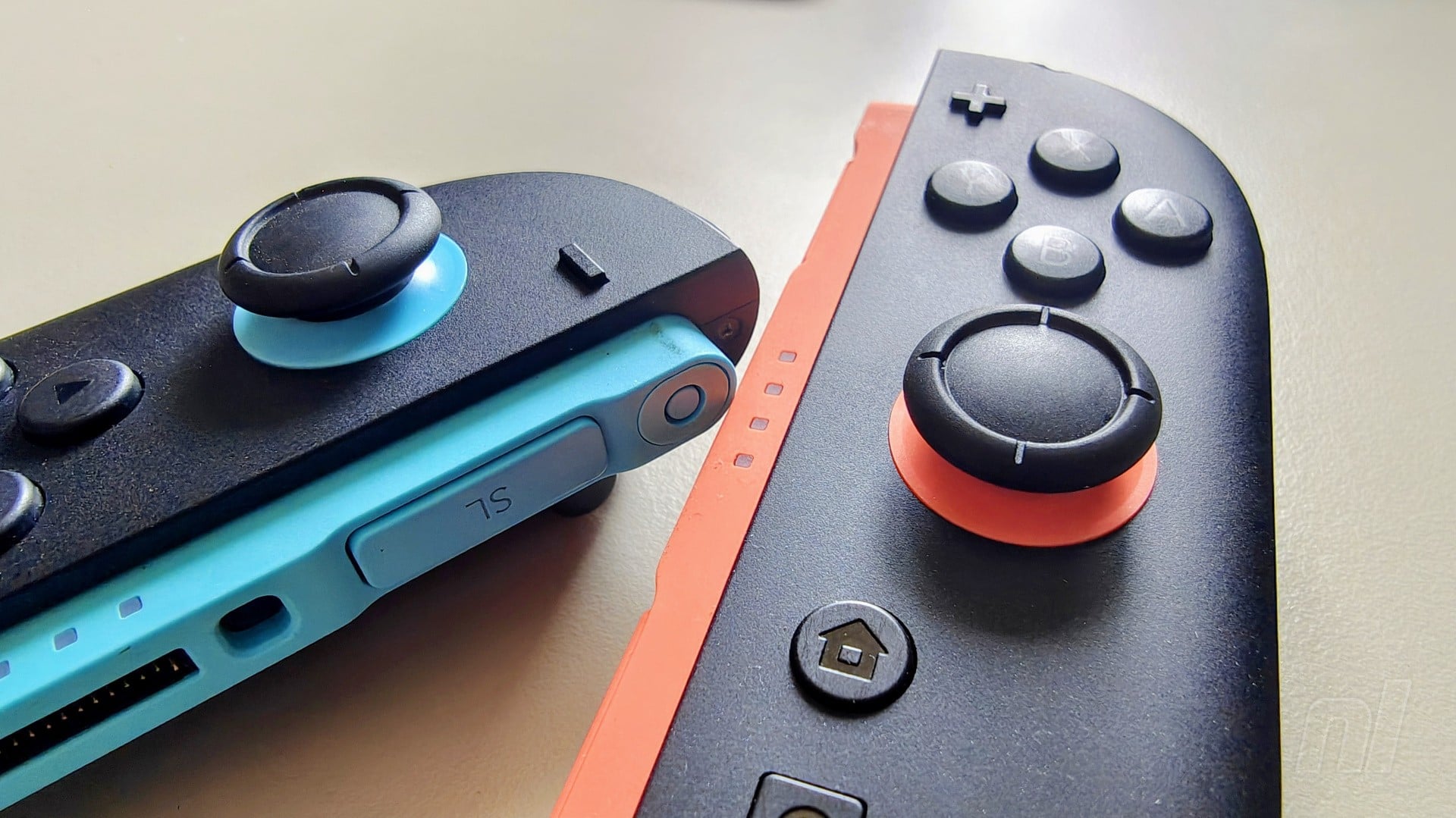
Connecting the C-AT to the Switch 1 or 2 is exactly the same as Cosmox’s previous models – just hold down the right button while plugging the device in to set it to the right mode. The braided cable is pleasingly lengthy and strong, while the C-AT itself takes inspiration from the M-Ultra Gen2 by including a lockable USB-C port at the top, helping to prevent instances in which the cable is accidentally removed.

An extra USB-C port is included on the left if you need it, while a USB-A port can be found on the right for those all-important authenticators for PS5 users. Don’t worry about that if you’re on Switch, though.

As for the button layout, the C-AT includes a total of 18 inputs, which is two more than those found on the M-Ultra. The extra inputs allow for some neat customisation, however, and by connecting the C-AT to a PC and accessing the web configurator, you can remap inputs and find the perfect layout that suits your needs. Naturally, if you’re entering into any official tournaments with the C-AT, you’ll likely be restricted in some ways, but for just playing locally or online, go nuts.

The main directional and attack buttons come with Wind Engine switches, which feel good and actuate with swift immediacy. They’re not quite as low-profile as the Shadow Hunting switches found in the M-Ultra, but by altering the travel distance to its lowest setting, you can pretty much emulate the same feeling. Meanwhile, the function buttons on the top right now come rocking Hide Mountain switches, which deliver a nice, satisfying clicking sound when pressed.

The function buttons actually feel similar to the inputs found on 8BitDo’s Arcade Controller. While I had an issue with having such loud, clicky buttons for the main inputs, limiting them to the function buttons works really well, and they feel wonderful. All of the button caps feel great, too, including a slightly rough texture that’s presumably designed to prevent your fingers from slipping and to stop them being worn down over time.

As for the overall presentation, the C-AT is slightly larger than anything I’ve got my hands on so far from Cosmox, likely to accommodate the extra buttons. You’ve got RGB lighting for the inputs as well on the outer rim, while some extra lighting can be seen at the bottom, shining out from beneath the translucent plastic cover. Each model also comes with a magnetic wrist rest, which covers up those pretty RGB lights, but it’s definitely nice to have if you suffer from pain every now and then (though it’s always good practice to keep your wrists off the device whenever possible).

The two available designs are pretty distinct, with one boasting some retro-inspired black and red buttons against a lighter background, and the other taking on a more ‘edgy’ approach with cat-like claw marks on each button, plus a darker aesthetic on the background. Like the C16 models, you can push the acrylic cover out from the back and replace the included artwork with some custom designs if you wish.

One thing I have to keep calling out with these controllers, however, is the labelling. The input labels are always included on the acrylic cover, and they’re always aligned with the Xbox/PC layout. This means that when you’re in Switch mode, the actual inputs don’t match with the labels, and there’s little you can do about it. The darker variant with the claw marks do include labelling on the buttons too, but this really needs to be the standard. Label the buttons and let us switch them around to our liking – please. If that’s not possible, then take a leaf out of Mayflash’s book and add in multiple platform labels in one go.

Final points to note are that the C-AT has the same OLED screen that you might be used to from Cosmox’s products, so you can keep an eye on your real-time inputs or even add in some custom pixel artwork via the web configurator. You’ve also got two switches next to the screen: one to toggle tournament mode and lock all function buttons, and the other to turn the RGB lighting on and off.

C-AT 11
Image: Ollie Reynolds / Nintendo Life

Conclusion

Cosmox Gaming manages to offer something new and interesting with pretty much every product it puts out. With the C-AT, the ability to alter the height of your inputs with a simple tool puts it right alongside the more premium Hit Box Ultra in terms of unique functionality. This, added with the 18-button layout, makes the C-AT one of the most versatile leverless controllers on the market.

Its overall build quality could be better; as someone who values weighty devices that feel premium, this one is a bit too light and hollow for my liking – though if you value lightweight peripherals, this might be a positive for you. I’m also getting a bit miffed at the labelling situation – just label the buttons and let us swap them around to match the Switch layout. It’s not a dealbreaker, but it feels like an easy issue to fix.

Thanks to Cosmox Gaming for providing the sample used in this review.

Posted on Leave a comment

Pokémon & Zelda Rip-Off ‘Pickmos’ Removed From Steam As Publisher Intervenes

Pickmos
Image: Networkgo

Pickmos (which, until recently, was called Pickmon) has been unceremoniously removed from Steam following an intervention from its publisher, Networkgo (thanks, PC Gamer).

Developed by PocketGame, Pickmos is a blatant rip-off title, copying character designs from the likes of Palworld (which itself is hardly a paragon of originality), Pokémon, and The Legend of Zelda: Breath of the Wild. Creature designs in particular look remarkably similar to iconic Pokémon, while the protagonist is the spitting image of Link from BotW.

So it seems Networkgo has had quite enough of the controversy, confirming the removal from Steam over on X with the following message:

“Hello players, this is the publisher, Networkgo. We’ve heard your feedback regarding the removal of our Steam store page and want to clear things up. Networkgo has officially intervened in the development of PocketGame.

“We will be supervising the Pickmos team from a player’s perspective to ensure the game keeps getting better. Thank you for your support.”

Naturally, Networkgo doesn’t outright state that the reasoning behind the removal is due to the controversy, instead claiming that it’s helping to ensure “the game keeps getting better”. It seems clear to us, however, that the publisher wants to get ahead of any potential lawsuits from the likes of Nintendo.

To back this up, a second message that’s seemingly directly from PocketGame confirms that it’s looking to ensure a “controversy-free experience”, stating:

“We are revising the game to ensure a controversy-free experience. It will be re-released once our publisher gives the final approval.”

So, we’ll have to wait and see what happens with this one. Given how shameless some of the imagery is in the game, we’d wager PocketGame will need to make some pretty extensive changes, so we’re not expecting to see this one again for quite some time.

Are you surprised by this turn of events? Do you think we’ll see Pickmos again soon? Let us know your thoughts with a comment in the usual place.

Posted on Leave a comment

Telltale Brings Five-Chapter Sci-Fi Adventure ‘The Expanse’ To Switch

The famous narrative game studio Telltale, known for series such as Sam & Max, has this week surprised fans with the release of The Expanse: A Telltale Series Deluxe Edition on the Switch eShop.

This story-driven sci-fi adventure, developed in partnership with Deck Nine (Life is Strange), is set before the events of The Expanse TV show and comes with five main chapters. The Deluxe Edition also includes a bonus episode.

Here’s some additional information, along with some screenshots of the Switch release:

“Experience the exciting universe of The Expanse like never before in Telltale’s latest adventure, The Expanse: A Telltale Series. Take on the role of Camina Drummer and explore the dangerous and uncharted edges of the Belt aboard the Artemis. From scavenging wrecked ships in a zero-g environment, to surviving a mutiny, to combating fearsome pirates, you make the difficult choices and reveal Camina Drummer’s resolve in this latest Telltale adventure.”

“Contend with the unforgiving brutality of space, the politics of a corrupt solar system, the animosities of your crew, and Drummer’s own conflicting responsibilities to the people she cares about and the Belt she has sworn to protect. There is no right or wrong path – only your choices and the consequences they unleash.”

THE DELUXE EDITION INCLUDES
Episode 1: Archer’s Paradox
Episode 2: Hunting Grounds
Episode 3: First Ones
Episode 4: Impossible Objects
Episode 5: Europa’s Folly
Bonus Episode: ARCHANGEL

The Expanse: A Telltale Series Deluxe Edition is now available on the Switch eShop for $29.99 USD (or your regional equivalent).

Would you be interested in playing this on Switch? Let us know in the comments.

Posted on Leave a comment

Vampire Crawlers Switch 2 Listing Pops Up On eShop

Vampire Crawlers
Image: Poncle

Vampire Crawlers: The Turbo Wildcard from Vampire Survivors — yes, that really is the full title — is coming to Switch next week. And, before today, we only knew about a Switch 1 version.

However, browsing the eShop today, we spotted a listing for a Nintendo Switch 2 version of the game, priced at £9.99 / $9.99, the same price as the native Switch version.

There aren’t any details on what the Switch 2 version will bring, but we have to assume higher frame rates, right? We also don’t know whether this will be a free upgrade, just in case you only have a Switch 1 right now and decide to upgrade later, or if you can transfer your save data between the two releases.

We’ve reached out to Poncle to confirm this, as there’s no official news out there. But it seems like, come 21st April, we’ll have a decision on whether to lose dozens of hours on Switch 1 or Switch 2.

In case you missed this one, Vampire Crawlers is indeed a spin-off of Vampire Survivors and, instead of simply being a bullet heaven roguelike, Crawlers is a dungeon-crawling blobber complete with deckbuilding and (of course) roguelike elements.

We’re sure it’s as madcap as the original, and we can’t wait to find out what it’s like next week.


Are you getting Vampire Crawlers next week? Will you grab it for Switch 2 or the original Switch? Let us know in the comments.

Posted on Leave a comment

Talking Point: What Would You Want From A New Star Fox Game?

Star Fox
Image: Nintendo

Whispers of a new Star Fox game this year just waiting to be announced by Nintendo for the summer have many a fan on edge.

On the one hand, it’s been nearly 10 years since Lylat’s finest had their own game — the admirable but divisive Star Fox Zero — so it’s certainly high time for a new series entry. Fox’s appearance in The Super Mario Galaxy Movie proves that Nintendo is keen to keep McCloud in our thoughts, too, and Star Fox is Shigeru Miyamoto’s baby.

And yet! The sentiment that the series peaked with Star Fox 64 and hasn’t hit those heights in the three decades since is widespread, even among fans who love the other games. After trying different variations on the on-rails theme and using it as a test bed for other gameplay ideas, could a new entry ever escape the spectre its 64-bit brethren? Would Shigeru Miyamoto sign off on a non-experimental, back-to-basics entry? What do we really want from a new Star Fox?

Let us know your thoughts in the poll at the bottom of the page, but first, let’s see what Team NL would like to see from a new Star Fox…

Gavin Lane, Editor

Star Fox
“I see ’em up ahead! Let’s rock and roll!” — Image: Nintendo

For me, Lylat Wars is it. That’s where I started, with a Rumble Pak slapped in my pad, nigh-on the first thing I played on my sparkly new N64. It ushered me into a new era of gaming. It was exciting.

Every Star Fox I’ve dabbled with afterwards failed to live up to that feeling – not an uncommon take, I know. The SNES original feels too rudimentary, and though I admire how Dinosaur Planet Adventures, Command, and Zero tried new things, it’s the B-movie spectacle of 64 and the nostalgia it evokes that pulls me back.

Nintendo (or Bandai Namco, or whoever they partner with) should lean into that. Give me a shlocky, time-travel story where Fox jumps around the timeline in his Arwing, going back to a black-and-white ’50s-serial-looking era to team up with his gramps, then hopping to an ’80s-style arcade era with plenty of neon and polygons, and then to the present — well, his present) — with all the modern trimmings.

I’d want them to lean into the Independence Day of it all, that glorious, on-the-nose, chintzy cinema feeling that comes with peril and zingers and sassy villains. That’s what I enjoy about Star Fox.

Ollie Reynolds, Reviews Editor

Star Fox
“Slippy, get back here!” — Image: Nintendo

I know plenty of people were disappointed by Star Fox Adventures back in 2002, but I genuinely think this stemmed from expectations over the actual quality of the experience – it’s a really good game!

So yes, I’d love to see something similar, but I’m also acutely aware that there needs to be some of that classic Lylat Wars-inspired aerial action, too. There was a bit of it in Adventures, but Nintendo would need to ensure there’s more of a healthy balance in whatever it’s supposedly cooking up.

It would be great if the game were split into multiple semi-open world environments across different planets, with the on-foot sections leaning into the more explorative gameplay seen in Adventures. Then travelling between the planets could feature the classic on-rails gameplay that we all know and love from Lylat Wars.

Heck, you could even split these into multiple segments: an asteroid field, a hostile space station, maybe even a trippy warp-speed section… all before reaching your final destination.

Alana Hagues, Deputy Editor

Star Fox
“I guess I should be thankful.” — Image: Nintendo

Along with F-Zero, Star Fox is probably the Nintendo franchise I have the least amount of love for. Though I admit, I adore the characters and their designs, and grew up with a healthy amount of Lylat Wars.

I’m glad the Mario Galaxy Movie leans into the cheesiness of the series (even if they probably go a bit far with Fox). So like Gavin, I want that OTT cinematic, dramatic style for a new Star Fox game. Give me some quotable memes and fun interactions!

In reality, I think Star Fox would need to be a totally different game for me to pick it up. Like Ollie, I do like Adventures! But for the sake of a “true return”, Star Fox needs to be similar enough with a few modern-day wrinkles.

Two things that would be fun to add are side-scrolling shmup-like sections — maybe go a little Mario Odyssey and make them pixel art or even use the old polygonal visuals from the SNES — and some kind of exploration. Let us explore Venom, Corneria, Fortuna, and Aquas a little. Maybe go Mass Effect-style with probes rather than on foot, or let the Landmaster transform into some kind of space buggy.

Jim Norman, Features Editor

Star Fox
“Oof, I done a whoopsie in me Arwing.” — Image: Nintendo

I’m very much in the middle ground where I want Lylat Wars again, but… different. I mean, as everyone else has said, the Star Fox format was never better than it was back on the N64, and I think returning to the series’ roots is a good thing — especially considering that would be the first Star Fox game for a huge audience. Give me some classic on-rails shooting with high melodrama, and we’re ticking all the boxes.

But, I also don’t just want ‘the same again’. Nintendo has clung to Lylat Wars so closely in past entries that the thought of “A bold retelling of the N64 classic” is enough to have my eyelids drooping already. There has to be something new, and a fresh, bigger story with a new antagonist doesn’t seem like a bad place to start.

What about taking things slightly more off the rails? No Man’s Sky has become the gold standard for open-world space exploration these days, and even something like Star Wars Outlaws shows how neat it can be in a more action-focused setting. The chance to freely explore a bigger galaxy certainly sounds like the kind of hook Nintendo might employ for a big series revival. This is increasingly sounding like Retro Studios’ rejected ‘Star Fox Armada’ pitch, isn’t it?

So, back to the gold-standard roots, but with a few surprises thrown in there too. Brace for Star Fox 64 3D HD, then…


Those are our thoughts, but let us know yours in the poll below, and feel free to hit the comments to espouse on how Nintendo should thread this needle for McCloud and co. Good luck.

Posted on Leave a comment

Digital Foundry Delivers Its Tech Review Of Pragmata On Switch 2

We’re still at the point where a same-day release across platforms, including Switch 2, is a rather exciting prospect, so we were eager to see how Capcom’s latest sci-fi shooter, Pragmata, would hold up on the system when it arrived earlier this week.

We had a wonderful time with it in our 9/10 review, calling it “another excellent Switch 2 port from Capcom”, but what do the tech experts over at Digital Foundry think? Today, the outlet has shared its performance deep dive, and the results are a little mixed.

Let’s start with the good, eh? In docked mode, the Switch 2 is using its DLSS magic to boost an internal 540p image up to 1080p, which DF describes as “arguably a competitive picture” against the PS5 as far as resolution is concerned.

In handheld, this is obviously downgraded, boosting from a 360p internal resolution instead, but the smaller screen and on-the-go playstyle mean it “holds up better than you would probably expect,” according to DF.

Compared to the picture in the Xbox Series S version, Switch 2 comes out on top. The outlet says there is a “fair hardware match” between the two system ports, with Nintendo’s hybrid frequently putting up better visuals.

Of course, it’s not all praise. Compared to the PS5 image, the Switch 2 version has some noticeable cutbacks, like lighting downgrades, worse shadows and simplified textures. While these are most apparent in cutscenes, the S2 has its usual hair rendering issues in standard gameplay, so don’t expect to see the fine strand work found elsewhere.

Things are a little choppier on the performance side of things, where Capcom has opted for an unlocked framerate on S2, which tends to sit around 30-40fps in busier areas and 50fps in indoor scenes. There’s no performance option to be found here, where a lower, locked frame rate could help iron out some of the more jarring drops.

Overall, a slightly mixed bag, then. You’ll find Digital Foundry’s full analysis in the video at the top of this article, and be sure to check out our review below.

What do you make of Pragmata’s Switch 2 tech? Let us know in the comments.

Posted on Leave a comment

The Street Fighter Movie Somehow Looks Both Terrible And Amazing

Paramount Pictures has released a new trailer for its upcoming Street Fighter movie, and uhh… well gosh, we’re not sure what to think.

On the one hand, it looks absolutely terrible, but we’d be lying if we said we didn’t have massive grins on our faces the whole time. Kinda like the Mario Galaxy Movie, y’know?

Too soon..? Okay, sorry.

It looks like director Kitao Sakurai is paying close attention to what makes the Street Fighter series so great, at least. We even catch a glimpse of Ken beating the living heck out of a car, for goodness’ sake.

Elsewhere, we can see characters like M. Bison, Blanka, Cammy, Akuma, and more, and they actually look reasonably authentic to their gaming counterparts.

We’ll reserve judgement until we finally see it for ourselves come 16th October 2026. But one thing’s for sure… Getting new Street Fighter and Mortal Kombat movies in the same year is giving us all sorts of tingly feelings. We’re loving it.

What are your thoughts on the latest trailer for the Street Fighter movie? Will you be keen to watch it later this year? Let us know with a comment.

Posted on Leave a comment

Japanese Charts: Combined PS5 Sales Can’t Even Beat Switch Lite

Switch Lite
Image: Gemma Smith / Nintendo Life

The latest Japanese charts are here thanks to Famitsu, and yet again, we can see that Pokémon Pokopia has beaten the competition to take the top spot with 23,738 sales. It’s inching toward that 1 million milestone!

Starfield also makes its debut on PS5 at number 3, selling 4,094 copies, but this isn’t enough to compete with Mario Kart World, which managed to shift 7,238 copies.

Otherwise, it’s a pretty standard week for software. Hopefully some new releases in the coming weeks will spice things up a bit. Yes, we see you Yoshi, waiting in the wings.

Here’s the top ten in for the bigger picture:

Position Game Platform Unit Sales (6th – 12th Apr) Total Unit Sales
1

Pokémon Pokopia

Switch 2

23,738 890,909
2

Mario Kart World

Switch 2

7,238

2,895,712

3

Starfield

PS5

4,094 NEW
4

Minecraft

Switch

4,956

4,186,601
5

Animal Crossing: New Horizons

Switch

3,831

8,419,664

6

Animal Crossing: New Horizons – Nintendo Switch 2 Edition

Switch 2

3,064 101,850
7

Pokémon FireRed & LeafGreen (Download Card)

Switch 2

2,757 18,049
8

Super Smash Bros. Ultimate

Switch

2,346 5,899,833
9

Mario Tennis Fever

Switch 2

2,429

101,590

10

Crimson Desert

PS5

2,408

42,593


Hardware this week continues to highlight the Switch 2 as an exceptionally popular device over in Japan, with the console shifting a further 52,058 units. As for the PS5, combined sales for all three SKUs totals 8,673, which doesn’t even beat sales for the Switch Lite on its own.

It’s clear that the recent price hikes for the PS5 are really starting to have an impact. The language-locked Digital Edition is still doing okay, but sales for the PS5 and PS5 Pro have absolutely tanked. Sony can’t keep this up, surely.

Here’s the charts in full:

Position Console Unit Sales (6th – 12th Apr) Lifetime Unit Sales
1 Switch 2

52,058

5,063,117
2

Switch Lite

10,630

6,914,594

3

Switch OLED

7,042 9,533,371
4 PlayStation 5 Digital Edition 6,426 1,254,941
5

Switch

3,462

20,274,507
6

PlayStation 5

1,219 5,911,693
7

PlayStation 5 Pro

1,028 342,576
8

Xbox Series X Digital Edition

502

29,864
9

Xbox Series X

110

326,062

10

Xbox Series S

73

341,695

< Previous charts


What do you make of the current hardware situation over in Japan? Let us know your thoughts on the Japanese Charts below.

Posted on Leave a comment

Feature: “A Huge Balancing Act” – Playtonic Spills The Beans On Yooka-Replaylee’s Massive Switch 2 Update

Yooka-Replaylee is a great reimagining of the enjoyable yet flawed 2017 original, yet for many the lack of a 60fps performance mode on Switch 2 was disappointing.

Well, the good news is that it’s finally here! After months of painstaking work to optimise the game, Playtonic has dropped a new 60fps mode for all owners on Switch 2, and it’s legit great. How do I know? Well, the studio kindly invited me over recently to test it out and speak with the game’s Software Lead, Simon Gerges.

I spent roughly an hour and a half with the new performance mode, hopping between several levels to see whether it could hold up under varying conditions – it absolutely does. Though there may be minuscule dips now and then, it certainly wasn’t noticeable to the naked eye in both docked and handheld. This is a game that — at least from my time with it so far — has been optimised to near perfection on Switch 2, delivering a smooth gameplay experience with minimal alterations to the visuals.

That’s not to say that the presentation has been completely untouched, mind. Shadows have slightly less clarity while assets in the far distance look slightly fuzzier. That said, I really had to study the visuals closely to notice any differences, flipping between fidelity and performance modes in the pause menu a few times to pick anything out.

Yooka-Replaylee 5
Image: Playtonic Games

Playtonic’s done a cracking job, then. To find out a bit more, I spoke with Simon, the mastermind behind the new performance mode. We touch on why 60fps wasn’t available at launch, what visual changes needed to be made, and the size of the update. Give it a read before you run off to download the update.

Nintendo Life: Could you give us an overview of the work/process of building this S2 performance mode, and why it wasn’t part of the original plan for the Switch 2 version?

Simon Gerges: Although it’s flattering to be compared with some of the major studios out there, I think people forget we’re a relatively small indie team. We’re proud of simultaneously delivering Yooka-Replaylee across all major platforms on day one, and that this included a great-looking version on Switch 2.

It’s easy to underestimate the challenge it is to get a game like this to run at higher frame rates. Yooka-Replaylee’s worlds are large and full of life, and the player has completely free rein to move wherever they want, and face the camera in any direction they want. This can mean we have thousands of objects that need to be drawn at any one time, as well as all the new graphical effects we have brought to the remake, this is all very costly both on the CPU and GPU.

The process to provide a performance mode is a long one, painstakingly profiling problem areas of each level, not only diagnosing noticeably costly areas for optimisation, but also requiring tackling countless smaller optimisations that all add up to something that helps. It’s a very time-consuming process. We have had to restructure much of the backgrounds, as well as making many optimisations that set us back a long way in terms of stability, which takes time to regain.

Yooka-Replaylee 2
Image: Playtonic Games

Following launch in October last year, when did work on the update begin?

Optimisation began before launch, we of course would have loved to have had it ready by then, but when a game is in its final stages, it’s not possible to make some of the changes that were necessary whilst maintaining the stability required to release the game. Therefore, much of it had to occur after the launch period.

Hindsight is great, but did you anticipate negative player reaction to the S2 version being 30fps prior to release?

We have chosen to use FSR for our performance mode, and are now using Unity’s impressive Spatial Temporal Postprocessing for our Fidelity mode.

Of course, we are all gamers too! For some of us it’s not an issue at all, but for others, they’d love to play the game at 60fps.

It often comes down to what you’re used to. We knew to expect some negative reaction, but similarly we knew that even more would have been upset to have to wait a further six months to play the game when they were more than happy to play the fidelity mode at launch.

Have you utilised any of Nintendo’s own brand of DLSS in order to achieve this 60fps goal?

We haven’t been able to yet, with new technologies, sometimes these things take time to become available in different engines and renderers. We have chosen to use FSR for our performance mode, and are now using Unity’s impressive Spatial Temporal Postprocessing for our Fidelity mode.

DLSS and Nintendo’s upscaler are becoming available now and we look forward to seeing what they can do for us in future.

Yooka-Replaylee 3
Image: Playtonic Games

Is there a challenge or obstacle you’ve overcome while building this that you’re particularly proud of?

It would have been easy for us when setting out on this goal to chop and change the levels drastically, removing many incidental props and reducing the quantity of enemies, but we adamant we didn’t want the game to be any different at all.

We’re very happy that we’re offering the exact same game and level setup that any other version or quality mode the game has, on any platform.

I noticed some minor visual adjustments in the new performance mode – for example, shadows have slightly less clarity. How did you decide which aspects of the visuals to adjust to achieve 60fps?

This is a huge balancing act, and one that has been a big challenge across all the versions of the game across all platforms. This is where the tech team and art team come together, and we discuss the cost of each of our options and weigh up and decide what we think gives the best bang for buck.

There are so many variables at play; resolution, render scale, post effects, shadow quality, grass, water, lighting, and fog settings, to name a few, that all need to be considered and evaluated. And these can’t be fully finalised until we know we have optimised as much of the game as possible.

We’re pleased in that many of our optimisations have allowed us to provide a great-looking performance mode at 60fps, and it has also meant we’ve been able to improve our fidelity mode further, too.

Yooka-Replaylee 4
Image: Playtonic Games

Performance seems very similar across both docked and handheld. Were there any additional challenges to get it running at 60fps in handheld mode?

Actually, I’d say it’s the opposite. The Variable Refresh Rate of the Switch 2 is fantastic, and it means if you drop from 60 to, for example, 57 momentarily, you almost never notice.

It’s when it’s docked that we are more particular about any drops in frame rate, as these are much more noticeable. Not many games like this are perfect, but we’re really pleased that the experience is very similar in both docked and handheld.

What is the size of the download for this update?

We have had to touch so much of the game to bring you this, that this is a well-worth-it nearly 5GB patch!

Beyond the frame rate, will there be any other changes/tweaks in this update?

Yes many, there has been numerous bug fixes and stability improvements made since launch, and they will be included in this update, too.

Will there be changes to any of the other platform versions?

Yes, this patch is coming to all platforms, and we’re looking forward to seeing if we can make use of some of the optimisations we have made to increase the fidelity on those platforms, too!

Is this the final chapter for Yooka-Replaylee? If so, what’s next from Playtonic?

Not necessarily, we’re still listening to fans and watching how the game does from here on out and there’s a lot of ideas within the studio for the game.

Beyond this there are other things happening and there is a chance you can see much more from us very soon, watch this space, and thank you for the support.

Yooka-Replaylee 1
Image: Ollie Reynolds / Nintendo Life

Thank you to Simon for taking the time to speak with us about Yooka-Replaylee’s new performance mode, and to Mark Boam for hosting our early playtest. The update is available now for all Switch 2 owners, so what are you waiting for? Get it downloaded.

Posted on Leave a comment

Boom! Yooka-Replaylee’s 60fps Switch 2 Performance Mode Is Finally Here

After its release in October 2025, Yooka-Replaylee is finally playable at 60fps on Switch 2 thanks to a new update from Playtonic Games.

Many were understandably disappointed when the Switch 2 version launched with its performance capped at 30fps (heck, it was one of just two ‘cons’ in our 8/10 review), so this will no doubt prove to be a welcome new update for fans of the 3D platformer.

The good news is that Playtonic Games has retained the previous fidelity mode if you do happen to value higher resolution visuals; you can simply toggle between the two options via the pause menu.

As for how much space you’ll need for the update, Playtonic says that it comes in at nearly 5GB. Quite a hefty one, then, and probably something that fans of physical editions might not be too chuffed about. Still, this is something that’s clearly been a labour of love for the team, and not merely a switch that can be flicked on to increase the frame rate.

So if you’re keen to see how the game plays at a higher frame rate, then go ahead and get it downloaded now. Better late than never, huh? You can also bag a 20% discount to celebrate the new update, bringing the price down to £19.99 / $23.99.

And if you’re still on the fence, Playtonic also confirmed that the free demo on Switch 2 will also sport the new 60fps performance mode, so you can try before you buy.

And if you’re after some hands-on impressions, we took it for a spin last week – check out our interview and impressions feature for more details.

What do you make of Yooka-Replaylee’s new performance mode? Will you be taking it for a spin? Let us know with a comment in the usual place.