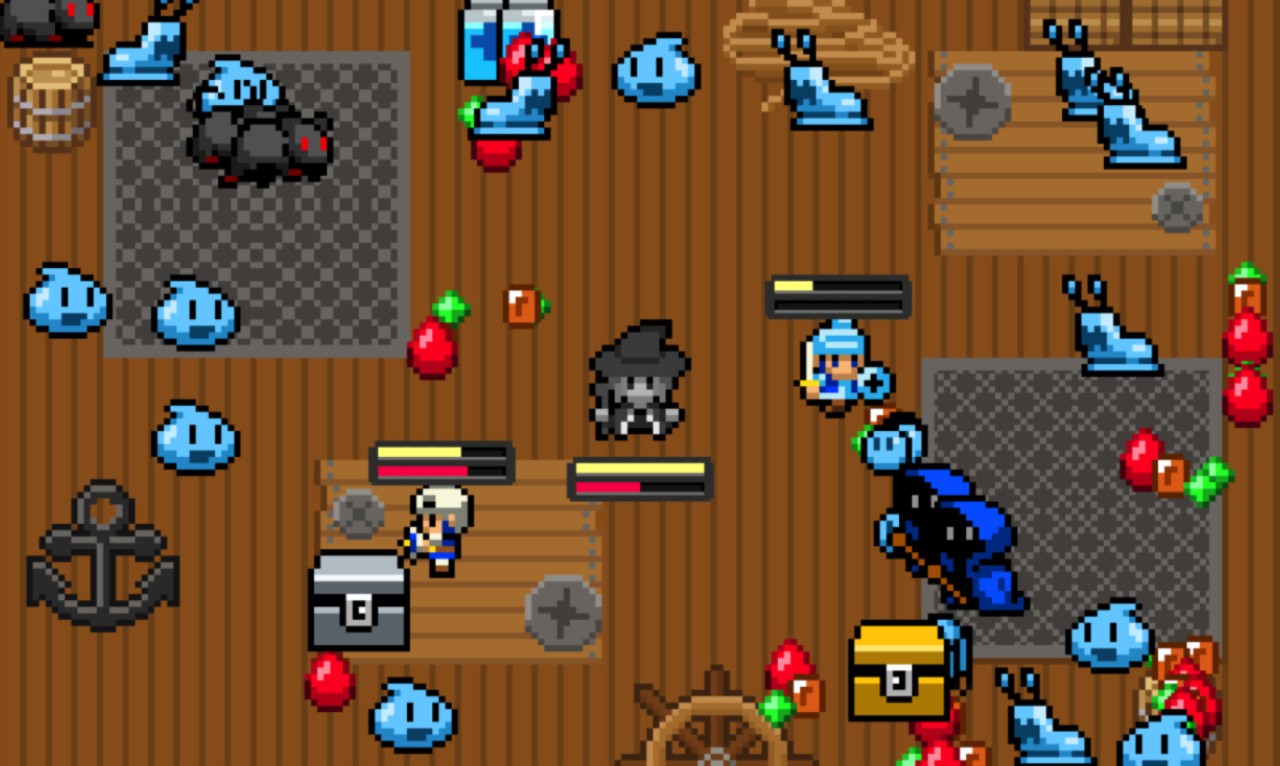
After being teased as ’fairly likely’ on social media in February, developer Aloft Studios has officially announced to Nintendo Life that Hazelnut Bastille, a game inspired by the golden era of SNES classic action RPGs, is planned for Switch.
Here’s what we were told:
The timescale for this release will either be simultaneous with our PC / Mac / Linux release, or following some months after, as funding and development time ultimately allows, but we would very much like to see a release across all four of our starter platforms if it proves possible!
Hazelnut Bastille, for PC, Mac, and Linux, and now Nintendo Switch, is a lush, topdown metroidvania in a 16bit JRPG style, which seeks to continue the great lineage of superior design from the mid 90’s- the moment in time when mainstream 2D titles reached arguably their greatest level of refinement, in titles such as Super Metroid and Link to the Past. We seek to emulate this period in most ways, from graphic presentation, to audio production, to general level design philosophy. Hazelnut Bastille tells the story of a young woman who travels to a foreign shore on the outskirts of her world, in order to seek out the promised gifts of mythological ancients, in hopes of retrieving something which was lost to her. On the way, her story becomes irrevocably intertwined with the lives of those living in this far off land.
In addition, legendary Secret of Mana composer Hiroki Kikuta is on board, contributing to the soundtrack.
Hiroki Kikuta, age 55, is joining us as a celebrity guest composer . He is an acclaimed Japanese video game composer, best known for his work at Square, which he joined in 1991. He was the lead composer for Secret of Mana, Seiken Densetsu 3, Sōkaigi, and later Koudelka, for which he also acted as producer and concept designer at his own company, Sacnoth.
Kikuta-San had this to say:
Hazelnut Bastille is a wonderful looking retro-style game! I’m looking forward to being a part of it and hope we can create music that lives up to the rest of the game and everyone’s expectations!
We talked exclusively to developer Aloft Studios about the project and the collaboration with Kikuta-San.
Nintendo Life: Could you introduce yourself?
Dennis Varvaro: I am Dennis Varvaro; I am a 31-year-old architect and architectural historian focused on ancient classicism, and contemporary construction based on pre-20th century movements. I have also recently been employed producing architectural renderings and game asset commissions. I have led a double life, and have also had my hand deeply planted in the world of game development, specialising in art assets and design, for about 10 years now. Architecture for me started as a way to stay involved in a wide range of disciplines, and my growth as an indie game developer has only driven that goal to a relentless pitch!
Is this your first project?
Dennis Varvaro: Being an indie developer is a bit like being an aspiring prize fighter. In the early days, you are going to get your face pounded on a regular basis. If anyone rises, you can be sure they’ve been through a real ringer getting there, whether they admit it or not. Mark Harbaugh and I each have more than a dozen projects in our past, as we climbed the ladder developing the full background and skillset necessary to realise a project of this scope. Some of these were three month prototypes taken on as feasibility studies, and others were year-long passion projects. In the early days, there was usually something critically wrong with the approach, which taught each of us about the thousand pitfalls. We each have the benefit now of these years to help us make informed decisions about project management, and the foundational skills developed over that time as well! Our most recent small project was our Ludum Dare 40 entry, Running with Scissors, where we managed to place 2nd of 6175 in the 72 hour category! We fully recommend the LD competition to other devs out there, it was a an ultra-positive experience in every facet!
How did the team come together?
Dennis Varvaro: Mark and I have been active in a small community for indie developers for around 5-6 years each now, created by a mutual friend, “Develteam.com”. The site started as a program to connect lone indie devs to larger collaborations, but that premise actually seemed to generate more unhealthy behaviours than positive interactions, so the site gradually grew to be more community-focused. Mark and I both loitered around as we worked on our own personal projects for years, gradually becoming friends. We had both abandoned the premise of the site ages ago, and were not looking to team up with anyone anymore, but one day Mark mentioned taking on a “Summer project”, and we conceived the idea together that later grew into Hazelnut over time. It is sort of the plot of a cheesy ’90s love story set in Seattle.
Shannon, our main composer working alongside Hiroki Kikuta, joined a year later, after we put out an ad. We compiled a giant list of portfolios people posted online, and folks who had responded directly, and did an exhaustive study of everyone’s work and capabilities, around 200 folks to start. There were around 8 or so who had a background with a strong connection to the type of sound we were looking for, and we ultimately offered some money for a few people to try their hand at it. While each of the folks was pretty spectacular in their own domain, Shannon’s work effortlessly hit the mark with minimal feedback. We are quite lucky to have found someone with such a developed background with 16-bit soundfont music, with an intuitive sense for the Romanticist character at the center of the SNES era of compositions.
A big part of what makes collaboration between indie developers even viable is having an established relationship. It is nearly impossible to join up with perfect strangers and form a stable development cycle. Our advice for anyone finding themselves in a similar situation, but without a close real-life partner is to immerse themselves in communities of people also focused on indie-development, and to network as much as possible to find talented, like-minded folks you jive with. Take on very small projects with your new collaborators to feel out a new relationship, and eventually you can find a strong fit!
What was the inspiration for the game?
Dennis Varvaro: For the setting of the story, we are partially drawing on some of the settings of JRPGs like Chrono Trigger, Secret of Mana, Final Fantasy 6, Alundra, and a host of others. Hiroki Kikuta has mentioned in the past that his own music has sprung from his relationship to places he has visited, like the Fiji Islands. I myself have a personal connection to the eastern Mediterranean region, as the site for all of the foundational western cultures and architectures, from Ancient Egypt and Greece, to Rome and Italy, and Byzantium. These places, with their sun-bleached layers of history built on the foundations of yet more history, their blue agave plants, wild lemon trees, red cliffs mounted by colonial Greek temples, hold a certain romance for me, and have shown up repeatedly in my own past game projects.
The title “Hazelnut Bastille” has a few dimensions to it. The word Hazelnut is a simple reference to the trees of the real world setting that partially inspired the game world. It produces positive mental imagery, which describes one major dimension of the game, but also has a large bit of dissonance with the second word, Bastille, which in the general sense is telling us this land and its buildings are a sort of fortress to be broken; this dissonance also hints at the the central conflict of the story… there is trouble in paradise. Finally, there is an event later in the story that also calls back to the literal French Bastille and the event that makes it significant.
Could you outline the story for us?
Dennis Varvaro: Hazelnut Bastille tells the story of an accidental heroine who has traveled to a foreign land, to seek out the knowledge of a fabled race of long-dead ancients, on the promise that she could regain something critical that was lost to her; I think if you know a little Jung and / or Joseph Campbell, you can sort of feel out where this is going, but we won’t spoil it!
Our heroine arrives on the island just in time for the funeral honoring the loss of a great and peerless hero. After a bewilderingly unlikely series of events, she vows to take up the mantle of this same lost hero, but unbeknownst to everyone present, her motives are her own. Over the course of her journey, her life becomes inextricably interwoven with the lives and stories of the people around her, and while she is pressing ever closer to her goals, she learns about those sharing her story, and what life experiences brought them to this same place.
We tell a heavily character-driven story which has both a grand sweeping arc, and a human scale narrative which deals with themes like social acceptance, community, ethical systems in conflict, and the process of creating a new life after experiencing major upheavals.
Hazelnut Bastille takes inspiration from the SNES classic action RPGs, but what does it offer that is new or innovative?
Dennis Varvaro: I’d say the biggest thing that differentiates Hazelnut Bastille from the actual 16-bit games is the climate it is being released in. A lot is made of the difficulty of the 8-bit era’s games, but a lot of that difficulty is left over from the arcade era of quarter-munching, where the player would be punished arbitrarily, or for being ignorant of what was on the next screen. Players today aren’t fond of this style of design, because it is simply about working out the quirks of a particular game, rather than actually winning a contest of skill. The 16-bit era walked a lot of this back, and designers were too afraid to lose players, and started holding their hands sometimes. The puzzles of A Link to the Past are all very tame, and the game at times tells the player exactly where the next dungeon is by marking it on the map! Recently though, there is a new philosophy about game difficulty: players are craving a challenge, as long as that challenge is fair, and they are provided the tools and knowledge to succeed. So Hazelnut Bastille is actually quite a difficult game, even compared to the 8-bit era. The puzzles get quite involved after a while, after we have provided the player with enough lessons. We lean on the same teaching methods which were canonised in the 8 and 16-bit eras, but we add some really difficult chapters toward the end, because modern games have faith in their audiences now, and this is a good thing. And at the end of the day… well there is the internet if someone really gets stuck!
We also have tools embedded in the game for customising your play-style. Certain items or modifiers lend themselves to various approaches to the game’s combat situations, and generally in most enemy fights, there isn’t one definitive right answer in the item arsenal; this time, it is less about, “Oh, this is the guy where you pull his mask off with the puller thing, or knock these guys over with the hammer”, and more about letting the player solve the problems from their own perspective. So you are in a room with narrow passages where the enemies are pretty clingy. Do you block their path? Repel them? Stun them?
Beyond this, the way the item-trading mechanic weaves the player into the story feels pretty new to us (we can’t think of an instance somewhere else, but it is probably out there). The story itself is a bit bolder and more confident in the risks it takes than the sorts of stories you would generally see from that time period, and while it is also embedded in a campy setting, it deals with fairly heavy issues.
How did you approach the art style?
Dennis Varvaro: A major goal of the visual style as it pertains to gameplay is clarity. It was a big feature of the 16-bit era, and something we found well worth emulating. In this style of art, there is extra emphasis on well-defined contours and edges, and shaping visual tiles to collision bounds pretty closely. A scene is supposed to be readable from the perspective of instantly identifying where the collision bounds are, and cataloging all of the threats and active elements on screen at any given time.
This art style seems to most readily suggest story sequences in the same spaces as gameplay, so most of the story advances as dialogue sequences between the characters on screen. We also have some cinematic slide- show-like sequences as well (Think the opening of Super Metroid: “The Last Metroid is in captivity, the galaxy is at peace!”)
It’s clear that being faithful to the era is important. Why is the genre so special to you and the team?
Dennis Varvaro: Part of what I think made the 16-bit era so special at the time was that it was the only game in town. Everyone was focused on developing these pixel art sprite-based experiences, and they had been at it a solid 10 years by then, and had built up a library of best practices and design tricks. Constraints are very often a powerful tool for creativity and refinement, and that was definitely true of the early-to-mid ’90s. The best examples from that time are like literal textbooks of exactly what you want to do to make the best experience possible in those settings. Very seldom does that level of refinement in level design and overall design ever get seen again, and almost never in a 2D setting. Super Metroid is probably still, all these years later, one of the best three Metroidvanias ever. A Link to the Past is what most consider the undisputed king of topdown 2D adventure design. Those days brought us Chrono Trigger and Secret of Mana and Final Fantasy 6 (and apparently Square-Enix has shamefully forgotten what pixel art even looks like in their recent re-releases, but this is another matter).
Developing a game rooted in this era is a powerful opportunity for a number of reasons. Working under the same constraints of that time art and design-wise is a great tool for keeping us focused, and prompting creativity through constraints. It is also an opportunity to dive deeply into studying those games from a deep mechanical perspective. Every time we reach a problem, we go back to the precedents to really study how exactly they approached the same problems, and it is making us better designers, because it is increasing our level of understanding for why those stellar games were built the ways they were.
And also… they are just freaking cool. The crisp visuals, the synthetic-yet-symphonic soundfont music, the super-focused player experience… nothing like it!
We noticed some of the effects and sprites are pretty impressive, as well as putting a demo out last year to get user feedback. Is there anything that modern resources have allowed you to include or experiment with?
Dennis Varvaro: One thing that anyone who studies the techniques from the 8 and 16-bit eras should remark on is that those games were all miracles of storage and efficiency. Oftentimes not a single Kb was wasted, and every single tile on a 128×128 sheet was utilised. Frankly, it is nice to be able to do this stuff and have some breathing room, not having to worry about what tiles we can afford to keep… we can have as much art as we want! We can have as many tile-sets, as many animation frames as we want, and that alone changes the look of the game slightly as compared with the actual 16-bit era. While we are striving very much not to do anything that strictly couldn’t be done in those days, we do take some conventions from that time and use them more extensively. For instance, the SNES hardware really struggled with transparencies, but we use them a fair bit more liberally. With the level-editor we built, we also make much more extensive use of layering in scenes than you would see on the SNES, oftentimes making use of 6 distinct levels of depth in a scene, and each of these being built from textures which are consolidated from multiple layers themselves. This tends to give Hazelnut a much more organic and feature-rich backdrop than would be typical of the era. We also slightly cheat with modern techniques while creating certain effects, such as the lightning arcs you can see in some our our clips and images. Even while doing things which we know would be a bit outside what the actual SNES hardware could cope with, we strive to keep the rendering style of these effects strictly within the range of what could actually be rendered.
And as mentioned, using demos partially as a design tool is an invaluable resource. Being able to connect with our users and instantly put a vertical slice of the game in their hands, to see what happens cannot be overstated in its impact on our process.
It must be a dream come true to work with composer Hiroki Kikuta. How did the collaboration come about?
Dennis Varvaro: It is pretty surreal for me, not going to lie! I played Secret of Mana as a kid. I also had sheet music from Secret of Mana which I played on the piano, while developing my musical background. I had this thing in my mind, where all the folks who worked on those games back then were in this “bin”, that existed in another reality. Sort of like you can watch footage from WW1, and you will never meet a single person with direct experience of the event, so it feels significantly less “real”. We all knew that kid who had “an uncle that worked at Nintendo” (who was really just a clumsy fiction to lend weight to their speculations about the next Mario game). The idea to me that not only would I later meet someone from that era of games, but work alongside them, after having worked in a totally different field even, never once occurred to me.
As noted above, as we were digging through the horde of super-qualified folks who applied to join us as the composer for Hazelnut, I remembered a few folks who had contacted us months back. They were scouting agents representing some established professional composers we hadn’t given much thought earlier. But when I looked through the rosters for a few, there were some classic names standing out. When I realised that Jayson Napolitano was representing on his Scarlet Moon label an actual figure from my childhood, who was also an undisputed master from the 16-bit era, we took the chance to reach out, and now here we are a year later!
When can we expect Hazelnut Bastille?
Dennis Varvaro: That… is a very good question! It is infamously difficult to judge with indie projects like this… we have all seen projects telescope before, and some of the most responsible developers of the past years have missed their projections by 4 years+. We don’t plan to go off into the bush for that long, and we have a fairly focused schedule. We have been developing full time for 2 years now, and we plan to have it out by mid-to-late 2019 at this time. We will continue to be active on our media platforms like Discord, Twitter and Reddit, and share milestones as they come, so interested folks will be able to follow development all the way through! We will share as much as we can without spoiling some stuff that is better left experienced firsthand!
We would like to thank Dennis for his time.