Posted on Leave a comment

Feature: What It’s Like To Run An Online Game Store In Japan

P2160452 1024x1024@2x

While a great many of the world’s best games come from western developers, for a certain sector of the gaming world, Japan is where it’s at. Not only is it the home of Nintendo, Sony, Sega and Capcom – as well as numerous other key players in the industry – but in the ‘80s and ‘90s it was the source of many of the world’s most acclaimed console titles. The balance may have shifted slightly in recent years with western studios like Rockstar, Bethesda and Epic Games becoming global giants, but Japan’s gaming heritage still commands massive respect from players – and as a result, Japanese gaming gear is in constant high demand.

This situation has seen a new breed of online gaming store appear in the Land of the Rising Sun; operated by westerners with the intention of exporting games and gear to willing buyers outside of Japan, these stores have thrived in an era where the web has enabled sellers to focus on reliable pricing and detect trends and hot products.

Steve Bruni is one such individual. He runs his own game store from Japan, sourcing retro and modern gaming gear and shipping it all over the world – a vital conduit for those who aren’t lucky enough to live within a stone’s throw of some of Japan’s most well-stocked retail stores. Keen to learn a little more about what it’s like to run your own game store in console gaming’s motherland, we spoke to Bruni about how he got started, the challenges he faces and what the future holds for his operation.

Can you tell us a little about yourself and how you ended up running a games store in Japan?

My story is really simple. I started playing games on a Commodore 64 and all I wanted to do is to have fun. The collectors ‘pathology’ started with my first job (and salary). I started working in a video game shop in my home country at the age of 15; this would have been the Playstation / Nintendo 64 period. During that time I started to understand how easy it was to import games from Japan, but also how much margin rival stores were getting from these imports; some were charging 50, 100 and even 200 percent on top of the cost price — it was really crazy.

I decided to move in Japan and with the help of some friends I started my own business here

We started to import stuff from USA and Japan and sold them at very competitive prices, but we knew it wouldn’t last forever. In the PS2 era, we had to fight with the big chain supermarkets, which were selling domestic games very cheaply; we were not able to survive just on import sales alone. After that, I decided to move in Japan and with the help of some friends I started my own business here. I can say I’ve been really lucky starting a job connected with my passion. I also collected a lot of arcade machines when I was back home; I had a big room in my house kitted out like an amusement centre. I had everything from a Sega Naomi to a Blast City cab, Scud Race Twin, Daytona USA 2, House of the Dead and many others. Unfortunately, a large part of this collection had to be sold before I moved to Japan.

You’ve got an impressive selection of games in your store covering a wide range of systems. How easy is it to source your stock in Japan?

Sometimes it’s easy, sometimes it’s not – it’s all based on finding good stuff at shops at the right time, or bumping into old collectors who sell their games in one job lot; the latter is really expensive for me, but is worth the effort. There are many resellers here who go around every morning the moment the shops open, buying all the good stuff. Luckily, I live outside Tokyo in an area where stuff can be found at better prices than in the center of Tokyo, but these shops are not easy to reach without a car. The reason most foreign buyers dont visit such stores is because it’s a pain to get to them every day. But as the saying goes, no pain, no gain, right?

Could you describe a typical day of work?

Due to the time difference between Japan and other countries, my ‘sale’ work starts at 10 PM and ends at around 2 to 3 AM. I wake up usually at 9 AM and prepare all my packages until the afternoon. If I need to go outside for some special request, I will do my usual round trip to shops near my home and then come back for 5 or 6 PM, and then send out all the packages to the post office.

You also accept requests from collectors. How difficult is it to track down certain games in good condition?

I do accept special requests but its very hard to satisfy collector’s conditions for certain games. I accept requests but I need a lot of patience from the customer, and I need the time to find the right game in the right condition.

Has the recent increase in ‘resellers’ in Japan impacted the price of games over there?

Yes, it has for sure. A really large number of foreigners are living here doing this ‘job’ and reselling games, anime or manga goods, figures, and everything related to people’s passions. Japanese people understand what is happening, and they can see this on eBay or on the Facebook market or internet shops, so they are now selling games and goods at higher prices than before. You can see it in Akihabara (Tokyo) or Den Den Town (Osaka); these are real traps for tourists, so you can see prices being inflated there – but the tourists buy it anyway.

The games market is moving a towards digital future – how will this impact your business and the games market in general?

It will be worse in the future, that’s for sure. It will change to digital services but some physical stuff will continue to exist. Now, companies are starting to sell collectors editions with gadgets and items but no disc inside, only a download code. Personally, being an hardcore collector, I hate digital services but I can understand how it makes sense for most people – physical collectors are a very small part of this business now, and that means big companies have big gains to make from causal players – just look at how Konami, Capcom and Nintendo are selling some of their classic games for the overseas market in digital form only.

Personally, being an hardcore collector, I hate digital services

Some other companies are starting to do reprints of old or rare games here, especially on Famicom and Super Famicom – a company called Columbus Circle is doing that, and I would be not surprised if other companies start to do physical reprints of older games. The good thing here is that these reprints are sold at the same price as a standard piece of modern software, if not less, so that’s good for collectors who don’t want to pay a premium and just want to own a copy of the game. As a seller, of course, digital is a problem for me, but I am more oriented to retro game stuff so the problem isn’t too bad at the moment. There’s more than enough physical stock floating around to keep me going.

What’s the most expensive or rarest item you’ve ever sold?

It would be easy to say any high-end Neo Geo AES title, but the most expensive item I’ve sold was a Neo Geo deck hotel unit, a really rare system made for hotel rooms. I haven’t seen more than five or six examples of this Neo Geo system in the world. I can’t say the price, but you could buy a car with this kind of money!

Posted on Leave a comment

Random: Flip Grip Inventor Creates “New Nintendo Switch DS”

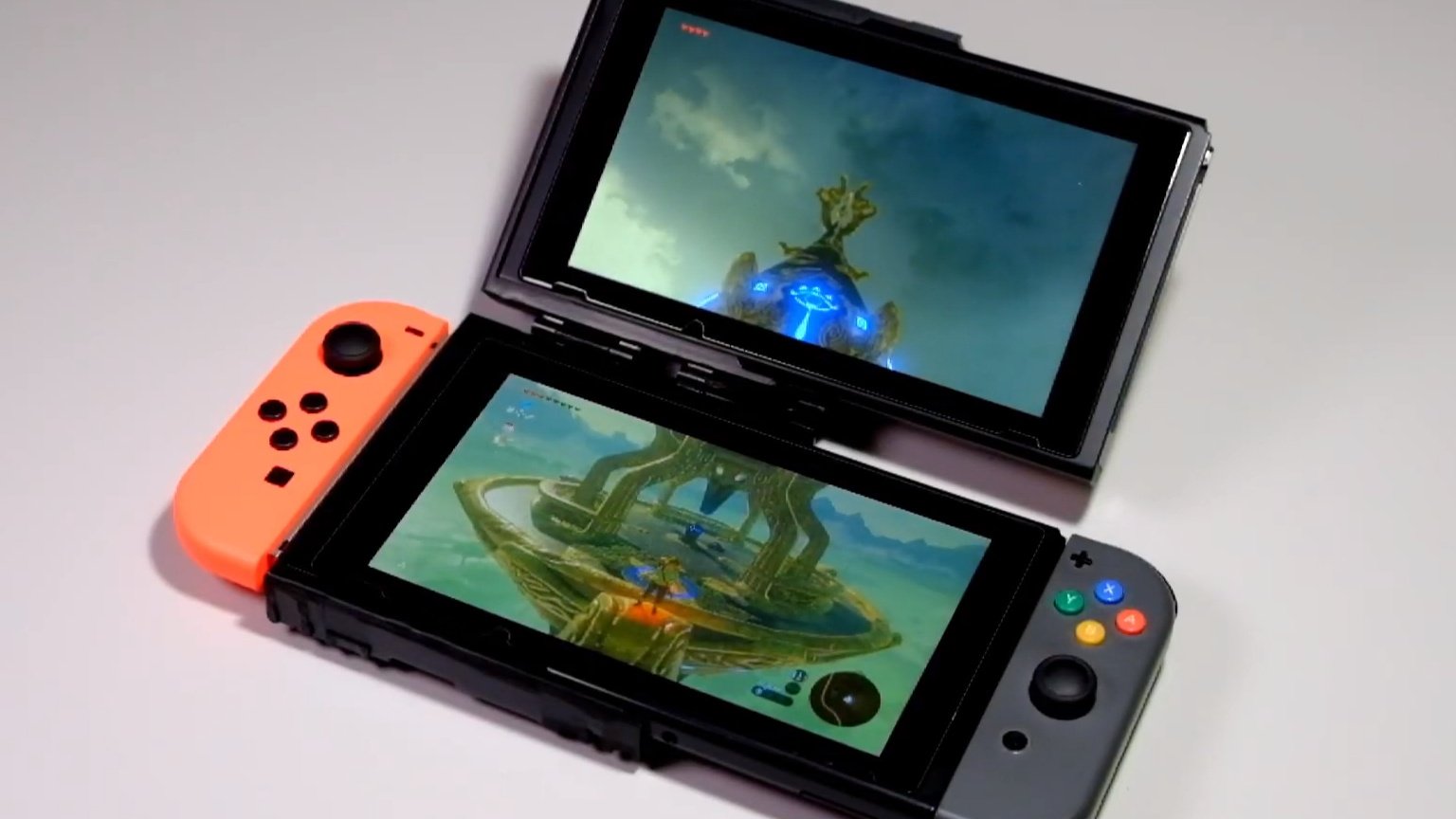
New Nintendo Switch DS

Shmup enthusiasts will no doubt remember the Flip Grip – a vertical grip accessory designed for the Switch and launched on Kickstarter in June last year. The product made TATE-enabled games an absolute joy to play. At the end of last month, the engineer behind this creation – Mike “Mechachoi” Choi – also came up with a more “useless” creation, as he put it, allowing Switch owners to connect two systems together.

Now, a few weeks later, he’s invented the “New Nintendo Switch DS”, combining together two Switch units to create something that looks like it could be a bulky successor to the 3DS. If the name didn’t already give it away, this is nothing more than a creative concept. See for yourself in Mike’s video demonstration featuring The Legend of Zelda: Breath of the Wild:

If you haven’t seen Mike’s more serious work before, be sure to check out our hardware review of the Flip Grip. For just $12, it’s an effortless recommendation for shmup fans.

What do you think of the New Nintendo Switch DS? Do you like this idea? Would you like to see Nintendo continue on with dual screen gaming in the future? Have you tried out the Flip Grip before? Tell us below.

Posted on Leave a comment

Review: Puyo Puyo Champions – A Fine Puzzler That’s More For Veterans Than Newcomers

After decades of largely being overlooked for localisation, the Puyo Puyo series is gaining some long-deserved recognition. Puyo Puyo Tetris was an early highlight in the Switch’s library, and a Sonic Mania nod to the game’s original western release (Dr. Robotnik’s Mean Bean Machine) was a highlight in a game packed full of highlights. But can the series succeed without bringing some of the most famous names in gaming along for the ride? It certainly deserves to, but by focussing primarily on online play Puyo Puyo Champions doesn’t make as strong a case as it could do, despite undeniably strong fundamentals.

To recap those fundamentals: with an eye-catching cutesy, off-kilter sense of style Puyo Puyo’s brand of quick, competitive falling block puzzling sees you arranging coloured pieces (puyos) into groups of four (or more). When these connected puyos disappear from the field of play, those resting on top will fall, allowing you to arrange and trigger multiple clearances (chains) sequentially for higher scores.

More importantly, large chains will send larger numbers of colourless ‘nuisance’ puyos into your opponent’s play area. If their puyos reach the X at the top of their playspace, you win. Layer in a tactical timing element via the opportunity to counter nuisance puyos in your queue with your own chains, and you have an easily learnt game with a high skill ceiling. Notably, in place of Tetris, Puyo Puyo Champions brings back the Fever ruleset from Puyo Puyo Fever. This is a solid choice, though somewhat inevitable considering the mode’s enduring popularity in new Puyo releases since 2003.

Aside from adding three and four Puyo clumps into the mix of pieces thrown your way, Fever’s big addition is a gauge that fills every time you counter enemy chains. It’s a slightly more methodical and tactical way of playing – instead of a mad rush to set off the biggest, baddest chain before your opponent (or to rapid fire enough nuisance to trip them up), Fever encourages you to hang back, build chains and wait for the right moment to fill the gauge. There’s scope for mind games too – firing off small chains in the hope that your opponent will commit, only for you to break off and start countering them.

Your reward for filling the gauge is a succession of pre-made chains to build upon and set flying – clear the screen and you’ll be rewarded with an even larger pre-made chain sequence. Ideally, you’ll inundate your opponent before they have a chance to build up their own gauge and counterattack. Beyond bringing Fever rules back to the west (and to modern consoles), Champions doesn’t present much else that is new, save for some largely cosmetic additions such as new playable characters, backgrounds and music tracks.

As a budget release, this is largely forgivable – it was unlikely that we would receive a repeat of the generous, and entertaining story mode from Puyo Puyo Tetris, for instance. The 2-4 player battle and endurance modes available to single players present enough entertainment for short morning commutes and the fuss-free split and wireless local multiplayer modes make Champions good party game fodder. Ultimately though, these modes are a supporting act, and if you’re not going to play online, expect to get only a modest amount of mileage out of the game.

Champions’ online is structured very similarly to Puyo Puyo Tetris, with ranked (‘Puyo Puyo League’) and unranked (‘Free Play’) modes to play in. The player population seems to be healthy, though not extensive – stick around for a few games and you’ll see a good number of faces (the game has been out since October in Japan under the name Puyo Puyo eSports and has been regularly and aggressively discounted to lure people in).

Encouragingly, the netcode appears to be completely up to the task of flinging puyos back and forth between hemispheres without too many hitches. Meanwhile, the matchmaking code does its best to pair you up with someone at your own skill level. Despite the Japanese Puyo community being inevitably overstocked with fantastic players, if you’re capable of efficiently stringing together some decent but low complexity chains, you’ll find opponents capable of giving you a tense, but winnable match.

Newcomers, on the other hand, are likely to be disappointed. Unless you’re a particularly quick learner, the current state of online play will feel very hostile: it doesn’t help that the minimal offline modes (including the omission of Puyo Puyo Tetris’ interactive lessons, though a chain hint mode is available with the singleplayer handicap set to ‘sweet’ or ‘mild’) offer meagre space to experiment and improve.

Conclusion

Puyo Puyo Champions ably covers the essentials of the series at a great price point. The inclusion of the Fever ruleset provides something of interest for veteran players and the most enthusiastic of new fans created by Puyo Puyo Tetris, and should be at least considered for any party game library. However, the lack of other single or multiplayer modes or a real tutorial make this less of a definitive entry-point or second helping for newly created casual fans than it perhaps could be.

Posted on Leave a comment

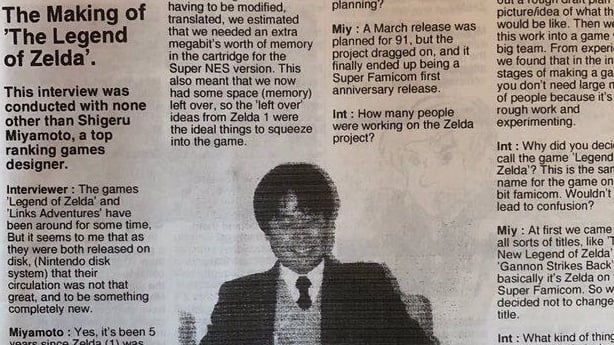
Forgotten Interview With Miyamoto Sheds Light On A Classic Zelda Production

Retro gamer Matt Sephton, who goes by the handle @gingerbeardman over on Twitter, has shared a forgotten interview with us dating back to 1992. It’s from issue 25 of the publication Electric Brain and features the one and only Shigeru Miyamoto talking about the development of The Legend of Zelda: A Link To The Past along with the first two Zelda entries on NES.

Throughout the interview, Miyamoto speaks about the various challenges and design choices Nintendo faced during development – such as trying to cram all of the game onto the cartridge. He also explained how the company often began projects with only a handful of people and even revealed how the development team had “all sorts of titles” for the SNES Zelda, like “Gannon Strikes Back” until a decision was made to stick with the original name.

In the second half of the interview, Shigeru touches on the role-playing genre, in general, and states how Zelda paved the way – with a number of original ideas that eventually became “bog standard” for all games under this banner. Later on, he references the original Mother (Earthbound) game on the NES and Pilotwings.

One of the final questions is about future production plans for the company. Miyamoto follows this up by saying how Nintendo “will never run out of ideas” and new genres can be easily created. Read the full interview below:

Did you enjoy reading this classic interview featuring Miyamoto? Share your thoughts in the comment section.

Posted on Leave a comment

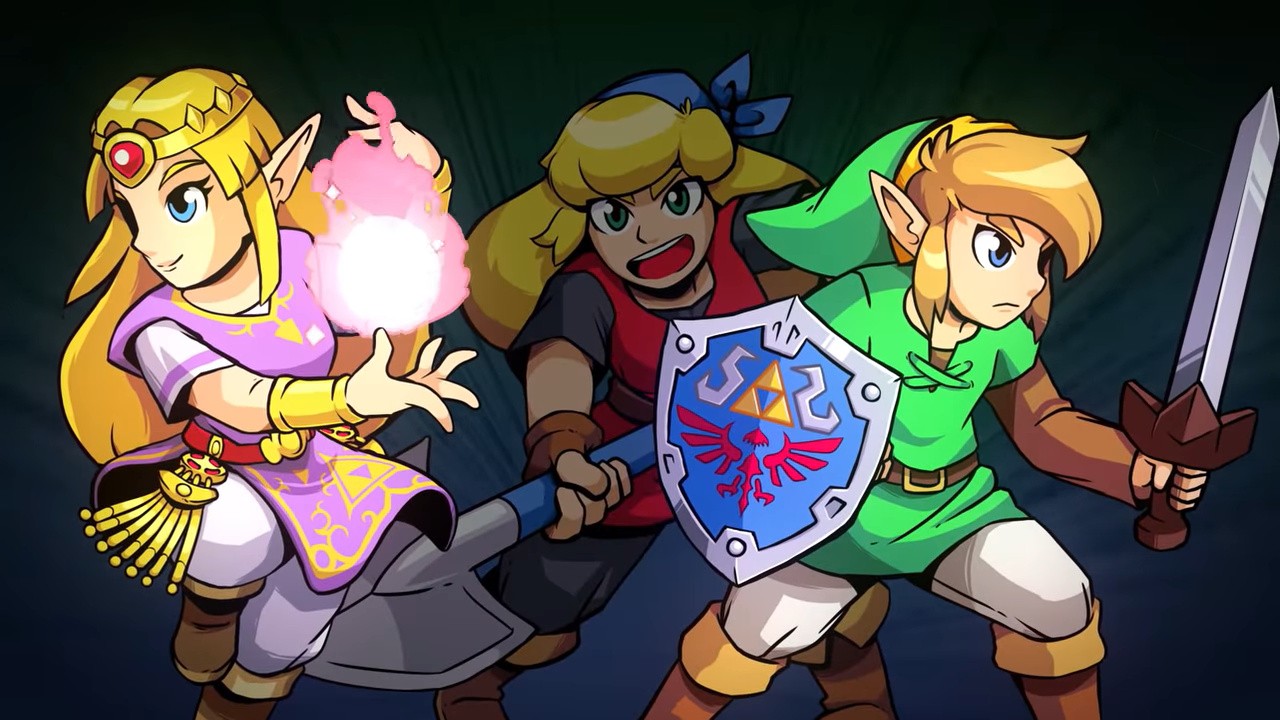
Nintendo Newsletter Suggests Cadence Of Hyrule Will Be Released This Month

Cadence Of Hyrule

If you had to pick one of the most surprising Nintendo Switch announcements so far this year, a standout would likely be Cadence of Hyrule: Crypt of the NecroDancer. The game was originally revealed during the March Nindie Direct showcase and is being developed by Brace Yourself Games and published by Spike Chunsoft.

Regarding a release date, the game is currently listed for “Spring 2019” on Nintendo’s official website. In saying this, a recent Nintendo Europe email – promoting all of the games coming to the Switch this May –includes Cadence of Hyrule in between the upcoming Resident Evil releases and Assassin’s Creed III Remastered. So, with any luck, we could be playing this rhythmic action-adventure before the end of the month.

For anyone who missed the Nindie announcement, Cadence of Hyrule is modeled on Brace Yourself Games’ original rhythm-combat title, Crypt of the NecroDancer. In the new game, you can play as Link or Princess Zelda as you go on a quest to save Hyrule. Here’s a bit more about it, along with the trailer:

As Link or Princess Zelda, players explore randomly generated overworld and dungeons on a quest to save Hyrule, and every beat of the 25 remixed Legend of Zelda tunes is a chance to move, attack, defend and more. From modern-looking Lynels to the Hyrulean Soldiers of old, players must master the instinctive movements of each pixel-art enemy and strategically outstep them in rhythmic combat using an arsenal of iconic items from The Legend of Zelda, as well as the spells and weapons from Crypt of the NecroDancer.

Have you been anticipating this release? Did you play Crypt of the NecroDancer? Tell us below.

Posted on Leave a comment

The Serious Sam Developer Is Porting Its New Game Engine To Switch

Serious Sam HD: The Second Encounter

As more publishers and developers jump on the Switch bandwagon, more game engines are being made compatible with the system.

During an interview with Wccftech a few weeks ago, Croteam’s CTO Alen Ladavac and Marketing Manager Daniel Lucic revealed the developer – responsible for the Serious Sam series – was working on making its new game engine compatible with Nintendo’s hybrid system. Unfortunately, they’re “not sure” about its current status or when exactly it will be made available.

“Yeah. It’s become very streamlined to just ship one of our games on Xbox One or PS4 or Nintendo Switch. We are working on all of those platforms to make sure that we can at any point ship any game…As long as that platform can actually handle the amount of content, we’re probably not gonna ship the next big game older platform. But in theory, the engine supports a number of platforms.”

When asked about the possibility of the first-person puzzle game The Talos Principle being released on the Switch, Daniel Lucic simply said it was “likely” to happen. If that wasn’t convincing enough, for some time now the official Serious Sam and Croteam Twitter accounts have been teasing Switch support. There’s also the mention of “NX” in the engine’s Editor.

Would you like to play Croteam’s games on your Nintendo device? Tell us below.

Posted on Leave a comment

Random: Leave Cardboard Behind With This 3D-Printed Labo VR Headset

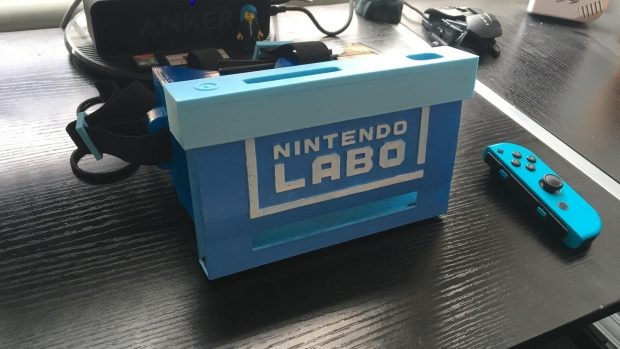
Since the release of the Nintendo Labo VR Kit last month, users have been looking for unique ways to enhance their virtual experience. A lot of people have simply added a strap to the headset so they can play for prolonged periods, while others have gone to the extent of rebuilding the device with more durable materials.

3D printing enthusiast Alex Blackmore actually designed two different 3D-printed Labo headsets. It took him a total of 40 hours to print and paint the designs which utilise the same lenses packaged with the Labo VR kits. The first version has you slide the Switch into the headset and is “fully compatible” with the VR Toy-Cons and with the second one you drop the system into the unit. You can download both designs from Autodesk Tinkercad.

Kotaku’s Laura Kate Dale actually printed out the headset and said it was comfortable and light enough to use for a good few hours. You can even charge the Switch at the same time. Here are a few additional photos of the 3D printout:

So, if you own a 3D printer – what are you waiting for? Print this 3D headset and see what it’s like for yourself.

Posted on Leave a comment

Nintendo’s Upcoming Switch Online NES Titles Include Donkey Kong Jr., VS. Excitebike And Clu Clu Land

Nintendo Switch Online

Nintendo’s American website has seemingly revealed the next batch of games coming to the Switch Online NES service later this month.

These “upcoming titles” include Donkey Kong Jr., VS. Excitebike and Clu Clu Land. More information about each of these games is expected to be shared when Nintendo makes an official announcement. For now, here’s a screenshot from the site:


Upcoming NES Games

Have you been playing the NES library on Switch lately? Are you looking forward to any of these games? Tell us below.

Posted on Leave a comment

Feature: I Think My Game Boy Predicts The Future

E7FE9D27 29D0 434B B475 7A22AF038512

The Game Boy turned 30 last month – to the shock of those of us realising we are therefore well over 30. Where did the past go? I think it went into a nook at the end of my bookshelf – at least that’s where I found my old DMG-01, the original Game Boy. Like many reading this, I’m sure, I took the occasion to hold it again and remember when a plastic brick felt like the future.

That grey hunk still thumps my heart like beating hoofs. But besides my pure and innocent love, I had an ulterior motive for the reunion: this Game Boy was going to make me filthy rich.

A Gift Horse

It was actually nostalgia that started the whole thing off. One twilight in spring, I strolled haplessly into the basement of a Tokyo department store at closing time. Just the day before it had been full of bicycles and luggage but, for today only, it was a “Retro Bazaar” of time-beaten consumer goods, none less than 20 years old. There were Walkmans, digital clocks, Famicom Disk Drives – the works. The bazaar had sprung from nowhere and, as closing time ticked closer, I knew it would be gone again in moments.

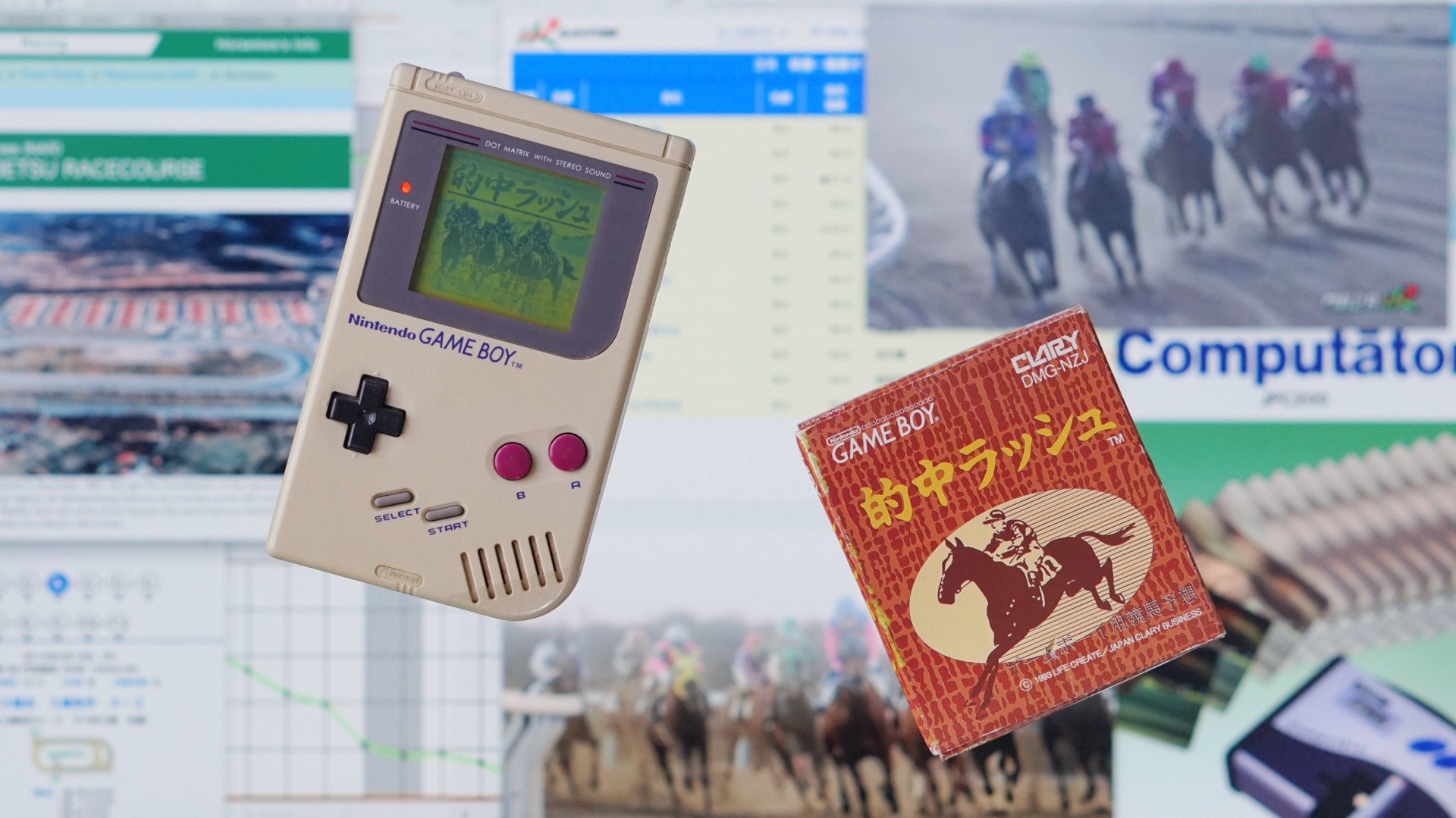
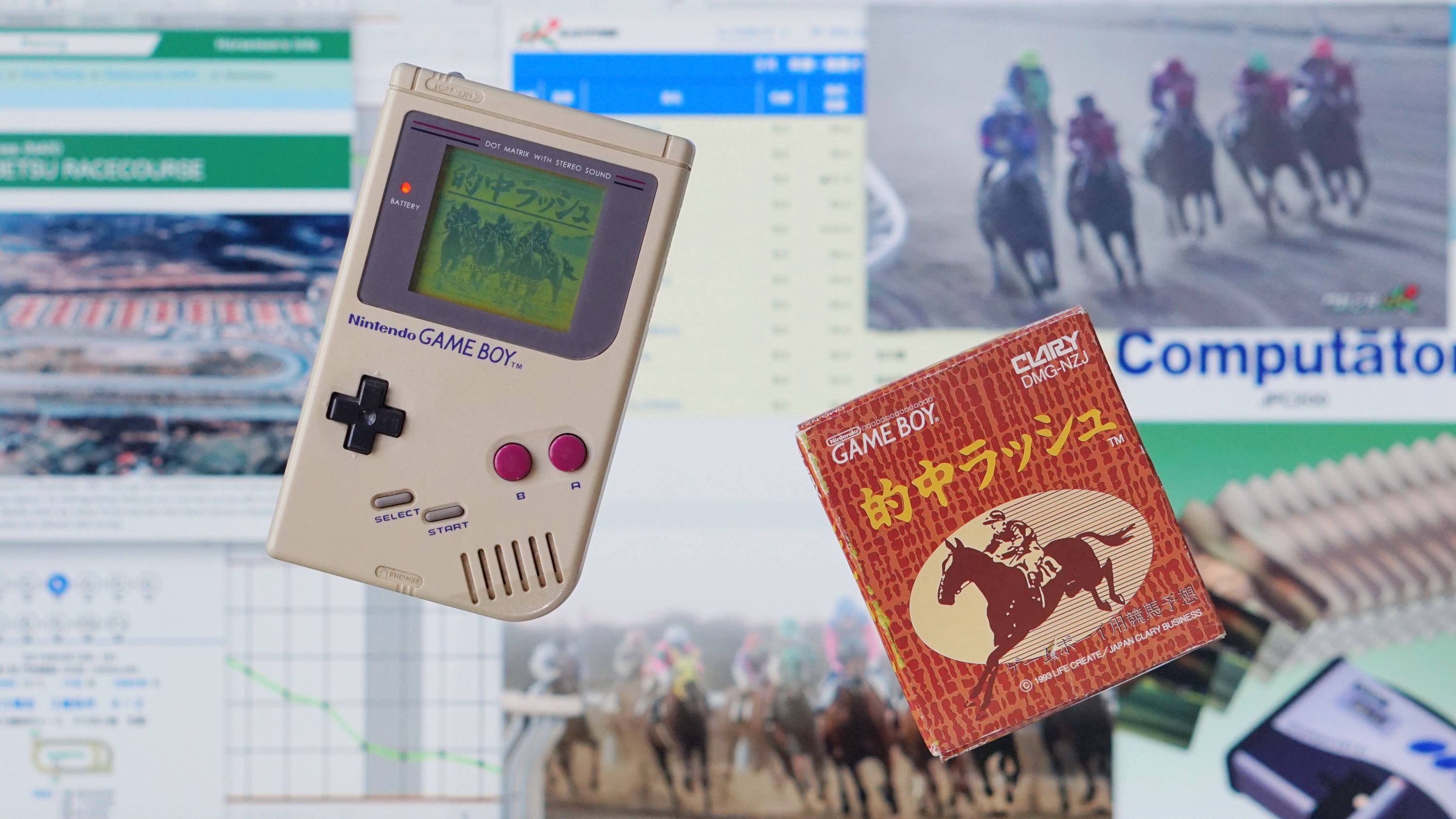
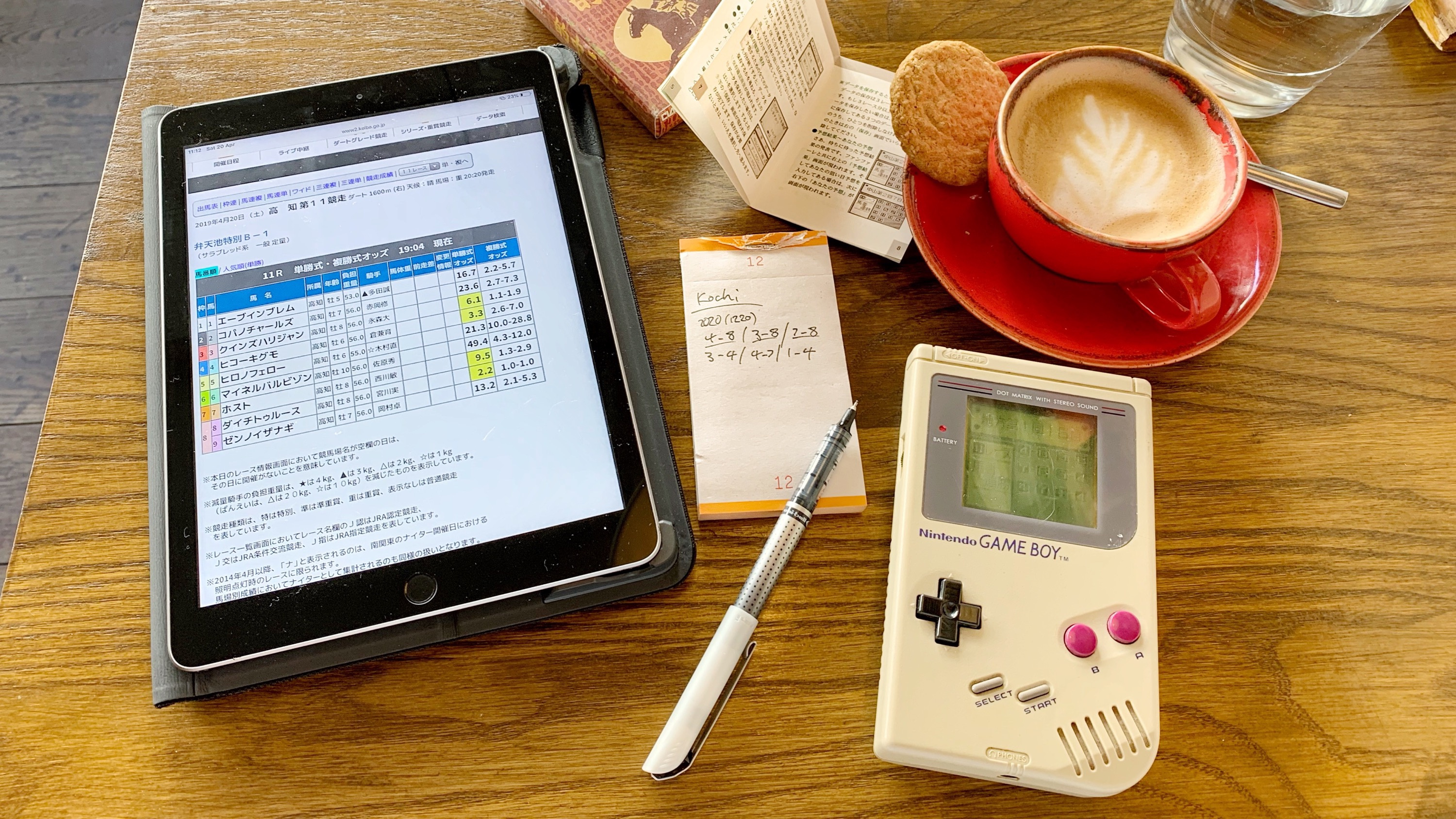
Something jumped out at me: an obscure 1993 Game Boy release, complete in box. But this was no game. On the front was a galloping horse; on the back an astonishing record of accurately predicting horse racing results. In the 1992 season, it had chosen the winner 48.4% of the time and returned winnings of 101%. What trip of fate had brought this to me? It was a relic of a youth I never really lived and a promise of a future I could make my own. I rushed the box to the clerk and buried it in my bag like a snared dream.

Studying the Form

9102E8D8 5AFA 4928 ADD6 EFF26C7C05D6

Tekichuu Rush (something like “Correct Prediction Rush”) was released in 1993 by Japan Clary Business. Some digging around online suggests Clary released no other Game Boy software and its website petered out into the Wayback Machine in the early 2000s. Not exactly a video game company, their flagship product was the “Computator”, which appears to be a budget-priced machine for counting cable TV registration cards.

Tekichuu Rush’s simple proposition is that if you tell it the listed odds for a horse race, it will tell you the winner. Apart from showing off its uncanny accuracy as a race predictor, the box promises “basic controls using few buttons – even the inexperienced can use it!’ – a reminder that, in 1993, a computer with just two main buttons might have bewildered some users.

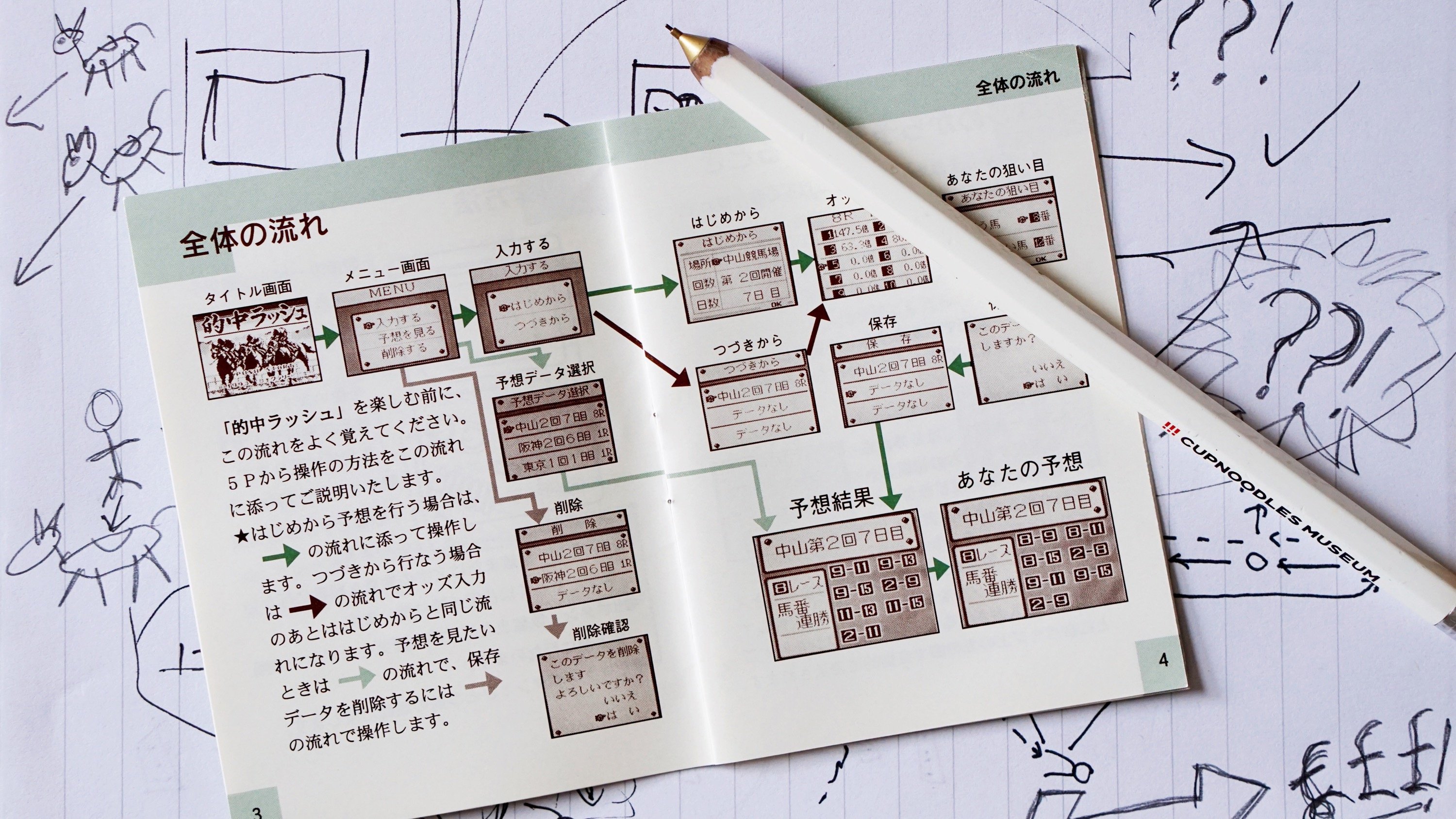
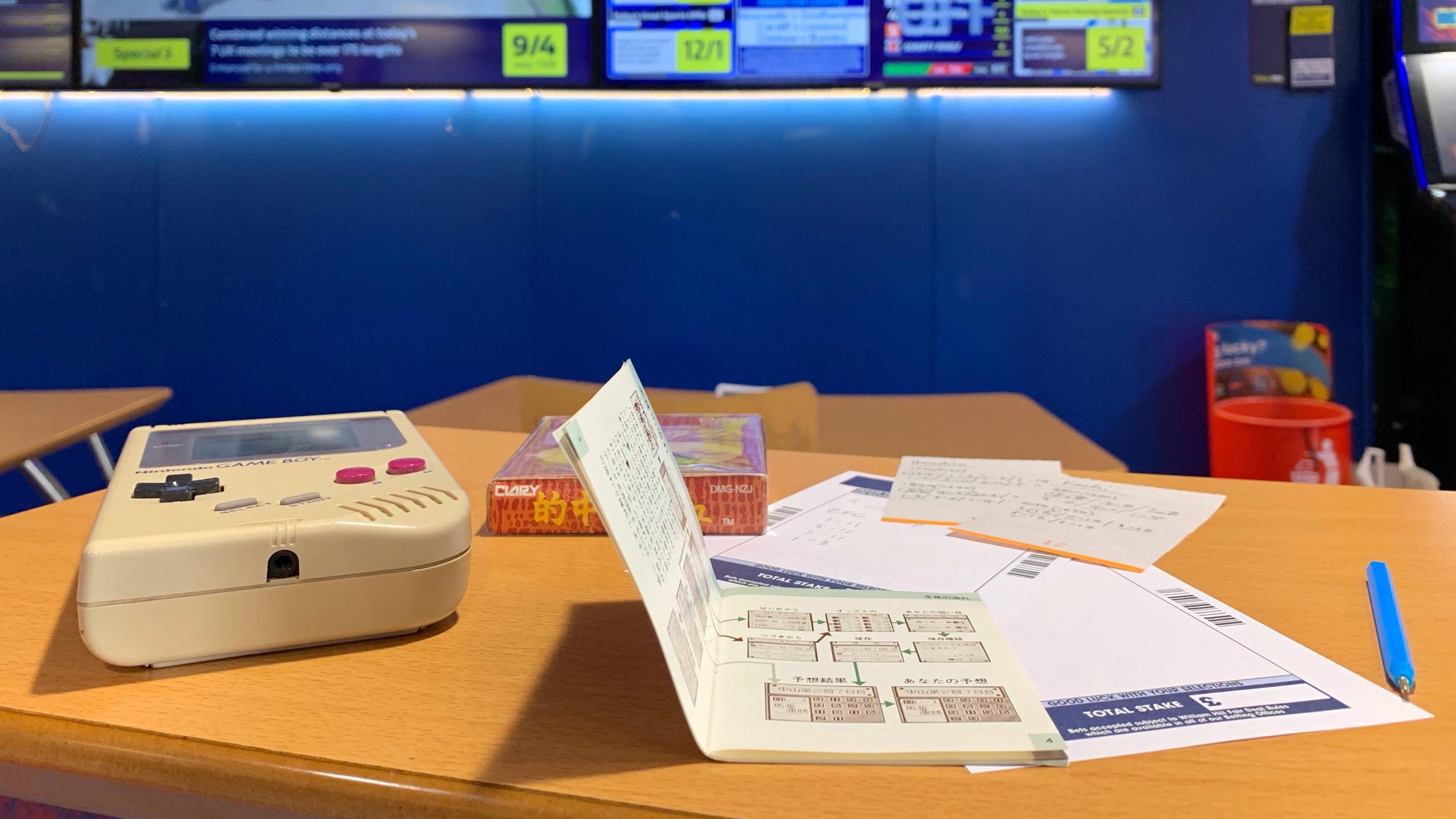
Basic control scheme aside, the instruction booklet does its best to confuse things. Every possible usage scenario is summarised in a single tortuous flow-chart labelled with tiny Japanese text. Ah, how hard can it be? Instructions are for losers: let’s bet on some horses!

Off to the Races

The nearest racecourse to me is in the Shakespearean county town of Warwick, England. One race day, I opened an online betting account and got cracking. Game Boy on; red light; Nintendo® smudge; ba-ding! And now a scene of horses, charging up the dust, jockeys pointed head-and-shoulders at the finish, cheered on by chirpy chiptune. “Tekichuu Rush. ©1993 Japan Clary Business.” I pushed START.

After trudging through a bog of green data-entry screens I felt like it might have been easier to make my millions doing shiftwork in a 1970s stock exchange

The oracle first demanded to know the location of the race. I couldn’t type it in: I could only cycle options excruciatingly slowly with the A button. This was great news: if Clary had kept their promise of basic controls then they would also keep their promise of unlimited wealth acquired by supernatural means. Surely.

I cycled: Tokyo – Nakayama – Kyoto – Hanshin – Sapporo… I started to worry that Warwick was going to be right at the end! Hakodate – Fukushima – Niigata – Chukyo – Kokura – and Warwick! Wait, no. No Warwick?! I decided it must come under “Regional” and selected that.

I started copying out the odds. After trudging through a bog of green data-entry screens I felt like it might have been easier to make my millions doing shiftwork in a 1970s stock exchange. Finally, indignant at having had to work for it, I greedily snaffled the winning horse number and placed my bet.

All in all, it was a longwinded way to lose £5. How could Tekichuu Rush have got it wrong? The only reason I could think of was that maybe Warwick didn’t count as a regional Japanese racecourse. Time to find a Japanese race.

What are the Odds?

C9C49233 A811 44A9 A7A4 16BFD49CEB5E

Kicking off, presumably, a long-running pattern of fantastic luck, the bookmaker happened to be offering betting on a single race in Nakayama that weekend.

After a grind that provided an irreproachable answer to the question “Why isn’t all text entered like this?” I had my predictions. I was given three possible one-two finishes: horse number 3 followed by horse 12; 4 followed by 12; or 7 followed by 12. Horse number 12, then, was clearly not going to win whatever happened, so I ignored that and placed my bets on 3, 4 and 7.

I could now be sure that Tekichuu Rush was essentially a Game Boy Printer that spooled out bank notes in place of stickers

You’re probably expecting that one of them one won – or perhaps that somehow all three of them won. Astonishingly, every bet went down. What had happened? I gazed over the results. In first was some nag named Saturnalia – number 12! The very horse we knew would lose! Next came Velox, Danon Kingly and Admire Mars – horses 7, 4 and 3! Our guaranteed winners!

Like you, I’m sure, I immediately suspected foul play. Tekichuu Rush was 25 years old, after all. Presumably, Big Racing had got its hands on it and twisted its power for underhand mega-corporate enrichment – instead of the good, honest personal enrichment that I deserved.

So in yet another gesture of earnest graft that would ultimately justify my making millions for free, I read the instructions. I’ll confess it now: I should have done that at the beginning. Turns out, the results guaranteed by Clary’s crystal ball were called “rensho”. In the UK, this is a “reverse forecast”, meaning that when Tekichuu Rush said horses 7 and 12, it actually meant those two would finish first and second in either order. Had I staked my £6 correctly, on reverse forecasts, I would now be rolling in £19.

But I felt no disappointment at all, because I could now be sure that Tekichuu Rush was essentially a Game Boy Printer that spooled out bank notes in place of stickers. Next time I turned on the Game Boy, the Nintendo® sound wasn’t ba-ding: it was ka-ching.

Back in the Saddle

However, there were a few more hiccups. It was always my fault, not the game’s, but the next few races also lost me money. I set up in the coffee shop opposite the bookies and studied the finer administrative points of Japanese horse racing. Then I scrunched real paper slips in the betting shop: I lost at Kochi because I entered the wrong number meeting. I lost at Hanshin because it was the fourth race-day when I had said second. And I lost at Fukushima because what I read as the first race of the schedule was actually the twelfth. But every mistake was a lesson: I could now read the Tekichuu tea leaves perfectly.

I felt the megalomaniacal thrill of a mad scientist who had calibrated a precariously functional time machine. But I had become obsessed. Spreadsheets and notepads and discarded slips were in a scatter around me. Ambition untempered will undo us all: what evil might this forbidden technology unleash?

But You Can’t Make It Drink

248F3AB3 3EB8 464A AA94 9206FF371CA2

It was back to Fukushima for the “Flora Stakes”. My prophet tipped me three reverse forecasts, all based on bookies’ favourite Therepeia in number 10. The racecourse was right; the meeting was right; the day was right; the race number was right. I checked and double-checked the runners and odds. Despite the certainty of my win, I was somehow nervous.

Therepeia rocketed to a dominating start and my hands sweated into my shivering betting slip. They rounded the first and the pack thinned; rounded the second and it thinned some more. Therepeia was on the heels of number 9, Jodie, and shutting out number 17, Leone d’Oro, either of which was a winning combination.

Then, booming heroically down the final straight, Therepeiawas passed by one, two, three, four, five, six, seven, eight, nine, ten, eleven, twelve horses! Twelve!

The quiver of expectation; the pride of entitlement; and the humility of the emperor, naked all along

My fists slowly unclenched and floated down from the sky. My eyes glazed and my jaw slackened in untethered bewilderment. How? Why? A punter swung the door and a gust swept my betting slips away and ruffled my piles of notes. With a flick and a flutter, the Tekichuu Rush instruction manual flapped onto the bookie bench. What was that on the very first page? I twisted my brow at the Japanese: “This software is for…” Entertainment? Entertainment. “…entertainment purposes only. Japan Clary Business offers no guarantee of the accuracy of predicted results.”

Suddenly it all made sense: Clary, in their timeless wisdom, had enchanted Tekichuu Rush just so that it would lead me on, so that I would indulge to its edge my sateless longing for a perfect past and a gifted future. And in that unseemly engorgement I would experience the ultimate thrill of the race: the rush of every dream held in hand, then falling away. The quiver of expectation; the pride of entitlement; and the humility of the emperor, naked all along.

So that was the end of Tekichuu Rush. A quarter of a century after a small manufacturer of electro-mechanical clerical time-saving devices decided to venture onto the Game Boy, here its creation was, on the other side of the planet. Clary’s cutting-edge of ‘90s Tokyo was still ticking away in an ancient English county town in the 21st century. More impressive than predicting the future, I realise now, was that this game lived to see it.

I dismissed my losses and counted my blessings. Well, OK, I counted my losses: £23. A reasonable price for a captivating Game Boy game.

Posted on Leave a comment

Yu-Gi-Oh! Legacy Of The Duelist: Link Evolution Physical Edition Confirmed

Legacy Of The Duelist

Each month, more and more card games are released on the Switch. Recently, for example, the system has received Super Dragon Ball Heroes: World Mission and Warhammer Age of Sigmar: Champions.

If these games aren’t the digital trading card game you’re looking for, perhaps you would prefer to try out Yu-Gi-Oh! Legacy of the Duelist: Link Evolution by Konami Digital Entertainment. The Japanese company first announced it would bring the Switch exclusive to the west this summer back in March.

Now, in the latest update, it’s been revealed the digital TCG will be available in both digital and physical form when it eventually arrives here in the west. This information was delivered via the official Twitter account for the game:

Attention Duelists! We’re excited to announce both a physical and digital version for the Western release of Legacy of the Duelist: Link Evolution on Nintendo Switch! More information will be available later this month! #YuGiOh

In Yu-Gi-Oh! Legacy of the Duelist: Link Evolution, you take on iconic duelists from the series’ universe and relive the stories of the original animated television series through Yu-Gi-Oh! ARC-V. You’ll also be able to battle the newest generation of duelists in the virtual world Yu-Gi-Oh! VRAINS. More information about this game will be released later this month.

Check out the game’s key features in our previous post and view the original 2016 trailer based on Yu-Gi-Oh! Legacy of the Duelist below:

Is this the card game you’ve been waiting to play on the Switch? Do you enjoy playing this genre on the go? What other TCG you would like to see made available on Nintendo’s hybrid system? Tell us down in the comments.