Posted on Leave a comment

Sky: Children of the Light has topped 50 million installs worldwide

Thatgamecompany’s social adventure Sky: Children of the Light has topped 50 million installs worldwide since launching in July 2019. 

The studio, which previously worked on other popular titles including Journey and Flower, said that “word-of-mouth in the Android community” and the launch of a new season and in-game events helped Sky reach the milestone. 

The free-to-play mobile title is currently available on both iOS and Android devices, and is heading to the Nintendo Switch in 2021. 

Earlier this year, we got some insight into what makes the title tick when thatgamecompany ‘feel engineer’ John Hughes took to the stage at GDC Summer to explain how emotion drives social play in Sky.

Posted on Leave a comment

Thunderful Group acquires UK developer Coatsink for $29.8 million

Nordic development and publishing group Thunderful has fully acquired Shadow Point and Phogs! developer Coatsink Software for an initial £23 million ($29.8 million). 

The deal will see Thunderful pay an initial £11.5 million ($14.9 million) in cash and £11.5 million ($14.9 million) in newly issued ordinary shares for the UK studio, which is currently working on five in-house projects including Jurassic World Aftermath and Transformers Battlegrounds along with several work-for-hire projects.

An earn-out consideration worth £42.5 million ($55.1 million) will also be paid out if Coatsink exceeds its financial targets for 2021 and 2022, taking the potential value of the acquisition to £65.5 million ($85 million). 

Thunderful, which owns other studios and publishers including Rising Star Games, Image & Form, and Zoink, said the deal will further bolster its games business. 

“The acquisition is in line with Thunderful’s strategy to expand its Games segment by adding attractive platform partnerships and publishing deals,” reads a press release. “The acquisition will allow both companies to accelerate and strengthen ongoing and future development projects.”

Coatsink will remain an independent developer under the Thundeful umbrella, and will be reported as part of Thunderful Games moving forward.

Posted on Leave a comment

Rovio CEO Kati Levoranta will leave the company at the end of 2020

Rovio CEO Kati Levoranta will depart the company at the end of 2020 after more than four years at the helm. 

Levoranta has spent over eight years at the Angry Birds maker, initially joining as chief legal officer in June 2012, before making the switch to head of sales in March 2015. She was eventually named CEO in January 2016, but will now be leaving the Finnish studio at the end of the year. 

“For years, Kati has been in a key position in many areas of Rovio’s development. During her time as CEO, the company has carried out systematic strategic and operative work to sharpen its business focus, develop the game business and cherish the Angry Birds brand,” commented Kim Ignatius, chairman of Rovio’s board of directors.

“Under Kati’s determined leadership, Rovio was also listed on the stock exchange. As Rovio reports in its half-year financial review 2020, the company’s result and cash flow development are on a good level and its balance sheet is strong.”

The board of directors has already begun the search for a new CEO, but hasn’t indicated when it will announce Levoranta’s successor.

Posted on Leave a comment

ParticleShop Hands-On

ParticleShop is one of the applications that is featured in the current Be A Creative SuperHero Bundle currently running on Humble. This bundle is a collection of graphical applications and add-ons from Corel. Today we are taking a hands-on look at ParticleShop, a PhotoShop plugin (also compatible with PaintShop Pro 2020 and Affinity Photo) that brings the particle system based brushes from Corel Painter to these other applications.

ParticleShop is described as:

Create stunning image enhancements with ParticleShop, a powerful Adobe® Photoshop® brush plugin powered by Painter. Experience NEW expressive Dynamic Speckle brushes and living grab-and-go Particle brushes and that are easy to use with a pressure sensitive tablet, touchscreen or mouse. Use your creativity and imagination to artistically enhance photos, designs and illustrations with strokes of genius.

We’ve done all of the work for you! Immediately start creating with one of 11 built-in custom brushes. Whether you’re looking to add playful Dynamic Speckle flourishes or compelling Particle flare to your work, you’ll find just the brush you need to artistically enhance your imagery and exponentially increase your range of painting expertise. Plus, explore the additional brush packs that were designed to match your specific workflow needs.

Out of the box ParticleShop ships with a pack with 11 brushes, although the Bundle contains more than a half a dozen additional brush packs. You can see ParticleShop in action, including instructions on how to install in PaintShop Pro and Affinity Photo, as well as showcasing several of the brush packs, in the video below.

[youtube https://www.youtube.com/watch?v=1UT0ZuvYQ44?feature=oembed&w=1500&h=844]
Posted on Leave a comment

Get a job: Join the team at Volition as a Junior Gameplay Programmer

The Gamasutra Job Board is the most diverse, active and established board of its kind for the video game industry!

Here is just one of the many, many positions being advertised right now.

Location: Champaign, Illinois

Looking to break into the games industry? Do you only have a little experience, but a lot of talent, passion and desire to learn? Then come work at Volition and assist us with the development of our new Saints Row title! At Volition, we have a highly collaborative team of game creators, a strong programming culture, and lots of senior programmers ready and willing to help mentor you and develop your talent.

Responsibilities:

  • Develop and enhance gameplay systems for AAA Xbox One, PlayStation 4, and PC titles.
  • Collaborate heavily with designers and artists.

Qualifications:

  • Bachelor’s Degree in Computer Science or related field, or equivalent experience.
  • Ability to program and debug in C++.
  • Ability to work well with others and learn quickly.

Pluses:

  • Familiarity with Visual Scripting (Unity, Unreal).
  • Demonstrated desire to work in the games industry by working on game projects in modern 3D engines.

Application Requirements:

  • Resume.
  • Code samples.
  • Cover Letter. We want to learn more about you. Why are you excited about this job, about working at Volition, about working in games, etc.? Help us understand what sets you apart from the competition.

Interested? Apply now.

Whether you’re just starting out, looking for something new, or just seeing what’s out there, the Gamasutra Job Board is the place where game developers move ahead in their careers.

Gamasutra’s Job Board is the most diverse, most active, and most established board of its kind in the video game industry, serving companies of all sizes, from indie to triple-A.

Looking for a new job? Get started here. Are you a recruiter looking for talent? Post jobs here.

Posted on Leave a comment

Google officially ends support for Daydream VR

Google’s short-lived foray into virtual reality has come to a close. The tech giant has officially announced that it has ended support for Daydream VR software and that, starting with Android 11, its mobile phone OS is no logner guarenteed to work properly with the mobile-powered VR setup.

This official end of support falls nearly four years after Google first launched its mobile-powered Daydream View VR headset, but really the end of official support has been something Google has been quietly working its way towards for some time now through hardware discontinuations and the like.

If last year’s discontinuation of Daydream support for Google’s Pixel-branded phones is any indication, a general lack of interest in its VR offerings is likely to blame.

Speaking to Variety last October, Google blamed a lack of broad consumer and developer adoption as well as decreasing usage of the Daydream View over time as is reasons for dropping support on Pixel (and ending the sale of its physical Daydream View headsets).

Though no longer in production, Google does note that an end of support won’t prevent the Daydream View from functioning, nor will it wipe current VR apps from mobile storefronts. In a support article, Google adds that “many of the third-party apps and experiences within Daydream may still be available as standalone apps in the Google Play store. We don’t expect users to lose account information or functionality for third-party apps as a result of Daydream no longer being supported by Google.”

Posted on Leave a comment

Don’t Miss: The buzzer-beating bug fix that saved Crash Bandicoot

The following blog post, unless otherwise noted, was written by a member of Gamasutra’s community.
The thoughts and opinions expressed are those of the writer and not Gamasutra or its parent company.


(Originally posted on Quora)

As a programmer, you learn to blame your code first, second, and third… and somewhere around 10,000th you blame the compiler. Well down the list after that, you blame the hardware. 

This is my hardware bug story.

Among other things, I wrote the memory card (load/save) code for Crash Bandicoot. For a swaggering game coder, this is like a walk in the park; I expected it would take a few days. I ended up debugging that code for 6 weeks. I did other stuff during that time, but I kept coming back to this bug — a few hours every few days. It was agonizing.

The symptom was that you’d go to save your progress and it would access the memory card,  and almost all the time, it worked normally… But every once in a while the write or read would time out… for no obvious reason. A short write would often corrupt the memory card. The player would go to save, and not only would we not save, we’d wipe their memory card. D’Oh.

After a while, our producer at Sony, Connie Booth, began to panic. We obviously couldn’t ship the game with that bug, and after six weeks I still had no clue what the problem was. Via Connie we put the word out to other PS1 devs — had anybody seen anything like this? Nope. Absolutely nobody had any problems with the memory card system.

About the only thing you can do when you run out of ideas debugging is divide and conquer: keep removing more and more of the errant program’s code until you’re left with something relatively small that still exhibits the problem. You keep carving parts away until the only stuff left is where the bug is.

The challenge with this in the context of, say, a video game is that it’s very hard to remove pieces. How do you still run the game if you remove the code that simulates gravity in the game? Or renders the characters? 

What you have to do is replace entire modules with stubs that pretend to do the real thing, but actually do something completely trivial that can’t be buggy. You have to write new scaffolding code just to keep things working at all. It is a slow, painful process.

Long story short: I did this. I kept removing more and more hunks of code until I ended up, pretty much, with nothing but the startup code — just the code that set up the system to run the game, initialized the rendering hardware, etc. Of course, I couldn’t put up the load/save menu at that point because I’d stubbed out all the graphics code. But I could pretend the user used the (invisible) load/save screen and asked to save, then write to the card.

I ultimately ended up with a pretty small amount of code that exhibited the problem — but still randomly! Most of the time, it would work, but every once in a while, it would fail. Almost all of the actual Crash code had been removed, but it still happened. This was really baffling: the code that remained wasn’t really doinganything.

At some moment — it was probably 3am — a thought entered my mind. Reading and writing (I/O) involves precise timing. Whether you’re dealing with a hard drive, a compact flash card, a Bluetooth transmitter — whatever — the low-level code that reads and writes has to do so according to a clock

The clock lets the hardware device — which isn’t directly connected to the CPU — stay in sync with the code the CPU is running. The clock determines the Baud Rate — the rate at which data is sent from one side to the other. If the timing gets messed up, the hardware or the software — or both — get confused. This is really, really bad, and usually results in data corruption.

What if something in our setup code was messing up the timing somehow? I looked again at the code in the test program for timing-related stuff, and noticed that we set the programmable timer on the PS1 to 1kHz (1000 ticks/second). This is relatively fast; it was running at something like 100Hz in its default state when the PS1 started up. Most games, therefore, would have this timer running at 100Hz.

Andy, the lead (and only other) developer on the game, set the timer to 1kHz so that the motion calculations in Crash would be more accurate. Andy likes overkill, and if we were going to simulate gravity, we ought to do it as high-precision as possible!

But what if increasing this timer somehow interfered with the overall timing of the program, and therefore with the clock used to set the baud rate for the memory card?

I commented the timer code out. I couldn’t make the error happen again. But this didn’t mean it was fixed; the problem only happened randomly. What if I was just getting lucky?

As more days went on, I kept playing with my test program. The bug never happened again. I went back to the full Crash code base, and modified the load/save code to reset the programmable timer to its default setting (100 Hz) before accessing the memory card, then put it back to 1kHz afterwards. We never saw the read/write problems again.

But why?

I returned repeatedly to the test program, trying to detect some pattern to the errors that occurred when the timer was set to 1kHz. Eventually, I noticed that the errors happened when someone was playing with the PS1 controller. Since I would rarely do this myself — why would I play with the controller when testing the load/save code? — I hadn’t noticed it. But one day one of the artists was waiting for me to finish testing — I’m sure I was cursing at the time — and he was nervously fiddling with the controller. It failed. “Wait, what? Hey, do that again!”

Once I had the insight that the two things were correlated, it was easy to reproduce: start writing to memory card, wiggle controller, corrupt memory card. Sure looked like a hardware bug to me.

I went back to Connie and told her what I’d found. She relayed this to one of the hardware engineers who had designed the PS1. “Impossible,” she was told. “This cannot be a hardware problem.” I told her to ask if I could speak with him.

He called me and, in his broken English and my (extremely) broken Japanese, we argued. I finally said, “just let me send you a 30-line test program that makes it happen when you wiggle the controller.” He relented. This would be a waste of time, he assured me, and he was extremely busy with a new project, but he would oblige because we were a very important developer for Sony. I cleaned up my little test program and sent it over.

The next evening (we were in LA and he was in Tokyo, so it was evening for me when he came in the next day) he called me and sheepishly apologized. It was a hardware problem.

I’ve never been totally clear on what the exact problem was, but my impression from what I heard back from Sony HQ was that setting the programmable timer to a sufficiently high clock rate would interfere with things on the motherboard near the timer crystal. One of these things was the baud rate controller for the memory card, which also set the baud rate for the controllers. I’m not a hardware guy, so I’m pretty fuzzy on the details.

But the gist of it was that crosstalk between individual parts on the motherboard, and the combination of sending data over both the controller port and the memory card port while running the timer at 1kHz would cause bits to get dropped… and the data lost… and the card corrupted.

This is the only time in my entire programming life that I’ve debugged a problem caused by quantum mechanics.


Dave Baggett was the first employee at Naughty Dog and one of two programmers on Crash Bandicoot. Dave now focuses on curing inbox overload at his new startup, Inky.

Posted on Leave a comment

20% of Ubisoft staff don’t feel respected or safe at work, reveals internal survey

According to an internal survey of Ubisoft staff, 20 percent its staff members say they don’t feel “fully respected or safe in the work environment,” while slightly more, 25% of the survey’s anonymous respondents, say that they’ve observed or witnessed misconduct at work themselves.

This information comes from a recent Kotaku report, but the publication notes in its full rundown of the survey data that it wasn’t received via a leak.

Rather, Ubisoft PR reached out to Kotaku to share the results of the company-wide survey, undoubtedly as a response to the many stories of abuse and misconduct at Ubisoft studios that made headlines this summer.

Other revelations from the company-shared report note that non-binary employees are 43 percent more likely to experience, witness, or hear about discrimination than men. For comparison, women are only 30 percent more more likely than men to encounter those same discrimination-related incidents. Kotaku has more data from Ubisoft’s internal report over in its full writeup.

Ubisoft has, in that same PR reach out, outlined its plans to address these shortcomings internally. Those include bonuses for management that meet diversity objectives to other steps like setting up a new review committee for content and product marketing that ensures it is “aligned with our values of respect and fairness.”

But, as this year’s discussion of Ubisoft’s studio culture have revealed, the issue isn’t a lack of awareness when it comes to misconduct and inequality, but rather a lack of accountability or willingness from studio leadership to meaningfully address the issues at the core of the problems. While the report itself highlights areas where Ubisoft has failed its employees in the past, the true test of Ubisoft’s mettle will be how leadership uses this information to improve its studio culture and protect its employees from behavior that has no place in the workplace.

Posted on Leave a comment

Blog: Switch & Steam discount strategies? Here’s some good ones

<!– –> Gamasutra: Simon Carless’s Blog – Switch & Steam discount strategies? Here’s some good ones

Gamasutra is part of the Informa Tech Division of Informa PLC

This site is operated by a business or businesses owned by Informa PLC and all copyright resides with them. Informa PLC’s registered office is 5 Howick Place, London SW1P 1WG. Registered in England and Wales. Number 8860726.

Gamasutra: The Art & Business of Making Gamesspacer

<!–

–>

If you enjoy reading this site, you might also want to check out these UBM Tech sites:


Share on Twitter    RSS

The following blog post, unless otherwise noted, was written by a member of Gamasutra’s community.
The thoughts and opinions expressed are those of the writer and not Gamasutra or its parent company.


[The GameDiscoverCo game discovery newsletter, which you can subscribe to now for free, is written by ‘how people find your game’ expert Simon Carless, and is a regular look at how people discover and buy video games in the 2020s.]

Welcome to the final GameDiscoverCo piece for the week – this one covering various discount strategies for console and PC games, as well as what can only be called a ‘gigantic chonk’ of miscellaneous game discovery news.

Incidentally, I keep forgetting to mention that GameDiscoverCo has a Twitter feed now, if you want to check out neat game discoverability news on social media, in real-time. (As opposed to waiting for much of it to be bundled into these pieces!) Anyhow, let’s go go to the content content:

Experiments in Nintendo Switch discounting?

You may have seen a looong Twitter thread from my No More Robots compadre Mike Rose last week, talking – in non-NDA-breaking ways – about the various Switch game launches that NMR has done over the past few months (Yes, Your Grace, Hypnospace Outlaw, Not Tonight, Nowhere Prophet).

The main takeaway I had from the thread was that unfortunately, much larger discounts are still a way to brute-force Switch sales. This is due to the eShop charts being unit-based, and possibly people having residual Nintendo Gold Points to spend. (I’ve mentioned this a couple of times in this newsletter.)

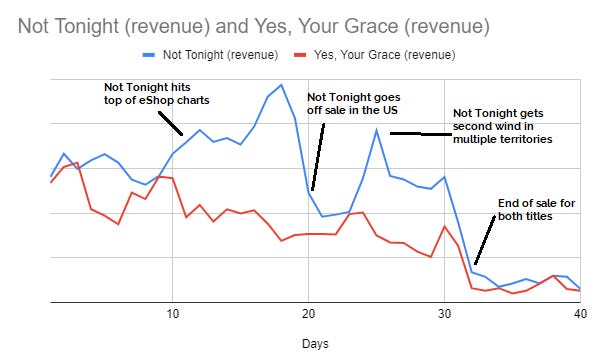
But I was heartened to see something else. If your game is good quality and stands out, you can actually do pretty decently at lower discounts. You’ll just miss the ‘you reached the top charts’ effect. Look at Mike’s plotting of overall gross revenue for Not Tonight (90% off sale) and Yes, Your Grace (40% off sale):

You can see that both titles are initially hitting somewhere towards 6-10x normal revenue in the sale, initially because Reddit and various deal sites will swiftly boost interesting Switch game deals when they announce. (There’s not really a email/notification effect like Steam for Switch.)

But honestly, I was surprised that Yes, Your Grace had such good revenue ‘staying power’ at 40% off in this increasingly crowded market. It implies that this discount is something you can repeat. And compared to other platforms, it’s a slightly, but not stupidly aggressive discount. (It’s a relatively recent and high rated game, though.)

Yet brute-force wise, the 90% off game (Not Tonight) is getting additional juice from its presence near the top of the Deals and Charts section in certain regions. And Mike does also note that a previous 30% sale for Not Tonight didn’t have much of an effect. So does that imply there’s a class/vintage of game that can only get extra sales on Switch at >50% off. Which… is the thing that encourages this behavior.

Concluding, it does seem like Nintendo is thinking about this trend – and we may even be seeing limited changes soon* as a result of these overly discount-centric trends. (*I couldn’t possibly say.)

But I still think that a move to a revenue-based top chart, as Steam already does (look, I re-confirmed it with Valve’s Alden Kroll, it’s true!) would be another step in the right direction, in terms of incentivizing the best dev behavior for longer-term ecosystem preservation.

(Although it does come with the danger that the non-digital eShop charts would become ‘all Nintendo, all the time’ due to most first-party games’ $59.99 price point. So it’s not a slam dunk. Anyhow, onward and upward.)

What boost does a themed Steam sale give you?

Now, on to Steam discount/sale strategy! In this ‘vanilla, but still useful’ micro-case study, Gary Burchell from Fireblade Software, makers of ‘age of sail’ pirate sim Abandon Ship, passed along some abstracted data and comments from their recent appearance in the Valve-organized Steam Pirate Sale. (That’s peg leg and hook piracy, not ‘copying games’ piracy!)

Here’s some highlights from Gary: “The themed Pirate sale on Steam ran from 17th September 10am PT to 21st September 10am PT. It covered the weekend of 19th September, which was “International Talk Like A Pirate” day.” It was a ‘weekend deal’ highlight, so it appeared in the Special Offers section at the top of the Steam homepage.

Abandon Ship ended up getting in one of the higher tiers of the sale: “On the Steam client, 4 titles were given prominence at the top of the page: Black Flag, Sea of Thieves, Blackwake and Atlas. These have between 14,000 and 32,000 user reviews.. Underneath this in a three-row section was Abandon Ship. This section comprised a total of 7 games.” (The web version of Steam had a slightly different layout, with Abandon Ship rotating more freely in the top section.)

Due to the sale traffic, “a “Sales Page” option was displayed in the marketing section of the Steam back end. This accounted for nearly 3 million impressions & 37,532 store page visits at a click-thru rate of 1.27% (low compared to our lifetime stats).”

Gary also notes: “As with any general increase in Steam popularity, a temporary boost to Discovery Queue occurs.” And with the game picking a 30% discount – almost as high as their highest-ever 33% off – “sales during this period represented a 742% boost over an “average” week.”

He adds: “Approximately 50% of the sales during this period came from our Wishlists, the vast majority through the Wishlist email. [In addition], the Wishlist balance for this period represented an 847% increase.” That’s useful too.

So the conclusion? Keep watching out for eligibility for these Steam sales, especially those where you can be featured higher up on the page, or with less games. (Sometimes Valve will reach out, sometimes they’re organized by third parties.)

Other Stuff..

You know, there’s plenty of other fish in the sea. If by fish you mean ‘links’, and sea, you mean ‘the rest of this newsletter’:

  • Lars Doucet just posted a Patreon update discussing his v0.3 update to his GameDataCrunch website, including a “find games similar to…” link on detail pages, with three methods: similar tags, similar audience, and a blend of both. I’ve already been joking about the gothic font-fest i found when looking at similar games to Yes, Your Grace. But seriously – some great data deep dives.

  • Here’s the newest attempt to corral the massive amount of virtual and physical (& hybrid, I presume!) game dev events out there – GameConfGuide.com. And good luck to them – there’s a lot to keep up on.

  • An odd Stadia-related note, via The Verge, here: “Google’s new $50 Chromecast with Google TV will support a lot of the streaming services most people would want… but the new Chromecast does have one very strange omission: Google’s own game streaming service, Stadia… Google says support will come sometime in the first half of 2021.”

  • Steam’s Digital Tabletop Fest (Oct 21st-26th) got officially announced to the public, and it includes “virtual let’s plays, panels, talks and more streaming activities” organized by Auroch Digital at Valve’s request, with guests including Sandy Petersen, Steve Jackson, and Elizabeth Hargrave. (Steam’s still keen on ‘virtual fests’ that include both community content and game sales.)

  • This Protocol story about Amazon Luna’s plans confirms my suspicions that Amazon’s VOD video channels is the conceptual model for Luna’s expansion: “”You’ll see other channels over time,” Amazon’s VP of Entertainment Devices and Services Marc Whitten told Protocol following the announcement.” Wonder which other major publishers will be hip to launch Luna ‘channels’?

  • As a follow-up from my Wandersong column, the crew at review data/ranking site Steam250 pointed out to me that they have a full review history for each Steam game as part of their (currently free) Club 250 section. Handy if you want to know exactly how many reviews a game had on a particular day in the past.

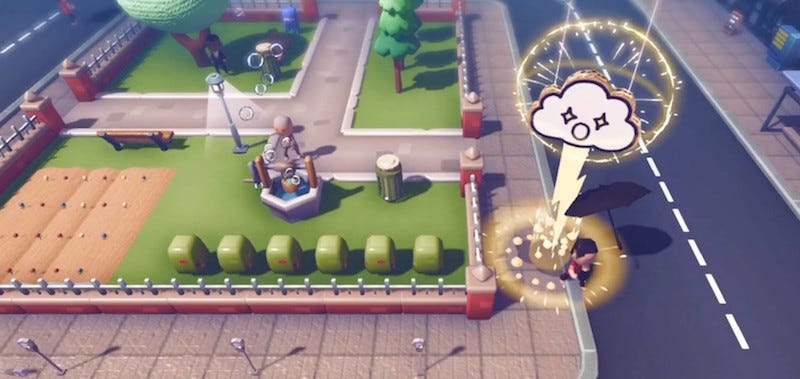
  • Didn’t have time to check out the many, many games featured in the #PitchYaGame Twitter showcase? GamersPack picked out some of their personal highlights, including Rain On Your Parade (pictured), where “you play as a jerk cloud. But…you do a heck of a lot more than to just rain on people’s parades (and weddings). You also dabble in arson, art-theft, and mass extinction.”

  • Paradox’s Jacob Jorstedt posted a FutureGames marketing course lecture that I thought was neat – “Target audience research – Choose your tools wisely, from $0 bootstrapping to multi-million $ research investments.” It features “27 minutes of tools I wished I had access to back when I was starting out in the video games industry.” It preaches the gospel of data-based decision making – which I’m a fan of, duh.

  • Microlinks: you can see the Steam Game Festival Autumn page-in-progress, including already-booked events, EA Play is coming to Xbox Game Pass Ultimate on November 10th; you can now buy Epic Games Store games via the GOG Galaxy meta-storefront.

Finally, here’s an ‘amusing story’ about platform % cuts, which is possibly not that amusing in the end, but hey:

[This newsletter is handcrafted by GameDiscoverCo, a new agency based around one simple issue: how do players find, buy and enjoy your premium PC or console game? We’ll be launching a ‘Plus’ paid newsletter tier with lots of extra info/data – watch out for it soon!]


Related Jobs

Champlain College

Deep Silver Volition

Deep Silver Volition

Deep Silver Volition


<!–

Extra Div –>