Posted on Leave a comment

Review: Space Leagues

Many years ago, there was a bit of a trend for computer game companies to include a novella with their latest big release. Whether the main reason for this was to enrich player immersion or to help justify the ridiculously large boxes popular at the time is a moot point. Space Leagues may not include an actual novella, but it does have a very wordy background story. If you opt for the long version, then you may want to settle back with tea and biscuits. There is a shorter version, or you can just stick with my even more abridged account – Evil is decimating the universe, which leads to surviving galaxies setting up space leagues to ensure the development of superior combat strategies.

Space Leagues is a fantasy sports management game, in which the sport involves bashing the bejesus out of the opposing team. The first team to eliminate all of the opposition players by draining their health bars to zero is declared the winner. If both teams still have active players when time runs out, then the match is declared a draw. There are four leagues, each with ten teams, who, during the course of a season, will play each other twice. The team that finishes top in each of the lower leagues is promoted, whilst the bottom-placed team is relegated.

SpaceLeague2

Each team is made up of a group of oddball characters, from giant tics to steam-powered golems and pretty much everything in-between. There are over 120 unique characters in the game, which are rated in terms of strength, speed, charisma, intellect and toughness. Before each match, you select five players and allocate their roles. Smashers charge recklessly into battle using their brute force to dish out powerful melee attacks. Strikers attack with speed and cunning, freely roaming the battlefield to identify vulnerable targets. Charmers are the equivalent of magic sponge wielding physios, using healing spells to rejuvenate battered teammates. Blasters use their superior intellect to avoid direct combat whilst peppering the arena with fireballs. Finally, thumpers use their massive constitution to absorb damage, protecting weaker members of their team from attack.

Matches are initially very confusing affairs, being closer to a barroom brawl than a sporting event. The unanimated player graphics are very basic with the action being viewed from above. This means that in spite of player names and the use of coloured auras to identify opposing players, the action tends to merge into a confusing mass scrum. Eventually, you will be able to recognise your established players and have a little more idea whether or not you are winning. After a few games, you may even be able to pick up a few tactical hints. You may realise, for instance, that your blaster is getting thwacked early on because you don’t have a good enough thumper to protect her.

SpaceLeague1

After the match, the otherresults in your league will be displayed. You will then be presented with a drama to resolve. It seems that your team is always bitching about something or someone, and your assistant doesn’t help, tossing in his own snarky comments to further fan the flames of unrest. In one situation, a player was complaining about a minor injury, or “boo-boo” as he insisted on calling it. Do I give him a dressing-down for being a wimp? Keep calm and tell them to toughen up? Sympathise and buy them a lollipop? If I’m too harsh his morale might dip, but although a lollipop may cheer him up, there is a big risk that the rest of the team are either going to lose respect for their sucker of a manager or begin queuing to discuss their ailments and favourite sweeties. These situations are full of humour and how you interact with their demands will impact on the individual’s morale and that of the team as a whole. Well this is the theory – no matter how mean I tried to be there did not seem to be a discernible impact upon team performance. Unfortunately, much like Murder She Wrote reruns, you will soon see the same dramas playing out again and again. Even the funniest ones begin to grate when you have to sit through them for the tenth time.

You also have a financial budget, which will provide you with the funds to buy new players and offer established ones new contracts. Your scout does his best to uncover promising stars of the future, although, he is never actually gushing in his praise. You will usually have a choice of three new recruits and only a rough idea of their overall ability. Getting a new player to join isn’t always that simple. You make them an offer and then follow their thought process as they mull over the offer. Some ambitious types will weigh up the chances of actually winning a trophy, others could just be thinking that they are badly in need of a comfort break. This all sounds quite involved until you realise that it is made redundant by a glaring oversight. A squad of just five players never suffer injuries and these players will improve as soon as they start winning games. Have more players in your squad and injuries will occur, causing experience points to be spread among a larger pool of players. So, stick with five established players and apart from renewing contracts, there is nothing else to worry about.

SpaceLeague3

Space Leagues sets the scene well, being full of humour and quirky characters. Together with the Danny Elfman style soundtrack there is definitely a Nightmare Before Christmas influence. The interactions between the players and management are definitely the game’s highlight, but even these become stale after a short time. The biggest problem is that the strategic elements do not have enough depth to maintain interest. The lack of a squad overview screen means that team selection requires way too much flicking back and forth. You cannot scout the opposition, so you end up going into games blind, meaning that nine times out of ten the best strategy is to ditch any ideas of finesse and just stick to a team made up of smashers and strikers. Grind out a couple of seasons in the lower division to improve your players and your team will begin to rise through the leagues with relative ease. Sadly, by this you point, you will probably be ready to move on to something more rewarding.

Posted on Leave a comment

PlayCanvas Engine Adds 2D Support

The PlayCanvas HTML5 game engine just added 2D support in the form of Sprites, texture atlases, animated sprites, sprite components and 9 patch support.

From the PlayCanvas blog:

PlayCanvas is one of the most popular ways to build 3D interactive web content today. But before 3D graphics was a thing, there was 2D graphics!

Today we’re excited to launch the first part of our 2D graphics support. Great for building classic 2D games.

There are 5 great new features which will help you build 2D games using PlayCanvas.

Those new features are:

  • Texture Atlas assets
  • Sprite Asset
  • Sprite Component
  • Sprite Editor
  • 9 Slicing

For more details on the new 2D functionality in the PlayCanvas editor, be sure to check out this hands-on video where we illustrate how to import a texture atlas and use it to create 2D sprite animations:

[embedded content]

If you are interested in learning more about PlayCanvas, be sure to check out our two part tutorial on building a simple bowling title in PlayCanvas available here and here.

GameDev News

Posted on Leave a comment

Rare says streamers were critical to Sea of Thieves’ success

Sea of Thieves broke its three-month sales target in 24 hours with a little help from Game Pass, and a lot of help from streamers. 

In a chat with USGamer, Rare producer Joe Neate explained that while Game Pass (Microsoft’s Netflix-style game subscription service) “was part of the success,” the team owes a huge amount to streamers and streaming platforms like Mixer and Twitch. 

It’s an interesting comment, given the general assumption that Sea of Thieves had hit the ground running thanks to the number of Game Pass subscribers that were granted access to the plundering sim from day one

“I think [Game Pass] was part of the success. We beat all of our sales numbers that we had planned. We had a target to hit by the end of June, which we hit in day one of sales,” said Neate. 

“But the number one thing that contributed to [our] success was streaming and content creators — like above all else. You could see it almost just in terms of when people were streaming, the number of streamers, the number of people viewing and all that stuff correlated to our playerbase.” 

A lack of concrete sales figures means it’s impossible to know just how well Sea of Thieves has been faring in terms of units sold. Still, we do know the game pulled in 2 million players in its first week, and Microsoft claims the title would’ve become its “fastest selling new IP” for the Xbox One even without those Game Pass downloads.

Posted on Leave a comment

Blog: Building the boss fights of X-Morph: Defense – Part 3

The following blog post, unless otherwise noted, was written by a member of Gamasutra’s community.
The thoughts and opinions expressed are those of the writer and not Gamasutra or its parent company.


One of the scenes from the boss’ intro prototype.

As you explore the newest expansion region, you start noticing the slight trembling of everything on the planet’s surface. Ripples on water start emerging. The tremors grow stronger, as cracks start appearing on the nearby windows. Your auditory sensors start picking up a low, steady hum. Hum grows louder and louder as everything starts shaking. Finally, something emerges on the horizon. Something so massive it blocks the last rays of the setting sun. A gigantic bomber, humanity’s ultimate airborne weapon. They mean business this time.

The camera work foreshadows the events that will unfold before the player.

That’s the kind of narrative we wanted to build with the boss fight that’s the topic of today’s article. Welcome back to ‘11 boss fights of X-Morph: Defense’, a series where we share our thoughts and insights about the design of bosses and the problems we encountered while trying to implement those ideas. You can find the previous parts here and here.

The boss would start the fight by collapsing a few bridges and re-arranging the scene.

As you know already, at its core concept X-Morph: Defense was supposed to have a boss fight at the end of each level, thematically connected to the rest of the map. The map in Britain is the first one where we throw airborne units at the player in a significant amount. New types of flying enemies are introduced, including the ones attacking the core directly. It shows the player that flyers serve not only the supporting role but are a real danger. That is why we decided we wanted a massive bomber to be the boss in this scenario. A true flying fortress – resilient, with lots of firepower and quite intimidating. With multiple weapon systems, allowing it to attack both the player’s ship or the base directly, it was sure to be a handful. 

The first time the players are able to see the boss in its entirety.

As far as the visual side goes the creation of this boss was quite straightforward. It was a massive, multi-engine aircraft with clearly distinguishable weapon system located either on or under its wings. In order to intimidate the opponents, the general shape and silhouette of the plane is quite aggressive, with lots of sharp angles and resembling a bird of prey diving straight for the kill. Not entirely in line with aerodynamics, but that was not our main concern here. 

The boss’ wings are equipped with various weapons and multiple engines. It was clearly built for fighting it head-on and required re-design.

Designing the fight itself was the trickiest part. Although the flying colossus was supposed to be powerful, all the attacks had to be entirely preventable by the player, not to make the fight unfair. Thus, we decided the boss will follow a set of predetermined paths and launch one of its attacks while it’s at its farthest from the base, preceded by a subtle dialog cue. While not straightforward at first, we wanted the players to learn the attack patterns and start connecting the dots – getting better at predicting what to do next to prevent core damage effectively. 

Early boss fight design for the Britain level. The paths of boss’ attacks are marked in yellow and orange.


The attacks could be aimed at the core, at the anti-air defenses or the player. Each of those would use a different type of missile. Every weapon system could be disabled by destroying the corresponding part on the aircraft. If slowly crippling your opponents is not your thing you could also go for destroying the pilot’s cabin directly or hinder the bomber’s ability to stay in the air by blowing up the wings and fuel tanks. All of these were equally viable strategies. Also, we made sure that nobody exploited the fact there are no weapons in the back, as the boss could drop airborne mines behind it. 

Every system the plane is equipped with has its own hitbox. The player may destroy them in any order, which will result in a slightly different fight every time.

One last thing – the boss also had a near-death mechanic – a nuclear bomb. Triggering at very low health, the plane would rush the alien base head-on, and if it managed to drop the nuke it was an instant kill. It was meant to create a sense of urgency, but wasn’t deliberately difficult – just enough to boost your adrenaline levels.

The player was initially supposed to fight the bomber head-on, but we made the weapon systems able to target objects behind the plane.

We have said it before and will say it again – the visuals are the easiest part of designing a boss. We had the model ready in no time, and throwing it into the game was no problem at all. We have lost a bit on the ‘epicness’ of the fight due to scale and size constraints. There were no problems regarding scripting the enemy behavior, though, and we managed to achieve all the goals we set for this fight. 

Very early concept of the map. You can notice a lot of differences from the final version in game today.

Upon extensive testing we reached a different conclusion – the boss was a bit too much for this part of the game. Fighting this beast did not warrant the massive barrage of missiles fired upon the player. Although we liked the mechanics, they did not fare well in the tower defense style of gameplay. All the design objectives were set when the game was a pure top-down shooter. That was the real natural habitat for this boss. Meaningfully incorporating the tower building and strategy aspect of our redesigned game was not really possible. 

One of the pages of the intro storyboard. We used these as a reference while preparing the cutscenes.

Since X-Morph: Defense is supposed to cater to the fans of both genres, including such a boss fight in the game would mean that some of the players would be thoroughly disappointed, as the highly tactical level suddenly turns out to be classic bullet hell. Rather than trying to rework it from the ground up we scrapped the boss from the game completely, reusing some of our ideas elsewhere.

All of this was also happening at the time when we were quite fresh with working on boss design. Nowadays, we tend to pair the designer with the programmer, which optimizes the workflow and ensures that we do not design something we actually can’t pull off. Moreover, it was the first time working with lua scripts for some people in the studio. Although we got the boss working it didn’t feel right. The boss fight was boring, exploitable and just not rewarding enough.

The fight was difficult and not satisfying. We backed off at the right moment, and this GIF sums it up perfectly. 

The flying fortress boss was another idea that had to be scrapped completely because what looked great on paper did not translate well into gameplay itself. Not all of the work went to the bin, and we learned a lot, but this was a hard lesson in modesty. We wanted this fight to be epic and exciting, while it turned out to be not so epic and repetitive. Sometimes it’s better to admit to the mistake and delete it rather than to face the players’ disappointment.  

Join us next time, as we unveil the intricacies behind the design and implementation of the boss from the Germany level in X-Morph: Defense – the highway tank, JAGUAR. Until then, follow us on our social media channels for updates and fresh content.

See you next time,

EXOR Studios

www.facebook.com/exorstudios

www.twitter.com/exorstudios

www.discord.gg/exorstudios


Posted on Leave a comment

Review: Bardbarian

This is the story of a brad named Bard who became a … no, sorry, it’s a bard named Bradbarian who … wait, a barbarian named Brad who became a bard. That’s it. He hung up his steel axe for a golden six-stringed axe and has an axe to grind with the monsters trying to destroy his home’s precious Town Crystal, which, as we all know, was the centrepiece of any medieval municipality.

Bardbarian is a really cool mix of tower defense, action RPG, and bullet-hell shooter. Since Brad the Bradbar… Bardbarian has tired of busting skulls over shredding riffs, he doesn’t do any fighting himself, preferring to summon a party from the town to support him. Each party member has a slightly different ability, from pure DPS to area-effect to healing, which makes up the strategy part of the game. More important, though, is the action.

Bard1

All the baddies shoot projectiles, so that’s where the bullet-hell shooter gameplay comes in. You’ve got to dodge the incoming fire, not only to stay alive but also to build up your stun ability that only charges after five untouched kills in a row and is vital to bring down the larger groups later in the game. Overall, the bullets are slower than in your average space-shooter, and they start pretty well spaced. However, in Bardbarian, you also have to drag along your party of warriors and keep them from getting hit too, which can be an impossible task when a half-dozen goblins are shooting death-flowers at you. Weaving your party through incoming fire is a major part of the gameplay, so much so that one upgrade (it’s Body spray, hah!) helps you tighten up the group to make them harder targets. The controls are a solid swipe-anywhere control stick that is precise and easy to use even as the gameplay becomes more frantic. There are also two bonus modes that get rid of any strategy elements whatsoever and go pure arcade.

The game has a great cartoony art style with floating limbs like Rayman that may have been chosen only because they are easier to animate but are still working really well in this game. Enemies and bullets are easy to spot and distinguish, even on tiny devices. The music is good fun too: pounding heavy metal riffs that will pump you up but won’t bother you when they repeat or get stuck in your head later in the day. Each of Brad’s buffs and summons will let loose a squeal of a solo, but even those are varied and fun enough to not be a drag after the hundredth time you hear them. The sense of humor is goofy in that very online sort of way (strips of delicious bacon are your healing pickups, for example) but never obnoxious.

BArd3

You make progress by collecting gold each run through the campaign and upgrading Brad’s abilities, the troops, or the town itself. Some of them make bigger change in the gameplay than others, like the pet that will snag pickups for you. Most of them are just iterative numerical upgrades that make your party faster or stronger, without changing the fundamentals is a big way.

Despite all the loot and upgrades, it’s difficult to feel like you are making real progress in Bardbarian, mostly because the playing field is identical every game. Once you finally do beat a boss and unlock the next chapter, you can feel free to start your new game from the checkpoint. However, you’ll be at a major disadvantage, because your troops will start at their base level (admittedly, this base level can be upgraded) and your stockpile of notes will start at zero too. It’s very difficult to make any more progress from that point, so a better idea is to start your new game all the way over from the beginning. Of course, your higher-level allies and buffs will (albeit slowly) make mincemeat of the initial waves of enemies but putting up with the boredom will net you piles and piles of gold and notes that you can use to push forward once you reach a level that’s challenging. That leaves the game feeling very grindy, because your best strategy is just to take it easy until you can upgrade your stuff enough to survive the higher-level enemies. It’s just a slow race to make your numbers bigger than the bad guys.

Bard4

Whether you enjoy the game will depend on how much the core bullet-dodging gameplay sinks its hooks into you. If you have a blast weaving your party around the slow but soon overwhelming bullets you won’t mind facing the same enemies over and over to make a little progress. If you’re looking for a deeper strategic tower defense or RPG experience, this is not your game. There’s a free-to-play version of the game for Android, so if that’s your platform, you’re lucky to be able to try before you buy. It’s actually too bad that the iOS version is premium only because the real test of a game like this is whether it’s genre-bending scratches your itch or not, because the rest of the design just isn’t that compelling.

Posted on Leave a comment

Daily Deal – Ni no Kuni™ II: Revenant Kingdom, 40% Off

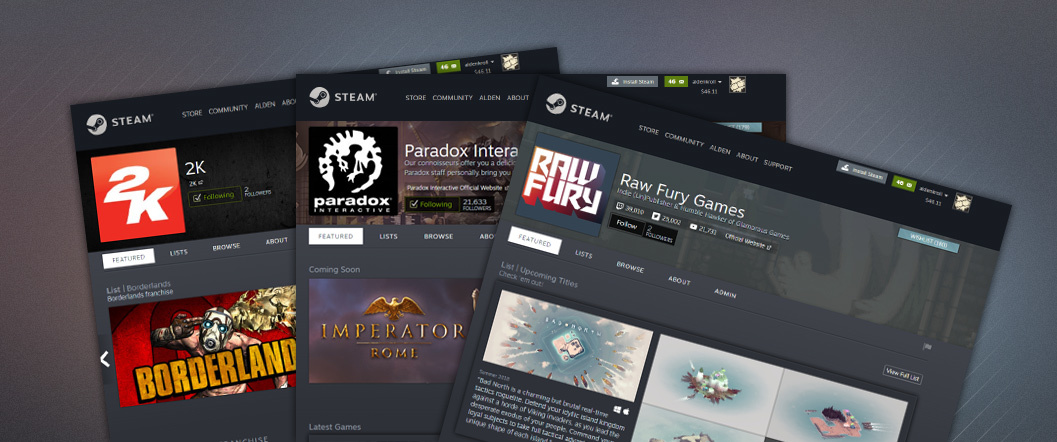
We’ve just launched an open beta for Creator Homepages, a new part of the Steam store designed to help players discover and connect with the developers and publishers behind their favorite games. With this feature, you can explore the full catalog of games created by the developers and publishers of games you enjoy and you can choose to follow those creators to be automatically notified when they release their next title.

How does it work?

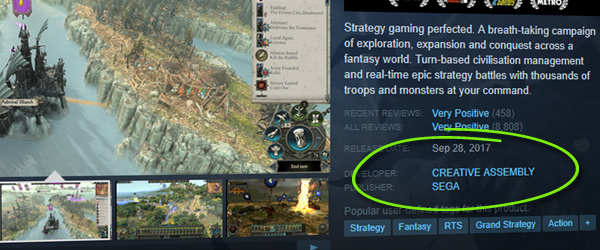
Any developer or publisher on the platform can now set up a customized homepage to showcase their full catalog of titles and content. Once set up, these homepages can be found by clicking on the developer or publisher name from the store page of your favorite games.

Check out the official Creator Homepage Announcement Page, which includes a list of all the homepages so far. This will quickly become an overwhelming and unusable list as more developers create their homepages, so at the top of the page we’ve also specifically highlighted the developers and publishers behind games that you’ve recently played.

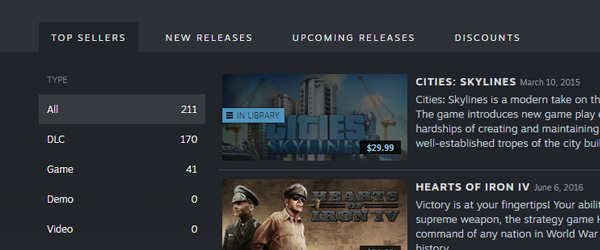
On these homepages, you’ll find standard lists of top-selling or new released titles from that developer or publisher.

You’ll also find collections that the developer or publisher has created to best highlight their portfolio of games and content available on Steam.

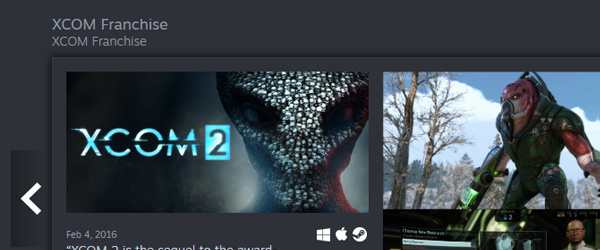
A studio might divide its games into collections by genre or franchise, or could choose to highlight their fan-favorite or top-selling games. A developer of only a single game might primarily dedicate their homepage to announcements of new projects.

Regardless of how each developer or publisher chooses to customize their homepage, you can easily follow them to be notified when they release their next title or post an announcement. Newly released titles from developers or publishers that you follow will show up at the top of your Steam homepage and we’ll send you an e-mail to let you know that they’ve released something new (as with other Steam e-mail notifications, you can opt out at any time by visiting your e-mail preferences page).

Creators can also set up unique URLs within Steam for easy reference to their homepage. You can see an example by following this customized URL for the Valve developer homepage: http://store.steampowered.com/dev/valve

Why Beta?

We’re pretty excited to get the core functionality into the hands of players and give developers the opportunity to set up their presence on Steam. While we haven’t worked out all of the smaller bugs or finished adding every feature we’d like to, we decided that the basic set of functionality is worth putting into the hands of players and creators. We still have a number of features that we are considering adding and there are still a few rough edges that need smoothing out, so opening this system up as a beta to players and developers will help us gather feedback and suggestions that inform the direction of those features.

Over the previous few weeks, we’ve worked with a number of developers and publishers on Steam to get their pages set up and help us work out as many of the bugs as we can. As a player, you’ll find that many of your favorite game makers probably already have a spiffy homepage created and customized. But there are still quite a few developers that have not yet had a chance to set up their pages and will do so during this open beta period.

Looking for more details?

Check out the official Creator Homepage Announcement Page.

For game developers, check out the Creator Homepages Steamworks documentation for more details and information on how the system works, the features that are included, and necessary permissions for game creators.

Reporting bugs and feedback

As always, we’ll keep an eye out for your feedback and suggestions as to what you’d like to see added or changed about this system.

Posted on Leave a comment

Daily Deal – Microsoft Flight Simulator X: Steam Edition, 70% Off

We’ve just launched an open beta for Creator Homepages, a new part of the Steam store designed to help players discover and connect with the developers and publishers behind their favorite games. With this feature, you can explore the full catalog of games created by the developers and publishers of games you enjoy and you can choose to follow those creators to be automatically notified when they release their next title.

How does it work?

Any developer or publisher on the platform can now set up a customized homepage to showcase their full catalog of titles and content. Once set up, these homepages can be found by clicking on the developer or publisher name from the store page of your favorite games.

Check out the official Creator Homepage Announcement Page, which includes a list of all the homepages so far. This will quickly become an overwhelming and unusable list as more developers create their homepages, so at the top of the page we’ve also specifically highlighted the developers and publishers behind games that you’ve recently played.

On these homepages, you’ll find standard lists of top-selling or new released titles from that developer or publisher.

You’ll also find collections that the developer or publisher has created to best highlight their portfolio of games and content available on Steam.

A studio might divide its games into collections by genre or franchise, or could choose to highlight their fan-favorite or top-selling games. A developer of only a single game might primarily dedicate their homepage to announcements of new projects.

Regardless of how each developer or publisher chooses to customize their homepage, you can easily follow them to be notified when they release their next title or post an announcement. Newly released titles from developers or publishers that you follow will show up at the top of your Steam homepage and we’ll send you an e-mail to let you know that they’ve released something new (as with other Steam e-mail notifications, you can opt out at any time by visiting your e-mail preferences page).

Creators can also set up unique URLs within Steam for easy reference to their homepage. You can see an example by following this customized URL for the Valve developer homepage: http://store.steampowered.com/dev/valve

Why Beta?

We’re pretty excited to get the core functionality into the hands of players and give developers the opportunity to set up their presence on Steam. While we haven’t worked out all of the smaller bugs or finished adding every feature we’d like to, we decided that the basic set of functionality is worth putting into the hands of players and creators. We still have a number of features that we are considering adding and there are still a few rough edges that need smoothing out, so opening this system up as a beta to players and developers will help us gather feedback and suggestions that inform the direction of those features.

Over the previous few weeks, we’ve worked with a number of developers and publishers on Steam to get their pages set up and help us work out as many of the bugs as we can. As a player, you’ll find that many of your favorite game makers probably already have a spiffy homepage created and customized. But there are still quite a few developers that have not yet had a chance to set up their pages and will do so during this open beta period.

Looking for more details?

Check out the official Creator Homepage Announcement Page.

For game developers, check out the Creator Homepages Steamworks documentation for more details and information on how the system works, the features that are included, and necessary permissions for game creators.

Reporting bugs and feedback

As always, we’ll keep an eye out for your feedback and suggestions as to what you’d like to see added or changed about this system.

Posted on Leave a comment

Dota 2 Update #2 – June 15th, 2018

Underhollow changes;
* When defeated, heroes now drop the 3 highest net worth items they are carrying. The remaining items are converted and dropped as gold for their sale cost.
* Significantly increased the amount of experience awarded for player eliminations.
* Fixed invisible Roshan killing players.
* Adjusted difficulty of a few combat encounters.
* Added an initial stock time to dynamite of 60s.
* Fixed heart being purchasable via its recipe.
* Added localization.

Posted on Leave a comment

Video: Building the touchy-feely world of Media Molecule’s Tearaway

Touch interfaces are now commonplace in game dev — but is it possible to build a world players actually feel beneath their fingertips?

That’s exactly what Media Molecule tried to do with Tearaway: build a papercraft adventure game that you can hold in your hands, and interact with, in a uniquely tactile way on Playstation Vita.

At GDC 2013, Tearaway creative lead Rex Crowle described the challenges of designing and building a world that can flex, fold, tear and crumple under the fingertips of players. He also explained in detail how the team designed digital tools to allow the game world to be built so realistically that it can be spooled out of any printer and remade in real paper as players progress on that journey.

It was a great talk that’s still worth watching today, so don’t miss your opportunity to do so now that it’s freely available on the official GDC YouTube channel!

In addition to this presentation, the GDC Vault and its accompanying YouTube channel offers numerous other free videos, audio recordings, and slides from many of the recent Game Developers Conference events, and the service offers even more members-only content for GDC Vault subscribers.

Those who purchased All Access passes to recent events like GDC or VRDC already have full access to GDC Vault, and interested parties can apply for the individual subscription via a GDC Vault subscription page. Group subscriptions are also available: game-related schools and development studios who sign up for GDC Vault Studio Subscriptions can receive access for their entire office or company by contacting staff via the GDC Vault group subscription page. Finally, current subscribers with access issues can contact GDC Vault technical support.

Gamasutra and GDC are sibling organizations under parent UBM Americas.

Posted on Leave a comment

Sales from Fallout 76 ‘Country Roads’ cover will be donated to charity

Starting July 4th, Bethesda Softworks will be donating 100 percent of sales made from the song used in Fallout 76’s announcement trailer to Habitat For Humanity. 

The company tweeted out the announcement earlier this week, citing all sales of the cover of John Denver’s “Country Roads” purchased from iTunes will go directly to funding Habitat For Humanity, a non-profit organization which seeks to build affordable housing with the help of volunteers. 

This isn’t the first time a company has donated their proceeds to a charitable cause, as Blizzard partnered with the Breast Cancer Research Foundation just last month to donate funds made from sales of a limited-edition skin to go towards the Breast Cancer Research Foundation.