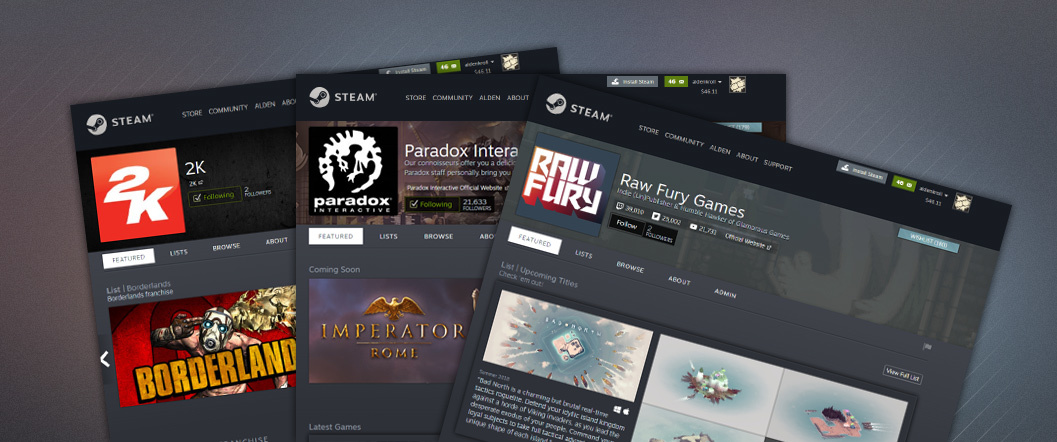
We’ve just launched an open beta for Creator Homepages, a new part of the Steam store designed to help players discover and connect with the developers and publishers behind their favorite games. With this feature, you can explore the full catalog of games created by the developers and publishers of games you enjoy and you can choose to follow those creators to be automatically notified when they release their next title.
How does it work?
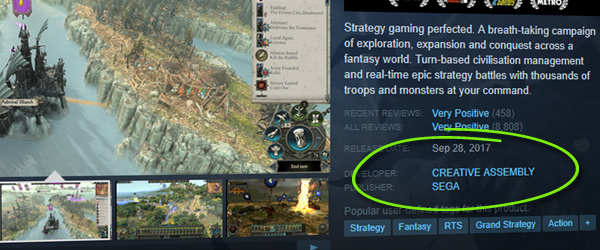
Any developer or publisher on the platform can now set up a customized homepage to showcase their full catalog of titles and content. Once set up, these homepages can be found by clicking on the developer or publisher name from the store page of your favorite games.
Check out the official Creator Homepage Announcement Page, which includes a list of all the homepages so far. This will quickly become an overwhelming and unusable list as more developers create their homepages, so at the top of the page we’ve also specifically highlighted the developers and publishers behind games that you’ve recently played.
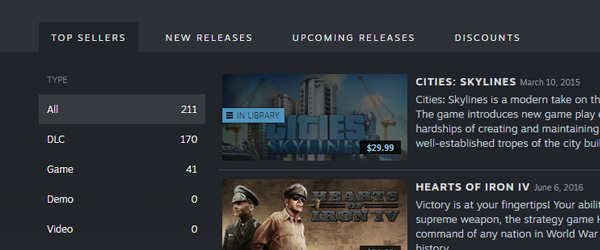
On these homepages, you’ll find standard lists of top-selling or new released titles from that developer or publisher.
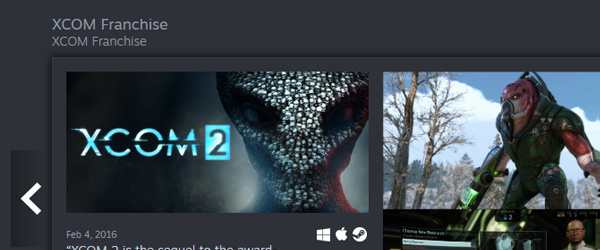
You’ll also find collections that the developer or publisher has created to best highlight their portfolio of games and content available on Steam.
A studio might divide its games into collections by genre or franchise, or could choose to highlight their fan-favorite or top-selling games. A developer of only a single game might primarily dedicate their homepage to announcements of new projects.
Regardless of how each developer or publisher chooses to customize their homepage, you can easily follow them to be notified when they release their next title or post an announcement. Newly released titles from developers or publishers that you follow will show up at the top of your Steam homepage and we’ll send you an e-mail to let you know that they’ve released something new (as with other Steam e-mail notifications, you can opt out at any time by visiting your e-mail preferences page).
Creators can also set up unique URLs within Steam for easy reference to their homepage. You can see an example by following this customized URL for the Valve developer homepage: http://store.steampowered.com/dev/valve
Why Beta?
We’re pretty excited to get the core functionality into the hands of players and give developers the opportunity to set up their presence on Steam. While we haven’t worked out all of the smaller bugs or finished adding every feature we’d like to, we decided that the basic set of functionality is worth putting into the hands of players and creators. We still have a number of features that we are considering adding and there are still a few rough edges that need smoothing out, so opening this system up as a beta to players and developers will help us gather feedback and suggestions that inform the direction of those features.
Over the previous few weeks, we’ve worked with a number of developers and publishers on Steam to get their pages set up and help us work out as many of the bugs as we can. As a player, you’ll find that many of your favorite game makers probably already have a spiffy homepage created and customized. But there are still quite a few developers that have not yet had a chance to set up their pages and will do so during this open beta period.
For game developers, check out the Creator Homepages Steamworks documentation for more details and information on how the system works, the features that are included, and necessary permissions for game creators.
Reporting bugs and feedback
As always, we’ll keep an eye out for your feedback and suggestions as to what you’d like to see added or changed about this system.
The following blog post, unless otherwise noted, was written by a member of Gamasutra’s community. The thoughts and opinions expressed are those of the writer and not Gamasutra or its parent company.
The following is a reproduction, and was originally posted November 2, 2017. The original post, and many others, can be found at RemptonGames.com
A few months ago, I wrote an article about game design lessons I learned from my honeymoon at DisneyWorld. In that article, I looked at some of the ways that design principles from other fields could be applied to game design. In this article, I want to go the other way, and look at how some designers have been trying to apply game design principles to real-life, also known as Gamification.
These days Gamification is practically everywhere, from education to fitness, health to business. Many businesses believe that gamification is a cheap and easy way to change consumer behavior by providing them with points and achievements. However, gamification is not without it’s critics. These critics believe that gamification is misleading, because it takes only the most surface elements of games in order to trick consumers.
In this article, I want to take a close look at gamification. First, I will go more in-depth into exactly what gamification is, and how it is used currently. Next, I will look at why gamification is used, and some of the criticisms of the current system. Finally, I’ll present some of my ideas on how this system could be improved.
Gamify me to the Moon
Pictured: A game, apparently
Lets start with a simple question – what does it mean to “Gamify” something? Games come in a massive variety of shapes and sizes, with almost infinite combinations of different mechanics to choose from. That being said, these days gamification generally refers to one thing – a rewards system. The simplest and most common form of gamification simply boils down to a system of points and achievements that users can gain over time by doing some task. The thought behind this method is that earning points and achievements will give “players” a sense of accomplishment, and make doing the task feel like playing a game.
In many cases, these techniques are actually used with good intentions. For example, for about a year I used an app called “Plant Nanny”, which I used to keep track of how much water I drank. In this app, you would set a daily goal for how much water to drink, and record the amount you drank as you went. As you drank, the app would water a plant in the app, and over time it would grow. When you grew a plant to full size, you would get some seeds which you could use to get and grow new types of plants.
D’aww
For me, Plant Nanny is proof that, when done right, this type of gamification can actually be a good thing. The app was simple, unobtrusive, and yet very effective – I actually did end up drinking more water, and it became a habit that I continue to this day. In certain applications, such as health, exercise, and education, simple gamified programs such as this can be useful tools for promoting positive behavioral change. However, not all gamified programs use it for such noble ends, and most are not so well designed.
Plan Nanny, in my eyes, does a lot of things right. Firstly, there is a very clear connection between what you do in real life and what happens in the game – you drink water, the plant gets water. Secondly, it actually gets you invested in the endeavor – instead of simply watching a progress bar fill up, you are actually watching an adorable plant grow. Over time you become attached to that little plant, and you actually want to take care of it. Finally, unlike many gamification programs there are actually consequences in Plant Nanny – if you don’t keep up with your water goals, the little plant will slowly shrivel and eventually die.
Quick! Somebody drink something!
Unfortunately, most gamified apps and systems are not this well designed. Instead of being a single, well unified system, in many cases the elements of points and achievements is simply pasted on top. However, if you are trying to encourage positive change, badly designed gamification can still be better than none at all. The best uses of gamification are when it is used to give users a little extra motivation to do something that they already want to do, like work out more or learn a new language.
The Name of the Game
Although there are some cases where gamification can be used to improve people’s lives, it is definitely not without it’s criticisms. One of the biggest criticisms of gamification is that it is misnamed, and has almost nothing to do with games. In many cases, the only aspect of games that are actually used is the reward system, which is presented as the entire game experience. While this type of points system may have it’s place, it is not necessarily fitting with the name “gamification”. In this article, author Margaret Robertson suggests the term “pointsification” instead.
The debate about gamification goes much deeper than the name, however. While gamification can give people the motivation to complete tasks they already wanted to do, it can also be a tool that companies use to influence consumer behavior. One example of this is the (now defunct) My Coke Rewards program. This program allowed users to enter codes found on Coca-cola products to earn virtual points, which could then be spent on “prizes” (usually more coke products). This program grew to become the world’s largest corporate rewards program, before it was replaced earlier this year with a new “Sip&Scan” system.
Boy do I love playing games!
The My Coke Rewards system is a great example of how gamification can be used to encourage unhealthy behavior, just as much as it can healthy behavior. Throughout it’s life, My Coke Rewards was criticized by numerous groups, mainly for promoting unhealthy behavior (particularly for children and young adults). Despite this, the system was incredibly popular, and was only replaced due it’s use of outdated technology.
While it’s true that gamification can be used to encourage unhealthy behavior, I don’t think that this necessarily makes it bad. Gamification is simply a tool, and like any tool it is only as good or bad as what you do with it.
Fun fact: Every time you give a player points for social media shares, a baby bunny sheds a single tear
Getting Your Head in the Game
According to Bunchball, the gamification company behind My Coke Rewards and numerous other gamification projects, gamification uses 10 primary “game mechanics”. These include:
Fast Feedback
Transparency
Leveling Up
Onboarding
Competition
Collaboration
Eagle-eyed readers might notice something about this list of “game mechanics”. With the exception of perhaps leveling up and points, none of the things listed are game mechanics. Some of them even have very little to do with games! For example, raise your hand if you consider “Onboarding” to be a game mechanic.
Now put your hands d….oh, nevermind
The biggest problem with gamification as it currently stands is that most often it is put into practice by people who seem to know very little about games (you know, the kind of people who consider one of the ten most important game mechanics to be “badges”). Because of this, as we have shown, gamification has almost nothing to do with actual games. The idea of using aspects of games to motivate people is not a bad one, but it would be a lot more effective if it actually tried to live up to that, instead of simply slapping a point system on top and calling it a day.
In fact, I believe that the system that is most effective at using game elements to motivate a change in behavior was not a “gamified” app at all, but Pokemon Go. While I believe that Pokemon Go has a lot of problems (some of which I wrote about here), one thing cannot be denied – it got a lot of people walking!
Pokemon Go did what no other app has managed to do – it got millions of users to start walking more, and actually made it fun (for a time). The reason for this is simple – it was designed, from the ground up, as a game. Although Pokemon Go resulted in a lot of walking, the walking was not itself the goal. Instead, the walking was a prerequisite to achieving the actual goal – catchin’ ’em all.
Or, more realistically, catchin’ a whole lot of Rattata
That is the big difference between “gamification” and designing a game – in the first one, your goal is to get somebody to do something, while in the latter the goal is to be fun. I think that gamification could be much improved if it started with the goal of making the action as fun as possible, and worked from there. Instead of simply rewarding users for doing what you want them to do, give them something that they actually want – a game.
Let’s suppose, for example, that you own a chain of gyms and want to create an app to encourage players to come in to the gym more often. The end goal is to increase the frequency and amount of time that they spend at your gyms. After establishing this goal, the next step is to figure out a way to make going to your gyms a fun and rewarding activity.
Cause let’s face it – personal health is just not a good enough reason
The activity that you are trying to encourage should correlate with what happens in the game itself. What could we possibly do in-game that correlates with the action of working out at a gym? Well, when you work out you are trying to make yourself stronger and healthier. Therefore, I think a good correlation would be if somehow the act of working out at the gym was able to improve the stats of your character inside the game.
Over time, you could see your character grow and level up as you workout more, gaining new skills and abilities. In addition, the game could be designed that the player can actually go backwards after not going to the gym for a certain amount of time. This mechanic would form the main “hook” of the game.
After deciding on this hook, we have a few questions. Firstly, we know that our character will grow over time as we attend the gym, but how will this actually be implemented? Secondly, what do we actually do with this character?
For the first point we have a couple of different options. One solution that jumps to mind is to tie the rewards to the location either through a GPS system, or through inputting codes that can only be found at the Gym location. This would do the job of encouraging people to go to the gym, but might not necessarily encourage them to workout. In order to get that part, you could have a system in which character upgrades are connected to your actual workout – running boosts your character’s speed and endurance, for example, while bench-pressing can increase strength.
Now that we have figured out how to reward the player, we need to make those rewards a prerequisite to the goal of the game, not the goal itself. Basically, we need to figure out a way to put all of those hard-earned stats to good use! For this, we have lots of options, but one that fits quite well is the RPG. Your character could start out weak, and as you go along the enemies and challenges would get more and more difficult. In order to move forward you would have to improve your character, and that means grinding – not in the game, but at the gym.
I know that my example above is quite rough, but even so I believe that it shows what is possible with gamification. I believe that the system above would be far more effective than simply giving the user points every time they walk into the gym, both for the user and the company.
Until Next Week
That is all I have for this week! I hope you enjoyed this article about gamification! If you did, check out the rest of the blog and subscribe on Facebook, Twitter, or here on WordPress so you will always know when I post a new article. If you didn’t, let me know what I can do better in the comments down below. And join me next week, where I will be talking all about the game design lessons of everyone’s favorite Italian plumber (besides Luigi)!
Valve has restricted both trading and use of the Steam Marketplace for Counter-Strike: Global Offensive and Dota 2 items for players in the Netherlands, explaining that, for the time being, shutting down those features is the only practical way for both games to remain on the right side of Dutch gambling legislation.
The Netherlands Gaming Authority ruled earlier this year that loot boxes that drop items with real-world value violate its Betting and Gaming Act that typically regulates gambling and games of chance. At the time, the NGA noted that 10 games were currently breaking the law due to this, and it seems that two of Valve’s games were among those initial titles.
In a message sent to Dutch Counter-Strike: Global Offensive players and later shared to Reddit, Valve confirmed that it had received two letters from the Dutch Kansspelautoriteit in regards to both CS:GO and Dota 2, each threatening to prosecute if Valve did not bring both games in-line with the Dutch Betting and Gaming Act by June 20.
“The Kansspelautoriteit accusation is different from how other countries think about loot boxes, so we hired Dutch legal counsel, looked at the recent Study into Loot Boxes published by the Kansspelautoriteit, and learned more about Dutch law. We still don’t understand or agree with the Kansspelautoriteit’s legal conclusion, and we’ve responded to explain more about CS:GOand Dota 2.”
Loot boxes as a whole don’t constitute illegal gambling under Dutch law, as long as the gear that results from a loot box purchase isn’t given any real-world value. But when players are able to put specific items gained from loot boxes up on a digital marketplace or trade things from their own inventory for other items, the in-game gear is ascribed real-world value and is no longer deemed legal.
The study published by Dutch legislators, Valve notes, specifically explains that “loot boxes contravene the law if the in-game goods from the loot boxes are transferable,” meaning that the removing the systems that do just that is likely the most practical way to bring both titles inline with the law for the time being.
“We hope that, after more engagement with the Kansspelautoriteit, they may refine their legal demands and we can find a solution that is less inconvenient.“
Onrush, the new title from the racing game veterans at Codemasters, bashed its way onto consoles and PC earlier this month. What at first seems like a high-energy racing game actually turns out to be a kind of automotive team PvP game like Overwatch, where the objective isn’t to win a race, but mix the abilities of different drivers together to win challenges.
Don’t believe us? Curious about why you’d make a game like that when racing fans seem to buy the newest Forza every year? Join us at 3PM EDT as we talk to Codemasters’ Paul Rustchynsky about the design and development of Onrush, and check in to see how the team is doing a few weeks after launch.
As always, we’ll be taking questions live in the chat. And for more developer interviews & editor roundtables, be sure to follow the Gamasutra Twitch channel.
Tropico is a really fun and interesting twist on the typical city builder/management genre. As the head of the Banana Republic/Dictatorship, your job is to exploit your people and your islands’ resources for wealth & power, often with hilarious results.
Depending on which version you played (Tropico 4 was the sweet spot, I feel), you’d also be jostling against the big superpowers of the world, potentially pitting them against each other while trying to avoid losing control through revolution, or invasion.
[embedded content]
Now, thanks to Feral Interactive we’ll be able to sun it up on our iPads. These guys are known for bringing PC games to mobile with quality ports, the most recent of which was Rome: Total War (the iPhone version is still incoming).
Coming “later this year”, Tropico will be releasing for iPad and according to TouchArcade will be a premium game. If you’re interested, this mobile port is actually a heavily modified version of Tropico 3. So while it’ll be missing some of the fun things they introduced in 4, Tropico 3 was still a great game so we’re very excited for this one.
RPGs swallow a player’s preconceptions about how things work and re-forge them into something new. The best ones take this opportunity and seal the deal with unique environments, well-rounded and written-characters, and unusual, original plots. Some of these games are more action-oriented while others are strictly turn-based, but they all have distinct, immersive visions in which the player might find their own ego subsumed, for a time, as deeply as is desired.
I was gobsmacked to find that one of the chief members of this list is no longer with us iOS gamers thanks to the Appocalypse. Harebrained Scheme’s initial offering, Shadowrun Returns, didn’t quite find its footing, but their next standalone adventure saw a vastly improved set of characters, a more intriguing anarchic setting in the flux-state of Berlin, and a more robust and tense battle- and character-progression system. Unfortunately, this better sequel died with the advent of iOS 11, so hold your cherished apps closed, everybody, for the digital is more ephemeral than one would think. Unless you’re an Android user and then everything is fine.
The Shadowrun saga’s unique blend of modern technomancy with high-fantasy magic and races (goblins, elves and dragons, oh my!) could have easily lapsed into farce, but the writing and plotting of Shadowrun made every moment and every meta-human the player meets count. They are all great fun, but it’s a right shame the most focused and shining example is lost to the mists of ages. Cybernetic augmentation, spellcasting, astral projection, drone warfare, synthetic brain chips: the future is here, and it all came true. To say nothing of the grid- and turn-based battles and the character backstories.
Developer: Overhaul Games Platforms: iOS, Android Price: $9.99
Planescape is strange and idiosyncratic, its characters ranging from a chaotic fire-lord whose passion is simple, total consumption and destruction of the world around him to a cherub from the Brothel for Slaking Intellectual Lusts. Its take on a D&D system isn’t particularly balanced, for the stats and character builds favor wisdom above all, both in terms of raw bonus experience and the extra interactions and dialogue options. But the story is to die for.
The multiplanar quest of an immortal, tormented, amnesiac main character to know thyself is at once alien and deeply human. Enjoying this pre-millennium classic before its enhanced edition debut last year meant overlooking a multitude of practical shortcomings; the non-scalable and at times grainy graphics, to say nothing of bugs and lost content. Now one can meet the protagonist and experience his joys and sorrows with ease, if not comfort. The game’s peccadillos are entirely the point, its strange, singular vision undimmed by age.
In a galaxy far, far away, in a distant time immemorial, the Sith and Jedi wore very different masks. To make something as nostalgic and cherished as Star Wars new again, BioWare and LucasArts flung their players millennia into the past and pitted them against Darth Malak in a struggle for the fate of the galaxy.
The characters remain iconic and memorable to this day (HK-47 as a murderous, seemingly punctilious droid, for example), and the now-standard paragon-neutral-renegade trifecta of alignment-based decision rubric for RPGs was a natural fit for the Star Wars mythos. Choose light or dark, good or evil: these archetypes resonate because they work, as does the class- and skill-systems which were tweaked from the paper RPG baseline.
The best introduction to Spiderweb Software’s all-around excellent series. Its interface is functional and natty in its own way, despite the overall retro impressions it might give. Ditto for the game’s deliberative, even stately pacing. The simmering political intrigue is carried throughout the game’s sense of detailed yet colorful writing and excellent rich cast of characters.
The best-laid plots and gameplay are given full space to develop and be grasped piece-wise, increasing the ultimate payoff of each. Its presentation is staid, but its functionality and ease are top-notch. Point in fact: there was a minor controversy upon the game’s release that it was too accessible and intelligently streamlined to offer a meaty experience on a natty platter.
Developer: Almost Human Platform: iOS Price: $4.99
What is Grimrock? Four prisoners marked for death are flung into the heart of an ancient mountain to see trial by the elements. By delving deeper as a party, defeating the enemies and unravelling the riddles, you will overturn your sentence and start afresh. The mysteries of the game’s titular dungeon, whose design indicates was intended a prison for a multitude of strange beings, mount with each level until the mother-horror is finally met on the deepest level. An old-school game with grid-based real-time combat, riddles, puzzles, traps and hand-crafted (read: non-procedural, non-roguelike) levels. Good looking and thoughtfully made, its battle pace and minimal input requirements make it a natural fit for mobile.
Developer: Overhaul Games Platforms: iOS, Android Price: $9.99
D&D spent a long time banished to the corners of a select few lives, shining for hours at a time in small gatherings held regularly among the elect. There have been many implementations of the various settings and rule systems of the original grand-daddy of pen-and-paper RPGs, but Baldur’s Gate is perhaps the most significant and enduring of them all. (Sorry, Temple of Elemental Evil and friends, close but no cigar).
A journey for the ages, with a motley crew visiting each era to repair the mistakes of the past and break other timelines, zig-zagging across character arcs and plot holes with aplomb. The RPG elements are just as great as the story, both of them equally…timeless. And the soundtrack is nuanced and varied, with mysterious, mournful threnodies as well as rousing boss-battle hymns. The game keeps popping up everywhere, and for good reason, for its characters, music and story both exemplify the JRPG genre and somehow transcend it. Chrono Trigger is Chrono Trigger; to play it involves learning about RPG conventions and mechanics but to experience it is so much more, a different creature altogether.
A diabolic, pan-Hellenic action-RPG whose loot system and mythic references have earned its place in the pantheon. See the world, from the Aegean to Bosphorus, to the Nile, slay its beasts of prominence. At the time of its release in 2006, the game seemed redundant and derivative; now it shines in a mobile market where a premium game with fascinating, nay, compelling, rich pool of random loot, none of it locked behind premium currency or lootboxes, is something of a rara avis. Serviceable combat, shiny loot, excellent pacing and nice controls: this is good simple fun.
Fashionable youths spirit themselves away to the Tokyo underground to do battle against the reapers. This is a vibrant panegyric to the intense and at times bizarre whirlwind of city culture and the influence of fresh music and tech on subcultures. It’s not for nothing the game uses pins as equipment, nay, as full-fledged partners in battle. The touch-based battles get frantic at times, and the countdown clock trudges slowly on to the final crisis. Zany and inspired yet ultimately cohesive, The World Ends With You is still a fresh thrill, even this many versions later.
Transistor
Developer: Supergiant Games Platforms: iOS Price: $4.99
The world is falling apart, being destroyed from without while society crumbles and the citizens of Cloudbank panic and retreat from their formerly comfortable lives. Transistor’s pace has only one setting, relentlessly pushing the player to new areas while a narrator overdubs the scenery and battles with evocative, if florid, prose. Transistor’s techno-utopia has clearly gone wrong at some point, and the whole city is flooded with swarms of the Process, a monochrome enemy whose various forms eerily mimic lifeforms.
The modular battle system with its flexible customization options is fun and satisfying, for any program you acquire can be equipped either as a primary (active) ability, a modifier boosting another active, or as a passive. The relative small number of programs means that this mix-and-match is always interesting, never burdensome. The combat itself is real time with the special ability to ‘pause’ the game and plan out actions.
What would your list of the best mobile RPGs look like? Let us know in the comments!
These days it seems most game engines have an integrated marketplace that make it easy for their users to acquire assets such as models, levels and scripts. The Leadwerks game engine just launched a store of their own. The Leadwerks Marketplace launched with over 50GB of assets with categories of Models, Materials, Scripts, Shaders and Sounds. There are a few free assets available, but oddly no ability to sort by price. You can browse the contents of the marketplace using the link above. The Leadwerks Marketplace is intended as a replacement for the Steam Workshop that didn’t work out as hoped.
Easy download of zip files that are ready to use with Leadwerks. You can use File > Import menu item to extract them to the current project, or just unzip them yourself.
All content is curated. Items are checked for compatibility and quality.
Clear technical specifications for every file, so you know exactly what you are getting.
Cheap and reliable storage forever with Amazon S3.
Any DLCs or Workshop Store items you purchased can be downloaded from Leadwerks Marketplace by linking your Steam account to your profile.
Easy publishing of your items with our web-based uploader.
We’re launching with over 50 gigabytes of game assets, and more will be added continuously. To kick off the launch we’re offering some items at major discounts during the Summer Game Tournament.
Be sure to read the blog for a great deal more details as well as information on how to link to your Steam account.
The following blog post, unless otherwise noted, was written by a member of Gamasutra’s community. The thoughts and opinions expressed are those of the writer and not Gamasutra or its parent company.
Tatiana Vilela dos Santos is an indie game designer and digital artist. She makes games with alternative controllers and render interfaces, all part of her interactive multimedia project MechBird. In March 2018, she gave a 60 minutes long talk at the GDC titled Game Design Beyond Screens & Joysticks about tools she uses to analyze and design this specific kind of games. This article discusses details of this talk.
The first reason that led me to design games with alternative interfaces was a will to tap the full potential of my medium. I wanted to embrace the wholeness of this discipline. Control and render devices are often the leftover aspect of video games. But as time goes by, I look at installation-game as a medium in itself: an art form with its own specificities, its own language, its own grammar. So what is it? What makes installation-games so unique?
As we saw in the previous article, this game form can provide unique experiences. These experiences are characterized by a greater sense of presence and awareness of one’s surrounding environment. This increased sensitivity allows to touch the players deeply and profoundly change their state of mind. It’s all about creating a special moment. But any art form is about creating a moment. So how do installation-games allow designers to master time and space in a unique way? Let’s start with space.
Designing a game field
One of the obvious special feature of installation-games is the way physical space is part of the game experience. In the third article, we saw that physical interfaces can constraint body movements. But the whole spatial environment is also shaping player’s moves. This can be done with tangible obstacles: walls, hurdles, pits… But the simple marking of space induces behaviors. In 寝ゲーム, the wrestling game mentioned in the previous article, players implicitly agree that the end of the projection is the border of the game space even though the mats extend far beyond the lighted area for safety reasons. The lighted area is the one of action as opposed to dark spaces meant for passive contemplation. This is an obvious yet tacit rule noticeable in performance halls and other venues. Space embodies the rules. These rules embodiments can be clearly stated but it’s not even necessary. Draw a line on the floor and it’ll become a border. Draw concentric circles on a wall and it’ll become a target. The design of physical games is a matter of space division: borders, paths, gates, goals… Just think about what rules are embodied by the lines of a tennis court or a baseball field. Horizontal space divisions embody circulation rules like race tracks. Vertical space divisions embody upward & downward movements like volleyball nets. Shapes embody game goals like the size of a basketball ball fitting perfectly the one of the basket. Materials embody restrictions like the bouncing ropes of a ring perpetually bringing you back in the middle. Nothing’s insignificant.
Every social space provides interesting examples of behavioral rules induced by spatial environments: prisons, hospitals, venues, museums, public transports, cities… But most of the time, these rules are merely operational. Sports give great insights about space constraints providing friction rather than smoothness. A soccer goal is not designed so a player can easily put the ball in the net. Just like standard gamepads aim for the most comfortable usability while alternative controllers can provide friction to create a tangible interface based gameplay, game field can provide friction necessary to the emergence of a performance. Because circulation is not easy in these spaces, players need to be skilled and creative to overcome their obstacles, like Dick Fosbury did with his famous Fosbury flop. One of the reason that led me to design installation-games is the pleasure I take in creating physical spaces. I love to rule the place like an architect, so players become performers.
[embedded content]
Designing a social environment
In installation-games, the environment is not only ruling how players can move but also how they can interact with each other. On the playground, the social rules are those of the game. Tackle someone on a football field and no one bats an eye. Tackle someone in the middle of the street and everyone loses their mind. Designing physical multiplayer game is designing a social space. A prime example of this is Adsono, the cooperative game where players have buttons strapped to their body. By turning the players’ body into the playground the game doesn’t only allow players to touch each other, it’s required to progress. This special social space is not only triggering playfulness because the context is fun and festive making it permissive, it’s prescriptive. Adsono is a social environment where touching each other is necessary. But this environment is not fully independent. It overlaps the basic social rules of the place and the relationship of the players. As I said in the previous article, the difference between Adsono’s players in galleries and in clubs is striking. In clubs, not only people are uninhibited by alcohol and other substances but they came to dance, so they’re not afraid of to make a spectacle of themselves. There, I often witness flirting couples using the game to get closer. In festivals, I often witness people from the same family playing. They tends to play with a distance by making mechanical and planned moves to defuse the sexual tension and so the social discomfort triggered by the game.
These playful social spaces are not only ruled by the game prescriptions. What happens before and after the game, the rituals, also have an important impact on the players’ state of mind. I call these two moments the hypnagogia and the hypnopomp: the moment you fall asleep, slip into the dream, and the moment you emerge from it. The hypnagogia is particularly important to trigger playfulness as it’s the moment players enter the magic circle, the game world. Well designed hypnagogia will help the players slip into a lusory attitude, a playful state of mind. It’ll let them know they obviously crossed the border and can now play by the game rules. Just like great foreplay allows someone to slowly indulge in kinky behaviors, a poor one will leave ambiguity and potentially triggers social discomfort. Martial Arts provide great insights on how to master these moments: wearing a gi, tying a belt, bowing when you get on and leave the mat… all these aspects contribute to the change of state of mind necessary to let the players know they’re not in their usual social space. One of the reason that led me to design installation-games is the pleasure I take in creating social spaces. I love to rule the moment like a DJ, so players can shed their everyday skin.
[embedded content]
Designing a playfulness trigger
But I don’t design installation-games only to master time and space and fulfill my demiurge complex. And changing players’ state of mind is not confined to sports and multiplayer games. I’d like to finish this series of posts by the story behind the design of one of my latest installation: Contre-ciel. Each year in Paris, an event called Play Me I’m Yours is organized by the city. Pianos are put in different public places and anyone can come and play. But amateur musicians are inhibited by their lack of technical skills and don’t dare play in public. Based on this observation, I designed Contre-ciel: a light and sound installation, composed of an interactive projected sky hanging from the ceiling. The sky reacts to the music played on a piano made available to bystanders. What’s played on the keyboard changes the weather, the time of the day and the planet from which the sky is looked at, according to different hidden parameters that the player has to discover. As it’s more uncommon for a keyboard to change a sky than produce sound and as we usually pay more attention to visual stimuli than sound ones, players and spectators of Contre-ciel are focused on the projection. So the musical performance becomes a consequence of the game on the sky. The performance shifts from the soundscape to the visual space. By turning the musical performance into a game players get uninhibited and dares explore the sky possibilities and, indirectly, the musical ones because it’s happening in the magic circle.
Contre-ciel is designed as a Rosetta stone that the player is invited to understand by exploration. Players have to communicate with this artificial sky to understand the grammar and vocabulary of this new language. They have to connect the pieces themselves and infer the relationship between the keyboard and the sky. Contre-ciel shares common points with GPU, mentioned in the third article and other games I made like (in)tact. I love to design this kind of Rosetta stone games because they require the player to speculate based on their personal life experiences. Players see patterns based on their knowledge. For example, while musicians tend to quickly look for musical relationship: scales, chords, tones… engineers tend to make hypothesis based on the communication protocol used : if that’s MIDI, then velocity could have an impact on the sky, if it’s an audio signal then frequency and decibels could be involved, etc. One of the reason that led me to design installation-games is the pleasure I take in creating both permissive and reflective spaces. I love to provide moments for the players to be daring and playful but also introspective and thoughtful.
[embedded content]
Final point
Designing digital games integrated to the physical world is a field of creation offering unique possibilities. It doesn’t just allow designers to experiment with funny weird interfaces during a weekend-long game jam. We can go beyond making installation-games and alternative controllers for the sake of it. Beyond screens and joysticks, physical interfaces allow designers to offer unique human experiences. Personally, in a world where communication technologies are isolating us more than getting us closer, I want to design experiences that make us share, even for a brief moment, a true unique human bond.
Take-Two CEO Strauss Zelnick has scoffed at the notion that single-player titles are dead in the water.
In a recent interview with VentureBeat, the chief exec was quizzed about the state of Red Dead Redemption 2 (Take-Two being the publisher behind Rockstar’s open-world western), and was asked what he makes of the perceived shift away from story-driven, single-player efforts.
His response was decidedly candid, and while Zelnick admitted there are some who believe multiplayer, free-to-play titles are the only sensible way forward, he claims they are very, very wrong.
“There are people [today] saying that a game won’t work if it’s not a free-to-play battle royale. People really are saying that, and not even tongue-in-cheek. I don’t buy that,” explained Zelnick.
“Single-player, in my opinion, is not dead, not even close. Companies that feel like they’ll just avoid the hard work of building a story and characters and go right to where the money is in multiplayer, I don’t think that’s going to work. I’d be surprised.”
Although Take-Two and Rockstar have experienced long-term success with Grant Theft Auto Online, the online multiplayer portion of Grand Theft Auto V, Zelnick says there’s “no evidence” to suggest people don’t want a single-player experience.
In fact, he agrees with the assertion that players only became so invested in GTA Online after buying into the single-player offering, and believes those narrative-driven, lone wolf experiences aren’t going anywhere.




 Sounds. There are a few free assets available, but oddly no ability to sort by price. You can browse the contents of the marketplace using the link above. The Leadwerks Marketplace is intended as a replacement for the Steam Workshop that didn’t work out as hoped.