Posted on Leave a comment

Get a job: Join Airship Syndicate as a Junior to Mid Programmer

The Gamasutra Job Board is the most diverse, active and established board of its kind for the video game industry!

Here is just one of the many, many positions being advertised right now.

Location: Austin, Texas

We’re currently working on an unannounced PC/console title featuring a new and original IP, and need a gameplay programmer to help bring it to life.

If you’ve got the experience and enjoy working with a focused group of talented and passionate game devs, then we’re the place for you.

RESPONSIBILITIES:

  • Gather requirements based on stakeholder input
  • Provide reasonable time estimates, and communicate when adjustments are needed
  • Collaborate iteratively with designers, artists and other team members to deliver polished gameplay
  • Create internal tools as needed to improve and support workflow
  • Deliver clean, efficient and well-documented code
  • Fearlessly and relentlessly debug difficult problems

REQUIREMENTS:

  • Solid knowledge and experience using C++
  • Motivated self-starter; complete tasks without intense supervision
  • Good oral and written communication skills
  • Proof of eligibility to work in the United States

PLUSES:

  • Experience working with Unreal 4
  • Experience working on a live-service game
  • Experience on at least one commercial game title
  • Multiplayer programming experience in Unreal 4
  • Latest generation console development experience
  • Recent time travel

SKILLS:

  • Travel
  • Written Communication
  • Estimates
  • Game Development
  • Console
  • C++
  • Gameplay
  • Time Travel
  • Programming
  • No Unreal Engine 4

SOME OF THE BENEFITS WE OFFER:

  • Full health benefits including medical, dental and vision
  • Profit sharing
  • Generous PTO
  • Relocation packages 

PLUS…

  • Office movie lunches
  • Snacks on snacks on snacks
  • Ping Pong with a leaderboard
  • One sick mame cabinet

Please note, due to a high volume of applicants we cannot reply to each individually. Only those in consideration for a position will receive a reply. Thank you!

Interested? Apply now.

Whether you’re just starting out, looking for something new, or just seeing what’s out there, the Gamasutra Job Board is the place where game developers move ahead in their careers.

Gamasutra’s Job Board is the most diverse, most active, and most established board of its kind in the video game industry, serving companies of all sizes, from indie to triple-A.

Looking for a new job? Get started here. Are you a recruiter looking for talent? Post jobs here.

Posted on Leave a comment

FamiStudio–NES Style Music Editor

Today we are checking out FamiStudio, a lighter weight alternative to programs like FamiTracker, that make it easy to create 8bit style musical scores.  Features of FamiStudio include:

  • Modern DAW-style UI with sequencer and piano roll, no hexadecimal anywhere
  • Instrument & Envelope edition
  • NSF import
  • Full Undo/Redo support
  • Copy & Paste support
  • Note drag & drop with audio preview
  • Import from FamiTracker FTM & Text (official 0.4.6)
  • Export to various formats (WAV, ROM, NSF, FamiTone2, FamiStudio Text, FamiTracker Text)
  • Volume, fine pitch, vibrato effect tracks
  • Slide notes (portamento)
  • Basic MIDI input support
  • Audio expansions supported: VRC6, VRC7, FDS, MMC5, Namco 163 & Sunsoft S5B.
  • Low CPU usage (Direct2D for graphics, XAudio2 for audio)

FamiStudio is open source under the MIT source license, with the C# based code available on GitHub.  You can learn more about FamiStudio in the video below.

[embedded content]

GameDev News General


<!–

–>

Posted on Leave a comment

Get a job: Join the Mountaintop Studios team as a remote Graphics Engineer

The Gamasutra Job Board is the most diverse, active and established board of its kind for the video game industry!

Here is just one of the many, many positions being advertised right now.

Location: Remote

Mountaintop is a new game studio creating multiplayer games for teams that crave a challenge. We’re an independent, remote-first studio primarily located in the US.

We’re creating the types of games that bring people together — and keep them together for “just one more round.” The types of games that inspired us as kids. The games that become our hobbies, and sometimes our obsessions.

Games are a reflection of the teams that make them. So to make the best games, we’re building a studio that puts the team first — one that’s collaborative, anti-crunch, diverse, and inclusive.

We’d love for you to join us.

THE ROLE

We’re looking for a Graphics Engineer who’s passionate about building extraordinary new experiences that inspire others. You’ll play a crucial role in bringing our first title to life.

YOU’LL BE RESPONSIBLE FOR

  • Developing, refining, and owning visual features and optimizations that deliver amazing player experiences
  • Collaborating with design and art to achieve a shared vision within performance constraints
  • Implementing custom shaders for in-game special effects
  • Contributing to concept, direction, and gameplay for all Mountaintop projects
  • Establishing engineering best practices that ensure high-quality results
  • Creating a team culture that prides itself on excellence, innovation, trust, and respect

ABOUT YOU

  • A love for playing and making amazing games
  • A passion for graphics programming
  • Fluent in C / C++ and HLSL
  • A minimum of 4 years programming experience, including at least one shipped PC or console title
  • Experience with cross-platform development
  • Experience with GPU and CPU profiling tools
  • Self-motivated and eager to contribute to many different areas of development
  • Excellent verbal and written communication skills

PLUSES

  • Experience working with Unreal Engine 4
  • Computer science, engineering, mathematics, or related degree

BENEFITS

  • Medical, dental, vision, and life insurance
  • 401k plan
  • Flexible Spending Account (FSA)
  • Unlimited PTO and sick leave
  • Remote-work friendly
  • Commuter Pass

Interested? Apply now.

Whether you’re just starting out, looking for something new, or just seeing what’s out there, the Gamasutra Job Board is the place where game developers move ahead in their careers.

Gamasutra’s Job Board is the most diverse, most active, and most established board of its kind in the video game industry, serving companies of all sizes, from indie to triple-A.

Looking for a new job? Get started here. Are you a recruiter looking for talent? Post jobs here.

Posted on Leave a comment

Don’t Miss: Inside Steam Diving Bell, a tool for ‘wikipedia binging’ Steam games

The following blog post, unless otherwise noted, was written by a member of Gamasutra’s community.
The thoughts and opinions expressed are those of the writer and not Gamasutra or its parent company.


So, two things:

  1. Last week, Valve announced Steam Labs, a new initiative where Valve pulls back the curtain on various projects they’re working on internally but that aren’t quite ready to be rolled out publicly just yet.

  2. Given the timing, I decided to go ahead and release a janky half-finished prototype of a little weekend project I had cooked up called Steam Diving Bell. You can play with it here. Just please don’t hug my server to death.

2019-07-14-14_26_50-Window-4

So now that my little project is out there, I’d like to talk a bit about it and Steam Labs in general.

Diving Bell is an experiment meant to address discoverability on Steam. It serves a similar purpose to Steam Labs’ Interactive Recommender, which is a really neat machine-learning based recommendation engine you can read all about here. I’ve tried it myself, and it really works — it’s an incredibly neat piece of tech.

So what the heck is Diving Bell, who is it for, and how is it different — why would anyone want to use it if we already have the fancy interactive recommender?

All great questions.

What is it?

It’s a (prototype) web app for quickly discovering interesting games on Steam.

Who is it for?

Anyone who wants better discovery for games on Steam. This means players (who want to find games), but also developers (who want their games to be found). But let’s not forget that curators need good tools, too. Human-powerd curation stands to benefit from better tools that make it easy to quickly find the games you want to showcase and talk about.

How is it different?

Diving Bell and the Interactive Recommender take entirely opposite approaches:

  • Interactive Recommender uses your play history to get to know you, and uses smart algorithms to serve up games it thinks you will like. You specify a few parameters, and it shows you a list of recommendations. Interactive Recommender is like a sommelier that uses their expertise to suggest a wine that pairs well with the courses you’ve already chosen.

  • Diving Bell has no clue who you are or what you like, and uses dumb algorithms to serve up games similar to a title you specify. From there you can browse around in any direction you want. Diving Bell, like its namesake, is a vessel that lets you safely descend into the murky depths to catch glimpses of weird and interesting fishes games.

The aesthetic I’m going for is “wikipedia binge.” You start with some topic, then you click on links within that topic that seem interesting, and before you know it you find yourself following some totally weird but fascinating bunny trail you never expected you’d go down.

Let’s start with a guided tour. You can tell Diving Bell to start with a specific game by adding “?appid=XYZ” at the end of the URL (sans quotes), where XYZ is a specific game’s Steam application id. Let’s start this plunge with Chrono Trigger:

(There’ll be a brief pause at the beginning while it bootstraps and then all subsequent loads should be faster).

2019-07-14-14_26_50-Window

Chrono Trigger is our selected game. Diving Bell serves up 8 games that it thinks are similar. There’s an information panel (cropped from the screenshot for space purposes) that tells us more about the game, and includes screenshots, trailer, etc, and then there’s some navigation on the bottom of the main panel: “Back”, “More”, and some mysterious blue buttons.

Clicking “More” will serve up another 8 recommendations, while keeping Chrono Trigger centered. At that point clicking “Back” will take us back a step and show us the previous recommendations. As for the blue buttons, these represent recommendation engines and can be individually toggled on and off. Right now all four are selected, and each corresponds to two of the currently visible recommendation results. I’ll explain each of the recommendation engines with illustrations below. First, let’s turn all four of them off:

2019-07-14-14_31_49-Window

These are “Default matches”, and they should feel familiar if you’ve visted Chrono Trigger’s Steam page, because I got them by scraping Steam’s “More Like This” section.

For every game on Steam, there is a “More Like This” page, and it has exactly 12 games. The explanation Steam offers for how it makes these matches is:

“The tags customers have most frequently applied to CHRONO TRIGGER® have also been applied to these products”

…but I just treat it as a black box. The matches are solid, but tend to be familiar games that are already popular.

The first iteration of Diving Bell used nothing but “More Like This” matches for each game, because the first issue I was attacking was a UX problem: Let’s say you want to browse more games like Chrono Trigger, then browse more games like those games, then visit one of those games’ store page.

Here’s how you do that currently:

  1. Visit Chrono Trigger’s Steam Page.
  2. Scroll down way below the fold to “More Like This” and click a tiny button that says “See All”
  3. The page reloads.
  4. Find a game you seem interested in (Grandia II?) and click it.
  5. The page reloads.
  6. Scroll all the way down to “More Like This” and click “See All”
  7. The page reloads.
  8. Find a game you seem interested in (The Legend of Heroes: Trails in the Sky?) and click it.
  9. The page reloads.

That’s 4 clicks, 4 full page reloads, and 2 scrolls (4 scrolls if you click a recommendation in the bottom row on the “More Like This” page). In Diving Bell, this same journey takes 2 clicks, zero page reloads, and zero scrolls. Granted, my prototype web app is a total potato and the async requests take longer than I’d like to fill in, but with a real database and some optimization there’s no reason those couldn’t be nearly instant.

Just by changing the UX I think we’ve already improved on the browsing experience of finding more games like Chrono Trigger. But there’s a problem: the default “More Like This” recommendations are a bit too good.

“Too good?” What? How could that be a problem?

Obviously I’m using “good” a bit facetiously, what I really mean is they’re too on-the-nose for the browsing experience I have in mind.

Take a look at Chrono Trigger’s 12 default recommendations:

2019-07-14-14_50_05-Window

Now compare those to Grandia II’s:

2019-07-14-14_48_01-Window

There’s a ton of overlap, which means even with the improved UX you’ll constantly loop back onto things you’ve already seen, and never get too far from the original game’s center of gravity. Maybe that’s what some people want (and it should certainly be an option) but a discovery tool meant for general use can do better.

Maybe we can cull results we’ve already seen? That could work, but we still only have 12 recommendations for each game, and with this much overlap we’ll hit dead ends in no time. We need a way to expand the pool.

Here’s an idea — we have this cool network of game connections from these “More Like This” pages, but what if we reverse the direction of the matches?

2019-07-15-11_05_24-Steam-Diving-Bell

We’ve already established that every game on Steam points to 12 other games in its “More Like This” section. But what if instead of looking for the 12 games pointed to by Chrono Trigger, we crawl every single game on Steam and see how many games themselves point to Chrono Trigger as one of their 12 games? Let’s call that a “reverse match.”

Now instead of 12 games, we have hundreds or more. Now we have to sort them so we can decide which 8 to show first. I went with a tag similarity heuristic which I’ll describe later, but all the results are viewable — the user can click “more” to see the next 8 until all the reverse matches are exhausted.

Whereas default matches favor genre kings, reverse matches favor niche games. That’s because every game in a genre tends to point to the genre kings, but the genre kings don’t point back to the niche games. This recommender flips that dynamic.

We see Grandia II and The Legend of Heroes: Trails in the Sky (themselves somewhat niche cult classic when compared to Chrono Trigger), but we also seem some great well regarded indie titles like Cthulhu Saves the World, Cosmic Star Heroine, and Epic Battle Fantasy 4. This gives us a much broader network to crawl — wikipedia binge here we come! Let’s click on “Cosmic Star Heroine” and see where that tackes up.

2019-07-15-11_19_42-Steam-Diving-Bell

Hmm, here’s a problem. Cosmic Star Heroine, despite being a great game with a lot of similarities to Chrono Trigger, only has seven reverse matches. This is because most similar games have already spent their 12 slots on genre kings. Diving Bell will fill in the gaps with Default recommendations, but we still need more fodder for general browsing.

This is where LOOSE matches come in.

2019-07-15-11_25_35-Steam-Diving-Bell

Loose matches crawl the “more like this” graph for the selected game twice. We get the 12 default matches, and then we grab each of those games’ 12 recommendations for a final list of 144 matches. Then we exclude the original default 12 matches from the results as well as any duplicates. This gives us a list of games that are still pretty similar to the selected game, while adding just enough noise to juice the variety a bit.

Loose seems more middle-of-the-road than Default and Reverse: it gets a good number of matches, but it doesn’t exclusively favor big games, nor does it dig too deep to shine light on niche ones.

The amount of games it returns varies too. For indie titles, it returns a lot —
we’ll have more than enough titles here for Cosmic Star Heroine. But let’s go back to Chrono Trigger for a second:

2019-07-15-11_28_17-Steam-Diving-Bell

This is really interesting. Chrono Trigger is only able to give us six unique loose matches! Now there’s a good chance this is just a stupid bug, but I also suspect this is at least in part because of how self-referential the “more like this” network is for genre kings. The 12 default matches reference each other to such a strong degree that even after you generate a pool of 144 second-degree matches, you only have 6 unique matches once you’ve excluded the default 12 and any duplicates. And even if these particular results are just down to a bug, we know from before that there’s tons of overlap in big games’ loose matches, and therefore less results over all.

This underscores the need for a variety of recommender engines. Each one so far has a different natural strength:

  • Default: small number of matches no matter what, favors genre kings
  • Reverse: big game = many matches, niche game = few matches, favors niche
  • Loose: big game = few matches, niche game = many matches, neutral(ish)

These three recommendation engines alone probably provide enough variety, texture, and depth to the network to give us that wikipedia binge feel we’re after. But we’re not done yet! There’s room for more.

At this point we’re leaving the “More Like This” results entirely behind and will generate new recommendation systems from scratch.

2019-07-15-11_41_31-Steam-Diving-Bell

This returns 8 games that Diving Bell considers to be similar to the selected title based entirely on their tags. This tends to favor niche games over popular and well rated ones because the only thing it looks at is the tags.

Warning: because this ugly prototype is done entirely with flat CSV files and client side javascript instead of nice server side code and a real database, the tag recommender in particular is pretty laggy. There’s no reason a final version couldn’t be super fast, so don’t judge it too harshly.

Some context: every game on Steam has a series of tags that describe different aspects of a game. There’s some tags for genre like “RPG” and “Action” and “Platformer”, some things that seem to describe visuals like “2D”, “Pixel Graphics”, and even “Beautiful”, as well as random nouns and adjectives like “Werewolves” and “Psychedelic.” You can see a complete list here.

Tags are a pretty messy system and the first iteration of my tag-based recommendation engine returned awful results. After a few tweaks, I settled on a decent approach and made it completely transparent to the user. Just hover over any game matched by tags and you’ll see a breakdown of how it calculates the score.

2019-07-15-11_50_08-Steam-Diving-Bell

What I did here was to take all the Steam tags and group them into various categories (RPG and Adventure go under “Genre”, Sci-fi and Retro go under “Theme”, JRPG under “Subgenre” and so forth). Then when matching games I go through each category and count how many tags the second game has in common with the first in that category. Then I multiply that number by a list of weights — for instance, I consider a subgenre match more important than a genre match, and the viewpoint and visual categories more important than the “misc” category. Then I add up all those scores and divide by a theoretical perfect score (where every category matches perfectly) to get a percentage.

This classification scheme is completely arbitrary and reflects my own subjective biases about what matters, but it seems to do the trick. I suspect that the mere act of breaking things down and applying some weights is more important than the exact set of categories and weights you choose — just anything to get you away from comparing two naked lists of tags in a naive way.

This recommender can be hit and miss, dependent as it is on the notoriously mixed quality of the tags placed on any given game. But this recommender is still capable of producing some really solid matches:

2019-07-15-14_01_39-Window

I’m torn on whether to actually display the X% match scores on tag results (or just use them internally for ranking), but I think it needs to stay in some form because this matching mode returns a lot of results. It starts by taking a subset of games that have at least one matching tag in a major category and then ranks them all. This can potentially return hundreds or even thousands of results, and after several pages in you’re going to get some really weird stuff that’s not similar at all. I could just hard cull results below some score threshold, but I prefer to let the user keep exploring and just give them accurate information about how sloppy the current results are. One thing I think I’ll change based on feedback is the exact number % I display. Although 68% is a pretty good match score, school has trained us to read this as a “failing” grade, so I might artificially inflate all the scores to compensate.

In summary — tags don’t care about bigness or popularity, they only care about similarity (as defined by tags). Not all games are well-tagged, and the matches can be noisy. But Diving Bell thrives on noisy results, so this is fine!

But there’s still room for at least one more recommendation engine.

2019-07-15-12_02_49-Steam-Diving-Bell

This is my favorite recommendation engine. You might have seen Steam250.com’s list of Hidden Gems, or read my article from five years ago proposing such a system. In either case, the idea’s the same — you find games that a) have a low # of total user reviews and b) have a very high user rating. Then, you rank them by a sensible algorithm, adding a penalty to anything with too many user reviews total. What you’re left with is a list of extremely well regarded games that haven’t gotten much attention — ie, “hidden gems.”

Diving Bell’s “Hidden Gem” recommender is derived from the tag recommender, but instead of starting with a pool of games that is basically everything on Steam, I tell it to only consider the top slice of a “hidden gems list.” Then I rank the results by their tag similarity to the selected game.

The results are the least on-the-nose matches of the four recommenders, but often the most surprising and delightful. They’re at least vaguely similar to the selected game, usually in the same or adjacent genre, and guaranteed to be well regarded titles most people haven’t heard of yet. If you like playing cool obscure stuff that hasn’t gone big yet, this is the tool for you.

Because this is a derivative of the tag recommender, it shows the same tooltip and score %, which I think is probably the wrong decision. I think it’s okay to show the breakdown, but hidden gems by their very nature are going to get lower tag % scores than pure tag matches. I’ll probably either remove the % score heading for gems entirely (but keep the tooltip breakdown), or else give hidden gems a bump in their score based on their hidden gem ranking, so they can compete on the same level as tag-based matches. I dunno, we’ll see.

Okay, turning all four recommenders back on, this is what we see:

2019-07-15-12_11_50-Steam-Diving-Bell

The reverse matches and loose matches give us a mix of niche and well known RPGs, and all Japanese to boot — just like Chrono Trigger. The tag and gem matches give us a mix of Japanese, American, and European indie titles. Clicking more will let us dive deeper into results from our current position, and clicking any specific game will let us branch out in a new direction. Whether we explore broadly by clicking a new game and going off on a bunny trail, or deeply by clicking “more” to page through the current matches, we’re sure to find something interesting.

Okay, our crappy prototype is done! Now, let’s consider whether it can be gamed, and evaluate its strengths and weaknesses in comparison to the Interactive Recommender.

Can it be gamed?

Possibly. The developer has no direct control over their “more like this” matches, but they do have control over the initial set of tags they put on their game at launch, which directly affects the “Tags” recommender results and indirectly derives “more like this” matches which drive Default, Loose, and Reverse matches. It’s possible to pick out some specific super popular game and then give your game the exact same set of tags, so that it shows up as a 100% match. The risk is that if the chosen tags aren’t accurate, players who feel misled could refund the game and leave negative reviews. Also, once a game has been out for a while, players will apply their own tags that eventually outweigh the developers’.

If this becomes a problem where everyone pretends to have tags exactly matching Dark Souls, destroying the usefulness of the “Tags” recommender, I’ll probably have to add some other heuristic to how I rank tag matches, either throwing in some randomness, or applying a small penalty to games that are on-the-nose matches but have only developer-set tags, similar to how SteamDB applies uncertainty to user rating rankings. Or I could factor in user ratings a bit. But that’s another can of worms.

Another way bad actors can try to game the system is by forging user reviews to get on the Hidden Gems list (or any other recommender that cares about user ratings). Steam has put some effort into combatting forged user reviews, but it’s a neverending game of cat-and-mouse. Chief among their efforts is the fact that they don’t use user reviews as a significant internal signal for surfacing games. In short, even if your game’s user rating is super high, it doesn’t vault you to the front page the way it might on Amazon or Yelp, where review fraud is rampant. Instead — and I have this directly from the mouth of Alden Kroll at Valve — the only value a user rating has in algorithmic discovery is whether a game’s rating is positive or not. All positive games get the same lift, all non-positive games don’t. That’s it. (Incidentally, this is how the current version of Diving Bell uses user ratings for all recommenders except for Hidden Gems: I exclude poorly rated games below a certain threshold from consideration so that it doesn’t take forever to generate results).

Now, even without an explicit algorithmic boost there is a concrete benefit to higher ratings because humans who see “Overwhelmingly positive” vs. merely “Positive”, are more likely to click the former. This likely has knock on effects on other metrics that The Algorithm(TM) does care about. But the point is that the system doesn’t directly care about user ratings, avoiding a direct casual financial incentive to game user ratings. Diving Bell would create a direct relationship between higher user ratings and increased visibility, at least in the case of Hidden Gems. So there’s a risk that recommender could run afoul of Goodhart’s Law: “When a measure becomes a target, it ceases to be a good measure.”

The hope is that both user rating and tags fraud could be met with counter-measures, and subject to self-correcting forces. When you get increased visibility you get more sales, but you also attract more feedback in the form of user tags and user ratings. And it won’t take much to sink a counterfeit gem or to to strip off deliberately misleading tags. And if Valve can prove you commited fraud, you risk losing your developer account (though that must be balanced against the risk of dropping the ban hammer on a false positive).

There’s no way to know for sure until something like this is deployed at scale. The good news is there’s plenty of room for tweaking not just the recommendation modules, but also ranking heuristics and filters that directly mitigate the efforts of trolls. Additionally, a human content review team could use a special version of Diving Bell with custom filters to quicly find possible cases of abuse, investigate them, and respond accordingly.

With that out of the way, let’s assess the more mundane strengths and weaknesses of Diving Bell.

Weaknesses

Diving Bell’s chief weakness is that it’s a dumb, slow, prototype. It also probably won’t hold up if a lot of people try using it at once. That’s not a fundamental flaw, and a more robust implementation could easily address these issues.

On the design side, it needs basic filtering and options to make sure to include X, exclude Y, or avoid stumbling across NSFW content. And it should be easier to specifcy a specific title as the starting point.

Implementation details aside, Diving Bell is never going to be as good as the Interactive Recommender at immediately serving up a dozen great games you want to play right now. This is more of an exploration tool to find things you didn’t even know you were interested in.

Diving Bell is highly reliant on extrinsic metadata like tags and to a lesser extent user ratings, whereas Interactive Recommender only cares about player behavior. Diving Bell needs user ratings to define Hidden Gems, and needs tags for everything else. The “Tags” and “Gems” recommenders consume tags directly, but “Default”, “Reverse” and “Loose” need them too, because the “more like this” recommendations on Steam are ultimately derived from tags. This requires developers to optimize their store metadata in order to be detected, and opens a possible vector for abuse as described above.

Strengths

Diving Bell’s chief strength is its dumbness. It’s dead simple, transparent, and predictable, but the results are delightful and surprising. You have complete control over the recommendation systems you want to use, and there’s no mystery for why you’re getting any particular results. The app doesn’t try to pigeonhole you based on previous play history or purchasing habits — given the same inputs, two different users will get the exact same results. You just give it a game and it tells you what games are similar to that one, and off you go.

Diving Bell is also modular by design. If we come up with better recommendation engines (perhaps even a derivative of the Interactive Recommender’s results), there’s no reason that couldn’t be slotted right in alongside the others.

Also, Diving Bell might have a slight edge on the Interactive Recommender when it comes to the “cold start” problem. From Steam’s own blog post on that subject:

New games in a system such as this one have a chicken-and-egg effect known as the “cold start” problem. The model can’t recommend games that don’t have players yet, because it has no data about them. It can react quite quickly, and when re-trained it picks up on new releases with just a few days of data. That said, it can’t fill the role played by the Discovery Queue in surfacing brand new content, and so we view this tool to be additive to existing mechanisms rather than a replacement for them.

Let’s see how Diving Bell fares with a quick test. Here’s a brand new game called “Break the Game” that just released on Steam Today — seems like some indie horror title — and here’s a snapshot of how its “More Like This” page looks today, the very same day it launched, July 15, 2019:

2019-07-15-12_33_40-Recommended---Similar-items---Break-the-G-ame----

Despite the fact that the game probably launched a few hours ago and has no user ratings yet, the developer was savvy enough to fill out a full list of tags for it:

2019-07-15-12_34_56-Break-the-G-ame-----on-Steam

This means that the game should immediately show up in three out of the five recommendation systems that Diving Bell uses — Loose, Reverse, and Tags. Or, it will in a final version of the app — you definitely won’t find it in the prototype version of Diving Bell, so don’t bother looking. That’s because the prototype uses static files scraped from Steam several weeks ago and I don’t yet have a script running on a server to update those results every day. But I’m confident even brand new titles like “Break the Game” will show up somewhere in the network if I did.

This game already has 12 “more like this” links, which means a finished Diving Bell app would return “Default”, “Loose” and “Reverse” results, and it has a full set of tags, which give it a fair shot of matching all sorts of other games on Steam based purely those tags. And if it manages to attract a niche audience with a high rating, it might even become a hidden gem.

This does mean that it’s on the developer to properly tag their game prior to release, but I think most devs would agree that’s a fair price to pay for a shot at improved visibility. Come to think of it, this might even suggest another recommender, or at least some kind of filter for Diving Bell — show me all new and recent games, and rank them by similarity (or whatever) to some other game I already like. That could do wonders for discovery.

I think a tool like Diving Bell could make a great complement to the Interactive Recommender — they take completely opposite approaches and are suited to different tasks and moods, but taken together they make bold steps to improve discovery on Steam for players, curators, and developers alike.

So Valve, if you’re reading this, I’d be more than happy to make this one of the next experiments in Steam Labs 🙂

Posted on Leave a comment

Blog: Can you be a full time solo indie developer?

The following blog post, unless otherwise noted, was written by a member of Gamasutra’s community.
The thoughts and opinions expressed are those of the writer and not Gamasutra or its parent company.


Hi, I’m Karl Kontus, one of the creators of a free games market research platform Video Game Insights. In this article I will cover how much a typical indie game developer is expected to earn by releasing a game on Steam. Is it boats and private islands for indie devs or super noodles and credit card debt?

Let’s start by looking at Steam games lifetime gross sales.

Steam games revenue distribution

This graph looks at all 41,000 games on Steam and ranks them into percentiles by estimated sales. I’ve used the Boxleiter method for sales estimates, which has its imperfections, but works well when looking at a large sample size.

Initial insights:

  • Over 50% of the games on Steam have never made more than $5,000
  • Only 23% of the games have made over $50,000, an average annual salary for a full time game developer in the US

Oh dear. That doesn’t sound promising. But then again, the majority of the games on Steam are hobby projects and c20% of the games are free to begin with. So let’s apply some filters to our criteria.

Earnings potential of a full time solo dev

I’m narrowing down the list by looking at self-published single player indie games that are fully released (eg not early access). They have to have at least 5 ratings in order to remove the really low end of games on Steam and it has to be in the price range of $4.99-$19.99, where most indie games lie. I’m also only looking at games released after 2018.

We’ve narrowed the # of games down from 41,000 to 3,300. That’s better, but we’ve also removed the AAA games with hundreds of millions of sales. So where does it leave us?

Steam games revenue distributionResults:

Bottom Quartile: <$5k / game

Median: $13k / game

Top Quartile: $44k / game

Top 15%: $108k / game

Top 5%: $555k / game

Only 15% of indie games make more than $100k. Scanning through games in that scale we find examples like MicroTown and Horizon’s Gate – Games with beautiful, but simple art and refined look. This looks like the kind of target an ambitious solo dev could set.

What it means to be top 15%?

Now, leaving aside that the solo dev has to be good enough at art, coding, marketing and the business side and needs a bit of luck on their side, let’s have some faith and say we can get there. Let’s also assume that the development time of such game would be c. 1 year, which is on the faster end, but not unheard of.

You’ve achieved greatness! You’ve proven the doubters wrong and have made it to the top of the solo dev food chain. You’ve made it to the top 15% of indie games in terms of earnings on Steam. Where’s your $100k?

Not so fast.

This $108k is the gross revenue, not including Steam’s cut, discounts, chargebacks, returns etc. Let’s see where we get after taking these out.

Gross Revenue: $108k

Post Discounts: $86.4k (A typical game like this sells a fair amount of games at discounts of >50%. On average, a good rule of thumb is to apply a 20% discount to gross revenue to account for discounts)

Post Returns and Chargebacks: $77.8k (Typically c. 10% of games are returned and chargebacks applies)

Net Revenue Post Steam Cut: $54.4k (Steam takes 30% of the revenue)

So, even in the optimistic case, defying odds and making it to the top, a solo indie dev would make as much as an average developer in a typical games company in the US, but without the job security and other benefits.

Is this the death of the dream?

Well, no. There are successful solo devs out there and there are many things a developer could do to improve their chances. I would argue that most of these, however, lie on the business and marketing side. A successful solo developer must realise that they are a solo entrepreneur. That means making the right pricing decisions, devoting a LOT of time on marketing efforts and doing proper research into the game space and competitors before fully getting into the development phase.

Being a solo dev is an option, but one that comes with some typically less appealing sides of game development if you want to succeed.

Posted on Leave a comment

Dust3D Modeling Application

Dust3D is an open source 3D modeling application we first looked at back in April of 2018.  Since that time Dust has improved a great deal, including winning a Epic MegaGrant award.  Dust3D is available for Windows, Mac and Linux and is open source on GitHub under the MIT open source library.  Key features of Dust3D include:

Free and Open-Source

Yes, it’s free. And it’s cross-Platform, no matter you are on Windows, Linux, or MacOS, the same experience you’ll get.

The Easiest Game Asset Pipeline

With Dust3D, you’ll see yourself finish a game asset in a blink! Dust3D also supports export your model as FBX and glTF format, so that you can then import the files into softwares like Unreal Engine, Unity, and Godot for further development.

Start Modeling with Zero Experience

Believe it or not, you don’t need any experiences to make a 3D model with Dust3D, all you’ll need are good reference photos. There’re more videos on this.

You can learn more about Dust3D and see it in action in the video below.  You can download several example Dust3D projects here.

[embedded content]

GameDev News Art


<!–

–>

Posted on Leave a comment

Nier Reincarnation is getting a closed beta later this month

Square Enix recently celebrated the tenth anniversary of the cult JRPG Nier’s launch on PS3 and Xbox 360 with an exciting livestream that detailed the series’ future. Not only was a remake of the original announced in the form of Nier Replicant (for PS4, Xbox One, and PC) but a mobile exclusive entry is also in the works.

Nier Reincarnation launches a closed beta across Android and iOS later this month, though it’s only open to people in Japan right now. There are 10,000 spots available for both platforms, and registrations are open until July 26. However, if the closed beta is oversubscribed, who gets to play is decided with a lottery draw. Sounds fair to us!

We don’t know that much about Nier Reincarnation just yet, but we’re able to surmise some details from the most recent trailer. Reincarnation seems to feature a young female protagonist, with a ghost-like companion, and in the trailer we see her wandering through expansive open locations, such as a stone city in the sky. The game also shows some party-based combat, and pretty fancy side-scrolling 2D sections.

It’s not a whole lot to go on, but you can check out the trailer below for more visual details on the game:

[embedded content]

Aside from what we see in the trailer, we know Square Enix is producing while Applibot is tasked with development duties. Cydesignation is also working on character design, and we know that Reincarnation takes place in a new Nier location called ‘The Cage’.

Square Enix has launched an official website dedicated to the game in Japan, so you can bookmark that if you’re desperate to learn more. It’s pretty bare bones, but chances are it will receive regular updates as we head towards launch. If you’re the social media type, you can also follow the official Twitter and Facebook pages to receive updates directly.

If you need something Nier-ish to play in the mean time, be sure to check in with our list of the best mobile RPGs, and the best mobile MMORPGs.

Posted on Leave a comment

Ubisoft executives resign amid sexual misconduct allegations

Three Ubisoft execs accused of participating in or allowing the sexual and professional misconduct that’s been detailed over the last few weeks have been ousted from the company.

The company announced the departures of Serge Hascoët, Yannis Mallat, and Cécile Cornet via a press release. Each faced different accusations that aligned with their respective positions.

These three departures are a shocking ouster even in the wake of previous accusations. Multiple reports have alleged a “mafia-like” culture at the company, that will go to great lengths to protect key studio members, while forcing out employees who attempt to file complaints.

Ubisoft says these departures are “voluntary,” not going so far as to declare that they are firing the three execs. 

According to an article in French magazine Liberation, Hascoët, head of Ubisoft’s editorial team had been accused of misogyny, homophobia, and attempting to drug teammates. Mallat himself has not faced any accusations, but as head of Ubisoft’s Canadian operations was oversaw the toxic environments described at Ubisoft Montreal and Ubisoft Toronto.

And up until this announcement Cornet led the company’s human resources department, and was involved in a “multidisciplinary working group” aimed at improving life at the company. Liberation’s reporting alleges that HR, under Cornet’s watch, made allowances for Hascoët and other employees’ behavior. 

Cornet herself appears to have implicated by Liberation’s article. According to Liberation, the head of HR said that “Yves [Guillemot] is okay with a toxic management as long as these managers’ results exceeds their toxicity level.”

That allegation stands in contrast to Ubisoft CEO Yves Guillemot’s concillatory statement included in the press release. 

“Ubisoft has fallen short in its obligation to guarantee a safe and inclusive workplace environment for its
employees. This is unacceptable, as toxic behaviors are in direct contrast to values on which I have never
compromised — and never will. I am committed to implementing profound changes across the Company to
improve and strengthen our workplace culture,” he wrote. 

“Moving forward, as we collectively embark on a path leading to a better Ubisoft, it is my expectation that
leaders across the Company manage their teams with the utmost respect. I also expect them to work to
drive the change we need, always thinking of what is best for Ubisoft and all its employees.”

Posted on Leave a comment

Get a job: Join Disbelief as a Senior Technical Artist

The Gamasutra Job Board is the most diverse, active and established board of its kind for the video game industry!

Here is just one of the many, many positions being advertised right now.

Location: Chicago, IL

Disbelief is a game development studio focusing on contracting and consulting services. We’ve worked with both AAA and independent studios to help their projects ship. Notable projects we’ve worked on include Gears Tactics, Gears 5, Borderlands 3, and Torn.

At Disbelief we value work-life balance, and want to create an alternative to the crunch-culture prevalent in game development. We also believe strongly in investing in our talent and our team. Disbelief is a place to puzzle out the solutions to cutting-edge problems for industry leading projects, but also a place where people can grow their careers and skills as valued members of a stable and close-knit team.

Currently, we’re looking for a Senior Technical Artist. This opportunity is for a full-time position in Chicago, IL. Senior Technical Artists at Disbelief are leaders and key contributors on their project. They act as a bridge between the technical and artistic aspects of game development, empowering both programming and art to achieve more than either could on their own. Beyond solving tough problems on their own, tech artists act as mentors and teachers. As a Senior Technical Artist, you will be responsible for performance while maintaining visual quality. You will work in a variety of areas including modelling, materials, texturing, animation, FX, gameplay, UI, as well as building art tools to improve workflows. 

We work with leading edge technologies to make them perform at the top of their capabilities, and we take pride in solving problems others can’t. 

Key Responsibilities 

  • Solve technical problems from an artist’s point of view 

  • Solve performance problems while championing visual quality standards

  • Act as a primary bridge between art, engineering and gameplay teams

  • Teach and mentor other artists

  • Continue to explore new software and techniques, including novel solutions

  • Prototype new workflows and systems

  • Make improvements to existing pipelines as part of a team

  • Clearly communicate internally and externally with clients

  • Estimate the time it takes to complete tasks with a big picture of the project schedule

Skills and Requirements

  • Degree in art, computer science, or equivalent experience

  • Excellent communication skills, both verbal and written 

  • 5+ years in game development, or 10+ in a related industry

  • Deep understanding of real time rendering

  • Experience working on at least one large project

  • Experience with version control with Perforce, Git, or equivalent on multiple projects

  • Portfolio demonstrating 

    • Shipped AAA quality game art

    • Gameplay or pipeline scripting

    • Proficiency in cross disciplinary tasks

Remote: Currently all of Disbelief is working remotely during the pandemic. Post-pandemic our plans are to return to a hybrid model where we still report into the office but often work from home. Some of our projects require access to physical infrastructure.

Visa Sponsorship: No

Technologies: Our DCC tools vary depending on the project, but will typically involve a combination of 3ds Max, Maya, Substance, Photoshop. Our real-time work often requires knowledge of animation, physics, material and particle systems. Primarily we work with Unreal Engine, but we also work with Unity and custom game engines. Scripting in Python, Maxscript, Mel, Javascript, C# and Unreal Blueprint is often required to solve pipeline and workflow problems.

Interested? Apply now.

Whether you’re just starting out, looking for something new, or just seeing what’s out there, the Gamasutra Job Board is the place where game developers move ahead in their careers.

Gamasutra’s Job Board is the most diverse, most active, and most established board of its kind in the video game industry, serving companies of all sizes, from indie to triple-A.

Looking for a new job? Get started here. Are you a recruiter looking for talent? Post jobs here.

Posted on Leave a comment

Analyzing those Satisfactory sales numbers (& more!)

The following blog post, unless otherwise noted, was written by a member of Gamasutra’s community.
The thoughts and opinions expressed are those of the writer and not Gamasutra or its parent company.


[Hi, I’m ‘how people find your game’ expert Simon Carless, and you’re reading the Game Discoverability Now! newsletter, which you can subscribe to now, a regular look at how people discover and buy video games in the 2020s.]

Welcome to the latest Game Discoverabilityland round-up, a compendium of the week’s top news/links in the space. As happens a bit recently, I started this yesterday and ended up getting so deep into a subject that it’s become a standalone newsletter for next week (hah!)

So here’s the ‘real’ roundup newsletter, starting with… this:

Epic Satisfactory (& Steam!) Sales

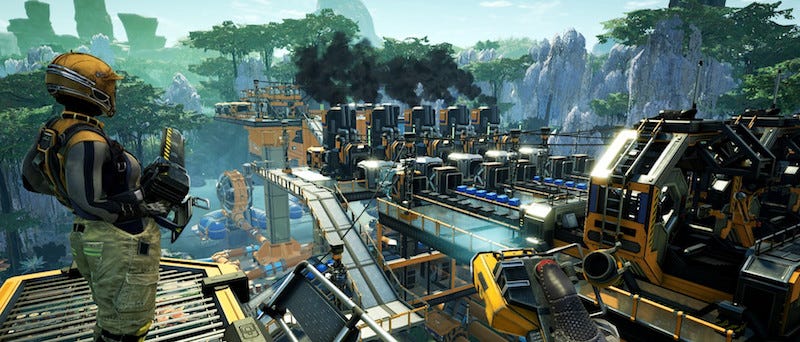
The folks at Coffee Stain Studios were kind enough to go public with their game sales for standout first-person factory building game (think Factorio, but hella 3D!) Satisfactory, and yep, they’re good:

This is notable because it’s one of the few Epic Games Store sales numbers ever released. It comes as EGS announced 61 million monthly active users on PC (and peak concurrent users of 13 million.)

Since you have to log in to EGS to access Fortnite, those MAU/PCU numbers aren’t necessarily that helpful in themselves. But we do know that third-party games had $251 million spent on them in 2019 (out of $680 million total spending, including Epic titles.) And it appears that Satisfactory was the #2 selling EGS title last year, according to that 2019 infographic. So those sales numbers are high-end for EGS.

Let’s guesstimate 8 to 10 million copies of third-party games sold on EGS in 2019. That’s not nothing, if still a fraction of Steam. And Epic’s aggressive ‘free games’ program must be bringing more users to the platform.

For devs, I still think EGS is a great move if you get an offer, especially with the current model of guaranteed advances, the 88% royalty rate, and lack of games on the store. My only comment: you do lack a little discoverability with an EGS launch, just because Steam is the more established ecosystem with the average streamer, etc.

(But you can still debut on Steam later and pick up ‘Steam or bust’ gamers, as Satisfactory did. Having a Steam page up to capture wishlists while on EGS is a great way to pick up latent demand, and Epic haters seem less prevalent nowadays.)

A Mobile Discoverability Follow-Up

Thanks to everyone who followed up on my mobile discoverability post from earlier this week. Here’s some extra detail from my follow-up discussions, especially since mobile games are now generating 1 billion downloads per week:

  • Jordan from Hitcents pointed out the model he’s pursuing with Forgotton Anne on mobile stores, which is a free download & in-game IAP to unlock the full game (for $8.) The game’s lush-looking and has great reviews – it’s doing a 5% conversion rate, with 100% organic traffic. I’ve seen this model on casual games before, but rarely on indies. Not for all, but good incremental revenue, maybe!

  • A couple of folks pointed out you can get independent UA (user acquisition) funding if your F2P title is tuned to be profitable. And indeed that’s true, with big firms like Tilting Point pumping tens of millions of dollars into games that monetize well, and other smaller funding sources out there too. Still, you have to get your F2P mobile game profitable on paid ads first, probably the tricky bit.

  • Finally, I just wanted to re-iterate – there’s a LOT of money in F2P mobile games, and they are becoming increasingly creative and interesting to play. There are fascinating genre niches – check out Ten Square Games, who grossed $40 million in the last quarter just from its game Fishing Clash (1 million reviews on Google Play!) But you’ve got to have your monetization design down. And for many making their own premium game, that may not be something they want.

Get Discovered In.. Somebody Else’s Game?

There’s obviously been a bit of a trend of ‘get large platform, make games within that platform’ in recent years. The most obvious of these is Roblox, which has a robust player-led game dev setup, some young devs making a lot of money, and a bunch of games with more than a billion plays.

But there’s also Media Molecule’s Dreams on PlayStation 4 (which isn’t monetizable right now and is more fan/player-centric, but has some amazing creations, given you literally have to use a PS4 controller to make everything in the game.)

The latest platform to add to this list is Core, whose creator Manticore Games has raised $45 million in VC already, and is now rolling out its creator economy with an initial $1 million in payouts. Here’s their initial pitch:

“Each calendar month, creators in the program can receive $3 per average daily player. This will be calculated by taking the daily number of unique users who log into your games and averaging them across that month.

This means that if you have 500 unique users log into your games every day (they do not need to be the same players) you could receive $1,500 after the end of the month. If you average 1,000 users, you could receive $3,000. If you average 10,000 … you get the idea.”

This seems like a pretty amazing deal, but I think the userbase is still, uhh, arriving – with just 12,000 players to date for the Manticore team’s battle royale game. Still, it’s interesting, right?

So I’m not sure regular ‘pro’ game devs should yet try to earn a living on these platforms – though some such as Jamie Fristrom have tried on Roblox with games like Dungeon Life – some fascinating lessons there.

But I think it’s an important trend to watch, because it’s democratizing game dev even further beyond Unity, in some ways. Although perhaps a bit based on VC firms trying to build platform monopolies, bleurgh, but that’s capitalism for you.

Other things…

OK, time to polish off this newsletter in style, with a few more links of neat things pointed out to me in the last 7 days. Let’s hit it:

  • Thanks to ICO’s Thomas Bidaux, we have a state of Kickstarter (not just game Kickstarter) for the first 6 months of 2020, and there’s even a tl; dr for us: “The number of projects launched on the platform has massively dropped [due to COVID-19]. However, a few hits surprisingly mean that the total amount of money raised recently is on par with the amount raised during the same period last year.”

  • Lorenzo Pilia from Maschinen-Mensch (most German company name ever, also the Curious Expedition devs!) recently noted a neat automated way the devs did a private Alpha for Curious Expedition 2 using email to Discord to bug reports & feedback via their project management tool (free for small devs!), Codecks.

  • Two Nintendo Switch things – firstly, I found someone using a new visibility hack for the eShop charts, which is ‘make a paid game free to owners of other specific Switch games, and it still shows on the charts.’ Jeez. And secondly, the Tangle Tower devs were kind enough to confirm that adding a free Switch demo “has boosted the long tail by about 25%! Not bad for 8 months after the game launched!”

  • The latest article from Chris Zukowski – exactly where his skillset is perfect to help indies – is on how to make your game’s written feature list into benefits, rather than a mechanical listing of how many levels the game has. It’s a classic marketing problem that many people fail at!

  • Micronotes: Apple confirmed all non-China licensed games are gone from the App Store July 31st, the much-awaited (!) Devolver Direct is taking place on Saturday, July 11th at noon PT, and if you want to see inside Valve (albeit the non-Steam bit), the exhaustive written/visual doc Half-Life: Alyx: Final Hours is now out on Steam.

Finally, I hope everyone had a decent Steam Summer Sale! From what I’ve heard, there was plenty of buying going on. But let’s end with Dan Marshall’s (Lair Of The Clockwork God) view on the aftermath, lol:

Take care & speak to you next week,
Simon.