Posted on Leave a comment

As the PS5 draws near, PlayStation promises there’s ‘still a ton of life in’ the PS4

PlayStation is taking a more clear-cut approach to its next-generational hardware than competing console maker Xbox, but both companies seem to agree that the launch of new hardware won’t suddenly spell the end for their current consoles.

Speaking during a Summer Games Fest-themed chat with Geoff Keighley (via IGN), PlayStation global marketing head Eric Lempel explained that, while it’s not as big on cross-gen launches as Xbox is, support of the PlayStation 4 doesn’t end when the PlayStation 5 finally makes its debut.

“PlayStation 4 is a big part of everything we do, and will continue to be a big part of everything we do. There’s a lot more to come on PlayStation 4,” says Lempel. 

“I think most recently we’re seeing some of the greatest titles of this generation have released in recent weeks but that will continue. Again, PlayStation 5 is the next generation product but we’ve got a lot to come for people on PlayStation 4. [There’s] still a ton of life in that product.”

On the other side of the fence, Xbox has similar plans to continue support of the current-generation Xbox One for years to come, though a key part of Xbox’s plan is to forgo any first-party next-generation exclusives and release heavy hitters both the Xbox One and the next gen Xbox Series X.

“We want every Xbox player to play all the new games from Xbox Game Studios. That’s why Xbox Game Studios titles we release in the next couple of years—like Halo Infinite—will be available and play great on Xbox Series X and Xbox One,” reiterates a recent blog post from the Xbox Team. “We won’t force you to upgrade to Xbox Series X at launch to play Xbox exclusives.”

Posted on Leave a comment

‘We believe in generations:’ PlayStation argues cross-gen games risk stifling innovation

“As we’ve said many times, with PlayStation 5 it’s a brand new generation, and we believe in generations. So we want to evolve every part of the experience. ”

– PlayStation global marketing head Eric Lempel talks generational jumps with Geoff Keighley.

PlayStation plans to make a clear jump to the next console generation and offer many games as next-gen exclusives, an approach that’s nearly opposite to how Xbox is handling the transition to the next generation but one that highlights PlayStation’s focus on evolution for the PlayStation 5.

As PlayStation global marketing head Eric Lempel explained to Geoff Keighley during the latest Summer Games Fest video (via IGN), PlayStation sees a clear line between console generations as a necessity, and one that helps drive the development of innovative and unique games for the PlayStation 5.

“In many cases, we can’t take everybody with us from previous consoles into [a next generation experience],” Lempel tells Keighley. “You need new hardware, you need new devices to experience what these developers want you to experience.”

That nod toward PlayStation’s belief in clear generational lines seems like a slightly tongue-in-cheek comment about how Sony’s next system fundamentally differs from Microsoft’s upcoming Xbox Series X and its plan to release first-party titles on both the Xbox One and Xbox Series X generation for at least the next few years.

Particularly for Ratchet & Clank: A Rift Apart developer Insomniac Games, Lempel says that the features and evolutions found in many upcoming PlayStation 5 titles is so tightly tied to the games being developed that it wouldn’t be possible for PlayStation devs to offer those games for both PlayStation 5 and the current generation PlayStation 4.

“When you look at a game like Ratchet, and we’ve talked about a lot of different features today but as you’ve mentioned we haven’t mentioned SSD, that is another thing that will make the whole gaming experience different, it’ll make it better, but it also allows the developers to do new things.”

“It isn’t just about faster loading time. You take a great developer like Insomniac and they found a way to say ‘ok look, here’s a game that could only be made on PlayStation 5, on this generation, using this technology.’ A lot of what you saw on the show, jumping through those different worlds instantly can’t be done in most cases. It needs new hardware, it needs new power,” Lempel tells Keighley. “So that’s something we’re looking forward to. All these things come together. You combine that with 3D audio, with the controller, ray tracing. I mean these are great experiences and these developers know how to harness every piece of those features to really bring you a unique experience. And that really speaks to what next gen is for us.”

When asked if it would be possible to make the same game for PlayStation 5, Lempel elaborates: “It would be a different experience. According to everything Insomniac has told us, this hardware allows them to deliver on this vision. They could not make it [on PlayStation 4]. If they did it would just be different. You would be playing a different type of game and the experience would be different.”

Posted on Leave a comment

GDC Summer State of the Industry: 33% of devs had a game delayed due to COVID-19

Yesterday the Game Developers Conference released the results of a special State of the Industry: Work From Home Edition Survey examining how the COVID-19 pandemic has impacted game developers worldwide.

This special edition of the long-running survey compiles responses from over 2,500 game industry professionals, and the results reveal that roughly a third have seen their business decline due to the pandemic, though nearly as many reported their business had actually increased.

Today, we dive deeper into the results to help illuminate how the COVID-19 quarantine measures implemented worldwide have affected game developers’ ability to ship games on schedule. We also excerpt a selection of the responses some of our respondents chose to write in about the biggest challenges they’ve faced making games during the pandemic, and how they’re tackling them.

Organized by Informa Tech, GDC Summer will take place August 4th through 6th in a new virtual format accessible from anywhere with an Internet connection. download the free report for full details and more insights from fellow game industry professionals!

1 in 3 devs have had a game delayed due to the COVID-19 pandemic

“Has your game suffered any delays due to the pandemic” was one of the core questions of this edition of the survey, and roughly a third (33 percent) of our respondents said yes. 46 percent said no, and 21 percent said the question wasn’t applicable (because, for example, they weren’t working on a game at the time).

We gave survey-takers the option of writing in with more details about why, and their responses shed some light on how studios around the world are adapting to life in the time of COVID-19.

“The company was quite effective in switching everyone to remote work,” wrote one respondent. “I work on a central team supporting external development. None of our games have been delayed due to COVID,” wrote another.

“Our entire team has stepped away in order to focus on desperately trying to manage their lives, living situations, and find bread and butter work to make ends meet,” said one respondent. “We were hoping to show our new projects but some major events were cancelled, working from home slowed us down, and some work-for-hire projects were delayed or cancelled,” another wrote.

“We transitioned to WFH okay, but it did cause us about a couple of weeks of disruption,” stated one respondent from New Zealand. “As NZ has got COVID under control we’re already back at the office and functioning 100 percent.”

Some respondents said they’d suffered delays and other losses due to the pandemic affecting their partners, even if they themselves were able to continue on schedule.

“Most of our delays are because of other companies/studios not being ready for a work-from-home model. Internally, we were already set up pretty good and the transition has not been very difficult to make,” wrote one respondent. Another stated that “Certifications through Nintendo have been backed up due to their processes being adversely affected by the pandemic.”

Poor communication, isolation, and lack of access to critical tools are some of the common challenges devs are dealing with right now

We also gave our survey-takers the option of telling us about the biggest challenges they and their team had yet faced due to the pandemic, and what solutions they’d implemented so far.

“The most important challenge was the subject of communication,” a respondent wrote. “We were starting the design of a game when the pandemic started; at the beginning it cost us to migrate everything to Discord servers for our communication, but we were able to do it and finish the design from our homes.”

“We have an office in downtown Rio de Janeiro, but since March we have all been working from home,” explained one surveytaker. “It took a while to get used to being available online, using Discord as the main means of communicating, lessening the distractions at home, knowing when to shut down, etc., but I believe we have managed to maintain our efficiency.”

“Recording voice actors from their homes,” was a big challenge for another respondent. “We created remote kits of recording gear and acoustic treatment to send to actors.”

“The voiceover recordings,” were the biggest challenge for another, “because the Italian laws forced us to close the studio, so our audio engineer had to change some processes (and add a few more hours for post-production).”

“Due to funding falling through, we attempted to cut costs as much as possible by moving to different cloud service providers, cut development and try to go with bare-minimum maintenance,” said one respondent. “We furloughed all but two employees initially.”

“The biggest overall team challenge has been managing ambient stress. Everyone has been affected by the pandemic in some way, even if not directly, and the general atmosphere of anxiety is impossible to ignore completely.” 

“The biggest functional challenge has been testing console features and/or platform certification requirements, which has not necessarily been easy from home due to hardware limitations and networking constraints,” wrote one respondent. “The biggest overall team challenge has been managing ambient stress. Everyone has been affected by the pandemic in some way, even if not directly, and the general atmosphere of anxiety is impossible to ignore completely. We’ve tried to address this by encouraging people to ask for time off if they need it, take breaks, and by organizing social activities via video conference to keep people from feeling too isolated.”

Download your free copy of the State of the Industry: Work From Home Edition report here!

For more details on GDC Summer, scheduled to take place virtually August 4th through the 6th, visit the show’s official website, or subscribe to regular updates via Facebook, Twitter, or RSS.

Gamasutra and GDC are sibling organizations under parent company Informa Tech

Posted on Leave a comment

Tales of Crestoria’s monthly subscription costs $75

It’s no secret that mobile games occasionally have silly prices for gems and various other in-game items. We see single microtransactions go over the $100 mark pretty often, and there’s, quite frankly, very little micro about that sum. But Tales of Crestoria, Namco Bandai’s latest entry in the Tales franchise, is just adding to the silliness with its monthly subscription model.

Tales of Crestoria offers two different subscriptions, which it markets as ‘Reward Passes’, and these cost $7.99 and $38.99 respectively. The cheaper of the two provides you with eight days worth of 50 Gleamstones (the game’s equivalent of gems) and six of 100, which totals at 1,000. The more expensive offers 20 days of 250, which totals at 5,000.

Taken on their own, individual terms, these subscriptions provide you with four and 20 summons over their own periods respectively, and represent a saving of around 50-60% when compared to purchasing the Gleamstones directly. But it’s when you consider how much you can end up paying for both over a 30 day period that it starts to look a bit silly.

The first calculation is easy. If you purchase the cheapest twice, that’s a total of $15.98 over 28 days. The second is trickier, as you need to calculate it 1.5x to represent 30 days. That’s $58.49. Add the two together, and we get $74.47 for both subscriptions over a 30 day period. To be clear, this represents you logging in every single day for 30 days and grabbing the rewards, as the subscriptions either last 24 or 30 days respectively, but end early once you’ve collected the maximum number of daily rewards.

In other words, the total cost is hiding in plain sight. We find this a lot more distasteful than a $75 microtransaction (which also exists, by the way) as at least the latter is upfront. Besides, you can put any price tag you want on an item, it doesn’t mean that people are going to spend it.

But the deliberately obtuse nature of this system is that you’re giving the players the illusion that they’re spending a lot less. You may lack sympathy for the player that chooses to spend this, but the entire business model of mobile relies on this sort of shotgun spending. You hit a paywall and you reach for your wallet.

[embedded content]

Besides, subscriptions are usually designed to offer value. Take AFK Arena’s options, for example. For $5 you get 12 summons per month, while the $15 provides you with 47. Purchase both and you’re getting over 20 more summons than Tales of Crestoria’s $75 subscription for around a quarter of the cost. AFK Arena’s subscriptions also offer a $44 and $180 saving versus outright purchasing the gems, which is a considerably higher saving than Tales of Crestoria’s variants.

Posted on Leave a comment

Learn AR game design from Pokemon Go dev Niantic at GDC Summer

Pokemon Go creator Niantic is an industry leader in augmented reality game design, which is why GDC organizers are excited to confirm that some of Niantic’s experts will be offering a crash course in AR game design at GDC Summer next month!

As part of the GDC Summer Design track of talks Niantic senior game designer Laura Warner and senior software engineer Kirsten Koa will present “AR Game Design 101“, a crash course in how the team behind Pokemon Go tackles the challenges of blending the digital world with every-day real world experiences.

If you’re a game designer, artist, or developer looking for inside knowledge on how Niantic is enhancing the real world through AR technology, don’t miss this talk! You can expect to walk away with deeper insight into the core game design principles Niantic relies on when crafting fun and exciting AR experiences for players.

Further details on this session and the many others on offer at next month’s event, check out the GDC Summer Session Viewer!

For more details on GDC Summer, scheduled to take place virtually August 4th through the 6th, visit the show’s official website, or subscribe to regular updates via Facebook, Twitter, or RSS.

Gamasutra and GDC are sibling organizations under parent company Informa Tech

Posted on Leave a comment

Pixelmash 2020 Hands-On

Included in the currently running Humble Game Creator Bundle, today we go hands-on with Pixelmash, a pixel art graphics application for Windows and Mac OS.  Pixelmash is described as:

A New, Easier Way To Make Pixel Art and Animated Sprites

Pixelmash is a new kind of pixel art and animation tool that makes quick work of many of the hardest parts of pixel art. Paint or import high-resolution artwork and then non-destructively pixelize it, animate layers using transforms, and apply advanced layer effects to create stunning art in no time. Mix and match hi-res layers with traditional hand-drawn pixel-by-pixel layers for incredible flexibility!

Pixelmash was recently updated to 2020 version, with new features including:

  • Added save and load custom layer effects
  • Added save project as template (saves all layer effects)
  • Added color profile support and management
  • Added gradient effect
  • Added reference image/layer support
  • Added ability to make parent layer effects not affect children
  • Added ability to paint anywhere in tiled view
  • Bug fixes

In the video below we showcase the features and functionality of this interesting pixel art application.

[embedded content]

Art GameDev News


<!–

–>

Posted on Leave a comment

Spike Chunsoft announces the release date for Danganronpa 2: Goodbye Despair

Spike Chunsoft has announced the launch of Danganronpa 2: Goodbye Despair on August 20 in Japan. Danganronpa 2: Goodbye Despair is the second installment of the Danganronpa series. The franchise is best described as a murder mystery adventure game, but it can be compared to Agatha Christie’s best-selling novel, Murder on the Orient Express. There are a lot of Japanese detective games on mobile, but few of which compares to the Danganronpa series.

Danganronpa 2: Goodbye Despair takes place on Jabberwock island, as part of your School Trip. The once-bustling tourist paradise is now uninhabited, but yet somehow in pristine condition. The students of Hope’s Peak Academy are all having fun until Monokuma returns to begin his diabolical game. Now, trapped on an island with a killer on the loose, it’s up to you to solve the mystery: if you want to escape.

As your classmates drop like flies, you must examine the crime scene for clues, interview suspects, and determining the motive for each despicable murder. If Danganronpa 2: Goodbye Despair sounds like a game you would enjoy, you can check out the trailer included below for more details.

Danganronpa 2: Goodbye Despair release date: When will it launch?

Famitsu has confirmed that Danganronpa 2: Goodbye Despair will launch on iOS and Android on August 20. It will list for 1960 yen, which equates to around $18.

DANGANRONPA 2: GOODBYE DESPAIR trailer: what does the gameplay look like?

If you are yet to play any of the Danganronpa series, then you should check out the trailer below. It shows how you will go about investigating the murders by interviewing your classmates.

[embedded content]

If you are looking for something to play now, why not check out Tales of Crestoria?

Posted on Leave a comment

Mobile dev Carbonated raises $8.5 million in seed funding

Newsbrief: Carbonated has raised $8.5 million at the close of a seed funding round, money the California-based team plans to use to get its first project, an AI-driven squad-based shooter for mobile, off the ground. 

The funding comes from the likes of Andreessen Horowitz, Bitkraft Ventures, and others, and will help the studio ramp up its hiring efforts and bring 20 more developers on board, remotely.

In addition to that in-development mobile game, the Carbonated team notes in a Medium post that it is also working on a live-ops tool it calls Carbyne that aims to allow it to quickly create, modify, and deliver in-game content.
 

Posted on Leave a comment

Stadia’s ‘Click To Play’ – the future?

The following blog post, unless otherwise noted, was written by a member of Gamasutra’s community.
The thoughts and opinions expressed are those of the writer and not Gamasutra or its parent company.


[Hi, I’m ‘how people find your game’ expert Simon Carless, and you’re reading the Game Discoverability Now! newsletter, which you can subscribe to now, a regular look at how people discover and buy video games in the 2020s.]

Welcome to this week’s GameDiscoverabilityLand round-up, in which I discover I have yet again found too many things to talk about in the world of ‘how people find out about your games’.

Which is good, right? Lots to discuss this time, so let’s get going…

Stadia’s ‘Click To Play’ option… the future?

So, Google knows it’s a marathon, not a sprint, when it comes to its initially maligned Google Stadia streaming game platform. And this week’s Stadia Connect announcement-cast reflected that:

The upside: Google is starting to sign more ‘Only On Stadia’ exclusives, such as Splash Damage’s Outcasters. The company is also bringing a bunch of medium-sized or larger titles across to the platform as non-exclusives.

Some of those new titles like Hitman & Hello Neighbor will be ‘free’ for Stadia Pro ($10 per month) subscribers, and others (Sekiro) are simply debuting on the Stadia store for purchase.

But it’s the ‘click to play’ concept – as an embeddable URL, which can be anywhere from YouTube descriptions to forums or beyond – that starts to get interesting:

There’s an example on this Orcs Must Die! 3 YouTube trailer that just debuted, for example – which is one of the games bundled with the Stadia Pro subscription. So if you have a Stadia Pro sub (and are in an eligible country, etc), it’s literally single-click from YouTube to immediately start playing the game. Interesting, right?

The jury is still out on Stadia, clearly. It has some diehard fans, but also a fair amount of skeptics, especially among core gamers who prefer the concept of ‘owning’ data on a physical PC/console. (Whether they really ‘own’ it is another question, but you know what I mean…)

Anyhow, the allegations that Google might see Stadia as a foldable experiment and would cave early aren’t really panning out. The company is opening new internal studios, signing a lot of games to fill out its catalog, and starting to do bigger deals with Harmonix and Supermassive for exclusives.

So there’s opportunities for devs here – both in signing upfront deals with Google to have their existing games on Stadia Pro or the Stadia store, and also for exclusive games and simultaneously-timed releases. The user-base is still – shall we say – ‘evolving’, and the platform is still fairly closed compared to the likes of Steam.

But it’s not something that should be 100% ignored, and it’ll be interesting to see where Stadia is in 3-5 years time. (I genuinely have no idea – tell me if you do.)

Welcome To… Devolverland?

Given I’ve been hyping it, it wouldn’t be a round-up without discussing Devolver Direct, the very silly indie publisher’s answer to these live ‘hype’ streams we’ve been enjoying all summer. The video itself is as entertaining as always:

…though a bit light on game reveals, perhaps. But that didn’t matter, because a key reveal was a free Steam game that’s also a ‘first-person marketing simulator’, Devolverland Expo:

So, there’s the hilarity of the space being ‘inspired’ by the Los Angeles Convention Center – which Devolver studiously ignores every year, instead renting adjacent space and getting into fights with E3 organizer the ESA.

But separately of that, this is a really well-done gag that Devolver & Flying Wild Hog put a lot of time into, and it even has Steam achievements for watching game trailers. That’s good discoverability, folks.

Finally, I was reading Stuffed Wombat’s genius ‘made up game design terms’ article, and was tickled to read this one about Devolver:

Other stuff…

OK, here comes both a bunch of compressed discoverability info, and some excellent feedback on previous newsletters, as follows:

  • Some great feedback from Codename Entertainment’s Eric Jordan (Idle Champions) on my recent DLC article and F2P Steam games: “If you make a F2P game, paid DLC is the only way to participate in Steam sales. Hard to discount a free game! DLC also helps with discoverability (such as Featured DLC section on the F2P store page). Finally, if you continue to add new DLC, then it is good to retire older DLC, so you can keep your game’s DLC fresh.”

  • Wondered what was happening with Steam China, after 2019’s Perfect World collaboration announce and subsequent radio silence. But just spotted the regular Steam client got an China Alpha in May with ‘healthy gaming’ messages & time restrictions. Maybe Valve is hoping to go that way, vs. making select games go to a separate China-only client? (I know Chinese gamers buy a lot of Steam titles, but it’d be nice if it was slightly less… governmentally precarious?)

  • A new Gamasutra blog from Karl Kontus tries to calculate how easy it is to make a living as a full-time indie, and comes up with the following: “Only 15% of indie games make more than $100k… [gross.. and they think the net revenue is $54k.]” Probably some things you could argue with in there, but it’s always good to be realistic in some way, right?

  • In my last DiscoverabilityLand round-up, I talked about games that let you make games inside them, and Andrew J. Smith popped up in the comments to point out one I forgot: “Crayta has launched on Stadia (as a ‘Stadia First’ title) and is very much a top-class “games-creation” game… They’ve announced a scheme to encourage people to make games on their platform, and we’ve already made Super Doom Wall for it as part of their indie fund ahead of launch. They also have a Black Creators Prize Fund & Mentoring program.” So now you know.

  • Rattling through some Steam things: it’s the first anniversary of Steam Labs, and Valve says “we’re celebrating with the official release of Community Recommendations, introduced to Steam via Labs.” Some Labs experiments like Deep Dive are being retired, but there’s new things coming, including new ways to browse the store and “adding the ability to include news from Steam Curators you follow, enabling posts from some of your favorite press outlets to appear right in your personalized view of Steam News.” Here’s the latest on News Hub via a detailed post. Possibly related: PC Gamer’s Robin Valentine says Steam has become exhausting – I think mainly quibbling with the sale metacurrency shenanigans, haha.

  • Missed this when it first came out, but Wings Interactive’s Cassia Curran’s recent GI.biz talk on researching the game market is extremely good, since it takes a very metrics-driven approach to evaluating for game success. She makes the same point I do – data isn’t absolute, but it’s broadly indicative and important. Oh, and the Boxleiter number is mentioned – I’ll be doing a survey on the ‘NB number’ (new Boxleiter number – yes, I just made that up) soon!

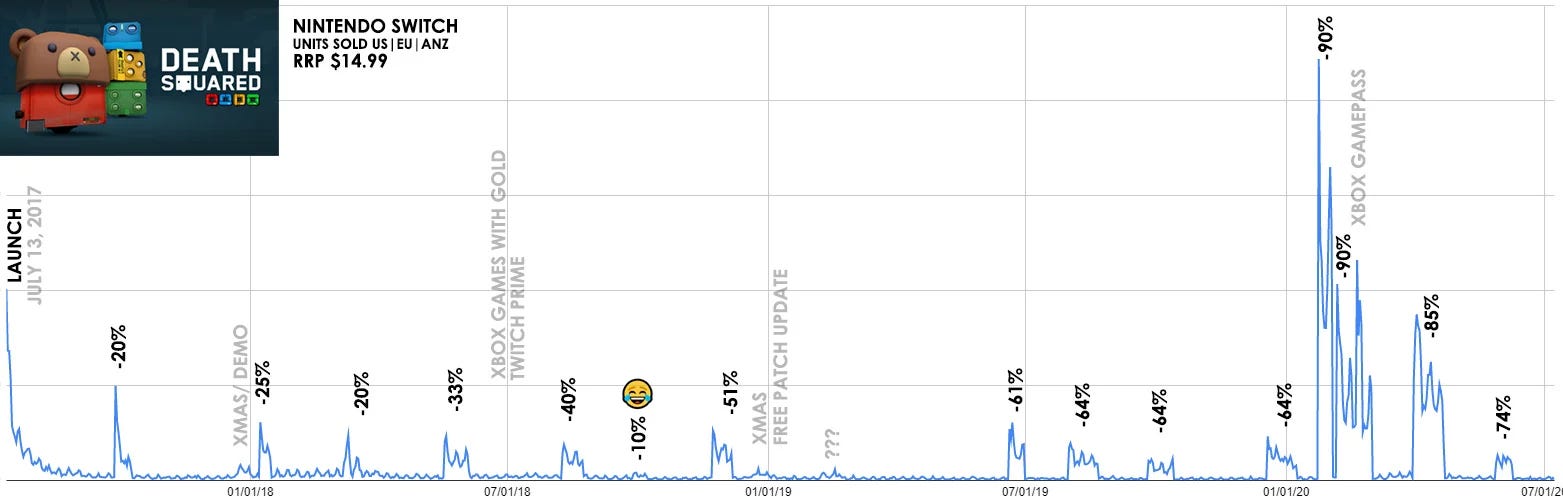
Finishing up this week, Ashley Ringrose at SMG Studio has done a super-transparent interview with NintendoLife about Death Squared sales (300,000 copies, more than 50% of those on Switch, units often discounted but hey, aren’t everyone’s?)

Read it all for Ashley’s other thoughts about sales & discounting, Xbox Game Pass possibly boosting Switch sales, etc. But here’s the full graph of units sold for Death Squared’s entire history on Switch, to give you an idea of what drove sales:

That’s some good graph-based action there! Until next time…

Posted on Leave a comment

Don’t Miss: Designing a domestic hunter-killer thriller the Hello Neighbor way

Dynamic Pixels’ Hello Neighbor is a bizarre breed of game.

Having spent serious time with a few different builds, I feel confident in saying I don’t know what it is at all — and that is probably what it intends to stir in me.

The game is ostensibly about invading your neighbor’s home and trying to undo a series of Adventure Game Logic puzzles in an effort to discover a terrible secret. Along the way there is… well, just so many terrible secrets. But also a gigantic world of impossible spaces that antagonizes the player into attempting a mix of terrible yet obvious challenges or thinking outside every box to come up with a solution that can just as easily be their undoing.

All the while, your Neighbor hunts you. You’re in their house for some reason (there is no direct prompting for why, other than a bizarrely disconnected inciting incident) and when they hunt you down you are forced to respawn back in your home across the street.

There’s a constant forward progression but, in the process, the AI this team developed learns from your every choice. And I mean it when I say it: this game is too clever. It learns too fast and it forces you to change your style of play almost immediately.

To get a sense of how it works, we sat down to discuss the game’s development with Dynamic Pixels lead designer Nikita Kolesnikov. Hello Neighbor is the biggest project to date for the team, and along the way are a few growing pains, surprise design decisions, and so on. There’s also an unholy AI that I think was summoned from Hell itself.

We’ll get to that.

How a small team faced big growing pains

Kolesnikov was thrilled to start working on such a big and exciting project, but the team very quickly found something of this scale was exceptionally difficult. Two people began development in 2014, and they’ve since expanded to the current (small yet mighty) team of seven full-time employees.

“We [were] greatly inspired by Nintendo as a company,” Kolesnikov says. “They are not afraid to experiment and are open to the new things, both in their games and platforms.”

Similarly, the team that began in mobile games hoped to experiment in the direction of something bigger and more demanding that a casual game. With that kind of experimentation comes a necessity to edit; occasionally brutally.

“There were so many times we scrapped all of our work-in-progress, and started all over again,” says Kolesnikov. “You can easily see this in the game’s art style: it started as a more realistic art style, and it became more cartoony over time.”


“There were so many times we scrapped all of our work-in-progress, and started all over again. You can easily see this in the game’s art style: it started as a more realistic art style, and it became more cartoony over time.”

It took a number of iterations to come up with the game’s style, which the team almost frustratingly acknowledges is somewhere between Tim Burton and Pixar. This was never the intention, but as animators and artists blended their work with the programming and design, this is what synthesized.

The larger influence was most complicated: the Canadian sci-fi TV series Orphan Black. In an early version of the game, the Neighbor was a spy (akin to “monitors” in Orphan Black) and that set up the idea of suspensefully trying to determine what was happening in the house next door — even though some of those clues might be total red herrings. Since then, the narrative around the gameplay was changed four times in total over the course of development before settling on the final arrangement.

Designing and tuning the perfect hunter neighbor

So what did that mean for the house itself, a self-contained world that exists with its own set of rules and even its own inter-dimensional forces, like gravity or light? The starting point, according to Kolesnikov, was to set physics that ruled the house and then determine how to use those physics to build puzzles.

“The Neighbor’s AI is calculating approximate player location based on sounds that the player makes in the house,” Kolesnikov says, “and changes around the house made by the player (opened or closed doors, broken windows, misplaced objects inside the house); the AI then places traps that allow him to track and/or slow down the player.”

The logic of said puzzles and traps were designed by working backwards. For example, if the player’s goal is to get to the basement, the team would start with the basement, and think through the logical process. “What did I need to do in order to get here? I needed to open the basement door. And in order to open the basement door, I needed the basement key and to remove the wood planks that block the door – and so on, and so on.” The house was designed so that players have several different ways to solve the game puzzles, but the sandbox physics allow for some solutions that even surprise the Dynamic Pixels team.’

But what does that mean for the more complex puzzles? The team is aware that they’ve built a world that, like their original intention, is far from casual, and they intentionally avoided building much into Hello Neighbor in terms of hints of guides. “Any puzzle in the game,” Kolesnikov says, “requires you to investigate. And requires you to experiment.” And that’s the end of the helping hands.

Hello Neighbor is a tense experience that borders on the terrifying, especially when the strings clamor and the cellos scream murder as the Neighbor gets within arm’s reach. For a game positioned to have broad appeal (it already has a Funko Pop character being released) was there ever any concern that it was too frightening?

“We never intended to make a horror game to begin with; more of a suspenseful thriller,” Kolesnikov says. “But during development there were moments when the game became just way too creepy, especially for sensitive people with big imaginations. One of our artist refuses to play the game by herself; she says it’s way too scary. However, it seems to be less scary to the younger audience – perhaps thanks to the bright, cartoony visuals.”

This is an excellent point for devs to consider: I’m too scared to play Five Nights At Freddy’s, but apparently children love it. Who am I to say what’s scary?

The heart of Hello Neighbor‘s scary parts is the AI behind the Neighbor, which I can attest operates with fearsome dedication and learns from player choices on a curve that I found to be nearly unfair. As far as the technology of the game goes, this seems the most impressive element.

“In the very beginning, the Neighbor just scanned the environment to figure out where the player would likely be, and then he would go and put traps in those locations,” Kolesnikov says.

“Now, the Neighbor is analyzing the way the player is interacting with the game: where he could be at this moment, why he was able to run away from a certain location, what trap will work better to catch the player if he repeats his actions. After an unsuccessful chase of the player, the Neighbor will think through what he can do better next time in order to catch the player.”


“When the Neighbor got closer, we saw the player’s radio in his hands! He walked up and threw the radio at the player. That was creepy. Later we understood that we didn’t program the Neighbor to distinguish between ‘his’ or ‘player’ objects, so all he was trying to do is to place objects back where they belong.”

The hunter learning from the prey is on display throughout the game. Remember how scary Alien: Isolation was despite being entirely random? That’s Hello Neighbor — except for realsies now.

This AI collects the data from the player’s actions, analyzes it and tries to counteract based on the things it learned. However, Kolesnikov mentions that they did have to turn down the dial on the Neighbor’s smarts.

“We noticed that it was acting ‘too smart’ in the beginning of the game, so it was nearly impossible for the beginner players to progress,” he says. “So we had to use different AI in the beginning to let people learn how to play against the Neighbor.”

In fact, Kolesnikov has a story about the playtesting and what they learned from this process, and what others might learn from the decision to include a super intelligence in your house-raiding title.

“The Neighbor is programmed to fix the things around the house: if you misplace an object, he will find it and will put it back in place,” explains Kolesnikov. 

“A player took the radio from his own house (which you return to after each death), turned it on, and placed it in the Neighbor’s house to distract the Neighbor. The next gameplay session started with the Neighbor walking to the player’s house, without any chase music. When the Neighbor got closer, we saw the player’s radio in his hands! He walked up and threw the radio at the player. That was creepy. Later we understood that we didn’t program the Neighbor to distinguish between ‘his’ or ‘player’ objects, so all he was trying to do is to place objects back where they belong.”

Ah. Nothing like an OCD sequence killer artificial intelligence. Now we know what the final season of Mindhunter will be about.

With similar precision, the fandom of the game has been picking apart every detail (including abandoned elements of the numerous patches) to build conspiracy videos. When asked how Pixels chose to engage with this, Kolesnikov admitted to a bit of deliberate baiting.

Hello Neighbor was intended to be a community-driven game, that people share, discuss and play together. We really love how community became involved with the game story,” he says. “Our entire team watched nearly all of the conspiracy videos, and we discuss them and share them with each other. Some people got really close to the original story, and some people have very original takes.”

Did any of the internet’s meddling sleuths upend the planned arc here? Yes, apparently. The Golden Apple, an element that was almost accidentally included in early builds, wound up taking a prominent (if still obscured) role on the newer releases. “During the alpha testing the players connected dots around it, which we appreciated because it gave a new meaning to the story,” Kolesnikov says.

But this isn’t where the story ends, by any stretch of imagination. And the team has leaned into that fandom-powered generator of potential. Kolesnikov says: “We have added game modding so players can create their own Hello Neighbor worlds, experiment and share with each other.”

Honestly, that sounds horrific, because given my own ability to take the darkness in my head and combine it with the tools of Hello Neighbor, some unsuspecting folk are about to get Silent Hill’d in a terrible way.

I try to ask Kolesnikov about potential DLC or whether the story will keep adapting and growing within the main game world. For for efforts to cut through the mystery at the heart of Hello Neighbor, the answer I am given is simply the release date of the game.

I deserved that.