Posted on Leave a comment

Kraft Heinz and Microsoft join forces to accelerate supply chain innovation as part of broader digital transformation

Multiyear cloud and AI agreement will focus on joint innovations across Kraft Heinz operations and product portfolio, representing one of the company’s largest technology investments to date

PITTSBURGH, CHICAGO, and REDMOND, Wash. — April 21, 2022 — On Thursday, The Kraft Heinz Company (“Kraft Heinz” or the “company”) and Microsoft Corp. announced they are joining forces to develop solutions designed to accelerate the consumer goods giant’s transformation and enable a more resilient supply chain. The initiative is one of Kraft Heinz’s largest technology investments to date and a key driver of the company’s ambitious [email protected] approach.

With Microsoft Azure as its preferred cloud platform, Kraft Heinz will migrate the majority of its global datacenter assets to Azure and its enterprise resource planning (ERP) software to SAP on Azure. Through this transformation, Kraft Heinz expects to reimagine its day-to-day operations, create a more collaborative supply chain, and enhance consumer experiences by using real-time predictive analytics to improve inventory transparency and anticipate consumer and channel demand. At the same time, the efficiencies created through the adoption of digital tools from Microsoft are expected to allow the food and beverage leader to continually reinvest into its business.

“Our collaboration with Microsoft is a critical piece of our transformation strategy, providing us with the machine learning and advanced analytics to drive innovation and efficiencies across the supply chain so we can get products into the market faster, better serve our customers and, ultimately, deliver on the sustained and growing consumer demand our iconic brands continue to experience.”

Extreme pressures on end-to-end supply chains during the past two years have exposed the need for more connected and collaborative networks between suppliers, buyers, retailers and other parties along the value chain. As part of its desire to better address supply chain disruptions, Kraft Heinz is leaning heavily into a digitized approach to shift the company to a more predictive strategy and rapid response model.

“As part of our [email protected] transformation, we are building a leading tech ecosystem to benefit the entire value chain,” said Carlos Abrams-Rivera, executive vice president and president, North America, Kraft Heinz. “Our collaboration with Microsoft is a critical piece of our transformation strategy, providing us with the machine learning and advanced analytics to drive innovation and efficiencies across the supply chain so we can get products into the market faster, better serve our customers and, ultimately, deliver on the sustained and growing consumer demand our iconic brands continue to experience.”

“The past two years have highlighted the urgent need for digital-first supply chain solutions across every industry,” said Judson Althoff, executive vice president and chief commercial officer, Microsoft. “Through this collaboration, we’re working shoulder to shoulder with Kraft Heinz, applying the power of Azure, data analytics and the industrial metaverse to co-innovate and create hybrid experiences that will ultimately put goods in the hands of retailers and consumers when they need and want them.”

A primary example of how the companies will collaborate is the creation of a “Supply Chain Control Tower” for Kraft Heinz. By serving as air traffic control across the company’s full product portfolio, the Control Tower will provide real-time visibility into plant operations and automation of its supply chain distribution across Kraft Heinz’s 85 product categories. This innovation — powered by Azure’s AI, IoT and data analytics capabilities — enables the company to get its products in the hands of its more than 2,500 U.S. retailer and food service customers and millions of consumers as fast and cost-effective as possible.

Furthermore, Kraft Heinz will create “digital twins” for its 34 owned manufacturing facilities in North America to help test and perfect solutions and processes before applying them on the plant floor. For example, the technology, fueled by Azure Digital Twins, will help predict outcomes that identify optimal product capacity and reduce mechanical interruptions by proactively addressing issues before they occur, with the goal of ensuring the products that reach retail shelves and consumer hands are the highest possible quality.

Finally, as part of the collaboration, Kraft Heinz and Microsoft will create a joint Digital Innovation Office to co-engineer new solutions that will help the company reimagine digital manufacturing and drive efficiencies with the help of hybrid experiences powered by Microsoft AI, machine learning and IoT.

Additional resources

About The Kraft Heinz Company

We are driving transformation at The Kraft Heinz Company (Nasdaq: KHC), inspired by our Purpose, Let’s Make Life Delicious. Consumers are at the center of everything we do. With 2021 net sales of approximately $26 billion, we are committed to growing our iconic and emerging food and beverage brands on a global scale. We leverage our scale and agility to unleash the full power of Kraft Heinz across a portfolio of six consumer-driven product platforms. As global citizens, we’re dedicated to making a sustainable, ethical impact while helping feed the world in healthy, responsible ways. Learn more about our journey by visiting www.kraftheinzcompany.com or following us on LinkedIn and Twitter.

About Microsoft

Microsoft (Nasdaq “MSFT” @microsoft) enables digital transformation for the era of an intelligent cloud and an intelligent edge. Its mission is to empower every person and every organization on the planet to achieve more.

For more information, press only:

Microsoft Media Relations, WE Communications for Microsoft, (425) 638-7777, [email protected]

Stephanie Peterson, Kraft Heinz Media, [email protected]

Note to editors: For more information, news and perspectives from Microsoft, please visit the Microsoft News Center at http://news.microsoft.com. Web links, telephone numbers and titles were correct at time of publication but may have changed. For additional assistance, journalists and analysts may contact Microsoft’s Rapid Response Team or other appropriate contacts listed at https://news.microsoft.com/microsoft-public-relations-contacts.

Forward-looking statements

This press release contains a number of forward-looking statements. Words such as “accelerate,” “build,” “create,” “deliver,” “develop,” “drive,” “make,” “enable,” “expect,” “help,” “plan,” “predict,” “result,” “serve,” “shift,” “solve,” “transform,” “will” and variations of such words and similar future or conditional expressions are intended to identify forward-looking statements. These statements are not historical facts and are based on Kraft Heinz’s current beliefs, expectations, estimates, and projections. These forward-looking statements are subject to a number of risks and uncertainties, many of which are difficult to predict and beyond Kraft Heinz’s control, which could cause actual results to differ materially from those indicated in the forward-looking statements. Those factors include, but are not limited to, Kraft Heinz’s ability to achieve intended benefits of the collaboration and the risk factors set forth in Kraft Heinz’s filings with the Securities and Exchange Commission, including Kraft Heinz’s most recently filed Annual Report on Form 10-K and subsequent reports on Forms 10-Q and 8-K. Kraft Heinz disclaims and does not undertake any obligation to update, revise, or withdraw any forward-looking statement in this press release, except as required by applicable law or regulation.


Posted on Leave a comment

AI-based mobile app All Aboard makes bus stops more accessible

When was the last time you used GPS services to navigate to a location? Probably just a few hours ago. From finding the fastest route to your destination, to navigating public transportation options, we often rely on this type of service. Imagine needing to find a bus stop based on a GPS service alone, without the ability to see its exact location even when in its proximity. For those who are blind or low vision that scenario is a reality, often having to rely on spatial geolocation data is not accurate enough, commonly referred to as the “last 30-feet problem.” Oftentimes, in the bus stop scenario, even a small gap in navigation can cause people to miss their bus entirely as the bus driver may misunderstand their intention of getting onboard.

A team at Schepens Eye Research Institute of Mass Eye and Ear, led by Associate Professor Gang Luo, has been focusing on vision assistive technology for over a decade, running research studies on technology development, intervention, evaluation, and human factors in mobility for people who are blind or low vision. While transit agencies have a mandate to improve accessibility to public transportation as part of the Americans with Disability Act, opportunities exist to improve existing technologies and further remove barriers. Developing a cost-effective tool was paramount for the team in their aim to make bus stops more accessible and easily identifiable to all. In their effort, they have developed and released a free app called All Aboard which prototypes 10 bus transit services across the US, Canada, UK and Germany. Their project has been awarded a Microsoft AI for Accessibility grant.

To utilize the app, a user needs to hold their mobile phone in upright orientation in proximity to the stop. The service will make a sonar-like sound to indicate it’s searching for the bus stop sign, followed by a beeping sound to indicate the bus stop was identified. The latter has different levels of pitch roughly representing various distances as demonstrated in this video tutorial.

To ensure the solution they were creating was centering the needs of those it was developed for, the team complemented its existing expertise in computer vision and programming by running focus groups with members of the disability community. Micro-navigation was identified as a key challenge, not only for bus stops, but for other places such as subways, stores, banks and more. Lastly, there was a wish that the micro-navigation functions to be integrated with other services, such as travel route planning, bus arrival announcements, indoor navigation and more. While All Aboard does not have that particular capability yet, the team at Schepens Eye Research Institute is searching for industry partners who have an interest to further the use of their technology.

The All Aboard app used deep neural networks to recognize bus stop signs, with the assumption the user is aware of the bus route they wish to take and is in proximity of the bus stop. By using object recognition, it can correctly identify bus signs which have the same design for a particular transit, while ignoring the exact route number on the signs. For each bus transit, around 5,000 to 10,000 bus stop sign images were collected, labelled, and used to train the neural network to automatically learn the features of the signage patterns. Consequentially, the neural network is capable of differentiating the bus stop signs from other objects and other types of road signs in images. For the recognition neural network to run in real time on a mobile device with lower computational power, a lightweight neural network was created, allowing processing on a mobile device.

Man holding his white cane in one hand and the phone in the other using All Aboard to navigate to a bus stop
User holding their phone towards the bus stop and using All Aboard to navigate
Posted on Leave a comment

Azure Purview is now Microsoft Purview—a comprehensive set of solutions to help you govern, protect and manage your entire data estate

In September of 2021, we announced the highly anticipated general availability of Azure Purview—a cloud-native data governance solution to enable organizations of all sizes to manage and govern their on-premises, multicloud, and software as a service (SaaS) data. Since Azure Purview was brought onto the market, thousands of organizations including London Heathrow Airport, Grundfos, and illimity have collectively discovered tens of billions of data assets as well as served up millions of searches every month to empower knowledge workers to find valuable enterprise data quickly and easily. 

Organizations that use Azure Purview have a more holistic understanding of their hybrid data estate, which is always kept up to date with automated data discovery and sensitive data classification. In addition to empowering knowledge workers, this understanding, along with insights from sensitivity, business context, and relationships between data assets is also being used by teams working under the Chief Data Officers (CDO), the Chief Information and Security Officers (CIO and CISO) and the Chief Risk and Compliance Officers (CRO and CCO) to govern, protect, and manage data more effectively.

Traditional data management solutions rely on multiple unconnected, duplicative business processes, and a patchwork of software products augmented with custom code and point-wise integrations. Dozens of products are sometimes used together to address fragments of the data governance and compliance landscape, forcing Chief Data, Security, Compliance, and Legal Officers to stitch together solutions that don’t work together, expose infrastructure gaps, and are costly and complex to manage. A survey of US-based decision-makers showed that to meet their compliance and data-protection needs, almost 80 percent had purchased multiple products, and a majority had purchased three or more.¹ The result is increased operations costs, ineffective data governance, poor security outcomes, failed compliance audits, and damage to brand reputation. Additionally, as the threat landscape continues to evolve, the types of risks organizations face inevitably expand and extend well beyond the traditional cybersecurity risks. This means that risk roles within the organization are blurring, requiring a collaborative and cohesive approach across data, compliance, and risk officers, as each drives an integral part of an effective data strategy. We believe the new way to optimize your data strategy is to deliver a unified view of data in the organization across hybrid, multicloud environments by bringing together the business users of data with the protectors of data.

In the past, we have shared how Azure Purview and Microsoft 365 Compliance are used together to ensure consistent, automated application of sensitivity labels to data assets across the data estate to simplify how organizations understand their sensitive data.

Today, we are excited to introduce Microsoft Purview—a comprehensive set of solutions from Microsoft to help you govern, protect, and manage your entire data estate. By bringing together the former Azure Purview and the former Microsoft 365 Compliance portfolio under one brand and over time, a more unified platform, Microsoft Purview can help you understand and govern the data across your estate, safeguard that data wherever it lives, and improve your risk and compliance posture in a much simpler way than traditional solutions on the market today.

Microsoft Purview

  • Helps you gain visibility into assets across your entire data estate.
  • Leverages that visibility to manage end-to-end data risks and regulatory compliance.
  • Governs, protects, and manages data in a new, more comprehensive, and simpler way. 

Customers of the Azure Purview portal can now use the Microsoft Purview governance portal. For customers of Microsoft 365 E5 or Microsoft E5 Compliance, check out the Microsoft Purview compliance portal to see what’s new!

Get started with Microsoft Purview today


1February 2022 survey of 200 US compliance decision-makers (n=100 599-999 employees, n=100 1000 plus employees) commissioned by Microsoft with MDC Research. 

Posted on Leave a comment

What’s new in Microsoft 365 accessibility: Intelligent tools to support neurodiversity in the hybrid workplace

As we observe World Autism Month this April, I want to highlight several improvements across Microsoft 365 that help users focus on their work and support effective reading and writing. These are useful capabilities for everyone, but are especially important for those with cognitive differences like autism, ADHD, dyslexia, and dyspraxia – a group that, by some estimates, makes up as much as 40% of the population. 

Having been diagnosed with dyslexia early in life, this is more than an abstract statistic to me. When I was younger, I struggled with tasks such as reading and writing, which made everything else more challenging. I often found myself gravitating away from these activities, filling my time with skiing and playing music instead.

As much as I tried to escape it, I eventually realized that reading and writing were going to be part of my life and I needed to develop tools to navigate. When it came to reading, one of the hacks I leveraged was to identify the words based on the number of characters, allowing me to do a quick process of elimination to narrow in on the word.    

as the Office apps have expanded their accessibility features, I have found myself becoming a power user of features like Immersive Reader, Editor, and Thesaurus, allowing me to stop relying on my own internal hacks and leverage technology to overcome these challenges. This has completely transformed how I get things done and provided a new form of confidence that I never thought I would find.  

And those tools are continuing to improve and expand. Let’s take a closer look at how recent features in Microsoft 365 can support focus and productivity for neurodiverse and neurotypical workers alike.  

Posted on Leave a comment

Microsoft Translator adds Basque and Galician

The Basque region in the Pyrenees Mountains straddling Spain and France

Today we’re adding two new languages, Basque and Galician, to the list of languages supported by Translator, a Microsoft Azure Cognitive Service. Basque and Galician are both Western European languages spoken by 750,000 and 2.4 million people respectively.

Basque is a language isolate, meaning it is not related to any other modern language. Basque is spoken in northern Spain and southern France in a region that straddles the Pyrenees Mountains. Galician is spoken in northern Portugal and western Spain. It is a Romance language that is closely related to Portuguese. Both languages are co-official languages of Spain.

Using Translator, you can translate to or from any of 100+ languages and dialects, now including Basque and Galician. As we continue to add new languages, Translator is available to help people translate in their personal lives, to help businesses expand their global reach, and is also used to help preserve at-risk and endangered languages.

Break the language barrier

The goal of Translator is to break the language barrier so that people can communicate freely in their language of choice and be understood by anyone around the globe. Whether you are a tourist travelling abroad, recently moved to a new country, or trying to email someone on the other side of the world, Translator powers the tools that help you communicate when and where you need.

The Microsoft Translator app for iOS and Android is your multifunctional personal translator. With the Microsoft Translator app, you can translate text, voice, images, and conversations. Translator for Bing is also available to translate text quickly on the web. You can use the Translator feature of the Edge browser to read webpages from around the world, you can quickly switch between languages on your mobile device with SwiftKey, and use Outlook to communicate with people via email regardless of the language they speak.

Expand the reach of your business

Translator is integrated into Microsoft products and is available as a service to help expand the reach of your business. With Microsoft 365, previously known as Office, you can instantly translate your Word documents, Excel spreadsheets, and PowerPoint presentations to make them accessible to a worldwide workforce or global customer base. You can also translate your Outlook emails to communicate around the globe.

Using Translator, a Microsoft Azure Cognitive Service you can add text translation to your apps, websites, workflows, and tools; or use Translator’s Document Translation feature to translate entire documents, or volumes of documents, in a variety of different file formats preserving their original formatting.

You can also build neural translation systems that understand the terminology used in your own business and industry with Custom Translator. The customized translation system can then be used with Text and Document Translation to seamlessly integrate into existing applications, workflows and websites.

To add additional capabilities such as speech-to-text and image translation into your apps, you can use Translator with Cognitive Services such as Speech or Computer Vision.

Preserving endangered languages

In order to train new language models, we must collect a large amount of bilingual training data. That is, materials written in the target language and another language. As many languages around the globe are dying, Translator is helping to preserve at-risk languages. We have worked with language communities across the world to collect and translate materials, and then create language systems. Through this we can ensure that these languages are recorded and preserved for generations to come.

Some of the at-risk languages that we have worked to preserve include Inuktitut, Māori, and Yucatec Maya. If your language community is interested in partnering with Microsoft to add your language to Translator and the products that are using it, and you have access to digital documents in your language and another commonly spoken language, please contact us using this form.

Posted on Leave a comment

Notorious cybercrime gang’s botnet disrupted

Today, we’re announcing that Microsoft’s Digital Crimes Unit (DCU) has taken legal and technical action to disrupt a criminal botnet called ZLoader. ZLoader is made up of computing devices in businesses, hospitals, schools, and homes around the world and is run by a global internet-based organized crime gang operating malware as a service that is designed to steal and extort money.

We obtained a court order from the United States District Court for the Northern District of Georgia allowing us to take control of 65 domains that the ZLoader gang has been using to grow, control and communicate with its botnet. The domains are now directed to a Microsoft sinkhole where they can no longer be used by the botnet’s criminal operators. Zloader contains a domain generation algorithm (DGA) embedded within the malware that creates additional domains as a fallback or backup communication channel for the botnet. In addition to the hardcoded domains, the court order allows us to take control of an additional 319 currently registered DGA domains. We are also working to block the future registration of DGA domains.

During our investigation, we identified one of the perpetrators behind the creation of a component used in the ZLoader botnet to distribute ransomware as Denis Malikov, who lives in the city of Simferopol on the Crimean Peninsula. We chose to name an individual in connection with this case to make clear that cybercriminals will not be allowed to hide behind the anonymity of the internet to commit their crimes. Today’s legal action is the result of months of investigation that pre-date the current conflict in the region.

Originally, the primary goal of Zloader was financial theft, stealing account login IDs, passwords and other information to take money from people’s accounts. Zloader also included a component that disabled popular security and antivirus software, thereby preventing victims from detecting the ZLoader infection. Over time those behind Zloader began offering malware as a service, a delivery platform to distribute ransomware including Ryuk. Ryuk is well known for targeting health care institutions to extort payment without regard to the patients that they put at risk.

DCU led the investigative effort behind this action in partnership with ESET, Black Lotus Labs (the threat intelligence arm of Lumen), and Palo Alto Networks Unit 42, with additional data and insights to strengthen our legal case from our partners the Financial Services Information Sharing and Analysis Centers (FS-ISAC) and the Health Information Sharing and Analysis Center (H-ISAC), in addition to our Microsoft Threat Intelligence Center and Microsoft Defender team. We also recognize the additional contribution from Avast in supporting our DCU field in Europe.

Our disruption is intended to disable ZLoader’s infrastructure and make it more difficult for this organized criminal gang to continue their activities. We expect the defendants to make efforts to revive Zloader’s operations. We referred this case to law enforcement, are tracking this activity closely and will continue to work with our partners to monitor the behavior of these cybercriminals. We will work with internet service providers (ISPs) to identify and remediate victims. As always, we’re ready to take additional legal and technical action to address Zloader and other botnets.

Tags: , ,

Posted on Leave a comment

Looking back at Bett 2022: In-person inspires and energizes

A few weeks ago (March 23-25), members of the Microsoft Education team took our first trip as a group in over two years, to Bett UK, the largest education conference in the world. After such a long time away from the energy and excitement of seeing colleagues, partners, and educators gathering to connect and share information, it was an incredible feeling to be together in person at the massive ExCeL center in London once more.  

There were differences, to be sure. Due to ongoing safety considerations, our team’s numbers were significantly smaller than in past years. But those in person, along with the support of many others back home worked together to present demos, keynotes, trainings, and dozens of meetings. The education community came out in large numbers as well: Bett management reports that 22,600 people attended over the course of the three days and that 30 percent of the audience were educator leaders, one of the highest representations of leaders ever at a Bett event.  

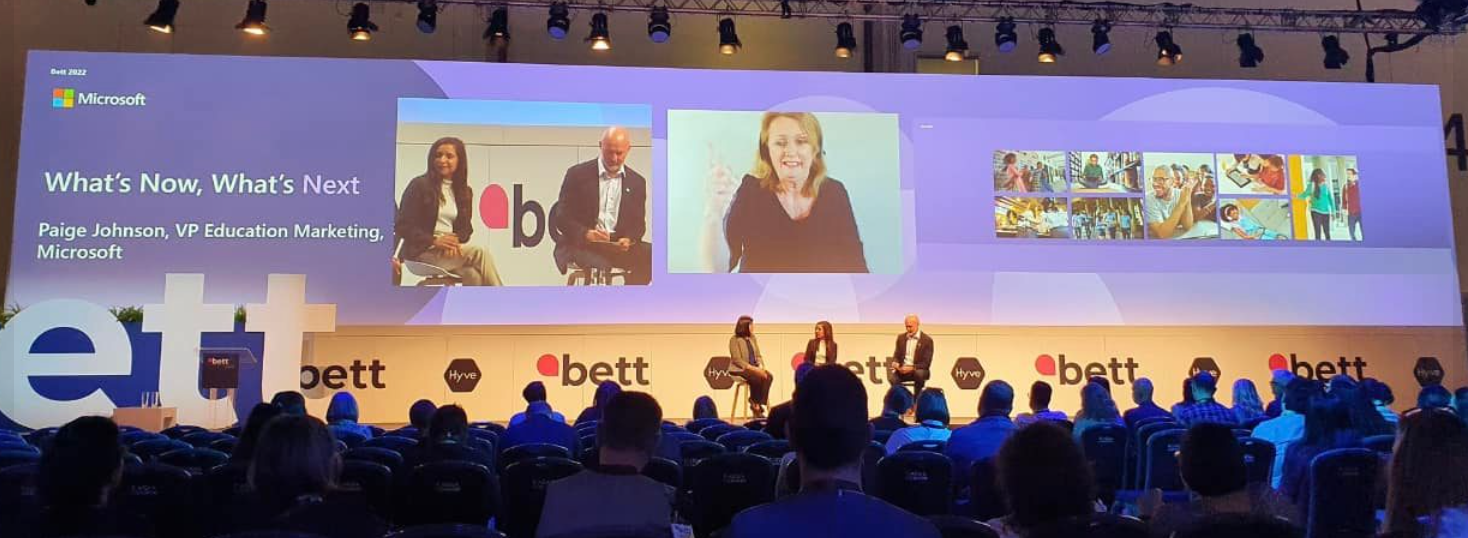
The overall theme of our content and events was focused on supporting educators in their efforts to drive equity and accelerate learning. Our many representatives and presenters shared these messages in a variety of ways from the keynote address, “What’s now, what’s next,” that packed the Bett Arena, to sixteen different sessions across eight Bett Theatres covering topics designed for teachers, education leaders, and IT professionals. These sessions were primarily presented by educators who shared real-world case studies and examples of using Microsoft Education products in their classrooms. Audience favorite topics included “Elevate your digital transformation and build community by collaborating with Microsoft,” “Learning from what works: How Microsoft Showcase Schools are preparing students for tomorrow,” and “Fostering well-being and engagement with Microsoft education solutions.“ 

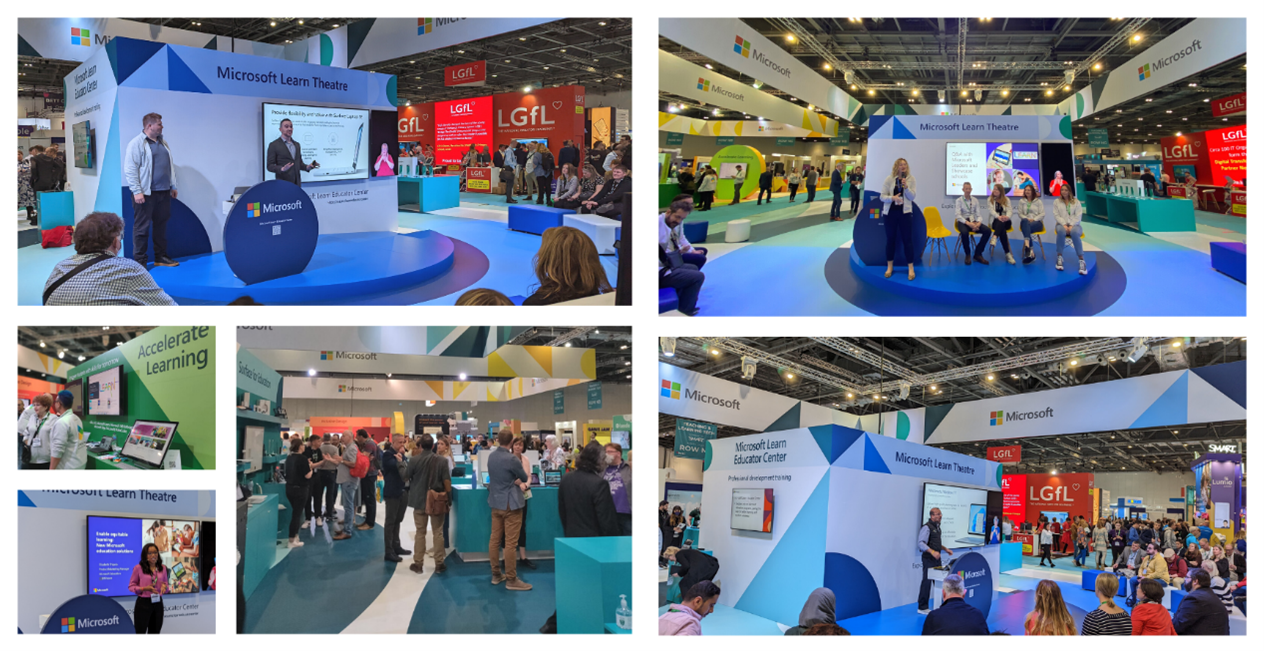
Our booth was a bustling hub of activity, with opportunities to get hands-on experience with Minecraft: Education Edition, MakeCode, and the newest devices for learning. Our teams guided thousands of people through the features of our new and updated literacy tools, Reading Coach and Reading Progress, shared tips and insights for making the most of Windows 11 and Windows 11 SE for education, and introduced educators to some of the incredible professional development opportunities in the Microsoft Learn Educator Center

Higher education was represented with “Ahead,” a space dedicated to higher education. Microsoft Education presented a keynote “Accelerating learning to help all learners engage, keep up, and get ahead,” and hosted several other opportunities for higher education leaders to connect, learn, and network. 

Esports was a big draw this year as well, and our Minecraft takeover tournament generated a standing-room-only crowd. And speaking of esports, I was honored to be asked to take part in a panel discussion, “Esports, the vehicle to develop future-ready skills” with some of the UK’s best-known esports personalities. It was an excellent way to introduce more educators to the promise of engaging learners with games that build skills.  

These are only a few examples of the types of experiences presented at Bett: there were also opportunities for teachers to get certified in different areas by Prodigy Learning, face-to-face meetings with school customers and product partners, and more demonstrations of devices and learning tools than you can count. 

After two years (and a postponement of 2 months), without an in-person Bett, the energy in the exhibition hall felt even more electric and the people felt even friendlier than in years past. Perhaps that’s partly because we all have been craving the opportunity to gather and connect, but it’s also because, after the challenges of those past years, the community of teachers, education leaders, and education technology providers shares a single-minded focus: to provide each learner with what they need to reach their academic and social potential inside and outside the classroom.  

To everyone who worked with us to make this event possible, and to all of the visitors who stopped by our booth and attended our sessions, a huge “THANK YOU!!” Your commitment to students and to the education industry is inspiring. I can’t wait to see you all again next year, mark your calendars for March 29-31, 2023!

Posted on Leave a comment

LinkedIn’s feature store Feathr now available on Azure

This blog post is co-authored by David Stein, Senior Staff Software Engineer, Jinghui Mo, Staff Software Engineer, and Hangfei Lin, Staff Software Engineer, all from Feathr team.

Feature store motivation

With the advance of AI and machine learning, companies start to use complex machine learning pipelines in various applications, such as recommendation systems, fraud detection, and more. These complex systems usually require hundreds to thousands of features to support time-sensitive business applications, and the feature pipelines are maintained by different team members across various business groups.

In these machine learning systems, we see many problems that consume lots of energy of machine learning engineers and data scientists, in particular duplicated feature engineering, online-offline skew, and feature serving with low latency.

Figure 1: Illustration on problems that feature store solves

Figure 1: Illustration on problems that feature store solves.

Duplicated feature engineering

  • In an organization, thousands of features are buried in different scripts and in different formats; they are not captured, organized, or preserved, and thus cannot be reused and leveraged by teams other than those who generated them.
  • Because feature engineering is so important for machine learning models and features cannot be shared, data scientists must duplicate their feature engineering efforts across teams.

Online-offline skew

  • For features, offline training and online inference usually require different data serving pipelines—ensuring consistent features across different environments is expensive.
  • Teams are deterred from using real-time data for inference due to the difficulty of serving the right data.
  • Providing a convenient way to ensure data point-in-time correctness is key to avoid label leakage.

Serving features with low latency

  • For real-time applications, getting feature lookups from database for real-time inference without compromising response latency and with high throughput can be challenging.
  • Easily accessing features with very low latency is key in many machine learning scenarios, and optimizations needs to be done to combine different REST API calls to features.

To solve those problems, a concept called feature store was developed, so that:

  • Features are centralized in an organization and can be reused
  • Features can be served in a synchronous way between offline and online environment
  • Features can be served in real-time with low latency

Introducing Feathr, a battle-tested feature store

Developing a feature store from scratch takes time, and it takes much more time to make it stable, scalable, and user-friendly. Feathr is the feature store that has been used in production and battle-tested in LinkedIn for over 6 years, serving all the LinkedIn machine learning feature platform with thousands of features in production.

At Microsoft, the LinkedIn team and the Azure team have worked very closely to open source Feathr, make it extensible, and build native integration with Azure. It’s available in this GitHub repository and you can read more about Feathr on the LinkedIn Engineering Blog.

Some of the highlights for Feathr include:

  • Scalable with built-in optimizations. For example, based on some internal use case, Feathr can process billions of rows and PB scale data with built-in optimizations such as bloom filters and salted joins.
  • Rich support for point-in-time joins and aggregations: Feathr has high performant built-in operators designed for Feature Store, including time-based aggregation, sliding window joins, look-up features, all with point-in-time correctness.
  • Highly customizable user-defined functions (UDFs) with native PySpark and Spark SQL support to lower the learning curve for data scientists.
  • Pythonic APIs to access everything with low learning curve; Integrated with model building so data scientists can be productive from day one.
  • Rich type system including support for embeddings for advanced machine learning/deep learning scenarios. One of the common use cases is to build embeddings for customer profiles, and those embeddings can be reused across an organization in all the machine learning applications.
  • Native cloud integration with simplified and scalable architecture, which is illustrated in the next section.
  • Feature sharing and reuse made easy: Feathr has built-in feature registry so that features can be easily shared across different teams and boost team productivity.

Feathr on Azure architecture

The high-level architecture diagram below articulates how would a user interacts with Feathr on Azure:

Feathr on Azure architecture.

Figure 2: Feathr on Azure architecture.

  1. A data or machine learning engineer creates features using their preferred tools (like pandas, Azure Machine Learning, Azure Databricks, and more). These features are ingested into offline stores, which can be either:
    • Azure SQL Database (including serverless), Azure Synapse Dedicated SQL Pool (formerly SQL DW).
    • Object storage, such as Azure BLOB storage, Azure Data Lake Store, and more. The format can be Parquet, Avro, or Delta Lake.
  2. The data or machine learning engineer can persist the feature definitions into a central registry, which is built with Azure Purview.
  3. The data or machine learning engineer can join on all the feature dataset in a point-in-time correct way, with Feathr Python SDK and with Spark engines such as Azure Synapse or Databricks.
  4. The data or machine learning engineer can materialize features into an online store such as Azure Cache for Redis with Active-Active, enabling multi-primary, multi-write architecture that ensures eventual consistency between clusters.
  5. Data scientists or machine learning engineers consume offline features with their favorite machine learning libraries, for example scikit-learn, PyTorch, or TensorFlow to train a model in their favorite machine learning platform such as Azure Machine Learning, then deploy the models in their favorite environment with services such as Azure Machine Learning endpoint.
  6. The backend system makes a request to the deployed model, which makes a request to the Azure Cache for Redis to get the online features with Feathr Python SDK.

A sample notebook containing all the above flow is located in the Feathr repository for more reference.

Feathr has native integration with Azure and other cloud services. The table below shows these integrations:

Feathr component

Cloud Integrations

Offline store – Object Store

Azure Blob Storage
Azure ADLS Gen2
AWS S3


Offline store – SQL

Azure SQL DB
Azure Synapse Dedicated SQL Pools (formerly SQL DW)
Azure SQL in VM
Snowflake

Online store

Azure Cache for Redis

Feature Registry

Azure Purview

Compute Engine

Azure Synapse Spark Pools
Databricks

Machine Learning Platform

Azure Machine Learning
Jupyter Notebook

File Format

Parquet
ORC
Avro
Delta Lake

Table 1: Feathr on Azure Integration with Azure Services.

Installation and getting started

Feathr has a pythonic interface to access all Feathr components, including feature definition and cloud interactions, and is open sourced here. The Feathr python client can be easily installed with pip:

pip install -U feathr

For more details on getting started, please refer to the Feathr Quickstart Guide. The Feathr team can also be reached in the Feathr community.

Going forward

In this blog, we’ve introduced a battle-tested feature store, called Feathr, which is scalable and enterprise ready, with native Azure integrations. We are dedicated to bringing more functionalities into Feathr and Feathr on Azure integrations, and feel free to give any feedback by raising issues in Feathr GitHub repository.

Posted on Leave a comment

Registration now open for Xbox Mentoring Program partnering women in gaming careers across Xbox studios and products

Xbox is thrilled to announce the official start of the Xbox Mentoring Program aimed at partnering women in gaming careers across Xbox’s diverse range of studios and products with aspiring talent.

First introduced on International Women’s Day, the Xbox Mentoring Program gives you the chance to access valuable 1:1 coaching sessions with key leaders in select markets such as the US, UK, Canada, Australia, New Zealand, France, Germany, Austria, Switzerland, Japan, and Korea with additional markets to follow.

If you aspire a career in gaming and live in the above regions, register below for the Xbox Mentor in your country and receive the chance of accessing their coaching session. Submissions are accepted starting now through April 6, 2022 April 17, 2022.


Meet Your Xbox Mentors


Hailey Geller (SHE/HER) Xbox Social Marketing Manager Region: US

Hailey Geller (She/Her)
Xbox Social Marketing Manager
Region: US

Hailey is a strategic creative marketer who specializes in dreaming up evocative and meaningful campaigns for your favorite games and products.

Register here: xbox.com/mentoring


Louise O´Connor (She/Her) Executive Producer of Everwild Region: UK

Louise O´Connor (She/Her)
Executive Producer of Everwild
Region: UK

Louise has been working in the gaming industry for over 20 years and loves making games that players remember. Starting as an animator, she has had the privilege of working on some of the incredible Rare IPs that players all over the world enjoy. Now she is looking after the team responsible for creating the studio’s new exiting IP: Everwild.

Register here: xbox.com/mentoring


Venessa Nyarko (She/Her) Producer at The Coalition Region: Canada

Venessa Nyarko (She/Her)
Producer at The Coalition
Region: Canada

Venessa’s role at The Coalition involves bringing teams together to develop cohesive storytelling between gameplay, cinematics, and the sequences in between to create a unified experience for players. She develops the framework to make the best plays, getting the right people in the right conversations, and executing on bringing all the pieces together for an epic end result.

Register here: xbox.com/mentoring


Tania Chee (She/Her) Xbox Business Lead, Australia & New Zealand Region: Australia & New Zealand

Tania Chee (She/Her)
Xbox Business Lead, Australia & New Zealand
Region: Australia & New Zealand

As Xbox Business Lead for Australia and New Zealand, Tania is responsible for driving the gaming platform’s business growth across the Tasman. Tania’s career spans 20+ years across roles in Australia and the UK from IT start-ups to managing Microsoft’s gaming, consumer software and office business through the retail channel.
Tania joined Team Xbox in 2008 in the UK and moved to the Australian business in 2011 driving Xbox’s subscription business, focused on subscriber growth and launching key app partners on the platform. Having also been involved in the success of multiple console generations and launches, Tania was announced as the Lead for Xbox ANZ in 2018 after a decade with the brand.

Register here: xbox.com/mentoring


Ina Gelbert (She/Her) Director of Xbox France Region: France

Ina Gelbert (She/Her)
Director of Xbox France
Region: France

As the first woman to lead the Xbox team in France, Ina’s main motivation is making gaming a diverse, safe and inclusive environment. With professional experiences in both the FMCG and gaming industries, she brings multi-cultural views and perspectives from various backgrounds to every discussion.

Register here: xbox.com/mentoring


Melek Balgün (She/Her) Esports | Web | TV | Event Host Region: Germany, Austria & Switzerland

Melek Balgün (She/Her)
Esports | Web | TV | Event Host
Region: Germany, Austria & Switzerland

Melek is a former professional gamer and started her career at ESL. Hosting and moderating is second nature to her, both online and on the big stage. Her web magazine “Art of Gaming” for TV station arte was nominated for the Grimme Award in 2018.

Register here: xbox.com/mentoring


Mie Koshimizu (She/Her) Xbox Category Manager Region: Japan

Mie Koshimizu (She/Her)
Xbox Category Manager
Region: Japan

Originally from Japan, Mie is the Xbox Category Manager supporting the Asian Xbox team based in Singapore. She is known for her friendliness and enthusiasm for her work. Mie is passionate about advocating for Women in Gaming – especially across Asia – and encouraging all gamers, including people in industry, to share their passion. Since graduating with a Master’s degree in Business Analysis, Mie has extended her knowledge and skills in consumer, market analysis/research, and user experience as well as stories that identify customer requirements and needs. Always looking for a new challenge, she enjoys working in a demanding environment and is willing to learn new things every day.

Register here: xbox.com/mentoring


Boyoun Kim (She/Her) Communications Manager Xbox Region: Korea

Boyoun Kim (She/Her)
Communications Manager Xbox
Region: Korea

Boyoun is a Communications Manager at Xbox and leads market communications across both Korea and Japan. She is seasoned in communications with deep regional experience in corporate reputation management, issues, and crisis communications. After receiving her Master’s in Social Policy from London School of Economics, Boyoun has built up a great understanding of planning and implementation of communications campaigns as well as regional digital and social media marketing strategies. She has over 10 years of experience having worked for hardware manufacturer Lenovo, Google and a German-based start-up.

Register here: xbox.com/mentoring


With the Xbox Mentoring Program, Xbox is opening up their world to inspire and support the next generation of women leaders in gaming. We are beyond excited to share our knowledge and hope that the program generates meaningful engagements with tangible and purposeful actions to help foster career development in the games industry. Visit the Xbox Mentoring Program website to learn more about the program.

Posted on Leave a comment

Learn the latest cybersecurity techniques at the May 12 digital Microsoft Security Summit

In a world marked by change and uncertainty, innovation is more than a nice-to-have—it’s vital to any healthy organization. But fearless innovation becomes impossible when gaps in security can put those ideas at risk.

Many organizations try to increase their defenses by piecing together a patchwork of security solutions over time. Not only is this piecemeal approach costly and difficult to manage, but it also leaves many security administrators wondering, “Did I miss something?”

Safeguard your future with the latest security innovations

On May 12, 2022, at the Microsoft Security Summit digital event, join other cybersecurity professionals in exploring how a comprehensive approach to security can empower organizations to innovate fearlessly—even in the face of evolving cyberthreats.

You’ll also be among the first to hear exciting announcements from Vasu Jakkal, Corporate Vice President of Security, Compliance, Identity, and Management at Microsoft, and engage in energizing conversations with leading cybersecurity experts about the role comprehensive security will play in our collective future.

Register for the Microsoft Security Summit today.

Get up to date on the security trends and projections

The security landscape is constantly evolving as the world continues to embrace a new model of hybrid work and bad actors shift their mode of attack. Cybercriminals are becoming more brazen and more sophisticated. It’s up to the collective security community to learn all we can about these criminals, familiarize ourselves with their techniques, and discover new ways to create better defenses against them.

At Microsoft, we’re doing all we can to help our customers stay ahead of bad actors and respond quickly when attacks occur. This includes informing security professionals about emerging risks and ensuring everyone who seeks to protect their organization is acquainted with the latest technologies.

This digital event is a great opportunity for you to listen in as Microsoft cybersecurity experts and technical researchers discuss the current threat landscape, the future of holistic threat intelligence, and share demos of brand-new security, compliance, identity, and privacy technologies already making waves in the industry. Staying informed is the first step to building a strong, resilient security strategy for your organization. We hope you’ll join us.

Extend protection to the outer limits

Comprehensive security starts with end-to-end coverage. Today’s organizations are moving increasingly more data and resources to the cloud while also working to integrate a growing number of unprotected devices into their security ecosystems. And the pace isn’t slowing.

To defend against sophisticated threats that move laterally across systems and platforms, you need a holistic view of your multicloud environment and a way to centrally manage the protection of your devices.

At this digital event, learn how to achieve least-privilege access across your multicloud, enable seamless information protection, identify critical privacy risks, and empower employees to make smart data handling decisions—without impeding productivity. This is an event you won’t want to miss.

Lay the foundation for a safer, more innovative future

Attend the Microsoft Security Summit on May 12, 2022, to experience the future of comprehensive security and explore the solutions that can get you there. Register to:

  • Learn how to strengthen your organization’s defenses in the face of evolving cyber threats. 
  • Get insights you can act on from defenders on the cybersecurity frontlines on topics like extended detection and response (XDR), proactive threat hunting, Zero Trust, and more.
  • Hear exciting product announcements from leading voices in Microsoft Security.
  • Watch demos of brand-new security, compliance, identity, and privacy technologies.
  • Plus, ask Microsoft cybersecurity and threat intelligence experts all your most pressing questions in a live chat Q&A.

Safeguard your future. Be fearless.

Register now.

Microsoft Security Summit
Digital event | May 12, 2022
9:00 AM to 12:00 PM Pacific Time (UTC-7)

To learn more about Microsoft Security solutions, visit our website. Bookmark the Security blog to keep up with our expert coverage on security matters. Also, follow us at @MSFTSecurity for the latest news and updates on cybersecurity.