Posted on Leave a comment

Accelerating payments modernization in the cloud with SWIFT

A person looking at a phone.

Over the last few years, financial institutions have been through seismic changes in the global economy. Among them has been the rapid increase and adoption of digital payment methods and the emergence of new cloud-native payment providers. To keep pace and unlock new value, these institutions are prioritizing the need to modernize their payment infrastructures to enhance the customer experience and support industry initiatives like open banking, real-time payments, and ISO20022 migration without compromising security and compliance.

In the payments and financial messaging area, SWIFT is a fundamental player, responsible for a daily average of 42 million messages. At Sibos 2019, Microsoft announced the first-ever successful public cloud-based, end-to-end payment transaction using SWIFT connectivity on Microsoft Azure, as part of our broader investment in payments.

This proof of concept by Microsoft Treasury included hosting their entire payment infrastructure on Azure—including their back-office payment infrastructure, Logic Apps connectivity solution, and SWIFT messaging infrastructure.

Since then, Microsoft has been working closely with SWIFT at a strategic level to architect its virtual connectivity solutions on Azure. With the completion of successful pilots with a range of financial institutions, the results of these investments are now coming to market.

This new solution, called Alliance Connect Virtual, will be available for customers to deploy in Azure in 2022, as a phased launch together with SWIFT. The first release is available now and the next release will follow later this year. Alliance Connect Virtual will enable financial institutions to accelerate their payments modernization strategy to reduce their on-premises footprint, rationalize the total cost of ownership, and rapidly deploy cloud-based payments architecture with the added operational, security and intelligence benefits the Microsoft Cloud offers. We have created a set of reference architectures for our customers to use as guidance in their deployments as well as Azure Policies to simplify meeting security requirements for SWIFT. Sophie Racquet, Head of Alliance Connect and Digital Connectivity Product Management at SWIFT states:

“Launching Alliance Connect Virtual marks a major milestone in supporting our customers’ journey to the cloud. Whether in the cloud or on-premises, our community will be able to experience the same level of security, reliability and availability, and attest their CSP compliance too. We’ve received overwhelming positive feedback from our pilot customers so far and I’m looking forward to our phased launch throughout 2022.”  

Bank of New York Mellon (BNY Mellon) was instrumental in the first public cloud connectivity pilot and is already using Azure-based SWIFT solutions for wire payments with Microsoft’s Treasury division. The company’s Treasury Services group, which delivers global payments, trade services, and cash management, provides payments services for Microsoft Treasury. Saket Sharma, Chief Strategy and Digital Officer for BNY Mellon Treasury Services gave his perspective on the reason for pioneering SWIFT connectivity in the cloud with Microsoft:

“As we continue to concentrate on enhancing the resiliency and capacity of our payments and broader financial market infrastructure through digitization, Microsoft Treasury and Azure have been critical collaborators with BNY Mellon in advancing this agenda. We continue to work together closely, remaining focused on providing always-on payment services and accelerating delivery of new capabilities to clients around the world.” 

Anita Mehra, Corporate Vice President of Global Treasury and Financial Services at Microsoft also shared her view on the collaboration:

“We are thrilled to partner with SWIFT in bringing their Alliance Connect Virtual offering to the Azure public cloud. This allows Microsoft Treasury, an early adopter of SWIFT, to continue our focus on security, compliance & resiliency of customer data.”

SWIFT connectivity on Azure goes further than simply translating an on-premises service to one that runs in the cloud. Microsoft will be offering additional value-add services to support our customers which will include unique seamless integration capabilities with back-end systems and support to the ISO20022 migration initiative (using Azure Logic Apps), and an automated and seamless approach to ensure compliance with SWIFT’s Customer Security Programme “CSP” (using Azure Policy solution for SWIFT CSCFv2022).

Microsoft partners with a range of leading global systems integrators in the financial services industry. To help customers take advantage of the new SWIFT connectivity solution on Azure, we’ve worked with Capgemini, Microsoft’s 2021 Partner of the Year for Financial Services, to build services to help financial institutions with the migration of their current SWIFT infrastructure, including Alliance Access, Alliance Messaging Hub (AMH) or AutoClient, to enable rapid deployment of the SWIFT connectivity solutions on Azure. Jeroen Holscher, Head of Global Payments at Capgemini Financial Services shares his perspective:

‘’Our long-standing strategic partnership with Microsoft and SWIFT’s payments technology is the perfect union to help our customers rapidly transition from on-premise to cloud. Together, we have built a strong framework for enterprises to mitigate risk, reduce TCO, drive innovation at scale, and achieve operational efficiencies. We are very excited to collaborate with Microsoft and support our client portfolio across the banking, financial and other industries to help them build a future-ready business for tomorrow.’’ 

At Microsoft, we want to ensure that every organization has the digital capability required to succeed going forward and are committed to helping our financial services customers improve time to value, reduce costs, increase agility, and accelerate innovation for sustainable growth. This latest initiative with SWIFT highlights that commitment, and we look forward to the value it will bring to drive innovation for our mutual customers and the financial services industry.

Additional Microsoft resources

Learn more information about architectural guidance for the deployment of Alliance Connect Virtual on Azure today. And to access additional resources and learn how financial services organizations are transforming digitally using technologies and solutions from Microsoft and our partners, visit our banking, capital markets, insurance, and Microsoft Cloud for Financial Services home pages.

Posted on Leave a comment

AI-enabled robotic boat cleans up harbors and rivers to keep plastic trash out of the ocean

Millions of tons of plastic trash float down polluted urban rivers and industrial waterways and into the world’s oceans every year. Now a Hong Kong-based startup has come up with a solution to help stem these devastating flows of waste.

A small boat on the water with a city skyline in the background.
An early prototype navigates Hong Kong harbor. Photo: Clearbot.

Open Ocean Engineering has developed Clearbot Neo – a sleek AI-enabled robotic boat that autonomously collects tons of floating garbage that otherwise would wash into the Pacific from the territory’s busy harbor.

After a long developmental phase, its creators are planning to scale up and have fleets of Clearbot Neos cleaning up and protecting waters around the globe.

The United Nations estimates that as much as 95% of plastic pollution in the world’s seas gets there via 10 major rivers, eight of which are in Asia.

And there are fears that the volume of plastic trash flowing into marine environments could nearly triple by 2040, adding 23 to 37 million metric tons into the oceans per year. That would be equivalent to about 50 kgs of plastic garbage per meter of coastline worldwide.

“If we clean up our rivers and harbors, we are helping to clean up our oceans,” says Clearbot Neo’s co-creator Sidhant Gupta.

At just three meters long and pushed along by a solar battery-powered electric motor, the Clearbot Neo systematically moves up and down designated sections of water – much like how a household robot cleaner moves across a living room floor.

Unlike other and much larger marine trash collection solutions that are tackling pollution on the high seas, the compact nature of the Clearbot Neo makes it ideal for harbor, canal and river use.

It skims the surface and scoops up floating trash onto an on-board conveyer belt fitted near its bow between its dual hulls and into a holding bin near its stern.

Clearbot Neo uses AI to recognize and log the types of trash it collects and were.

It can bring in as much as a metric ton of refuse per day for recycling or disposal. And when fitted with a bespoke boom, it can tackle localized oil and fuel spills by collecting up to 15 liters of pollutant a day.

But this is more than just a simple clean-up machine. It also collects masses of data in the cloud using a two-camera detection system.

One camera surveys the water’s surface so the bot can identify rubbish and avoid marine life, navigational hazards and other vessels – making it safe and versatile for river and harbor work.

Garbage floating in water with computer graphics on the image.
With AI, Clearbot can identify and log the trash it collects. Photo: Clearbot.

The second camera photographs each piece of trash that lands on the conveyor belt and transmits its image and GPS location to the company’s data compliance system, which is hosted on Microsoft’s Azure platform.

When this data is put together with variables, like sea current and tide information, environmentalists and marine authorities have a head start on identifying the sources of the trash. Water quality data is also fed into the cloud.

Computer engineers Gupta and Utkarsh Goel founded their startup and began working on their Clearbot solution shortly after graduating from Hong Kong University in 2019.

Their inspiration came during a trip to the Indonesian vacation island of Bali where they witnessed how local workers would take to the water every day in small boats and even on surfboards to manually fish trash out of the sea to keep the shoreline and beaches safe and clean for tourists.

That got the two partners thinking: How could this slow and cumbersome process be automated?

Gupta and Goel developed a basic aluminum prototype in Bali and upon their return to Hong Kong, upgraded to a fiberglass version. A series of prototypes followed with the sleek Clearbot Neo being the latest model.

Two men sitting together.
Clearbot’s creators Sidhant Gupta (left) and Utkarsh Goel (right). Photo: Clearbot.

The most challenging part of the project was developing an AI model that could detect and identify waste in the water.

“We simply didn’t have the computing power available to train, run and test the models,” Gupta says. “This is exactly where Azure comes in. We ended up getting an AI for Earth grant from Microsoft in Spring 2020, and over the next year developed the AI model entirely on the Azure platform.

“It took a while because initially we didn’t have enough data to reasonably train it, but very quickly we ended up building out a model. We then put it on the robot and started training it for path planning, collecting waste and generating data.”

With the aid of GPS, Clearbot Neo can simultaneously clear the trash and produce a data point for each and every item collected — information that includes location, size, type, material and weight. After every mission, Azure’s AI capabilities have already classified the Clearbot Neo’s haul and added it to a growing database.

Posted on Leave a comment

Math Assistant in OneNote helps students get ahead

Since the return to in-person learning, educators have been working to evaluate students’ knowledge levels compared to pre-pandemic benchmarks, along with how to help students catch up, keep up, and get ahead. To support these efforts, Microsoft Education has commissioned a series of “Accelerate Learning Kits” to introduce teachers to free and easy-to-use tools and features that can help every learner achieve more.

Each kit includes a paper, an infographic, and a topic abstract focusing on how teachers and students can use specific education products and features, in various scenarios, to ensure every learner can fully participate in learning now and develop skills needed for the future.

In this, the first of five posts highlighting the individual kits, we’ll take a look at “Accelerate Learning with Workplace Math Skills” to see how Math Assistant in OneNote for Education provides multiple accessible methods for students to write, solve, and practice equations.

A recent report1 that focused on the impact of the pandemic on literacy and math skills in students from kindergarten through eighth grade showed that while literacy skills were “modestly” impacted, math skills were “substantially” impacted. Results for schools in low socio-economic status areas showed larger skills gaps, exacerbating historical racial and economic inequities. 

Equity is top of mind for educators, and it’s clear that focusing on math skills is key to not only addressing inequities in the education system, but in the areas of employment and lifetime earning power as well. Math skills are incredibly important for employment in STEM, and these careers make up 23 percent of the current U.S. workforce and offer a higher median salary than other vocations. The number of STEM jobs is also growing annually.2 So, closing the gap for students in traditionally disadvantaged groups can have positive effects well beyond academic performance, including increased diversity in STEM companies and prospects of higher earnings over the course of students’ lifetimes. 

“Our economy depends on math and science literacy. This is not only a concern for those with careers in those topics but also for the public at large.” — Julia Phillips, National Science Board.

Learning gaps can be narrowed using tools that empower students to learn in more personalized and self-directed ways. For example, Math Assistant in OneNote for Education provides multiple input options (digitally inked or typed); the ability to have equations read aloud in multiple languages; step-by-step process explanations; and student-created practice quizzes. All of these features are free and built in to OneNote, which means no additional downloads. To support learners who may move between internet connected and unconnected locations, key features work online and offline.

The way Math Assistant works is that with just a few clicks, students can write or type an equation, get detailed help showing the correct process to solve it, and generate similar questions to practice the concepts.

One of the most challenging aspects of math for many students is understanding the steps to go from equation to solution. “Show Steps” in Math assistant breaks down each part of the process, with text explanations that show each operation in detail. Additionally, students can use the built-in Immersive Reader to hear the equation and solution steps read aloud.

This is much like how Reading Coach in Microsoft Teams provides students with the ability to build skills on their own, with self-directed, non-stigmatizing practice and exercises in a safe and secure environment.

We know that potential is equally distributed, but opportunity is not. So, tools like Math Assistant can make a difference in the effort to close the opportunity gap and accelerate learning for all. When all students have the ability to practice with support, self-assess their skills, and review their actions to improve, they feel more confident in their abilities and in more control of their learning.

Get the full “Accelerate Learning with Workplace Math Skills” paper, view the Abstract and Infographic, and look for the next post in the “Accelerate Learning Kits” series, coming soon!

EdSurge

2 The STEM Labor Force of Today

Posted on Leave a comment

Save the date: Xbox & Bethesda Games Showcase streaming to you Sunday, June 12

Today, we are excited to announce that the Xbox & Bethesda Games Showcase will stream on Sunday, June 12 at 10 a.m. PT. This show will feature amazing titles coming from Xbox Game Studios, Bethesda, and our partners around the world.

The Xbox & Bethesda Games Showcase will include everything you need to know about the diverse lineup of games coming soon to the Xbox ecosystem, including upcoming releases to Game Pass on Xbox and PC.

The Xbox & Bethesda Games Showcase will be streamed on a variety of outlets, in over 30 languages. You can choose where you want to tune in from:

We’ll see you on Sunday, June 12 at 10 a.m. PT.

Posted on Leave a comment

The hybrid war in Ukraine

Today, we released a report detailing the relentless and destructive Russian cyberattacks we’ve observed in a hybrid war against Ukraine, and what we’ve done to help protect Ukrainian people and organizations. We believe it’s important to share this information so that policymakers and the public around the world know what’s occurring, and so others in the security community can continue to identify and defend against this activity. All of this work is ultimately focused on protecting civilians from attacks that can directly impact their lives and their access to critical services.

Starting just before the invasion, we have seen at least six separate Russia-aligned nation-state actors launch more than 237 operations against Ukraine – including destructive attacks that are ongoing and threaten civilian welfare. The destructive attacks have also been accompanied by broad espionage and intelligence activities. The attacks have not only degraded the systems of institutions in Ukraine but have also sought to disrupt people’s access to reliable information and critical life services on which civilians depend, and have attempted to shake confidence in the country’s leadership. We have also observed limited espionage attack activity involving other NATO member states, and some disinformation activity. 

As today’s report details, Russia’s use of cyberattacks appears to be strongly correlated and sometimes directly timed with its kinetic military operations targeting services and institutions crucial for civilians. For example, a Russian actor launched cyberattacks against a major broadcasting company on March 1st, the same day the Russian military announced its intention to destroy Ukrainian “disinformation” targets and directed a missile strike against a TV tower in Kyiv. On March 13th, during the third week of the invasion, a separate Russian actor stole data from a nuclear safety organization weeks after Russian military units began capturing nuclear power plants sparking concerns about radiation exposure and catastrophic accidents. While Russian forces besieged the city of Mariupol, Ukrainians began receiving an email from a Russian actor masquerading as a Mariupol resident, falsely accusing Ukraine’s government of “abandoning” Ukrainian citizens.

The destructive attacks we’ve observed – numbering close to 40, targeting hundreds of systems – have been especially concerning: 32% of destructive attacks directly targeted Ukrainian government organizations at the national, regional and city levels. More than 40% of destructive attacks were aimed at organizations in critical infrastructure sectors that could have negative second-order effects on the Ukrainian government, military, economy and civilians. Actors engaging in these attacks are using a variety of techniques to gain initial access to their targets including phishing, use of unpatched vulnerabilities and compromising upstream IT service providers. These actors often modify their malware with each deployment to evade detection. Notably, our report attributes wiper malware attacks we previously disclosed to a Russian nation-state actor we call Iridium.

Today’s report also includes a detailed timeline of the Russian cyber-operations we’ve observed. Russia-aligned actors began pre-positioning for conflict as early as March 2021, escalating actions against organizations inside or allied with Ukraine to gain a larger foothold into Ukrainian systems. When Russian troops first started to move toward the border with Ukraine, we saw efforts to gain initial access to targets that could provide intelligence on Ukraine’s military and foreign partnerships. By mid-2021, Russian actors were targeting supply chain vendors in Ukraine and abroad to secure further access not only to systems in Ukraine but also NATO member states. In early 2022, when diplomatic efforts failed to de-escalate mounting tensions around Russia’s military build-up along Ukraine’s borders, Russian actors launched destructive wiper malware attacks against Ukrainian organizations with increasing intensity. Since the Russian invasion of Ukraine began, Russian cyberattacks have been deployed to support the military’s strategic and tactical objectives. It’s likely the attacks we’ve observed are only a fraction of activity targeting Ukraine.

Microsoft security teams have worked closely with Ukrainian government officials and cybersecurity staff at government organizations and private enterprises to identify and remediate threat activity against Ukrainian networks. In January of this year, when the Microsoft Threat Intelligence Center (MSTIC) discovered wiper malware in more than a dozen networks in Ukraine, we alerted the Ukrainian government and published our findings. Following that incident, we established a secure line of communication with key cyber officials in Ukraine to be sure that we could act rapidly with trusted partners to help Ukrainian government agencies, enterprises and organizations defend against attacks. This has included 24/7 sharing of threat intelligence and deployment of technical countermeasures to defeat the observed malware.

Given Russian threat actors have been mirroring and augmenting military actions, we believe cyberattacks will continue to escalate as the conflict rages. Russian nation-state threat actors may be tasked to expand their destructive actions outside of Ukraine to retaliate against those countries that decide to provide more military assistance to Ukraine and take more punitive measures against the Russian government in response to the continued aggression. We’ve observed Russian-aligned actors active in Ukraine show interest in or conduct operations against organizations in the Baltics and Turkey – all NATO member states actively providing political, humanitarian or military support to Ukraine. The alerts published by CISA and other U.S. government agencies, and cyber-officials in other countries, should be taken seriously and the recommended defensive and resilience measures should be taken – especially by government agencies and critical infrastructure enterprises. Our report includes specific recommendations for organizations that may be targeted by Russian actors as well as technical information for the cybersecurity community. We will continue to provide updates as we observe activity and believe we can safely disclose new developments.

Tags: , , , ,

Posted on Leave a comment

MoLeR: Creating a path to more efficient drug design

Drug discovery has come a long way from its roots in serendipity. It is now an increasingly rational process, in which one important phase, called lead optimization, is the stepwise search for promising drug candidate compounds in the lab. In this phase, expert medicinal chemists work to improve “hit” molecules—compounds that demonstrate some promising properties, as well as some undesirable ones, in early screening. In subsequent testing, chemists try to adapt the structure of hit molecules to improve their biological efficacy and reduce potential side effects. This process combines knowledge, creativity, experience, and intuition, and often lasts for years. Over many decades, computational modelling techniques have been developed to help predict how the molecules will fare in the lab, so that costly and time-consuming experiments can focus on the most promising compounds.

Diagram illustrating the process of drug discovery. It uses icons for the various stages, and arrows to show how drug discovery projects progress. The bottom section of the diagram shows the human-led approach, which includes
Figure 1: Classic human-led drug design (bottom) is an iterative process of proposing new compounds and testing them in vitro. As this process requires synthesis in the lab, it is very costly and time consuming. By using computational modelling (top), molecule design can be rapidly performed in silico, with only the most promising molecules promoted to be made in the lab and then eventually tested in vivo.

The Microsoft Generative Chemistry team is working with Novartis to improve these modelling techniques with a new model called MoLeR. 

“MoLeR illustrates how generative models based on deep learning can help transform the drug discovery process and enable our colleagues at Novartis to increase the efficiency in finding new compounds.”

Christopher Bishop, Technical Fellow and Laboratory Director, Microsoft Research Cambridge

We recently focused on predicting molecular properties using machine learning methods in the FS-Mol project. To further support the drug discovery process, we are also working on methods that can automatically design compounds that better fit project requirements than existing candidate compounds. This is an extremely difficult task, as only a few promising molecules exist in the vast and largely unexplored chemical space—estimated to contain up to 1060 drug-like molecules. Just how big is that number? It would be enough molecules to reproduce the Earth billions of times. Finding them requires creativity and intuition that cannot be captured by fixed rules or hand-designed algorithms. This is why learning is crucial not only for the predictive task, as done in FS-Mol, but also for the generative task of coming up with new structures. 

In our earlier work, published at the 2018 Conference on Neural Information Processing Systems (NeurIPS), we described a generative model of molecules called CGVAE. While that model performed well on simple, synthetic tasks, we noted then that further improvements required the expertise of drug discovery specialists. In collaboration with experts at Novartis, we identified two issues limiting the applicability of the CGVAE model in real drug discovery projects: it cannot be naturally constrained to explore only molecules containing a particular substructure (called the scaffold), and it struggles to reproduce key structures, such as complex ring systems, due to its low-level, atom-by-atom generative procedure. To remove these limitations, we built MoLeR, which we describe in our new paper, “Learning to Extend Molecular Scaffolds with Structural Motifs,” published at the 2022 International Conference on Learning Representations (ICLR)

The MoLeR model

In the MoLeR model, we represent molecules as graphs, in which atoms appear as vertices that are connected by edges corresponding to the bonds. Our model is trained in the auto-encoder paradigm, meaning that it consists of an encoder—a graph neural network (GNN) that aims to compress an input molecule into a so-called latent code—and a decoder, which tries to reconstruct the original molecule from this code. As the decoder needs to decompress a short encoding into a graph of arbitrary size, we design the reconstruction process to be sequential. In each step, we extend a partially generated graph by adding new atoms or bonds. A crucial feature of our model is that the decoder makes predictions at each step solely based on a partial graph and a latent code, rather than in dependence on earlier predictions. We also train MoLeR to construct the same molecule in a variety of different orders, as the construction order is an arbitrary choice. 

Animation showing a
Figure 2: Given a latent code, that may either come from encoding a molecule or sampling from the prior distribution, MoLeR learns to decode it step-by-step. In each step, it extends a given partial molecule by adding atoms, bonds, or entire structural motifs. These choices are guided by graph neural networks (GNNs) trained on construction sequences for molecules in the training dataset. 

As we alluded to earlier, drug molecules are not random combinations of atoms. They tend to be composed of larger structural motifs, much like sentences in a natural language are compositions of words, and not random sequences of letters. Thus, unlike CGVAE, MoLeR first discovers these common building blocks from data, and is then trained to extend a partial molecule using entire motifs (rather than single atoms). Consequently, MoLeR not only needs fewer steps to construct drug-like molecules, but its generation procedure also occurs in steps that are more akin to the way chemists think about the construction of molecules. 

Diagram with two parts (left and right), with an arrow pointing from left to right. The left part shows a molecule, while the right part shows the same molecule divided into chunks representing groups of atoms, which are formed by removing some of the bonds from the original molecule. Each chunk in the right part of the figure has a box around it.
Figure 3: Motif extraction strategy applied to Imatinib (a drug developed by Novartis, shown on the left) converts it into a collection of common building blocks and individual atoms (shown on the right, with motifs in red boxes and remaining atoms in blue ones). 

Drug-discovery projects often focus on a specific subset of the chemical space, by first defining a scaffold—a central part of the molecule that has already shown promising properties—and then exploring only those compounds that contain the scaffold as a subgraph. The design of MoLeR’s decoder allows us to seamlessly integrate an arbitrary scaffold by using it as an initial state in the decoding loop. As we randomize the generation order during training, MoLeR implicitly learns to complete arbitrary subgraphs, making it ideal for focused scaffold-based exploration. 

Diagram showing a 5x5 grid, with each cell depicting one molecule. The molecule in the middle has a box around it. All the molecules are different, but relatively similar, and all contain a particular substructure, which is marked in red.
Figure 4: Given a molecule (shown in the box in the center) containing a particular scaffold of interest (highlighted in red), MoLeR can traverse its scaffold-constrained latent space, and propose “neighbors” of the given molecule that have similar structure and properties. 

Optimization with MoLeR

Even after training our model as discussed above, MoLeR has no notion of “optimization” of molecules. However, like related approaches, we can perform optimization in the space of latent codes using an off-the-shelf black-box optimization algorithm. This was not possible with CGVAE, which used a much more complicated encoding of graphs. In our work, we opted for using Molecular Swarm Optimization (MSO), which shows state-of-the-art results for latent space optimization in other models, and indeed we found it to work very well for MoLeR. In particular, we evaluated optimization with MSO and MoLeR on new benchmark tasks that are similar to realistic drug discovery projects using large scaffolds and found this combination to outperform existing models. 

Outlook

We continue to work with Novartis to focus machine learning research on problems relevant to the real-world drug discovery process. The early results are substantially better than those of competing methods, including our earlier CGVAE model. With time, we hope MoLeR-generated compounds will reach the final stages of drug-discovery projects, eventually contributing to new useful drugs that benefit humanity. 

Posted on Leave a comment

Meet the 20th anniversary Imagine Cup judges

Student_Developer_Team_0-1650992340978.png

2022 brings the 20th anniversary of Imagine Cup, the preeminent global student technology competition where students from around the world apply technology to imagine, develop, and present innovative solutions that address real-life local and global issues.  This year, students from over 160 countries participated in the competition.  Submitted ideas included an app that teaches kids how to write interactively, a monitoring system that ensures ideal conditions for the safe storage and transportation of produce, an app that translates sign language into Python code, and a health monitoring system for breeding chickens.

From tens of thousands of registrants, 48 World Finalist teams were selected last month, and now only 3 teams remain.  On May 24, the first day of Microsoft Build, they will be competing in the Imagine Cup World Championship for the grand prize of USD50,000 in Azure credits, USD100,000 cash prize, and a mentoring session with Microsoft Chairman and CEO, Satya Nadella.  Each team will pitch their project and demo their technology, followed by questions from a panel of seasoned professionals. Judges will use their industry and personal experience to assess each solution based on its use of Azure technology, accessibility and inclusion, marketability as a business idea, and its potential for making an impact.

Let’s meet the judges:

Student_Developer_Team_1-1650581908833.png

Linda Lian

CEO/Founder

Community Room

Linda Lian is co-founder and CEO at Common Room, the intelligent community growth platform for today’s fastest-growing companies. She founded Common Room in 2020 to help bring organizations of all sizes closer to their communities. Common Room is the first and only platform that gathers community engagement, product usage, and customer data into a single place and makes it actionable for organizations. Previously, Linda led product marketing for serverless computing at Amazon Web Services, where she saw firsthand the impact developer communities had on product adoption and advancing the company’s goals. She lives in Seattle where she enjoys spending time outdoors and with her partner, dog, and cat.


Student_Developer_Team_2-1650581908912.png

Kat Norton

Founder and Chief Excel Officer

Miss Excel

Kat Norton spent 4 years as a consultant teaching Excel and in June 2020 decided to post mini Excel lessons on TikTok out of boredom.  Her viral Excel trick videos are infused with creativity, music, dance, and genuine passion; they of course quickly went viral.  The fourth video was about the data-searching  XLOOKUP feature set to DMX’s song “X Gon Give It To Ya” and surpassed 100,000 views within just a few days.  Within a few months, she built out online courses to sell directly to consumers.  This fun side hustle turned into Miss Excel, a successful full-time Excel training business that has grown to more than 1 million followers across TikTok & Instagram — and has brought in 7 figures in course sales..

She also hosts corporate Excel trainings and does motivational speaking engagements on how to shift your energy to find fulfillment in your career.  Kat was recently awarded the Microsoft MVP award and was featured in Business Insider, CNBC, Fox, Bloomberg, The Times and Daily Mail as a pioneer in the “Excel Influencer” space. Kat was also named one of the Top 10 Social Media Influencers of 2021 by Forbes.

Student_Developer_Team_3-1650581909016.png

Phil Spencer

CEO

Microsoft Gaming

Phil Spencer leads Microsoft’s global interactive entertainment business across all devices and services. He plays all sorts of games and has worked in technology and entertainment for more than 30 years, leading global business, creative and engineering teams.  He has previously held roles across Microsoft including Executive Vice President, Gaming; Head of Xbox; Corporate Vice President, Microsoft Studios; and General Manager, Microsoft Game Studios EMEA.

In his roles at Microsoft, Phil has led the Xbox organization through multiple console launches; multiple acquisitions, including Mojang (parent company of Minecraft); and influenced global entertainment franchises such as Halo, Gears of War and Forza. He has also led the expansion of cross-platform gaming with the Xbox Network, investments in subscription business models with Xbox Game Pass, and Microsoft’s introduction of Xbox Cloud Gaming. With his team and colleagues, he continues to push the boundaries of creativity, technical innovation, and fun across genres, audiences, and devices.

Before beginning his career as an intern with Microsoft in 1988, Phil graduated from the University of Washington.  He is an executive sponsor of the university’s Department of Human Centered Design and Engineering and also serves on the Board of Trustees of The Paley Center for Media.


Join us on May 24 at Microsoft Build to find out who will become the 2022 Imagine Cup champion! Follow the action on Instagram and Twitter to stay up to date with all the competition action. Plus, as a student at Microsoft Build, you can explore topics designed to inspire your learning journey and help you further your career in tech or build your next amazing project.  Register at no cost now!

Posted on Leave a comment

The Neurodiversity @ Work Employer Roundtable and nonprofit Disability:IN are launching the Neurodiversity Career Connector, a job search portal for neurodivergent candidates

Companies including CAI, Dell Technologies, EY, Freddie Mac, Google, HP, Microsoft, SAP, Spectrum Designs Foundation reaffirm commitment to neurodivergent candidates, an untapped talent pool that can help close record-high job openings.

SEATTLE, April 27, 2022 – To address the lack of neurodiverse talent hiring, member companies of the Neurodiversity @ Work Employer Roundtable are launching the Neurodiversity Career Connector (NDCC), a career portal dedicated to neurodivergent jobseekers.

This new job marketplace connects neurodivergent people with companies already committed to neurodiversity hiring programs. Currently, the Neurodiversity Career Connector features job listings by U.S. employers seeking applicants who are neurodivergent. This commonly includes but is not limited to autism, ADHD, dyspraxia, dyslexia, dyscalculia, and/or Tourette Syndrome.

“It’s a phenomenal resource,” says Jason Ross, who recently landed a cybersecurity job through NDCC. “It’s made for us, by us. That level of understanding, baked in from the jump, is a meaningful distinction for this platform versus going on any general job platform and throwing your resume into the world.”

The Neurodiversity @ Work Employer Roundtable includes a group of nearly 50 companies with neurodiversity hiring programs and support systems in place for new employees. The goal of the group is to decrease job barriers and increase neurodiversity hiring in the workplace.

“Neurodiverse individuals possess key competencies that are increasingly valuable to companies, such as strong problem-solving skills and unconventional thinking,” says Jill Houghton, President and CEO, Disability:IN. “A growing number of companies are seeing the value that diversity and inclusiveness brings to a company, and that’s why Disability:IN is proud to support the Neurodiversity @ Work Roundtable and help companies activate programs that work to hire neurodivergent candidates.”

According to the Neurodiversity @ Work Employer Roundtable there are ways to increase support for neurodivergent candidates such as:

  • Assign job coaches/mentors.
  • Allott time weekly for employees to connect with other employees to share feedback on their lived experience. This is especially important for those who are in a remote work environment.
  • Take advantage of the trainings offered through the Neurodiversity @ Work Employer Roundtable for managers of employees hired through the Neurodiversity Career Connector.

ABOUT
The Employer Roundtable is powered by Disability:IN to help close the disability employment gap. The Neurodiversity @ Work Employer Roundtable started in 2017 with six founding members: DXC Technology, EY, Ford, JP Morgan Chase, Microsoft, and SAP. Since 2017, over 40 additional employers have joined the Roundtable – all with a commitment to and experience in hiring and supporting neurodivergent talent. You can find the complete list of employers here. The Roundtable employers have collectively hired 1,400 neurodivergent employees through their dedicated neurodiversity hiring programs, spanning across industries and company size. This includes, but not limited to, those identifying as autistic as well as those with ADHD, dyspraxia, dyslexia, dyscalculia, and/or Tourette Syndrome.

MEDIA CONTACTS

Microsoft Media Relations, WE Communications for Microsoft, (425) 638-7777, [email protected]

Disability:IN, Suzanne Robitaille, [email protected]


Posted on Leave a comment

Microsoft Cloud strength fuels third quarter results

REDMOND, Wash. — April 26, 2022 — Microsoft Corp. today announced the following results for the quarter ended March 31, 2022, as compared to the corresponding period of last fiscal year:

  • Revenue was $49.4 billion and increased 18%
  • Operating income was $20.4 billion and increased 19%
  • Net income was $16.7 billion and increased 8% GAAP (up 13% non-GAAP)
  • Diluted earnings per share was $2.22 and increased 9% GAAP (up 14% non-GAAP)

Revenue and diluted earnings per share results include $(302) million and $(0.03) of additional impact from unfavorable foreign exchange rate movement within the quarter and $111 million and $(0.01) from Nuance, which closed on March 4, 2022, neither of which were included in the forward-looking guidance provided on January 25, 2022. Additional details are provided in the Earnings Call Slides.

“Going forward, digital technology will be the key input that powers the world’s economic output,” said Satya Nadella, chairman and chief executive officer of Microsoft. “Across the tech stack, we are expanding our opportunity and taking share as we help customers differentiate, build resilience, and do more with less.”

“Continued customer commitment to our cloud platform and strong sales execution drove better than expected commercial bookings growth of 28% and Microsoft Cloud revenue of $23.4 billion, up 32% year over year,” said Amy Hood, executive vice president and chief financial officer of Microsoft.

The following table reconciles our financial results reported in accordance with generally accepted accounting principles (GAAP) to non-GAAP financial results. Additional information regarding our non-GAAP definition is provided below. All growth comparisons relate to the corresponding period in the last fiscal year.

Three Months Ended March 31,
 ($ in millions, except per share amounts) Revenue Operating Income Net Income Diluted Earnings per Share
2021 As Reported (GAAP) $41,706 $17,048 $15,457 $2.03
Net income tax benefit related to India Supreme Court decision on withholding taxes (620) (0.08)
2021 As Adjusted (non-GAAP) $41,706 $17,048 $14,837 $1.95
2022 As Reported (GAAP) $49,360 $20,364 $16,728 $2.22
Percentage Change Y/Y (GAAP) 18% 19% 8% 9%
Percentage Change Y/Y (non-GAAP) 18% 19% 13% 14%
Percentage Change Y/Y (non-GAAP) Constant Currency 21% 23% 17% 18%

Business Highlights

Revenue in Productivity and Business Processes was $15.8 billion and increased 17%, with the following business highlights:

  • Office Commercial products and cloud services revenue increased 12% (up 14% CC) driven by Office 365 Commercial revenue growth of 17% (up 20% CC)
  • Office Consumer products and cloud services revenue increased 11% (up 12% CC) and Microsoft 365 Consumer subscribers grew to 58.4 million
  • LinkedIn revenue increased 34% (up 35% CC)
  • Dynamics products and cloud services revenue increased 22% (up 25% CC) driven by Dynamics 365 revenue growth of 35% (up 38% CC)

Revenue in Intelligent Cloud was $19.1 billion and increased 26%, with the following business highlights:

  • Server products and cloud services revenue increased 29% (up 32% CC) driven by Azure and other cloud services revenue growth of 46% (up 49% CC)

Revenue in More Personal Computing was $14.5 billion and increased 11%, with the following business highlights:

  • Windows OEM revenue increased 11%
  • Windows Commercial products and cloud services revenue increased 14% (up 19% CC)
  • Xbox content and services revenue increased 4% (up 6% CC)
  • Search and news advertising revenue excluding traffic acquisition costs increased 23% (up 25% CC)
  • Surface revenue increased 13% (up 18% CC)

Microsoft returned $12.4 billion to shareholders in the form of share repurchases and dividends in the third quarter of fiscal year 2022, an increase of 25% compared to the third quarter of fiscal year 2021.

Business Outlook

Microsoft will provide forward-looking guidance in connection with this quarterly earnings announcement on its earnings conference call and webcast.

Quarterly Highlights, Product Releases, and Enhancements  

Every quarter Microsoft delivers hundreds of products, either as new releases, services, or enhancements to current products and services. These releases are a result of significant research and development investments, made over multiple years, designed to help customers be more productive and secure and to deliver differentiated value across the cloud and the edge.

Here are the major product releases and other highlights for the quarter, organized by product categories, to help illustrate how we are accelerating innovation across our businesses while expanding our market opportunities.

Environmental, Social, and Governance (ESG)

To better execute Microsoft’s mission, we focus our Environmental, Social, and Governance (ESG) efforts where we can have the most positive impact. To learn more about our latest initiatives and priorities, please visit our investor relations ESG website.

Webcast Details

Satya Nadella, chairman and chief executive officer, Amy Hood, executive vice president and chief financial officer, Alice Jolla, chief accounting officer, Keith Dolliver, deputy general counsel, and Brett Iversen, general manager of investor relations, will host a conference call and webcast at 2:30 p.m. Pacific time (5:30 p.m. Eastern time) today to discuss details of the company’s performance for the quarter and certain forward-looking information. The session may be accessed at http://www.microsoft.com/en-us/investor. The webcast will be available for replay through the close of business on April 26, 2023.

Non-GAAP Definition

The India Supreme Court Decision Impact. In March 2021, the India Supreme Court issued a decision on withholding taxes in the case of Engineering Analysis Centre of Excellence Private Limited vs The Commissioner of Income Tax. Microsoft has historically paid India withholding taxes on software sales through distributor withholding and tax audit assessments in India. The India Supreme Court ruled favorably for companies in 86 separate appeals, some dating back to 2012, holding that software sales are not subject to India withholding taxes. Although Microsoft was not a party to the appeals, Microsoft’s software sales in India were determined to be not subject to withholding taxes. Therefore, Microsoft recorded a net income tax benefit of $620 million in the third quarter of fiscal year 2021 to reflect the results of the India Supreme Court decision impacting fiscal year 1996 through fiscal year 2016.

Microsoft has provided non-GAAP financial measures related to the India Supreme Court decision to aid investors in better understanding our performance. Microsoft believes these non-GAAP measures assist investors by providing additional insight into its operational performance and help clarify trends affecting its business. For comparability of reporting, management considers non-GAAP measures in conjunction with GAAP financial results in evaluating business performance. The non-GAAP financial measures presented in this release should not be considered as a substitute for, or superior to, the measures of financial performance prepared in accordance with GAAP.

Constant Currency

Microsoft presents constant currency information to provide a framework for assessing how our underlying businesses performed excluding the effect of foreign currency rate fluctuations. To present this information, current and comparative prior period results for entities reporting in currencies other than United States dollars are converted into United States dollars using the average exchange rates from the comparative period rather than the actual exchange rates in effect during the respective periods. All growth comparisons relate to the corresponding period in the last fiscal year. Microsoft has provided this non-GAAP financial information to aid investors in better understanding our performance. The non-GAAP financial measures presented in this release should not be considered as a substitute for, or superior to, the measures of financial performance prepared in accordance with GAAP.

Financial Performance Constant Currency Reconciliation

Three Months Ended March 31,
 ($ in millions, except per share amounts) Revenue Operating Income Net Income Diluted Earnings per Share
2021 As Reported (GAAP) $41,706 $17,048 $15,457 $2.03
2021 As Adjusted (non-GAAP) $41,706 $17,048 $14,837 $1.95
2022 As Reported (GAAP) $49,360 $20,364 $16,728 $2.22
Percentage Change Y/Y (GAAP) 18% 19% 8% 9%
Percentage Change Y/Y (non-GAAP) 18% 19% 13% 14%
Constant Currency Impact $(1,003) $(677) $(577) $(0.08)
Percentage Change Y/Y (non-GAAP) Constant Currency 21% 23% 17% 18%

Segment Revenue Constant Currency Reconciliation

Three Months Ended March 31,
 ($ in millions) Productivity and Business Processes Intelligent Cloud More Personal Computing
2021 As Reported (GAAP) $13,552 $15,118 $13,036
2022 As Reported (GAAP) $15,789 $19,051 $14,520
Percentage Change Y/Y (GAAP) 17% 26% 11%
Constant Currency Impact $(332) $(418) $(253)
Percentage Change Y/Y (non-GAAP) Constant Currency 19% 29% 13%

Selected Product and Service Revenue Constant Currency Reconciliation           

Three Months Ended March 31, 2022
Percentage Change Y/Y (GAAP) Constant Currency Impact Percentage Change Y/Y (non-GAAP) Constant Currency
Office Commercial products and cloud services 12% 2% 14%
Office 365 Commercial 17% 3% 20%
Office Consumer products and cloud services 11% 1% 12%
LinkedIn 34% 1% 35%
Dynamics products and cloud services 22% 3% 25%
Dynamics 365 35% 3% 38%
Server products and cloud services 29% 3% 32%
Azure and other cloud services 46% 3% 49%
Windows OEM 11% 0% 11%
Windows Commercial products and cloud services 14% 5% 19%
Xbox content and services 4% 2% 6%
Search and news advertising excluding traffic acquisition costs 23% 2% 25%
Surface 13% 5% 18%

About Microsoft

Microsoft (Nasdaq “MSFT” @microsoft) enables digital transformation for the era of an intelligent cloud and an intelligent edge. Its mission is to empower every person and every organization on the planet to achieve more.

Forward-Looking Statements

Statements in this release that are “forward-looking statements” are based on current expectations and assumptions that are subject to risks and uncertainties. Actual results could differ materially because of factors such as:

  • intense competition in all of our markets that may lead to lower revenue or operating margins;
  • increasing focus on cloud-based services presenting execution and competitive risks;
  • significant investments in products and services that may not achieve expected returns;
  • acquisitions, joint ventures, and strategic alliances that may have an adverse effect on our business;
  • impairment of goodwill or amortizable intangible assets causing a significant charge to earnings;
  • cyberattacks and security vulnerabilities that could lead to reduced revenue, increased costs, liability claims, or harm to our reputation or competitive position;
  • disclosure and misuse of personal data that could cause liability and harm to our reputation;
  • the possibility that we may not be able to protect information stored in our products and services from use by others;
  • abuse of our advertising or social platforms that may harm our reputation or user engagement;
  • the development of the internet of things presenting security, privacy, and execution risks;
  • issues about the use of artificial intelligence in our offerings that may result in competitive harm, legal liability, or reputational harm;
  • excessive outages, data losses, and disruptions of our online services if we fail to maintain an adequate operations infrastructure;
  • quality or supply problems;
  • government litigation and regulatory activity relating to competition rules that may limit how we design and market our products;
  • potential consequences under trade, anti-corruption, and other laws resulting from our global operations;
  • laws and regulations relating to the handling of personal data that may impede the adoption of our services or result in increased costs, legal claims, fines, or reputational damage;
  • claims against us that may result in adverse outcomes in legal disputes;
  • uncertainties relating to our business with government customers;
  • additional tax liabilities;
  • the possibility that we may fail to protect our source code;
  • legal changes, our evolving business model, piracy, and other factors may decrease the value of our intellectual property;
  • claims that Microsoft has infringed the intellectual property rights of others;
  • damage to our reputation or our brands that may harm our business and operating results;
  • adverse economic or market conditions that may harm our business;
  • catastrophic events or geo-political conditions, such as the COVID-19 pandemic, that may disrupt our business;
  • exposure to increased economic and operational uncertainties from operating a global business, including the effects of foreign currency exchange and
  • the dependence of our business on our ability to attract and retain talented employees.

For more information about risks and uncertainties associated with Microsoft’s business, please refer to the “Management’s Discussion and Analysis of Financial Condition and Results of Operations” and “Risk Factors” sections of Microsoft’s SEC filings, including, but not limited to, its annual report on Form 10-K and quarterly reports on Form 10-Q, copies of which may be obtained by contacting Microsoft’s Investor Relations department at (800) 285-7772 or at Microsoft’s Investor Relations website at http://www.microsoft.com/en-us/investor.

All information in this release is as of March 31, 2022. The company undertakes no duty to update any forward-looking statement to conform the statement to actual results or changes in the company’s expectations.

For more information, press only:

Microsoft Media Relations, WE Communications for Microsoft, (425) 638-7777, [email protected]

For more information, financial analysts and investors only:

Brett Iversen, General Manager, Investor Relations, (425) 706-4400

Note to editors: For more information, news and perspectives from Microsoft, please visit the Microsoft News Center at http://www.microsoft.com/news. Web links, telephone numbers, and titles were correct at time of publication, but may since have changed. Shareholder and financial information, as well as today’s 2:30 p.m. Pacific time conference call with investors and analysts, is available at http://www.microsoft.com/en-us/investor.

Posted on Leave a comment

Leading change: How industries are partnering with Microsoft to empower their teams and serve customers through uncertainty

Cityscape with abstract particles
Photo credit: lupengyu/Getty Images

This past quarter was shaped by global events and has renewed our focus on how the cloud enables organizations to manage risk while supporting growth. In my conversations with customers, building more resilient and adaptable supply chains is top of mind. Organizations across industries are using cloud-powered technologies to help predict supplier constraints and deliver on their customer promises. Customers have also shared how the cloud enables them to achieve more with less and better track, measure and report progress toward their sustainability goals. By deploying AI-based solutions, data sensors and predictive analytics, among other digital technologies, they are accelerating their sustainability journey and creating greater business value. That extends to what we term the industrial metaverse, where we are helping companies to drive material outcomes through simulations and artificial intelligence. In parallel, as our customers continue to adapt and transform through cloud adoption, they face increased security considerations. Digital defenses using automation to prevent, detect and contain cyber-risks are helping them innovate in multi-cloud environments.

Microsoft has been at the forefront of delivering the digital tools and services organizations need to lead their teams through unprecedented times, embracing partnerships to achieve more together. Today, Mastercard announced the launch of an enhanced identity solution integrated with Microsoft Dynamics 365 Fraud Protection to improve the online shopping experience and tackle digital fraud. Through one of Kraft Heinz’s largest technology investments to date, the consumer goods giant is applying SAP on Azure, Microsoft AI and digital twins to transform its operations and create a more collaborative supply chain to enhance experiences for more than 2,500 U.S. customers and millions of consumers. With Azure as its primary cloud provider, U.S. Bank is scaling innovative products to customers and partners while empowering its increasingly agile workforce. Westpac has announced its strategic partnership with Microsoft to help drive the bank’s digital and hybrid multi-cloud strategy, using Azure AI and data services to rapidly respond to customer needs. Boeing is deepening its partnership with Microsoft to update its technology infrastructure and mission-critical applications, unlock innovation and further strengthen its commitment to sustainable operations through the Microsoft Cloud and its AI capabilities. XPENG is reimagining in-vehicle voice experiences with Azure Cognitive Services. We have also completed our acquisition of Nuance to help providers offer more affordable, effective and accessible healthcare.

Containers stacked at port
Manufacturing and logistics leaders are transforming supply chains.

Manufacturers are choosing the Microsoft Cloud to establish more resilient supply chains
Brazil-based food company BRF is leveraging Azure Machine Learning to tightly monitor its supply chain, reduce food waste, produce food more sustainably and personalize recommendations for customers. London-based fashion retailer ASOS is using Azure AI to expand the range and availability of products, and maximize demand conversion, customer choice and stock availability. With Azure IoT Hub and Azure IoT Central, Keurig Dr Pepper is revolutionizing the coffee experience for consumers and simplifying fleet management and maintenance for commercial partners. Siemens Mobility has transformed its CRM with Dynamics 365 and integrated with Microsoft Teams to handle complex sales and service efforts across employees, customers and partners. With Azure, Tekion is modernizing the end-to-end automotive retail journey to enable seamless customer engagements and the highest level of operational efficiencies. Swiss manufacturer Jansen is using Dynamics 365 to resolve complex reporting requirements related to EU cross-border supplier and customer relationships. Indonesia’s largest shipping company, Meratus, is working with Microsoft 365, Dynamics 365 and Azure to increase internal efficiency and improve workplace agility.

YouTube Video

Sustainability is a non-negotiable priority across industries
Spanish firm Nueva Pescanova has built the world’s first intelligent aquafarm to better feed the world through Azure AI- and IoT-enabled sound detection. Danish wind company Vestas is using Azure Machine Learning and High Performance Computing to control the “shadow effect” of wind turbines slowing down each other. Japan’s Seven Bank is working with the Microsoft Emissions Impact Dashboard to help reduce its carbon emissions. The National Fund for Environmental Protection and Water Management in Poland has moved its public-facing applications and internal SAP systems to Azure to help citizens save energy and reduce air pollution. Singapore’s REC Group has also migrated its SAP system to Azure to minimize operating costs, increase efficiency and accelerate growth. Finally, as software is critical for a greener future, Shell is providing a unified development platform with GitHub Enterprise to more than 4,000 developers.

Singapore at nightfall
Telecom operators and partners are unlocking 5G.

5G is enabling immersive personal and professional experiences
AT&T is integrating its 5G network with Azure private multi-access edge compute (MEC) to help deploy private wireless networks for low-latency services. e& (formerly Etisalat) is partnering with us to accelerate its transformation and reinvent consumer experiences. We have also expanded our collaboration with Telefónica to the consumer space and are working with Rogers to revolutionize hybrid workplace communications with Operator Connect Mobile across Canada. HARMAN is accelerating smart connectivity innovations with Azure private MEC, and one of the largest airports in the U.S. has already gained significant savings through an IoT-enabled cargo process. Lockheed Martin is collaborating with Microsoft to rapidly advance reliable connections for U.S. Department of Defense systems capable of spanning air, land, sea, space and cyber domains.

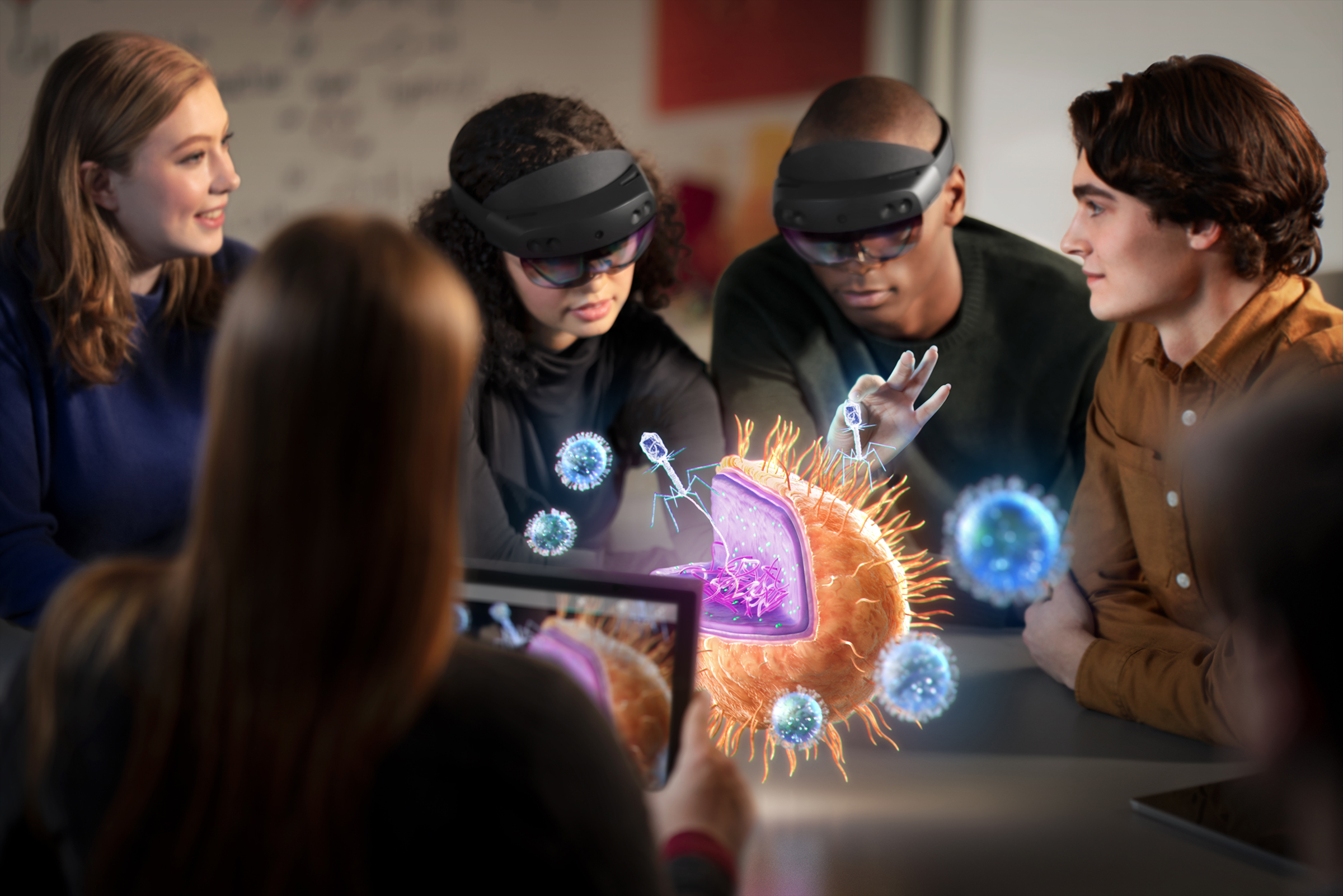
Three students using HoloLens
Microsoft AI and mixed reality enhance operations and training.

Industrial metaverse technologies are spurring leaders to transform their operations
Australian resources company Newcrest is leveraging Microsoft technology to improve operational performance through a digital twin of its value chain and a high-impact sustainability data model. Renault is optimizing training for its technicians with HoloLens 2 and Dynamics 365 Remote Assist, cutting CO2 emissions by 80% through reduction in travel. With Microsoft HoloLens 2 and Azure Mixed Reality, GE Healthcare is giving service engineers hands-on practice to service complex medical equipment. NUS Yong Loo Lin School of Medicine in Singapore is using  HoloLens 2 to teach medical and nursing undergraduates. Italian rail infrastructure manager Ferrovie dello Stato Italiane is deploying Azure AI and mixed reality technology for onsite and remote progress evaluation and quality checks of rail construction sites.

Organizations are differentiating through end-to-end security
Swiss agriculture supply chain company COFCO International is using Microsoft Defender for IoT and Microsoft Sentinel to secure its production environment. Heineken is meeting its security and agility needs with Microsoft while “brewing a better world” that is zero waste, carbon neutral and water positive. In Canada, the Government of Alberta has stopped at least 1,000 cyberattacks with our technology. The Royal Melbourne Institute of Technology is future-proofing a secure university-to-student connection with Azure Active Directory. Martin & Zerfoss is turning to Microsoft Defender for Business to make enterprise-level security affordable for small businesses. E-commerce company QNET has migrated to Azure with an end-to-end security strategy for more productivity, transparency and return on IT investments.

Two students look at Surface screen
Digital technologies transform virtual and classroom learning.

Hybrid learning is here to stay
Austria-based SOS Children’s Villages is helping children in more than 130 countries and offers child care training to parents and caregivers through a multilingual digital assistant with Azure Cognitive Services. The Sinjai Regional Office of Education in Indonesia is transforming the way students learn together in hybrid classrooms using Microsoft 365 and Teams. The University of Bath is helping its researchers process high volumes of data faster with Azure HPC + AI. Mexico’s Instituto Tecnológico de Monterrey is serving teachers, students and staff with a virtual assistant built with the Azure Bot Framework. The Education Authority is delivering 20,000 new Microsoft Surface Pro 7+ devices to more than 1,100 schools in Northern Ireland. The Tolleson Union High School District is helping develop the next generation of leaders with Surface laptops, and the Space Plants Lab at the University of Florida is pushing the boundaries of botany in space with Microsoft Surface Pro 7.

Despite ongoing headwinds, customers continue to innovate in impressive ways. With the power of the Microsoft Cloud, they are actively mitigating risks to better serve their own customers and reach their targets for sustainable growth and market share. As their most trusted technology partner, we take great pride in co-innovating solutions that help their businesses achieve their potential, and we look forward to our continued collaboration ahead.

Tags: , , , , , , , , , , ,