It is bittersweet to announce that I have decided to move on from my role as the Fedora Community Action and Impact Coordinator (FCAIC). For me, this role has been full of growth, unexpected challenges, and so much joy. It has been a privilege to help guide our wonderful community through challenges of the last three years. I’m excited to see what the next FCAIC can do for Fedora. If you’re interested in applying, see the FCAIC job posting on Red Hat Jobs and read more about the role below.
Adapting to Uncertain Times
When I applied back in 2019, a big part of the job description was to travel the globe, connecting with and supporting Fedora communities worldwide. As we all know, that wasn’t possible with the onset of COVID-19 and everything that comes with a pandemic.
Instead, I learned how to create virtual experiences for Fedora, connect with people solely in a virtual environment, and support contributors from afar. Virtual events have been a HUGE success for Fedora. The community has shown up for those events in such a wonderful way. We have almost tripled our participation in our virtual events since the first Release Party in 2020. We have more than doubled the number of respondents to the Annual Contributor Survey over last year’s turnout. I am proud of the work I have accomplished and even more so how much the community has grown and adapted to a very challenging couple of years.
What’s next for me
As some of you may know, I picked up the Code of Conduct (CoC) work that my predecessor Brian Exelbierd (Bex) started for Fedora. After the Fedora Council approved the new CoC, I then got started on additional pieces of related work: Supplemental Documentation and Moderation Guidelines. I am also working on expanding the small Code of Conduct Committee(CoCC) to include more community members. As a part of the current CoCC, I have helped to deal with the majority of the incidents throughout my time as FCAIC.
Because of my experience with all this CoC work, I will be moving into a new role inside of Red Hat’s OSPO: Code of Conduct Specialist. I will be assisting other Community Architects (like the FCAIC role) to help roll out CoC’s and governance around them, as well as collaborating with other communities to develop a Community of Practice around this work. I am excited and determined to take on this new challenge and very proud to be a part of an organization that values work that prioritizes safety and inclusion.
What’s next for Fedora
This is an amazing opportunity for the Fedora community to grow in new and exciting ways. Every FCAIC brings their own approach to this role as well as their own ideas, strengths, and energy. I will be working with Matthew Miller, Ben Cotton, and Red Hat to help hire and onboard the new Fedora Community Action and Impact Coordinator. I will continue as FCAIC until we hire someone new, and will help transition them into the role. Additionally, I will offer support, advice, and guidance as others who have moved on have done for me. I am eager to see who comes next and how I can help them become a success. And, as I have for years prior to my tenure as FCAIC, I will continue to participate in the community, albeit in different ways.
This means we are looking for a new FCAIC! Do you love Fedora? Do you want to help support and grow the community full time? This is the core of what the FCAIC does. The job description has a list of the primary job responsibilities and required skills- but that is just a taste of what is required and what it is to support the Fedora community full time. Day-to-day work includes working with the Mindshare Committee, managing the Fedora budget, and being a part of many other teams and in many places. You should be ready and excited to write about Fedora’s achievements, policies, as well as generate strategies to help the community succeed. And, of course, there is event planning and support (Flock, Nest, Hatch, Release Parties, etc). It can be tough work, but it is a lot of fun and wonderfully rewarding to help Fedora thrive.
How to apply
Do you enjoy working with people all over the world, with a variety of skills and interests? Are you good at setting long term goals and seeing them through to completion? Can you set priorities, follow through, and know when to say “no” in order to focus on the most important tasks for success? Are you excited about building not only a successful Linux distribution, but also a healthy project? Is Fedora’s mission deeply important to you? If you said “yes” to these questions, you might be a great candidate for the FCAIC role. If you think you’re a great fit, please apply online, or contact Marie Nordin, or Jason Brooks.
One of the key aspects of system security is encrypting storage at rest. Without encrypted storage, any time a storage device leaves your presence it can be at risk. The most obvious scenario where this can happen is if a storage device (either just the storage device or the entire system, server, or laptop) is lost or stolen.
However, there are other scenarios that are a concern as well: perhaps you have a storage device fail, and it is replaced under warranty — many times the vendor will ask you to return the original device. If the device was encrypted, it is much less of a concern to return it back to the hardware vendor.
Another concern is anytime your storage device is out of sight there is a risk that the data is copied or cloned off of the device without you even being aware. Again, if the device is encrypted, this is much less of a concern.
Fedora (and other Linux distributions) include the Linux Unified Key Setup (LUKS) functionality to support disk encryption. LUKS is easy to use, and is even integrated as an option in the Fedora Anaconda installer.
However there is one challenge that frequently prevents people from implementing LUKS on a large scale, especially for the root filesystem: every single time you reboot the host you generally have to manually access the console and type in the LUKS passphrase so the system can boot up.
If you are running Fedora on a single laptop, this might not be a problem, after all, you probably are sitting in front of your laptop any time you reboot it. However, if you have a large number of Fedora instances, this quickly becomes impractical to deal with.
If you have hundreds of systems, it is impractical to manually type the LUKS passphrase on each system on every reboot
You might be managing Fedora systems that are at remote locations, and you might not even have good or reliable ways to access a console on them. In this case, rebooting the hosts could result in them not coming up until you or someone else travels to their location to type in the LUKS passphrase.
This article will cover how to implement a solution to enable automated LUKS volume unlocking (and the process to implement these features will be done using automation as well!)
Overview of Clevis and Tang
Clevis and Tang are an innovative solution that can help with the challenge of having systems with encrypted storage boot up without manual user intervention on every boot. At a high level, Clevis, which is installed on the client systems, can enable LUKS volumes to be unlocked without user intervention as long as the client system has network access to a configurable number of Tang servers.
The basic premise is that the Tang server(s) are on an internal/private or otherwise secured network, and if the storage devices are lost, stolen, or otherwise removed from the environment, that they would no longer have network access to the Tang server(s), and thus no longer automatically unlock automatically at boot.
Tang is stateless and doesn’t require authentication or even TLS, which means it is very lightweight and easy to configure, and can run from a container. In this article, I’m only setting up a single Tang server, however it is also possible to have multiple Tang servers in an environment, and to configure the number Tang servers the Clevis clients must connect to in order to unlock the encrypted volume. For example, you could have three Tang servers, and require the Clevis clients to be able to connect to at least two of the three Tang servers.
Linux System Roles is a set of Ansible Roles/Collections that can help automate the configuration and management of many aspects of Fedora, CentOS Stream, RHEL, and RHEL derivatives. Linux System Roles is packaged in Fedora as an RPM (linux-system-roles) and is also available on Ansible Galaxy (as both roles and as a collection). For more information on Linux System Roles, and to see a list of included roles, refer to the Linux System Roles project page.
Included in the list of Linux System Roles are the nbde_client, nbde_server, and firewall roles that will be used in this article. The nbde_client and nbde_server roles are focused on automating the implementation of Clevis and Tang, respectively. The “nbde” in the role names stands for network bound disk encryption, which is another term to refer to using Clevis and Tang for automated unlocking of LUKS encrypted volumes. The firewall role can automate the implementation of firewall settings, and will be used to open a port in the firewall on the Tang server.
Demo environment overview
In my environment, I have a Raspberry Pi, running Fedora 36 that I will install Linux System Roles on and use as my Ansible control node. In addition, I’ll use this same Raspberry Pi as my Tang server. This device is configured with the pi.example.com hostname.
In addition, I have four other systems in my environment: two Fedora 36 systems, and two CentOS Stream 9 systems, named fedora-server1.example.com, fedora-server2.example.com, c9s-server1.example.com, and c9s-server2.example.com. Each of these four systems has a LUKS encrypted root filesystem and currently the LUKS passphrase must be manually typed in each time the systems boot up.
I’ll use the nbde_server and firewall roles to install and configure Tang on my pi.example.com system, and use the nbde_client role to install and configure Clevis on my four other systems, enabling them to automatically unlock their encrypted root filesystem if they can connect to the pi.example.com Tang system.
Installing Linux System Roles and Ansible on the Raspberry Pi
I’ll start by installing the linux-system-roles package on the pi.example.com host, which will act as my Ansible control node. This will also install ansible-core and several other packages as dependencies. These packages do not need to be installed on the other four systems in my environment (which are referred to as managed nodes).
$ sudo dnf install linux-system-roles
SSH keys and sudo configuration need to be configured so that the control node host can connect to each of the managed nodes in the environment and escalate to root privileges.
Defining the Ansible inventory file
Still on the pi.example.com host, I’ll create an Ansible inventory file to group the five systems in my environment into two Ansible inventory groups. The nbde_servers group will contain a list of hosts that I would like to configure as Tang servers (which in this example is only the pi.example.com host), and the nbde_clients group will contain a list of hosts that I would like to configure as Clevis clients. I’ll name this inventory file inventory.yml and it contains the following content:
Ansible variables are set to specify what configuration should be implemented by the Linux System Roles. Each role has a README.md file that contains important information on how to use each role, including a list of available role variables. The README.md files for the nbde_server, nbde_client, and firewall roles are available in the following locations, respectively:
I’ll create a group_vars directory with the mkdir group_vars command. Within this directory, I’ll create a nbde_servers.yml file and nbde_clients.yml file, which will define, respectively, the variables that should be set for systems listed in the nbde_servers inventory group and the nbde_clients inventory group.
The nbde_servers.yml file contains the following content, which will instruct the firewall role to open TCP port 80, which is the default port used by Tang:
firewall: - port: ['80/tcp'] state: enabled
The nbde_clients.yml file contains the following content:
Under nbde_client_bindings, device specifies the backing device of the encrypted root filesystem on the four managed nodes. The encryption_password specifies a current LUKS passphrase that is required to configure Clevis. In this example, I’ve used ansible-vault to encrypt the string rather than place the LUKS passphrase in clear text. And finally, under servers, a list of Tang servers that Clevis should bind to are specified. In this example, the Clevis clients will be configured to bind to the pi.example.com Tang server.
Creating the playbook
I’ll create a simple Ansible playbook, named nbde.yml that will call the firewall and nbde_server roles for systems in the nbde_servers inventory group, and call the nbde_client role for systems in the nbde_clients group:
The -i flag specifies which inventory file should be used, the –ask-vault-pass flag will prompt for the Ansible Vault password to decrypt the encryption_password variable, and the -b flag specifies that Ansible should escalate to root privileges.
play recap output from ansible-playbook command showing playbook successfully completed
Validating the configuration
To validate the configuration, I rebooted each of my four managed nodes that were configured as Clevis clients of the Raspberry Pi Tang server. Each of the four managed nodes boots up and briefly pauses on the LUKS passphrase prompt:
Systems boot up to LUKS passphrase prompt, and automatically continue booting after a brief pause
However, after the brief delay, each of the four systems continued booting up without requiring me to enter the LUKS passphrase.
Conclusion
If you would like to secure your data at rest with LUKS encryption, but need a solution that enables systems to boot up without intervention, consider implementing Clevis and Tang. Linux System Roles can help you implement Clevis and Tang, as well as a number of other aspects of your system, in an automated manner.
First-person shooter video games are a great proving ground for strategies that make you finish on the top, reflexes that help you to shoot before getting shot and agility that adjusts you to whatever a situation throws at you. Add the open-ended nature brought in by large intricately-designed worlds into the mix, and it dials the player experience to eleven and, with that, it also becomes great evidence of what a platform is capable of. Needless to say, I have been a great fan of open-world first-person shooter games. And Ubisoft’s Far Cry series happens to be the one which remains closest to my heart. So I tried the (second) most recent release in the long-running series, Far Cry 5 which came out in 2018, on Fedora Workstation 35 to see how it performs.
Just like in my previous case study, the testing hardware has an AMD RDNA2-based GPU, where the video game was configured to the highest possible graphical preset to stress the hardware into performing as much as its limiting factor. To ensure that we have a fair comparison, I set up two environments – one with Windows 10 Pro 21H2 and one with Fedora Workstation 35, both having up-to-date drivers and support software such as MSI Afterburner or MangoHUD for monitoring, Steam or Lutris for video game management and OBS Studio for footage recording. Adding to that, the benchmarks were ensured to be both representatives of a common gameplay scenario and variable enough to address resolution scaling and HD textures.
Cover art for “Far Cry 5”, Ubisoft, fair use, via Wikimedia Commons
Before we get into some actual performance testing and comparison results, I would like to go into detail about the video game that is at the centre of this case study. Far Cry 5 is a first-person action-adventure video game developed by Ubisoft Montreal and Ubisoft Toronto. The player takes the role of an unnamed junior deputy sheriff who is trapped in Hope County, a fictional region based in Montana and has to fight against a doomsday cult to take back the county from the grasp of its charismatic and powerful leader. The video game has been well received for the inclusion of branching storylines, role-playing elements and side quests, and is optimized enough to be a defining showcase of what the underlying hardware and platform are capable of.
Preliminary
Framerate
The first test that was performed had a direct implication on how smooth the playing experience would be across different platforms but on the same hardware configuration.
Without HD textures
On a default Far Cry 5 installation, I followed the configuration stated above but opted out of the HD textures pack to warm up the platforms with a comparatively easier test. Following are the results.
On average, the video game had around a whopping 59.25% more framerate on Fedora Workstation 35 than on Windows 10 Pro 21H2.
To ensure an overall consistent performance, both the minimum and maximum framerates were also noted to monitor dips and rises.
The minimum framerates on Fedora Workstation 35 were ahead by a big 49.10% margin as compared to those on Windows 10 Pro 21H2.
The maximum framerates on Fedora Workstation 35 were ahead by a big 62.52% margin as compared to those on Windows 10 Pro 21H2.
The X11 display server had roughly 0.52% more minimum framerate as compared to Wayland, which can be taken as a margin of error.
The Wayland display server had roughly 3.87% more maximum framerate as compared to X11, which can be taken as a margin of error.
With HD textures
On a default Far Cry 5 installation, I followed the configuration stated above, but this time I enabled the HD textures pack to stress the platforms with a comparatively harder test. Following are the results.
On average, the video game had around a whopping 65.63% more framerate on Fedora Workstation 35 than on Windows 10 Pro 21H2.
To ensure an overall consistent performance, both the minimum and maximum framerates were also noted to monitor dips and rises.
The minimum framerates on Fedora Workstation 35 were ahead by a big 59.11% margin as compared to those on Windows 10 Pro 21H2.
The maximum framerates on Fedora Workstation 35 were ahead by a big 64.21% margin as compared to those on Windows 10 Pro 21H2.
The X11 display server had roughly 9.77% more minimum framerate as compared to Wayland, which is big enough to be considered.
The Wayland display server had roughly 1.12% more maximum framerate as compared to X11, which can be taken as a margin of error.
Video memory usage
The second test that was performed had less to do with the playing experience and more with the efficiency of graphical resource usage. Following are the results.
Without HD textures
On a default Far Cry 5 installation, I followed the configuration stated above but opted out of the HD textures pack to use comparatively lesser video memory across the platforms. Following are the results.
On average, Fedora Workstation 35 uses around 31.94% lesser video memory as compared to Windows 10 Pro 21H2.
The Wayland display server uses roughly 1.78% more video memory as compared to X11, which can be taken as a margin of error.
The video game usage estimated is closer to the actual readings on Fedora Workstation 35 than they are those on Windows 10 Pro 21H2.
Adding this to the previous results speaks about how Fedora Workstation 35 performs better while using fewer resources.
With HD textures
On a default Far Cry 5 installation, I followed the configuration stated above but this time I enabled the HD textures pack to stress the platforms by occupying more video memory. Following are the results.
On average, Fedora Workstation 35 uses around 22.79% lesser video memory as compared to Windows 10 Pro 21H2.
The Wayland display server uses roughly 2.73% more video memory as compared to X11, which can be taken as a margin of error.
The video game usage estimated is closer to the actual readings on Fedora Workstation 35 than they are those on Windows 10 Pro 21H2.
Adding this to the previous results speaks about how Fedora Workstation 35 performs better while using fewer resources.
System memory usage
The third test that was performed had less to do with the playing experience and more with how other applications can fit in the available memory while the video game is running. Following are the results.
Without HD textures
On a default Far Cry 5 installation, I followed the configuration stated above but opted out of the HD textures pack to warm up the platforms with a comparatively easier test. Following are the results.
On average, Fedora Workstation 35 uses around 38.10% lesser system memory as compared to Windows 10 Pro 21H2.
The Wayland display server uses roughly 4.17% more system memory as compared to X11, which can be taken as a margin of error.
Adding this to the previous results speaks about how Fedora Workstation 35 performs better while using fewer resources.
Lesser memory usage by the video game leaves out extra headroom for other applications to run simultaneously with no compromises.
With HD textures
On a default Far Cry 5 installation, I followed the configuration stated above, but this time I enabled the HD textures pack to stress the platforms with a comparatively harder test. Following are the results.
On average, Fedora Workstation 35 uses around 33.58% lesser system memory as compared to Windows 10 Pro 21H2.
The Wayland display server uses roughly 7.28% more system memory as compared to X11, which is big enough to be considered.
Adding this to the previous results speaks about how Fedora Workstation 35 performs better while using fewer resources.
Lesser memory usage by the video game leaves out extra headroom for other applications to run simultaneously with no compromises.
Advanced
Without HD textures
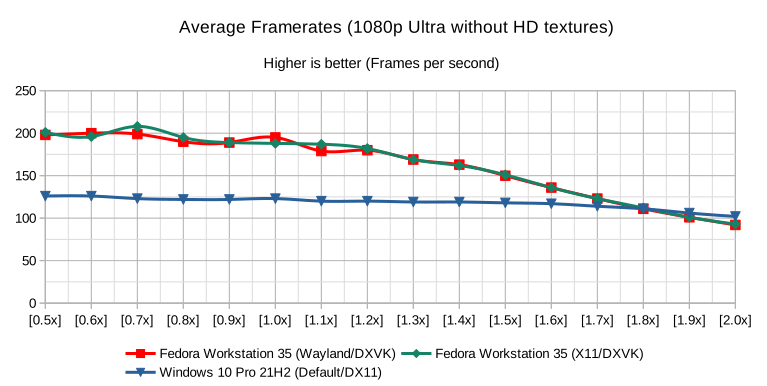
On a default Far Cry 5 installation, I followed the previously stated configuration without the HD textures pack and ran the tests with varied resolution multipliers. Following are the results.
Minimum framerates recorded
A great deal of inconsistent performance is visible on Fedora Workstation 35 with both display servers in lower resolution scales.
The inconsistencies seem to normalize for the resolution multipliers on and beyond the 1.1x resolution scale for Fedora Workstation 35.
Resolution multipliers do not seem to have a great effect on the framerate on Windows 10 Pro 21H2 as much as on Fedora Workstation 35.
Although Windows 10 Pro 21H2 misses out on potential performance advantages in lower resolution multipliers, it has been consistent.
Records on Windows 10 Pro 21H2 in the 2.0x resolution multiplier appear to be marginally better than those on Fedora Workstation 35.
Maximum framerates recorded
A small amount of inconsistent performance is visible on Fedora Workstation 35 with both display servers in lower resolution scales.
The inconsistencies seem to normalize for the resolution multipliers on and beyond the 1.1x resolution scale for Fedora Workstation 35.
Resolution multipliers change starts noticeably affecting performance on Windows 10 Pro 21H2 on a 1.6x scale, beyond which it falls greatly.
Although Windows 10 Pro 21H2 misses out on potential performance advantages in lower resolution multipliers, it has been consistent.
Records on Windows 10 Pro 21H2 in the 1.6x resolution multiplier and beyond appear to be better than those on Fedora Workstation 35.
Average framerates recorded
A minor amount of inconsistent performance is visible on Fedora Workstation 35 with both display servers in lower resolution scales.
The inconsistencies seem to normalize for the resolution multipliers on and beyond the 1.1x resolution scale for Fedora Workstation 35.
Resolution multipliers change starts noticeably affecting performance on Windows 10 Pro 21H2 on a 1.6x scale, beyond which it falls greatly.
Although Windows 10 Pro 21H2 misses out on potential performance advantages in lower resolution multipliers, it has been consistent.
Records on Windows 10 Pro 21H2 in the 1.9x resolution multiplier and beyond appear to be better than those on Fedora Workstation 35.
With HD textures
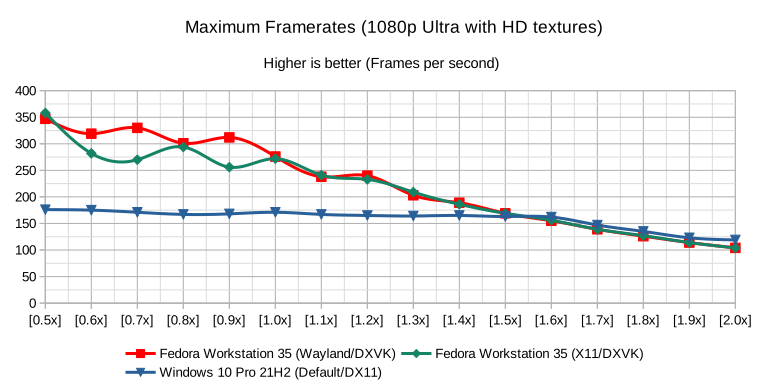
On a default Far Cry 5 installation, I followed the previously stated configuration with the HD textures pack and ran the tests with varied resolution multipliers. Following are the results.
Minimum framerates recorded
A great deal of inconsistent performance is visible on Fedora Workstation 35 with both display servers in lower resolution scales.
The inconsistencies seem to normalize for the resolution multipliers on and beyond the 1.5x resolution scale for Fedora Workstation 35.
Resolution multipliers do not seem to have a great effect on the framerate on Windows 10 Pro 21H2 as much as on Fedora Workstation 35.
Although Windows 10 Pro 21H2 misses out on potential performance advantages in lower resolution multipliers, it has been consistent.
Records on Windows 10 Pro 21H2 in the 2.0x resolution multiplier appear to be marginally better than those on Fedora Workstation 35.
Maximum framerates recorded
A great deal of inconsistent performance is visible on Fedora Workstation 35 with both display servers in lower resolution scales.
The inconsistencies seem to normalize for the resolution multipliers on and beyond the 1.0x resolution scale for Fedora Workstation 35.
Resolution multipliers change starts noticeably affecting performance on Windows 10 Pro 21H2 on a 1.6x scale, beyond which it falls greatly.
Although Windows 10 Pro 21H2 misses out on potential performance advantages in lower resolution multipliers, it has been consistent.
Records on Windows 10 Pro 21H2 in the 1.6x resolution multiplier and beyond appear to be better than those on Fedora Workstation 35.
Average framerates recorded
A minor amount of inconsistent performance is visible on Fedora Workstation 35 with both display servers in lower resolution scales.
The inconsistencies seem to normalize for the resolution multipliers on and beyond the 1.1x resolution scale for Fedora Workstation 35.
Resolution multipliers change starts noticeably affecting performance on Windows 10 Pro 21H2 on a 1.6x scale, beyond which it falls greatly.
Although Windows 10 Pro 21H2 misses out on potential performance advantages in lower resolution multipliers, it has been consistent.
Records on Windows 10 Pro 21H2 in the 1.9x resolution multiplier and beyond appear to be better than those on Fedora Workstation 35.
Inferences
If the test results and observations baffle you, please allow me to tell you that you are not the only one who feels like that. For a video game that was created to run on Windows, it is hard to imagine how it ends up performing way better on Fedora Workstation 35, all while using a much lesser amount of system resources at all times. Special attention has been given to noting down the highest highs and lowest lows of framerates to ensure that consistent performance is made available.
But wait a minute – how is it that Fedora Workstation 35 manages to make this possible? Well, while I do not have a clear idea of what exactly goes on behind the scenes, I do have a certain number of assumptions that I suspect might be the reasons attributing to such brilliant visuals, great framerates and efficient resource usage. These can potentially act as starting points for us to understand the features of Fedora Workstation 35 for compatibility layers to make use of.
Effective caching of graphical elements and texture assets in the video memory allows for keeping only those data in the memory which are either actively made use of or regularly referenced. The open-source AMD drivers help Fedora Workstation 35 make efficient use of the available frame buffer.
Quick and frequent cycling of data elements from the video memory helps to bring down total occupancy per application at any point in time. The memory clocks and shader clocks are left at the application’s disposal by the open-source AMD drivers, and firmware bandwidth limits are all but absent.
With AMD Smart Access Memory (SAM) enabled, the CPU is no longer restricted to using only 256MiB of the video memory at a time. A combination of leading-edge kernel and up-to-date drivers makes it available on Fedora Workstation 35 and capable of harnessing the technology to its limits.
Extremely low system resource usage by supporting software and background services leaves out a huge majority of them to be used by the applications which need it the most. Fedora Workstation 35 is a lightweight distribution, which does not get in your way and puts the resources on what’s important.
Faster loading of data elements to and from the physical storage devices to the system memory is greatly enhanced with the use of high-capacity modern copy-on-write file systems like BTRFS and journaling file systems like EXT4, which happens to be the suggested file system for Fedora Workstation 35.
Performance improvements like these only make me want to indulge more in testing and finding out what else Fedora Workstation is capable of. Do let me know what you think in the comments section below.
The kernel team is working on final integration for Linux kernel 5.18. This version was just recently released, and will arrive soon in Fedora. As a result, the Fedora kernel and QA teams have organized a test week now through Sunday, June 12, 2022. Refer to the wiki page for links to the test images you’ll need to participate. Read below for details.
How does a test week work?
A test week is an event where anyone can help make sure changes in Fedora work well in an upcoming release. Fedora community members often participate, and the public is welcome at these events. If you’ve never contributed before, this is a perfect way to get started.
To contribute, you only need to be able to do the following things:
Download test materials, which include some large files
Read and follow directions step by step
The wiki page for the kernel test day has a lot of good information on what and how to test. After you’ve done some testing, you can log your results in the test day web application. If you’re available on or around the day of the event, please do some testing and report your results. We have a document which provides all the steps written.
Happy testing, and we hope to see you on test day.
Fedora Linux provides several variants to meet your needs. You can find an overview of all the Fedora Linux variants in my previous article Introduce the different Fedora Linux editions. This article will go into a little more detail about the Fedora Linux official editions. There are five editions — Fedora Workstation, Fedora Server, Fedora IoT, Fedora CoreOS, and Fedora Silverblue. The Fedora Linux download page currently shows that three of these are official editions and the remaining two are emerging editions. This article will cover all five editions.
Fedora Workstation
If you are a laptop or desktop computer user, then Fedora Workstation is the right operating system for you. Fedora workstation is very easy to use. You can use this for daily needs such as work, education, hobbies, and more. For example, you can use it to create documents, make presentations, surf the internet, manipulate images, edit videos, and many other things.
This Fedora Linux edition comes with the GNOME Desktop Environment by default. You can work and do activities comfortably using this appearance concept. You can also customize the appearance of this Fedora Workstation according to your preferences, so you will be more comfortable using it. If you are a new Fedora Workstation user, you can read my previous article Things to do after installing Fedora 34 Workstation. Through the article, you will find it easier to start with Fedora Workstation.
Many companies require their own servers to support their infrastructure. The Fedora Server edition operating system comes with a powerful web-based management interface called Cockpit that has a modern look. Cockpit enables you to easily view and monitor system performance and status.
Fedora Server includes some of the latest technology in the open source world and it is backed by an active community. It is very stable and reliable. However, there is no guarantee that anyone from the Fedora community will be available or able to help if you encounter problems. If you are running mission critical applications and you might require technical support, you might want to consider Red Hat Enterprise Linux instead.
Operating systems designed specifically for IoT devices have become popular. Fedora IoT is an operating system created in response to this. Fedora IoT is an immutable operating system that uses OSTree Technology with atomic updates. This operating system focuses on security which is very important for IoT devices. Fedora IoT has support for multiple architectures. It also comes with a web-based configuration console so that it can be configured remotely without requiring that a keyboard, mouse or monitor be physically connected to the device.
Fedora CoreOS is a container-focused operating system. This operating system is used to run applications safely and reliably in any environment. It is designed for clusters but can also be run as a standalone system. This operating system has high compatibility with Linux Container configurations.
This edition is a variant of Fedora Workstation with an interface that is not much different. However, the difference is that Fedora Silverblue is an immutable operating system with a container-centric workflow. This means that each installation is exactly the same as another installation of the same version. The goal is to make it more stable, less prone to bugs, and easier to test and develop.
Each edition of Fedora Linux has a different purpose. The availability of several editions can help you to get an operating system that suits your needs. The Fedora Linux editions discussed in this article are the operating systems available on the main download page for Fedora Linux. You can find download links and more complete documentation at https://getfedora.org/.
Copr is a build system for anyone in the Fedora community. It hosts thousands of projects for various purposes and audiences. Some of them should never be installed by anyone, some are already being transitioned to the official Fedora Linux repositories, and the rest are somewhere in between. Copr gives you the opportunity to install third-party software that is not available in Fedora Linux repositories, try nightly versions of your dependencies, use patched builds of your favorite tools to support some non-standard use cases, and just experiment freely.
You may be aware the DNF team is working on DNF5. There is a change proposal for Fedora Linux 38. The benefit is that every package management software — including PackageKit, and DNFDragora — should use a common libdnf library. If you have an application that handles RPM packages, you should definitely check out this project.
Hare is a systems programming language designed to be simple, stable and robust. Hare uses a static type system, manual memory management, and a minimal runtime. It is well suited to writing operating systems, system tools, compilers, networking software, and other low-level, high-performance tasks. A detailed overview can be found in these slides.
My summary is: Hare is simpler than C. It can be easy. But if you insist on shooting in your legs, Hare will allow you to do it.
These packages are available for Fedora Linux 35, 36 and Rawhide. They are also available for OpenSUSE Leap and Tumbleweed. To install them, enter these commands:
As automation expands to cover more aspects of IT, more administrators are learning automation skills and applying them to ease their workload. Automation can ease the burden of repetitive tasks and add a level of conformity to infrastructure. But when IT workers deploy automation, there are common mistakes that can wreak havoc on infrastructures large and small. Five common mistakes are typically seen in automation deployments.
Lack of testing
A beginner’s mistake that is commonly made is that automation scripts are not thoroughly tested. A simple shell script can have adverse affects on a server due to typos or logic errors. Multiply that mistake by the number of servers in your infrastructure, and you can have a big mess to clean up. Always test your automation scripts before deploying in large scale.
Unexpected server load
The second mistake that frequently occurs is not predicting the system load the script may put on other resources. Running a script that downloads a file or installs a package from a repository may be fine when the target is a dozen servers. Scripts are often run against hundreds or thousands of servers. This load can bring supporting services to a stand still or crash them entirely. Don’t forget to consider end point impact or set a reasonable concurrency rate.
Run away scripts
One use of automation tools is to ensure compliance to standard settings. Automation can make it easy to ensure that every server in a group has exactly the same settings. Problems may arise if a server in that group needs to be altered from that baseline, and the administrator is not aware of the compliance standard. Unneeded and unwanted services can be installed and enabled leading to possible security concerns.
Lack of documentation
A constant duty for administrators should be to document their work. Companies can have frequent new employees in IT departments due to contracts ending or promotions or regular employee turnover. It is also not uncommon for work groups within a company to be siloed from each other. For these reasons it is important to document what automation is in place. Unlike user run scripts, automation may continue long after the person who created it leaves the group. Administrators can find themselves facing strange behaviors in their infrastructure from automation left unchecked.
Lack of experience
The last mistake on the list is when administrators do not know enough about the systems they are automating. Too often admins are hired to work positions where they do not have adequate training and no one to learn from. This has been especially relevant since COVID when companies are struggling to fill vacancies. Admins are then forced to deal with infrastructure they didn’t set up and may not fully understand. This can lead to very inefficient scripts that waste resources or misconfigured servers.
Conclusion
More and more admins are learning automation to help them in their everyday tasks. As a result, automation is being applied to more areas of technology. Hopefully this list will help prevent new users from making these mistakes and urge seasoned admins to re-evaluate their IT strategies. Automation is meant to ease the burden of repetitive tasks, not cause more work for the end user.
Fedora Silverblue is an operating system for your desktop built on Fedora Linux. It’s excellent for daily use, development, and container-based workflows. It offers numerous advantages such as being able to roll back in case of any problems. If you want to update or rebase to Fedora Linux 36 on your Fedora Silverblue system (these instructions are similar for Fedora Kinoite), this article tells you how. It not only shows you what to do, but also how to revert things if something unforeseen happens.
Prior to actually doing the rebase to Fedora Linux 36, you should apply any pending updates. Enter the following in the terminal:
$ rpm-ostree update
or install updates through GNOME Software and reboot.
Rebasing using GNOME Software
GNOME Software shows you that there is new version of Fedora Linux available on the Updates screen.
Fedora 36 update available
First thing you need to do is download the new image, so click on the Download button. This will take some time. When it’s done you will see that the update is ready to install.
Fedora 36 update ready to install
Click on the Restart & Upgrade button. This step will take only a few moments and the computer will be restarted at the end. After restart you will end up in new and shiny release of Fedora Linux 36. Easy, isn’t it?
Rebasing using terminal
If you prefer to do everything in a terminal, then this part of the guide is for you.
Rebasing to Fedora Linux 36 using the terminal is easy. First, check if the 36 branch is available:
$ ostree remote refs fedora
You should see the following in the output:
fedora:fedora/36/x86_64/silverblue
If you want to pin the current deployment (this deployment will stay as option in GRUB until you remove it), you can do it by running:
$ sudo ostree admin pin 0
To remove the pinned deployment use the following command:
$ sudo ostree admin pin --unpin 2
where 2 is the position in the $rpm-ostree status
Next, rebase your system to the Fedora Linux 36 branch.
$ rpm-ostree rebase fedora:fedora/36/x86_64/silverblue
Finally, the last thing to do is restart your computer and boot to Fedora Linux 36.
How to roll back
If anything bad happens—for instance, if you can’t boot to Fedora Linux 36 at all—it’s easy to go back. Pick the previous entry in the GRUB menu at boot (if you don’t see it, try to press ESC during boot), and your system will start in its previous state before switching to Fedora Linux 36. To make this change permanent, use the following command:
$ rpm-ostree rollback
That’s it. Now you know how to rebase Fedora Silverblue to Fedora Linux 36 and roll back. So why not do it today?
Nowadays, the number of devices is getting bigger and bigger, and modern operating systems must try to support all types and several of them with every integration, with every release. Maintaining a large number of devices is difficult, expensive and also hard to test, specially for plug-and-play devices, like USB devices.
Therefore, it is necessary to create a mechanism to facilitate the maintenance and testing of old and new USB devices. And this is where USB device emulation comes in. In that way, a complete framework including a big bunch of emulated and validated USB devices will allow easier integration and release. The area of application would be very wide: earlier bug search/detection even during development, automatic tests, continuous integration, etc.
How to emulate USB devices
USB/IP project allows sharing the USB devices connected to a local machine so that they can be managed by another machine connected to the network by means of a TCP/IP connection.
Then USB/IP project consists of two parts:
local device support (host) to allow remote access to every necessary control events and data
remote control that catches every necessary control event and data to process like a normal driver
The procedure is valid for Linux and Windows, here I will focus only on Linux.
The idea behind emulation is to replace the remote device support with an application that behaves in the same way. In this way we can emulate devices with software applications that follow the commented USB/IP protocol specification.
In the following points I will describe how to configure and run the remote support and how to connect to our USB emulated device.
Remote support
Remote support is divided in two parts:
kernel space to control a remote device as it was local, that is, to be probed by the normal driver.
user space application to configure access to remote devices.
At this point, it is important to remark that the device emulators, after configuration by user space application, will communicate directly with the kernel space.
Local support has a very similar structure, but the focus of this article is device emulation.
Let’s analyze every part of remote support.
Kernel space
First of all, in order to get the functionality we need to compile the Linux Kernel with the following options:
CONFIG_USBIP_CORE=m CONFIG_USBIP_VHCI_HCD=m
These options enable the USB/IP virtual host controller driver, which is run on the remote machine.
Normal USB drivers need to be also included because they will be probed and configured in the same way from virtual host controller drivers.
Besides there are other important configuration options:
These options define the number of ports per USB/IP virtual host controller and the number of USB/IP virtual host controllers as if adding physical host controllers. These are the default values if CONFIG_USBIP_VHCI_HCD is enabled, increase if necessary.
The commented options and kernel modules are already included in some Linux distributions like Fedora Linux.
Let’s see an example of available virtual USB buses and ports that we will use later.
Default and real resources in example equipment:
$ lsusb Bus 002 Device 001: ID 1d6b:0003 Linux Foundation 3.0 root hub Bus 001 Device 002: ID 0627:0001 Adomax Technology Co., Ltd Bus 001 Device 001: ID 1d6b:0002 Linux Foundation 2.0 root hub $ lsusb -t /: Bus 02.Port 1: Dev 1, Class=root_hub, Driver=xhci_hcd/15p, 5000M /: Bus 01.Port 1: Dev 1, Class=root_hub, Driver=xhci_hcd/15p, 480M |__ Port 1: Dev 2, If 0, Class=Human Interface Device, Driver=usbhid, 480M $
Now, we will load the module vhci-hcd into the system (default configuration for CONFIG_USBIP_VHCI_HC_PORTS and CONFIG_USBIP_VHCI_NR_HCS):
$ sudo modprobe vhci-hcd $ lsusb Bus 004 Device 001: ID 1d6b:0003 Linux Foundation 3.0 root hub Bus 003 Device 001: ID 1d6b:0002 Linux Foundation 2.0 root hub Bus 002 Device 001: ID 1d6b:0003 Linux Foundation 3.0 root hub Bus 001 Device 002: ID 0627:0001 Adomax Technology Co., Ltd Bus 001 Device 001: ID 1d6b:0002 Linux Foundation 2.0 root hub $ lsusb -t /: Bus 04.Port 1: Dev 1, Class=root_hub, Driver=vhci_hcd/8p, 5000M /: Bus 03.Port 1: Dev 1, Class=root_hub, Driver=vhci_hcd/8p, 480M /: Bus 02.Port 1: Dev 1, Class=root_hub, Driver=xhci_hcd/15p, 5000M /: Bus 01.Port 1: Dev 1, Class=root_hub, Driver=xhci_hcd/15p, 480M |__ Port 1: Dev 2, If 0, Class=Human Interface Device, Driver=usbhid, 480M $
The remote USB/IP virtual host controller driver will only use the configured virtualized resources. Of course, emulated devices will work in the same way.
User space
The other necessary part in the USB/IP project is the user space tool usbip and needs to be used to configure the referred kernel space on both sides, although, in the same way, we only focus on the remote side, since the local side will be represented by the emulator.
That is, usbip tool will configure the USB/IP virtual controller (tcp client) in kernel space to connect to the device emulator (tcp server) in order to establish a direct connection between them for USB configuration, events, data, etc. exchange.
The tool is independent of the type of device and is able to provide information about available and reserved resources (see more information in the examples below).
The local USB/IP virtual host controller needs to specify the pair bus-port that will used for remote access, it will be the same for emulated devices, but in this case, this pair can be anything because there is no real device and resource reservation is not necessary.
This tool is found on the Linux Kernel repository in order to be totally synchronized with it.
Location of the tool on the Linux Kernel repository: ./tools/usb/usbip
In some distribution like Fedora Linux, the usbip utility can be installed by means of usbip package from repositories. If usbip utility or related package can not be found, follow the instruction in the available README file to compile and install. Suitable rpm package can also be generated from the usbip-emulatorrepository:
$ git clone https://github.com/jtornosm/USBIP-Virtual-USB-Device.git $ cd USBIP-Virtual-USB-Device/usbip $ make rpm ...
$
How to emulate USB devices
Emulators are generated in Python and C. I have started with C development (I will focus on this part), but the same could be done in Python.
For C development, compile emulation tools from the usbip-emulatorrepository:
$ git clone https://github.com/jtornosm/USBIP-Virtual-USB-Device.git $ cd USBIP-Virtual-USB-Device/c $ make ...
$
All the supported devices emulated at this moment will be generated:
hid-keyboard
hid-mouse
cdc-adm
hso
cdc-ether
bt
rpm package (usbip-emulator) can be also generated with:
$ make rpm ...
$
As examples, Vendor and Product IDs are hardcoded in the code.
Following three examples to show how emulation works. We are using the same equipment for the emulator and remote USB/IP but they could run in different equipment. Besides, we are reserving different resources so all the devices could be emulated at the same time.
Example 1: hso
From one terminal, let’s emulate the hso device:
(“1-1” is the pair bus-port for the USB device on the local machine, as we are emulating, it could be anything. It is only important because usbip tool will have to use the same name to request the emulated device)
(As we saw previously, for this example machine, bus 3 is virtualized)
$ ip addr show dev hso
0 3: hso0: <POINTOPOINT,MULTICAST,NOARP> mtu 1486 qdisc noop state DOWN group default qlen 10 link/none $ rfkill list 0: hso-0: Wireless WAN Soft blocked: no Hard blocked: no ...
$ lsusb ... Bus 003 Device 002: ID 0af0:6711 Option GlobeTrotter Express 7.2 v2 ... $ lsusb -t ...
/: Bus 03.Port 1: Dev 1, Class=root_hub, Driver=vhci_hcd/8p, 480M |__ Port 1: Dev 2, If 0, Class=Vendor Specific Class, Driver=hso, 12M ...
$
In order to release resources:
$ sudo usbip port Imported USB devices ==================== Port 00: <Port in Use> at Full Speed(12Mbps) Option : GlobeTrotter Express 7.2 v2 (0af0:6711) 3-1 -> usbip://127.0.0.1:3241/1-1 -> remote bus/dev 001/002 $ sudo usbip detach -p 00 usbip: info: Port 0 is now detached! $
And we can check that the device is released:
$ ip addr show dev hso0 Device "hso0" does not exist. $ rfkill list ...
$ lsusb ... $
After this, we can emulate again or stop the emulated device from the first terminal (i.e. with Ctrl-C).
Example 2: cdc-ether
From one terminal, let’s emulate the cdc-ether device (root permission is required because raw socket needs to bind to specified interface for data plane):
(“1-1” is the pair bus-port for the USB device on the local machine, as we are emulating, it could be anything. It is only important because usbip tool will have to use the same name to request the emulated device)
(As we saw previously, for this example machine, bus 3 is virtualized)
$ ip addr show dev eth0 4: eth0: <BROADCAST,MULTICAST,UP,LOWER_UP> mtu 1500 qdisc fq_codel state UNKNOWN group default qlen 1000 link/ether 88:00:66:99:5b:aa brd ff:ff:ff:ff:ff:ff $ sudo ethtool eth0 ...
Link detected: yes $ lsusb ... Bus 003 Device 003: ID 0fe6:9900 ICS Advent ... $ lsusb -t ...
/: Bus 03.Port 1: Dev 1, Class=root_hub, Driver=vhci_hcd/8p, 480M |__ Port 2: Dev 3, If 0, Class=Communications, Driver=cdc_ether, 480M |__ Port 2: Dev 3, If 1, Class=CDC Data, Driver=cdc_ether, 480M ...
$
For this example, we can also test the data plane.
(IP forwarding is disabled in both sides)
First, we can configure the IP address in the emulated device:
$ sudo ip addr add 10.0.0.1/24 dev eth0 $ ip addr show dev eth0 4: eth0: <BROADCAST,MULTICAST,UP,LOWER_UP> mtu 1500 qdisc fq_codel state UNKNOWN group default qlen 1000 link/ether 88:00:66:99:5b:aa brd ff:ff:ff:ff:ff:ff inet 10.0.0.1/24 scope global eth0 valid_lft forever preferred_lft forever $
Second, for example, from other directly Ethernet connected machine (real or virtual) we can configure a macvlan interface in the same subnet to send/receive traffic (ping, iperf, etc.):
$ sudo ip link add macvlan0 link enp1s0 type macvlan mode bridge $ sudo ip addr add 10.0.0.2/24 dev macvlan0 $ sudo ip link set macvlan0 up $ ip addr show dev macvlan0 3: macvlan0@enp1s0: <BROADCAST,MULTICAST,UP,LOWER_UP> mtu 1500 qdisc noqueue state UP group default qlen 1000 link/ether d6:f1:cd:f1:cc:02 brd ff:ff:ff:ff:ff:ff inet 10.0.0.2/24 scope global macvlan0 valid_lft forever preferred_lft forever inet6 fe80::d4f1:cdff:fef1:cc02/64 scope link valid_lft forever preferred_lft forever $ ping 10.0.0.1 PING 10.0.0.1 (10.0.0.1) 56(84) bytes of data. 64 bytes from 10.0.0.1: icmp_seq=1 ttl=64 time=55.6 ms 64 bytes from 10.0.0.1: icmp_seq=2 ttl=64 time=2.19 ms 64 bytes from 10.0.0.1: icmp_seq=3 ttl=64 time=1.74 ms 64 bytes from 10.0.0.1: icmp_seq=4 ttl=64 time=1.76 ms 64 bytes from 10.0.0.1: icmp_seq=5 ttl=64 time=1.93 ms 64 bytes from 10.0.0.1: icmp_seq=6 ttl=64 time=1.65 ms ...
In order to release resources:
$ sudo usbip port Imported USB devices ==================== ...
Port 01: <Port in Use> at High Speed(480Mbps) ICS Advent : unknown product (0fe6:9900) 3-2 -> usbip://127.0.0.1:3245/1-1 -> remote bus/dev 001/003 $ sudo usbip detach -p 01 usbip: info: Port 1 is now detached! $
And we can check that the device is released:
$ ip addr show dev eth0 Device "eth0" does not exist. $ lsusb ... $
And of course, traffic from the other machine is not working:
From 10.0.0.2 icmp_seq=167 Destination Host Unreachable From 10.0.0.2 icmp_seq=168 Destination Host Unreachable From 10.0.0.2 icmp_seq=169 Destination Host Unreachable From 10.0.0.2 icmp_seq=170 Destination Host Unreachable ...
After this, we can emulate again or stop the emulated device from the first terminal (i.e. with Ctrl-C).
Example 3: bt
From one terminal, let’s emulate the Bluetooth device:
(“1-1” is the pair bus-port for the USB device on the local machine, as we are emulating, it could be anything. It is only important because usbip tool will have to use the same name to request the emulated device)
(As we saw previously, for this example machine, bus 3 is virtualized)
$ hciconfig -a hci0: Type: Primary Bus: USB BD Address: AA:BB:CC:DD:EE:11 ACL MTU: 310:10 SCO MTU: 64:8 UP RUNNING PSCAN ISCAN INQUIRY RX bytes:1451 acl:0 sco:0 events:80 errors:0 TX bytes:1115 acl:0 sco:0 commands:73 errors:0 Features: 0xff 0xff 0x8f 0xfe 0xdb 0xff 0x5b 0x87 Packet type: DM1 DM3 DM5 DH1 DH3 DH5 HV1 HV2 HV3 Link policy: RSWITCH HOLD SNIFF PARK Link mode: SLAVE ACCEPT Name: 'BT USB TEST - CSR8510 A10' Class: 0x000000 Service Classes: Unspecified Device Class: Miscellaneous, HCI Version: 4.0 (0x6) Revision: 0x22bb LMP Version: 3.0 (0x5) Subversion: 0x22bb Manufacturer: Cambridge Silicon Radio (10) $ rfkill list ...
1: hci0: Bluetooth Soft blocked: no Hard blocked: no $ lsusb ...
Bus 003 Device 004: ID 0a12:0001 Cambridge Silicon Radio, Ltd Bluetooth Dongle (HCI mode) ...
$ lsusb -t ...
/: Bus 03.Port 1: Dev 1, Class=root_hub, Driver=vhci_hcd/8p, 480M |__ Port 3: Dev 4, If 0, Class=Wireless, Driver=btusb, 12M |__ Port 3: Dev 4, If 1, Class=Wireless, Driver=btusb, 12M ...
$
And we can turn off and turn on the emulated Bluetooth device, detecting several fake Bluetooth devices:
(At this moment, fake Bluetooth devices are not emulated/simulated so we can not set up)
Turn Bluetooth offTurn Bluetooth on
In order to release resources:
$ sudo usbip port Imported USB devices ==================== ...
Port 02: <Port in Use> at Full Speed(12Mbps) Cambridge Silicon Radio, Ltd : Bluetooth Dongle (HCI mode) (0a12:0001) 3-3 -> usbip://127.0.0.1:3243/1-1 -> remote bus/dev 001/002 $ sudo usbip detach -p 02 usbip: info: Port 2 is now detached! $
And we can check that the device is released:
$ hciconfig $ rfkill list ...
$ lsusb ... $
And of course, device is not detected (as before emulation):
Bluetooth is not found
After this, we can emulate again or stop the emulated device from the first terminal (i.e. with Ctrl-C).
Emulated vs real USB devices
When the real hardware and/or final device is not used to test, we can always feel insecure about the results, and this is the biggest hurdle that we will have to overcome to check the correct operation of the devices by means of emulation.
So, in order to be confident, emulation must be as close as possible to the real hardware and in order to get the most real emulation every aspect of the device must be covered (or at least the necessary ones if they are not related with other aspects). In fact, for a correct test, we must not modify the driver, that is, we must only emulate the physical layer, so that the driver is not able to know if the device is real or emulated.
Starting to test with the real hardware device is a very good idea to get a reference to build the emulator with the same features. For the case of USB devices, the device emulator building is easier because of the existing procedure to get remote control that complies with all the characteristics mentioned above.
Conclusion
USB device emulation is the best way to integrate and test the related features in an efficient, automatic and easy way. But, in order to be confident about the emulation procedure, device emulators need to be previously validated to confirm that they work in the same way as real hardware.
Of course, the USB device emulator is not the same as the real hardware device, but the commented method, thanks to the tested procedure to get remote control of the device, it’s very close to the real scenario and can help a lot to improve our release and testing processes.
Finally, I would like to comment that one of the best advantages of using software emulators is that we will be able to cause specific behaviors, in a simple way, that would be very difficult to reproduce with real hardware, and this could help to find issues and be more robust.
The latest release of Fedora Workstation 36 continues the Fedora Project’s ongoing commitment to delivering the latest innovations in the open source world. This article describes some of the notable user-facing changes that appear in this version.
GNOME 42
Fedora Workstation 36 includes the latest version of the GNOME desktop environment. GNOME 42 includes many improvements and new features. Just some of the improvements include:
Significantly improved input handling, resulting in lower input latency and improved responsiveness when the system is under load. This is particularly beneficial for games and graphics applications.
The Wayland session is now the default for those who use Nvidia’s proprietary graphics driver.
A universal dark mode is now available.
A new interface has been added for taking screenshots and screen video recordings.
In addition, many of the core apps have been ported to GTK 4, and the shell features a number of subtle refinements.
Refreshed look and feel
GNOME 42 as featured in Fedora Workstation 36
GNOME Shell features a refreshed look and feel, with rounder and more clearly separated elements throughout. All the symbolic icons have been updated and the top bar is no longer rounded.
Universal dark mode option
In Settings > Appearance, you can now choose a dark mode option which applies a dark theme to all supported applications. In addition, the pre-installed wallpapers now include dark mode variants. Dark themes can help reduce eye-strain when there is low ambient light, can help conserve battery life on devices with OLED displays, and can reduce the risk of burn-in on OLED displays. Plus, it looks cool!
New screenshot interface
Taking screenshots and screen video recordings is now easier than ever
Previously, pressing the Print Screen key simply took a screenshot of the entire screen and saved it to the Pictures folder. If you wanted to customize your screenshots, you had to remember a keyboard shortcut, or manually open the Screenshots app and use that to take the screenshot you wanted. This was inconvenient.
Now, pressing Print Screen presents you with an all-new user interface that allows you to take a screenshot of either your entire screen, just one window, or a rectangular selection. You can also choose whether to hide or show the mouse pointer, and you can also now take a screen video recording from within the new interface.
Core applications
Apps made in GTK 4 + libadwaita feature a distinct visual style
GNOME’s core applications have seen a number of improvements. A number of them have been ported to GTK 4 and use libadwaita, a new widget library that implements GNOME’s Human Interface Guidelines.
Files now includes the ability to sort files by creation date, and includes some visual refinements, such as a tweaked headerbar design and file renaming interface.
The Software app now includes a more informative update interface, and more prominently features GNOME Circle apps.
The Settings app now has a more visually appealing interface matching the visual tweaks present throughout GNOME Shell.
Text Editor replaces Gedit by default. Text Editor is an all-new app built in GTK 4 and libadwaita. You can always reinstall Gedit by searching for it in the Software app.
Wayland support on Nvidia’s proprietary graphics driver
In previous versions, Fedora Workstation defaulted to the X display server when using Nvidia’s proprietary graphics driver – now, Fedora Workstation 36 uses the Wayland session by default when using Nvidia’s proprietary graphics driver.
If you experience issues with the Wayland session, you can always switch back to the Xorg session by clicking the gear icon at the bottom-right corner of the login screen and choosing “GNOME on Xorg”.
Under-the-hood changes throughout Fedora Linux 36
When installing or upgrading packages with DNF or PackageKit, weak dependencies that have been manually removed will no longer be reinstalled. That is to say: if foo is installed and it has bar as a weak dependency, and bar is then removed, bar will not be reinstalled when foo is updated.
The Noto fonts are now used by default for many languages. This provides greater coverage for different character sets. For users who write in the Malayalam script, the new Meera and RIT Rachana fonts are now the default.
systemd messages now include unit names by default rather than just the description, making troubleshooting easier.