Posted on Leave a comment

Conde Nast still waiting for Apple News+ success


The CEO of influential magazine publisher Conde Nast says he hopes Apple News+ will be a success, but so far “the jury is out,” and his company hasn’t seen the expected impact.

Magazines in Apple News+ on an iPad (Source: Apple)

Magazines in Apple News+ on an iPad (Source: Apple)

Roger Lynch, CEO of publisher Conde Nast, says its magazines —including Vanity Fair and Conde Nast Traveler —have yet to see the success on Apple News+ that was expected. The company, whose titles regularly reach 84 million readers across print and digital services, had an initial burst of new subscribers but that interest failed to continue.

According to Variety, Lynch was talking at the Recode Code Media conference about issues including both publishing and streaming.

“I hope Apple News+ is wildly successful,” he said. “[However] I think the jury is out.”

Conde Nast was one of the original publishers on Apple News+ when it launched in the US and Canada in March 2019. Lynch says that, as reported on AppleInsider within the first 48 hours of that launch, Apple News+ signed up 200,000 subscribers, but has struggled to grow further.

Apple News+ subscriptions begin with a free month’s trial, but Lynch said he was specifically talking about paying ones, so people who continued after that initial period. Users pay a single subscription and publishers earn part of their revenue through a share of that fee —the rest through advertising and selling direct subscriptions —though Lynch declined to say how much the company had earned.

He did speak to an issue that has previously concerned other publishers, that of the comparatively low price Apple News+ subscription undercutting other firms. Lynch was asked about how it affects publishers trying to build their own services, and whether it meant users could circumvent paywalls.

“We haven’t seen that effect,” he said.

Magazines on Apple News+

Magazines on Apple News+

Lynch joined Conde Nast in April, so after the firm negotiated terms with Apple for the service, but says the publisher could ultimately quit Apple News+ if necessary. “Over time, we have options,” he said.

While Apple News+ has been available in the US and Canada for most of the year, it only began in the UK and Australia countries in September. Publishers in Europe have reported that the service is paying off for them, if not dramatically.

“We’re seeing quite good traffic from Apple News,” said one unnamed publishing executive, “but the revenue is not show-stopping.”

Nonetheless, rival organisations are seeing the potential value of a news service and CNN is reported to be planning its own competitor to Apple news+, as is Mozilla.

Posted on Leave a comment

Comparing Apple’s 13-inch MacBook Pro & 16-inch MacBook Pro

The 16-inch MacBook Pro is a considerable refinement of the 15-inch model’s design, but how does it compare against its smaller stablemate, the 13-inch MacBook Pro? AppleInsider takes a closer look.

The 16-inch and 13-inch MacBook Pros

The 16-inch and 13-inch MacBook Pros

Those in the market for a new powerful and portable Mac currently have two options available —the existing 13-inch MacBook Pro and the newly unveiled 16-inch Macbook Pro. Let’s talk about the differences.

Design

Each machine is primarily based on the 2016 unibody design with only minor tweaks since the original unveiling. Closed, they look almost identical to one another —other than the obvious size difference.

Comparing the sizes of the 16-inch and 13-inch MacBook Pros

Comparing the sizes of the 16-inch and 13-inch MacBook Pros

The 13-inch model is far more portable than the 16-inch, coming in at more than a pound lighter, slightly shorter, more than two inches narrower, and more than an inch shallower. If portability is most important, there is a clear choice here —though the MacBook Air remains lighter and smaller than either of them.

When opened, you can see more of the differences and similarities.

[youtube https://www.youtube.com/watch?v=JrnUywLZFfI&w=560&h=315]

Both machines have the Touch Bar sitting above their respective keyboards. The 16-inch MacBook Pro has larger speaker grills sitting to either side of said keyboard.

The 13-inch MacBook Pro keyboard arrow keys (left) compared to the 16-inch MacBook Pro version

The 13-inch MacBook Pro keyboard arrow keys (left) compared to the 16-inch MacBook Pro version

Speaking of the keyboards, there are a variety of differences here. The 16-inch has the new independent physical escape key and Touch ID sensor whereas the 13-inch has both incorporated into the Touch Bar. The 16-inch also has a more defined inverted “T” design for the arrow keys.

Different mechanisms are also used —the 13-inch still relies on the possibly-flawed butterfly design and the new 16-inch has an updated scissor-switch design Apple has called the Magic Keyboard.

16-inch MacBook Pro display

16-inch MacBook Pro display

Looking at the displays, the 16-inch model has noticeably smaller bezels around the screen versus the slightly aged look of the 13-inch which has chunkier bezels.

13-inch MacBook Pro display

13-inch MacBook Pro display

Of course, the displays are also different sizes —13.2 inches versus 16 inches —but have very similar pixel densities —227 versus 226 PPI.

Pros do have an option on the larger model to specify their refresh rate, something new to the MacBook Pro feature set.

Other standout features for the 16-inch include vastly better speakers and a new set of incredible microphones.

Specs

The 2019 13-inch MacBook Pro

The 2019 13-inch MacBook Pro

Apple’s 13-inch MacBook Pro starts with a 1.4GHz quad-core 8th-gen Intel i5 processor, Intel Iris Plus Graphics 645, 8GB 2133MHz RAM, and 128GB of SSD storage.

The 16-inch MacBook Pro starts with a 2.6GHz 6-core 9th-gen Intel i7 processor, AMD Radeon Pro 5300M with 4GB of GDDR6 memory, 16GB of RAM, and 512GB of SSD storage.

The new 16-inch MacBook Pro

The new 16-inch MacBook Pro editing with Logic Pro X

The former can be maxed out with 2.8GHz 8th-gen Intel i7 processor, Intel Iris Plus Graphics 655, 16GB RAM, and 2TB SSD storage. The latter goes all the way up to a 2.4GHz 8-core 9th-gen Intel i9 processor, 64GB RAM, AMD Radeon Pro 5500M with 8GB of GDDR6 memory, and 8TB of SSD storage.

Price and recommendations

While there are often ongoing sales, the base model 13-inch generally starts at $1,299 and the base 16-inch starts at $2,399. If you max out either option, the 13-inch can cost as much as $3,099 and the 16-inch goes all the way up to $6,099.

MacBook Pro

MacBook Pro

Needless to say, maxing out the 16-inch machine yields far more performance than the 13-inch ever could achieve.

The 13-inch is still no slouch, and there are decent upgrades available in the more compact body. But, as it is a fresh addition to the lineup, the 16-inch is exceptionally capable. If you want the most power, the best choice is the 16-inch model.

If you do lean towards the 13-inch unit, we may recommend holding off until early 2020 before picking one up. The machine was updated earlier in 2019 and rumors point to an early-to-mid 2020 update with improved performance and an updated keyboard mechanism to match the 16-inch.

Save money on both options

Apple resellers are accepting orders for the new 16-inch MacBook Pro with a variety of incentives. Expercom is knocking up to $438 off select new configurations with coupon code appleinsider, while Adorama is taking up to $250 off retail models with promo code APINSIDER (prices start at just $2,199 with code). Details can be found in this 16-inch MacBook Pro deal roundup.

Meanwhile, at B&H, shoppers can save $100 on the retail systems and select between no interest financing when paid in full within 12 months with the B&H Financing Card or a sales tax refund in eligible states with its Payboo Credit Card. The latter can save many shoppers anywhere from $200 to $500 on average.

Amazon is also offering instant discounts on the 16-inch MacBook Pro, matching B&H with prices as low as $2,299.

Those looking for the best deal on a 13-inch MacBook Pro can find prices as low as $1,199 and savings of up to $200 off.

Be sure to check out the AppleInsider 16-inch MacBook Pro Price Guide and the 2019 13-inch MacBook Pro Price Guide for the latest deals and product availability on Apple’s current hardware.

Posted on Leave a comment

New Olloclip lenses and cases enhance cameras on iPhone 11, Pro, Pro Max


The bolt-on lens manufacturer Olloclip has released a new range of protective cases and one-piece clip lenses for Apple’s latest iPhones, bringing them a new macro feature plus extra stability.

One of the new Olloclip lenses clipped to an iPhone

One of the new Olloclip lenses clipped to an iPhone

Long-time makers of extra lenses for the Apple iPhone and other smartphones, Olloclip has now updated its range to fit the new iPhone 11, iPhone 11 Pro and iPhone 11 Pro Max. These lenses clip on to the phone and provided extra photography and video features such as a macro zoom for what the company describes as like using a “digital microscope.”

“With the arrival of the iPhone 11 series and Samsung’s new S series, Olloclip is proud to continue innovating exciting solutions for mobile photographers who just want to shoot on their phones,” said CEO Jim Weisz.

“Olloclip’s unique unibody clips make attachment to the phone a breeze, and our precise engineering ensures that whatever lens is being used fits perfectly every time,” he continued.

Olloclip lenses on iPhone 11, iPhone 11 Pro and iPhone 11 Pro Max

Olloclip lenses on iPhone 11, iPhone 11 Pro and iPhone 11 Pro Max

The company is selling two new types of case for each of the 2019 model iPhones. There’s a Classic Case which is clear with a black rim, and a Charcoal one with a darker finish. Both cost $39.99 direct from the maker.

The lenses are being sold both in kit collections and individually. On their own, lenses come in one of ten types from telephoto to ultrawide, and costing from $39.99 to $119.99. Users have to also buy a clip in order to add any of the lenses to their phones, and that retails for $29.99.

One of the new Olloclip protective cases for iPhone

One of the new Olloclip protective cases for iPhone

This clip is a new design especially for the iPhone 11, iPhone 11 Pro and iPhone 11 Pro Max. The company says that it is redesigning its clip for the iPhone 7, and iPhone 7 Plus, iPhone 8 and iPhone 8 Plus. The reworked clip will let owners use the new lenses from some time in December.

Olloclip also says that it will be offering a series of three lens kits, although currently only the ElitePack and Macro ProPack are available on its site.

The former includes the new clip plus the macro lens and telephoto one for $129. The latter, the Macro ProPack, features a choice of clip plus all five macro lenses in a custom case for $199.99.

The third option is to be an Olloclip StartPack. For $79.99, it includes the telephoto lens, a Superwide Start lens and an Ultrawide Start Lens.

Most recently, Olloclip introduced a Pro and Intro version of its clip-on lenses and AppleInsider has previously recommended Olloclip for iPhone X as the best budget lens system.

Posted on Leave a comment

Apple Watch styles drop to $169 (record low prices); AirPods fall to $139 at Amazon


Fresh early Black Friday markdowns have been issued at Amazon, with Apple Watch devices dropping to new record low prices thanks to discounts of up to $350 off. Meanwhile, Apple AirPods have received another price cut, knocking the earphones down to $139 while supplies last.

Apple Watch and AirPod deals at Amazon

New Apple deals

Kicking off the pre-Black Friday sale, Amazon has dropped prices on several Apple Watch devices, with Series 3 models as low as $169.99 and Apple Watch Series 4 styles up to $350 off.

According to our Apple Watch Price Guide, these the best deals available on the devices found below.

The AppleInsider Price Guide also picked up a new discount on 2019 Apple AirPods with Charging Case. Now $139 after an additional $5 price drop, this is the the lowest price on record at Amazon for the handy earphones. At press time, the AirPods are in stock and ready to ship, without an extended wait like the one to two month delay found on Apple AirPods Pro.

For the latest Black Friday and Cyber Monday offers, stay tuned to AppleInsider for exclusive savings and the lowest prices on Apple hardware and accessories. Looking for deals on Apple’s new 16-inch MacBook Pro? Check out our savings guide for discounts of up to $438 off.

Apple Watch Series 3 for $169

Apple Watch Series 4 up to $350 off

Apple Watch Series 5 up to $80 off

2019 AirPods on sale

Additional Apple deals

AppleInsider and Apple authorized resellers are also running additional exclusive savings this month on Apple hardware that will not only deliver the lowest prices on many of the items, but also throw in discounts on AppleCare, software and more. These deals are as follows:

  1. Save up to $438 on Apple’s 16-inch MacBook Pro
  2. Best early Black Friday deals on everything Apple
  3. Apple AirPods Pro are on sale
  4. Pick up a 2018 13″ MacBook Pro for $1,399
  5. 2019 15″ MacBook Pros drop to $1,999

Interested in additional Apple hardware? See if there is a Mac, iPad or Apple Watch deal that will save you $100s by checking out prices.appleinsider.com.

Posted on Leave a comment

Ex-Apple executives take aim at datacenter processor market


A trio of former Apple executives who worked on the iPhone maker’s mobile chips have launched their own startup to design processors destined for use in data centers, with the company Nuvia recently raising $53 million in funding.

From left to right: John Bruno, Gerard Williams III, and Manu Gulati

From left to right: John Bruno, Gerard Williams III, and Manu Gulati

The three founders of Nuvia are Gerard Williams III, Manu Gulati, and John Bruno, who all worked for Apple for multiple years. Williams left Apple earlier this year after spending nine years at the company, leaving his position as senior director of platform architecture, and having helped architect Apple’s CPU and Systems-on-Chip development for Apple’s self-designed A-series processors.

According to Williams’ LinkedIn, he was the “Chief Architect for all Apple CPU and SOC development,” including leading work on the Cyclone, Typhoon, Twister, Hurricane, Monsoon, and Vortex architectures.

Gulati worked on mobile SoC development for eight years at Apple, before being hired away by Google in 2017. Bruno worked on Apple’s platform architecture group for five years after spending time at AMD, before making a similar exit to Google.

Reuters reports the trio are using their backgrounds in mobile chip development and the creation of power-efficient but powerful processors for the iPhone and other Apple products in Nuvia, but for data center usage. By targeting a processor market that typically uses power-hungry chips, the team are hoping their self-designed chip codenamed “Phoenix” will offer performance gains and lower energy usage, as well as more security than current server processors.

“We want to bring all these aspects that we have developed over time through our careers to this new market and really exploit them in this market, because it’s an area ripe for innovation and advancement,” Williams advised.

The effort puts them against industry giants like AMD and Intel who already make up the majority of server processors used today. A similar concept is also being made like other chip producers, such as Qualcomm and Marvell, who are keen to pivot their knowledge of mobile chip design towards server usage.

So far, the project has caught the attention of major server vendor Dell, who among with a number of other investors has put $53 million in funding into the startup. Dell is a major customer of Intel, so investing in potential alternatives offering power savings could be worth investigating, but the company advised it could not comment on whether Dell would use Nuvia’s chips in its servers.

Posted on Leave a comment

Here’s what the 16-inch MacBook Pro keyboard sounds like

Apple has released the 16-inch MacBook Pro to the world, after almost a year of rumors. The most obvious changes are how the keyboard feels, and what the machine sounds like in use.

Comparing the 2019 16-Inch MacBook Pro (right) keybaord against the Mid-2019 15-Inch MacBook Pro keybaord

Comparing the 2019 16-Inch MacBook Pro (right) keybaord against the Mid-2019 15-Inch MacBook Pro keybaord

Apple’s new MacBook Pro Keyboard

Keyboards are highly subjective. So highly subjective, that computer manufacturers have produced hundreds if not thousands of different key switches, all with different performance characteristics.

So, a little context is important. We’re not giant fans of typing on glass, like the iPad. We didn’t have a problem with the keyboard that was introduced with the 2016 MacBook Pro —but it wasn’t a favorite of ours.

We get that the 2016 design, and iterations, are polarizing. Where the 2012 through 2015 design had the entire expression of keyboard like and hate, the 2016 through 2019 MacBook Pro weighed more heavily on the “it’ll do” to “this is terrible” range.

[youtube https://www.youtube.com/watch?v=4PTm8tBvBus&w=560&h=315]

In regards to reliability, across the entire staff, exactly one unit had to be replaced. We had the same failure rate with the 2012 through 2015 keyboard. And, the data we’ve been collecting on the 2018 model and the mid-2019 refresh suggests that whatever Apple did for reliability is working, with it having an equivalent failure rate in the first year to the 2012 through 2015 design.

The new 16-Inch MacBook Pro has slightly more key travel than the previous generation

The new 16-Inch MacBook Pro has slightly more key travel than the previous generation

Looking forward, the key actuation on the 16-inch MacBook Pro is punctuated by a soft click, most similar to the mid-2019 noise versus any other, if a bit quieter. Where the 2015 design noise was more from the key bottoming out the switch, if you press slowly, you can feel where the click is on the new computer, before hitting the bottom of the chamber. Gone is the clackety-clack of the original 2016 MacBook Pro keyboard, and you’ll never mistake this keyboard for a desktop mechanical model.

There is more sensory data on the keys in the video that accompanies this piece. But, here are the numbers —the key travel on the 16-inch MacBook Pro keyboard is one millimeter. This is in comparison to between 0.6 millimeters and 0.7 millimeters on the 2016-style keyboard, and between 1.2 millimeters and 1.5 millimeters on the 2012 through 2015 style.

Typing on the updated 16-Inch MacBook Pro keyboard

Typing on the updated 16-Inch MacBook Pro keyboard

In our testing, we had a baseline of 38 DBa of ambient noise measured with a Kanomax model 4431 meter, with the test gear at head height and distance. Typing on the 2016 MacBook Pro with no other CPU load brought that up to about 43 DBa. The highest we could manage on the 16-inch MacBook Pro with a particularly angry bout of random key-mashing was 40 DBa. Quieter indeed.

With that 2016 redesign, Apple made a big deal about key stability being an underpinning of the design. In short, the new keyboard is more key travel than the 2016, but less than the 2012. Whatever Apple did for key stability in the 2016 was moved to the 16-inch MacBook Pro —and this is a good thing.

And, Apple tells us that individual keys can be replaced. We didn’t get any information on what this entails, but at this juncture, it still looks like a complete disassembly is required to do so.

The 16-inch MacBook Pro has a new cooling system, and it sounds different

Apple says that the new MacBook Pro has a completely redesigned cooling system, with different fan blades and more surface area in heat exchanging surfaces. This means that the computer sounds different under load.

Strictly from a noise standpoint, in the same 38 DBA room, the 2016 MacBook Pro under heavy load is about 45 DBa at the same range that we did the keyboard testing. The 16-inch MacBook Pro hit a maximum of 44 DBa, with equivalent fan speeds to the 2016 model.

The MacBook Pro for the last seven years has sounded about the same. It’s hard to describe how it sounds now, but there is a lower pitch and a different warble to the fans now, likely because of the new blade shape. You’ll notice the difference if you’re a long-time user, but it isn’t distracting, and you’ll forget the old sound pretty quickly.

The updated keyboard includes a physical escape key

The updated keyboard includes a physical escape key

We’ve only just started testing thermal performance. Our initial testing suggests that the 16-inch MacBook Pro can maintain a higher clock speed for longer —which isn’t well-reflected in benchmark testing to date.

The fans on the new MacBook Pro start to get audible in that 38 DBa office environment at about 83C processor temperature. Based on observation, they start to pick up speed at about a 75C CPU temperature. a bit earlier than the 80C that the 2016 through 2019 MacBook Pro start to ramp up. We’ll be testing this more in the future.

The efficacy of this thermal re-design in regards to your workflow will vary very much depending on your individual workload. But —using a utility that turns off the boost feature on the processor essentially guarantees a silent machine with next to no fan noise, at a cost of taking about one and a half times longer to complete your job. We’ll be talking about this in the future too.

Save hundreds on the 16-inch MacBook Pro

Apple resellers are accepting orders for the new 16-inch MacBook Pro with a variety of incentives. Expercom is knocking up to $438 off select new configurations with coupon code appleinsider, while Adorama is taking up to $250 off retail models with promo code APINSIDER (prices start at just $2,199 with code). Details can be found in this 16-inch MacBook Pro deal roundup.

Meanwhile, at B&H, shoppers can save $100 on the retail systems and select between no interest financing when paid in full within 12 months with the B&H Financing Card or a sales tax refund in eligible states with its Payboo Credit Card. The latter can save many shoppers anywhere from $200 to $500 on average.

Amazon is also offering instant discounts on the 16-inch MacBook Pro, matching B&H with prices as low as $2,299.

Be sure to check out the AppleInsider 16-inch MacBook Pro Price Guide for the latest deals and product availability on Apple’s new 16-inch MacBook Pro hardware.

Posted on Leave a comment

Apple News+ fails to bring in new subscribers despite impressive launch


Apple’s Apple News+ launched earlier this year with impressive initial subscriber counts, but the company has failed to bring in significant numbers since then.

Apple News+

When it launched in March, Apple News+ had wrangled more than 200,000 subscriptions in its first two days. Since then, the company has struggled to gain new subscribers, according to those familiar with the subject.

Apple News+ costs customers $9.99 a month, the same cost as Apple Music, and gives customers access to over 300 curated publications. Publications included are People, Vanity Fair, the Los Angeles Times, the Wall Street Journal, and paywalled versions of popular online news sites.

However, the subscribers don’t seem to be rolling in, according to CNBC. One publisher had told them his company received somewhere between $20,000 and $30,000 per month in revenue, a number that was far lower than initially expected.

Interestingly enough, another publisher disclosed that while subscription revenue was lower than expected, it had brought in a different demographic of readers that skewed younger and more female. The same publisher had also said that advertising revenue from Apple News, a free news service from Apple, has consistently trended upwards.

Publisher revenue is an issue Apple is reportedly attempting to improve, with one June report indicating it is seeking input from participating publishers to tweak the service. At that time, publishers who were allegedly advised by Apple they would see ten times the revenue of Apple acquisition Texture in its first year of operation, one publishing executive claimed “it’s one-twentieth of what they said. It isn’t coming true.”

Apple News is, however, starting to pay off for some European publishers, despite the relatively small number of countries offering Apple News+. An August report revealed publishers were seeing increased revenues from being on the basic Apple News service, including some where ad impressions had tripled while revenue doubled.

A report on Thursday had claimed that Apple is including a section in deals signed, telling publishers that it reserves the right to bundle services in the future. Sources familiar with the matter say that Apple may roll out these bundles in 2020, in an attempt to get more people to subscribe. This would likely give users the option to subscribe to Apple TV+, Apple Music, and Apple News+ for one lower monthly rate.

Posted on Leave a comment

Deals: Save up to $438 on Apple’s 16-inch MacBook Pro; 15-inch MacBook Pro falls to $1,999


For a limited time, grab triple-digit discounts on Apple’s brand new 16-inch MacBook Pro. Announced today, the 16-inch MacBook Pro is now up to $438 off, plus $50 off AppleCare at time of purchase, setting the bar for the lowest prices on the stunning devices. Meanwhile, B&H has slashed the price of Apple’s 2019 15-inch MacBook Pro to just $1,999 while supplies last.

Apple 16 inch MacBook Pro deals

Hundreds off 16-inch MacBook Pros

The 16-inch MacBook Pro deals are courtesy of Expercom, a well-known Apple Premier Partner. With prices starting at just $2,227, shoppers can snag the robust Late 2019 16-inch MacBook Pro with a gorgeous display and new keyboard for a record low price at launch.

Looking to purchase AppleCare? The extended protection plan is also $50 off when purchased with a 16-inch MacBook Pro.

16-inch MacBook Pro deals

New 15-inch MacBook Pro closeout deals

Apple 15 inch MacBook Pro deal


Price drops are in effect on Apple 15-inch MacBook Pro laptops

Grab ’em while you can! B&H has just cut the price of Apple’s standard 2019 15-inch MacBook Pro to $1,999. This $400 cash markdown is valid while supplies last, with limited quantities available at the reduced price. Premium configurations are also now $450 to $500 off, with a full list of the deals available in our 15-inch MacBook Pro Price Guide.

15-inch MacBook Pro price drops

[youtube https://www.youtube.com/watch?v=9hm3A2wIwqk&w=560&h=315]

Additional Apple deals

AppleInsider and Apple authorized resellers are also running additional exclusive savings this month on Apple hardware that will not only deliver the lowest prices on many of the items, but also throw in discounts on AppleCare, software and more. These deals are as follows:

Interested in additional Apple hardware? See if there is a Mac, iPad or Apple Watch deal that will save you $100s by checking out prices.appleinsider.com.

Posted on Leave a comment

Apple predicted to launch 16-inch MacBook Pro this week


Apple is again predicted to launch the 16-inch MacBook Pro very soon, possibly Wednesday, with reports claiming the company has started to brief members of the media.

Rendering of Apple's rumored 16-inch MacBook Pro.

Rendering of Apple’s rumored 16-inch MacBook Pro.

The 16-inch MacBook Pro has been rumored to make an appearance soon for some time. As with other rumors for unreleased products, predictions about the device’s launch are starting to circulate once again, buttressed by reports of media briefings being held in New York City, and other locations.

According to a tweet from Bloomberg’s Mark Gurman on Monday, the release of the 16-inch MacBook Pro will take place “this week.” A later tweet suggested multiple people mentioned the existence of briefings on Tuesday, and the lifting of review embargoes on Wednesday, with people questioning when Apple will officially launch the model.

Meanwhile, a report from 9to5Mac on Monday corroborated the claim of Apple’s closed-door media briefings on the 16-inch MacBook Pro, including providing hands-on demonstration time and presentations to members of the press.

While the reports of an imminent launch are seemingly promising, this is the latest in a number of rumored announcement timings for the model. Earlier rumors put the production of the 16-inch MacBook Pro in September and October, with insinuations a launch of the model would take place in the same months, but to no avail.

Given Apple’s history of not launching major hardware changes so close to the end of the year, so as to not interfere with holiday season sales, it seems extremely unusual for Apple to go through with the launch, if the rumors turn out to be right this time.

According to sources of IDC in a report for Forbes, production is underway with “early signs” from the supply chain for an announcement, but the timing “is still uncertain.” The firm also anticipated an announcement in October, but “it didn’t come to fruition.”

Current rumors propose the 16-inch MacBook Pro will use a refresh of Intel’s Coffee Lake-H mobile processor series, continuing from the line used in the 15-inch MacBook Pro. A new scissor-switch mechanism is believed to be in use for the keyboard.

The screen will feature a new “ultra-thin bezel design” to keep the physical dimensions of the notebook down despite the girthier display size. The resolution has also been tipped be in the ballpark of 3,072 by 1,920, up from the 2,880-by-1,800 used in the 15-inch model.

One image leak from the second beta of macOS 10.15.1 Catalina seemed to indicate the model will have a discrete Touch ID sensor next to the Touch Bar strip above the keyboard.

It is believed the model will also be equipped with a 96-watt USB-C power adapter, which would be a step up from the 87W version but remain the same size. The wattage is coincidentally the amount of power delivery offered by the Pro Display XDR via its Thunderbolt 3 port.

One analyst anticipates the 16-inch MacBook Pro will cost over $3,000 when it ships.

Posted on Leave a comment

Review: iPhone 11, iPhone 11 Pro, and iPhone 11 Pro Max one month later

Apple’s iPhone 11, iPhone 11 Pro, and iPhone 11 Pro Max were released just over a month ago. Here’s what all three of Apple’s newest iPhones are really like after intensive, daily, real-world use.

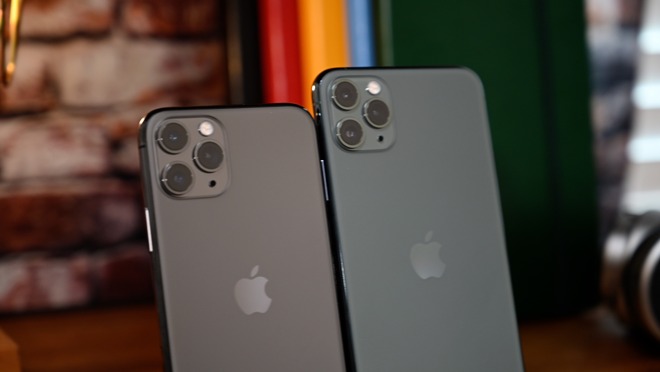
iPhone 11 Pro & iPhone 11 Pro Max

iPhone 11 Pro & iPhone 11 Pro Max

If you go by the specifications, or by what Apple championed at the launch of the new iPhones, you’ll know one of the biggest internal changes to the new phones is meant to be their performance. Running on the A13 Bionic, it is true that on paper there are serious performance gains from the iPhone XS line of 2018 to the 2019 iPhone 11 line. All three of the new phones come with the A13 Bionic and so have the same level of performance.

[youtube https://www.youtube.com/watch?v=P0S1KOTC_tc&w=560&h=315]

For now, however, the benefits are largely unnoticeable. The iPhone XR, iPhone XS, and iPhone XS Max never really felt slow, so after spending a month with the new iPhones, we truly did not see much of a difference in our day-to-day use.

We were, though, working with the beta of iOS 13 on our iPhone XS Max so we were used to the features, and the speed, of that operating system. So our perception is that the move to the 11 line wasn’t that big a jump in performance but you may notice more depending on which phone or iOS you’re coming from.

It would have been great to visibly see tremendous performance improvements, but we’re not disappointed that we haven’t. The performance of the iPhone 11, iPhone 11 Pro and iPhone 11 Pro Max is very good right now —and we will see the differences later.

That’s because Apple designs iPhones to have long lifespans. What is shipping now with an A13 Bionic processor isn’t supposed to be an overnight improvement on the last model. Instead, it’s meant to be an improvement that we feel several years down the line when features and apps get more power-intensive and exploit the A13 Bionic more.

If we can’t say that the new 2019 iPhones are dramatically faster than the 2018 ones, we can certainly say that they are going to last longer as viable, up to date phones because of this new internal improvement.

The display and Haptic Touch

All of the 2019 iPhones have dropped support for 3D Touch in favor of Haptic Touch. We talked about this a while ago, but as heavy users of the old feature, the change is still on our mind.

If you had an iPhone XR then you already know what Haptic Touch feels like, but for those coming from an iPhone XS or iPhone XS Max, it’s gong to feel limited in comparison. It causes us plenty of frustration each day but we know that we must get used to it as it won’t be going back.

It’s true, though, that if everyone had loved and used 3D Touch, we might still have it. So, again, you may not feel the omission quite as strongly as we do.

Haptic Touch replaces 3D Touch on the new iPhones

All
Haptic Touch replaces 3D Touch on the new iPhones

We were much more pleased with the new Super Retina XDR OLED displays found on the iPhone 11 Pro and iPhone 11 Pro Max though.

They looked absolutely great and as we watched movies —and Apple TV+ —we saw a big improvement on HDR or Dolby Vision content. It is bright, vivid, and at times amazingly bright. For movie and TV lovers, this is huge.

Watching John Wick in Dolby Vision on an iPhone 11 Pro

Watching John Wick in Dolby Vision on an iPhone 11 Pro

Outside of watching movies and TV, though, we otherwise didn’t notice too much of a difference in the display. It felt and looked just like it did on the iPhone X, iPhone XS, and iPhone XS Max.

The cameras

We seem to have spent the month qualifying our first impressions. The OLED displays are great, but only when you’re watching video. The performance improvement is true, but not noticeable in regular use.

Where we were blown away —and, crucially, continue to be —was with the cameras. These new shooters were better than we expected, and we have not become inured to them with use.

An example of an ultra-wide shot on the iPhone 11 Pro

An example of an ultra-wide shot on the iPhone 11 Pro

First, that ultra-wide lens. Intellectually, we understood what it could do as soon as Apple announced it, but that’s just not the same thing as having it in your hands and using it every day.

The ultra-wide lens is incredibly useful, far more than we had expected. That is greatly to do with how well the lens works, but Apple also nailed it with how they implemented using the feature in iOS 13’s Camera app. That app gives you the ability to see what was going on outside the frame when shooting with the standard wide lens.

Consequently, we’d be going to take a picture, see the Camera app’s display of what’s outside the frame, and realise that the wider view was what we needed for this particular epic shot like the one above.

You won’t use ultra-wide for every photo you take. These shots of ours are well stylized and simply aren’t right for every situation, but enough to be regularly used by us since getting the new phones.

An example of a night mode shot from the iPhone 11 Pro

An example of a night mode shot from the iPhone 11 Pro

Night mode was also handy, and again there is a huge difference between being told what it does and getting to see it in action yourself.

We’d take pictures in low-light situations expecting a certain outcome based on our previous iPhone usage. But we’d notice the iPhone 11 taking a few moments to capture and we’d see the night mode icon. When checking the image, it would be sharp, bright, and a departure from our old iPhone XS Max.

The shots are genuinely good and quite impressive. The above shot was taken with just a small amount of hallway light and yet the dogs —even the black one —came out with a lot of detail. More images have been hitting our camera roll since the addition of night mode.

We just have to train ourselves to try to get shots that we used to assume wouldn’t be possible.

A month in

Upgrading to a new iPhone is not a casual decision, not when they are expensive devices to buy. Nonetheless, we haven’t had one second where we regretted or even questioned updating to the iPhone 11 line.

That could have been true solely for the big elements like the ultra-wide lens and the Night Mode, because those were what we noticed and kept on noticing over and over again during the past month. Yet we did also appreciate many other small details.

Placing the phone on a wireless charger is faster, for instance, which means we don’t have to stare at the plate for a few seconds to ensure it’s working.

Then the 3D audio is impressive-sounding when using iPhone’s speakers. And the feel of the matte backs on the Pro and Pro Max feels and looks much better than the glossy ones of before.

Apple says that the iPhone 11, iPhone 11 Pro and iPhone 11 Pro Max are the best iPhones yet. A month in, we don’t disagree at all.

Pros:
Super Retina XDR display (on iPhone 11 Pro and iPhone 11 Pro Max) is superb for watching video
The ultra-wide lens is not a gimmick or an occasionally useful extra, it’s a boon to photography
Night Mode works tremendously and changes when we can take photos

Cons:
While the performance specifications are better, we don’t see the difference in regular use yet. That’s going to take some time but they do mean that these iPhones will last longer than last year’s.

Score: 4.5 out of 5

How to save on Apple’s iPhone 11

iPhone 11 Pro and iPhone 11 Pro Max

iPhone 11 Pro and iPhone 11 Pro Max

Wireless carriers are offering a variety of incentives, from trade-in bonuses to deals when you switch providers. Here’s a sampling of the current iPhone 11 promotions:

iPhone 11 deals

  • eBay: iPhone 11 devices starting at $669.
  • AT&T Wireless: Get up to $700 in bill credits with trade-in on a qualifying smartphone. Port-in and new line required. $500 in bill credits when you add a line without a port-in. Unlimited plan required.
  • Verizon Wireless: Switch to Verizon Wireless and get up to $700 with trade on Unlimited plan, plus free Echo Dot and Amazon Smart Plug.
  • Sprint: Lease the new iPhone 11 for just $11 per month. Or Lease an iPhone 11, 11 Pro or 11 Pro Max and get a second iPhone 11 on Sprint via bill credits. See site for T&C.
  • T-Mobile: Get $580 off Apple’s iPhone 11 when you switch and trade in an eligible iPhone.
  • Walmart: Save up to $100 on the iPhone 11. Offer valid only on purchase with installment plan.
  • Visible: Get up to a $200 Prepaid Mastercard Virtual Account when you buy an iPhone 11 and bring your phone number to Visible. Plus get 0% financing, no money down, no upgrade fees, and free overnight shipping for well-qualified customers.