Posted on Leave a comment

13 Insane Bitcoin Demand Drivers That Force the Price Up

5/5 – (1 vote)

Price is a function of supply and demand. Increase demand and price goes up. Increase supply and price goes down.

Bitcoin has a fixed supply of 21 million coins forever. So we don’t need to worry about supply, it is 100% predictable and limited to 21,000,000 BTC in the year 2140.

Bitcoin’s predictable supply curve (source)

With fixed supply, the investment case for Bitcoin is simple: Will there be more demand for Bitcoin in the future?

If yes, the price will go up. 🚀 If not, the price will go down. 📉 The extent of future demand for BTC controls the exact degree of price movement.

So, what are some key demand drivers for Bitcoin?

Here’s a quick overview of the demand drivers and my estimated annual $ volume:

Demand Driver Estimated Annual Dollar Volume
Nation States’ Adoption $50 billion – $100 billion
Corporate Adoption $20 billion – $40 billion
Individual Investment Strategy $10 billion – $30 billion
AI and Autonomous Agents $10 billion – $30 billion (or more)
Bitcoin ETFs $15 billion – $25 billion
Remittances and Cross-border Transactions $5 billion – $10 billion
Hedge Against Inflation $15 billion – $25 billion
Financial Inclusion $2 billion – $10 billion
Speculation and Trading $20 billion – $50 billion
Decentralized Finance (DeFi) Platforms $1 billion – $5 billion
Retail and Merchant Adoption $1 billion
Institutional Investment Products $10 billion – $20 billion
Network Effects and Education $5 billion – $10 billion

Let’s dive into these points one by one. At the end of this article, I’ll give you my estimation of what this will mean for the BTC price (this will blow your mind 🤯)!

1. Nation States’ Adoption

📈 How it Drives Demand: As countries face economic uncertainties, some are turning to Bitcoin as a strategic reserve. By holding Bitcoin on their balance sheets, nations can hedge against currency devaluation and global economic downturns.

Guess who’s the biggest holder of Bitcoin among all nation states?

The United States of America! (source)

But there are many other nation states that have a large incentive to accumulate and hold Bitcoin quickly. The game theory may drive more nations into Bitcoin — and quicker than you expect!

The inception of Bitcoin was driven by the need for a decentralized currency, free from the control of central banks, especially in the wake of financial crises that have historically plagued various nations.

Bitcoin, built on a peer-to-peer network, offers a solution to countries with weak currencies or high inflation rates, serving as a hedge against currency devaluation. Its decentralized nature also shields it from government censorship or interference.

Countries like El Salvador and the Central African Republic have recognized Bitcoin’s potential, adopting it as official legal tender. El Salvador’s experience post-adoption showcases the tangible benefits, with significant growth in tourism, remittance savings, and a surge in popularity.

Currently, nation states hold roughly $11 billion in Bitcoin (source):

But how much money could flow into Bitcoin? What is the TAM? Here’s a chart of the consolidated balance sheet assets of the Eurosystem:

If 1% of the $8,000 billion balance sheet of the Eurosystem consolidated balance sheets would flow into Bitcoin each year, the annual dollar demand would be $80 billion for the Eurozone alone.

However, Europe makes only a small portion of the overall nation state reserves as can be seen in this graphic (source):

Bitcoin demand driver: So a conservative estimation of the annual dollar volume that could easily be flowing into Bitcoin only by nation state treasuries would be as follows.

Estimated Annual Dollar Volume: $50 billion – $100 billion.

2. Corporate Adoption

📈 How it Drives Demand: Companies, from tech giants to small startups, diversify their assets by investing in Bitcoin, which can act as a hedge against inflation and showcase a forward-thinking approach.

Currently, public and private companies hold already $17 billion in Bitcoin (source):

Here are a few examples (non-exhaustive list) of public companies holding Bitcoin on their balance sheets (source):

As Bitcoin is already one of the largest currencies by market cap (source) and the only currency with limited supply (=21 million BTC), companies worldwide may decide to allocate a fair portion of their currency holdings to Bitcoin.

13 US companies hoard $1 trillion in cash (Google, Apple, Amazon, Tesla, Microsoft). A sensible strategy for these cash holdings is to invest a portion, e.g., 10%, into the hardest currency, Bitcoin, that cannot be inflated away. Investing 10% or even only 2% into Bitcoin would contain volatility while injecting a better-than-treasury risk/return ratio, as determined in many financial research studies.

For example:

5% of 1 trillion USD is $50 billion dollars and we’re talking only about 13 US companies’ cash positions! So we may easily see a $20 to $40 billion annual USD demand for Bitcoin from corporate investors alone (public and private companies).

Estimated Annual Dollar Volume: $20 billion – $40 billion.

3. Individual Investment Strategy

📈 How it Drives Demand: The average person is becoming more crypto-savvy. By dollar-cost-averaging into Bitcoin, individuals are viewing it as a long-term investment, similar to stocks or real estate.

There are already more Bitcoin Hodlers than Spanish citizens. It’s a medium-sized country that grows quicker than any other nation state!

What do these people do? They accumulate Bitcoin, month after month after month, and never stop. This drives annual demand.

For example, say you have 100 million people buying only $100 of Bitcoin every single month, on average, you’ll get an annual USD demand for Bitcoin by individual hodlers of $10 billion USD.

But the average is always skewed up in financial matters, because a small percentage of people hold a big percentage of assets, the average buy pressure may be much higher for 100 million individual hodlers.

Estimated Annual Dollar Volume: $10 billion – $30 billion.

4. AI and Autonomous Agents

📈 How it Drives Demand: The rise of AI and autonomous agents using Bitcoin for transactions showcases the digital currency’s versatility. These agents require a permissionless system to operate efficiently.

Soon an infinite number of intelligent agents based on LLMs and other AI technologies will start to acquire the scarcest good on Earth, which makes it even more scarce for ordinary people like you and me.

💡 Recommended: The Scarcest Resource on Earth

Bitcoin is money over IP, it is Internet-native money that can be accessed without permission. A machine cannot open a bank account but they can create a Bitcoin account — or hundreds at the same time — and start accumulating monetary energy.

With the rapid adoption of autonomous agents such as BabyAGI and Auto-GPT, there will be billions of profit-oriented AIs soon that do nothing else but accumulate and hold the most Internet-native scarce good, that is, Bitcoin.

This recent Ark invest video talks about Bitcoin’s role for AI agents: 👇📈

YouTube Video

With 100 million autonomous Bitcoin agents working for 24 hours 365 days per year, we can expect an average income of $365 per year or a dollar a day (conservative!). All of this will flow into Bitcoin!

Estimated Annual Dollar Volume: $10 billion – $30 billion. Or much more.

5. Bitcoin ETFs

📈 How it Drives Demand: ETFs simplify Bitcoin investment for traditional investors. By buying into an ETF, investors indirectly own Bitcoin without managing a wallet.

This is the historical development of assets under management of the ETF industry globally (source):

If we estimate that only 0.5% of the AUM will flow into Bitcoin annually (there’s a lot of internal and external growth so this is extremely conservative), we’d get a $50 billion annual USD demand for Bitcoin.

Let’s cut this by half to stay super conservative:

Estimated Annual Dollar Volume: $15 billion – $25 billion.

6. Remittances and Cross-border Transactions

📈 How it Drives Demand: Bitcoin offers a cheaper and faster solution for international money transfers, especially in countries with expensive or slow banking processes.

We already discussed this in the “nation state adoption” point but we didn’t count it towards the Bitcoin demand there.

🌍 Worldbank: “This edition of the Brief also revises upwards 2022’s growth in remittance flows to 8%, reaching $647 billion.” (source)

“Globally, sending remittances costs an average of 6.25 percent of the amount sent.” (source)

As already proven by the country El Salvador, Bitcoin is the easy fix the Worldbank is looking for. The Bitcoin Lightning network can solve the remittance problem in the world, instant and free payments without intermediaries, saving $40 billion annually or more.

We assume that of the $600 billion of annual remittance payments, $5 to $10 will flow into the superior solution Bitcoin. Again, we err’ on the conservative side.

Estimated Annual Dollar Volume: $5 billion – $10 billion.

7. Hedge Against Inflation

📈 How it Drives Demand: In countries with hyperinflation, Bitcoin is a refuge. It offers a stable alternative to rapidly devaluing local currencies.

But inflation is a fact in almost every economy — most people would agree that the major source is monetary debasement, i.e., more dollars are created which results in higher prices of non-dollar assets and goods.

Here’s the chart of recent inflation numbers globally (as these are official, they are a conservative proxy for real inflation):

Thus, if the demand for Bitcoin stays the same, the monetary units (e.g., USD, EUR, CNY) flowing into Bitcoin will increase by ~5% annually. For a $500 billion asset that is Bitcoin, this yields an annual demand increase of $25 billion.

Note that this figure doesn’t include the additional monetary units coming from people who actually want to hedge against inflation by buying Bitcoin. This is just to account for the monetary debasement of the money already flowing into Bitcoin.

The real annual demand is likely to be much higher.

Estimated Annual Dollar Volume: $15 billion – $25 billion.

8. Financial Inclusion

📈 How it Drives Demand: For the billions without access to traditional banking, Bitcoin offers financial services, from saving to borrowing.

As the billions of unbanked people are usually poor, the annual dollar volume from these people won’t be much.

According to the World Bank Group, as of 2017, 31% of the world’s adult population, or approximately 1.7 billion people, were unbanked (source: World Bank Group). McKinsey & Company estimates that as of 2019, 2.5 billion of the world’s adults do not use formal banks or semiformal microfinance institutions to save or borrow money (source: McKinsey & Company).

According to the World Bank Group, the bottom 20% of the world’s population had an average income of $1,298 in 2017 (source: World Bank Group).

Although the numbers are unimpressive, let’s assume that only $1 to $3 per year goes into Bitcoin. I don’t know how I can make it more conservative than that given that Bitcoin may be the only option for those people to participate in the global financial system — and Bitcoin is inclusive and doesn’t reject them like banks do.

Estimated Annual Dollar Volume: $2 billion – $10 billion.

9. Speculation and Trading

📈 How it Drives Demand: Active traders buy and sell Bitcoin daily, hoping to profit from its volatility. This trading volume significantly contributes to its demand.

The monthly trading volume is roughly $400 billion for Bitcoin (~$5,000 billion annually). Let’s assume the Bitcoin trading demand grows by 1% per year and the growth rate gradually declines. Assuming a $50 billion annual new flow into Bitcoin just for trading purposes doesn’t seem unrealistic to me at all, that’s only 1% of the annual trading volume.

Estimated Annual Dollar Volume: $20 billion – $50 billion.

10. Decentralized Finance (DeFi) Platforms

📈 How it Drives Demand: Bitcoin can be integrated into DeFi platforms, allowing for lending and borrowing.

💡 Business Research Company: “The global lending market size grew from $7887.89 billion in 2022 to $8682.26 billion in 2023 at a compound annual growth rate (CAGR) of 10.1%.” (source)

The CAGR of 10% implies a first-year cash flow (demand) into the decentralized finance market of $800 billion per year.

Many platforms for borrowing and lending using Bitcoin exist but I don’t believe it’ll be a big market share from the $800 billion of new capital, probably only a tiny portion like $1 billion to $5 billion will flow into Bitcoin. This is because you need asset collateral first before you can borrow against them. Most people don’t have significant BTC assets though.

This may change over time but let’s stay hyper conservative.

Estimated Annual Dollar Volume: $1 billion – $5 billion.

11. Retail and Merchant Adoption

📈 How it Drives Demand: As more merchants accept Bitcoin, its utility as a currency grows, driving both consumer and business demand.

The lightning network (=Bitcoin’s layer 2 cheap and fast payment solution) grows significantly but is still small (source):

The total addressable market (TAM) of payments is huge but let’s keep it super conservative. This overestimates the cash demand in the short term but significantly underestimates it in the long term:

Estimated Annual Dollar Volume: $1 billion

12. Institutional Investment Products

📈 How it Drives Demand: Beyond ETFs, products like futures and mutual funds centered around Bitcoin attract institutional investors.

Business Research Company: “The market size of global investments market is expected to grow to $5193.94 billion in 2027 at a CAGR of 7.9%.” (source)

There will be some demand for Bitcoin derivatives such as futures or short products and mutual funds concentrating on Bitcoin-related industries such as mining. Let’s assume the new money flowing into these products is less than the CAGR so it remains meaningless in the big scheme of things. Again to stay conservative.

Estimated Annual Dollar Volume: $10 billion – $20 billion.

13. Network Effects and Education

📈 How it Drives Demand: The more people use Bitcoin, the more valuable and accepted it becomes, creating a positive feedback loop.

For instance, the more developers, educators, researchers, and investors contribute to Bitcoin, the stronger the network becomes creating a virtuous loop. A classic example of a network effect that is hard to beat.

You could argue this will be the mother of all demand drivers for BTC but let’s stay conservative and assign a small number to it:

Estimated Annual Dollar Volume: $5 billion – $10 billion.


If you want my detailed view on Bitcoin network effects, check out the following blog tutorial: 👇

📈 Recommended: Want Exploding Prices North of $500,000 per BTC? “Grow N” Says Metcalfe’s Law

Summary and Bitcoin Price Derivation

So let’s recap the annual dollar demand moving into Bitcoin based on the analysis in this article:

Demand Driver Estimated Annual Dollar Volume
Nation States’ Adoption $50 billion – $100 billion
Corporate Adoption $20 billion – $40 billion
Individual Investment Strategy $10 billion – $30 billion
AI and Autonomous Agents $10 billion – $30 billion (or more)
Bitcoin ETFs $15 billion – $25 billion
Remittances and Cross-border Transactions $5 billion – $10 billion
Hedge Against Inflation $15 billion – $25 billion
Financial Inclusion $2 billion – $10 billion
Speculation and Trading $20 billion – $50 billion
Decentralized Finance (DeFi) Platforms $1 billion – $5 billion
Retail and Merchant Adoption $1 billion
Institutional Investment Products $10 billion – $20 billion
Network Effects and Education $5 billion – $10 billion
Total (Aggregated) $164 billion – $355 billion

Based on this analysis, we anticipate an annual USD inflow of $164 billion to $355 billion into Bitcoin. While there will be outflows, the demand drivers are expected to expand over time rather than diminish. For example, as nation states continue to print more currency, their acquisition of Bitcoin will likely intensify. But for the sake of argument, let’s assume that half of the projected inflow is withdrawn from the Bitcoin market each year. This would result in an approximate annual net positive demand of $80 billion to $175 billion for Bitcoin.

Consider a scenario where the net demand for Bitcoin is $100 billion, and its market cap stands at $500 billion (as of this writing). If the market cap remained constant for five years, the cumulative net demand would have absorbed all available Bitcoin by the end of the fifth year. If the USD demand remains consistent or increases, the only logical outcome would be a rise in the market capitalization, translating to an increase in Bitcoin’s price.

With a consistent $100 billion net demand increasing annually, Bitcoin’s market cap would likely approach $10 trillion USD rather than just $1 trillion USD. Otherwise, we’d encounter the same supply issue.

This market cap would continue to grow indefinitely in response to unceasing demand. Thus, Bitcoin’s price trajectory is upward, albeit with expected fluctuations.

At a market cap of $10 trillion, the additional annual demand of $100 billion could be theoretically accommodated, as it would take a century for this demand to absorb all the Bitcoin. However, if an increasing number of individuals, institutions, and nation states adopt a long-term holding strategy (HODL), the market cap would need to rise even further.

A $10 trillion market cap for Bitcoin would correlate with a price of $500,000 per Bitcoin. This aligns with my recent analysis using Metcalfe’s Law 👇 and is also comparable to the gold market cap (approximately $12 trillion USD or roughly $600k per BTC). This suggests a convergence of multiple influencing factors.

📈 Recommended: Want Exploding Prices North of $500,000 per BTC? “Grow N” Says Metcalfe’s Law

The post 13 Insane Bitcoin Demand Drivers That Force the Price Up appeared first on Be on the Right Side of Change.

Posted on Leave a comment

The Autobots Roll Out On Switch Next Month In Transformers: Earthspark – Expedition

Outright Games has today revealed another gameplay trailer for its latest game about the robots in disguise — Transformers: Earthspark – Expedition journeys onto Switch on 13th October.

Based on the recent Paramount+ and Netflix animated series, Transformers: Earthspark, this game will see you taking on the role of Bumblebee as you make your way through biomes, defeating Decepticons (of course) and unlocking new abilities as you go. You can expect to see a host of familiar faces along the way including Optimus Prime, Grimlock, Skullcrusher, and more, so keep your eyes on the road.

From the small amount of gameplay that we have seen so far, this is looking fine. The visuals aren’t too harsh on the eye and the combat looks simple enough — let’s just hope that it doesn’t get stale. Outright previously worked on the my-first-turn-based-game Transformers: Battlegrounds (which we gave a perfectly serviceable 6/10) so there is some pedigree here — albeit a perfectly average one.

Please note that some external links on this page are affiliate links, which means if you click them and make a purchase we may receive a small percentage of the sale. Please read our FTC Disclosure for more information.

TRANSFORMERS: EARTHSPARK - Expedition

For a closer look at some screenshots, check out the following from Outright.

This one will be rolling out next month (along with every other game ever, it seems), so you don’t have long to wait if you think it looks up your street.

Will this make it into your October purchases? Let us know in the comments.

Posted on Leave a comment

Nintendo Reportedly Showed ‘Switch 2’ Demos To Developers At Gamescom

Nintendo Switch OLED
Image: Damien McFerran / Nintendo Life

While there is still no official word on the whereabouts of the ‘Switch 2’, sources for both Eurogamer and VGC have reported that demos for Nintendo’s next console were shown at this year’s Gamescom.

The reports state that the Switch successor was shown to selected developers behind closed doors during the event, supposedly with the former console’s launch title, Breath of the Wild, running on the follow-up’s more powerful specs. Both outlets stress, however, that there is no suggestion that the title will be re-released.

A further source for VGC claimed that Nintendo demoed Epic’s The Matrix Awakens Unreal Engine 5 demo on the ‘Switch 2’ — the project formally used to showcase the power of the PlayStation 5 and Xbox Series X back in 2021.

According to the VGC report, the console demo’s visuals were comparable to the current-gen offerings from both Sony and Microsoft, running with Nvidia’s DLSS upscaling technology with advanced ray tracing enabled.

Apart from that, we still know very little about what form the console will take. VGC sources suggested that the demoed equipment could be used in a handheld mode much like the current Switch, though that seems like a no-brainer at this point.

Nintendo is still yet to announce anything about its follow-up console for the time being, though the latest rumour suggested that the company would be targeting a late 2024 release — only time will tell…

What do you make of these reports? Do you reckon we’ll have an official announcement soon? Let us know in the comments.

Posted on Leave a comment

Review: Thunder Ray – Imperfect But Beautiful, Bloody, ‘Punch-Out!!’-Inspired Pugilism

Thunder Ray Review - Screenshot 1 of 4
Captured on Nintendo Switch (Handheld/Undocked)

Nintendo’s Punch-Out!! was one of the most iconic arcade and console fixtures of the early ’80s, migrating from coin-op to the NES, where it was remoulded as Mike Tyson’s Punch-Out!! and bestowed a Rocky-esque narrative around up-and-coming challenger Little Mac. Since Super Punch Out!! and the Wii’s original entry, however, it’s a series that, in stark contrast to its emphasis on fast footwork, has slouched for modern movement. And, with Nintendo reluctant to step back into the ring, Argentina’s Purple Tree Studio is now fixing to become the new victor of an undernourished franchise.

Thunder Ray’s musculature is cut and framed entirely around the Punch-Out!! formula, to the point that anyone claiming Nintendo’s cease-and-desist manoeuvres are overly aggressive might want to reconsider their stance; they’re still a far cry from toppling Capcom from the shutdown podium. There is little in the way of modern bonuses or extra modes here, just three difficulty settings to work through that save your progress and allow you to go back and revisit previously felled challengers. This works well if you’re struggling on a higher difficulty, allowing you to drop back to Rookie settings, for example, to learn the patterns more effectively.

Thunder Ray Review - Screenshot 2 of 4
Captured on Nintendo Switch (Docked)

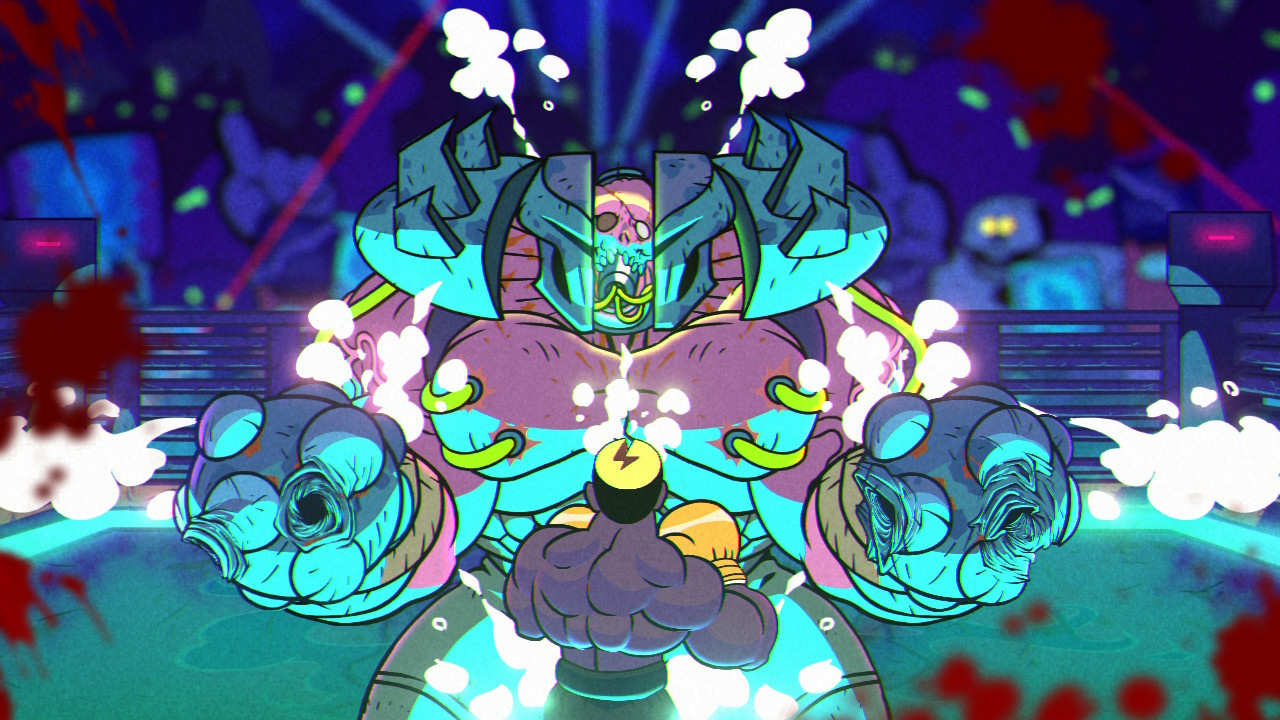
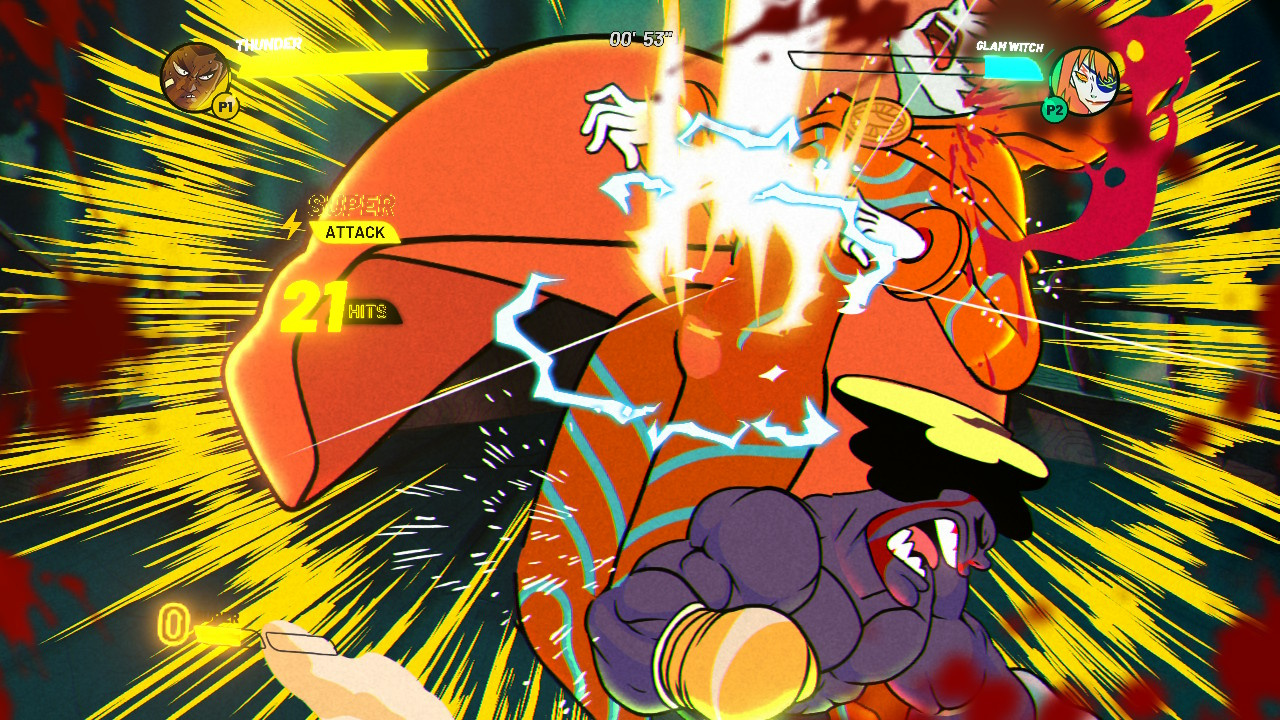
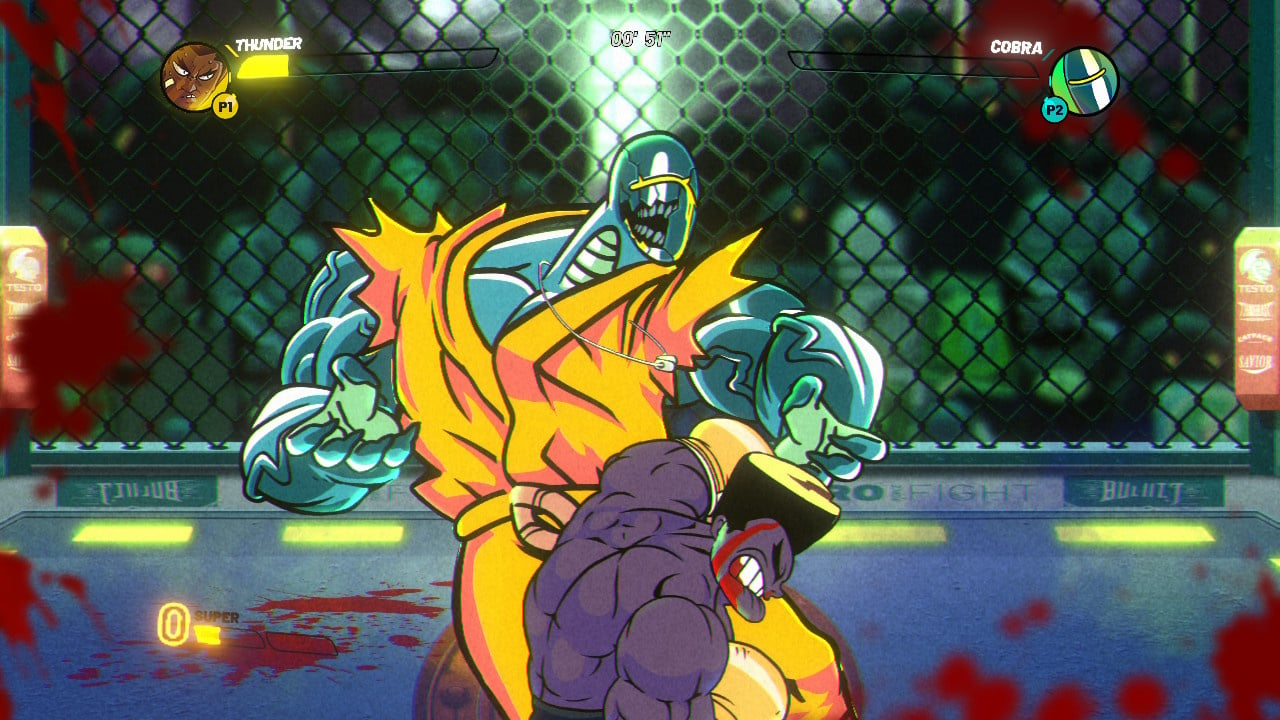
The game’s presentation is superb, with a graphical style that really pops, flows, bobs, and weaves, full of artistic expression and stylistic grace. It combines its darker narrative with comical animation very effectively, and while some may feel the Flash in it, most will no doubt enjoy its thick, cartoon weight and ultra-violent affectation. The colours are rich and there’s a dab of filter grain added to the backgrounds to enhance the flavour. It’s bloody, too, Thunder Ray’s face pulping up, blood spattering the ring and screen extremities, and your adversaries literally exploding with Hokuto no Ken inspiration in a fountain of viscera.

The story goes, told through narration over pretty panel art, that Thunder Ray, an undefeated champion on Earth, is suddenly zapped across the universe to battle opponents in an intergalactic ring. The roster is drawn from champions across the galaxy, of all shapes and sizes, opening up a whole new creative angle on the Punch-Out!! formula. These foes don’t fight human-fair, rather using telekinetic powers, shields, and mighty powered-up supers to smash you into the countdown phase. It’s the Space Jam of the Punch-Out!! world, and more thematically accomplished with it. The structure of the game is as one would expect, except there are no bouts, as such, rather just a face-off that results in a knockout for either you or your opponent. Knock them down three times and victory is yours; see yourself toppled three times and it’s back to the title screen for another try.

Thunder Ray Review - Screenshot 3 of 4
Captured on Nintendo Switch (Handheld/Undocked)

The game expands on Punch-Out!! where controls are concerned by having four attack buttons: left and right low blows and left and right head punches. We’re yet to figure out why this was necessary, as most of the game revolves around the classic dodge and retaliate system, and, seeing as there isn’t much difference in which standard attack you choose, the four buttons instead of two overcomplicates things slightly. There’s also a charged punch which deals slightly more damage, but is slower to start up, engaged by holding a shoulder button. While these charged punches are useful for felling your opponent more quickly, they need more tactical strategy to land, and should be threaded between a volley rather than used constantly.

Directional controls allow you to dodge left and right, duck downwards, or block, each having use in avoiding damage from specific attacks. And, as is expected, each opponent is navigated by learning their attack repertoire, seeing the cues, and responding with the right defence. Successfully avoid a regular, mega, or mammoth attack, and there’s a window of opportunity to smash back, and, once your super bar is topped up, you can unleash a devastating finisher of your own. This super-attack gets stronger as you progress through the game, bolting on additional bars. Play a game of patience and skill, and you can charge up three in a row for a major face-buster.

Thunder Ray is a short game reflective of its very reasonable $14.99 price. It might seem tough, but considering your title is only eight fights deep, it’s over fairly quickly. What initially seems overly challenging actually reveals itself to be entirely less demanding with a little practice. Some matches, even halfway through, seem to buck the difficulty curve, and you can find yourself in surprise and unexpected victories. To this end, Thunder Ray is not a Nintendo game in execution: it doesn’t have the same kind of exactness. That’s not to say it’s not well-formed; Purple Tree Studio’s new twists work well; there’s just more leeway in it than with Punch-Out!!’s utterly clinical demands. The enemies are inventive and occasionally monstrously huge, requiring you to identify dodge openings and strategies, but they can also succumb to a fudged and cheap early win. This is, of course, less commonplace on Beast difficulty, the toughest of the three options.

Thunder Ray Review - Screenshot 4 of 4
Captured on Nintendo Switch (Docked)

We went back to the original NES Punch-Out!! for comparison. While the movement there is knife-edge taut, allowing you to land a blow and almost instantaneously dodge with a sense of blistering speed, Thunder Ray’s animation frames are more elongated and don’t allow for frame-cancelling. That means when you’ve thrown one to the head, you need to wait a split second to return to neutral before making your dodge. Now, this isn’t being overly critical, or even critical at all: it all still holds together very well in its assembly; but, if you’re wondering why it doesn’t have quite the same snap, this is the culprit. The enemy attack animations allow plenty of time for you to dodge, the only issue is knowing when that is, especially with very drawn-out animations. It’s not always clear, for example, when Mr. Pega, the sixth combatant, will actually strike after he coils up like a spring, expands and rotates, and flops in your direction. To that end, it’s quite a different dodging experience to the likes of Piston Honda’s flurries or Nick Bruiser laying a sudden smackdown on you. Additionally, while it’s heavy hitting, your super attacks don’t feel as solid or satisfying, somehow, as those in Super Punch-Out!!, when the jaw felt truly busted by that charged-up gunshot blow.

Finally, when your energy is low, the screen zooms in and the colours bleach to signify your fading energy. During this state your health slowly regenerates and you can come back out of the daze if you can hold out for long enough. It’s a novel idea, but we’re not convinced the zoom-in entirely works. It brings dramatic tension, but the cropping of the screen and the whiteout of the colours make it altogether more difficult to make a comeback. Unless you know your opponent’s movements down-pat (and, if you do, it’s unlikely you’ll be in this state at all), it can be hard to make a recovery from this position later in the game.

Conclusion

Thunder Ray isn’t perfect, but it is very good. The feel of the blows and the creativity of your opponents are very nicely executed. It’s missing the minute precision of Punch-Out!!, but it’s close enough, and while you can occasionally win matches at higher difficulties with a certain amount of luck, you’ll get the most from the experience by mastering each opponent and earning a true sense of boxing accomplishment. Being able to toggle between difficulties and going back to previous opponents is great, and the entire thing feels polished and flashy. It could have been more elaborate, featuring more modes, and bonuses, but, as it stands, it’s a brief but solid tribute for fans of Punch-Out!! to enjoy knocking into next week.

Posted on Leave a comment

Cosy Sandbox Worldbuilder ‘My Little Universe’ Lands On Switch Next Month, Demo Out Now

Developer Estoty and publisher SayGames have announced that the cosy worldbuilder My Little Universe will be making its way onto Switch on 5th October. What’s more, the foundations are already being laid as a local co-op demo is now available to try out on the Nintendo console.

This one will see you creating your own civilisation, as you take your mighty pickaxe and use it to transform the world to your liking — be that creating new land, harvesting materials or searching the mysteries of the environment around you (did somebody say ‘dungeons’?). There are some less-than-friendly foes that you will encounter along the way, so expect a combination of farming and fighting as you build your universe.

The visual style is basic, to be sure, but we feel that it works with the small hexagonal islands that you have to shape into larger continents — it keeps things looking clean. With a co-op mode enabled to help with dividing up the tasks, we can see this being a pretty relaxing way to while away the hours (albeit, with a few monster fights thrown in for good measure).

For a little more information about some of the game’s features and a look at a handful of screenshots, check out the following.

EXPLORE!
9 mythical worlds and 65+ different dungeons, from mythology-inspired lands to hostile alien worlds await you and your friends. Filled with wonder and plunder, challenges and adversaries, your task is to restore these beautiful worlds to their former glory!

GATHER RESOURCES!
The worlds are filled with rich minerals ready to be harvested by your trusty tools, and mythical artifacts of untapped power guarded by powerful foes. Use more than 70 different gatherable resources to recreate lands long lost to a mysterious threat.

RISE UP TO THE CHALLENGE!
The universe won’t be restored that easily, and each challenge requires the proper tools for the job. Equipped with your trusty pickaxe, sharp sword, and sturdy axe, you’ll be thrown against 150+ different adversaries including mythical creatures, alien horrors, and even demigods!

UPGRADE YOUR GEAR!
With each planet comes new challenges and because of that, you have to stay prepared by upgrading to the newest and freshest tools, which will always keep you one step ahead of your opponents! Improve your weapon, tools, and armor up to 30+ levels!

Just Enjoy The Adventure.
Get entranced by the game’s cozy atmosphere, enjoy the relaxing soundtrack, and fall in love with the simplistic yet charismatic visuals. After all, it’s all about the journey and the friends we make along the way!

My Little Universe will be available on the Switch eShop from 5th October for $14.99 / €14.99. Pre-orders will open on 21st September, with the game seeing a tasty 10% discount until 12th October.

Does this one look up your street? Build your thoughts in the comments below.

Posted on Leave a comment

New Limited-Time Pokémon Scarlet And Violet Distribution Is Now Available

Pokemon Scarlet and Violet

In case you missed it, the first episode of the new Pokémon web series Paldean Winds is now officially live.

As part of this, The Pokémon Company is giving away a free Cetitan in Pokémon Scarlet and Violet. As highlighted by Serebii.net, the code you’ll need for this one is L1KEAFLUTE, and you have until 31st August 2024 to redeem it.

There are also a number of other codes that can be redeemed right now. Perhaps most important is the one for Mew. Trainers have until 18th September to get their hands on this one – so be sure to check out our guide for the code:

Have you redeemed this latest code yet? Looking forward to the upcoming DLC for Scarlet and Violet? Tell us below.

Posted on Leave a comment

Mortal Kombat 1 Trailer Reveals Megan Fox As The Outworld Vampire Nitara

Megan Fox Nitara

After an advertisement featuring the actor and former wrestler Dave Bautista, Mortal Kombat 1 has now officially revealed the vampire of the Outworld Nitara will be played by the actress Megan Fox.

Although Fox’s involvement seems to be the focus in the latest trailer, this does still count as another playable fighter reveal. Nitara made her playable debut in Mortal Kombat: Deadly Alliance. As highlighted in the new trailer, she’s being voiced by Fox, with the character’s likeness also seemingly based on Fox.

Megan mentioned how she’s had “a lot of fun” playing Nitara and goes on to state how “Mortal Kombat is just one of those staples” in video game history, and she’s honored to have a role in “one of the greatest video games of all time”.

This new trailer also gives us another look at Ashrah, who made her debut in the “official banished trailer” last month, and originally debuted in Mortal Kombat: Deception. Mortal Kombat 1 launches later this month on 19th September. You can catch up on all things related to this game in our previous coverage:

Excited to see Nitara’s return? How do you feel about Megan Fox voicing the character? Tell us below.

Posted on Leave a comment

Malicious Google ads deceive Mac users into installing Atomic Stealer malware

Google search can turn up malicious ads

A macOS malware discovered in April has found a new vector of attack, with people searching for software on Google finding malware presented as legitimate ads.

The malware payload known as Atomic macOS Stealer (AMOS) first appeared in April being sold on Telegram for $1,000 per month. Once installed, it collects the user’s system password via aggressive pop-ups and then siphons off sensitive data like passwords, crypto, and files.

According to a report from researchers at Malwarebytes, AMOS is being delivered via a Google ad scheme to unsuspecting searchers. The ads are legitimate and paid for but disguise themselves as the website or software the user is searching for.

This attack relies on users’ trust in Google when clicking on ad search results. It appears at the top of the page and has Google’s ad stamp of approval, so users click through without inspecting for suspicious URLs or domain owners.

Once the user clicks the link, they are presented with a normal-looking page. The attackers create a near-perfect clone of the website users expect, so they click through and download the software.

AMOS doesn’t need to go through the normal installation process through Gatekeeper since it is an ad-hoc signed app. Users are directed to right-click and open the software from the mounted .dmg file.

After the file is opened, a fake prompt for the system password keeps popping up until the user relents and enters their password. It then harvests what data it can from the user’s Keychain, file system, and crypto wallets and sends it to the malware operator.

A disguised malware delivery page. Source: Malwarebytes

A disguised malware delivery page. Source: Malwarebytes

How to protect yourself from AMOS

Google isn’t a foolproof tool. It delivers information based on the user’s account data and keywords, and malicious ads aren’t always going to get caught on review.

The number one security rule of the internet is paying attention to the URL. In the example given by Malwarebytes, the URL is trabingviews.com.

Users should exercise caution whenever they choose to download software from the web. The Mac App Store is the safest route for Mac users, but that won’t always be an option.

Pay attention to Google’s results, the URL you’re directed to, and the software installer itself. Be wary of how the software asks to be installed. Most software shouldn’t ask the user to bypass Gatekeeper.

A potential red-flag is software that demands the user open the app in place, on the installer image. As a general rule, it should ask the user to drag the installed app to the Finder.

Also, be wary of random requests for the system password, especially right after installing new software. Inspect the dialog for design irregularities or typos.

Posted on Leave a comment

Video: It’s Finally Time To Talk About Zelda: Tears Of The Kingdom’s Ending

Ganondorf Tears of the Kingdom
Image: Nintendo

Believe it or not, The Legend of Zelda: Tears of the Kingdom does have an ending. It might be a 200-hour sprawling epic where you support Addison over 80 times or dig into every single nook and cranny of Hyrule, but there is a main story — and its ending is a doozy.

We’re still thinking about it nearly four months after the game came out, and now is the time when we unleash all of those feelings — good and bad — unto the world.

Well, that’s what Alex, Zion, and Felix decided to do anyone. Our lovely trio over on YouTube managed to get together in person to discuss the final moments of Link’s incredible adventure. From the final boss to the game’s surprising reveals, nothing is going untouched here.

It should go without saying, but this video contains huge spoilers for Tears of the Kingdom, so if you haven’t beaten the game — do not click on it. Unless you don’t mind being spoiled. But where’s the fun in that?

What did you think of Tears of the Kingdom’s ending? Share your feelings down below.

Posted on Leave a comment

Bloodstained: Ritual Of The Night To Share Details On Two New Modes Next Week

We were promised a “big year” for Bloodstained: Ritual of the Night back in December 2022. And it’s been a bit of a wait, but, developer ArtPlay has released a new blog update on Kickstarter along with a video to tease the future of the Metroidvania.

First up, the Castlevania-inspired action platformer — which was created by former Castlevania producer Koji Igarashi — has sold over 2 million copies worldwide since it launched in 2019. An impressive figure for a game that could potentially never have been made.

Importantly, Igarashi and the game’s director, Shutaro Iida, have both given updates on two new modes coming to the game: VS and Chaos Modes. The delay has been caused by unexpected “challenges” which have come from including online multiplayer in both modes. Check out the statement below for more details:

“The development team has been busy working on the new VS and Chaos modes, both of which include online multiplayer play for the first time. This has resulted in some challenges and delays that we did not expect, but we continue forward! We are nearing completion of the new content.”

As an apology, the duo have shared a sneak peek at the upcoming modes in a teaser (which we’ve popped at the top of the article). Not only that, we’ll be getting even more details on both new modes on 14th September, which is next week. Pop that one in your diaries, then.

Will you be checking out VS and Chaos Modes in Bloodstained: Ritual of the Night? Let us know in the comments.