If you’re looking for a little bit of lightness this holiday season for you and the kids, then hopefully you’ve been saving up a bunch of those It’s Me, Mario! shorts. Nintendo has been sharing these on its family-friendly Play Nintendo YouTube Channel since August 2025.
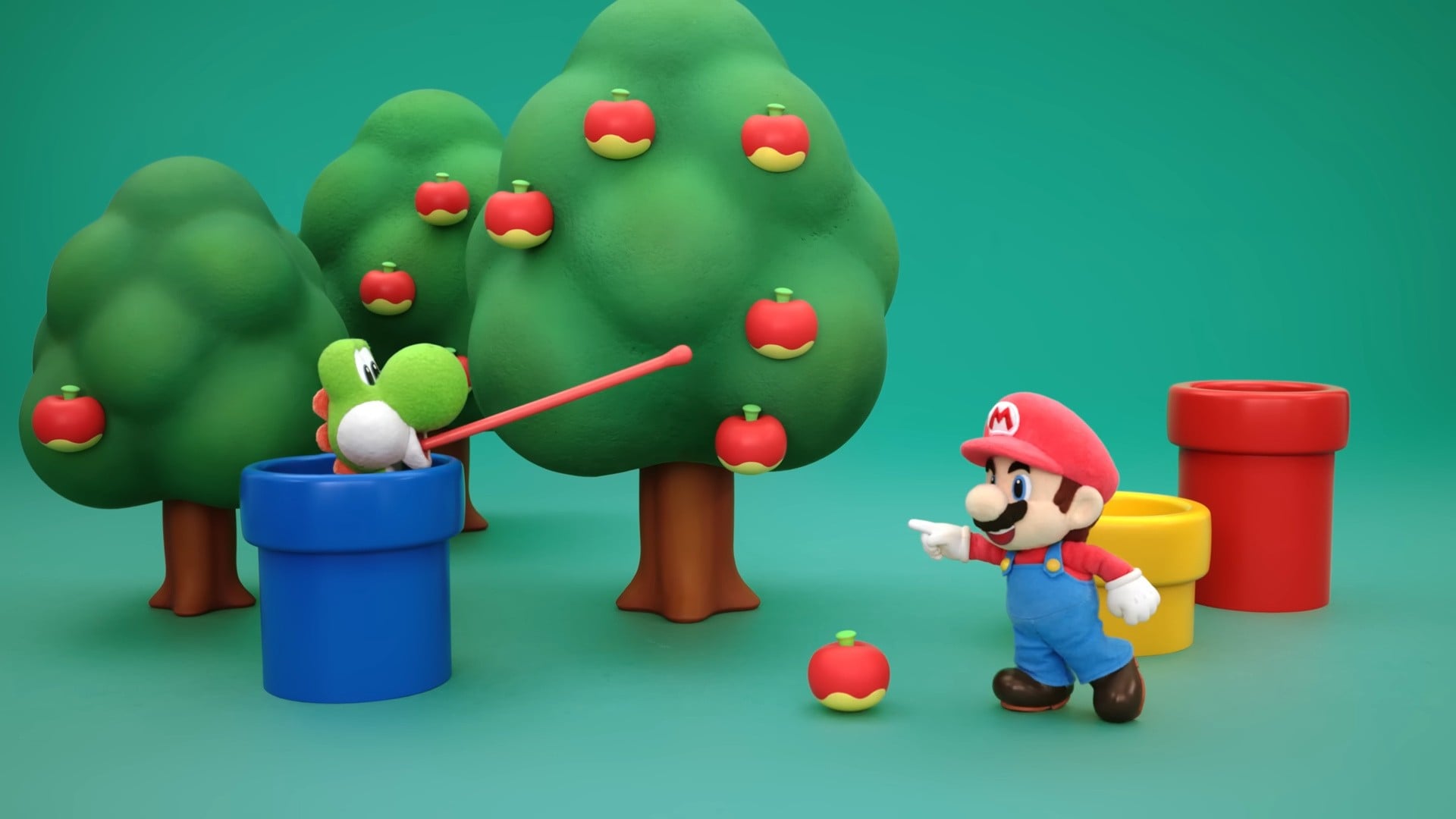
Episode 5 dropped overnight and features Mario with Yoshi and Toad, who are playing a simple game of hide-and-seek. Mario must find both of his friends, who have found devious places to keep themselves out of the plumber’s eyesight.
And look, we’re extremely partial to stop-motion animation, but Yoshi and Toad look particularly adorable; we love the little Super Mario World nod with the trees and the fruit, and Toad is… well, Toad! He can hide in some pretty easy places in the Mushroom Kingdom.
All five shorts have some lovely little callbacks to the Mario series as a whole, so while the kids might delight in the lovely colours and animations, parents (or grandparents, or uncles, aunts — whoever!) can get all nostalgic. You can see all five currently released episodes in this playlist.
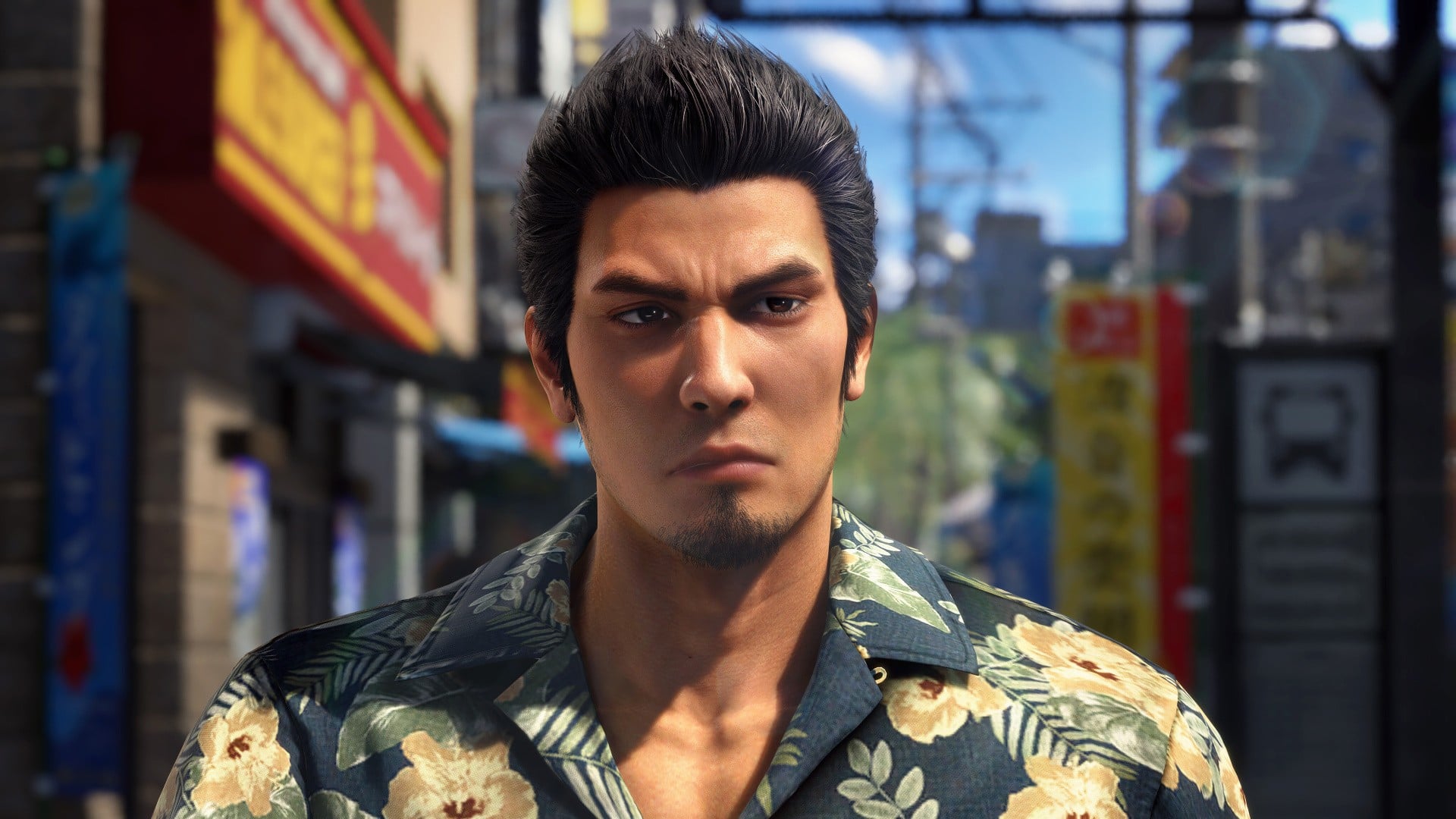
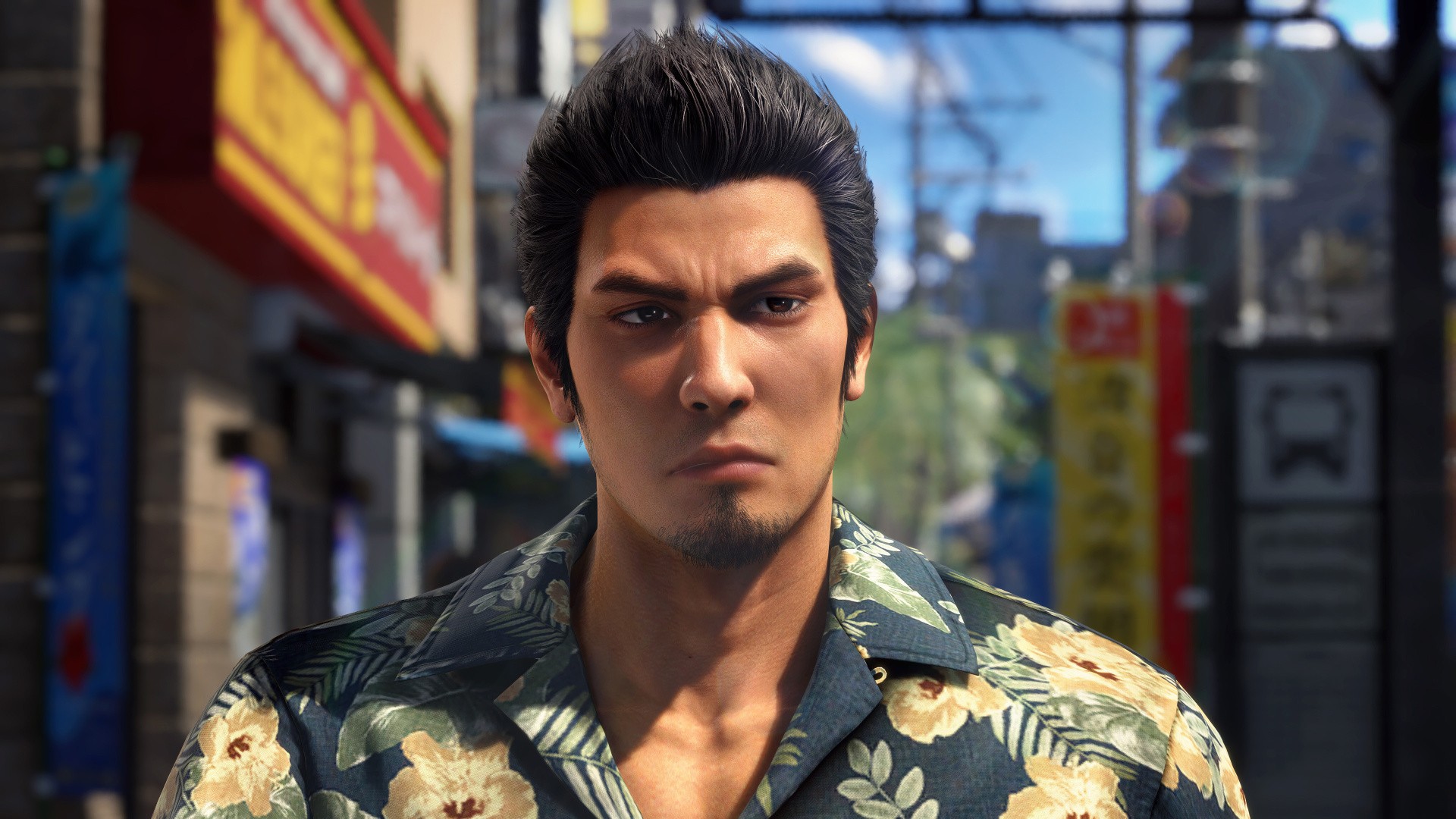
SEGA and Ryu Ga Gotoku Studio have announced that they will be airing a Yakuza Kiwami 3 & Dark Ties Direct next week, which launches on Switch 2 on 12th February 2026.
The Direct will be a late one for UK and European folks, with the stream kicking off on 23rd December 2025 at 1am GMT / 2am ET — that’s 22nd December at 5pm PT / 8pm ET for those in North America. It’ll be available on both YouTube and Twitch.
As for what to expect, well, it’s a deep dive — that’s basically all we know! “This Direct will dive into new features, experiences, and gameplay from the upcoming two-in-one title” Sega says. So expect a little bit of everything.
We wonder whether we’ll get any hints as to what this enhanced version of the 2009 PS3 title means for the future of the series RGG Studio director Yokoyama Masayoshi teased this himself a few weeks ago.
So, tune in next week to find out what to expect from Kiryu’s third (fourth?) chapter.
Will you be watching the Yakuza Kiwami 3 direct next week? Let us know in the comments.
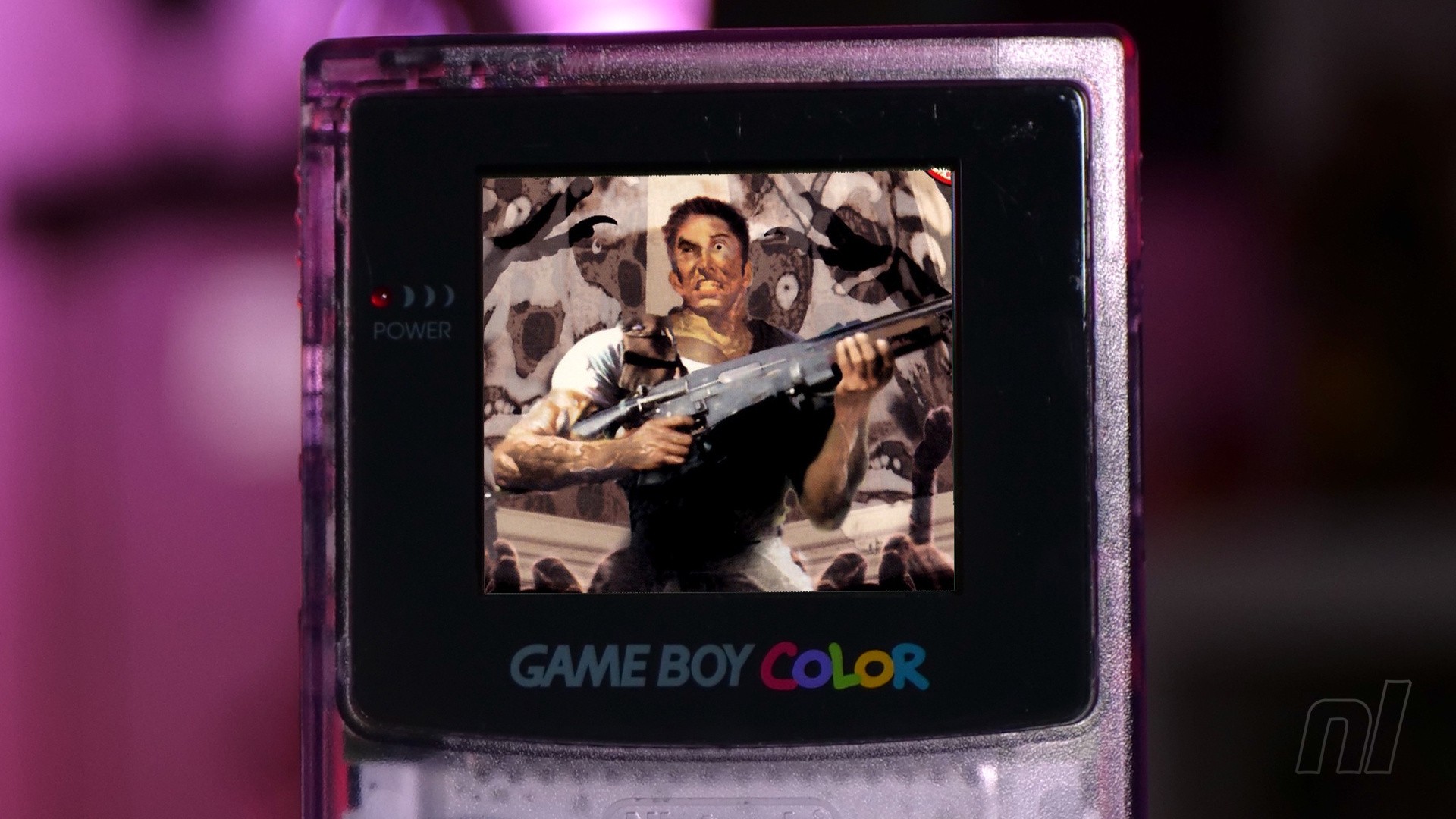
Back in the middle of 1999 (a weird time for everyone, rest assured), British developer HotGen attempted something that was considered to be somewhat of an impossible task. Namely, porting the full glory of 32-bit Resident Evil to the dinky little 8-bit Game Boy Color. In the end, not only did these maestros manage to do it, but they did it in a way that, judging by the gameplay vid above, makes for a more than decent stab at the “impossible”.
Unfortunately, the port was then cancelled and thought lost to time before popping up online in various states throughout the years – though none of these were anywhere near playable from start to finish. That is until now, thanks to Games That Weren’t (thanks to VGC for the heads-up).
Indeed, over on their official social media, the video game preservationists have made a very exciting post revealing a 98% complete version that seems to be fully playable and completable. Hooray!
The above post links to an excellent article about the entire affair surrounding the game’s almost-completion and subsequent cancellation, so do make sure to give it a full read.
One little nugget of note in said article comes from assistant programmer Pete Frith, who recalls that the team were told their game would be cancelled because the creator of Resident Evil (they haven’t disclosed exactly who they mean here) “didn’t feel the GBC was worthy of his creation, and that he had personally instructed the cancellation.” That’s gotta hurt!
Instead of this port, M4’s Resident Evil Gaiden, a completely new game, was greenlit instead.
Frith is also noted as the source of this latest build, and he seems confident, with some added content now in there, that it should be fully completable.
Who amongst us is brave enough to find out if this latest version of the cancelled Game Boy Color port is fully completable? You sir? Madam? Let us know in the comments!
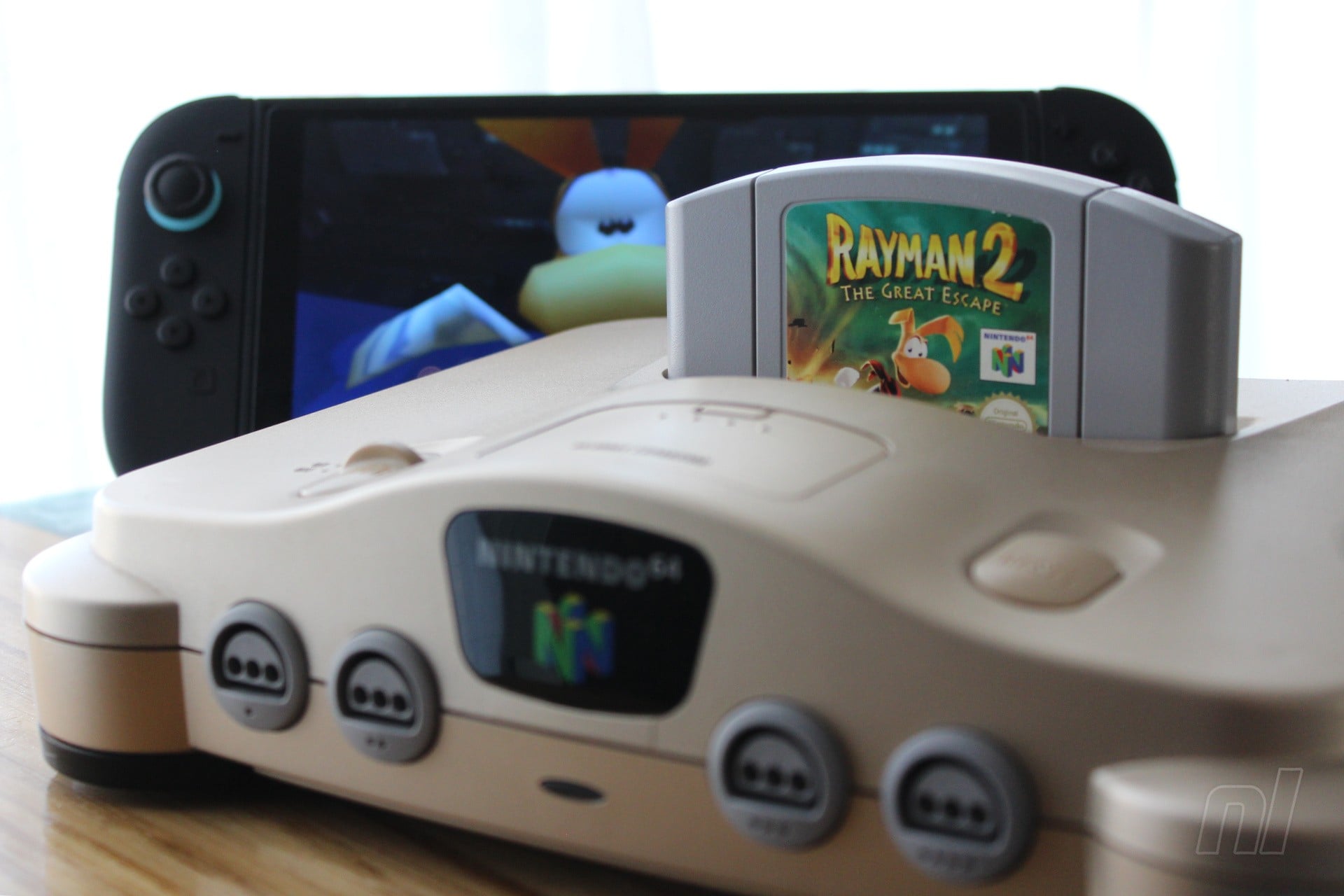
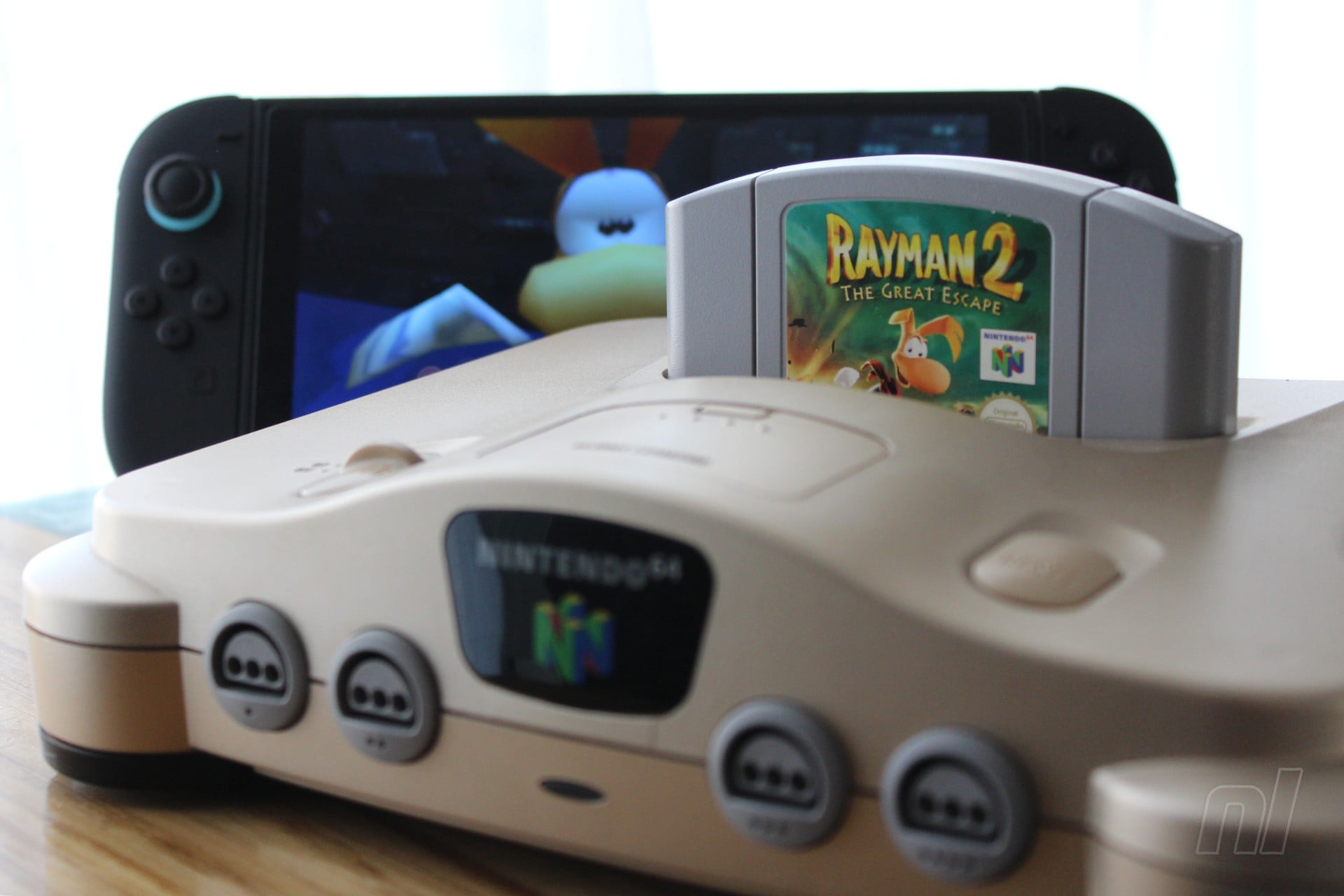
Rayman 2 has been added to the Nintendo Switch Online N64 library. His fight for freedom against a literally iron-fisted despot represented a braver, weirder time for Ubisoft, and today Francisco looks back on a classic…
For many of us, Super Mario 64 changed platforming forever by introducing the boundless possibilities of the third dimension. I wasn’t one of them. As a latecomer, Rayman 2: The Great Escape was my Mario 64, the game which opened my eyes to all the strangeness, spectacle, and drama the revamped 3D genre could offer.
It happened by pure chance. I couldn’t afford Mario 64 after becoming the proud owner of my baby blue Pikachu Nintendo 64 in 2000. However, my local game store had Rayman 2 on a special deal, sat on the shelf unloved since coming out in 1999. And the oppressive world, sinister tone, and unique brand of heroics I discovered have been seared into my memory ever since the first time I wandered into the fantasy dystopia of the Glade of Dreams.
The Glade is a fairytale land, whose whimsy gave way to perpetual gloom under the literally iron-fisted rule of Admiral Razorbeard and his clanking robo-pirate minions. Their slave count grows by the second. The Teensie Kings, their citizens, and the fairy-like Lums are all helplessly locked up. Rayman himself starts the game imprisoned in the brig, hopeless and alone. When his powers are smuggled in (thanks, Globox!) to finally allow a dramatic prison break, he becomes a freedom fighter unlike any platforming hero before him.
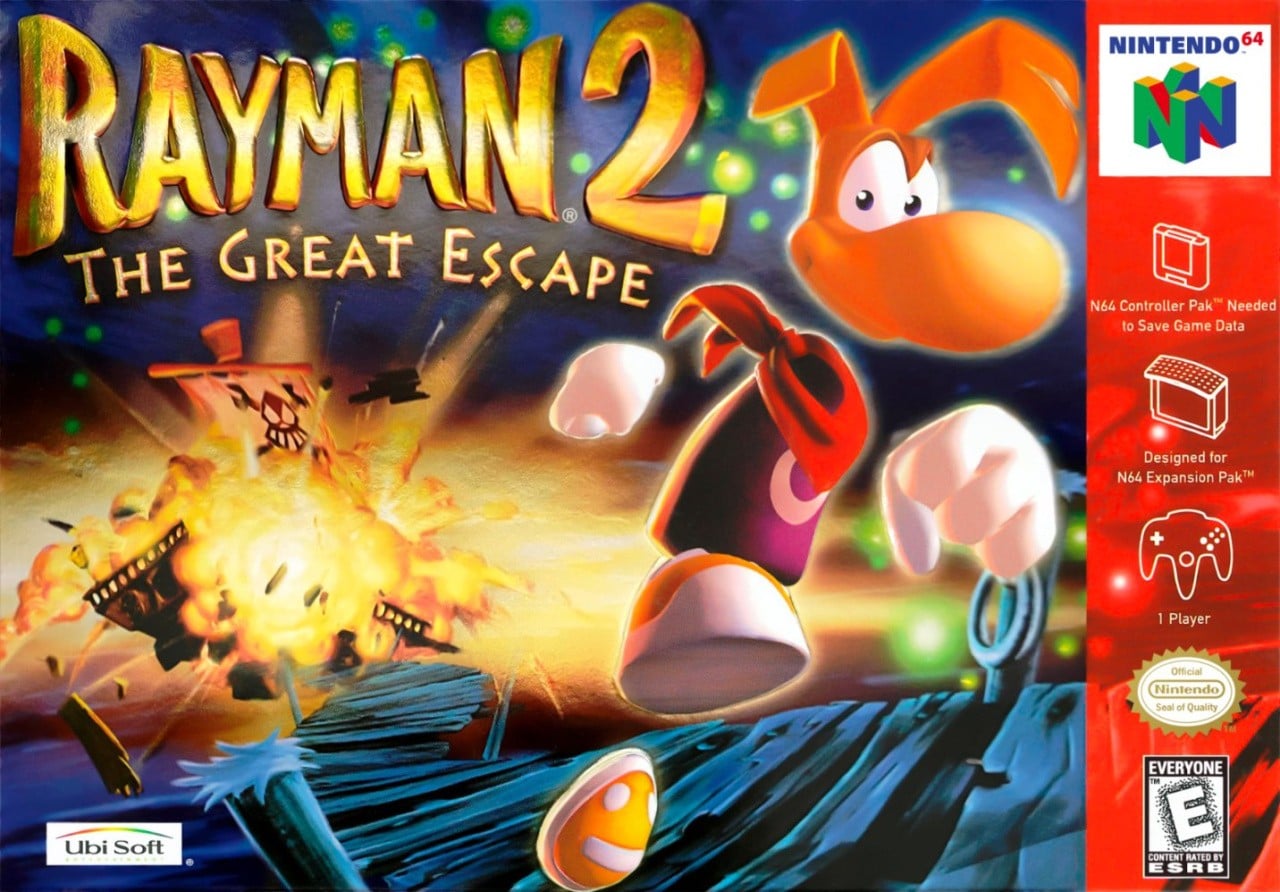
If Paul Thomas Anderson’s flick One Battle After Another was an N64 platformer where Leo could actually pull off a long jump, its cover art would likely be a lot like Rayman 2: a member of the resistance speeding away from a well-placed detonation.
Image: Ubisoft
I’ll be the first to admit there are N64 platformers with more expansive level design, but Rayman had other goals. Rayman 2’s linear levels make the most of his polished moveset of “hairlicopter” gliding and lobbing energy projectiles, while giving his eight-hour adventure a breakneck sense of dramatic momentum.
He may look ‘armless, but he has the unruly toolkit to beat the most committed anarchist, even Donkey Kong! Rayman is shattering cages to free vulnerable Teensies and Lums. He’s raiding the robo-pirates’ very own gunpowder kegs to blow up every barred door in his way. He’s taming walking rockets bronco-style for high-stakes pursuit, even commandeering their own ships to blast his way to Admiral Razorbeard.
A one-man counterattack from France’s favourite platforming hero draws a painfully obvious comparison to the spirit of the French Resistance; no coincidence when the game shares its name with the famous Steve McQueen film about Allied POWs in World War II. From the moody opening cinematic — which rivals the dramatic stakesetting of Metal Gear Solid if you ask me — the game’s sky-high stakes represent Rayman’s darkest hour.
It’s a world away from the original Rayman, which was an accomplished but straightforward jaunt through platforms creatively constructed from sticky nougat before battling giant saxophones. Rayman 2 went so much darker. The series, always inspired by The Dark Crystal, came closest to Jim Henson and Frank Oz’s creepy cult classic with Rayman 2’s palette of ominous green shades and environments layered with deep shadows.
When you come to the unnerving Cave of Bad Dreams, you find a Tim Burton-esque nightmare. You’re running down giant skeletal spinal columns, leaping from skull to skull as they sink into forboding depths, then climbing up rows of ribcages like you’re bouldering in the Parisian catacombs. With other levels introducing putrid waterlogged bayous and frightening pirate-infested cave docks, the vibe’s often closer to Shadow Man than Banjo-Kazooie’s pantomime nasties – despite Banjo Tooie’s imaginatively creepy efforts.
With its dystopian setting and firm sense of justice, the similarities between Rayman 2 and director Michel Ancel’s next game, Beyond Good & Evil, are impossible to ignore. Just swap out Rayman’s kidnapped Teensie Kings for Jade’s alien-abducted orphans, or Razorbeard’s Buccaneer flying ship for the Dom-Z’s space base. It’s a tragedy that this promisingly ambitious trajectory ended in 2003, as much as I love Rayman Legends’ giddy thrills.
Today, both games represent a braver, weirder time for Ubisoft in the mid-2000s. A time before money-printing machines like Assassin’s Creed and Far Cry kicked into gear, and the Rabbids condemned Rayman to a supporting role in his own series. This was when the Ubisoft I loved the most were at the peak of their powers, exploring the outer reaches of the 3D platforming genre.
Decades later, Rayman remains on his interminable hiatus, and the question of which version of Rayman 2 is best remains stubbornly unsolved. The PlayStation and PlayStation 2 versions spoil the game’s rich atmosphere with cloyingly over-enthusiastic English voice acting. Many claim the Dreamcast version is definitive, but no additions could convince me to pick up that Tamagotchi contraption it calls a controller.
For me, and I’ll admit this is a game where my nostalgia-tinged glasses are practically superglued on, the Nintendo 64 version is the best way to play Rayman 2. Its soundtrack is unique to the system; without the CD storage space other formats could use, it relies on catchy and effective MIDI melodies. Its pared-back approach is best seen in its opening cutscene (below), which adds none of the distractions of its other versions. And the N64’s anti-aliasing haze suited its shadowy vibe magnificently.
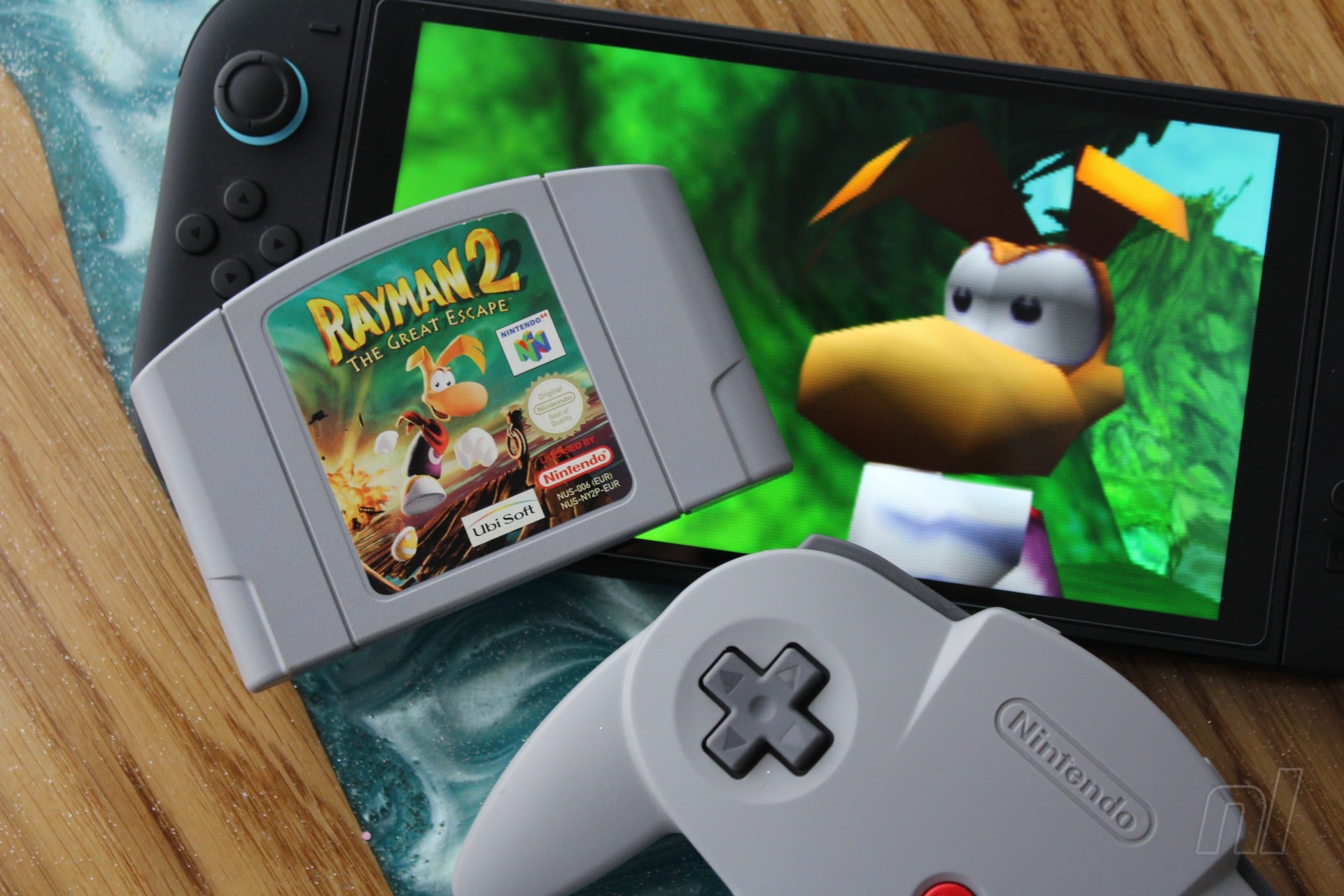
Now it’s on Switch Online, Rayman 2’s own Great Escape from its undeserved obscurity gives the N64 version an unbeatable claim to be the best of all: you can play it right now. And you absolutely should.
I’ll never forget Rayman 2. And that’s not just because I replayed its opening stage more times than I could ever count, having missed the fact that the N64 cart needed a memory card to save my game. It’s proven so memorable thanks to its rebellious heroism, oddball creativity, and unusual place in Ubisoft history. It taught me to fight for freedom or die trying. Even if the outcome was usually an explosive end after taking a wrong turn on my untamed rocket steed.
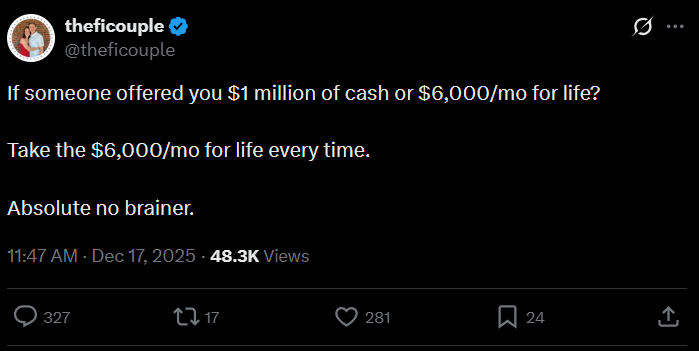
Post: “If someone offered you $1 million of cash or $6,000/mo for life? Take the $6,000/mo for life every time. Absolute no brainer.”
I was stunned that most people didn’t seem to understand that this is not the best option.
So, which option is better:
Choosing $1M now, or
$6,000 per month for life?
To answer this mission-critical question, I ran an analysis. Here it is:
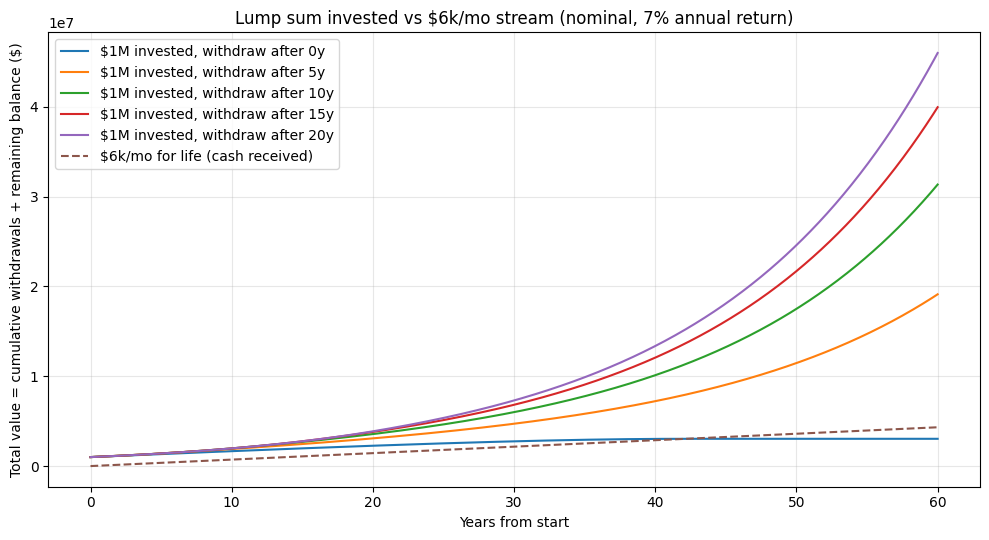
$1M invested starts growing immediately. If you don’t touch it for X years (see chart), you can later withdraw $6k/m and still end up with WAY more money.
The monthly deal looks safe but it’s trading away the compounding engine (the $1M) for a fixed paycheck.
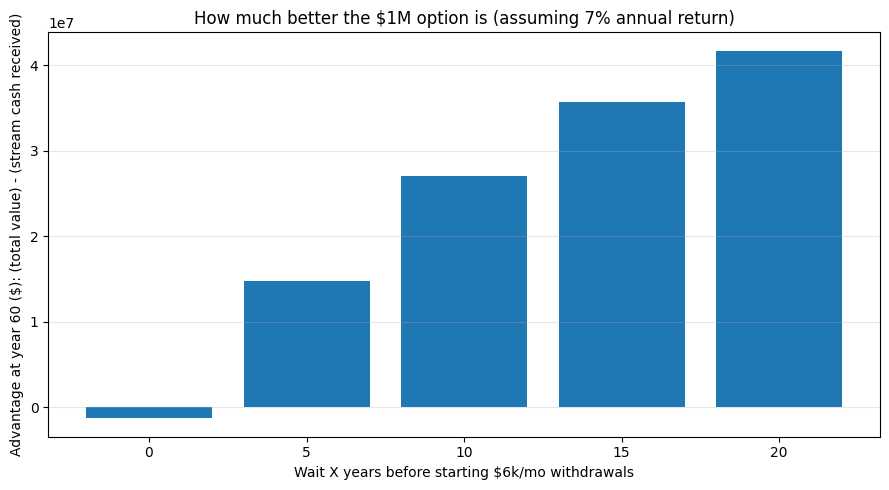
You can also see this graphic for which option is better:
Key takeaways:
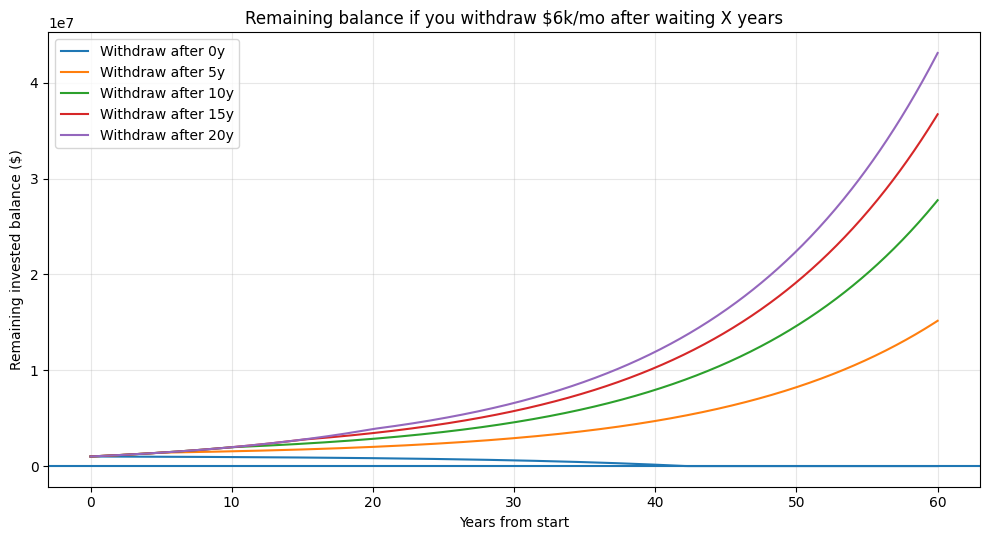
If you start withdrawing immediately ($6k/mo), you’re taking $72k/yr = 7.2% of $1M. With a 7% return, the portfolio eventually depletes (in this simulation: around year ~42).
If you wait even 5–10 years before starting withdrawals, the account grows enough that the $6k/mo becomes easily sustainable, and you end up with a huge remaining balancewhile also receiving the same $6k/mo thereafter.
Compared to the “$6k/month stream” (which leaves you with no asset), the “$1M then withdraw later” strategy produces dramatically higher total value = (cash withdrawn + remaining balance).
Game-Key Cards have been perhaps the hottest topic of the Switch 2’s lifecycle so far. Outside of particularly large releases, the running theory is that many studios are turning to a Game-Key physical release because Nintendo has failed to offer small/cheap options for those who don’t want to cough up for the big 64GB cartridges. But that might be about to change.
A rumour making the rounds online today states that Nintendo will soon introduce 16 and 32GB cartridge options, so smaller devs hoping to launch a physical release won’t have to turn to Key Cards as the only financially viable way of making it happen.
That is according to both the game preservation community Does It Play and Physical Paradise on Twitter, the latter of which claims to have been informed of the introduction by two separate sources.
@Nintendeal also claimed to have heard the same information, though it pointed out that increasing material costs and chip shortages mean there’s no guarantee that more cart size options will directly affect pricing.
Earlier this year, Ubisoft employee Rob Bantin explained that Star Wars Outlaws had launched on Switch 2 as a GKC, not because of a cost issue, but because the S2 carts “simply didn’t give the performance we needed at the quality target we were going for”. To be clear, different cart sizes would do nothing to mend this issue, but they would provide an alternative for smaller games that are less reliant on speedy asset streaming.
Of course, it is nothing more than a rumour for the time being, so make sure to take things with a hefty pinch of salt.
Something that isn’t rumoured, however, is the physical launch of R-Type Dimensions III, which ININ Games has today announced will be arriving as a Game-Key Card since “switching entirely to cartridges would significantly raise manufacturing costs and increase the retail price by at least 15€”.
“To avoid this, we chose to release the game on a key card while continuing to explore alternative solutions for the Special and Collector’s Edition,” the publisher wrote in an explanation post on Twitter. “There is still hope for a real cartridge, and we are trying everything.”
It remains to be seen whether more cart sizes from Nintendo will actually impact the number of Game-Keys on the market, or whether studios will continue to stick firmly to the download option. We’ll be keeping an eye out for more developments in this particular rumour, and will update you should we hear anything.
What do you make of this rumour? Do you think it would result in fewer Game-Key Cards? Let us know in the comments.
Morgan Stanley has raised its Apple stock price target to $315, with the stock still a core overweight pick for the analysts heading into 2026.
As 2025 comes to an end, analysts take stock of their stock picks from the year and what to expect for the year ahead. For Morgan Stanley, that includes an increase in confidence in Apple.
In a note to investors seen by AppleInsider on Wednesday, Morgan Stanley is increasing its price target for Apple from $305 to $315. This is an increase of $10 from the last time it changed the target on October 31.
In the note, Morgan Stanley says it sees bit opportunities for Apple to grow in 2026.
Memory and AI
When it comes to cloud services and expenditure, Apple’s demand is expected to remain static despite the prospect of rising prices for infrastructure. Enormous RAM cost increases could cause a problem for some companies regarding the bill of materials, which naturally includes Apple.
With pricing pressure on memory, Morgan Stanley doubts that can be offset by Apple Intelligence. The infrastructure buildout to handle AI in general probably cannot outpace the cost of memory rising sharply.
For the price target itself, the raise reflects an unchanged multiple of 32 times for Morgan Stanley’s 2027 financial year expectations. For that year, it anticipates an earnings per share of $9.83, up from $9.55.
The increase is due to an anticipated lower gross margin because of higher memory costs, as well as a 5% higher anticipated revenue. This revenue increase will apparently be from price hikes driven by commodity cost inflation, as well as a marginal increase in iPhone shipment forecasts.
The iPhone 17 cycie in particular is apparently benefiting from a longer 5-year replacement cycle. Core feature upgrades and better carrier subsidies and trade-in offers have also helped increase sales.
Going into 2027, Apple is expected to exit the 2026 financial year with about 550 million iPhones on the market that cannot upgrade to Apple Intelligence. With the newSiri and third-party LLM support expectations, this could help push upgrades more into the year.
That said, Morgan Stanley doesn’t assume Apple will make any real artificial intelligence monetization plays yet. The movements are positive, but there doesn’t seem to be any immediate product or Services upside.
Supply chain and Services
There’s also an effectively unchanged operational expenditure trajectory for Apple, despite historical seasonality, thanks to its AI investments.
Better supply chain leverage than other companies also helps Apple considerably, as well as lower China tariff expectations, and anticipated price increases for iPhones.
Services will still be a growth center, Morgan Stanley forecasts, with sustained double-digit revenue growth for the segment thanks to price increases and App Store improvements.
Ultimately, Morgan Stanley gives Apple a continued “Overweight” rating, a 14% risk-adjusted risk-reward, and a 1.6 bull-to-bear skew.
The US has suffered its worst November since 1995 in terms of hardware sales, according to Circana’s Mat Piscatella.
In his monthly thread detailing sales figures and retail highlights, Piscatella confirms that a total of 1.6 million hardware units were sold across all platforms in the US during November. This is the lowest total since 1995, during which a total of 1.4 million units were sold.
To potentially explain this figure, Piscatella also notes that the average price paid for a new piece of hardware was “an all-time November high of $439”, which is up 11% compared to a year ago.
Looking at the data a bit closer, the PS5 managed to beat the Switch 2 to be the highest-selling platform during November, which is the first time Sony has managed such a feat since the launch of Nintendo’s new console. Meanwhile, the NEX Playground came in third place in units sold, though the Xbox managed to bag third in dollars.
We know what you’re thinking… You don’t need yet another reason to pick up Resident Evil Requiem, right? Well, you know us, we’re here to deliver the goods.
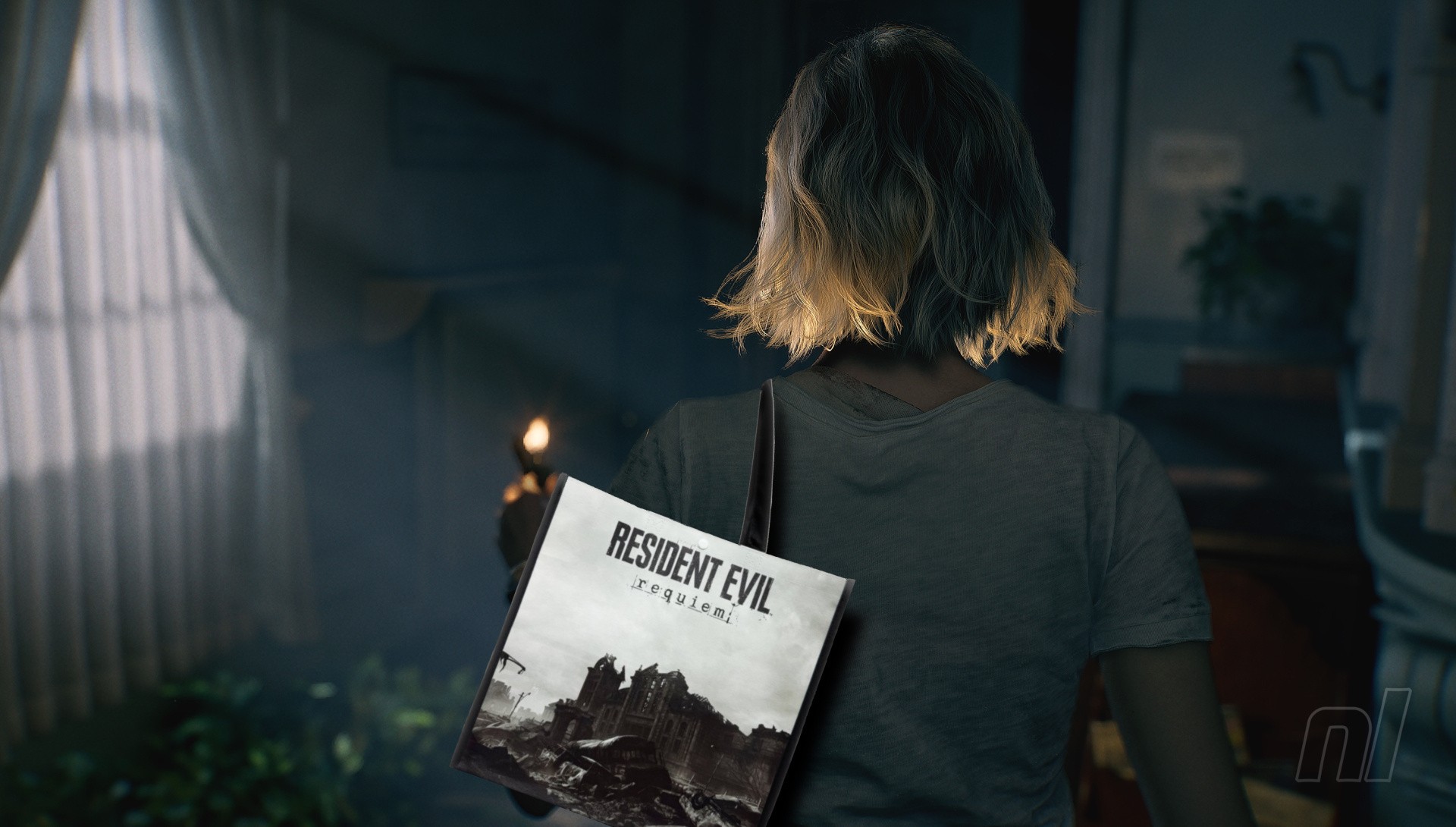
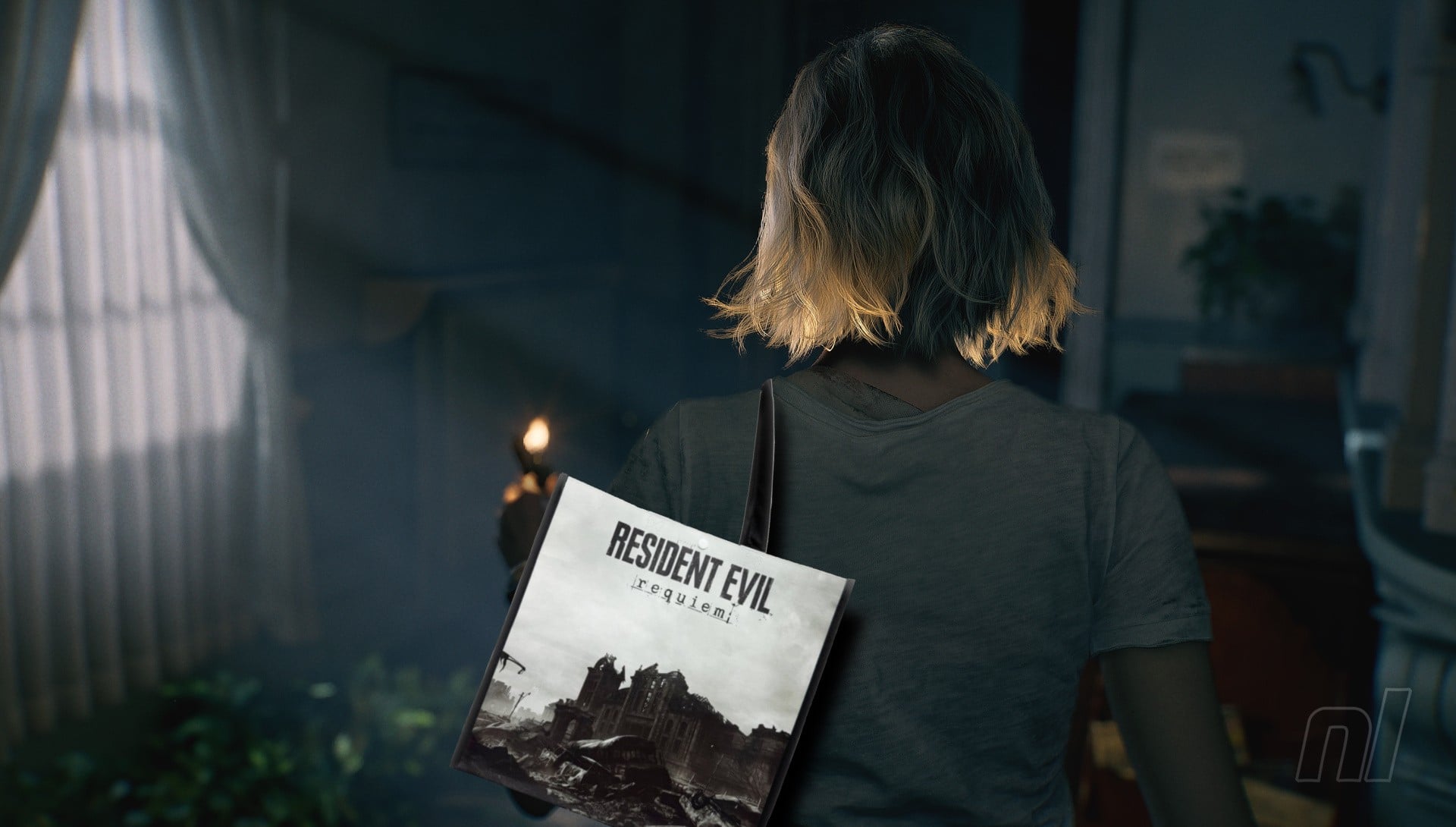
GameStop has announced that it will be issuing a free tote bag (gasp!) for in-store pre-orders for Requiem on all available platforms. It depicts the ruined landscape of Racoon City with the game’s title at the top. Form an orderly queue folks, come on now!
Look, to be serious for a moment, we know it’s not the coolest pre-order bonus ever, but heck, it’s free. For diehard fans of the series, it could be a cool little thing to hang off the end of a shelf, or something. We’re grasping, sure, but still…
Regardless of where you wind up purchasing it, Resident Evil Requiem will launch on the Switch 2 on 27th February 2026. It sees the return of veteran Leon Kennedy and the introduction of FBI agent Grace Ashcroft, whose mother – Alyssa – was a key character in the classic PS2 title, Resident Evil: Oubreak.
What do you make of this pre-order bonus from GameStop? Has it convinced you to go for the Game Key Card release for Requiem? Let us know with a comment.
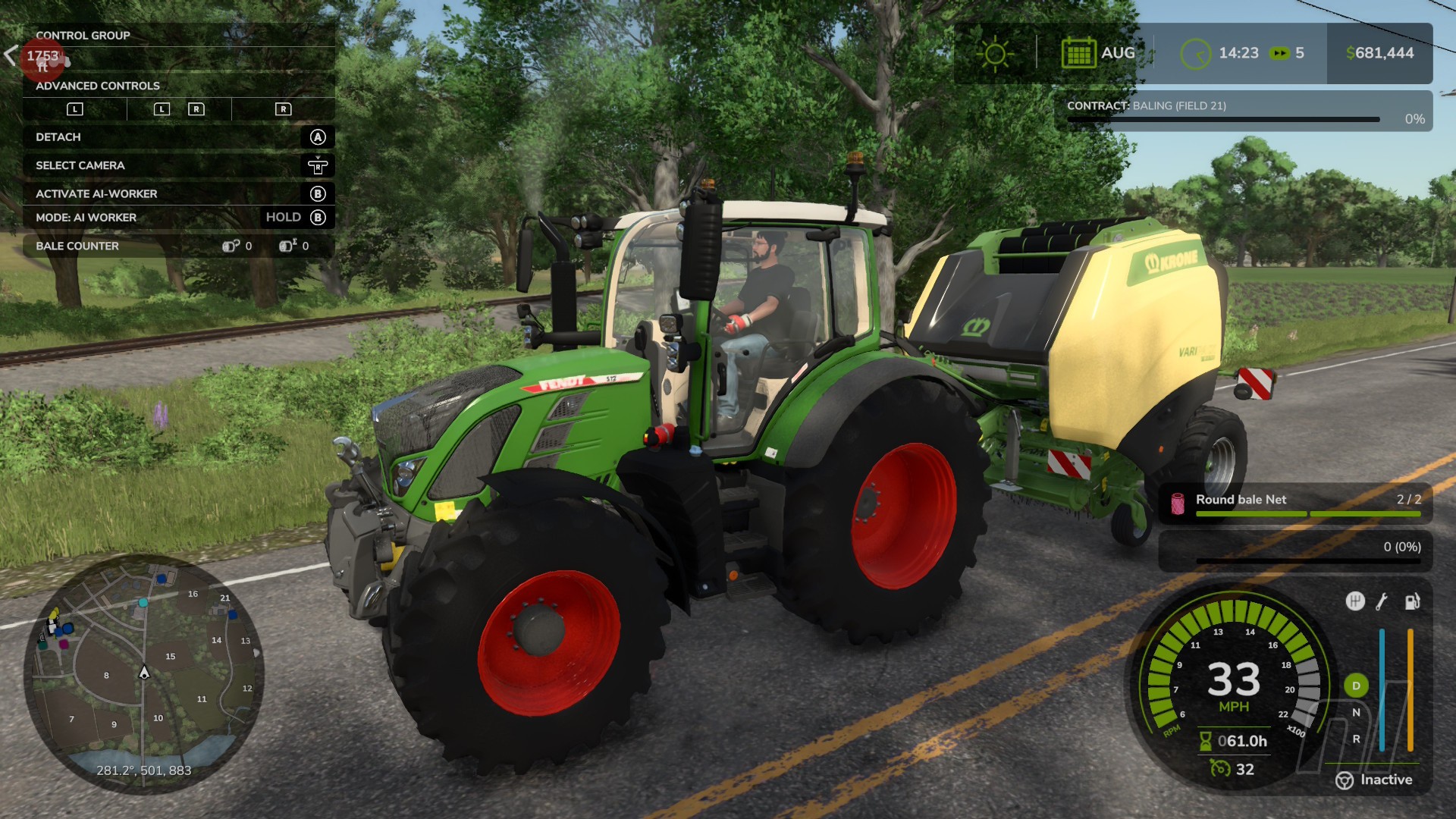
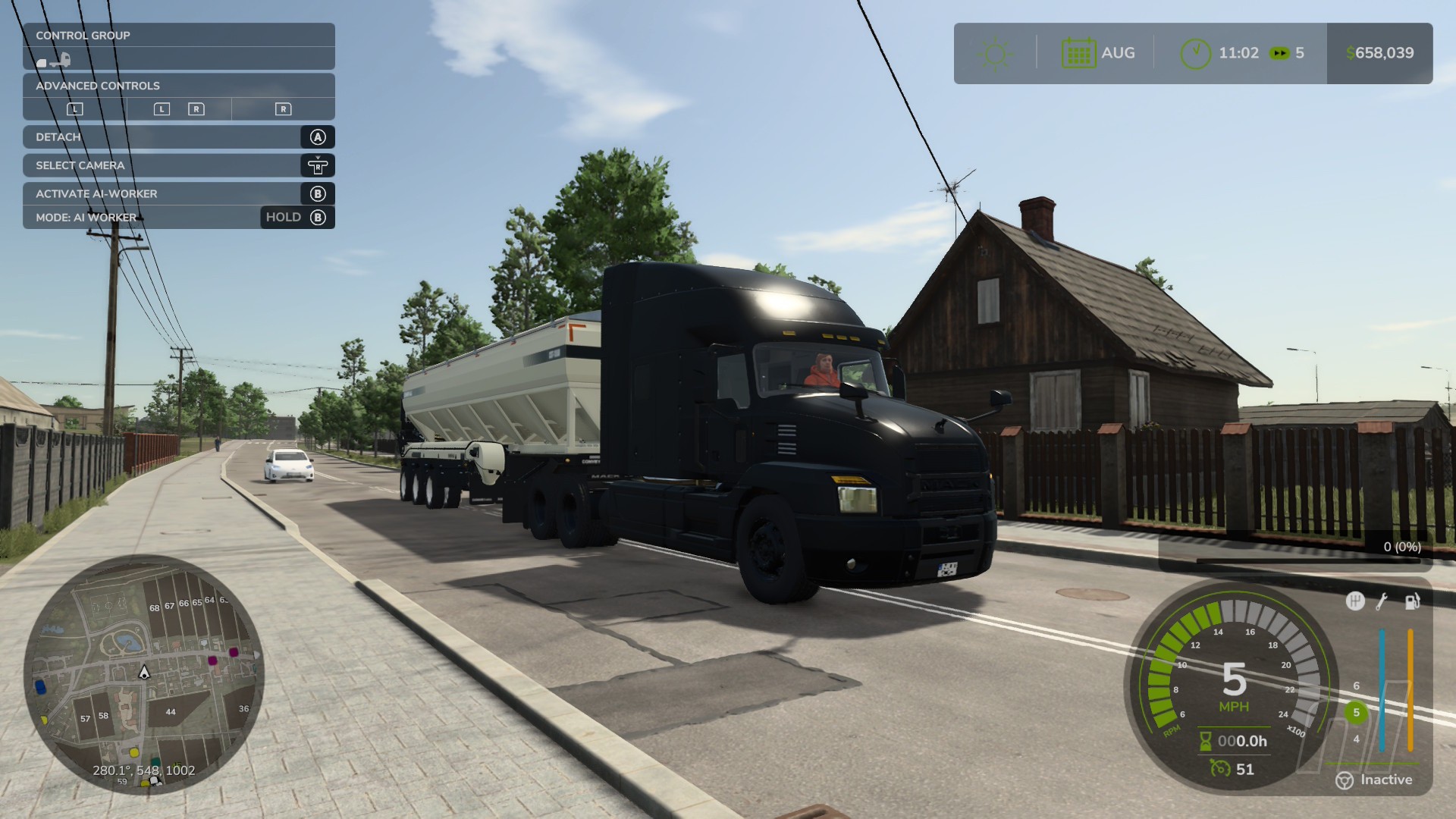
My pigs are starving and I do not know how to feed them.
The pig feed is ready to pick up at the shop, but I don’t know where the shop is. Once I find the correct establishment, I need to figure out how to pick up the pallets of food and take them back to my emaciated swine.
Later, after I purchased a front loader and the appropriate bucket attachment, I take the feed back to my farm. Then comes another problem. How do I actually deposit it in the trough?
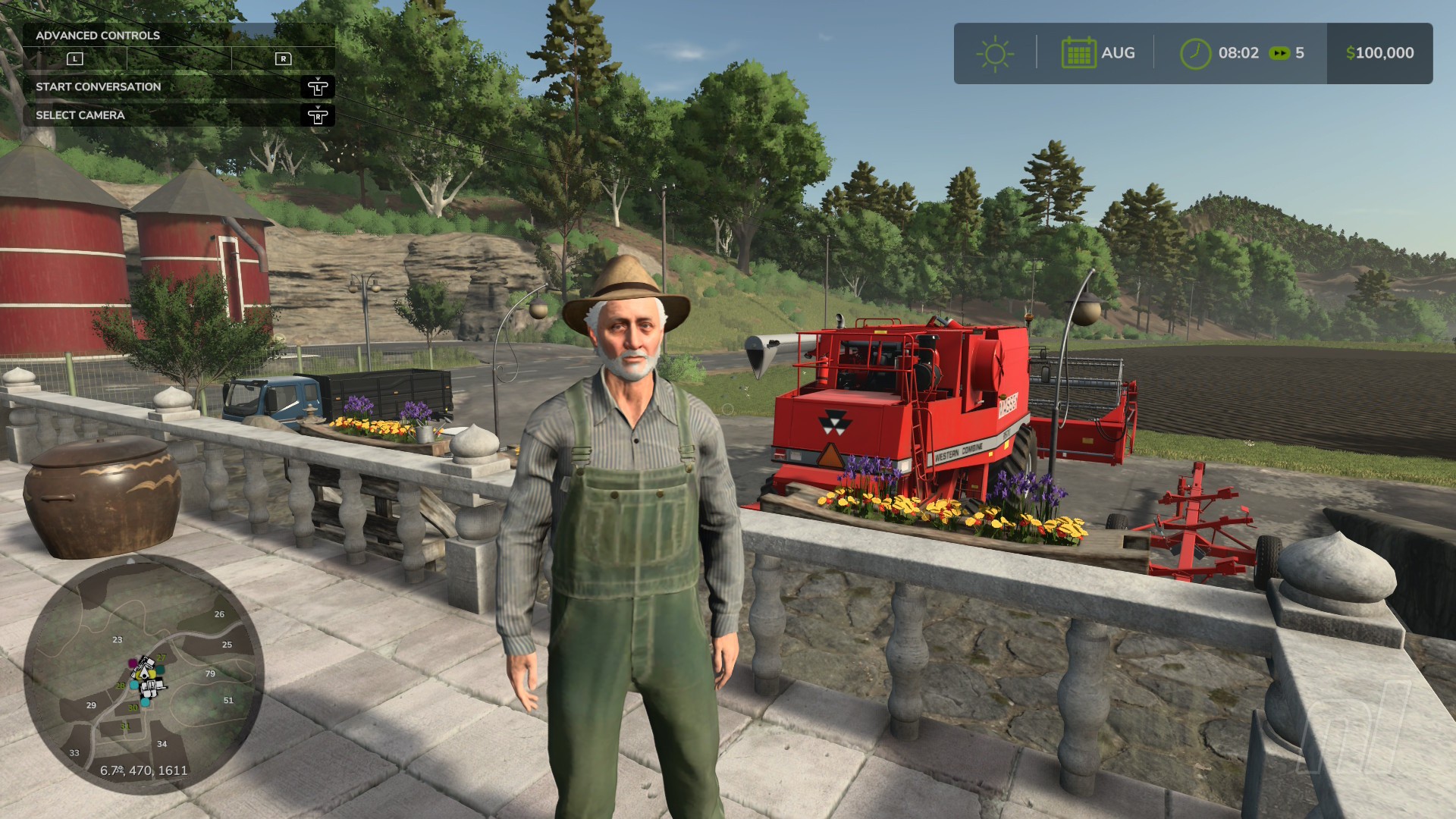
Fans of Stardew Valley will recognise the setup straight away. Your grandfather is getting a bit long in the tooth and wants to leave you in charge of his agricultural empire. It is up to you to tend the land, reap, sow, and explore the surrounding community.
Captured on Nintendo Switch 2 (Docked)
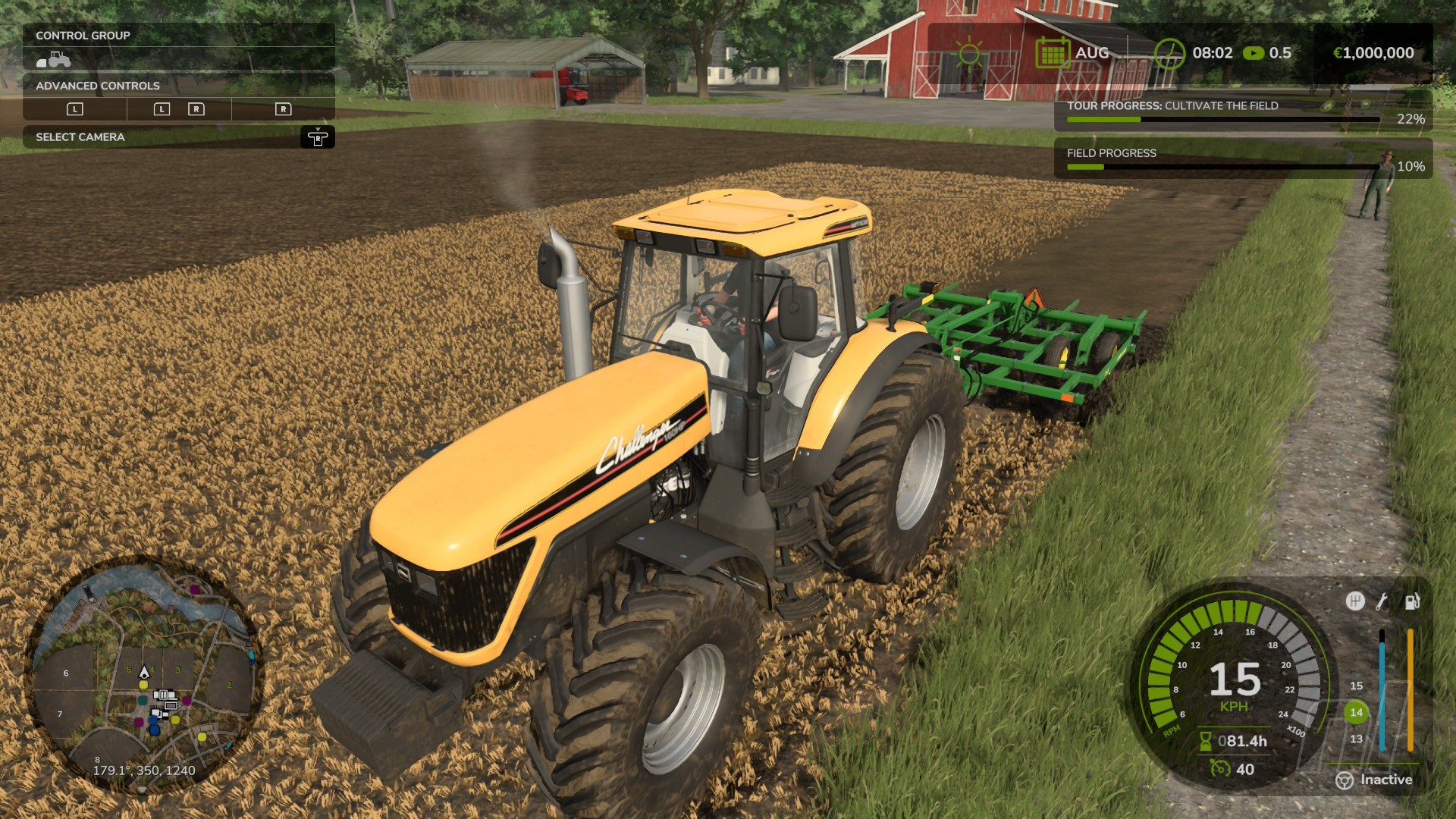
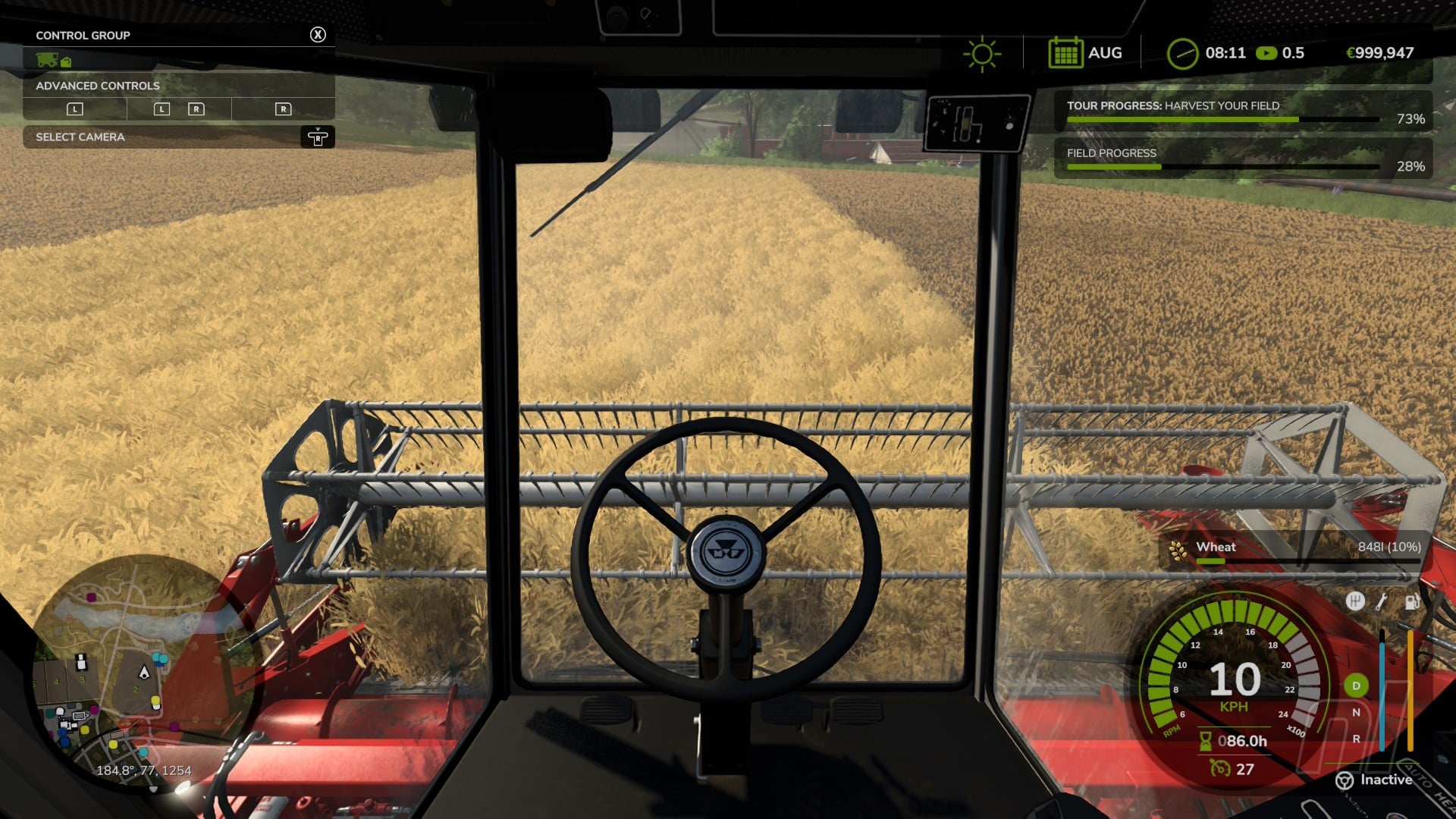
Unlike Stardew, this is not a cutesy, cosy life sim. Instead, it is a meticulously designed and realistic depiction of farming life. There is more painstaking attention to detail in a single combine harvester here than there is in most racing games.
After your grandfather takes you through a brief tutorial tour, you are free to tackle your life as a farmer in any way you desire. My immediate compulsion was towards animal husbandry, which, as mentioned, was far more complex than I imagined.
Luckily, one of the best things about these games is that there is no one way to play. The map, of which there are several to choose from, is a surprisingly biodiverse collection of land plots and population centres.
You are free to begin your career from scratch or as a mature farmer. Either way, the core loop of the game is in engaging with its many systems of commerce to earn a profit. Seasonal variation, layout, and topography vary between the maps, but everything else remains the same. You trade with the same collection of NPCs and the overwhelming contents of the in-game stores are the same regardless of career choice.
Captured on Nintendo Switch 2 (Docked)
As a newcomer, I chose to start a farm from scratch. There is a guided tutorial of sorts, but it only scratches the surface of the myriad systems at play. From there, I had to look up almost every aspect of farm life. While series veterans may not find the early hours as obtuse as I did, these kinds of games would still benefit from putting information more front and centre.
That said, there is a wealth of accessibility and quality-of-life options available throughout your farming adventures. Almost every task can be completed by an AI farmhand, who will cultivate fields, deliver yields, and handle all the repeatable work that you are too rich to bother with after reaching a certain level of maturity.
These simulators can be as simple or as complex as you make them, but there are still lots of plates to spin. On any given day cycle, you’ll be keeping an eye on the calendar to grow crops at the optimal time, managing your animal produce, and steadily growing your empire to make grandfather proud. Then there is the farm equipment itself, each machine having a different purpose and slight variation on how to drive and control them. Every single task in Farming Simulator requires a specific tool to undertake. The late game almost becomes a collectathon as you populate your farm with a fleet of shiny tractors and attachments.
Captured on Nintendo Switch 2 (Docked)
This kind of time sink is tailor-made for Switch. The just-one-more-hour compulsion and cyclical routine feel perfect for long trips in handheld mode, or for docked couch sessions. It is exactly the sort of game that fits the platform’s strengths.
It’s a shame, then, that the optimisation of this Switch 2 port is sorely lacking in places. General image fidelity is solid between modes, but performance is wildly unpredictable. The game struggles to hold a steady 30fps in both docked and undocked modes.
Some areas, particularly your hub farm, tank the frame rate considerably. Elsewhere, there are frequent graphical glitches and bugs. For me, this involved excessive clipping into terrain and loss of vehicle control. There aren’t even any Switch 2 native additions to the experience, with mouse controls sadly missing. Touchscreen is present across all functionality, which, for a game where you spend most of your time in menus, is a mercy.
Captured on Nintendo Switch 2 (Handheld/Undocked)
Audio is sharp, particularly in the sounds of the machinery, which are as distinct as their visual rendering. If you don’t want to hear the endless chug of a tractor engine, there’s a selection of original music on the in-game radio. Why not listen to chip tune anthems while cutting down deadwood?
The appeal of Farming Simulator is obvious, even from the perspective of a fledgling land tiller like myself. However, the uneven technical presentation will ultimately compromise anyone willing to sink a few hundred hours into the experience, especially if Giants Software does not find a way to patch in some much-needed stability.
Conclusion
Farming Simulator arrives on Switch 2 in a familiar state for returning fans. While newcomers will face an early spike of confusion before eventually settling into the addictive routine of virtual agriculture, veterans will immediately feel at home. Unfortunately, technical issues with the port will blight the careers of both camps.