?Indie Burger Bundle, Frontier Sale, Awesome Guys Sale
Indie Burger Bundle | 6 Steam Games | 92% OFF
[www.indiegala.com] With 6 fine ingredients, this tasteful selection is made with love, skill & all-natural video game spices that will positively make you ask for seconds. Grab a bite from the Indie Burger Bundle today!
The games are free to keep until Mar 10th 2022 - 16:00 UTC.
Next week's freebie: Cities: Skylines
We are welcoming everyone to join our discord[discord.gg]. We are more active there on finding giveaways, small or large, and there are daily raffles you can participate.
Set sail and discover the wonders of a flooded world rife with mystery. Dive into unknown depths on the hunt for fuel and salvage, devise innovative solutions to overcome intricate obstacles, and unearth forgotten relics lost to time.
How Quarkus brings imperative and reactive programming together
The supersonic subatomic Java singularity has expanded!
42 releases, 8 months of community participation, and 177 amazing contributors led up to the release of Quarkus 1.0. This release is a significant milestone with a lot of cool features behind it. You can read more in the release announcement.
Building on that awesome news, we want to delve into how Quarkus unifies both imperative and reactive programming models and its reactive core. We’ll start with a brief history and then take a deep dive into what makes up this dual-faceted reactive core and how Java developers can take advantage of it.
Microservices, event-driven architectures, and serverless functions are on the rise. Creating a cloud-native architecture has become more accessible in the recent past; however, challenges remain, especially for Java developers. Serverless functions and microservices need faster startup times, consume less memory, and above all offer developer joy. Java, in that regard, has just in recent years done some improvements (e.g., ergonomics enhancements for containers, etc.). However, to have a performing container-native Java, it hasn’t been easy. Let’s first take a look at some of the inherent issues for developing container-native Java applications.
Let’s start with a bit of history.
Threads and containers
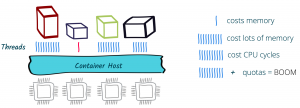
As of version 8u131, Java is more container-aware, due to the ergonomics enhancements. So now, the JVM knows the number of cores it’s running on and can customize thread pools accordingly — typically the fork/join pool. That’s all great, but let’s say we have a traditional web application that uses HTTP servlets or similar on Tomcat, Jetty, or the like. In effect, this application gives a thread to each request allowing it to block this thread when waiting for IO to occur, such as accessing databases, files, or other services. The sizing for such an application depends on the number of concurrent requests rather than the number of available cores; this also means quota or limits in Kubernetes on the number of cores will not be of great help and eventually will result in throttling.
Memory exhaustion
Threads also cost memory. Memory constraints inside a container do not necessarily help. Spreading that over multiple applications and threading to a large extent will cause more switching and, in some cases, performance degradation. Also, if an application uses traditional microservices frameworks, creates database connections, uses caching, and perhaps needs some more memory, then straightaway one would also need to look into the JVM memory management so that it’s not getting killed (e.g., XX:+UseCGroupMemoryLimitForHeap). Even though JVM can understand cgroups as of Java 9 and adapt memory accordingly, it can still get quite complex to manage and size the memory.
Quotas and limits
With Java 11, we now have the support for CPU quotas (e.g., PreferContainerQuotaForCPUCount). Kubernetes also provides support for limits and quotas. This could make sense; however, if the application uses more than the quota again, we end up with sizing based on cores, which in the case of traditional Java applications, using one thread per request, is not helpful at all.
Also, if we were to use quotas and limits or the scale-out feature of the underlying Kubernetes platform, the problem wouldn’t solve itself; we would be throwing more capacity at the underlying issue or end up over-committing resources. And if we were running this on a high load in a public cloud, certainly we would end up using more resources than necessary.
What can solve this?
A straightforward solution to these problems would be to use asynchronous and non-blocking IO libraries and frameworks like Netty, Vert.x, or Akka. They are more useful in containers due to their reactive nature. By embracing non-blocking IO, the same thread can handle multiple concurrent requests. While a request processing is waiting for some IO, the thread is released and so can be used to handle another request. When the IO response required by the first request is finally received, processing of the first request can continue. Interleaving request processing using the same thread reduces the number of threads drastically and also resources to handle the load.
With non-blocking IO, the number of cores becomes the essential setting as it defines the number of IO threads you can run in parallel. Used properly, it efficient dispatches the load on the different cores, handling more with fewer resources.
Is that all?
And, there’s more. Reactive programming improves resource usage but does not come for free. It requires that the application code embrace non-blocking and avoid blocking the IO thread. This is a different development and execution model. Although there are many libraries to help you do this, it’s still a mind-shift.
First, you need to learn how to write code executed asynchronously because, as soon as you start using non-blocking IOs, you need to express what is going to happen once the response is received. You cannot wait and block anymore. To do this, you can pass callbacks, use reactive programming, or continuation. But, that’s not all, you need to use non-blocking IOs and so have access to non-blocking servers and clients for everything you need. HTTP is the simple case, but think about database access, file systems, and so on.
Although end-to-end reactive provides the best efficiency, the shift can be hard to comprehend. Having the ability to mix both reactive and imperative code is becoming essential to:
Use efficiently the resources on hot paths, and
Provide a simpler code style for the rest of the application.
Enter Quarkus
This is what Quarkus is all about: unifying reactive and imperative in a single runtime.
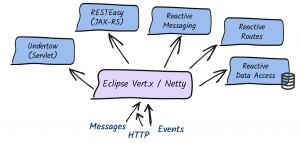
Quarkus uses Vert.x and Netty at its core. And, it uses a bunch of reactive frameworks and extensions on top to help developers. Quarkus is not just for HTTP microservices, but also for event-driven architecture. Its reactive nature makes it very efficient when dealing with messages (e.g., Apache Kafka or AMQP).
The secret behind this is to use a single reactive engine for both imperative and reactive code.
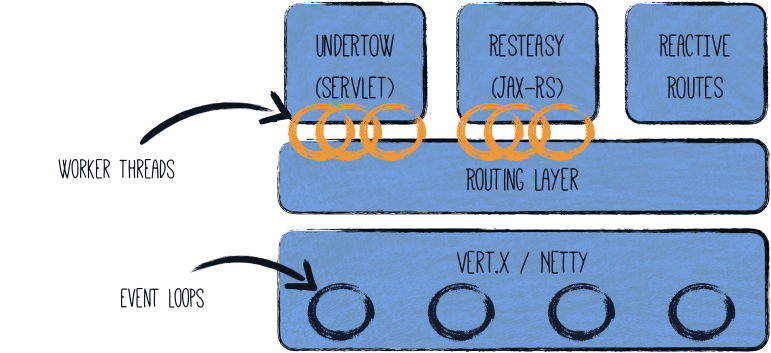
Quarkus does this quite brilliantly. Between imperative and reactive, the obvious choice is to have a reactive core. What that helps with is a fast non-blocking code that handles almost everything going via the event-loop thread (IO thread). But, if you were creating a typical REST application or a client-side application, Quarkus also gives you the imperative programming model. For example, Quarkus HTTP support is based on a non-blocking and reactive engine (Eclipse Vert.x and Netty). All the HTTP requests your application receive are handled by event loops (IO Thread) and then are routed towards the code that manages the request. Depending on the destination, it can invoke the code managing the request on a worker thread (servlet, Jax-RS) or use the IO was thread (reactive route).
For messaging connectors, non-blocking clients are used and run on top of the Vert.x engine. So, you can efficiently send, receive, and process messages from various messaging middleware.
To help you get started with reactive on Quarkus, there are some well-articulated guides on Quarkus.io:
There are also reactive demo scenarios that you can try online; you don’t need a computer or an IDE, just give it a go in your browser. You can try them out here.
Posted by: xSicKxBot - 03-25-2022, 09:14 AM - Forum: Python
- No Replies
Python enumerate() — A Simple Illustrated Guide with Video
If you’re like me, you want to come to the heart of an issue fast. Here’s the 1-paragraph summary of the enumerate() function—that’s all you need to know to get started using it:
Python’s built-inenumerate(iterable) function allows you to loop over all elements in an iterable and their associated counters. Formally, it takes an iterable as an input argument and returns an iterable of tuples(i, x)—one per iterable element x. The first integer tuple value is the counter of the element x in the iterable, starting to count from 0. The second tuple value is a reference to the element x itself. For example, enumerate(['a', 'b', 'c']) returns an iterable (0, 'a'), (1, 'b'), (2, 'c'). You can modify the default start index of the counter by setting the optional second integer argumentenumerate(iterable, start).
I’ve created a short visual guide into enumerate in the following graphic:
Usage Example
Learn by example! Here are some examples of how to use the enumerate()built-in function:
fruits = ['apple', 'banana', 'cherry']

for counter, value in enumerate(fruits): print(counter, value) # OUTPUT:

# 0 apple

# 1 banana

# 2 cherry
The enumerate(iterable, start) function takes an optional second argument that is the start value of the counter.
fruits = ['apple', 'banana', 'cherry']

for counter, value in enumerate(fruits, 42): print(counter, value) # OUTPUT:

# 42 apple

# 43 banana

# 44 cherry
You can use the enumerate function to create a list of tuples from an iterable where the first tuple value is the index of the element:
Syntax:

enumerate(iterable) -> loop over all elements in an iterable and their counters, starting from 0.

enumerate(iterable, start) -> loop over all elements in an iterable and their counters, starting from start.
Arguments
iterable
The iterable you want to enumerate.
start
The start counter of the first element iterable[0].
Return Value
enumerate object
An iterable that allows you to iterate over each element associated to its counter, starting to count from start.
Exercise: Change the start value of the enumerate function to your personal age and run the code. What’s the associated counter to the last fruit in the list?
Next, you’re going to dive deeper into the enumerate() function.
But before we move on, I’m excited to present you my brand-new Python book Python One-Liners (Amazon Link).
If you like one-liners, you’ll LOVE the book. It’ll teach you everything there is to know about a single line of Python code. But it’s also an introduction to computer science, data science, machine learning, and algorithms. The universe in a single line of Python!
The book was released in 2020 with the world-class programming book publisher NoStarch Press (San Francisco).
What is the Return Value of Python’s enumerate() function?
The return value of enumerate(iterable) is an object of type enumerate. The enumerate class definition implements the iterable interface—the__next__() function—which means that you can iterate over it.
The default implementation of enumerate() is done in C++, assuming you use cPython as your Python engine. However, the documentation shows an equivalent implementation of enumerate() in Python code that helps you understand how it works under the hood:
def enumerate(sequence, start=0): counter = start for element in sequence: yield counter, element counter += 1
You can see that the return value of enumerate() is not a list but a generator that issues the (counter, element) tuples as they appear in the sequence. Thus, the implementation is memory efficient—it doesn’t generate all (counter, element) pairs in advance and holds them in memory, but generates them as they’re needed.
How to Use enumerate() on Strings?
The enumerate(iterable) function takes an iterable as an input argument. A string is an iterable, so you can pass the string as an input. The return value of the function enumerate(string) will be an enumerate object that associates a counter to each character in the string for a series of tuples (counter, character). Here’s an example:
How to Make Your Loop More Pythonic With enumerate()?
Beginner Python coders and coders coming from other programming languages such as Java or C++, often think in indices when creating loops such as this one:
# NON_PYTHONIC

fruits = ['apple', 'banana', 'cherry']

for i in range(len(fruits)): print(i, fruits[i])
The output of this correct, but unpythonic code is:
0 apple

1 banana

2 cherry
While the code does what it needs to do, it shouts into the world that its creator is not an experienced Python coder, but a newbie in Python. Why? Because an experienced Python coder will always prefer the enumerate() function due its more idiomatic and crisp functionality:
# PYTHONIC

fruits = ['apple', 'banana', 'cherry']

for i, fruit in enumerate(fruits): print(i, fruit)
You don’t have to use a single indexing mechanism—which reduces the likelihood of a bug and improves readability of your code.
Python enumerate() step
How to set a step in the indices used by the enumerate() function? For example, you may want to use only every third counter:
0 element_0

3 element_1

6 element_2
The answer is to multiply the returned counter value from a default call of the enumerate() function with the step size like this:
lst = ['element_0', 'element_1', 'element_2']

step = 3

for i, x in enumerate(lst): print(i*step, x)
OUTPUT:

0 element_0
3 element_1
6 element_2
Summary
Python’s built-inenumerate(iterable) function allows you to loop over all elements in an iterable and their associated counters.
Formally, it takes an iterable as an input argument and returns an iterable of tuples(i, x)—one per iterable element x.
The first integer tuple value is the counter of the element x in the iterable, starting to count from 0.
The second tuple value is a reference to the element x itself.
For example, enumerate(['a', 'b', 'c']) returns an iterable (0, 'a'), (1, 'b'), (2, 'c').
I hope you enjoyed the article! To improve your Python education, you may want to join the popular free Finxter Email Academy:
Do you want to boost your Python skills in a fun and easy-to-consume way? Consider the following resources and become a master coder!
Where to Go From Here?
Enough theory, let’s get some practice!
To become successful in coding, you need to get out there and solve real problems for real people. That’s how you can become a six-figure earner easily. And that’s how you polish the skills you really need in practice. After all, what’s the use of learning theory that nobody ever needs?
Practice projects is how you sharpen your saw in coding!
Do you want to become a code master by focusing on practical code projects that actually earn you money and solve problems for people?
Then become a Python freelance developer! It’s the best way of approaching the task of improving your Python skills—even if you are a complete beginner.
When developers speak with admiration of the Java ecosystem, they’re referring especially to two things: the abundance of excellent development tools and the vast number of third-party libraries. Libraries are available today to do almost anything that is required, and for the most part, they’re ope...
FREE Little Kite, Team17, Yogscast & Untold Tales Sales
Little Kite FREEbie
[freebies.indiegala.com] The latest FREEbie is game about one tragic evening for a struggling family, when emotions & tensions are simply too high to quite manage.
The game is profile limited, meaning owning it won't contribute to any steam stats, including in not counting as a +1 to your library.
We are welcoming everyone to join our discord[discord.gg]. We are more active there on finding giveaways, small or large, and there are daily raffles you can participate.
Shadow Warrior 3 launches the offbeat first-person shooter series to the next level with a seamless blend of fast-paced gunplay, razor-sharp melee combat, and a spectacular free-running movement system. Fallen corporate shogun Lo Wang and his former employer turned nemesis turned sidekick Orochi Zilla embark on an improbable mission to recapture an ancient dragon they unwillingly unleashed from its eternal prison. Armed with a punishing mix of blades and bullets, Lo Wang must traverse uncharted parts of the world to track down the dark beast and push the apocalypse back yet again. All it will take is the mask of a dead god, a dragon's egg, a touch of magic, and enough firepower to hold off the impending cataclysm. Bring a Katana to a Gunfight. Conduct a symphony of death with each encounter by mixing overwhelming firepower with devastatingly precise katana strikes as you dash in and around the demonic hordes.
Fancy Footwork
Flow between nimble movement techniques including air dashes, wall running, double jumps, and the fancy new grappling hook busts your combat and movement options wide open in every battle.
Execute Then Annihilate
Execute spectacular finishing moves to claim a piece of your conquered foe and unleash its powers back on the horde in a burst of unstoppable fury and powerful magic.
Dynamic Combat Arenas
Each environment is lined with hazardous structures and devices that can be activated to add another layer of creative choice to the offensive strategy.
Neo Feudal Japan
Trek across a mythic Asian land infused with the magic and technology of ancient samurai, now overrun by the demonic yokai from Japanese folklore.
Funny Business
Brace for expertly delivered one-liners from Lo Wang, pointed banter with Zilla, and an intense thrill ride of absurd predicaments on the way to turning doomsday into a new day.
Open Liberty Java runtime now available to Red Hat Runtimes subscribers
Open Liberty is a lightweight, production-ready Java runtime for containerizing and deploying microservices to the cloud, and is now available as part of a Red Hat Runtimes subscription. If you are a Red Hat Runtimes subscriber, you can write your Eclipse MicroProfile and Jakarta EE apps on Open Liberty and then run them in containers on Red Hat OpenShift, with commercial support from Red Hat and IBM.
Develop cloud-native Java microservices
Open Liberty is designed to provide a smooth developer experience with a one-second startup time, a low memory footprint, and our new dev mode:
Open Liberty provides a full implementation of MicroProfile 3 and Jakarta EE 8. MicroProfile is a collaborative project between multiple vendors (including Red Hat and IBM) and the Java community that aims to optimize enterprise Java for writing microservices. With a four-week release schedule, Liberty usually has the latest MicroProfile release available soon after the spec is published.
Also, Open Liberty is supported in common developer tools, including VS Code, Eclipse, Maven, and Gradle. Server configuration (e.g., adding or removing a capability, or “feature,” to your app) is through an XML file. Open Liberty’s zero migration policy means that you can focus on what’s important (writing your app!) and not have to worry about APIs changing under you.
Deploy in containers to any cloud
When you’re ready to deploy your app, you can just containerize it and deploy it to OpenShift. The zero migration principle means that new versions of Open Liberty features will not break your app, and you can control which version of the feature your app uses.
Monitoring live microservices is enabled by MicroProfile Metrics, Health, and OpenTracing, which add observability to your apps. The emitted metrics from your apps and from the Open Liberty runtime can be consolidated using Prometheus and presented in Grafana.
Learn with the Open Liberty developer guides
Our Open Liberty developer guides are available with runnable code and explanations to help you learn how to write microservices with MicroProfile and Jakarta EE, and then to deploy them to Red Hat OpenShift.