JDK 15 is live! Download it from the Java SE Downloads page. See the JDK 15 Release Notes for detailed information about this release. The following are some of the important additions and updates in Java SE 15 and JDK 15: Text Blocks, first previewed in Java SE 13, is a permanent feature in this re...
Before we learn about the money, let’s get this question out of the way:
What Does a Security Engineer Do?
A security engineer is a “white-hat hacker”, i.e., an IT professional who analyzes computer systems and computer networks to ensure they are running securely. This involves proactive analysis and understanding of possible security threats and attack vectors and designing the system to minimize the exposure to these threats.
Security Engineer Skills and Qualifications
Security Engineers should have at least a bachelor’s degree in computer science or a related field.
You need to understand networking, computer security systems, databases, HTTP, and web protocols, as well as an intimate understanding of distributed systems.
In particular, here are some crucial qualifications that are relevant as a Security Engineer:
Bachelor of Science in Computer Science or a related field
5+ years of work experience as a System Security Engineer or a related position
3+ years of work experience in development, operation, and maintenance of real-world security systems
Knowledge of operating systems
Knowledge of distributed systems
Knowledge of databases and database security
Knowledge of computer networks, networking technologies, network security
Knowledge of network monitoring solutions
Knowledge of anti-virus filters, content filtering, firewalls, authentication systems, and intrusion detection systems
Knowledge of security protocols, cryptographic algorithms, and principles
Critical thinking
Ability to solve complex problems
Annual Income Security Engineer (US)
Question: How much does a Security Engineer in the US make per year?
Figure: Average Income of a Security Engineer in the US by Source. [1]
The average annual income of a Security Engineer in the United States is between $75,732 and $144,874, with an average of $108,851 and a statistical median of $105,928 per year.
This data is based on our meta-study of ten (10) salary aggregators sources such as Glassdoor, ZipRecruiter, and PayScale.
If you decide to go the route as a freelance Security Engineer, you can expect to make between $30 and $150 per hour on Upwork (source). Assuming an annual workload of 2000 hours, you can expect to make between $60,000 and $300,000 per year.
Note: Do you want to create your own thriving coding business online? Feel free to check out our freelance developer course — the world’s #1 best-selling freelance developer course that specifically shows you how to succeed on Upwork and Fiverr!
But don’t wait too long to acquire practical experience!
Even if you have little skills, it’s best to get started as a freelance developer and learn as you work on real projects for clients — earning income as you learn and gaining motivation through real-world feedback.
Tip: An excellent start to turbo-charge your freelancing career (earning more in less time) is our Finxter Freelancer Course. The goal of the course is to pay for itself!
Related Video
You can find more job descriptions for coders, programmers, and computer scientists in our detailed overview guide:
The following statistic shows the self-reported income from 9,649 US-based professional developers (source).
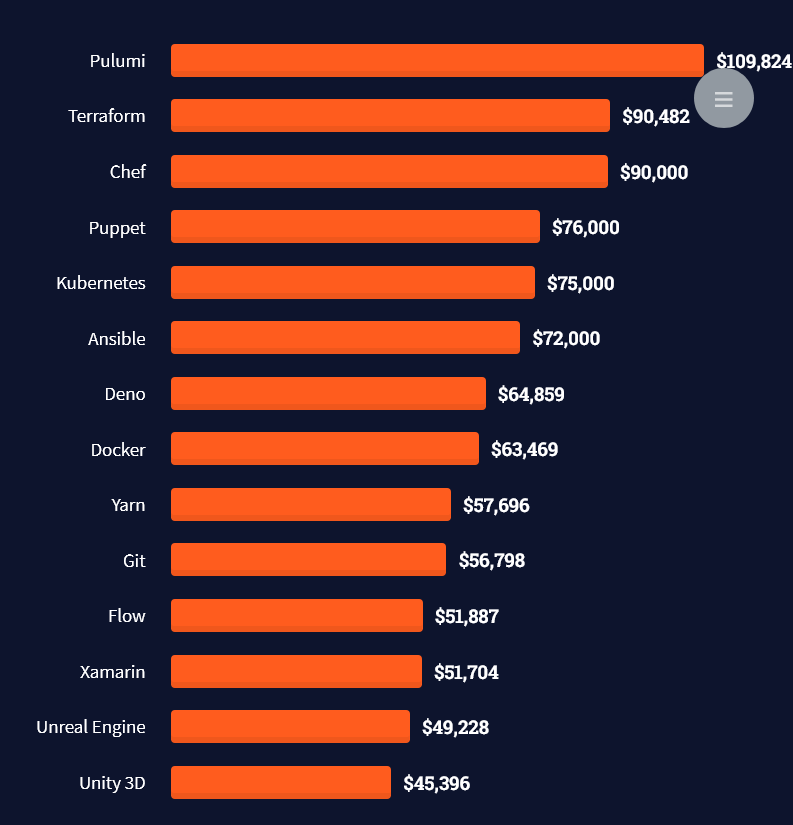
The average annual income of professional developers in the US is between $70,000 and $177,500 for various programming languages.
Question: What is your current total compensation (salary, bonuses, and perks, before taxes and deductions)? Please enter a whole number in the box below, without any punctuation. If you are paid hourly, please estimate an equivalent weekly, monthly, or yearly salary. (source)
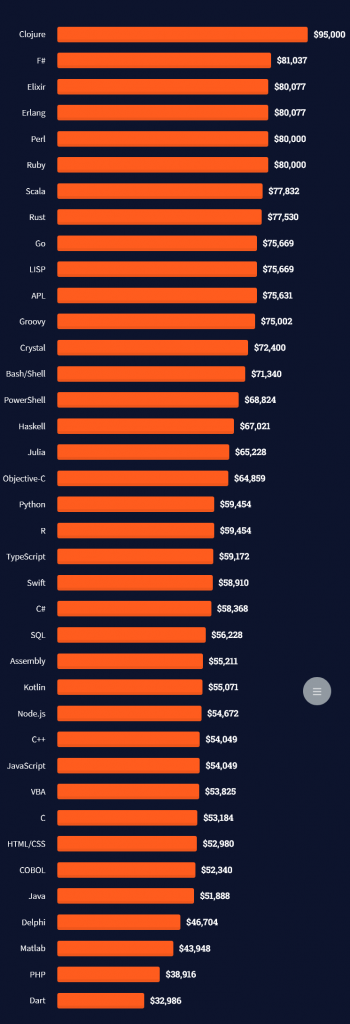
The following statistic compares the self-reported income from 46,693 professional programmers as conducted by StackOverflow.
The average annual income of professional developers worldwide (US and non-US) is between $33,000 and $95,000 for various programming languages.
Here’s a screenshot of a more detailed overview of each programming language considered in the report:
Here’s what different database professionals earn:
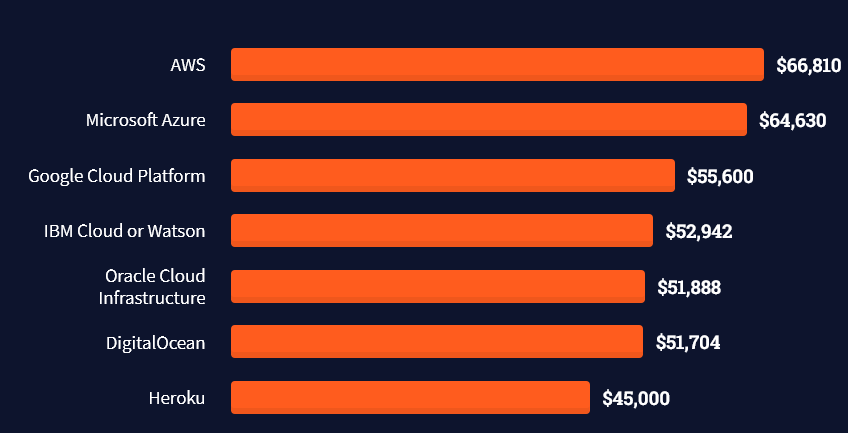
Here’s an overview of different cloud solutions experts:
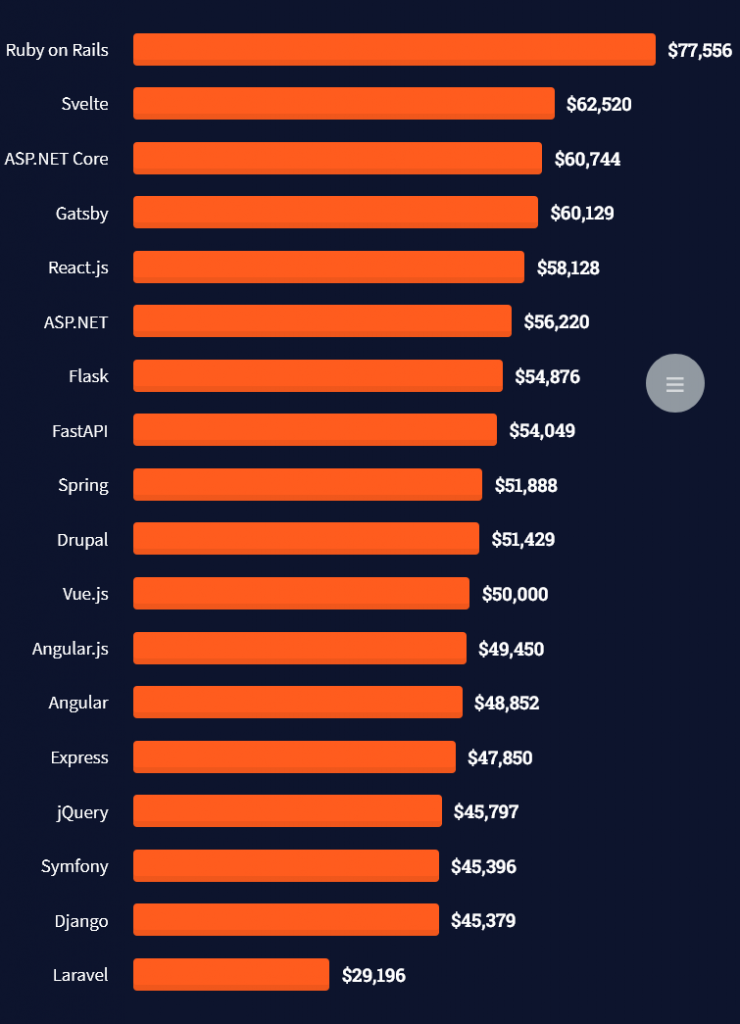
Here’s what professionals in web frameworks earn:
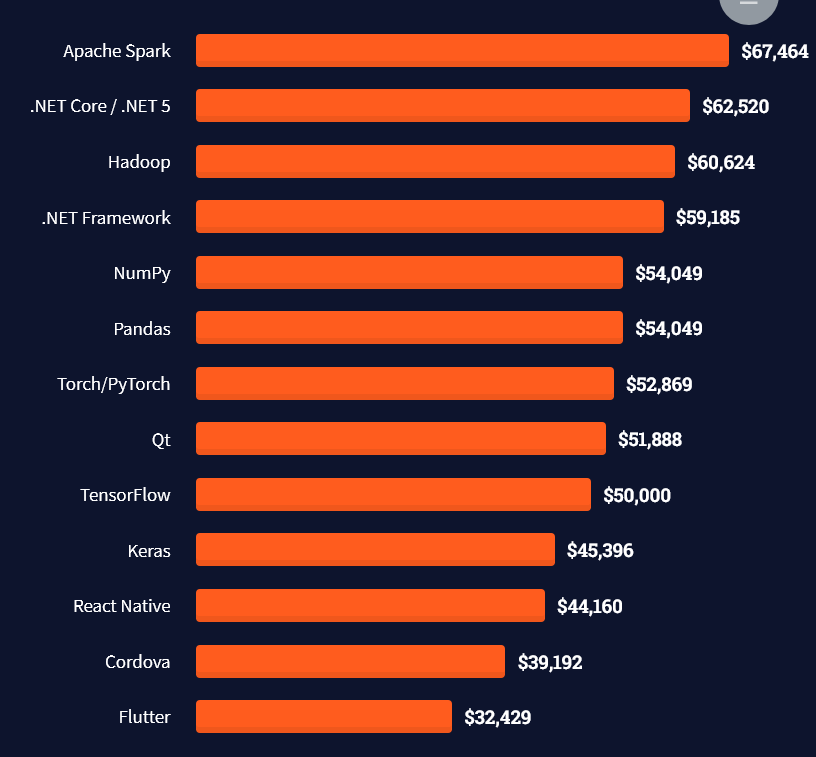
There are many other interesting frameworks—that pay well!
Look at those tools:
Okay, but what do you need to do to get there? What are the skill requirements and qualifications to make you become a professional developer in the area you desire?
Let’s find out next!
General Qualifications of Professionals
StackOverflow performs an annual survey asking professionals, coders, developers, researchers, and engineers various questions about their background and job satisfaction on their website.
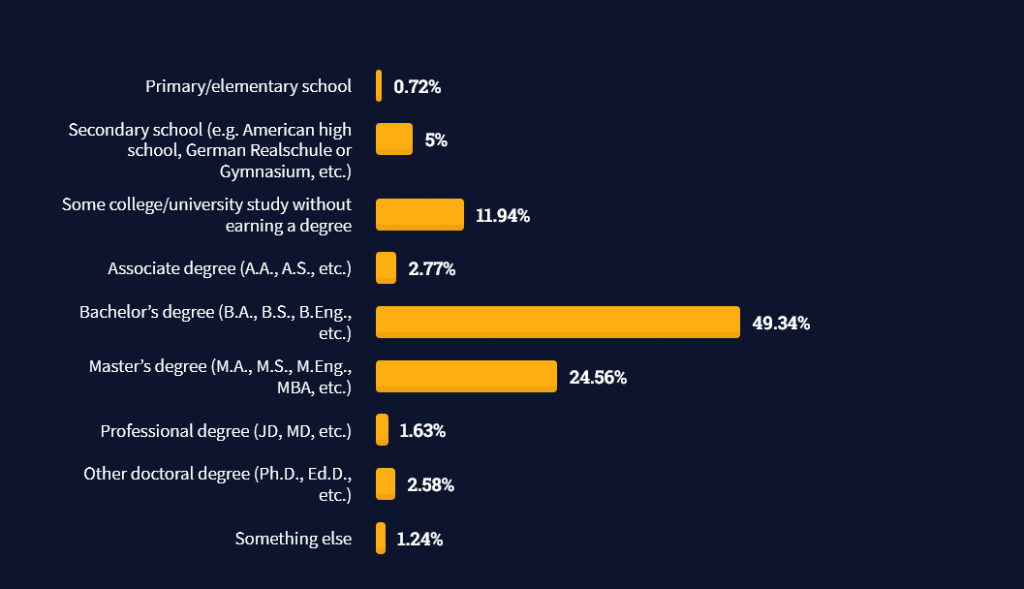
Interestingly, when aggregating the data of the developers’ educational background, a good three quarters have an academic background.
Here’s the question asked by StackOverflow (source):
Which of the following best describes the highest level of formal education that you’ve completed?
However, if you don’t have a formal degree, don’t fear! Many of the respondents with degrees don’t have a degree in their field—so it may not be of much value for their coding careers anyways.
Also, about one out of four don’t have a formal degree and still succeeds in their field! You certainly don’t need a degree if you’re committed to your own success!
Freelancing vs Employment Status
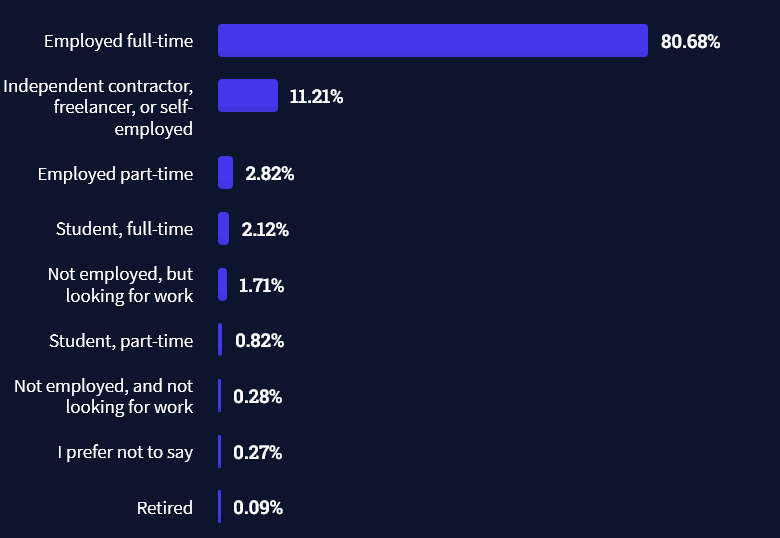
The percentage of freelance developers increases steadily. The fraction of freelance developers has already reached 11.21%!
This indicates that more and more work will be done in a more flexible work environment—and fewer and fewer companies and clients want to hire inflexible talent.
Here are the stats from the StackOverflow developer survey (source):
Do you want to become a professional freelance developer and earn some money on the side or as your primary source of income?
Resource: Check out our freelance developer course—it’s the best freelance developer course in the world with the highest student success rate in the industry!
Other Programming Languages Used by Professional Developers
The StackOverflow developer survey collected 58000 responses about the following question (source):
Which programming, scripting, and markup languages have you done extensive development work in over the past year, and which do you want to work in over the next year?
These are the languages you want to focus on when starting out as a coder:
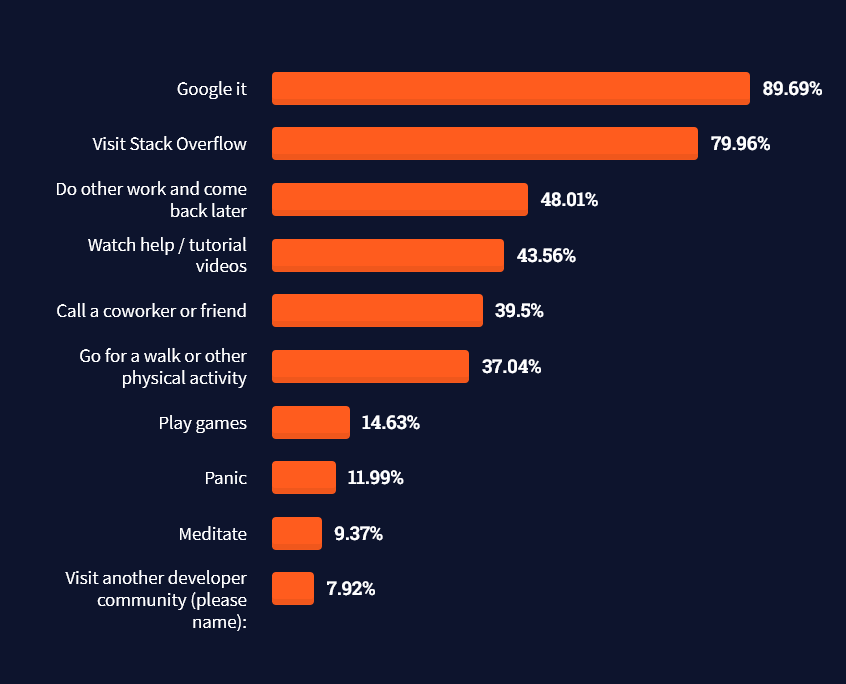
And don’t worry—if you feel stuck or struggle with a nasty bug. We all go through it. Here’s what SO survey respondents and professional developers do when they’re stuck:
What do you do when you get stuck on a problem? Select all that apply. (source)
Related Tutorials
To get started with some of the fundamentals and industry concepts, feel free to check out these articles:
Coders get paid six figures and more because they can solve problems more effectively using machine intelligence and automation.
To become more successful in coding, solve more real problems for real people. That’s how you polish the skills you really need in practice. After all, what’s the use of learning theory that nobody ever needs?
You build high-value coding skills by working on practical coding projects!
Do you want to stop learning with toy projects and focus on practical code projects that earn you money and solve real problems for people?
If your answer is YES!, consider becoming a Python freelance developer! It’s the best way of approaching the task of improving your Python skills—even if you are a complete beginner.
If you just want to learn about the freelancing opportunity, feel free to watch my free webinar “How to Build Your High-Income Skill Python” and learn how I grew my coding business online and how you can, too—from the comfort of your own home.
VR Zen Bundle, Stellaris: Overlord, Graffiti Goblinz Sales
VR Zen Bundle | 6 Steam Games | 92% OFF
[www.indiegala.com] Trust your intuition & achieve a state of calm attentiveness with the newest virtual reality game collection featuring: VR JAPAN, You Caligrapher, Crazy Kung Fu, Under Lock, ORKANA CONFLICT VR, Quest for Runia.
Gears Of War Getting MCC-Style Collection - Report
Microsoft is developing a Halo: The Master Chief Collection-style compilation package themed around Gears of War, according to a new report. Nick Baker of Xbox Era revealed this on a podcast recently.
"A while back I said there is another Microsoft franchise that's getting the Master Chief Collection-type treatment, I am of the belief that that is coming this year," Baker said (via VGC), adding that this will be Gears of War.
The Master Chief Collection launched in 2014 on Xbox One, and it struggled mightily at launch with server issues and other problems. Developer 343 Industries has supported, grown, and evolved the game significantly since then, and it's now in great shape--even outperforming Halo Infinite on Steam.
Rogue Legacy 2 is what you'd get if you mashed Rogue Legacy and a sequel together. Every time you die, your children will succeed you, and each child is unique. Your daughter might be a Colourblind Archer, and your son could be a Pacifistic Chef. Either way, one of them is getting conscripted.
(Authored by Manish Gupta, VP Global Marketing - Java and GraalVM) As we celebrate its 25th birthday in 2020, Java continues to be the world’s most popular programming language among developers. According to IDC’s latest report “Java Turns 25”, over nine million developers representing 69% of full-t...
Caesar Cipher is a simple encryption and obfuscation method. It’s a straightforward substitution cipher that replaces each plain text character with the obfuscated character obtained by shifting the plain text character a fixed number of positions in the alphabet.
What is Cryptography?
Before we introduce our first cryptographic algorithm, Caesar’s cipher, let’s first introduce cryptography as a scientific and industrial discipline.
Definition: Cryptography is the study of secure communications techniques that allow only the sender and recipient of a message to view its contents. The term is derived from the Greek word kryptos, which means hidden.
Definition: Cryptography provides for secure communication in the presence of malicious third-parties – known as adversaries. Encryption uses an algorithm and a key to transform an input (i.e., plaintext) into an encrypted output (i.e., ciphertext).
By this point, we begin to notice certain similarities or keywords.
(1) The first thing to notice is that both definitions emphasized secure communication, i.e. a communication whose content is unavailable to anyone other than the sender and receiver(s) of the message. The content is at the center of communication, as it is being carried in the form of a message.
(2) The second thing to notice is that we have the first party, i.e., the sender of the message; a second party (or more than one), i.e., the recipient(s) of the message; and possibly a third party, i.e., any unintended/uninvited recipient of the message, also known as an adversary.
An adversary is generally considered an unintended recipient of the message who might misuse the content of the message with any malicious intent.
(3) The third thing to notice from the definitions are mentions of a key, an algorithm, a plaintext message, and a ciphertext message.
A key is a changeable component, usually a number or a sequence of symbols that drive the encryption algorithm.
An encryption algorithm is represented as a series of computational steps which transform an input content (e.g., non-binary text or other binary content), by applying a key, to a secure ciphertext message.
The ciphered content is practically unreadable and, as such, suitable for transfer over an insecure information system to its intended recipient. The intended recipient holds a key that enables him to apply a reverse algorithm and decipher the ciphertext message back to the original, plaintext message.
It is assumed that a third party doesn’t hold the key and is unable to retrieve the plaintext message content in any other way, so the message is available only to the intended recipient and therefore secure.
From a practical point of view, absolute security may not be achieved as there are attack methods that might enable a third party to break the ciphered message and retrieve the original content, but their existence depends on the strength of a specific algorithm, which we will discuss at a later point.
What is Caesar’s Cipher?
Caesar’s cipher is a simple cryptographic algorithm that uses substitution, i.e., systematic replacement of each symbol from the original, plaintext message with another, predetermined symbol.
According to popular belief, it is said it was used by the Roman emperor Julius Caesar in his private correspondence.
Due to the algorithm’s simplicity, Caesar’s cipher in the modern era is not used as a standalone method of encryption but still finds its place as a component in more complex cryptographic systems, such as the ROT13 system or Vigenere cipher.
Besides that, it is a nice and simple algorithm to start our journey into cryptography.
How Does Caesar’s Cipher Work?
Caesar’s cipher algorithm construction begins by defining a set of unique symbols, which we will refer to as the alphabet.
Note: if an alphabet is also defined by order of its symbols, which is not a common case with Caesar’s cipher, it is said that the cipher algorithm uses monoalphabetic substitution.
For example, alphabets a1 = {A, B, C} and a2 = {A, C, B} are treated as different alphabets because the algorithm would produce different outputs for each of them.
We’ll take a closer look at the effect of symbol ordering a bit later.
Besides the alphabet in Caesar’s cipher, we will also introduce a key, i.e., a number that represents an offset in the symbol substitution.
This might sound a bit complicated, but it’s very straightforward: it just means how many symbols in the alphabet we have to skip before reaching the corresponding output symbol.
It is always helpful to take a look at an example: with an alphabet defined as al = {X, R, G, A, F, T, I} and a key k = 5, a plaintext pt = “GRAFITTIX” would be encrypted to ciphertext ct = “XIRGFAAFT”.
For symbols closer to the end of the alphabet than the length of a key, we would just continue counting from the beginning of the alphabet.
Such example is a symbol “F” that reaches the end of the alphabet after three skips: “F”, “T”, “I”, and continues symbol skipping for two more symbols from the start of the alphabet: “X”, “R”, and finally lands on the symbol “G”.
We will see how to simplify the skipping process by a calculation in our source code.
Once we have defined and shared the key with our second parties (the recipients), we can start exchanging secret messages.
In the era of Julius Caesar, literacy was not widespread, and ciphertexts were not so easily deciphered.
However, now in the modern era, Caesar’s cipher is no longer considered strong enough. Therefore, we will take a slight detour and have a look at the cipher with a monoalphabetic ordering.
Python Caesar Cipher
Here we’ll take a look at our source code and see how the magic happens. The comments are here to help in understanding particular ideas and choices in each of the algorithm steps.
def caesars_cipher(message, key=3, operation='encrypt'): # Performs an operation, either 'encrypt' or 'decrypt'. if operation.lower() not in ('encrypt', 'decrypt'): return message # Constructs our alphabet of symbols. alphabet = 'ABCDEFGHIJKLMNOPQRSTUVWXYZabcdefghijklmnopqrstuvwxyz1234567890 !?.' # Sets the encryption/decryption key. key = key % len(alphabet) # Initializes the store for encrypted/decrypted message. translated = '' # Processes each symbol in the message according to the operation and the alphabet. for symbol in message: # Just some housekeeping - the object initialization. shifted_index = -1 # Note: Only symbols in the 'alphabet' can be processed. if symbol in alphabet: symbol_index = alphabet.find(symbol) # Performs the actual operation. if operation == 'encrypt': shifted_index = symbol_index + key elif operation == 'decrypt': shifted_index = symbol_index - key # Handles possible overstepping. if shifted_index >= len(alphabet): shifted_index = shifted_index - len(alphabet) elif shifted_index < 0: shifted_index = shifted_index + len(alphabet) translated = translated + alphabet[shifted_index] else: # Leaves the symbol untouched if it's outside the alphabet: translated = translated + symbol return translated original_message = 'Finxter rules!'

caesars_key = 55 print(f'Original message = {original_message}')

ciphertext = caesars_cipher('Finxter rules!', caesars_key, 'encrypt')

print(f'Ciphertext = {ciphertext}')

plaintext = caesars_cipher(ciphertext, caesars_key, 'decrypt')

print(f'Plaintext = {plaintext}')
The Backstage Math
If we consider an alphabet of aN symbols, the number of ordered alphabets is aN! (! is a factorial operation) and there is aN! possible ciphertexts of the same plaintext.
Here we have to notice that having a key with a monoalphabetic substitution would have no effect. This is because it is always possible to generate an alphabet with an ordering that would exactly match Caesar’s cipher with a key.
In other words, each Caesar’s cipher with a specific key can be generalized by exactly one monoalphabetic substitution.
If we take the regular English alphabet of 26 symbols, the number of possible alphabets with unique orderings would amount to 26! ≈ 4 * 1026 possible ciphertexts (that’s 4 with 26 zeroes!).
Note: If you’re wondering why is this number so large, just consider the following: there are 26 letters in the English alphabet, hence 26 possibilities in picking the first letter. In the next round, for each of these possibilities, there are 25 possibilities in picking the second letter (since the first letter has already been picked). Going all the way, that’s 26 (first pick) * 25 (second pick) * 24 (third pick) * … * 1 (26th – last pick) = 26! ≈ 4 * 1026.
Now we can see that monoalphabetic substitution represents a superset of Caesar’s cipher, and since Caesar’s cipher uses an alphabet with typical alphabetical ordering, it drastically reduces the number of possible ciphertexts to only aN-1, which is, in our case, only 25.
With that in mind, Caesar’s ciphertext can easily be attacked by several approaches, such as a brute-force attack or frequency analysis.
Conclusion
We learned about Caesar’s Cipher, a simple encryption and decryption algorithm, in this article.
First, we made a gentle intro to cryptography.
Second, we encountered some of the fundamental terms in cryptography.
Third, we got acquainted with Caesar’s Cipher.
Fourth, we explained how Caesar’s Cipher works.
Fifth, we took a glance at the source code.
Sixth, we sneaked in the backstage and saw some traces of math behind the algorithm.
Learn More: ROT13 in Python
ROT13 is a simple encryption method. It shifts each character of the clear text string 13 positions forward in the alphabet.
This Python one-liner does ROT13 encryption for you:
Dream Beats Bundle, Ubisoft & The Division 2 Sales
Dream Beats Bundle | 16 Music Albums | 96% OFF
[www.indiegala.com] Looking for a way to unwind while studying or travelling? Want to create a really unique and chill atmosphere? Fill your thoughts with peace and tranquility with the newest music bundle and its 16 relaxing albums.
Dorfromantik is a peaceful building strategy and puzzle game where you create a beautiful and ever-growing village landscape by placing tiles. Explore a variety of colorful biomes, discover and unlock new tiles and complete quests to fill your world with life!
Steam Deck Tips: Screenshots, Virtual Keyboard, Back Buttons, And More
The Steam Deck has been out in the world for a few months and more and more people are starting to get their hands on Valve's newest creation thanks to the rollout of new devices every day. The handheld PC is one of the biggest innovations in recent memory, and there's a plethora of functionality at the fingertips of each user. However, that functionality isn't always readily apparent. Some users might not even know half of what their Steam Deck can do. In order to help bridge the gap between the undiscovered and the user, we're going over several tips that can help players get the most out of their Steam Deck.
Tips for using the Steam Deck
We're going to go over several tips related to the Steam Deck. Most of these will be simple actions that every user will need to know how to do if they want to fully access Steam Deck's functionality.
Connecting a controller
While the handheld experience of Steam Deck is perfect for some games, for most titles it can be a bit unintuitive. For example, when playing a multiplayer title like Fortnite, players won't want to suddenly learn an entirely new set of controls and place their hands in a different position than what they're used to. Luckily, Steam Deck allows for the use of an external controller.



 Question: How much does a Security Engineer in the US make per year?

 Note: Do you want to create your own thriving coding business online? Feel free to check out our

 Tip: An excellent start to turbo-charge your freelancing career (earning more in less time) is our
  The average annual income of professional developers in the US is between $70,000 and $177,500 for various programming languages.