Posted by: xSicKxBot - 07-03-2018, 08:37 AM - Forum: Lounge
- No Replies
Free Steam And Xbox One Game Playable This Weekend
PC and Xbox One owners have a chance to play Rocket League for free this weekend. Between Thursday, July 5 and Monday, July 9, you can download the game on Steam or Xbox One without paying a cent. The free version includes all game modes, playlists, features, and arenas. The one caveat is that Xbox One owners will need an Xbox Live Gold subscription to play.
To encourage players to buy the game, Rocket League and select DLC will be available for 50% off on Steam and Xbox One starting this weekend and running through July 9. That brings the core game down to $10.
Free Weekend Start Time: Thursday, July 5 at 10am PDT (1pm EDT, 7pm CEST)
Free Weekend End Time: Monday, July 9 at 10am PDT (1pm EDT, 7pm CEST)
Rocket League is a team-based online competitive game that's basically indoor soccer with cars. That might sound like it would be a clunky game to play, but once you get the hang of it, you'll probably find that it's surprisingly nuanced and highly competitive.
From GameSpot's 9/10 Rocket League review: "The joy of Rocket League rests on the countless plans that are conceived and discarded every other second in any given match. Trying to predict where and how the ball will bounce next is a game within the game. Despite the use of cars, Rocket League emulates the emotional surges typical of The Beautiful Game, such as the rush of an unexpected fast break or a well-timed header into a goal. With Rocket League, the promising concept of combining two wonderful things--cars and soccer--is equally magnificent in execution."
Last year the game came out on Nintendo Switch, where it remains very good. Rocket League developer Psyonix announced earlier this year that Rocket League had passed 40 million players.
Posted by: xSicKxBot - 07-03-2018, 08:37 AM - Forum: Windows
- No Replies
Windows 10 Tip: Yikes, stop that sound! Mute-a-tab in Microsoft Edge
Does this sound familiar? You’ve got multiple tabs open in your browser and all of a sudden, music or voices blares from one of them. You scramble to find the audio icon on that tab, open the page and scroll down to stop the video that’s playing.
Set 50 years after the climactic events of the original Red Faction, Red Faction: Guerrilla allows players to take the role of an insurgent fighter with the newly re-established Red Faction movement as they battle for liberation from the oppressive Earth Defense Force. Red Faction: Guerrilla still defines the limits of destruction-based game-play with a huge open-world, fast-paced guerrilla-style combat, and true physics-based destruction.
Features:
* Open World Guerrilla Warfare - You decide who, when, where and how to battle. Utilize guerrilla tactics, improvised weaponry, and modified vehicles to lead insurgent attacks on EDF targets. Launch attacks based on your own gameplay style, take on missions in any order you choose, or engage in destructive activities to weaken the EDF's grip on Mars.
* Strategic Destruction - Use destruction to your tactical advantage, setting ambushes or chain reaction explosions to attack enemy strongholds and permanently modify the game environment. Leverage fully-dynamic physics-based destruction to improvise on the fly: blow holes in a wall or floor to set an ambush or escape, take out a staircase to stop your pursuers, or drive vehicles through blown out walls.
* Evolving & Emergent Gameplay - Carve your path through an ever-changing landscape as you improvise your combat tactics - mixing gameplay styles, vehicles, weapons and explosives to defeat the EDF.
* Epic Sci-Fi Setting - Explore the huge, unforgiving Martian landscape, from the desolate mining outpost of Parker to the gleaming EDF capital city of Eos; then tear through the fully destructible open-world environments swarming with EDF forces, Red Faction resistance fighters, and the downtrodden settlers caught in the cross-fire.
* Multiplayer Combat - There is no place to hide when you put your guerrilla warfare skills to the test in a variety of highly destructive multiplayer combat modes.
Re-Mars-tered Features:
> Fully reworked graphics Heavily reworked textures and graphic features adding for example specular maps.
> Improved shadow rendering
> Improved Lighting
> Shader & Postprocessing rework
> Native 4k support for the finest up to date mars destruction experience ever
In this next scenario, let’s say that only one person knows who took your cookie and only by name. The person who took the cookie won’t fess up to it either, so you have to name off each other friend to the friend you are talking to. This can be written in Python3:
>>> def who_has_my_cookie(my_friends):

... for friend in my_friends:

... for their_friend in friend.get('friends'):

... if their_friend.get('has_cookie'):

... return their_friend.get('name')
If you imagine yourself in this situation you can see that it’s going to take a lot longer than any of the other situations because you need to keep reciting everyone’s name every time you go to the next friend.Worst case scenario, you need to cycle through each friend and ask them about every other friend. If you look at the loops, you can see that the outer loop has a time complexity of O(n), and the inner loop also has a time complexity of O(n). This means the function will have a time complexity of O(n^2) because you multiply the time complexities together O(n * n).
Let’s feed this function some input and see who took your cookie:
Summary of O(n^2): There is a loop within a loop, so you could instantly think that it would be O(n^2). That’s a correct assumption, but to make sure, double check and make sure the increments are still being incremented ntimes. Some loops within loops turn out to be O(nlog(n)).
GameStop Summer Sale Is On: PS4, Xbox One, Nintendo Switch Deals In The US
It's a good time to stop by the local GameStop or head to the website, because between now and July 15 the retailer is running its annual summer sale. This year you can find lots of good deals on games, consoles, and accessories for PS4, Xbox One, and Nintendo Switch. The main difference between this sale and GameStop's regular weekly sale is quantity. A lot more games are on sale now than usual, even if the sale prices are about the same as you'd find any other week. At any rate, let's dive in and see what kind of money we can save during this year's GameStop summer sale.
On the hardware side, if you buy a 1TB Xbox One console, you'll get a $50 GameStop gift card for free. The green and gray Xbox One wireless controller is available for 20% off, bringing it down to $52. PS4 owners can grab a gold or magma red DualShock 4 controller for $55, saving $10 in the process.
All in all, there's a lot of deals during GameStop's summer sale, so you're sure to find something worth playing, no matter which platform you prefer. We have more of our picks below, but you can find the full sale here.
Review: Marshall multi-room speakers sound great, but lack AirPlay 2
AppleInsider checks out Marshall’s Stanmore and Action multi-room speakers to test out if they are solid options for the wireless speaker fan, even if they only support only the original AirPlay.
[embedded content]
These speakers were added alongside Marshall’s existing Bluetooth models, making the decision that much more difficult for potential buyers.
All of Marshall’s speakers share similar aesthetics, a bold retro design to complement the impressive sound that they put out.
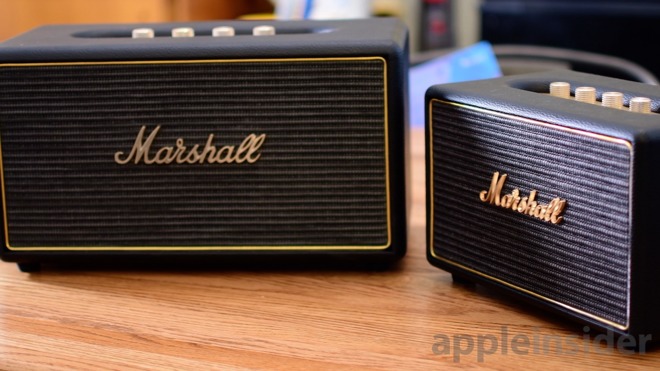
Of all their multi-room speakers, of which there are three models, we played with the smaller two of the three – the Acton and the Stanmore. Not included in this review is the Woburn, though we’ve spent plenty of time with the non-Wi-Fi version of the Woburn in the past. We can touch on that a bit later when we get to audio quality.
Though the exterior may be vintage-inspired, inside it is all new. Each speaker has a wealth of different inputs making them great to use with or without a host device to stream from.
To kickoff our review lets take a look at the build quality and design of these powerful speakers.
Fit and finish
Without a doubt, the design of these speakers can be polarizing. Some people just may not go for that nostalgic design invoked by Marshall’s speakers. For us, we love it. It takes us back to all the live concerts we’ve gone to with countless oversized Marshall amps gracing the stage. Live music is something we’re very passionate about and it is hard not to get that feeling when kicking back and listening to our favorite jams over one of their consumer-targeted home speakers.
Similarly to those giant amps, Marshall’s speakers aren’t small or light. When compared to many other in-home Wi-Fi or Bluetooth models, any of Marshall’s will be larger and weigh more. Acton is the smallest, with roughly the same height as HomePod and twice the width. Since these aren’t designed to be portable, we didn’t have too many qualms with this. The larger size just helped them standout.
The exteriors are made of the same rubber material used on Marshall’s larger stage-destined amps, giving it a bit of a soft touch. On the bottom, four rubber feet help dampen any vibrations that may emanate from playback.
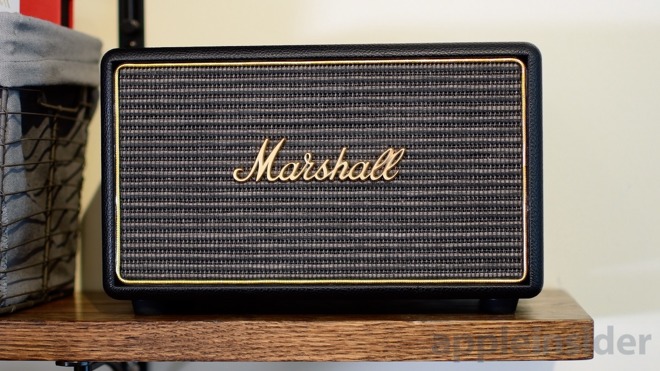
Marshall’s iconic scripted wordmark graces the front atop a screen that covers the array of woofers and tweeters that reside inside. Gold/brass are used frequently as accents, such as on top of the logo, around the front, and liberally along the top.
Speaking of the top, that is where a mess of controls are found above a metal plate. Metal knobs with knurling are used to adjust the volume, treble, bass, and input. They provide a great tactical feel, with just the right amount of tension when adjusting.
A tiny toggle button is used to switch between multi and single modes, depending on your use cases.
Lastly, on the right, are a pair of previous/next buttons to use during playback.
Inputs galore
Marshall’s multi-room speakers have between five and six inputs depending on the model. Both the larger two (Stanmore and Woburn) have RCA, but the rest all share Chromecast, AirPlay, Bluetooth, aux, Spotify, and 3.5mm options.
A knob on the top can be used to change inputs, as can the accompanying multi-room app. Using the app, seven presets can be programmed as well to correspond to the favorites on the input knob. Spotify playlists or internet radio stations can make up these favorites.
Those RCA inputs can be useful but would be hard to use in a home theater environment. Even the Stanmore, the smallest with RCA, is far too large to act as a soundbar. A more appropriate use for these inputs would be for another music device such as a turntable.
Even though these speakers have AirPlay, a great convenience for Apple users, they do not currently support AirPlay 2.
Multi-room and AirPlay 2
Interestingly, while Marshall was among those listed as backers of AirPlay 2 on stage during the announcement, they’ve yet to commit to bringing AirPlay 2 to any of their devices. When pressed for comment, Marshall said their speakers “are made to be interacted with directly through the controls on the speakers, rather than having users be dependent on their devices. Because of this, and because we already support multi-room playback using any input as a source – including AirPlay – we are only at this point exploring AirPlay 2, but have not made a decision if we will implement it in our product assortment.”
This statement is true, they do have their own multi-room technology that works very well, it won’t be enough to appease many users. AirPlay 2 isn’t just about the ability to stream audio to different rooms simultaneously, though of course, that is a large part of it. AirPlay 2 also increases the buffer, reducing the drops in audio that occasionally happen. It also makes them part of HomeKit, allowing Siri to control music playback, stream Apple Music, and possibly more as Apple adds functionality to HomeKit.
That said, Marshall’s multi-room solution does have good sides. It is dead simple to use, just by toggling a button on the top of the speaker. When the light is in the “single” position, the speaker will act as a standalone device. When toggled to “multi”, all Marshall multi-room speakers will play back the same audio, no fuss.
This can be switched inside of the Marshall multi-room app as well, so it doesn’t have to just be done on the speaker itself.
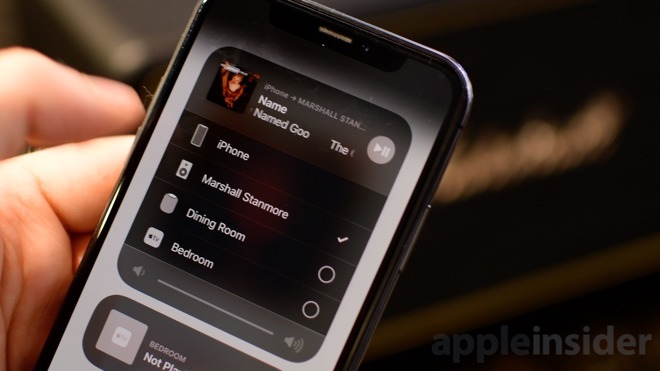
When looking at the speakers through AirPlay, there is a bit of a change. When in single mode, each speaker has its own name and shows in the AirPlay menu. When switched to multi, each speaker will disappear and instead, a single new “Multi” speaker will appear in the AirPlay menu.
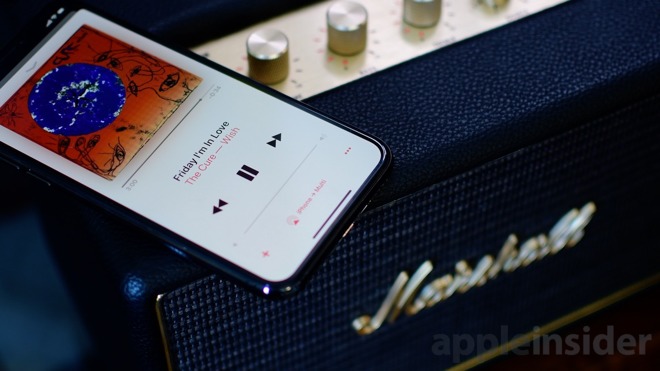
AirPlay is super useful for Apple users. Nearly any Apple device – including the Apple TV, Mac, iPhone, iPad, and HomePod – can cast music to an AirPlay-quipped speaker.
We played back a variety of different music through multi-room mode, including from our Apple TV, and tt worked surprisingly well though we did notice some dropped audio that would come out of one speaker but not the other. This happened infrequently and for less than a second each time, but definitely a few times during testing.
Audio quality
Across the board, audio quality was very consistent. Each model had the same balance to it, just with different volumes. We also found more pronounced bass on the larger models, assuming it has a bit of room to breath around the back where the vent lives.
When we increased the volume output to the max, which was very loud on the Stanmore and Woburn, we had no distortion in the quality, which is something we always check for in speakers. Oftentimes audio quality is sacrificed to creep out a few more decibels. In our tests, the Stanmore —at max volume —was far louder than you’d need for a normal sized room. Most people could probably get by with just the Acton, only moving to the Stanmore when a room is larger or more bass is wanted.
Adjusting the audio quality with the knobs is not nearly as drastic as we imagined. It is actually much more subtle of an effect, allowing you to fine-tune it to your tastes, but not dramatically changing the balance of the audio. This is good as it shows Marshall’s confidence in their sound.
When you look at Marshall’s target audience, the sound profile is clear. It is aimed squarely at those listening to predominantly rock or instrument heavy music with distinct vocals. Rap and hip-hop just weren’t the exact genres these speakers were tuned for. It isn’t to say they don’t sound good, but they don’t have the punch or sharpness we’d hear from speakers that aim towards pop and rap listening millennials.
We did notice a huge difference in audio quality when moving between the Bluetooth input and Wi-Fi, with AirPlay clearly offering a much more crisp and lossless audio profile. Wi-Fi is definitely the way to go, with Bluetooth mostly an afterthought if you try to take the speaker with you and don’t have Wi-Fi available.
You’ve got options
Marshall’s lineup of speakers has been growing, originally with a full range of portable and non-portable Bluetooth speakers and now a lineup of Wi-Fi-equipped multi-room speakers. For those with the need to easily travel with their speakers, or even just Bluetooth as a requirement, their original models (Stockwell, Acton, Stanmore, Woburn) will fit the bill.
On the contrary, any of the multi-room (Acton, Stanmore, Woburn) will be ideal for those who want a bit more out of their speakers. Both the Wi-Fi and Bluetooth models share the same names, so it is important to keep an eye out for which version of each model you are shopping for.
Each model has subtle differences, though the biggest differentiator is the volume and output. Bigger models have additional inputs, such as the Stanmore and Woburn each getting RCA ports on the back.
Crank it up
These speakers are clearly targeted to my music tastes. Rockers like Joe Walsh, Don Henley, Steve Miller band, all sound beautiful on these speakers, regardless of which model you pick up. Guitar licks sound clean and powerful and the physical knobs make it dead-easy to really tune your tunes to your tastes.
AirPlay 2 would be nice to have, and I’m hopeful that Marshall, and parent company Zound Industries, devices to implement it later through an update, but as-is these are fantastic speakers for rockers and other music enthusiasts.
Their retro vibe is as eye-catching as it is nostalgia-inducing, making it almost as much a statement piece as much as it is a powerful speaker. Some may not prefer that look, but the list of modern-look speakers is a mile long, giving them endless other options.
Rating: 4.5 out of 5 stars
Where to buy
You’ve got many options when picking out any of Marshall’s speakers. The Marshall Stanmore Multi-Room speaker can be found on Amazon or B&H for $449. B&H and Amazon also have the Marshall Acton Multi-Room speaker for $299. If you really want to increase the volume, the massive Marshall Woburn can be found for $599 on Amazon.
None are much more than the Bluetooth counterparts, so we highly recommend the Wi-Fi models for those interested. Mutli-room, AirPlay, and better audio quality make up for the difference in price.
The Elder Scrolls: Blades Appears on iOS Pre-order
The Elder Scrolls: Blades is not quite the Skyrim port many perhaps would have liked, but it still looks to be an intriguing adaptation of the iconic franchise onto mobile.
If you’ve forgotten what it is (E3 seems like forever ago already), here’s the segment from Bethesda’s presentation:
[embedded content]
While you’ve been able to ‘pre-register’ your interest on Google Play since the E3 announcement, the game has just popped up on Apple’s pre-order list – with a tentative release date of September 1st.
It’s free, so you won’t need to pay anything but it remains to be seen whether we really will see Blades that soon.
In this next scenario, let’s say that only one person knows who took your cookie and only by name. The person who took the cookie won’t fess up to it either, so you have to name off each other friend to the friend you are talking to. This can be written in Python3:
>>> def who_has_my_cookie(my_friends):

... for friend in my_friends:

... for their_friend in friend.get('friends'):

... if their_friend.get('has_cookie'):

... return their_friend.get('name')
If you imagine yourself in this situation you can see that it’s going to take a lot longer than any of the other situations because you need to keep reciting everyone’s name every time you go to the next friend.Worst case scenario, you need to cycle through each friend and ask them about every other friend. If you look at the loops, you can see that the outer loop has a time complexity of O(n), and the inner loop also has a time complexity of O(n). This means the function will have a time complexity of O(n^2) because you multiply the time complexities together O(n * n).
Let’s feed this function some input and see who took your cookie:
Summary of O(n^2): There is a loop within a loop, so you could instantly think that it would be O(n^2). That’s a correct assumption, but to make sure, double check and make sure the increments are still being incremented ntimes. Some loops within loops turn out to be O(nlog(n)).
Rare Plans To Give Sea Of Thieves Fans What They Want
Rare's high-seas adventure experiment Sea of Thieves for PC and Xbox One has gone through several noteworthy changes since its launch. The game focuses on a pirate's life in a shared world, where players embark on missions, sail across the seas, find hidden treasure, and even take on the occasional Kraken lurking beneath the waters. While the game found a passionate audience, it received some notable criticisms for lack of content and a repetitive gameplay loop, which the developers have spent the last few months working to address in the many post-launch updates.
Sea of Thieves' executive producer Joe Neate, senior designer Shelley Preston, and design director Mike Chapman sat down with GameSpot during E3 2018 to talk about the online game's growth since its launch. With the upcoming Cursed Sails and Forsaken Shores expansions coming later this year, each adding several new ships, items, and entirely new areas to explore, they spoke about the feedback they've received from fans, and just how far the game has come since release.
The fans have been very vocal about what they want to see in Sea of Thieves, which has grown a lot since its release last March. Can you talk about what the general response has been like for you all at Rare?
Joe Neate: Yeah, it's been pretty intense and amazing. It really has. We built up a lot of awareness and excitement around the game, we launched it and we had a lot of players come in and play--those first couple of weeks was quite the adventure. With Sea of Thieves, our goal at launch was to create a new IP, create a community around it, and make a new type of multiplayer game that's a different experience. And success for us meant landing all of that, which would give us the right to go and build on it more.
I just love that we've managed to make something that's different, and had a bold ambition--we've all been on this project since the start. To see it land and then to now have the opportunity to just go wild adding stuff and doubling down on the vision because we've got this amazing player base with us, and they want more of it. The goal at launch was to create the opportunity, basically, to go and invest on top of what we started with. We exceeded all of our expectations, in terms of player numbers and everything else.
So, yeah, we've now got that opportunity, and it's all about how big can we make it. To see how far can we take this game, and how many people can we make fall in love with it as we add new content and the new ways to play. It blows my mind, I want be back here in a year's time talking more about the stats and the things that we've done. It's the most rewarding game I've ever worked on in my career, and honestly it's the biggest opportunity I think I've had in my career in terms of the game and the possibilities right now.
Mike Chapman: We were actually just commenting before you walked into the room about how different it is now compared to how it was at launch. It's now much easier to talk about the game because people understand what it is now, in terms of what the heart of the game is. Sea of Thieves has this social connectivity with players in a shared world where they're coming across each other, and what's gonna happen is emergent and unpredictable. We kind of break it down into there's always different ways to play. Like the brigantine ship that you saw briefly in the E3 teaser trailer, that's perfectly designed for three players to have this big ship experience. And then things like new goals for everyone, especially for players who've hit the Pirate Legend status.
These sort of things enrich your adventures while you're out there. So you're heading towards an island and you play musical instruments, drink grog, you've now got the speaking trumpet and the drum that we added in the Hungering Deep. It's more things like that that's gonna enrich your adventures. So you may have seen in the trailer we've got skeleton ships coming to the world. You could team up with another crew to take them down, board their ships and take a gunpowder keg downstairs and use that to destroy the ship. All of that emergent gameplay is all there.
Like the Hungering Deep, all the new content that will release in this update will come in with time limited quests with specific rewards. The Hungering Deep came in with that quest line around Merrick, which introduced a storyline that allowed us to showcase the new content. We also added a drum and the speaking trumpet at the same time, and you use the drum to summon the megalodon at the end of that quest line. The speaking trumpet was a way to broadcast your voice across a far distance, so you could hail another ship at distance to ask them if they want to work together with you. That's now in the world as well. That was our approach with Cursed Sails, and it will be with Forsaken Shores. And Shelley, your team is working on that, aren't they?
Shelley Preston: Yeah, Forsaken Shores is coming out this September. This expansion has a new world area. There's three seas, which are the different areas in the Sea of Thieves world. They have different visual styles, but they're all kind of the same in terms of difficulty and challenge. So what we really wanted to do with the new area was for this expansion was for it to be visually striking, and a different, newer experience. We wanted it to have a major impact on gameplay as well, as it's about a perilous voyage.
Part of the shroud that surrounded the Sea of Thieves [map] will recede and there'll be a new area that you can get to, but you'll never start in that area. It's up to players to opt in to go on that voyage, and think about when you want to take on these more challenging, but more rewarding voyages. And then when you sail out there, it's all kind of fire and ash. It's like a volcanic kind of area. We really felt excited about this idea of making the world, the islands themselves almost are turning against you while you're questing. So it's not just about other players or AI threats. It's actually the world itself. You might start feeling tremors and you're like, "What's going on, guys? Are we safe? Do we think this is gonna subside?" And then you're looking up at the peak of the volcano and you see smoke signs that churn out of that volcano and still you're making that decision, "We're gonna just carry on.
We've just got this one more x to dig up." We've been prototyping these elements of what we can do to make this environment turn against you and we're really excited about it. Everything that we add into the game will live beyond the expansion releases. The gameplay that we've given players will just live beyond to just enrich Sea of Thieves all up.
Since the game has been released, what would you say were some of the biggest lessons you took away from the game's launch, and the reaction from the community?
JN: We sat down as soon as the launch craziness ended, like the first week or so, we managed to get on top of any scale and stability issues that we had. And then we literally sat in a room for about a week with loads of post-it notes. Mike, the design team, and everyone else were going through all of the forums, looking at all the feedback. Broadly, the response from the community was that this game is great, we love what you're doing, but give us more things to do. Yeah, threats in the world, all of that stuff. And then we just started deciding which order did we want to grow this in based on feedback, based on what we want to see see.
Skeleton ships was one of the biggest things actually because for years now we've been saying to our community every sail on the horizon is another player and explaining why we didn't wanna do AI ships because we wanted every encounter to be emergent. But we've seen that...well, there's a few things that feed into it in terms of players' love for ship combat, and we love to drive different interactions between players. So ship combat is cool between players, but like in Hungering Deep, we love to see different crews team up and then go take down stuff together. With the AI ships coming into the world, it gives people that combat, the ship combat they can have with AI and stuff. They can have that experience more frequently and it doesn't necessarily impact the balance of the shared world. It's also something where we can encourage players to crew up, almost to form alliances with each other and then go and take down these fearsome skeleton ships in the world.
So it's all been about driving what we love about the game, that social interaction where you're encountering strangers and doing stuff together. It scratches that itch from the community. That was probably one of the biggest lessons for us. The E3 trailer was the first time our community would have seen that, and there's gonna be a lot of happy people. But of course they're gonna go and pick up Mike's forum post that he wrote ages ago explaining why we would never do it. We're listening, and we will change.
SP: I think that's a great example of that. We were adamant that we didn't want to add AI ships for all those reasons. But the most powerful things are our players, responding to that feedback, and making sure as long as it's right for Sea of Thieves, it enriches that experiences for everybody. So we're gonna listen to that feedback.
MC: It's a mix of giving players what they want, putting that Sea of Thieves spin on it, but also surprising them. It's the fact that a lot of players would ask, "I would really like an expanded world. I want more regions to explore." We haven't just given them that, we've actually gone and made the visuals a core part of the gameplay and added in a whole region with volcanoes that's geologically unstable. We want to surprise players, and there's things we do in the game that won't be expected and I think both of those aspects are at a healthy mix right now.
JN: And what's great is that because we're live, we're updating it, and we're adding new stuff, we're actually learning something new every time. After the Hungering Deep, one of the things I think we learned the most is that positive social interaction is great, and players love it when you give them reasons to engage in it. Because it was quite risky for us to go, look, the only way to take down this megalodon is if you find another crew in the world and communicate that to them. Whether it's through the speaking trumpet or the flat system we put in, you had to go and do this thing together.
But to see what it did to our player base, seeing everyone partying together on a beach after they'd taken the thing down--taking selfies and making friends--it was an amazing experience seeing how well our player base reacted to that. Again, it makes us want to double down on that and do more of that because it's so cool. It's so unique to Sea of Thieves. I think in most multiplayer games it's all about competition. And in this we want to drive much more interesting or varied, I guess, encounters. That's when it's most special. When you have an unexpected encounter with other players you meet new people and you have positive social interaction.
Do you have a favorite moment from your own time playing Sea of Thieves, where you just saw the many systems and the dynamic nature of the game come to life?
SP: There've been many, but my recent one was when I played the Hungering Deep, and we made it so that you needed to work together with another crew and I've had friendly and unfriendly encounters with other crews throughout playing Sea of Thieves, but turning up and seeing all these ships that are kind of waiting and there's this new hub of social activity--we made friends with a couple of crews who wanted to go and do the voyage with us.
And there was just this beautiful moment where I was on my ship with my crew and then I've turned around, looked out the back, the sun was setting and there were these two other galleons just following us on the waves and we were all going to do something together and it's like these are people that I don't know. These are people I've never played with before and this game has brought us together and we're about to go and have this amazing encounter. That was really cool.
MC: Yeah, I'd say anything to do with the speaking trumpet. And since we've added this tool we've seen so many cool videos of people rickrolling other ships, like the Rick Astley song. And there's people pretending to be, like they work at Wendy's, like, "Can I take your order, please?" People pretending to be air hostesses, like telling them where the exits are. I think that's the fun part of having players in a shared world. We've added this tool to the world and I think just the variety of encounters and the opportunities for humor and how you can bring players together and then form friendships. Just from adding that on the surface is a really simple tool, but in our shared world it comes to life.
JN: For me, it's the amount of people I've met. All I've seen on Twitter or wherever else who are like, "Me and my husband, or me and my wife, play this together and one of them doesn't play games normally or hasn't done for ages, but they've been enticed back in." It's bringing multiplayer to new players. People are playing with their sons. A lot of people in Xbox actually. A lot of our leadership team and execs have been playing with their kids and it's the first game they can really do that with apart with maybe like Minecraft and stuff. So just seeing that we created a different type of multiplayer game that took some risks in the progression system and in what we wanted to do and what our focus was. It wasn't for everyone and not everybody resonated with some of the decisions we made, but we purposely did that so that we could bring multiplayer to a new audience. A new experience and make this fun, welcoming game that broke down barriers.
And to continually get that feedback from new players or people that just came to this because it is that type of experience. The photos of literally husband and wife set up in the front room with two TVs and two sofas and the big thread on Twitter of everyone adding their photos to it and stuff, showing the kind of setups that they had made so they could game together. That, for me, is one of the most rewarding things. Again, because we took risks 'cause we wanted to do something different in multiplayer space.
And to just constantly get that feedback that that's landed with so many people is amazing. That's one of the things that I think that speaks to me the most and what makes me most passionate, as well as basically everything funny--like the Rick Astley thing. Anything like that is what we send around online through social media, we love that. We never thought of doing that. Player creativity is amazing. There's so many things like that, and that's what gets us going. It puts a spring in our step each morning.
Second Life creator’s VR platform High Fidelity secures $35M investment
Newsbrief: High Fidelity has closed a $35 million funding round, raising money the company says it plans to use to continue to develop its open source, blockchain-powered social VR platform.
The platform itself was created by Second Life founder Philip Rosedale, and seeks to provide devs global infrastructure for VR experiences, a sector High Fidelity predicts will boast an economy of $1 trillion in a decade’s time.
Specifically, the $35 million secured by this latest funding round will help the company expand R&D, accelerate hiring, and open a new office in Seattle.
The funding round itself saw contributions from Galaxy Digital’s EOS Ecosystem fund, Blockchain Capital, and existing investors Breyer Capital, IDG Capital Partners, and Vulcan Capital. Altogether, this now brings High Fidelity’s lifetime investments to over $70 million.