The Steam Intergalactic Summer Sale continues! For the next three days, take advantage of huge savings throughout our store on over ten thousand games. You can also help unlock free games by playing our Summer Saliens Game.
Today’s Featured Deals include:
ARMA III – 66% off House Flipper – 20% off Black Desert Online – 50% off Call of Duty Franchise – Up to 67% off XCOM Franchise – Up to 80% off Salt and Sanctuary – 50% off Firewatch – 75% off and many more
Along with the sale is the Summer Saliens Game. Team up with other Saliens to fight The Duldrumz on different planets and free the abducted games. Gain XP as you battle, level up, unlock new abilities, and win cosmetic items to deck out your Salien. Plus, get Summer Sale Trading Cards just for playing.
Choose to battle on a planet that piques your interest and you’ll automatically be entered for a chance to win one of its rewards when it’s conquered. The longer your Salien spends on a planet the higher your chances of winning! The groups with the most tiles when a planet is taken will get to plant their flag as conquerors, undoubtedly gaining Saliverse-wide fame in the process.
The Steam Intergalactic Summer Sale will run until 10 AM Pacific, July 5th. Complete information can be found HERE.
New Preview Beta & Delta 1806 System Update – 6/24/18
Starting at 2:00 p.m. PDT today, members of the Xbox One Preview Beta and a subset of the Delta Ring will begin receiving the latest Xbox One system update (1806.180621-1929). We are adding more Delta users with this release as we are targeting the upgrade process and will move the remaining set of Delta users in over the next 24 hours. Read on for more about the fixes and known issues in the latest 1806 system update.
Fixes:
Groups
Fixed a UI bug with groups that resulted in the inbox apps showing a generic pin icon rather than the Application artwork.
My Games and Apps
Fixed an issue with various Games failing due launch or update correctly after a title update and users found that they had to reinstall the title.
Home – Alerts
Fixed an issue in which the clear all button/shortcut on the Alerts page was doing nothing for some users.
Home – Content
Fixed an issue in which the User was unable to navigate the add suggestions content on Home.
Localization
Various localization fixes across the console.
Networking – Wi-Fi
Fixed the network Wi-Fi drivers so that when a user resumes the console from Instant on they no longer experience the following Wi-Fi network issues:
Your Wi-Fi SSID is missing and/or
Your console having no Wi-Fi on resume and /or
Your console was unable to obtain an IP address from your Wi-Fi network.
System Performance
Misc. performance fixes in the platform.
Known Issues:
Groups
You may see issues with Groups if you frequently switch between your non-Preview console and your Preview console. Workaround: Reset your Groups locally on the Preview console through “My games & apps” > Groups, then using the “Reset groups” button at the bottom of the page to resync from the service.
Profile Color
Sometimes users may encounter an incorrect Profile color when powering on the console.
Team17’s Mugsters Will Invade Your Switch On 17th July
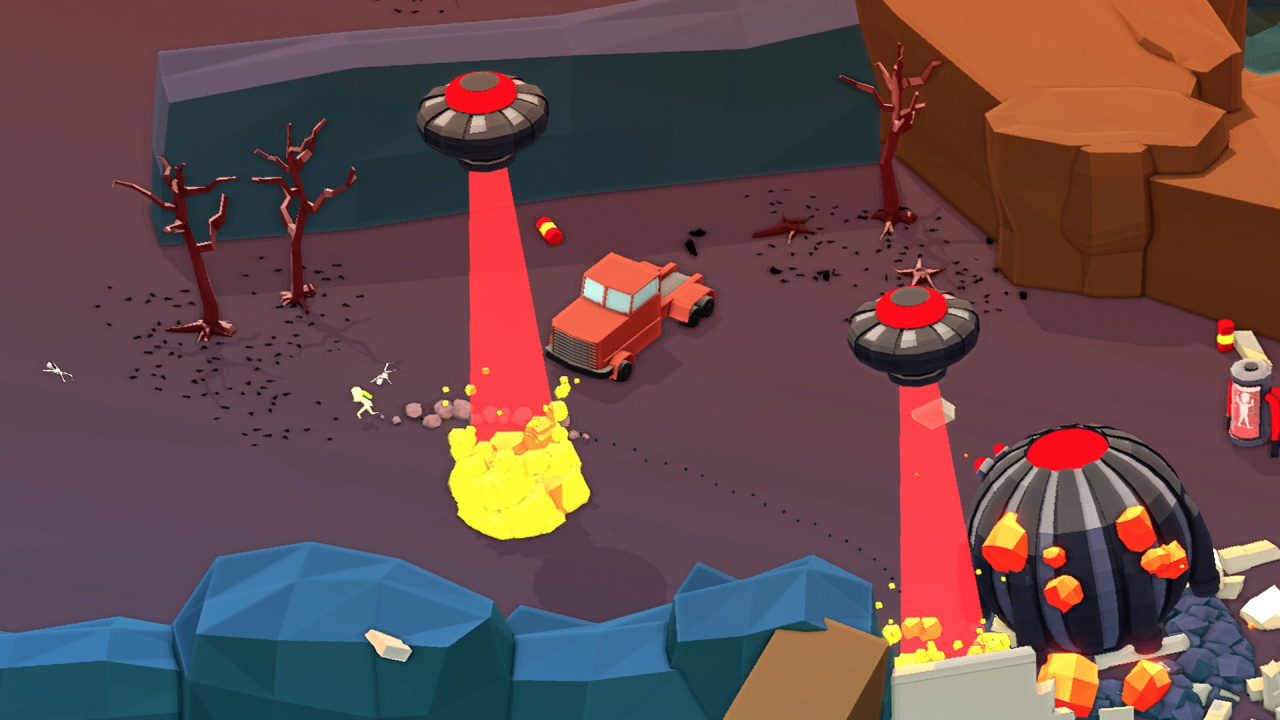
Team17 has announced that Mugsters, an upcoming physics-based, action puzzle game, will arrive on Nintendo Switch on 17th July.
Taking place inside a variety of sandbox-like levels, Mugsters has players experimenting with a whole host of different vehicle types, environmental traps, and usable items such as explosives to clear their way through each level and outsmart their enemies. There are over 30 vehicles to drive around in, each with their own unique feel, including cars, motorbikes, helicopters, planes, and even an ice cream van.
Back in April, when Mugsters was first officially announced, we were lucky enough to go hands-on with the game, and also spent some time chatting to Finnish developer Reinkout to explore the title in a little more detail. If you’re interested, make sure to give those a thorough read.
Mugsters is scheduled to launch for £9.99 / €14.99 / $14.99 when it arrives on the Nintendo Switch eShop in a couple of weeks’ time.
Will you be jumping in the driving seat for this one? Let us know if Mugsters is speeding onto your gaming wishlist with a comment below.
Step into the shoes of sports manager and lead your pro cycling team through a challenge-packed 2018 season. Compete in over 200 races across 500 stages around the world, including famous Tours such as La Vuelta and the iconic Tour de France.
Posted by: xSicKxBot - 07-04-2018, 09:58 AM - Forum: Lounge
- No Replies
Game Release Dates In July 2018: Nintendo Switch, PC, PS4, And Xbox One
It's July, which means we've finally hit the second half of 2018. Summer usually has a reputation for being a rather dry period for exciting games, but this month looks to have some interesting titles to keep you busy during the warm and sunny days. In the month of July, there's a surprising amount of remasters and re-releases looking to find new homes on PC, PS4, Switch, and Xbox One--which includes Sonic Mania Plus and the cleverly named Red Faction: Guerilla Re-Mars-tered Edition. While remasters and ports are common, July certainly has them in healthy abundance.
Along with these remasters, we also have the first-time releases of Octopath Traveler and The Banner Saga 3, which should keep RPG and strategy fans engaged for quite sometime. For a more in-depth look at all the most notable games coming this year, check out our more detailed list of releases here.
Octopath Traveler (Nintendo Switch) -- July 13
Set for release on July 13 for the Switch, Octopath Traveler is Square-Enix's long-awaited return to classic 2D RPG gameplay that fans have been yearning for. With a visual style that recreates those familiar old-school graphics for the HD era, you'll band together a party of heroes, level up, and do battle with bandits and other monsters in a world of myth and mystery.
Sonic Mania Plus (Nintendo Switch, PS4, Xbox One) -- July 17
Coming almost a year after the original release, Sonic Mania Plus plans to offer new and returning players alike the purest form of classic Sonic the Hedgehog gameplay. Coming to the Nintendo Switch, PS4, and Xbox One on July 17, Sega's next big return to traditional Sonic action will include new levels, more secrets, and two additional characters in the form of Mighty the Armadillo, and Ray the Flying Squirrel--both of whom have been long absent since their appearance in the arcade-only release of SegaSonic the Hedgehog.
The Banner Saga 3 (PC, PS4, Switch, Xbox One) -- July 24
Starting out as a Kickstarter success story, The Banner Saga series has grown from crowdfunding hopeful to a game series with a passionate following. With the third installment now approaching its release, the developers behind the punishing RPG aim to give the main story a fitting conclusion, while also offering far more challenging battles and tough decisions to make in order to stay alive in the harsh environment.
Posted by: xSicKxBot - 07-04-2018, 03:51 AM - Forum: Lounge
- No Replies
That GTA 6 Release Date Listing In GTA 5's Online Mode Is Fake
Grand Theft Auto V players in GTA Online have reported receiving in-game messages stating that Grand Theft Auto VI will launch in 2019. Developer Rockstar Games has addressed the rumors, confirming the messages are fake and not from official channels.
GTA Online players reported receiving the message, which reads, "Rockstar Message GTA VI Coming 2019," on Reddit and the GTA Online forum. This inevitably prompted people to ask the Rockstar Support Twitter account about it. The response follows below; it confirms it is indeed a hoax, as suspected.
Although Rockstar hasn't provided any information on how this happened, the Reddit community has speculated that an opportunistic hacker is using mods and a flaw in the Rockstar Social Club's messaging system to send out the message. Perhaps the biggest giveaway is that the pop-up messages are predominantly appearing in the PS3, Xbox 360, and PC versions of the game, where mods are more prevalent.
This is a hoax made with the use of mods, and not an official message or statement from Rockstar Games. *OV
— Rockstar Support (@RockstarSupport) July 2, 2018
Obviously, it'd be incredibly out of character for Rockstar to simply reveal the release date for the next entry in its biggest franchise in such a haphazard way. Rockstar like to be very measured in the way it reveals games, delivering fleeting teases and drip-feeding little details to build up excitement.
On top of that, casually announced GTA VI would steal all the thunder from its next game: Red Dead Redemption 2. As confirmed in July, Red Dead Redemption 2's release date is October 26, 2018. The much-anticipated sequel will be available for PS4 and Xbox One. Rockstar hasn't said whether the game is coming to PC, but one of the programmers working on the game has indicated Red Dead Redemption 2 for PC is in development.
Amazon Prime Video Adds A Ton Of Movies In July 2018
Looks like Amazon's streaming list is getting a whole lot longer this July. A host of new shows and movies are coming to Amazon Prime Video including oldies, newbies, and originals.
A handful of new shows are being added like Burn Notice and The Closer, along with a few originals like Comicstaan. Amazon will also be adding new seasons of shows they already have like season 6 of The Americans. One notable addition is that the first two seasons of 21 Jump Street, the show that made Johnny Depp famous, will be added to Prime.
Most of the titles added will be movies though, and there are a lot of them. To name a few, Snowden, American Psycho, Mulholland Drive, The Twilight Saga, and the Jaws franchise will all become streamable on Amazon starting in July. Amazon will also be the only place to stream a new movie called Zoe starring Ewan McGregor which will be released July 20.
If you want to know everything that's coming to Amazon Prime Video in July and when, check out the complete list below.
Amazon Prime Video's New Releases For July 2018
July 1
21 Jump Street, Seasons 1-2
Burn Notice, Seasons 1-7
Damages, Seasons 1-5
NYPD Blue, Seasons 1-12
The Closer, Seasons 1-7
20,000 Days on Earth (2004)
A.I. Artificial Intelligence (2001)
All is Lost (2013)
American Psycho (2000)
American Psycho 2 (2002)
An Inconvenient Sequel: Truth to Power (2017)
And God Created Woman (1988)
Angel Heart (1987)
Angela's Ashes (1999)
Assassination (1987)
Avenging Force (1986)
Barfly (1987)
Blazing Saddles (1974)
Blue Chips (1994)
Body Count (1997)
Breakfast at Tiffany's (1961)
Cadillac Man (1990)
Christmas Trade (2015)
Cronicas (2004)
Dead Man Walking (1995)
Double Jeopardy (1999)
Dr. T. and the Women (2000)
Finding Bliss (2009)
Gran Torino (2008)
Highlander II: The Quickening (1991)
Incident at Loch Ness (2004)
Invaders from Mars (1986)
Jeepers Creepers (2001)
Killer Klowns from Outer Space (1988)
Ladybugs (1992)
Late Phases: Night of the Lone Wolf (2014)
Letters to Juliet (2010)
Maximum Overdrive (1986)
Mixed Signals (1997)
Monkey Shines: An Experiment in Fear (1988)
Ms. 45 (1981)
Mulholland Drive (2001)
Murphy's Law (1986)
Next (2007)
Number One with a Bullet (1987)
Our Nixon (2013)
P.O.W. the Escape (1986)
Patriot Games (1992)
Pee-Wee's Big Adventure (1985)
Pretty in Pink (1986)
Rabbit Hole (2011)
Sahara (2005)
Sex Drive (2008)
Six Shooter (2013)
Snake Eyes (1998)
State of Grace (1990)
Street Smart (1987)
Stripes (1981)
Switchback (1997)
The Act of Killing (2012)
The Adventures of Buckaroo Banzai Across the 8th Dimension (1984)
The Brothers Bloom (2009)
The Eternal (1998)
The Foot Fist Way (2006)
The Fourth War (1990)
The Graduate (1967)
The Haunting of Molly Hartley (2008)
The Invisible War (2012)
The Longest Yard (2005)
The Mechanic (1972)
The Monster Squad (1987)
The Twilight Saga (2008)
Trade (2007)
V for Vendetta (2005)
Waste Land (2010)
Witness (1985)
Woody Allen - A Documentary Parts 1 & 2 (2011)
Wooly Boys (2004)
Yelling to the Sky (2011)
Zodiac (2007)
July 8
Snowden (2016)
July 9
Jaws (1975)
Jaws 2 (1978)
Jaws 3 (1983)
Jaws: The Revenge (1987)
July 13
Comicstaan, Season 1, Episodes 1-4-- Prime Original series
AGL Outlines Virtualization Scheme for the Software Defined Vehicle
Last August when The Linux Foundation’s Automotive Grade Linux (AGL) project released version 4.0 of its Linux-based Unified Code Base (UCB) reference distribution for automotive in-vehicle infotainment, it also launched a Virtualization Expert Group (EG-VIRT). The workgroup has now released a white paper outlining a “virtualized software defined vehicle architecture” for AGL’s UCB codebase.
The paper explains how virtualization is the key to expanding AGL from IVI into instrument clusters, HUDs, and telematics. Virtualization technology can protect these more safety-critical functions from less secure infotainment applications, as well as reduce costs by replacing electronic hardware components with virtual instances. Virtualization can also enable runtime configurability for sophisticated autonomous and semi-autonomous ADAS applications, as well as ease software updates and streamline compliance with safety critical standards.
The paper also follows several recent AGL announcements including the addition of seven new members: Abalta Technologies, Airbiquity, Bose, EPAM Systems, HERE, Integrated Computer Solutions, and its first Chinese car manufacturer — Sitech Electric Automotive. These new members bring the AGL membership to more than 120.
AGL also revealed that Mercedes-Benz Vans is using its open source platform as a foundation for a new onboard OS for commercial vehicles. AGL will play a key role in the Daimler business unit’s “adVANce” initiative for providing “holistic transport solutions.” These include technologies for integrating connectivity, IoT, innovative hardware, on-demand mobility and rental concepts, and fleet management solutions for both goods and passengers.
The Mercedes-Benz deal follows last year’s announcement that AGL would appear in 2018 Toyota Camry cars. AGL has since expanded to other Toyota cars including the 2018 Prius PHV.
An open-ended approach to virtualization
Originally, the AGL suggested that EG-VIRT would identify a single hypervisor for an upcoming AGL virtualization platform that would help consolidate infotainment, cluster, HUD, and rear-seat entertainment applications over a single multicore SoC. A single hypervisor (such as the new ACRN) may yet emerge as the preferred technology, but the paper instead outlines an architecture that can support multiple, concurrent virtualization schemes. These include hypervisors, system partitioners, and to a lesser extent, containers.
Virtualization benefits for the software defined vehicle
Virtualization will enable what the AGL calls the “software defined vehicle” — a flexible, scalable “autonomous connected automobile whose functions can be customized at run-time.” In addition to boosting security, the proposed virtualization platform offers benefits such as cost reductions, run-time flexibility for the software-defined car, and support for mixed criticality systems:
Software defined autonomous car — AGL will use virtualization to enable runtime configurability and software updates that can be automated and performed remotely. The system will orchestrate multiple applications, including sophisticated autonomous driving software, based on different licenses, security levels, and operating systems.
Cost reductions — The number of electronic control units (ECUs) — and wiring complexity — can be reduced by replacing many ECUs with virtualized instances in a single multi-core powered ECU. In addition, deployment and maintenance can be automated and performed remotely. EG-VIRT cautions, however, that there’s a limit to how many virtual instances can be deployed and how many resources can be shared between VMs without risking software integration complexity.
Security — By separating execution environments such as the CPU, memory, or interfaces, the framework will enable multilevel security, including protection of telematics components connected to the CAN bus. With isolation technology, a security flaw in one application will not affect others. In addition, security can be enhanced with remote patch updates.
Mixed criticality — One reason why real-time operating systems (RTOSes) such as QNX have held onto the lead in automotive telematics is that it’s easier to ensure high criticality levels and comply with Automotive Safety Integrity Level (ASIL) certification under ISO 26262. Yet, Linux can ably host virtualization technologies to coordinate components with different levels of criticality and heterogeneous levels of safety, including RTOS driven components. Because many virtualization techniques have a very limited footprint, they can enable easier ASIL certification, including compliance for concurrent execution of systems with different certification levels.
IVI typically requires the most basic ASIL A certification at most. Instrument cluster and telematics usually need ASIL B, and more advanced functions such as ADAS and digital mirrors require ASIL C or D. At this stage, it would be difficult to develop open source software that is safety-certifiable at the higher levels, says EG-VIRT. Yet, AGL’s virtualization framework will enable proprietary virtualization solutions that can meet these requirements. In the long-term, the Open Source Automation Development Lab is working on potential solutions for Safety Critical Linux that might help AGL meet the requirements using only open source Linux.</ul>
Building an open source interconnect
The paper includes the first architecture diagrams for AGL’s emerging virtualization framework. The framework orchestrates different hypervisors, VMs, AGL Profiles, and automotive functions as interchangeable modules that can be plugged in at compilation time, and where possible, at runtime. The framework emphasizes open source technologies, but also supports interoperability with proprietary components.
The AGL application framework already supports application isolation based on namespaces, cgroups, and SMACK. The framework “relies on files/processes security attributes that are checked by the Linux kernel each time an action processes and that work well combined with secure boot techniques,” says EG-VIRT. However, when multiple applications with different security and safety requirements need to be executed, “the management of these security attributes becomes complex and there is a need of an additional level of isolation to properly isolate these applications from each other…This is where the AGL virtualization platform comes into the picture.”
To meet EG-VIRT’s requirements, compliant hardware virtualization solutions must enable CPU, cache, memory, and interrupts to create execution environments (EEs) such as Arm Virtualization Extensions, Intel VT-x, AMD SVM, and IOMMU. The hardware must also support a trusted computing module to isolate safety-security critical applications and assets. These include Arm TrustZone, Intel Trusted Execution Technology, and others. I/O virtualization support for GPU and connectivity sharing is optional.
The AGL virtualization platform does not need to invent new hypervisors and EEs, but it does need a way to interconnect them. EG-VIRT is now beginning to focus on the development of an open source communication bus architecture that comprises both critical and non-critical buses. The architecture will enable communications between different virtualization technologies such as hypervisors and different virtualized EEs such as VT-x while also enabling direct communication between different types of EEs.
Potential AGL-compliant hypervisors and partitioners
The AGL white paper describes several open source and proprietary candidates for hypervisor and system partitioners. It does not list any containers, which create abstraction starting from the layers above the Linux kernel.
Containers are not ideal for most connected car functions. They lack guaranteed hardware isolation or security enforcement, and although they can run applications, they cannot run a full OS. As a result, AGL will not consider containers for safety and real time workloads, but only within non-safety critical systems, such as for IVI application isolation.
Hypervisors, however, can meet all these requirements and are also optimized for particular multi-core SoCs. “Virtualization provides the best performance in terms of security, isolation and overhead when supported directly by the hardware platform,” says the white paper.
For hypervisors, the open source options listed by EG-VIRT include Xen, Kernel-based Virtual Machine (KVM), the L4Re Micro-Hypervisor, and ACRN. The latter was announced as a new Linux Foundation embedded reference hypervisor project in March. The Intel-backed, BSD-licensed ACRN hypervisor provides workload prioritization and supports real-time and safety-criticality functions. The lightweight ACRN supports other embedded applications in addition to automotive.
Commercial hypervisors that will likely receive support in the AGL virtualization stack include the COQOS Hypervisor SDK, SYSGO PikeOS, and the Xen-based Crucible and Nautilus. The latter was first presented by the Xen Project as a potential solution for AGL virtualization back in 2014. There’s also the Green Hills Software Integrity Multivisor. Green Hills announced AGL support for Integrity earlier this month.
Unlike hypervisors, system partitioners do not tap specific virtualization functions within multi-core SoCs, and instead run as bare-metal solutions. Only two open source options were listed: Jailhouse and the Arm TrustZone based Arm Trusted Firmware (ATF). The only commercial solution included is the TrustZone based VOSYSmonitor.
In conclusion, EG-VIRT notes that this initial list of potential virtualization solutions is “non-exhaustive,” and that “the role of EG-VIRT has been defined as virtualization technology integrator, identifying as key next contribution the development of a communication bus reference implementation…” In addition: “Future EG-VIRT activities will focus on this communication, on extending the AGL support for virtualization (both as a guest and as a host), as well as on IO devices virtualization (e.g., GPU).”
Posted by: xSicKxBot - 07-03-2018, 09:39 PM - Forum: Windows
- No Replies
Q&A: How genomic data can boost patient-centered care
Genomic data provides the foundation for the delivery of personalized medicine, although cost-effective and secure management of this data is challenging. BC Platforms, a Microsoft partner and world leader in genomic data management and analysis solutions, created GeneVision for Precision Medicine, Built on Microsoft Cloud technology. GeneVision is an end-to-end genomic data management and analysis solution empowering physicians with clear, actionable insights, facilitating evidence-based treatment decisions.
David Turcotte: What led to your transition from a clinical provider to a leader within the healthcare technology industry? Simon Kos: It wasn’t intentional. In critical care medicine, having the right information on hand to make patient decisions, and being able to team effectively with other clinicians is essential. I felt that the technology we were using didn’t help, and I saw that as a risk to good quality care. This insight led to an interest, and the hobby eventually became a career as I got more exposure to all the incredible solutions out there that really do improve healthcare.
Given your unique perspective within the healthcare technology industry, how do you see digital transformation progressing in healthcare?
Digitization efforts have been underway for more than thirty years. As an industry, healthcare is moving slower than others. It’s heavily regulated, complex, and there is a large legacy of niche systems. However, the shift is occurring, and it needs to happen. We have a fundamental sustainability issue, with healthcare expenditure climbing around the world, and our model of healthcare needs to change emphasis from treating sick people in hospitals to preventing chronic disease in the community setting. Each day I see new clinical models that can only be achieved by leveraging technology, enabling us to treat patients more effectively at lower cost.
How are you and other healthcare leaders managing the shift from fee-for-service to a value-based care model?
My role in the shift to value-based care is building capability within the Microsoft Partner Network—which is over 12,000 companies in health worldwide—and bringing visibility to those that support value-based care. For healthcare leaders more directly involved in either the provision or reimbursement side, the challenge is more commercial. Delivering the same kind of care won’t be as profitable, but adapting business processes comes with its own set of risks. I think the stories of organizations that have successfully transitioned to value-based care, the processes they use, and the technology they leverage, will be important for those who desire more clarity before progressing with their own journeys
What role does precision medicine play in delivering value-based care?
Right now, precision medicine seems to be narrowly confined to genetic profiling in oncology to determine which chemotherapy agents to use. That’s important since these drugs are expensive, and with cancer it’s imperative to start on a therapy that will work as soon as possible. However, I think the promise of precision medicine is so much broader than this. In understanding an individual’s risk profile through multi-omic analysis (i.e. genomics), we can finally get ahead of disease before it manifests, empower people with more targeted education, screen more diligently, and when patients do get unwell, intervene more effectively. Shifting some of the care burden to the patient, preventing disease, intervening early, and getting therapy right the first time, will drive the return on investment that makes value-based care economically viable.
As genomics continues to become more democratized, how will we continue to see it affect precision medicine?
It’s already scaling out beyond oncology. I expect to see genomics have increasing impact in areas like autoimmune disease, rare disease, and chronic disease. In doing so, I think precision medicine will cease to be something that primary care and specialists refer a patient on to a clinical geneticist or oncologist, instead they will integrate it into their model of care. I also see a role for the patients themselves to get more directly involved. As we continue to understand more about the human genome, the value of having your genome sequenced will increase. I see a day when knowing your genome is as common as knowing your blood type.
What role can technology play in closing the gap between genomics researchers and providers?
I think technology can federate genomics research. Research collaboration would tremendously increase the data researchers have to work with, which will accelerate breakthroughs. The more we understand about the genome, the more relevant it becomes to all providers. I also think machine learning has a role to play. Project Hanover aims to take the grunt work out of aggregating research literature. Finally, I think genomics needs to make its way into the electronic medical records that providers use, ideally with the automated clinical decision support that help them use it effectively.
What challenges are healthcare leaders facing when implementing a long-term, scalable genomics strategy?
On the technical side, compute and storage of genomic information are key considerations. The cloud is quickly becoming the only viable way to solve for this. Using the cloud requires a well-considered security and privacy approach. On the research side, there’s still so much we have to learn about the genome. As we learn more it will open new avenues of care. Finally, on the business side, we have resourcing and reimbursement. The talent pool of genomics today is insufficient for a world where precision medicine is mainstream. These specialized resources are costly, and even with the cost of sequencing coming down, staffing a genomics business is expensive. And then there’s the reality of reimbursement – right now only certain conditions qualify for NGS. So, I think any genomics business needs to start with what will be reimbursed but be ready to expand as the landscape evolves.
How do genomic solutions like BC Platforms’ GeneVision for Precision Medicine have the potential to transform a provider’s approach to patient care?
Providers are busy, and more demands are being placed on them to see more patients, see them faster, but also to personalize their care and deliver excellent outcomes. BC Platforms’ GeneVision allows insights to be surfaced from the system level raw data and delivered to the clinician to assist them in meeting these demands. The clinical reports that can be leveraged through GeneVision enable providers to make critical decisions about therapies and treatment within the context of their existing workflows.
In addition to report generation, GeneVision optimizes usage of stored genomic data so that when it is produced, it can be repeatedly re-utilized by merging it with clinical data as many times as a patient enters the health care system. GeneVision makes this possible through BC Platforms’ unique architecture, the dynamic storage capabilities of Microsoft Azure cloud technology, and Microsoft Genomics services. Together, these capabilities make genomic solutions like GeneVision a key factor in delivering patient-centered care at scale.
What will it take for genomics to become a part of routine patient care?
The initial barrier was cost. I think we are past that, with NGS dipping below $1000 and continuing to fall. Research into the genome is the current challenge. Genomics will eventually touch all aspects of medicine, but given the previous cost constraints we are the most advanced in oncology today. A key benefit of GeneVision is that it supports both whole genome sequencing and genotyping, which is currently the more cost-effective method to generate and store genomic data. Although the cost of whole genome sequencing is coming down, this flexibility is essential to enabling rapid proliferation of genomics applications in healthcare. The future challenge will be educating the clinical provider workforce and introducing new models of care that leverage genomics. I think the reimbursement restrictions will melt away organically, as it becomes clearly more effective to take a precision approach to patient care.
What future applications of genomics in healthcare are you most excited about?
I’m really excited about the evolution of CRISPR and gene editing. Finding that you have a genetic variant that increases your risk of certain diseases can be helpful of course—it allows you to be aware, to screen, and take preventative steps. The ability to go a step further though and remediate that variant I think is incredibly powerful. At the same time, gene editing opens all sorts of other ethical issues, and I don’t yet think we have a mature approach to considering how we tackle that challenge.
BC Platforms GeneVision for Precision Medicine, Built on Microsoft Cloud technology, is available now on AppSource. Learn how GeneVision equips physicians with the tools they need to improve and accelerate patient outcomes by trying the demo today.
Comparing the six major live TV streaming services for cord cutters
For all the appeal of services like Netflix and HBO Now, some people just can’t bear to part with live TV when they cut the cord. Here are the major options DirecTV Now, Playstation Vue, Sling TV, Hulu with Live TV, YouTube TV, and WatchTV compared, and how to decide which to get — if any.
Sling TV
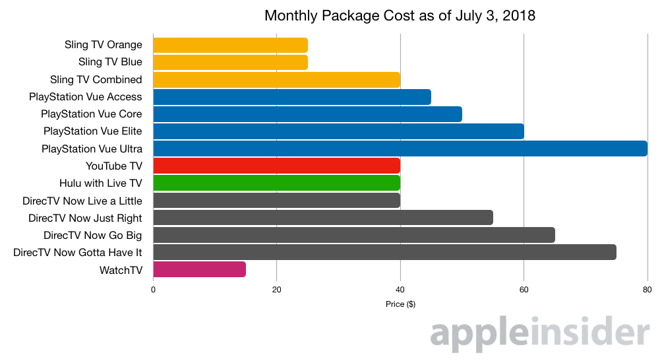
One of the first internet-only live TV services and still often considered the go-to, Dish Network’s Sling is divided primarily into “Orange” and “Blue” bundles, each costing $25 per month. The first includes 30 channels, while the second includes 42. The biggest difference is that while Blue includes Fox, NBC, and the pair’s sports networks, Orange has ESPN 1, 2, and 3. $40 merges both packages with plenty of overlap.
Instead of selling additional tiers, Sling relies on small add-ons. Most, such as Epix, “Sports Extra,” and “Best of Spanish TV,” are $5 per month. There’s a strong emphasis on international content — indeed for some people Sling may be the only way to go, since it has add-ons for countries you may not find anywhere else, like China and India.
“Premium” channels like HBO, Showtime, and Starz are also available, but usually at a higher cost. HBO for example is $15, as much as a separate HBO Now subscription, although here you get the live feed on top of on-demand content. Basketball freaks can sign up for NBA “Team Passes” that cover specific teams for $18, or the entire league for $29.
Cloud DVR support is another $5 add-on. This includes up to 50 hours of material, so you can’t go berserk picking shows and movies.
Supported Apple devices include iPhones, iPads, and the Apple TV.
PlayStation Vue
In case there was any confusion, PlayStation Vue has long been available on more than just Sony’s PlayStation consoles. As with Sling, it’s on iPhones, iPads, and the Apple TV.
The platform is divided into four tiers: Access, Core, Elite, and Ultra. Access, priced at $45 per month, includes about 47 channels such as AMC, Cartoon Network, SyFy, and ESPN 1 and 2. Notably this includes sports networks from NBC and Fox.
Sony has a pretty hefty amount of sports content included in its default plans, and even some non-sports channels you might have a hard time finding. To sum up though, Core costs $50 for over 60 channels, Elite is $60 for 87, and Ultra is $80 for over 90. Notably, Ultra incorporates HBO and Showtime.
There are far fewer add-on options for Vue than Sling, but some include channels that are missing even from the Ultra package, such as Cinemax or some of the more niche sports channels.
Some perks of the service include up to 10 profiles, the ability to stream on as many as five devices simultaneously, and hold as much DVR content as you want for up to 28 days and 500 programs.
YouTube TV
This one has just a single $40 plan, but with over 60 channels, some highlights being several ESPN options, and the four major broadcast networks: ABC, CBS, NBC, and Fox, along with a bunch of their affiliated channels. Naturally Google also tosses in YouTube Red Originals.
Showtime, Starz, Shudder, Fox Soccer Plus, and Sundance Now are the only add-ons available, so people wanting the likes of HBO will have to turn elsewhere. It also lacks important channels like Comedy Central, so keep that in mind.
As features go there isn’t much to distinguish YouTube — a subscription includes six accounts, and the ability to stream to three devices simultaneously. The biggest selling point may be its cloud DVR functions, which are practically unlimited since you can keep any and all recordings for as long as nine months.
The service was initially heavily mobile-focused, but you can now watch it on the Apple TV as well as iPhones and iPads.
Hulu with Live TV
Hulu is a relative latecomer to live TV, but it may be hard to beat for the simple reason that $39.99 gets you not just 50-plus channels, but access to the company’s regular on-demand library, including shows and a spattering of movies. Depending on your tastes, a Hulu account could eliminate the need for separate services like Netflix.
Most of the usual suspects are present in the service’s channel lineup, but there are some conspicuous gaps, such as Comedy Central once again. And on-demand content is included in the form of a “Limited Commercials” plan, so expect to be annoyed by advertising that would you wouldn’t run into with Netflix.
All Apple devices are supported, but by default you can only stream on two devices simultaneously. Likewise, cloud DVR functions are normally restricted to 50 hours of material.
Hulu not only charges you for premium channels — $14.99 for HBO, $9.99 for Cinemax, and $8.99 for Showtime — but extra for a 200-hour DVR and/or more screens (unlimited at home, three on the road).
DirecTV Now
If you absolutely insist on having a cable-like experience, AT&T’s DirecTV Now foregoes anything like a “skinny” bundle. There are five tiers, the smallest offering over 60 channels and the biggest over 120. Every recent Apple device is compatible.
For a while the service was considered something of a bargain, so long as you were willing to put up with early disruptions and a clunky interface. AT&T has tried to clean up the experience, and as of this writing it’s even still offering a free Apple TV 4K if you’re willing to prepay for three months. Prices are going up on Aug. 1 however, such that packages will cost $40, $55, $65, and $75 — roughly aligned with the rest of the market.
The service is also relatively stingy in features, offering just a 20-hour beta DVR and charging customers $5 to stream to a third screen on top of the first two. You can however add HBO or Cinemax for just $5, while Starz and Showtime are $8 apiece.
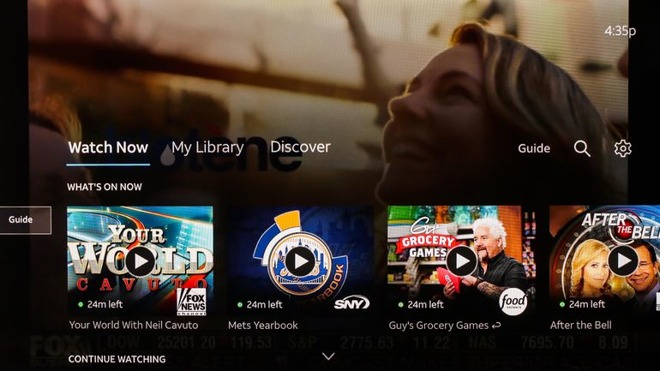
WatchTV
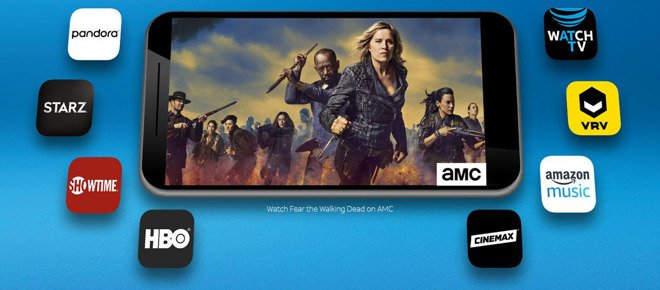
Another AT&T offering, the newest service on this list is only $15 per month, but currently offers just 31 channels. None of these carry sports, so if you want to watch the NFL, you’re out of luck.
The main reason to subscribe to WatchTV at this stage is if you have one of AT&T’s “Unlimited &More” data plans, in which case the service is free and even lets you add one of several “premium” services at no extra cost. You can add something like HBO or Showtime, but a few non-video services are available too, such as Pandora Premium and Amazon Music Unlimited.
Which should you choose?
Before anything else, make sure to check that a service or package has channels you’ll actually use. Having 120 channels is meaningless if you never see most of them. Accordingly many people will probably be happy with Sling Orange or Blue, and as we said, Hulu may be appealing to people who want more on-demand content.
It’s also worth evaluating whether you like the interface a service has. All of the above options are usable, but some will suit your style of viewing better than others. We found DirecTV Now to be more awkward than Sling or YouTube for example, yet your experience may vary.
We strongly recommend taking advantage of the trials each service offers before making a commitment. There’s no skin lost as long as you’re quick to cancel anything you don’t want to keep.
You may even find yourself questioning the value of live TV. Sports fans don’t have much choice, but people who only care about news, shows, and movies can possibly combine a few on-demand services and still save money — say, Netflix and HBO Now.