Posted by: xSicKxBot - 05-07-2019, 06:54 AM - Forum: Lounge
- No Replies
Video: Inside Prismata†s hierarchical portfolio search AI
In this 2017 GDC session, Lunarch Studios’ David Churchill describes the Hierarchical Portfolio Search AI system created for Prismata, and how it can be adapted to fit almost any genre of game, including search-heavy ones like strategy games.
It was a detailed dive into a fascinating technical challenge rich in takeaways for game devs, so if you missed seeing it live, take advantage of the fact that you can now https://www.youtube.com/watch?v=sQSL9j7W7uA“>watch it for free on the official GDC YouTube channel!
In addition to this presentation, the GDC Vault and its accompanying YouTube channel offers numerous other free videos, audio recordings, and slides from many of the recent Game Developers Conference events, and the service offers even more members-only content for GDC Vault subscribers.
Those who purchased All Access passes to recent events like GDC or VRDC already have full access to GDC Vault, and interested parties can apply for the individual subscription via a GDC Vault subscription page. Group subscriptions are also available: game-related schools and development studios who sign up for GDC Vault Studio Subscriptions can receive access for their entire office or company by contacting staff via the GDC Vault group subscription page. Finally, current subscribers with access issues can contact GDC Vault technical support
April 27th: New Preview Beta 1905 Update (1910.190424-1940)
Starting at 2:00 p.m. PST today, members of the Xbox One Preview Beta Ring will begin receiving the latest 1905 Xbox One system update (19H1_RELEASE_XBOX_DEV_1905\18362.3038.190424-1940) Read on for more about the new features, fixes and known issues in the latest 1905 system update.
DETAILS:
OS version released: 19H1_RELEASE_XBOX_DEV_1905\18362.3038.190424-1940
Based on user feedback, we’re broadening your ability to sort games and apps by date, including updated options to “last updated” or “last used” title selection. Please check out this change in “My Games & apps” and let us know what you think!
Friends list shows where your friends are playing
You can now see where your friends are playing their games. Keep an eye out for the console, mobile and PC icons next to your friends’ names in your friends list in the Guide!
Voice channels in messaging
Voice channels have been added to Xbox Live messaging on console. This feature is only available in Alpha and can only be used between Alpha users. If you and a friend are both in Preview Alpha, we’d highly encourage you try adding a voice channel and let us know what you think!
Fixes:
My Games and Apps
Additional fixes for an issue in which switching from media apps such as Youtube/Hulu to a game or from a game to a media app would crash the console.
Known Issues:
Audio
Headsets are not being assigned to the users profiles.
Some users are experiencing no audio with headsets and we are investigating
Some users are encountering no audio on their Xbox console after boot (no shell audio, no game audio, no app audio), then have CSS ask them to perform the following steps:
Cold reboot the console
OR
Go to Audio settings on console
Change their HDMI audio settings to the highest supported uncompressed channel count for their equipment
Switch back to the desired format
Audio should be restored
My Games and Apps
We are tracking the video corruption issue with Youtube and Netflix 4k playback.
Profile Color
Sometimes users may encounter the incorrect Profile color when powering on the console.
Posted by: xSicKxBot - 05-07-2019, 02:22 AM - Forum: Lounge
- No Replies
How The Game Of Thrones Spinoffs Are Shaping Up
Thanks to author George R.R. Martin, we've got an idea of how things are going for the several "successor" TV shows that could come into being after the final season of Game of Thrones wraps up. In a post on his blog, the "A Song of Ice and Fire" novel series author, on which Game of Thrones is based, said three of the five shows are moving still moving forward. They're coming along "nicely," he said. As for the other two, their status is uncertain.
This news comes not long after Game of Thrones director and producer Bryan Cogman said his Game of Thrones successor show was canceled. One of the shows, which Martin originally wrote on his blog was called The Long Night (he later walked that back, so the name could change), stars Naomi Watts and will start shooting this year.
That show is set thousands of years before the mainline HBO show and concerns legendary characters like Bran the Builder, founder of House Stark, and Lann the Clever, founder of House Lannister. The title Martin mentioned, the Long Night, refers to a winter that lasted a generation--which also included the first war with the White Walkers.
The other two shows are still working on scripts, but there is no word yet on the stories they'll tell or who may star in them. Martin teased that at least one might concern the Targaryen dynasty, which is covered in the recently released companion book, "Fire & Blood."
"We have had five different Game of Thrones successor shows in development (I mislike the term 'spinoffs') at HBO, and three of them are still moving forward nicely," he said. "The one I am not supposed to call The Long Night will be shooting later this year, and two other shows remain in the script stage, but are edging closer. What are they about? I cannot say. But maybe some of you should pick up a copy of Fire & Blood and come up with your own theories."
There are a bunch of major events in the 300-year history of the Targaryens in Westeros that could make for good shows. Aegon Targaryen's original conquest of the Seven Kingdoms would be pretty intense, but there's also the Dance of Dragons, when a Targaryen prince battled a princess over who would succeed their father on the Iron Throne, and the Blackfyre Rebellion, when a bunch of legitimized Targaryen bastards banded together to overthrow the trueborn Targaryens.
HBO has only ordered a pilot for the Naomi Watts Game of Thrones successor show, so it remains to be seen if it will get picked up to series.
While modern IT environments move towards Linux containers, the need to secure these environments is as relevant as ever. Containers are a process isolation technology. While containers can be a defense mechanism, they only excel when combined with SELinux.
Fedora SELinux engineering built a new standalone tool, udica, to generate SELinux policy profiles for containers by automatically inspecting them. This article focuses on why udica is needed in the container world, and how it makes SELinux and containers work better together. You’ll find examples of SELinux separation for containers that let you avoid turning protection off because the generic SELinux type container_t is too tight. With udica you can easily customize the policy with limited SELinux policy writing skills.
SELinux technology
SELinux is a security technology that brings proactive security to Linux systems. It’s a labeling system that assigns a label to all subjects (processes and users) and objects (files, directories, sockets, etc.). These labels are then used in a security policy that controls access throughout the system. It’s important to mention that what’s not allowed in an SELinux security policy is denied by default. The policy rules are enforced by the kernel. This security technology has been in use on Fedora for several years. A real example of such a rule is:
The rule allows any process labeled as httpd_tto create, append, read and lock files labeled as httpd_log_t. Using the ps command, you can list all processes with their labels:
To see which objects are labeled as httpd_log_t, use semanage:
# semanage fcontext -l | grep httpd_log_t
/var/log/httpd(/.)? all files system_u:object_r:httpd_log_t:s0
/var/log/nginx(/.)? all files system_u:object_r:httpd_log_t:s0
...
The SELinux security policy for Fedora is shipped in the selinux-policyRPM package.
SELinux vs. containers
In Fedora, the container-selinux RPM package provides a generic SELinux policy for all containers started by engines like podman or docker. Its main purposes are to protect the host system against a container process, and to separate containers from each other. For instance, containers confined by SELinux with the process type container_t can only read/execute files in /usr and write to container_file_tfiles type on host file system. To prevent attacks by containers on each other, Multi-Category Security (MCS) is used.
Using only one generic policy for containers is problematic, because of the huge variety of container usage. On one hand, the default container type (container_t) is often too strict. For example:
Fedora SilverBlue needs containers to read/write a user’s home directory
Fluentd project needs containers to be able to read logs in the /var/log directory
On the other hand, the default container type could be too loose for certain use cases:
It has no SELinux network controls — all container processes can bind to any network port
It has no SELinux control on Linux capabilities — all container processes can use all capabilities
There is one solution to handle both use cases: write a custom SELinux security policy for the container. This can be tricky, because SELinux expertise is required. For this purpose, the udica tool was created.
Introducing udica
Udica generates SELinux security profiles for containers. Its concept is based on the “block inheritance” feature inside the common intermediate language (CIL) supported by SELinux userspace. The tool creates a policy that combines:
Rules inherited from specified CIL blocks (templates), and
Rules discovered by inspection of container JSON file, which contains mountpoints and ports definitions
You can load the final policy immediately, or move it to another system to load into the kernel. Here’s an example, using a container that:
The default container type (container_t) doesn’t allow any of these three actions. To prove it, you could use the sesearch tool to query that the allow rules are present on system:
# sesearch -A -s container_t -t home_root_t -c dir -p read
There’s no allow rule present that lets a process labeled as container_t access a directory labeled home_root_t (like the /home directory). The same situation occurs with /var/spool, which is labeled var_spool_t:
# sesearch -A -s container_t -t var_spool_t -c dir -p read
On the other hand, the default policy completely allows network access.
It would be great to restrict this access and allow the container to bind just on TCP port 21 or with the same label. Imagine you find an example container using podman ps whose ID is 37a3635afb8f:
# podman ps -q
37a3635afb8f
You can now inspect the container and pass the inspection file to the udica tool. The name for the new policy is my_container.
# podman inspect 37a3635afb8f > container.json
# udica -j container.json my_container
Policy my_container with container id 37a3635afb8f created!

Please load these modules using:
 # semodule -i my_container.cil /usr/share/udica/templates/{base_container.cil,net_container.cil,home_container.cil}

Restart the container with: "--security-opt label=type:my_container.process" parameter
That’s it! You just created a custom SELinux security policy for the example container. Now you can load this policy into the kernel and make it active. The udica output above even tells you the command to use:
The udica tool helps you create SELinux policies for containers based on an inspection file without any SELinux expertise required. Now you can increase the security of containerized environments. Sources are available on GitHub, and an RPM package is available in Fedora repositories for Fedora 28 and later.
By Christine McKee Monday, May 06, 2019, 06:16 pm PT (09:16 pm ET)
B&H Photo just unveiled the Payboo Card, which offers shoppers a tax-equivalent loyalty reward to counteract sales tax assessed on purchases. This new marketing initiative sets B&H apart from competitors, such as Best Buy and Amazon, that collect sales tax on purchases in all applicable states without the reward, potentially putting hundreds of dollars back in the pockets of consumers.
B&H Photo Payboo Credit Card with tax incentive
Shoppers subscribed to B&H emails began receiving a message describing Payboo as “the solution to the sales-tax challenge,” which references the South Dakota vs Wayfair ruling that allows states to collect sales tax on purchases made from out-of-state sellers, even when said sellers do not have a physical presence in the state. As we reported in October 2018, B&H began collecting sales tax in additional states after the ruling, with even more states added to the list during the remainder of 2018. As it stands now, B&H collects sales tax in a total of 26 states and reports purchases in several more, due to local taxation laws.
Shortly after 6 p.m. Pacific, B&H launched the Payboo Credit Card page, with a message reading “you pay the tax, we pay you back.” Shoppers in eligible states will receive a reward equivalent to the amount paid in sales tax on every purchase with the B&H Payboo Card. At press time, the tax-equivalent loyalty reward is not valid in Alabama, District of Columbia, Indiana, Iowa, Nebraska, North Dakota, Vermont, West Virginia and Wyoming, although other Payboo Card incentives may be available.
Payboo comes on the heels of Apple’s own Apple Card announcement, which offers 3% cash back on purchases made at Apple and 2% back on purchases using the Apple Card via Apple Pay.
This story is developing. Stay tuned for more details following B&H’s official announcement.
If you are looking for a tool to quickly create complex shaders by mixing and matching existing shaders, ShaderFrog might be the perfect tool for you! Running entirely in your browser, ShaderFrog can be used to create WebGL shaders in two ways. First you can create a shader by connecting together existing shaders, to create a new composite shader. Shaders can even be imported from ShaderToy or the GLSL Sandbox.
In addition to the composition based approach, there is also a full blown GLSL text editor with automatic compilation/error reporting, syntax highlighting and more. Once you are happy with your created shader, you can save it, share it, or export it to iOS, Unity or Three.js.
Check out ShaderFrog in action in the video below.
Fortnite Season 8's Unvaulting Event Bugs, Epic Offers Free Item In Response
As is custom when a season of Fortnite approaches its conclusion, Epic Games held a one-time world event that gave people in the right place at the right time the opportunity to see something cool happen on the island. Except, this time it didn't go off without a hitch, and in response Epic has offered those who encountered a problem a make-good gift.
On May 4, players gathered around Loot Lake for an event called the "Unvaulting." As the name implies, the mysterious vault at the center of the location opened up and Fortnite players jumped in. Inside they were faced with a number of pillars that represented different weapons and items. Players effectively chose which of these to free from the vault by collectively striking down a pillar using their pickaxes. The liberated item was the Tommy Gun, and once freed everyone was launched back onto the island.
After being returned from the vault, players got to witness the volcano that appeared for Season 8 erupt and destroy Tilted Towers, effectively reshaping the island and laying the groundwork for Season 9.
That's how it should have gone, and for many that's what they saw. However, a large contingent of players that gathered for the event encountered issues and were not able to see the event unfold as intended. Epic Games has acknowledged the issue and said, "We apologize to those who were unable to witness the event and place their vote."
To make up for the snag, those that were in the Unvaulting playlist at the right time will be given the Arcana Glider free of charge. If you already purchased the Arcana Glider using V-Bucks, you will be refunded the 1200 V-Bucks.
We apologize that some players were unable to view the Unvaulting event. Anyone who jumped into the Unvaulting playlist will be granted the Arcana Glider in the coming days. Players who purchased the Arcana Glider previously will be refunded their V-Bucks.
Fortnite Season 8 is now its 10th week and the season is coming to a close very soon. But before you start thinking about what's next, we recommend wrapping up the season's challenges as quickly as possible. Once the transition to Season 9 happens, older challenges will no longer be available and rewards attached to Season 8's Battle Pass will also expire. If you want any of those, act fast.
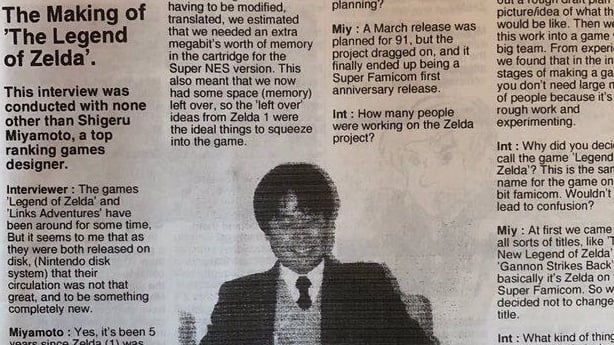
Forgotten Interview With Miyamoto Sheds Light On A Classic Zelda Production
Retro gamer Matt Sephton, who goes by the handle @gingerbeardman over on Twitter, has shared a forgotten interview with us dating back to 1992. It’s from issue 25 of the publication Electric Brain and features the one and only Shigeru Miyamoto talking about the development of The Legend of Zelda:A Link To The Past along with the first two Zelda entries on NES.
Throughout the interview, Miyamoto speaks about the various challenges and design choices Nintendo faced during development – such as trying to cram all of the game onto the cartridge. He also explained how the company often began projects with only a handful of people and even revealed how the development team had “all sorts of titles” for the SNES Zelda, like “Gannon Strikes Back” until a decision was made to stick with the original name.
In the second half of the interview, Shigeru touches on the role-playing genre, in general, and states how Zelda paved the way – with a number of original ideas that eventually became “bog standard” for all games under this banner. Later on, he references the original Mother (Earthbound) game on the NES and Pilotwings.
One of the final questions is about future production plans for the company. Miyamoto follows this up by saying how Nintendo “will never run out of ideas” and new genres can be easily created. Read the full interview below:
Did you enjoy reading this classic interview featuring Miyamoto? Share your thoughts in the comment section.
Posted by: xSicKxBot - 05-06-2019, 08:19 PM - Forum: Windows
- No Replies
Accelerating the journey from automated to autonomous systems
Microsoft’s autonomous systems platform overcomes some of these challenges by using a unique approach called machine teaching. It relies on a developer’s or subject matter expert’s knowledge — someone who may not have a background in AI but understands how to steer a drill or keep the airflow in an office building at safe levels — to break a large problem into smaller chunks.
Instead of having reinforcement learning algorithms explore how to solve a problem randomly or naively, which could take forever, that person uses a programming language called Inkling to show the system how to solve simpler problems first and provide clues about what’s important. This shortcuts the learning process and enables the algorithms to hit on a solution much faster.
Microsoft’s platform also enables non AI-experts to establish and tweak the reward system, which is key to arriving at a solution that truly works. And it selects and configures the algorithms to tackle the task, eliminating the need for machine learning experts to custom build solutions.
For instance, team members worked with Schneider Electric, a global company working to digitally transform energy management in homes, buildings and industries, to test whether AI could help reduce the carbon footprint of HVAC systems that are used to heat and cool large commercial buildings.
“Schneider is very focused on sustainability, and large buildings are a top contributor to carbon pollution. So there’s a really important mandate to make HVAC systems more energy efficient,” said Barry Coflan, senior vice president and chief technology officer for Schneider Electric’s EcoBuildings Division.
Centered on a longstanding relationship, a proof-of-concept test was conducted using the Microsoft toolchain and Schneider supplied simulation to train an AI system to autonomously run the HVAC systems that controlled airflow and heating in a conference room. It had to balance saving energy with other goals, such as keeping the temperature comfortable for people inside and making sure there’s enough fresh air to keep carbon dioxide levels from building up.
Optimizing for all those factors — which are controlled by different physical systems — requires far more intelligence than a simple thermostat, says Microsoft’s Hammond. The system has to account for environmental variables that are constantly changing: energy costs that fluctuate throughout the day, people coming and going from the room, what the outside weather is doing, the physics of how air flows.
Using a machine teaching approach, Schneider and Microsoft experts first taught the reinforcement learning system to control temperature well. Then the AI system learned how to control air flows to keep air quality at healthy levels. Then it learned to consider how room occupancy affected those outcomes.
Taking all those factors into account, Microsoft’s AI system was able to reduce energy consumption in the room by about 20 percent, while preserving comfort and high air quality when it mattered. The teams are now embarking on a second phase of collaboration to scale the simulation across different types of rooms and further boost energy savings.
Coflan said the laddered approach to teaching and the ability to layer in different rewards enabled Schneider Electric to understand how the AI system was learning and track which factors contributed to the biggest gains.
“A lot of what we do has safety ramifications so we really need to understand how the AI system is making decisions,” Coflan said. “This approach lets you see how the system is getting smarter and gives you an audit trail that is essential for safety and reproducibility. Our customers would want that too — you can’t just put a system out there and say ‘Trust us.’”
Microsoft’s autonomous systems platform uses a simulated warehouse environment in AirSim to train an intelligent forklift to pick up and deliver loads autonomously while recognizing and avoiding other obstacles. This video illustrates the vision for a future warehouse with pre-trained, intelligent forklifts assisting people in everyday activities.
Running simulation at scale in Azure
Because no company can afford to let a robot or an intelligent control system make millions of mistakes in a real-world factory or wind farm or highway as it is learning, reinforcement learning algorithms need to practice in a simulated environment that can replicate the thousands or millions of different real-world scenarios they might encounter.
The Microsoft toolchain also includes AirSim, an open source simulation platform originally developed by Microsoft researchers to use AI to teach drones, self-driving cars or robots to learn in high fidelity simulated environments. Or, the team can work with customers to train autonomous systems using existing industry-specific simulators.
In either case, running these data-hungry simulations in the Azure cloud enables the system to test thousands of different decision-making sequences in parallel, which allows the AI models to learn what does and doesn’t work much faster.
“If I have the ability to spawn thousands of simulations at once and in each one the pedestrian crossing the street is different and the curve of the road is different, suddenly the AI system is able to gather much more diverse experience in a short amount of time ,” said Ashish Kapoor, Microsoft principal research manager. “Azure gives us the ability to run these simulations at scale, which is really important.”
AirSim also allows developers to train different AI and control tools to solve different parts of more complex problems. In helping develop autonomous forklifts for Toyota Material Handling, for instance, researchers broke the task down into sub-concepts that are simpler to learn and debug: navigating to the load, aligning with the pallet, picking it up, detecting other people and forklifts, delivering the pallet, returning to the charging station.
In these complex scenarios, Kapoor said, it may make sense to use reinforcement learning to train a forklift on basic control tasks, like picking up a pallet. Machine teaching helps the system learn in progressively more difficult steps, such as aligning the lift horizontally and then finding the proper angles.
But other parts of the problem might be better solved by entirely different tools like obstacle detection and avoidance algorithms, robotics path planning or classical control techniques. Decomposing the larger task into smaller ones allows developers to select and deploy the best tool for that particular job.
“We are working to provide a comprehensive platform for customers who want to build intelligent autonomous systems, covering development, operation and end-to-end lifecycle management,” Hammond said.
Top image: An experimental version of the Sarcos Guardian S, a visual inspection robot that can be used in disaster recovery or for industrial inspections, has learned to avoid obstacles and climb stairs on its own using Microsoft’s autonomous systems platform. Photo by Dan DeLong for Microsoft.
Microsoft Build 2019 — related autonomous systems links:
Jennifer Langston writes about Microsoft research and innovation. Follow her on Twitter