Posted on Leave a comment

Get a free copy of premium sport game WST Snooker!

The variety of sport-based games on mobile is pretty amazing – we’ve got racing games like Kartrider Rush+ and Asphalt, some of the best mobile sports manager games like Football Drama, or Motorsport Manager Mobile, and we also have games covering plenty of other sports. WST Snooker is one such title, a premium snooker game offering solid play to both fans of the sport and new players alike – read our WST Snooker review if you don’t believe us!

That’s why we’ve decided to partner with Lab42 this week to give away some copies of the game! If you like sport games, want to try something new, or enjoy snooker or pool in real-life, WST Snooker might be a fun new mobile play for you to try out.

We’ve also got a fair few copies for both Android and iOS up for grabs. So, if competing in snooker tournaments and climbing the ranks of the professional world sounds like your sort of thing, be sure to try your luck!

In order to enter, all you need do is select which platform you want a copy for – but also please have a browse of our terms and conditions before you do!

android

PT – WST Snooker – Android giveaway

ios

PT – WST Snooker – iOS giveaway

If you can’t wait to play WST Snooker, it is available for purchase on Google Play and the App Store. For more sport-related recommendations, our best Android games and best iOS games lists have some pretty good picks!

Posted on Leave a comment

Get a job: Join Robot Entertainment as a Senior VFX Artist

The Gamasutra Job Board is the most diverse, active and established board of its kind for the video game industry!

Here is just one of the many, many positions being advertised right now.

Location: Plano, Texas

Robot Entertainment, the independent developer of the Orcs Must Die! franchise, is looking for a Senior VFX Artist to join our team.  This individual will be responsible for creating VFX across a variety of game platforms.  This is an excellent opportunity for someone with game industry experience looking for new challenges, including mentoring junior staff, and developing leadership skills.

Responsibilities

  • Creates, designs, and implements in-game visual effects;
  • Model, paint, and animate as needed to create high quality VFX assets;
  • Work with the Art Director and Leads to develop VFX languages that are consistent with project art styles;
  • Collaborate with other departments such as Design, Engineering, Tech, and Animation, to make sure artwork fits the specs and gameplay needs.
  • Assist with Tech Art and Engineering in planning and implementing our VFX pipeline;
  • Work with production to follow and build schedules and to deliver assets on time;
  • Serve as a mentor for less experienced artists;

The Ideal Candidate… 

  • Is proficient in VFX development using Unreal 4 and its particle systems and materials.  
  • Has strong VFX and traditional art skills (timing, shape language, color theory and illustration, painting, composition, 2D & 3D design);
  • Is proficient in Photoshop (or other 2D software) and Maya (or 3D modeling package);
  • Has a minimum of five (5) years’ experience working as a VFX artist for games;
  • Has familiarity with video game development including, but not limited to workflow, tools, lighting, modeling, VFX material setup, in-game animation, and engine parameters/optimizations;
  • Has contributed to multiple shipping video game titles;
  • Likes to participate in the research and development of a product’s visual style;
  • Is capable of identifying, investigating and resolving a range of artistic development issues often encountered during the game creation process;
  • Great oral and written communication skill;
  • Self-managing with capability to work individually in a remote location;
  • Plays and enjoys a variety of games.

Educational Requirements

BS/BA/MS degree in Art, or equivalent work experience.

Interested? Apply now.

Whether you’re just starting out, looking for something new, or just seeing what’s out there, the Gamasutra Job Board is the place where game developers move ahead in their careers.

Gamasutra’s Job Board is the most diverse, most active, and most established board of its kind in the video game industry, serving companies of all sizes, from indie to triple-A.

Looking for a new job? Get started here. Are you a recruiter looking for talent? Post jobs here.

Posted on Leave a comment

Don’t Miss: Why multiplayer almost didn’t make it into Halo: Combat Evolved

One could argue that the multiplayer component in Bungie’s original Halo: Combat Evolved single-handedly made Microsoft’s Xbox a staple in college dorms nationwide, giving the company’s fledgling console a foothold.

But when Microsoft acquired Bungie, at the time a veteran PC and Mac developer, and repositioned Halo as a flagship Xbox title, its multiplayer mode was almost axed in the interest of expediency and cost-saving — a move that may have altered Microsoft’s early status in the hardware race.

Gamasutra recently caught up with multiplayer designer Hardy LeBel, half of the two-man team that brought the mode back from the brink. After Halo 2, LeBel went on to head up Zipper Interactive’s SOCOM: U.S. Navy SEALs franchise — itself a multiplayer staple on Sony’s PlayStation 2 — and now serves as multiplayer lead on Far Cry 2. In this retrospective interview, he recalls his Bungie days and comments on the various design approaches available to multiplayer developers.

Were you on Halo when it was still targeting PC?

Hardy LeBel: I was at Bungie when Halo was a PC project, but the origin of the title was out of the Chicago office, and I was the creative director for the San Jose office. When we got bought by Microsoft and relocated, it was clear that for us to be able to hit the launch window for Xbox, we all had to work on Halo, so we all kind of got pulled in.

What was your project before that?

HL: I was the lead designer on Oni, which was a kind of a third-person action title. When we got bought by Microsoft, Alex Seropian and Jason Jones, who were the two principals of Bungie, came to me and [former Bungie engineer and animator] Michael Evans, and said, “Multiplayer is cut from Halo because we’re trying to make it really work on the console and we just don’t have the resources.”

But we threw a fit and were like, “No way! You can’t cut it! It’s just too cool!”

They said, “We were hoping you’d say that — because you two guys have to resurrect it.”

Wow, talk about changing the course of history. (laughter) That component of the game is a big part of what made it so ubiquitous.

HL: Well, my goal with the design for Halo was to make something that was a shooter that played like an action game. In other words, I honest to God wanted to make something that would have felt like it could have been made by Nintendo. It was just — oh yeah, you get in there and everything feels good. It’s smooth, it’s really accessible, the sound effects are really accessible.

Even the naming conventions — I’d like to point out that I didn’t call it “deathmatch” because I felt like [the term] “deathmatch” was too hardcore, perhaps. I called it “Slayer” instead, because I wanted it to be more broadly accessible as a naming convention, like [the Halo gametype] “Oddball.”

Bungie had a tradition of that — in the Myth series and so forth. There was a history of off-kilter stuff in the multiplayer gametypes.

HL: Yep. Absolutely, there was that tradition. So the two of us basically dove in to resurrect multiplayer. Michael made a set of tools for me so that I could create multiplayer maps that plug into the Halo toolset. It wasn’t the full set of Halo tools and we didn’t actually have a level artist, so a lot of the levels in Halo were me learning how to use 3D Studio Max.

(laughter)

Really?

HL: Yeah! I was like, “Oh, I wonder what happens if I use this extrude tool. Whoa! That opens up all new possibilities!” (laughter) Anyway, it was a very, very small team.

So I worked on Halo, I was a contributing level designer on Halo 2, and then I was the creative director for the SOCOM [U.S. Navy SEALs] series of games. I left Microsoft and I went over to Zipper Interactive.

That’s interesting, because the SOCOM games were almost the counterpart to Halo in terms of being the big flagship multiplayer games for the PlayStation 2.

HL: It’s true, yeah. Absolutely, absolutely.

In each one of those games, to kind of bring the conversation back around, in Halo and in the SOCOM series of games, encounter design and level design is very much about creating a basis for the encounters and then populating it with a bunch of different elements that are sort of randomly generated.

Every time you play Halo, if you were to play the same level or the same encounter three separate times, you’re going to get different guys every time. And you’re also going to get different guys depending on the difficulty setting. You can try that.

Next-generation development is more about saying, “OK, we have this bed, or this group, of elements,” and you’re really trying to conduct them more than you’re necessarily trying to explicitly say, “I want this guy to run this way and this guy to run that way.” I’ve spent a lot of time and experience trying to shape the random elements together to make something fun and interesting.

In terms of including all the crazy modes, Halo still does that more than most games — although I imagine you guys were influenced by Unreal Tournament in that regard as well.

HL: Well, sure. With Halo, I can authoritatively say that we learned at the feet of Unreal how much value you can glean and get out of the ability to customize your own rules.

However, in terms of the overall fun play experience, I personally never got as much huge value out of weird, kind of custom rules so much as a really screamingly good map with kind of good fundamental weapons and some complexity to the combat model. You know, that it was sort of deep enough for me to be able to explore and enjoy. For me, that’s so much that you can really sort of get into and plumb. Counter-Strike is the absolute opposite end of the spectrum, right?

Right.

HL: Counter-Strike is all about map customization, really not about game play customization. Love that. Just love it.

Then some games are sort of neither — you’ve got Team Fortress 2, which is more, “We’ve whittled this down to a few really solid things that we think work. We’re pretty confident you’ll like this mode on this map, because you’re going to be playing a lot.” That seems to be working for them.

HL: I think, it is. Yes. It can work. It is interesting how modal that is. In other words, if you find TF2 to be to your taste and you like it, then you’ll like it anyway. But, if not…

Right, you’re kind of locked out.

HL: Exactly. You’re kind of frozen out. So, I think, for that particular product, that strategy makes sense, because there’s a proven history, and there’s an audience out there of people who are sort of looking for that team based, class based game play model. But, yeah, with not wiggle room, you either love it or you don’t love it. That’s a little bit tough.

In single-player as well, that’s Valve’s design aesthetic, is to go for that highly authored experience — but they’re also doing Left 4 Dead, which has the dynamic spawning and all that.

HL: Oh, yeah. Absolutely. I should say, I worship the ground that Valve walks on. For me, their authored experiences are better than anybody in terms of creating and maintaining that amazing sense of location and feeling.

But, yes, a lot of games — Halo, SOCOM, Far Cry — are looking more at introducing those random elements so that it’s [about] the fun set-ups. And really, so much of what comes out of this systemic approach in the single-player side in Far Cry 2, because it is so systemic, everyone’s story ends up being incredibly unique and incredibly personal. You and I may have run into separate checkpoints, separate encounters, separate gunfights, and our personal story about what the weapons did or what the weather was or anything else, becomes personal.

Posted on Leave a comment

Xbox narrows down Series X launch window to November 2020

Both Xbox and PlayStation have yet to actually disclose a set-in-stone launch date for their next generation consoles, but Xbox is inching ever-so-closer to doing so. 

The company officially announced today that the Xbox Series X will launch during the month of November, narrowing down its previously announced launch window of Holiday 2020 to a single month.

The timing of this particular update is interesting in its own right. By Xbox’s own admission, the announcement lines up with news that 343 Industry’s Halo Infinite has been delayed into 2021 and is no longer marked down as an Xbox Series X launch title. 

Xbox head Phil Spencer previously said that, hypothetically speaking, Microsoft wouldn’t delay the launch of its next-gen console if a flagship game like Halo were to be delayed. Today’s announcement looks to reassure the world that the console’s launch plans remain unchanged by Halo Infinite’s delay. 

The full blog post, found here, hypes up some of the other features and games offered by the Series X at launch and beyond, and leads with the idea that the Series X technically launches “with thousands of games spanning four generations” due to its previously-detailed backwards compatibility plans.
 

Posted on Leave a comment

Twitch announces ‘Prime Gaming’ rebrand

Amazon-owned streaming giant Twitch announced today it would rebrand its Twitch Prime premium service to “Prime Gaming.”

The rebranding brings the service closer to Amazon Prime, which has 150 million subscribers who can access Prime Gaming benefits such as in-game content, a rotating library of PC games, and more.

From Twitch’s official announcement:

So for the TL; DR: new name, same Prime subs, lots more awesome in-game content ahead (plus free games every month!), and even happier gamers, publishers, and Twitch streamers. 

Posted on Leave a comment

Controller leak all but confirms ‘Xbox Series S’

New images of a revamped Xbox-style controller point to a heavily rumored, more affordable Xbox Series S next-gen console.

While it may seem that we’ve known of the “Series S” for months now, it’s the first time “Xbox Series S” (reportedly codenamed “Lockhart”) has been seen on official Microsoft Xbox product packaging out in the wild.

Tech site The Verge has images of the new cross-gen compatible white controller, which is smaller than Xbox One controllers, sports a share button, and an updated d-pad. Like current-gen Xbox controllers, the leaked controller requires two AA batteries.

Twitter user Zakk S, who was able to actually purchase the controller, posted up-close images of the device. Microsoft declined to elaborate further on the leak.

The shape of Microsoft’s hardware strategy is becoming more concrete as days go on. With the current-gen Xbox One X now out of production, it seems that the Xbox One would serve as the entry-level Xbox, with the Xbox Series X serving as the next-gen, lower-powered but more affordable version, and the Xbox Series X, due out this holiday season, topping out the lineup.

Posted on Leave a comment

Game Discoverability Now: How big is your game’s Discord? (Not this big!)

The following blog post, unless otherwise noted, was written by a member of Gamasutra’s community.
The thoughts and opinions expressed are those of the writer and not Gamasutra or its parent company.


[Hi, I’m ‘how people find your game’ expert Simon Carless, and you’re reading the Game Discoverability Now! newsletter, which you can subscribe to now, a regular look at how people discover and buy video games in the 2020s.]

Welcome to the latest edition of the Game Discoverabilityland round-up. In this edition, I smoosh together all of the notable news of the week into one post, so you can consume it like dining out on a fine three-course meal.

Not that any of us is doing that currently, of course. So let’s proceed with the hastily microwaved curry which is this week’s newsletter:

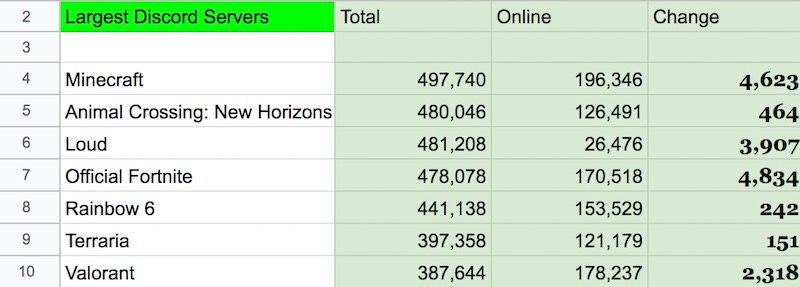
The biggest game Discords in the world ever!

This week, I was chatting (electronically) to Stephen Takowsky, who works on the massive Discord for Terraria at 505 Games (and also used to be a pro Civilization player with Team Liquid!)

Anyhow, Stephen does a bunch of neat work with Discord plug-ins and collaborations between large-scale Discords. He was kind enough to share with me his daily updated list of the most popular game-related Discord servers.

I’ve talked a little bit about Discord in the past. It’s a really great tool to attract and retain a community around your game and update them on your progress, no matter how many people hang out there.

But I thought some of the trends in the biggest/most active servers were super interesting, just to peruse what games are currently popular! Here’s what I particularly noticed:

  • A lot of the top servers are ‘official’, but not all of them. The ‘verified’ servers for Minecraft, Fortnite and others are run by staff or mods that are approved by the developers themselves. But you also get Discord-partnered servers like Animal Crossing and the Reddit-linked r/LeagueOfLegends – which are not endorsed by the maker of the game, but still thrive anyhow.

  • The top games are pretty much what I expected. When looking at the most active servers out there, the top titles include Minecraft, Valorant (wow, Riot’s done a good job here!), Fortnite, Rainbow 6, Roblox, and so on. There’s also a few ‘big’ indies like Terraria and Risk Of Rain 2 punching above their weight. And impressed to see Deep Rock Galactic, TemTem & SatisFactory also in the Top 30.

  • There’s some very active game Discords I was surprised about. If you were to tell me the Top 30 included Spellbreak (a game I clearly need to pay more attention to), Escape From Tarkov and GTFO, I admit I would have been a little surprised. And a Beat Saber modding Discord almost in the Top 10? Yup, that’s reinforcing its position as the breakout VR game – not surprising that Oculus bought the studio.

So that was what I personally took from the rundown of the top Discords! Feel free to read over it yourself and draw your own conclusions.

Which came first – the discount or the wishlist email?

Something that came up on Twitter today that I thought was worth passing along. I made the point that, at least on Steam, it’s not just the fact that a game is on sale that makes people buy it – it’s also Valve’s outbound marketing efforts:

And as if by magic, somebody turned up in the comments to validate my opinion. (I always love it when that happens.)

Obviously, this isn’t the only way that people find out games are on sale. For higher-profile titles, they will see it on Reddit, social media, or via dynamic deal-finding websites like the SteamDB sales tab. And for the larger sales, people will often browse for a while.

But the email is important – and it’s worth looking into those stats further. If you go to the bottom of your ‘Wishlist Actions’ page on the Steam back end, you’ll see a list of all the ‘Wishlist Notifications’ (emails!) sent, with the dates and 1-day and 7-day conversion numbers. (Though I believe this stat only tracks purchases directly from clicks, so you real number is going to be quite a lot higher.)

Oh, and bonus note from me: “Also, you have to discount your game by at least 20% to get the wishlist email sent by Steam!” You all know that, right? It’s on the Steamworks wishlist page documentation, but that’s not necessarily somewhere that we all reference all the time, haha.

Other Stuff…

As always, there’s plenty of other things going on here. In fact, I’m already filing things to post in NEXT week’s Game Discoverabilityland round-up. So let’s get going on this one, shall we?

  • There’s going to be a new Microsoft Store on Xbox rolling out soon, with redesigned search functionality, a more prominent wishlist feature (interesting!), and a whole new, faster interface. I actually think the existing Xbox store interface was in the ‘good enough’ category for me, and so perhaps this one will take it to ‘great’. (Hoping for ‘Hot New Games’ real-time charts, too, but a boy can dream…)

  • Liam Twose, who does the #pitchyagame tag on Twitter, also has a Global Games Industry directory he’s hosting for free on Itch (PDF) and Trello. I know directories can be unwieldy (and get outdated!), but I was impressed with his publisher list in here – there will almost certainly be indie pubs you don’t know.

  • In case you missed it, and SteamDB on Twitter didn’t, Valve “has recently made changing your store country more strict, which requires completing a purchase using a payment method from that country. This should hinder [those] using VPNs to buy games cheaper.” Some rumblings of reduced sales because of this, but it’s a bit early to tell, and I imagine the revenues will equalize (if not units).

  • Epic noted that mod support is now in beta on the Epic Games Store, starting with Mechwarrior 5. This is interesting, and not a feature I was expecting as an Epic-exclusive integration. IMO, the ‘mods on PC’ situation is starting to get messy, given there’s Steam Workshop, third-party solutions like Mod.io (which you can use on Steam!), and then Microsoft’s Game Store on PC requires specific moderation standards for mods… maybe a subject for another time!

  • There’s an MCV Develop interview with Inkle’s Joseph Humfrey & my bombastic No More Robots compadre Mike Rose about the state of the eShop for discoverability. I’ve already gone on about this at length, but Nintendo needs to think about the ‘charts/eShop interface encouraging 90% off discounts’ thing. (I think NMR might be sharing Not Tonight eShop discount results abstractly soon, that was an experiment that worked irritatingly well.)

  • Scourgebringer director Thomas Altenburger has an excellent Twitter thread about pitching to publishers that I recommend you read. Basically: know your publisher, have a playable prototype, have a short/sweet 5-page pitch deck, maybe even make a 5-minute ‘this is us and our game!’ video, be very specific about production budget and schedule. (But read the thread!) Some people get a bit, uhm, overblown with their pitches.

  • More asset guidelines for game devs, the sexiest thing in the world! This time, Steph H. & the smart folks at Evolve have done one for Twitter, Facebook, Instagram, Discord, Twitch, LinkedIn (!), YouTube and Steam. Twin this with Derek Lieu’s game trailer specs, and you may be tearing your hair out marginally less.

  • Microlinks: Epic’s Tim Sweeney talks about the metaverse (& game platform costs!), xCloud gaming streaming with Xbox Game Pass Ultimate is out on September 15th on Android (and probably not at all on iOS, hah), ‘make a game in our game’ service Core announced a Dungeons & Dragons IP hookup/contest, Switch eShop game releases in July were up by almost 30, year on year.

Finally this week – I was amused, following my piece about sales/reviews ratios and the Steam UI change, to have someone point out this amazing example:

(Subtext: Farming Simulator fans like ploughing fields a LOT. So they’ve been getting Steam reminders galore to review the game, following their daily tractor ride.)

Until next time, hope you enjoyed that curry!
Simon

Posted on Leave a comment

Hot Wheels Unlimited races into soft launch in Canada, Australia, and the UK

Budge Studios has soft-launched a new Hot Wheels game on mobile. Hot Wheels Unlimited is a mobile version of what every Hot Wheels fan dreams of – a racing game where you can build your very own custom tracks.

The game is set in Hot Wheels City, a busy metropolis full of challenges designed to test your speedy skills. Once you’ve let your hair down, you can zoom into the Build-A-Race Festival, where you get to build your very own track and race against your friends. Besides constructing the craziest course ever, you can build your very own collection of iconic speedsters by completing challenges and earning some red wheels. Exchange these wheels for your favourite Hot Wheels, like the monster truck and Rodger Dodger.

Unfortunately for some, Hot Wheels Unlimited is only available to download in select regions. These include Canada, Australia and the UK. While we don’t have an exact global release date for Hot Wheels Unlimited, we can show you the new gameplay trailer and keep you updated for when the game is released.

If you are curious about the gameplay of Hot Wheels Unlimited, then check out the trailer below:

[embedded content]

It’s not often that a 30-second trailer gets us excited, but just looking at those crazy tracks makes me want to dust off my crash helmet and take on the Nemeses.

Hot Wheels Unlimited has soft launched on the App Store and Google Play. If you are in the mood for kicking some butt, why not check out our best mobile multiplayer games guide?

Posted on Leave a comment

How to better design your game communities for kindness

“Even if we don’t want to, we need to start asking ourselves: what kinds of communities are we building?”

With that Kitfox Games communications director Victoria Tran opened her talk at GDC Summer this week about how game devs can better design game communities for kindness.

Tran pointed out that most developers do have some idea of the tone they’d like the communities around their games to have, but they too either don’t act on it or couch that goal in vague, “fluffy” terms like engaged, positive, or nice.

“That’s a really great goal, but it doesn’t concretely describe what actions to take,” Tran said. This is where she sees a need for community developers, people who take your vague community goals and figure out what that actually looks like, then work to build and nurture your community in that direction.

“You may think a violent FPS game will only attract violent, aggressive people, but that’s wrong,” said Tran. “Some of the nicest people can be found here. And the ultimate final tone [of your game’s community] is dependent on the structure of the space you set out.”

To help you better understand your role as a community developer, or to try and think like a community developer when nurturing your own game’s fanbase, Tran shared five key traits and questions to keep in mind.

Ambition: “Do I plan for and demand the best of my platform and community?”

Goals are important, says Tran; if you don’t set clear goals (in collaboration with your team) for your community, you won’t be able to achieve it.

Decisiveness: “Do I make decisions quickly?”

Building a healthy community means being willing to act quickly and decisively, and it will sometimes require you to ban some people. 

Clarity: “Are my community expectations expressed and consistent?”

Tran emphasized the importance of “soft skills” in community development, noting that clear expectations are vital and must be communicated to your community in an effective, consistent manner. 

Collaboration: “Am I working with my community?”

You’re not a lone wolf, even if you do happen to be a lone developer; Tran encourages devs to keep in mind that the community is their collaborator, and should be respected as such.

Energy: “Do I bring positivity to my community and lead by example?”

Leading by example and bringing the energy you want to foster among your community is key to Tran’s methodology. 

Since the goal of her talk was to raise awareness about how to create kinder communities she focused on kindness as the example you want to put forth, defining “kindness” as a verb (not a noun) that requires continual practice and effort.

“Kind community design doesn’t mean chanting positive aphorisms into your community every day (though you can if you want to),” she said. “What it really means is creating a safe, low-pressure, helpful, and encouraging interactive space among the players, who in turn want to help each other.”

Tran is clear that kindness doesn’t mean thoughtlessly forgiving bad behavior or saying “we just need to be kind to each other” when a player does something offensive like use a slur; it means we “need to hold people accountable, think of the realities of the world, and set up our spaces to be both warm and progressive.” 

She also pointed out that effectively designing your game’s community for kindness won’t necessarily be easy, quick, or a guaranteed path to big KPI growth and a huge fanbase; it will probably be hard and frightening at times, but the goal is to create a safer, more welcoming space for your players. 

To achieve that goal, she again laid out five steps you can take to design social systems optimized for what she sees as kindness.

Rules: Social systems that shape and influence behavior

“Rules that aren’t as helpful you think they are are things like don’t be a dick, or just be nice, just be respectful, et cetera,” says Tran. “These aren’t really that productive or informative, and often result in people disputing the rule’s meaning when they break it.”

To build a better rule, says Tran, understand what social systems are: the relationships between individuals, groups, and institutions. Social systems in place at libraries, hospitals, and workplaces have their own sets of unique rules which help everything function smoothly, and game communities are very similar.

You can see how rules flow out from a game’s stated goal by looking at a classic like Monopoly: greed is what Monopoly wants its players to cultivate, and all the game’s rules are designed to encourage players to compete for the most money. If someone breaks the rules, they’re out of the game, and the game continues to flow smoothly.

So what makes a good rule? Tran recommends five principles, taken from the World Justice Project’s expectations for the rule of law: rules should be clearly defined, publicized, stable, just, and applied evenly and quickly.

If someone breaks a rule, Tran recommends you contact them privately first with a warning; a public remonstration can often 

“Shame and embarassment in public is usually more effective for making the person feel defensive, rather than receptive to change,” said Tran. “Give people a chance to improve and learn.”

If they just don’t understand, Tran encourages you to think of membership in your community as a conditional privilege that can be revoked. If they’re not getting the message, or they’re just a toxic troll, ban them.

“Basically, just nip toxic members in the bud; don’t keep toxic members around because they talk and contribute to a space, and you’re afraid of silence,” said Tran. “They actually take up more space and drive away more genuinely interested members.”

Respect: Foster respect for boundaries between you, the players, the devs, and more

“A good community shouldn’t collapse because you’re not around,” said Tran. “So the next step in community design is creating a baseline of respect of you as a person in the community.”

Tran recommends that first, you be offline whenever you need to be so you create a communal expectation that you have off hours and won’t always be able to respond immediately. 

Also, cultivate a culture of respect in your community; on Discord and in forums, allow yourself to be called out (politely) for your mistakes, and make sure that when others in the community disagree with or criticize each other, they do so respectfully. 

“You need to separate people from their behaviors,” said Tran. “Address what they’re doing, and not who they actually are.”

Basically, try not to hold bad behavior against people; Tran recommends trying to offer community members who voice something undesirable a “golden bridge” which lets them get out of a conversation or your community entirely, without rancor. We all make mistakes.

“Basically, just don’t be petty,” said Tran. “Be someone they can look up to.” 

Norms: Acceptable ways of communication

Establishing acceptable ways of communicating in your community is key to long-term success. Tran laid out two ways of thinking about this: mores and folkways. Mores are the expectations about important communications, and folkways are how people behave in casual, daily interaction.

“Mores we understand really well: rules should not be broken,” said Tran. “Folkways distinguish what we think is rude or polite, and often in community development that’s overlooked, but can plant the seed of unkindness when broken.” 

As a community dev, says Tran, you have to decide what are the acceptable mores and folkways your community uses when talking to each other. Folkways are especially hard to define through anything other than example, so think through how you speak and chat

“You’ll become the de facto leader for setting the folkways, even if you don’t feel like you are,” Tran said. “So keep in mind how you interact and the jokes you make, because this will automatically be seen as the acceptable way to communicate.”

The better your fans understand the mores and folkways of your community, argues Tran, the better they’ll interact with each other.

Trust: Facilitating cooperation

“I don’t think I’m a perfect community developer; far from it,” said Tran. “But what matters is that your community trusts that you’re doing your best with the resources you have.”

Often, you are the primary and perhaps only window inside your game and your studio. So you need to build and keep trust; to do that, Tran recommends you stick to the core tenets of integrity, openness, action, and intimacy.

To show integrity, admit your mistakes when you make them, be honest (even when you’d rather not be), and keep promises. To demonstrate action, show a willingness to follow through on your promises and do things for your community. Show compassion and share your thoughts to be more open with your community, and try to find common ground with your community to build rapport and establish intimacy.

“This is partly dependent on your own studio acting responsibly; some things are out of your control,” said Tran. “Also, this will take time; you cannot rush this. This is a continual circle of events that needs to happen constantly.”

Home: Coziness for warm, personal experiences among members

“Say it with me: soft skills are valuable, they are so valuable,” Tran said. “Especially online when you’re missing most of the non-verbal cues that give context to how a person is feeling, your soft skills are imperative to creating a warm, relaxing space. Home, if you will.”

She acknowledges it’s hard to do this in one-way communications like email; forums and Discords are a better place, but they can be overwhelming. 

Communication with others doesn’t actually guarantee connection; to create cozy spaces where community members can build a sense of home, Tran recommends you create small areas where fans with similar goals or interests can build community through repeated interaction.

She points to Kitfox’s own Discord as a good example: it has pronoun rolls, offshoot rooms for smaller groups to chat about a variety of topics (like what’s cute and good, or what’s yummy), and little servers and secrets for community members to discover and enjoy.

“You may find other ways to foster a kinder space in your places; this is by no means the only way to create home-like feelings,” said Tran, suggesting fun themes, metagames, or whatever your community enjoys.

“As you solidify your community pillars and uphold your community to the standards you set, the better their reputation becomes,” she added. “We’ve had people join Kitfox purely because people said it was a positive place to be.”

Ultimately, “Kitfox and any other studio exists to sell products,” concluded Tran. “But while we’re at it, we might as well do our best to make the places we touch a little bit more positive.”