Posted on Leave a comment

Epic asks court to block Apple’s ‘retaliation’ as Fortnite, Unreal Engine face consequences

Epic is asking a California court to protect it from what the company describes as retaliation from Apple over the escalating conflict between the two massive tech companies.

It’s the latest development in a dispute that rapidly unfolded late last week and ultimately saw Epic Games filing a lawsuit against both Apple and Google for allegedyl unfair and anti-competitive actions relating to each platform holders’ handling of third-party storefronts and payment options. 

It’s a lot to catch up on, so here’s a quick summary: 

This all started August 13 when Epic Games updated Fortnite to include a payment method that bypassed the usual platform fees taken out of in-app purchases. (More on that here.)

Apple fired back that afternoon by pulling Fornite from the App Store, claiming that payment scheme and update violated its App Store Guidelines. (And, more on that here.)

Soon after, Epic broadcast an in-game short to Fortnite parodying an Apple commercial and displaying the message “Epic Games has defied the App Store Monopoly. In retaliation, Apple is blocking Fortnite from a billion devices. Join the fight to stop 2020 from becoming 1984” to players. 

Around that same time, Epic filed a lawsuit against Apple arguing its App Store policies were unlawful and anti-competitive. (More on that here.)

Much later into the day, Google also opted to remove Fortnite from Android’s Google Play store. That action was similarly followed up with a lawsuit, though the examples at the core of Epic’s issue with Google differ slightly due to the platform’s more open nature. (More here.)

That brings us to today where Epic Games has revealed that Apple’s action against it extends much further than simply delisting Fortnite.

As stated in this recent filing, Apple has decided to revoke Epic Games’ entire developer account, preventing Epic both from having apps on the App Store and making it impossible for the company to keep iOS and MacOS support up to date in Unreal Engine.

That, as explored more in-depth here, would prevent external developers from creating iOS or MacOS games through Unreal Engine or updating existing games down the line, while Epic itself won’t be able to update its Unreal Engine client on MacOS either.

Though Apple has yet to make a statement on this most recent development, its comments from last week seems to indicate that Apple views its reaction as a natural consequence of Epic Games’ decision to knowingly violate the App Store guidelines with the controversial Fortnite update.

Epic disagrees, and is asking the court to bar Apple from taking what it views as retaliation against Epic’s lawsuit against Apple. From today’s motion: “Not content simply to remove Fortnite from the App Store, Apple is attacking Epic’s entire business in unrelated areas.”

As such, Epic is asking the court to prevent Apple from delisting or refusing to list Fortnite or any of its future updates on the basis of Epic’s payment processing options, from removing or modifying versions of Fortnite already present on players’ devices, or from taking any “adverse action” against Epic (like the decision to cut its developer tools access) over Epic’s decision to include payment processing options.

“When Epic gave users of its app Fortnite a choice of how they wanted to make purchases, Apple retaliated by removing Fortnite from its App Store,” reads Epic’s motion. “Then when Epic sued Apple to break its monopoly on app stores and in-app payments, Apple retaliated ferociously. It told Epic that by August 28, Apple will cut off Epic’s access to all development tools necessary to create software for Apple’s platforms—including for the Unreal Engine Epic offers to third-party developers, which Apple has never claimed violated any Apple policy.”

Epic argues that it stands to face significant harms in the short term if Apple is allowed to carry out its alleged retaliation. Part of its argument in favor of the motion hinges on the fact that Epic believes it is “likely to succeed on the merits of its antitrust claim” given antitrust rules outlined in Section 1 of the commerce-regulating law The Sherman Act.

But even if Apple were to come out on top, Epic argues any damages against Apple could be “redressed monetarily” while the harms Epic says it will endure in the meantime could not be fixed through the exchanging of funds.

Part of that is because of the reputational harms Epic says it faces by Apple’s actions against it and its properties, both with the player base of Fortnite users and with the community of external developers that use Unreal Engine in their day-to-day. 

On the Fortnite side of things, iOS users already can’t receive any of Fortnite’s frequent updates and, once they fall behind, will lose the ability to play with the full pool of up-to-date Fortnite players on other platforms. This stands to, from Epic’s perspective, destroy the trust between Epic and players, “a loss that is impossible to quantify.”

The potential harm Epic perceives against external developers that either use Unreal Engine to create iOS and Mac games or the devs who primarily work in Unreal Engine from a MacOS-powered device has already been stated. “The ensuing impact on the Unreal Engine’s viability, and the trust and confidence developers have in that engine, cannot be repaired with a monetary award,” reads the motion. “This is quintessential irreparable harm.” 

In Epic’s words: “Without [an injunction], millions of players will lose their ability to stay connected on Epic games, and an entire ecosystem based on the Unreal Engine will collapse.”

Posted on Leave a comment

Apple to revoke Epic’s dev tools, including those used for Unreal Engine

The fight between Apple and Epic is only picking up steam, and, according to Epic’s latest development, it looks like the collateral damage has begun.

Epic has now filed a motion with the court to block Apple from retaliating or taking any adverse action against Epic’s business in response to the lawsuit it filed last week.

(That earlier lawsuit accused Apple of “unfair and anti-competitive actions,” and itself was a response to Apple delisting Fortnite over Epic’s inclusion of an unsanctioned payment method that bypassed Apple’s mandated 30 percent revenue cut.)

We’ll have more on that full motion shortly, but one piece of news from the lawsuit developers might want to keep an eye on is Epic’s mention that Apple plans to cut off Epic’s access to development tools entirely by August 28.

While Fortnite is the Epic product that kickstarted this whole very public spat, the effects of that first blow are leaking into other aspects of Epic’s business. Apple’s notice to revoke Epic’s developer resources, according to Epic’s most recent legal document, include the tools and access Epic Games uses to keep its Unreal Engine compatible with Apple platforms.

“When Epic sued Apple to break its monopoly on app stores and in-app payments, Apple retaliated ferociously. It told Epic that by August 28, Apple will cut off Epic’s access to all development tools necessary to create software for Apple’s platforms—including for the Unreal Engine Epic offers to third-party developers, which Apple has never claimed violated any Apple policy.”

The motion filed by Epic today would presumably prevent Apple from revoking that access, but until a decision is made by the courts this entire affair makes for a troubling time for game developers using Unreal Engine to develop a game for Apple platforms.

It’s not that Apple is outright removing every game that uses Unreal Engine from iOS, but for many Unreal Engine-favoring mobile devs the result may as well be the same. Without access to Apple’s development tools, which cover development for iOS as well as MacOS, Epic is then unable to keep Unreal Engine compatible with new iOS versions, a harm that trickles down rather quickly to the developers using its engine. 

“Millions of developers rely on the Unreal Engine to develop software, and hundreds of millions of consumers use that software,” argues Epic.

It’s an impact that would be felt short term by teams with in-development projects, but one that could also negatively impact devs that have already launched Unreal-powered games on Apple platforms should Apple roll up another update that renders older games unplayable, such as recent decisions to drop compatibility for 32-bit apps on iOS and on MacOS.

Epic’s concern, as noted in the lawsuit, is that this action on Apple’s part is targeting an unrelated section of Epic’s business and that, “if the Unreal Engine can no longer support Apple platforms, the software developers that use it will be forced to use alternatives.”

“Developers that intend to sell their apps for use on iOS or macOS devices will have to forgo the Unreal Engine in favor of other engines,” reads the motion. “The effects will reverberate well beyond video games; it will affect developers who use the Unreal Engine on Apple products in many fields. The ensuing impact on the Unreal Engine’s viability, and the trust and confidence developers have in that engine, cannot be repaired with a monetary award. This is quintessential irreparable harm.”

Apple, for its part, maintains that Epic deliberately violated its App Store policies and that any action taken is a result of that. The company has yet to issue a statement on this latest development, but when reached for comment by CNBC Apple called back to the statement it made last week when all this first began. 

“Epic agreed to the App Store terms and guidelines freely and we’re glad they’ve built such a successful business on the App Store,” reads that statement, originally issued in response to its delisting of Fortnite over Epic’s addition of unsanctioned payment methods. “The fact that their business interest now lead them to push for a special arrangement does not change the fact that these guidelines create a level playing field for all developers and make the store safe for all users.”

“We will make every effort to work with Epic to resolve these violations so they can return Fortnite to the App Store.”

Posted on Leave a comment

Dota 2 – Aghanim’s Labyrinth Update – August 14, 2020

Aghanim’s Trials
– For this week’s Trial the ascension level will be Sorcerer, and the monsters from beyond dimensions are extra resistant to physical attacks, including bosses.

General
– Fixed a bug that could cause Kinetic Field’s Formation Time to become negative.
– Fixed Static Storm’s cooldown reduction upgrade applying as a flat value instead of a percentage reduction.
– Fixed some cases where ability values would not update after taking a shard.
– Fixed Rend lifestealing from reflected damage.

Posted on Leave a comment

Get a job: Join the Wooga team as a Unity Game Engineer

The Gamasutra Job Board is the most diverse, active and established board of its kind for the video game industry!

Here is just one of the many, many positions being advertised right now.

Location: Berlin, Germany

Based in Berlin, Europe’s creative tech capital, our employees from over 45 different nations work together to create high-quality casual games with engaging stories for millions of users. Wooga’s signature approach to making great games for mobile is working in independent teams where both product and development work closely together. This chance to make a real impact on the game’s roadmap has made us one of the world’s most popular game developers.

About the job

As a Game Engineer, you will be an essential member of one of our cross-platform game teams on mobile. Our ideal candidate is a team player who looks forward to working together with other engineers, product, and art team members to raise the bar in terms of quality.

In addition, you will:

  • Build high-quality games for mobile platforms
  • Code in all areas of game development to make a complete product
  • Actively participate in design and code reviews as well as in the  mentorship of more junior team members
  • One of our values is Sharing Knowledge. As part of our team, you will bring your knowledge and experience to the company, sharing both methods and best practices. 

We are currently looking for both Unity Game Developers and Senior Unity Game Developers to join our team, so let’s talk about how can we influence each other’s trajectories in a positive way!

Who we are looking for

  • You have been working with Unity on mobile game titles in a professional setting for at least 3 years
  • You have experience working with big codebases and keeping them nice and clean
  • You are a great team player and value collaboration over personal achievements
  • You can translate complex product requirements into maintainable technical solutions
  • You have a solid understanding of the different mobile platforms and their performance implications
  • You are an expert in C# and have a strong understanding of patterns and architectural concepts
  • You have experience with writing automated tests
  • Ideally, you have experience creating tools and understand both art and content pipelines 

As English is our official language, no German skills are required. But we’ll help you learn if you want to!

Why you should join us

  • Wooga is one of the top players in story-driven casual mobile games
  • We nurture a strong focus on the quality of our products 
  • As our games are under constant development, you will be able to bring in your own ideas
  • We are committed to our players and use machine learning for personalization
  • You will have the chance to work with and learn from well-respected Unity experts
  • We are a fast-paced and international environment (we have over 45 nationalities here at Wooga!)
  • We offer an incredible range of benefits, including free in-house German lessons, an annual Educational Budget, regular professional development training opportunities, and much more
  • Don’t live in Berlin? We offer a comprehensive relocation package for you and your family!

At Wooga we are committed to providing a friendly, safe and welcoming environment for everyone who works here or with us, regardless to gender, gender identity and expression, sexual orientation, disability, physical appearance, body size, race, age, religion (or lack thereof) and game preferences.

Interested? Apply now.

Whether you’re just starting out, looking for something new, or just seeing what’s out there, the Gamasutra Job Board is the place where game developers move ahead in their careers.

Gamasutra’s Job Board is the most diverse, most active, and most established board of its kind in the video game industry, serving companies of all sizes, from indie to triple-A.

Looking for a new job? Get started here. Are you a recruiter looking for talent? Post jobs here.

Posted on Leave a comment

EA unifies EA Access and Origin Access branding as EA Play

EA is giving its subscription services a fresh coat of paint, and cleaning up its naming schemes for its EA Access and Origin Access subscription plans in the process.

Moving forward, both EA Access and Origin Access will be known simply as EA Play, while Origin Access Premier will now be known as EA Play Pro.

If the name EA Play already rings a bell, that’s because the name was previously used for EA’s slate of E3-adjacent game reveal events which, for clarity’s sake, were renamed to EA Play Live this year and will continue to use that moniker moving forward.

“EA Play puts you at the center of the experience. Moving all the benefits to a single brand is an important step in streamlining our services to ensure that being an EA Play member is the best way to play,” reads EA’s FAQ.

Previously, Origin Access covered the PC version of EA’s pay-for-access subscription game library, while EA Access covered other platforms like PS4 and, soon, Steam. While both are now known as EA Play no matter the platform, it’s not explicitly mentioned if EA Play will continue the per-platform subscription of its predecessors or if that aspect of the program is unifying as well.

Given the platform fee complications that likely led to the per-platform subscription requirement, it’s unlikely one EA Play subscription will grant access to the program’s perks across all supported platforms, but we’ve reached out to EA for clarification just to be sure.

Update:  An EA rep confirmed to Gamasutra that, despite the new branding, each platform will require its own EA Play subscription, just as before.

“The platform subscriptions are still separate but with the same great benefits – it made sense to move to one name which is more in line with what we are delivering: Play,” explains an EA representative. “EA Play is really about enhancing and deepening your play.”

Posted on Leave a comment

Video: Matching the world to the player with procedural regeneration

In this 2018 GDC talk game designer Heather Robertson introduces the concept of procedural regeneration — that is, the concept of dynamically altering the world space of a game to fit the play style of its play.

It was a fascinating talk about a novel way of designing games, and now you can watch it for free on the official GDC YouTube channel!

In addition to this presentation, the GDC Vault and its accompanying YouTube channel offers numerous other free videos, audio recordings, and slides from many of the recent Game Developers Conference events, and the service offers even more members-only content for GDC Vault subscribers.

Those who purchased All Access passes to recent events like GDC or VRDC already have full access to GDC Vault, and interested parties can apply for the individual subscription via a GDC Vault subscription page. Group subscriptions are also available: game-related schools and development studios who sign up for GDC Vault Studio Subscriptions can receive access for their entire office or company by contacting staff via the GDC Vault group subscription page

Posted on Leave a comment

What should a game publishing agreement look like? (& more!)

The following blog post, unless otherwise noted, was written by a member of Gamasutra’s community.
The thoughts and opinions expressed are those of the writer and not Gamasutra or its parent company.


[Hi, I’m ‘how people find your game’ expert Simon Carless, and you’re reading the Game Discoverability Now! newsletter, which you can subscribe to now, a regular look at how people discover and buy video games in the 2020s.]

Welcome to the latest GameDiscoverabilityland round-up, in which I flit around a whole bunch of subjects in the ‘game discoverability & game platform business’ lexicon – and try to keep it under a few thousand words in length.

Lots happening again this time out. So let’s get it going with an excellent data set from the rather good (but I’m biased) GDC Summer virtual event that took place last week.

Indie game publishing deals, aggregated!

A key part of discoverability is making sure you’re getting the right buzz. And the right publishers can really help with that. (As does having enough money to actually complete your game, I guess?) But there are a multitude of things to think about when signing a deal.

So, it’s great that Kellen Voyer of Voyer Law did a virtual talk at GDC Summer which “collected data from 30 publishing agreements for a variety of non-mobile indie games to give developers an idea of what other teams are agreeing to in terms of advances, revenue share, IP ownership, and more.” (I’m using the Gamasutra write-up here, but PC Gamer and GamesIndustry also did articles based on the data that are worth looking at.)

On upfront payments: “The average advance to fund a game is $318,000, including both advance and no advance deals.. counting only deals with an advance, the average amount is $460,000. The lowest advance was $100,000 and the highest $2 million. 18 percent of the agreements had no advance, likely due to higher revenue share.”

One notable point: “42 percent of deals require advances to be recouped before developers see a single dollar. 58 percent see the advance recouped while both the developer and publisher receive revenue share.” Voyer notes, and I agree, that you should get a split recoup on revenue share – unless you think your game will recoup in the first month or two.

And on rev split: “The average revenue split sees developers taking 60 percent, publishers taking 40. That jumps up to 71 percent to devs in the case of no-advance deals, often seen in deals with nearly-finished games that only need marketing support and the like. That drops to 55 percent to devs when only averaging deals that include an advance.” Again, not surprised, but great to have real data on it.

Concluding, there’s always outliers – more generous publishers %-wise, smaller ones who give tinier advances than this. But, this is a benchmark – and I love benchmarks! (Kellen told me they plan to open up the data and crowdsource more in the future! I’ll post here when that happens.)

Nintendo Switch’s discounts, color-coded!

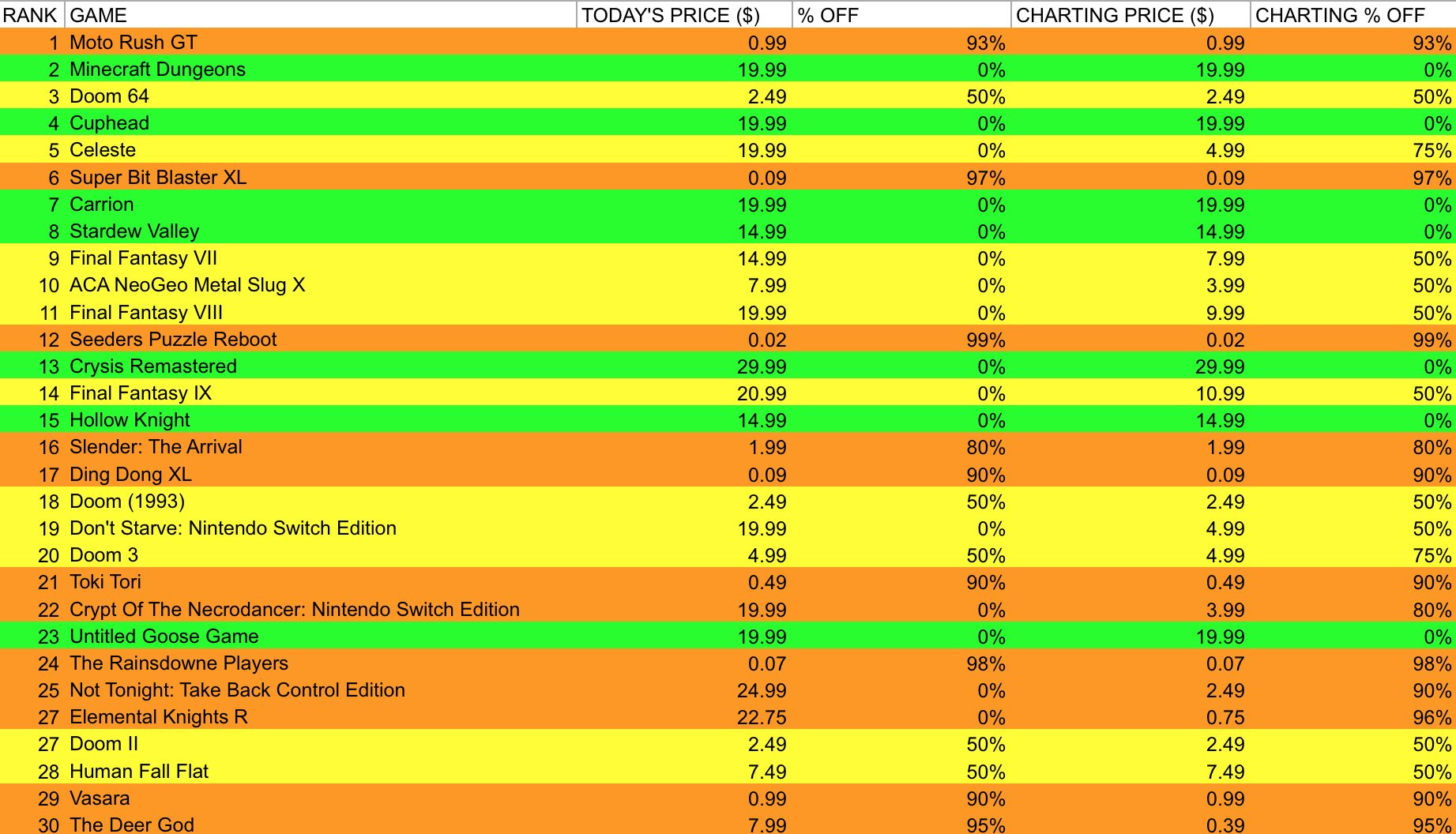
Perhaps I’ve been discussing this a little bit too much in recent weeks. But re: how discounting is affecting the Nintendo Switch eShop game charts, I made a color-coded diagram explaining the state of play.

Here my analysis, for August 9th 2020’s U.S. eShop digital chart (ranked by 14-day unit sales):

The eShop charts are complex. Games zoom up them if they’re X% off, but often stay there after the discount’s done. I listed the current price, but also the ‘charting price’, which was the discounted price that got the game in the charts in the first place. Green = full-price, yellow = 50-79% off, red = 80-99% off.

As I noted on Twitter: “Yes, this means that only 7 games in the eShop digital top 30 are actually selling at full price. So 23 made it into the charts by selling at 50% off or more, & 12 made it in by selling at 80% off or more.”

We’ve heard that your sales go up with a 40-50% discount, thanks to popular subReddits like Nintendo Switch Deals & various Nintendo fan blogs/social media. But they go down again, unless you start charting on the ‘deal’ or overall eShop charts in a particular country.

And you need to be a fairly well-known game (Final Fantasy, Doom, etc!) to chart at 40-50% off – which is why a lot of people are getting ‘extreme’ with discounting. Some of them don’t care about the money, and just want lots more people to play their game.

(Final weirdness: you really don’t sell many copies after the discount is done. So this leads to the super weird phenomenon of 30% of the eShop charts or more not selling copies while… actually in the charts. The mind boggles.)

Other Things…

There’s still plenty of other fish in the sea, velociraptors in the pen, baboons in the enclosure, and so on. So let’s get to the rest of the game discoverability news for this week:

  • I’m sure you all got the email already, but the Steam Game Festival (demos! of unreleased games!) is returning in October. Same general idea as last time, though submitted games “must launch between October 13, 2020, and May 1, 2021”, which is a similar time frame to the last demo showcase.

  • We just had a good ‘how we pitched our game to publishers’ Twitter thread, but here’s another great one, from the developers of Backbone. Once again – have a playable prototype, be direct, pointed, and specific about your asks, and reach out to as many relevant publishers as possible.

  • Following my updated sales/reviews stats, Richie at Dutch Game Garden has updated his Steam Guesstimator to include sales stats using the new ratios. Some of the estimating is a little granular on the Guesstimator, but this type of tool is super useful for thinking about real budgets & sales possibilities.

  • A couple of other GDC Summer things: Chris Zukowski summarized three of the most actionable talks, including Victoria Tran and Dana Trebella’s on game market & competitor research, which I really dug – they also have their slides online. More SWOT analysis for games, plz!

  • No More Robots head honcho Mike Rose (also featured in the GDC Summer piece) had a fairly viral Twitter thread this week about ‘Brutal Reasons Why Your Game Isn’t Going to Sell, and What You Can Potentially Do To Turn It Around’. Basically: make games swiftly, don’t presume you’ll hit big with your first one, look for uniqueness and beware crowded genres, & is your game genuinely visually attractive? (Read the whole thread for extra points and context!)

  • Just spotted that Apple Arcade’s upcoming games are getting a bit stronger, in my view – or at least, a bit less boutique indie. (It includes the new Samurai Jack game and Hello Games’ intriguing side project The Last Campfire, plus the next title from Oxenfree creator Night School.) So we’ll see where this goes longterm, right?

  • Platform rebranding thing! The free indie games/perks/Twitch subs formerly known as Twitch Prime is now being labeled as Prime Gaming, which makes sense if you know what their other offerings (Prime Video, etc) are called. I wonder what percentage of Twitch viewers with Prime use their free sub? And how the bundled goodies may evolve?

To end things out, here’s something I spotted this week:

Notably, Daniel Gubala pointed out in reply“EXOR Studios and Ultimate Games have both tied their prologues to a publisher sale – using the daily deal visibility was a great kick-start for the releases.” So that’s clever cross-promotion in action!

Posted on Leave a comment

Epic Games is now also suing Google over ‘anti-competitive’ Android policies

Fortnite dev Epic Games captured headlines yesterday by its coordinated effort to update Fortnite to bypass strict mobile payment rules, having Fortnite removed from Apple’s App Store as a result, and swiftly filing a lawsuit against Apple for anti-competitive behavior, all in a matter of hours.

Google, slower to the punch, also opted to remove Fortnite from its first-party Google Play Store last night for the same reasons as Apple.

Now, following its lawsuit against Apple and Google’s own removal of Fortnite, Epic has filed a similar lawsuit against Google (via The Verge), though there are some key differences between the two cases due to how each platform owner handles their mobile ecosystems.

Google, for one, does not have as tight of a grip on Android as Apple keeps on iOS, but Epic argues in its lawsuit that Google’s claims that Android is an open platform no longer ring true. The core complaints are the same: Epic is asking the court to “end Google’s unlawful monopolization and anti-competitive restraints” in markets for Android app distribution and payment processing for app-related purchases.

Google does allow other developers to host their own storefronts on Android–both Amazon and now Epic have launched apps that do just that–but Epic argues that Google eliminates “competition in the distribution of Android apps using myriad contractual and technical barriers.”

Epic’s own fraught history with Google Play provides a perfect example of what the lawsuit is taking issue with here. Rather than launch through Google’s first-party Google Play Store and forfeit 30 percent of its revenue to Google, Epic first launched its own launcher for Fortnite outside of the Play Store. But, as Epic vocally highlighted earlier this year, downloading any sort of app or launcher outside of the Play Store requires Android users to jump through a series of hoops that take the form of “scary, repetitive security pop-ups,” which put third-party apps at an immediate disadvantage according to an April 2020 statement from Epic.

Due to this alleged guise of openness, Epic’s lawsuit now says that “Google’s actions force app developers and consumers into Google’s own monopolized  ‘app store’—the Google Play Store. Google has thus installed itself as an unavoidable middleman for app developers who wish to reach Android users and vice versa.”

“If not for Google’s anti-competitive behavior, the Android ecosystem could live up to Google’s promise of open competition, providing Android users and developers with competing app stores that offer more innovation, significantly lower prices and a choice of payment processors,” continues the lawsuit. 

That crux of the argument, that more competition would benefit mobile users and developers alike, mirrors Epic’s lawsuit against Apple as well. In both lawsuits, Epic paints its attacks as altruistic rather than moves made out of its own self interest or pursuit of higher profits.

While an end to what Epic describes anti-competitive platform monopolies would allow Epic to fully launch its own competing storefront to both platforms on equal footing as first-party offerings and reap the financial benefits of its own (comparatively generous) revenue share deals, Epic maintains that these lawsuits are about the principle of the matter and, as such, the company isn’t asking the court for monetary compensation in either case, only that Google and Apple be made to embrace some healthy competition.

Posted on Leave a comment

Blog: Game composers and the importance of themes – Part 3

The following blog post, unless otherwise noted, was written by a member of Gamasutra’s community.
The thoughts and opinions expressed are those of the writer and not Gamasutra or its parent company.


This is a photo of composer Winifred Phillips in her production studio at Generations Productions. Phillips is known for her music for several well known games and game franchises, including LittleBigPlanet, God of War, Total War, Assassin's Creed, and The Sims.

By Winifred Phillips | Contact | Follow

Hi!  I’m video game composer Winifred Phillips, and welcome to the third installment of my five article series based on the presentation I gave at this year’s online Game Developers Conference that took place this past March.  My talk was entitled “From Assassin’s Creed to The Dark Eye: The Importance of Themes” (I’ve included the official description of my talk at the end of this article).  In my presentation, I discussed the music I composed for several video game projects, including Assassin’s Creed Liberation (Ubisoft), God of War (Sony Interactive America), LittleBigPlanet (Sony Interactive Europe), Homefront: The Revolution (Deep Silver), Speed Racer (Warner Bros Interactive), Spore Hero (Electronic Arts), and The Dark Eye: Book of Heroes (Wild River).

In the previous article, we took a look at how thematic material was employed in subtle ways within two of my video game projects – Assassin’s Creed Liberation and Homefront: The Revolution.  We considered how repetition can reinforce the significance of musical themes, particularly when they are associated with specific narrative ideas, and we talked about how repetition can work to make musical themes memorable and meaningful.  But we all know that repetition can get stale if we don’t approach it creatively.  So that brings us now to the topic of variation – how to keep themes feeling fresh.

Variation

An image excerpted from a presentation given in March 2020 at the GDC online conference. The talk was presented by video game composer Winifred Phillips.

A zoomed-in detail image from the presentation given by award-winning video game composer Winifred Phillips during her GDC 2020 talk in the first-ever online conference. Phillips was discussing her music from LittleBigPlanet for the PSVita.To date, I’ve worked on six LittleBigPlanet games (pictured above) – four in the main franchise and two DLC games.  While the music in LittleBigPlanet can be very melodic, the melodies don’t tend to be repeated from one level to another.  Because of this, the music has an episodic quality that suits LittleBigPlanet’s episodic gameplay structure very well.  Sackboy moves from one world to another, and the music completely changes.

There are, however, a few exceptions to this rule, and it’s a good example of theme and variation in the LittleBigPlanet universe.  In LittleBigPlanet Vita, developed by Tarsier Studios for Sony Computer Entertainment Europe, Sackboy explores a world called the “Land of Odd” – which includes Marianne’s garden of living puppets and clockworks.  The music I composed for this level included a melody featuring the sound of clockworks and a solo ingénue voice.  Later on in the game, that same melody returns during a boat race – except now it’s twice as zany and carried by a hyper trumpet. Here’s what that was like:

[embedded content]

While repeating melodies are few in the LittleBigPlanet franchise, they definitely stand out and get noticed, especially when they’re expressed in two dramatically different arrangements.  Not all projects will offer the chance to introduce such extreme variation.  It’s an example of how far the variation technique can go.  And when variation isn’t enough and we need to go further, we can break our themes apart and use fragments of them instead of the whole.

Fragmentation

Depiction of the official logo from the Spore Hero video game from Electronic Arts, as included in the article by Winifred Phillips (video game composer).The music I composed for the video game Spore Hero was very thematic, including lots of repeating melodies.  One of the most important of these melodies figured prominently in the main theme, and was a pretty long melody that took awhile to fully state.  So it was a puzzle, trying to figure out how to make that melody recur in the game.  When it wasn’t possible to present it in its entirety, I used it as a highly-recognizable fragment consisting of five notes:

This five-note fragment became extremely useful in Spore Hero.  Here it is in the game’s opening menu:

[embedded content]

And here it is in the character creation menu:

[embedded content]

Likewise, here is that five note fragment as it appeared in the game’s most important and frequently-used stinger:

[embedded content]

Finally, here’s a little fun fact – the Spore Hero theme gets pretty heroic towards the end of the game – and this version of the theme got licensed from the publisher and used in a trailer for Avengers Endgame, the highest grossing movie of all time. So here’s a look at that:

[embedded content]

Just goes to show that a flexible theme can be used in a lot of different ways, especially when we break it into fragments.

Conclusion

So now we’ve explored how variation and fragmentation can add utility to our themes. In the next article in this series, we’ll take a look at how recurring themes can enhance different types of gameplay, and how a compelling narrative rationale for thematic recurrence can be a powerful tool for a game composer.  Until then, thanks for reading!


From Assassin’s Creed to The Dark Eye: The Importance of Themes

An image depicting the official logos of the game projects included in the GDC 2020 presentation, "From Assassin's Creed to The Dark Eye: The Importance of Themes." This presentation was delivered by video game composer Winifred Phillips during the GDC 2020 online conference in March.

(Game Developers Conference Session Description)

Through an exploration of her work composing music for games such as Assassin’s Creed Liberation, God of War, LittleBigPlanet and the upcoming RPG The Dark Eye: Book of Heroes, composer Winifred Phillips will examine the potential of thematic music to enable a game to stand out as special and unique.

By employing musical themes, a composer can infuse a game with a strong sense of character and originality.

According to research, music heard during activities is remembered vividly. Coupling this with the innately memorable nature of themes allows a game composer to create an indelible musical signature for any game. This talk will examine composition techniques that extend the life and utility of themes. Variation, development, figures, fragmentation, and motifs will be explored, along with examples of themes in combat, menus, cutscenes, and stingers. Finally, dynamic music construction will be considered, including workarounds to enable effective themes within interactive systems.

Takeaway

Using examples from several games, Phillips will discuss specific composition techniques designed to enhance the utility of thematic content. Attendees will learn how themes may be incorporated into specific game music asset types. Also included in the discussion: composition adjustments required by interactive music constructs.

Intended Audience

This session will present inspirational ideas for composers seeking to create distinctive musical signatures for their game projects. Discussion of thematic use within different types of game music assets may be helpful for audio developers engaged in preparing music design documents. The talk will be approachable for all levels.


Popular game music composer Winifred Phillips works in her music production studio.Popular music from composer Winifred Phillips’ award-winning Assassin’s Creed Liberation score is currently featured as a part of the Assassin’s Creed Symphony World Tour, which kicked off in 2019 in Paris with performances by a top 80-piece orchestra and choir. As an accomplished video game composer, Phillips is best known for composing music for games in five of the most famous and popular franchises in gaming: Assassin’s Creed, God of War, Total War, The Sims, and LittleBigPlanet.  Phillips’ other notable projects include music for the triple-A first person shooter Homefront: The Revolution (Deep Silver), and numerous virtual reality games from such accomplished developers as Supermassive Games, High Voltage Software, and Armature Studio.   She is the author of the award-winning bestseller A COMPOSER’S GUIDE TO GAME MUSIC, published by the MIT Press. As the foremost authority on music for interactive entertainment, Winifred Phillips has given lectures at the Library of Congress in Washington DC, the Society of Composers and Lyricists, the Game Developers Conference, the Audio Engineering Society, and many more. Phillips’ enthusiastic fans showered her with questions during a Reddit Ask-Me-Anything session that went viral, hit the Reddit front page, received 14.9 thousand upvotes, and became one of the most popular gaming AMAs ever hosted on Reddit. Follow her on Twitter @winphillips.    

Posted on Leave a comment

Former Assassin’s Creed Valhalla creative director fired after misconduct investigation

Ubisoft has fired former Assassin’s Creed Valhalla creative director Ashraf Ismail following an independent misconduct investigation. 

A company spokesperson confirmed the news in a short statement sent to Gamasutra, explaining that “as a result of investigations, Ashraf Ismail has been dismissed from Ubisoft and is no longer an employee.”

Ismail stepped down as Valhalla creative director in June after being accused of using his position to make inappropriate advances towards young Assassin’s Creed fans. 

He acknowledged the allegations on Twitter, where he explained he would be “stepping down from my beloved project to properly deal with the personal issues in my life. The lives of my family and my own are shattered. I am deeply sorry to everyone hurt in this.”

Ismail is just one of a number of high-profile Ubisoft employees facing accusations of misconduct, rating from sexual harassment to physical assault. 

Over the past two months, the company has terminated editorial vice presidents Tommy Francois and Maxime Beland over misconduct allegations, while other execs including Serge Hascoet, Yannis Mallat, and Cecile Cornet all resigned for either perpetrating or enabling professional misconduct. 

As we conducted our own investigation into the matter, a number of former and current employees spoke of how Ubisoft enabled a culture of abusive and control. Our most recent report, published earlier today, revealed new allegations against senior figures at the company

Ubisoft, for its part, has promised to address that toxicity. The Assassin’s Creed maker recently outlined a five pronged action plan to begin the culture shift, which includes overhauling divisions like the HR and editorial department, appointing a head of diversity and inclusion, and working with outside consultants to investigate allegations. 

Ubisoft chief exec Yves Guillemot has also acknowledged the need for change, and wrote an email to employees at the beginning of June entitled “change starts today.”