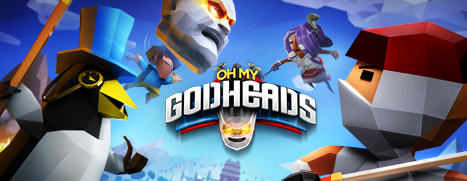
Oh My Godheads is Now Available on Steam and is 10% off!*
Sprint headlong into a multiplayer world of fast and frenetic, Capture-the-Head, mayhem. Beware the heads, they have a tendency to kill those around them!
General game developing news and updates.

Oh My Godheads is Now Available on Steam and is 10% off!*
Sprint headlong into a multiplayer world of fast and frenetic, Capture-the-Head, mayhem. Beware the heads, they have a tendency to kill those around them!


© 2018 Valve Corporation. All rights reserved. All trademarks are property of their respective owners in the US and other countries.
View mobile website

To kick off Computer Science Education Week, Google Doodle has featured its first kid-focused coding doodle in collaboration with Google Blockly and MIT Scratch. Blockly and Scratch are visual block programming languages used to teach computer science concepts to kids and encourage the next generation of programmers.
The interactive doodle revolves around a basic educational game (Coding for Carrots) where children program a rabbit across 6 levels by snapping together visual coding blocks based on the language Scratch.
In a Google blog post Director of Communications at Scratch Champika Fernando recalls her time using Logo, the first programming language designed for kids.
It was developed by Seymour Papert and researchers at MIT who saw the value in teaching children about math and science. Like Logo, Scratch was developed at MIT and builds on Papert’s early ideas about kids and computers.

Quality matchmaking and ranking systems have become a staple for competitive multiplayer games, especially with the rise of professional online gaming. How do designers put players into matches that are fun, but also reflect their skill level?
In this 2016 GDC session, Activision’s Josh Menke covers his personal design philosophies, such as considering your audience when creating interactive experiences, and stresses the importance of communicating with multiplayer system designers.
He also expands upon how skill, matchmaking, and ranking systems are all different but related, highlighting the “what is it” and “why?” of each facet.
Devs who work in systems design may appreciate the fact that you can now go back and watch Menke’s talk completely free via the official GDC Vault YouTube channel!
In addition to this presentation, the GDC Vault and its new YouTube channel offers numerous other free videos, audio recordings, and slides from many of the recent Game Developers Conference events, and the service offers even more members-only content for GDC Vault subscribers.
Those who purchased All Access passes to recent events like GDC, GDC Europe, and GDC Next already have full access to GDC Vault, and interested parties can apply for the individual subscription via a GDC Vault subscription page. Group subscriptions are also available: game-related schools and development studios who sign up for GDC Vault Studio Subscriptions can receive access for their entire office or company by contacting staff via the GDC Vault group subscription page. Finally, current subscribers with access issues can contact GDC Vault technical support.
Gamasutra and GDC are sibling organizations under parent UBM Americas

Creators of Star Control Fred Ford and Paul Reiche III have made a statement claiming they are in “legal conflict” with Stardock, accusing the game and software development company of publishing their earlier games without permission.
Stardock acquired Atari’s rights for the Star Control IP at a bankruptcy auction back in 2013, although Ford and Reiche say that “Atari’s rights to publish our earlier games terminated over a decade before the auction and we contend that Stardock has zero rights to our games, including any code and other IP we created.”
President and CEO of Stardock Brad Wardell responded to the duo’s claim, saying “for the entirety of the time we have held the rights, they have been getting paid for those sales. If they had an objection to the games being sold this is something that could and should have been addressed before we were ever involved.”
The post by Wardell goes on to state that “many assets were transferred to us including the various publishing agreements to the Star Control franchise. The short version is that the classic IP is messy.”
In response to the accusations, digital distributor GOG.com has announced that it will remove Star Control 1, 2, and 3 from its storefront on Tuesday, December 5th.

The following blog post, unless otherwise noted, was written by a member of Gamasutra’s community.
The thoughts and opinions expressed are those of the writer and not Gamasutra or its parent company.
[Video Game Deep Cuts is a weekly newsletter from curator/video game industry veteran Simon Carless, rounding up the best longread & standout articles & videos about games, every weekend.
This installment includes a podcast about Dream Daddies, a wonderful video profile of Million Onion Hotel creator Yoshiro Kimura, and lots more.
Still kicking it here in the UK, working hard on updating the GDC 2018 schedule with lots of excellent new talks, and thinking hard about Mike Rose’s Tweet this week: ‘The problem with there being *so many* game sales now, is that when I see a game on sale that I want, I’ve started thinking “eh, it’ll be even cheaper in a month”. Our industry is careering towards a crash.’
As you guys may know, I’m working with Mike (as an advisor/investor) on the publisher No More Robots, and the Steam Early Access version of our first published game, Descenders is due early in 2018. And honestly, the market has rarely been scarier for people launching games from scratch – even people who super-know what’s up like Mike.
But if you can scale your dev/publishing expenses correctly for the size of of opportunity, I think things should still work out. We’ll see, huh? (I’ll tell you whether it does or not!)
Take care,
– Simon, curator.]
——————
Modern magic text adventure Thaumistry tries to balance puzzles and people (Emily Short / PC Gamer – ARTICLE)
“Thaumistry: In Charm’s Way is a rare thing—a new commercially released text adventure, available on Steam. The author, Bob Bates, wrote for Infocom and Legend Entertainment in the ’80s and early ’90s, and successfully Kickstarted Thaumistry early in 2017.”
Game Design Deep Dive: The Spinning Plates approach of Bomber Crew (Dave Miller / Gamasutra – ARTICLE)
“My name is Dave Miller; I’m a co-founder of Runner Duck Games, a two-person indie studio based in Brighton, UK. I handle the artwork, half the design and a tiny bit of programming. We’ve been going since the beginning of 2017, and have recently released our first title, Bomber Crew on PC.”
Wolfenstein II: The New Colossus (Spoilers) (Errant Signal / YouTube – VIDEO)
“Wolfenstein II: The New Colossus is a new videogame about shooting Nazis. It’s also got some other stuff on it’s mind. Also it’s got a cat’s head on the body of a monkey, so that’s cool.”
The 10 best video games of 2017 (Christopher Byrd & Michael Thomsen / Washington Post – ARTICLE)
“On the other hand, the rising costs of blockbuster video game development could result in a gathering of momentum for the microtransaction trend. It will be interesting to see how this plays out in 2018. This year was also chock full of exciting titles. Here are the games that we could not stop thinking about.”
Oral History: How Marvel’s Creative Head Helped Bring Nintendo To America (Jim McLauchlin / Wired – ARTICLE)
“But Joe Quesada found a way to get people to buy them. Lots of them. Yes, the guy whose name you may recognize because he’s now chief creative officer of Marvel Entertainment (he produces the Marvel TV shows, among other things) was once a clerk at FAO Schwarz in Manhattan who found himself in the rare position of being a Nintendo evangelist.”
Destiny & Horizon (Raycevik / YouTube – VIDEO)
“[SIMON’S NOTE: There’s also a comment update from Raycevik, following some of the Destiny 2 level-up complaints, which weren’t in the video: ‘It’s about expectations, and how they’re set by more than just marketing, but our own biases, desires, and ideas; Destiny 2 is only used here as it’s a personal and recent example for me.’]”
A Last Airbender writer and Uncharted director are building a new game and show (Joseph Knoop / Polygon – ARTICLE)
“For Aaron Ehasz, Saturday mornings as an 11-year-old were defined by the mystical worlds of action heroes and giant robots, and few captured that sense of awe more than 1985’s Robotech. With a grand sense of scale and lengthy, emotional character arcs, the animated series stuck with him.”
Gamers won ‘Battlefront 2’ spat with EA, but in-game purchases will probably persist (Tracy Lien / LA Times – ARTICLE)
“If you’ve already paid $60 for a video game, haven’t you spent enough? That’s the question Electronic Arts, or EA, the maker of games including the Madden NFL series, FIFA and Battlefield, has to answer after angering customers who eagerly anticipated one of its biggest holiday releases, ‘Star Wars: Battlefront 2.'”
Tone Control 15: Leighton Gray (Steve Gaynor / Idle Thumbs – PODCAST)
“Kicking off Season 2 of Tone Control, Steve sits down with Leighton Gray, one of the main creative forces behind the daddy dating hit Dream Daddy! Steve discusses daddies, art school, Disneyland, the perils of sudden success, toilets, and daddies, with one of the most exciting up-and-coming creative figures in indie game development.”
The sunk cost fallacy: Devs describe how it almost destroyed them (Rich Moss / Gamasutra – ARTICLE)
“Sometimes game development goes wrong. It happens — technical problems emerge, designs can sound better on paper, early decisions can cause difficulties later on. It’s just a reality of the craft that you will have failures and mistakes during development. But what if you refuse to accept that a feature or project needs to be dropped or changed?”
When Games Like Marvel Heroes Shut Down, There Are Hardly Any Happy Endings (Matt Kim / USGamer – ARTICLE)
“It happened quickly. On November 15, Marvel announced that it was severing ties with Gazillion Entertainment, the developers behind the Action RPG Marvel Heroes. Then the company announced that servers for the game would be shutting down permanently at the end of the year before changing the closing date again to the end of November. And before anyone could process what was happening, Marvel Heroes was gone.”
The MMA Fighter Inspired by Video Game Cosplay (Waypoint / YouTube – VIDEO)
“Meet Angela “Overkill” Hill. Inspired by her favorite games and by cosplaying as some of her favorite characters, she found an unexpected way to redefine her identity as a fighter and make it back to the UFC after being cut.”
Board Games Were Indoctrination Tools for Christ, Then Capitalism (Robert Rath / Waypoint – ARTICLE)
“It’s 1843, and you twirl the spinner to find your fate. Will you succeed through industry, temperance, and chastity? Or will you wallow in drunkenness, get sent to the whipping post for breaking the sabbath, or live an almost perfect life, only to be undone by ingratitude?”
In-Game Purchases Poison The Well (Kirk Hamilton / Kotaku – ARTICLE)
“Video games will always manipulate us. Each challenge and scenario in a game has been carefully engineered to make us react a certain way. Most of the time, that’s what we sign up for. But the moment real money enters the equation, something changes.”
The Polybius Conspiracy’s Story of an Arcade Urban Legend Is Twisty Fun. It’s Also Fake. (Jacob Brogan / Slate – ARTICLE)
“Bobby’s story sits at the heart of The Polybius Conspiracy, a compulsively listenable serialized podcast by Jon Frechette and Todd Luoto that premiered in October from Radiotopia’s Showcase. As the series proceeds, the producers try to evaluate his claims, struggling to determine whether there’s any truth to his horrifying narrative.”
toco toco – Yoshiro Kimura, Game Creator (toco toco TV / YouTube – ARTICLE)
“Yoshiro Kimura is a game creator now turned indie, known for his work on moon, Chulip, Rule of Rose and more recently Dandy Dungeon and Million Onion Hotel. In this episode, Kimura will tell us about his career, a lifelong journey marked by many twists, companies and travels overseas.”
Data and Insights from a Month on Steam (Josh Ge / Gamasutra Blogs – ARTICLE)
“So last month Cogmind “launched” … for the second time 😛 It’s now on Steam EA and doing fairly well. Not like indie smash hit amazingly well, but that’s a given considering it’s way too niche for that kind of attention. Still, the relatively unexciting screenshots and two-year-old alpha trailer are apparently sufficient to attract the type of player who will enjoy Cogmind, and that’s all that really matters.”
Why do indie developers sign with publishers? (Alex Wiltshire / PC Gamer – ARTICLE)
“”Indie dev is a minefield now,” says Paul Kilduff-Taylor, co-founder of Mode 7 Games, the indie developer behind the Frozen Synapse series. “To have a chance at a good level of success, you basically have to nail everything. That’s a really tall order, so devs are simply looking to stack the odds in their favour.””
The Gunsmiths: developing the slow-mo satisfaction of Sniper Elite 4’s longshots (Kirk McKeand / PCGamesN – ARTICLE)
“This is The Gunsmiths, a PCGamesN series about videogames’ favourite interaction: shooting people directly in the face. There is no shortage of great games where gunplay is the main draw, so we wanted to dig down into these games’ inner workings… For our second feature in the series, it’s the slow-mo satisfaction of Sniper Elite 4.”
The 2017 Experimental Gameplay Workshop (GDC / YouTube – VIDEO)
“In this 2017 GDC workshop, Matt Boch, Jonas Bohatsch, Josef Wiesner, Pauline Marliere, Hamish Todd, John Polson, Isaac Cohen, Josh Lee, Jenn Sandercock, Steven Smith, Mark Laframboise, Tim Garbos, Robin Hunicke, Kasson Crooker, Anita Tung, Bastien Gorissen, Aaron Weingarten, Tobiah Zarlez, Ian Thomson, Guillaume Cerdeira, AP Thomson, Bennett Foddy, Angelo Yazar and Daniel Benmergui showcase a selection of surprising and intriguing prototypes made by innovation-minded game developers from all over the world.”
Developers share their most memorable dirty coding tricks (Brandon Sheffield / Gamasutra – ARTICLE)
“We’ve gathered unusual solutions to unusual problems from across the industry. Those who submitted may not all be proud of these “fixes,” but perhaps they should be. They got the game out the door, they didn’t break anything, and more importantly, nobody noticed. At least… not until now.”
——————
[REMINDER: you can sign up to receive this newsletter every weekend at tinyletter.com/vgdeepcuts – we crosspost to Gamasutra later on Sunday, but get it first via newsletter! Story tips and comments can be emailed to vgdeepcuts@simoncarless.com. MINI-DISCLOSURE: Simon is one of the organizers of GDC and Gamasutra & an advisor to indie publisher No More Robots, so you may sometimes see links from those entities in his picks. Or not!]

“You can’t ‘solve’ a 15-year-old on the internet hating you. It’s just not a thing you can do.”
– Dream Daddy co-creator Leighton Gray, reflecting on how to deal with the anxieties of releasing a game people are passionate about.
After helping ship Tacoma, Fullbright cofounder Steve Gaynor has started a new season of his game dev interview podcast Tone Control by publishing his recent chat with Dream Daddy co-creator Leighton Gray.
The conversation (recorded this summer during the IndieCade Festival in Los Angeles) is an entertaining listen that helps shed some light on how Dream Daddy came to be, how Gray got into games, and what it’s been like for her to see her first publicly-released game achieve some measure of high-profile success.
“I’m very anxious, I don’t like confrontation, and for a while a lot of people would yell at me on the Internet,” said Gray, explaining that she [along with Dream Daddy co-creator Vernon Shaw] was caught off-balance by her transition into being something of a public figure. “Not internalizing all of that is really difficult.”
She went on to suggest this sort of thing happens to a lot of devs (“it’s a really common thing”) and lamented that more folks in the game industry don’t openly talk about it. Together, she and Gaynor explore the notion that an instinctual drive to “solve” problems can be helpful during game development, but incredibly stressful after you’ve shipped a game and have to deal with your creative work being out in public.
“In the wake of this game, I have realized a lot about myself, and that has been a big part of it,” said Gray. “This experience has been really enlightening. I think [making games is] kind of what I want to do. I thought I wanted to be an illustrator, and I think I do, but I’m way more passionate about games. And making games.”
She and Gaynor go into much deeper detail in the full episode, which is well worth your time. In addition to specific stories about the making of Dream Daddy, there’s a really good chat about metamodernism and its expression through games that was too big to quote but too good to miss.

As you know, some of us aboard the good ship Gamasutra have an affinity for giant robots. We also love tabletop games, and of course, we are fascinated and compelled by video games.
Earlier today on the Gamasutra Twitch channel we were lucky enough to be joined by game director Mike McCain, a man who could satisfy all three of our primal needs, since he’s working on Harebrained Schemes’ Battletech as we speak.
As it turns out, our conversation with McCain also steered away from those areas, and wandered through what life is like for one of the successful Kickstarter-driven indie studios these days.
It was a full and illuminating conversation about everything from the history of Battletech to the nuance of fog of war. You can watch it up above, or if you’re rolling into battle for House Steiner as we speak, here are a few quick takeaways for you down below.
Balancing mechanics from the tabletop game
When pulling mechanics from the tabletop game to adapt to the new video game, McCain says it was more important to think about ‘behaviors’ than ‘rules,’ such as heat management, mech weight, and the melee system.
Since mechs are a “collection of parts that contribute to their performance,” McCain says the development team has been focusing on adapting those interconnected systems into the game’s combat rather than literal rulesets.
Fog of war has changed (and helps unit variety happen)
According to McCain, one of the reasons to keep fog of war in the game (something not necessarily seen in the tabletop game), was to help give light mechs (faster units that have less armor and weaponry) a sense of purpose in the game. In earlier versions of the game, McCain says combat turned into a race to roll out the heaviest mechs possible, without much regard for the lighter variations.
Since light mechs come with their own abilities like the scanning function seen in our playthrough, they’re able to range ahead of the larger units and encourage players to mix up their unit variety. So if you’re considering fog of war in your game, maybe start thinking how you can use it to drive what units the player uses to counter it.
Battletech is partially competing with Shadowrun
When queried about how he feels about game discoverability in 2017, McCain sarcastically commented “yeah, I’m a bit worried.” While not claiming that the sky is falling, McCain acknowledged that part of the challenge for a PC development company like Harebrained Schemes is that they’re partly competing with their own existing library.
As he described it, when players are seeking new games, they’re not only grappling with the array of new releases, they’re also looking at their Steam backlog and regular sales for games like Shadowrun, which Harebrained released back in 2013. That means when Battletech hits (digital) store shelves, the studio’s prior output may be partly a bane on its new game’s release (while also being a boon, since it’s brought them financing and a fanbase willing to follow them to new games).
In any case, McCain says he thinks Battletech will do well with those who love turn-based strategy games, but his insight that you may be your own competition sometimes is a thought worth heeding if you’re releasing on Steam anytime soon.
For more developer interviews, editor roundtables and gameplay commentary, be sure to follow the Gamasutra Twitch channel.

Over the course of 12 months of live operations, N3twork’s free-to-play mobile game Legendary: Game of Heroes reportedly grew both its engagement and monetization through regular feature updates and a strong focus on live operations.
That steady growth, according to N3twork’s Ethan Levy at GDC 2017, was due to the company’s diligent, metrics-driven development style.
In his talk Levy went on to share the top 5 lessons learned through the first year of Legendary‘s live operations phase, offering fellow F2P game devs some best-practices to follow and pitfalls to avoid when designing and operating their games.
Devs who work in the F2P game space may appreciate the fact that you can now go back and watch Levy’s talk completely free via the official GDC Vault YouTube channel!
In addition to this presentation, the GDC Vault and its new YouTube channel offers numerous other free videos, audio recordings, and slides from many of the recent Game Developers Conference events, and the service offers even more members-only content for GDC Vault subscribers.
Those who purchased All Access passes to recent events like GDC, GDC Europe, and GDC Next already have full access to GDC Vault, and interested parties can apply for the individual subscription via a GDC Vault subscription page. Group subscriptions are also available: game-related schools and development studios who sign up for GDC Vault Studio Subscriptions can receive access for their entire office or company by contacting staff via the GDC Vault group subscription page. Finally, current subscribers with access issues can contact GDC Vault technical support.
Gamasutra and GDC are sibling organizations under parent UBM Americas

The Gamasutra Job Board is the most diverse, active and established board of its kind for the video game industry!
Here is just one of the many, many positions being advertised right now.
Location: Seattle, Washington
Our team at Stoic, 4-time BAFTA nominated indie video game company, is seeking a Game Engine Programmer for development of Banner Saga and our next projects to join us in bustling downtown Seattle.
As Game Tools Programmer, you will support and facilitate art and design by improving their tools. The Banner Saga is built on a custom set of content tools that will be maintained, expanded, and improved for some time. You will also be essential to crafting new tools for Stoic’s next generation of games.
You will use your ability to understand the design of the game and extrapolate that into a vision of the most effective methods for our creative team to implement their ideas. Together we will discover areas for improvement and iterate on the tools to make them better and better. We encourage the use of validated UX methodologies to establish what our best possible outcome can be, and work toward the goal of maintaining a high quality standard.
You will collaborate with a diverse range of programmers, artists, designers, and writers and use your interpersonal skills to help everyone function at their highest potential by providing excellent tools. Together we will continually look for training opportunities to ensure that the tools are being used to the best effect.
We have built our success on aspiring to the highest quality possible, using our skills and attention to detail to their best effect. Will your unique perspectives and skills help our studio reach the next level of success?
Role and Responsibilities
You will participate in the game design process from inception to completion, providing feedback and input, and establishing a deep personal understanding and investment in the games. You will approach the tools design by imagining the best possible UX and work with project managers to estimate and prioritize the work required.
You will accomplish deep learning of our existing tools, both through personal use, discussion with content developers, and direct observation of content developer workflow. Your knowledge in this area will allow you to make high value improvements to the existing tools and keep production flowing smoothly.
Your understanding of these game systems and tools will enable you to address existing problems and shortcomings, and to build new features as necessary. Together we will craft automation for asset pipelines, content creation, and tool delivery.
Qualifications
You have worked on a variety of different tools and user interface projects, video game related or otherwise, and you have participated on multiple video game projects specifically. You take personal pride in your passion for user experience optimization, and are continually learning and growing in your field.
You are capable in several programming languages, technologies, techniques, and environments. You have an empathetic and scientific approach to understanding how people use your tools, and how they want to get their work done, both user-focused and motivated by data. You use well-established methods to handle technological challenges, such as source control, continuous integration, unit testing, and automation.
Your approach to supporting content developers is generous and enthusiastic in your desire to facilitate their work and vision. We value the effort that goes into using technology to streamline the creative workflow, do you?
We want to enhance our team with a Tools Programmer who shares our vision and can be a catalyst for growth and improvement. Do you want to be this person?
We are an equal opportunity employer and value diversity at our company. We do not discriminate on the basis of race, religion, color, national origin, gender, sexual orientation, age, marital status, veteran status, or disability status.
Interested? Apply now.
Whether you’re just starting out, looking for something new, or just seeing what’s out there, the Gamasutra Job Board is the place where game developers move ahead in their careers.
Gamasutra’s Job Board is the most diverse, most active, and most established board of its kind in the video game industry, serving companies of all sizes, from indie to triple-A.
Looking for a new job? Get started here. Are you a recruiter looking for talent? Post jobs here.