Posted on Leave a comment

Get a job: Rabbit is hiring a Lead Game Designer

The Gamasutra Job Board is the most diverse, active and established board of its kind for the video game industry!

Here is just one of the many, many positions being advertised right now.

Location: San Mateo, California

Rabbit is an incredibly innovative product, with unique a mission: To create the ultimate social mashup experience! We’re looking for an amazing game designer to a whole new game experience that is a mashup of fandom obsession, trivia, Animal Crossing, and socialization!

Must have a deep passion for fandom culture, whether sci-fi fantasy, games, anime, and/or K-pop. We have over a million monthly users who crave a new interactive experience based around this.

This is a contract role for a several month project. Ideally based in the Bay Area, but can be remote for the right candidate.

RESPONSIBILITIES

  • Work with the product team to conceptualize, wireframe, prototype and build a new game experience that is layered on top of a popular social experience
  • Define the game’s vision and game design documents
  • Design features which will increase user experience, engagement, and monetization
  • Develop systems and UI elements around the economy to guide the player’s learning process
  • Perform & analyze user testing and recommend design solutions
  • Update game variables based on collected data
  • Conceptualize, create and maintain detailed game design documentation throughout the project cycle
  • Stay up to date on the state of the industry, trends (new game genres, new game design methods, and emerging platforms)

REQUIREMENTS

  • 5+ years experience as a Game Designer in the game industry
  • Worked on at least two complete product cycles for games
  • Proven experience with designing game systems, economy, gameplay balancing
  • Strong experience in game design, level design, gameplay theory & story writing
  •  Previous experience working in an agile scrum environment
  •  Passionate game player with in-depth knowledge of mobile and PC games

ABOUT RABBIT  

Rabbit is reinventing how we connect with each other. Combining social media, watching videos live, and playing games together, we give millions of people the best way to share experiences together. To feel closer to the people you care about. To discover people who enjoy the same things as you. To truly connect.

Rabbit funded (Series B) by some of biggest VC’s in Silicon Valley and was founded by gaming industry luminaries who lead award-winning projects at Sony Online Entertainment, Konami, Acclaim, Sega, Bethesda Softworks. Our headquarters are located in San Mateo, CA (just a hop south of San Francisco), but our team is located around the world. And we’re hunting for Rabbits—creative, dedicated, inspired, fun people who are ready to make things happen. Join our small team and make a big impact, both in what you do and in the lives of our users around the world. Welcome to Rabbit.

Interested? Apply now.

Whether you’re just starting out, looking for something new, or just seeing what’s out there, the Gamasutra Job Board is the place where game developers move ahead in their careers.

Gamasutra’s Job Board is the most diverse, most active, and most established board of its kind in the video game industry, serving companies of all sizes, from indie to triple-A.

Looking for a new job? Get started here. Are you a recruiter looking for talent? Post jobs here.

Posted on Leave a comment

Hellblade: Senua’s Sacrifice passes 1 million sold

Newsbrief: Ninja Theory’s Hellblade: Senua’s Sacrifice has surpassed 1 million copies sold across all platforms, according to a tweet shared by the developer. The game itself first launched for PlayStation 4 and PC in August 2017 before arriving on Xbox One in April 2018. 

At least 500,000 of those sales fell within the first three months following release and the studio previously mentioned that the earlier milestone was also the moment where the game shattered internal expectations and became profitable for Ninja Theory.

Ninja Theory itself has seen its fair share of big changes since launching Hellblade last year. The studio was notably one of many studios to be revealed as Microsoft acquisitions during the company’s E3 press conference earlier this month alongside the likes of Undead Labs, Compulsion Games, and Playground Games. 

“[Microsoft] asked us what our goals and ambitions were as a studio in an ideal world, and so we said we wanted to free from the triple-A machine and make games focused on the experience, not around monetization,” noted Ninja Theory creative lead Tameem Antoniades in an earlier video discussing the studio’s acquisition.

“We want to take bigger creative risks, and creative genre-defining games without constant threat of annihilation. We want to make our own games our own way, and not be told what to make and how to make it, and above all, we want to protect our team, our culture, and our identity.”

Posted on Leave a comment

YouTube introduces new monetization methods for its creators

Two years after creators expressed concerns over being properly compensated, YouTube is finally rolling out new alternative payment methods including a $4.99 channel membership and features similar to Twitch’s subscription service including special emojis and subscriber badges. 

As reported by Polygon, YouTube creators who have more than 100,000 subscribers and belong to YouTube’s Partner Program can charge a monthly recurring fee of $4.99 that gives viewers the ability to display tier badges. 

This new channel subscription alternative is in response to demonetization concerns YouTube creators brought up a few years ago in regards to securing revenue.

 Rohit Dhawan, YouTube’s senior director of product management at YouTube, noted that this change has been in the works specifically to address monetization issues.

“I’ve been working on it for a long time,” Dhawan explained to Polygon. “We’ve been testing these features and they’ve reached a certain level of success, so it’s very much inspired by the fact that it was just a great opportunity to help creators make more money.”

YouTube will get a portion of the $4.99 subscription fee, gleaning 30 percent of revenue while leaving the remaining 70 percent to its creators. For comparison, Twitch streamers earn 50 percent from their $4.99 subscription fee.

According to YouTube’s website, creators will receive 70 percent of sponsorship revenue after local sales tax is deducted, with all transaction costs (including credit card fees) being covered by YouTube.

Posted on Leave a comment

Don’t Miss: Sonic the Hedgehog co-creator’s philosophy of game design

[The most recent issue of Game Developer magazine printed a truncated version of this interview with Namco Bandai Games America senior design director Hirokazu Yasuhara. Gamasutra is proud to present the unabridged version. Yasuhara has a great design philosophy which he espouses here, complete with his original notes and illustrations, alongside a history lesson on the Sonic series.]

Hirokazu Yasuhara is one of the great unsung heroes of game design. He is currently senior design director at Namco Bandai Games America, and before that he held the unassuming title “game designer” at Naughty Dog, having most recently shipped Uncharted: Drake’s Fortune — but his history is inexorably intertwined with the history of modern character game development.

Yasuhara was the chief level designer on the original Sonic the Hedgehog, as the third person to join that team after Yuji Naka and Naoto Ohshima, and played a key role in the fleshing out of that seminal title, as well as a number of its sequels. He was responsible for the first 3D Sonic game, Sonic R, and was involved in the Jak series for Naughty Dog since the first sequel.

In this extensive interview, Yasuhara outlines his carefully constructed theories of fun and game design, including the differences between American and Japanese audiences, with illustrated documents. After conducting this interview, I was convinced that he should write a book based on his theories. Until then, consider these words to be sketches — a preamble to that necessary work.

I heard that you still use graph paper for all your level designs and things like that. What is your process for designing at this point?

Hirokazu Yasuhara: Actually, I stopped using graph paper to make the level. [pointing out some paper materials] I use this to work out all the gimmicks [ie. the unique features to each level], but I threw some small, easy —

Can I take a picture?

HY: Actually, no. (laughs)

It’s so cute. I want that.

HY: So I come up with some ideas about events that are happening; how the player acts, you know, at each stage. What kind of results happen once you perform this or that gimmick in each level. For example, in a jungle stage, you would use…

So these are small bits of design concept, like moments that you could use? I see.

HY: Mm-hmm. So I come up with some ideas for the programmer to work with, and they decide what’s good and what’s impossible to implement, based on schedule or programming difficulty.

So it’s more high-concept design, and then they narrow it down?

HY: Yeah. So this is the idea for a section, and I make a picture or a scan of what kind of image I have going, add some simple comments, and make a document that I bring to the artists and programmers. These are all concepts. I make a lot of ideas and inserts. And this is what I just created. I don’t write the map by hand anymore; I use Illustrator instead to do the map. It has about five layers.

Do you think of ideas and then put down whatever comes to mind, and then is it you that shrinks it down to the actual design that it’ll be, or is it other designers?

HY: I shrink it down by myself, actually. It’s up to the schedule, so… (laughs) If the artists or programmers say “no”, then that’s the answer. So it’s kind of a mix. I always try to push a can-do attitude with them, you know? (laughs) For the programmer. But sometimes, you know…

How do your ideas come from these individual moments into the full art of game game design?

HY: So I always think about all the different elements of what makes something fun. This formula is made by a sociologist from France who did some thinking into what it is that makes something fun, or interesting, for people to experience. One of the things is competition. The next is happy coincidences; a gamble that pays off, that kind of thing. Following that is dizziness or exhilaration, and the final thing is imitating, or copying.

For example, let’s say we go to a theme park one day. There are two slides there: a regular metal slide, and one shaped like an elephant. Which one is more attractive to a child? It’ll usually be the one with the elephant, because the form of “imitation” that it represents is more interesting to the eye. That, in itself, is enough to make it fun.

So what happens when you put all of these factors together? Well, if your park’s trying to improve its business, then maybe it’d try to make the slide a longer or faster ride, or maybe make it bigger and shaped like a dinosaur so it’ll be more fun for the kids.

Maybe they’ll make it a dual slide so kids can compete with each other to get to the bottom faster — add a competitive element.

If they keep going with it, it’ll get big enough that it winds up becoming a log-flume ride or something — but there’s still more you can do, like maybe put wheels on the logs and make it look like a car.

It’s a continual process to make it more fun. So the more you think about the externals of something, the more grandiose it’ll wind up being. You’ll wind up with a roller coaster eventually — and then you’ll make it rotate or something, if you think it’ll improve business. That is one of my basic principles.

Posted on Leave a comment

Bluehole to acquire mobile dev Delusion Studio

Newsbrief: According to the South Korean news publication Korea Joongang Daily, PUBG Corp parent company Bluehole is set to acquire the mobile game developer Delusion Studio.

Also based out of South Korea, Delusion Studio is known for creating mobile games like Castle Burn and Guardian Stone. Though Korea Joongang Daily notes that Bluehole announced the acquisition plans earlier this week, the exact terms of the deal were not disclosed.

The acquisition itself comes as reports circulate that Tencent has been eyeing ways to increase its stake in Bluehole. The Chinese company is reportedly considering a $470 million investment that would bring its ownership of Bluehole up to 11.5 percent, making it the second largest Bluehole shareholder in the process. 

Posted on Leave a comment

Radiating outward to meet the wilderness: Avery Alder on her games

Naomi Clark’s introduction of tabletop game developer Avery Alder, for her Practice 2018 talk, was an effusion for her trade: “We see non-digital design as a great way to prototype and jam quickly, but there are also things you can do in a non-digital space that digital games have only just begun to catch up to,” she said, describing various communal and interpersonal dimensions of tabletop play, “like the collaboration between gamemasters and  emergent and collaborative storytelling that happens in these spaces.”

Alder, who is perhaps best known for the game Monsterhearts, spoke about her latest game, Dream Askew, through the lens of her past work including Monsterhearts, a paranormal romance game about messy teenage life; The Quiet Year, a conversational game about a post-apocalyptic community dealing with a good year after defeating a major threat; and Brave Sparrow, a solo LARP meant to be played amidst your daily life. The latter is a “pervasive game,” which asks the player to imagine they’re a sparrow, “to help you develop grace, and a sense of self.”

Wrapping up this development CV, she sums up the core themes of her work as “queerness, the apocalypse, relationships, self-doubt, and self-discovery.” All of these are combined in her latest game, a post-apocalyptic RPG entitled Dream Askew. 

Alder, who understood herself to be performing something of a didactic role for an audience that was less familiar with indie tabletop, sought first to situate her new game in the larger, recent history of tabletop. She identified five design trends in tabletop roleplaying games from the aughts: scene-based conflict resolution, pre-negotiated stakes, everything was made a trait, bespoke dice mechanics, and endgame mechanics. 

“Apocalypse World positioned the act of roleplaying as a conversation; we’re talking about what we’re doing to advance the story,” she said, arguing that Apocalypse World fundamentally responded to all these trends. Where mechanics were often constant and agnostic or orthogonal to the evolving story, Apocalypse World flipped that on its head, by Alder’s lights. Conversational story progressed the plot, and the mechanics were invoked by the story in a way that always produced clear story outcomes. 

Situational moves and partial success were always deeply tethered to the unique circumstances of everyone’s character and story. Moves facilitated more conversation and collective storytelling, by compelling hard choices and exacting costs. Alder was quick to note that some gamemasters had always played games this way, but for many others it was a “revelation” to enthrone story and really emphasize the RP in RPG. 

Ever the minimalist, with an eye to access, Alder critiqued her beloved Apocalypse World, however. Despite its pared-down, non-crunchy modality, the game still comes across as jargony and unduly complex. For veteran roleplayers, it may be intuitive. But for neophytes, it may still be unduly intimidating. The “arcane presentation” and “participation demands” imposed limits on people with only two hours to play. 

More and more, she wanted to create an accessible game that could be picked up and enjoyed by someone who’d never played an RPG before–digital or analog.

“Acronyms are the number one way to convince new players that they can’t do what you’re trying to get them to do,” she said, and while this got a laugh, she was only half joking.

The lessons she took from this, with her own Powered by the Apocalypse games, were to reduce the appearance of complexity, eliminate jargon, and the alter appearance of math. Even Apocalypse World’s simple 2d6 was removed in favor of a simpler token-exchange economy. But this wasn’t merely a process of taking things away: it was also about adding more emphasis on relationships, which Apocalypse World already did well, “but I was greedy and wanted more,” Alder joked.

She then pivoted to discussing the origin of a mod for Dream Askew, set in a shtetl in the 19th Century Russian Pale of Settlement, created by Benjamin Rosenbaum with Alder’s blessing. It was called Dream Apart. As the two discussed the development of the game, it helped her better critique her own game, refining mechanics and making them more elegant. One innovation, developed by Rosenbaum, cut back on logistics in Dream Askew. Instead of having mutually exclusive playbooks (for their character class and a larger setting element), a mechanic was developed to allow players to swap mid-play.

She also noted that her own work failed to live up to her own goals. Some command language like ‘explore themes of compulsion and estrangement,’ in a list of thematic recommendations for a particular class, were too vague and cerebral, according to feedback. “I might as well have told people ‘make deep and meaningful art,’” she said. Paring these down to brief, punchy ‘tips’ as opposed to ‘principles,’ helped her realize her goals.

Dream Askew and Dream Apart are now being Kickstarted and sold together. Alder noted the many similarities between the games, each, for instance, dealing with the theme of hope amidst hardship in a marginalized community. Alder also noted where the games were different. Rosenbaum’s has an extensive glossary of Jewish terminology to help situate the player in the distinct historical setting, while Alder eschewed that in service to her understanding of queerness, which is “elusive to definition.” The queer relationships found in her games are meant to be contingent and polyvocal, after all.

Alder and Rosenbaum played off both each other and off of larger works like Apocalypse World, which in turn was a reaction to even larger design trends in the tabletop world. This sort of relational design creates complex, even beautiful lineages of design, and as Alder put up a slide with art from Askew, Apart, and Apocalypse World on screen, it seemed to emphasize this fact. “Dream Askew took the child role to the parent of Apocalypse World,” she said, driving the metaphor home. “Benjamin’s coming up with cool ideas, I want to let them change and challenge my vision,” she said, describing the emerging collaboration between her and Rosenbaum.

In the Q&A, she talked a bit about a subtle but profoundly important issue: “learning to trust people,” she said, “has been really rewarding.” In this case, that meant letting people mod her games without asking for royalties, which, she said “wasn’t profitable anyway.” She felt “gross” asking other, mostly queer developers for money for the right to modify her game which was, itself, heavily inspired by Apocalypse World. She spoke movingly of feeling rewarded by giving it away, and meeting those developers later at conventions; they’d buy her coffee and update her on their progress. 

This, she said, felt much better to her and led to considerably more growth for everyone involved. As she put it when discussing design challenges in response to another question, there was a process of “radiating outward to meet the wilderness.”

Alder had a clear design goal–make a game anyone can pick up–and pursued it aggressively, whittling away the often lovable but impenetrable garnish of tabletop roleplaying. In the process, it served to surface the core of all tabletop roleplaying: the relationships between players, and between their characters. In the process, there was a lot to learn about trust between developers, and reaching out with an open hand. Sharing one’s work can be frightening, but, as was also made clear in Adriel Wallick’s talk, it’s a necessary step in one’s growth as a developer. What Alder added was simply this: if your work is to flourish, then even your sense of ownership might have to give way.

Posted on Leave a comment

Good and bad at all times: Adriel Wallick on jamming for a year

Adriel Wallick, the former satellite engineer turned game dev and jam organizer, kicked off Practice 2018 with a talk about the rapid project development inherent to jamming. In introducing her, Professor Clara Fernandez-Vera described Wallick as “a true adventurer,” praising the winding path that took her on a global journey — from Lockheed Martin to Harmonix and Rock Band Blitz, to being a full time indie and leading game jams.

During her talk, Wallick focused on the lessons learned from a yearlong exercise in making games, with the idea that she would teach herself game design through sheer force of repetition.

Back in 2014, at the urging of her partner, fellow developer Rami Ismail, she began to work on a game a week; the core idea was that there was merit in making a game and pushing it out of the nest to practice techniques and exercise your creativity, rather than refining a single game for a year or more.

The rules were simple. Release a game every week on Sunday, vary your ideas, and write a postmortem. The best way to learn the core competencies of game design, she believes, is to simply do it over and over — likening it to pottery techniques where repetition of skills leads to “going on autopilot.”

“It sounds super obvious but it’s amazing how not-obvious it is a lot of the time,” she explained.

Despite her commitment to the cause, Wallick noted that she didn’t turn any of her 52 games (which you can find here) into larger projects, and lamented the fact that she might’ve perpetuated crunch culture around herself during that intense year. “Every single game [I made during Game a Week] had all the checkboxes ticked off, but I’d never say any of them were truly finished. I never really learned how to finish a game,” she said, revealing that she only considers three games she ever worked on to be properly finished: Rock Band Blitz (pictured below), Candescent, and Press X to be Okay.

“You have to show people how to make a game for real, not just prototyping,” she observed, joking that she maybe should’ve tried “Polish and Production a Quarter.” Even if there was value in the intensity of repetition, drilling in techniques and strategies, it still lacked scope for, say, solving a design problem. “If I had an idea and it didn’t work, I threw it out.”

As with so much in this field, balance is essential, and that was a theme of this talk. Wallick regretted doing too much of one thing and not enough of its opposite, failing to quite hit that elusive happy medium. That was certainly true with the essential skill of scaling down one’s ambitions.

“The most immediate and quick lesson I learned is this: every game idea is too big. You need to pare down ideas to the smallest level,” she explained. This comes with its own challenge, however, as minimalism is its own art.


“The most immediate and quick lesson I learned is this: every game idea is too big. You need to pare down ideas to the smallest level.”

“I got really good at small game, abandon; small game, abandon. You don’t really practice making an actual game,” continued Wallick, observing that there’s a difference between a gimmick and a full game, and that the risk of paring down to a single mechanic meant the software became “a proof of concept for a mechanic with the conceit of a game around it.”

“Put out your work. It can be a piece of unplayable crap but it shows you’re doing something and learning,” she joked, as she talked about the earliest “unpolished garbage” she churned our during Game a Week, describing the first ten weeks as the absolute worst.

The most valuable process, she suggested, was opening herself up to criticism over those fifty-two weeks, where she became steadily more comfortable with soliciting and accepting critique, especially from other devs. This, she claimed, was the most valuable benefit of putting her games out into the world. It allowed her to get past the sense of her creations being “her babies” and embrace the collective process of learning.

“Even when you think you didn’t learn anything — you did,” she added, as she talked about the importance of both writing postmortems and re-reading them later down the line to remind yourself of lessons learned. Notably, there were six weeks where she didn’t make a game, yet still wrote postmortems about her ideas for that week.

That led to one of her most important revelations. “Think of how tired you are after one game jam, and multiply that by 52. Other than those six weeks I didn’t make a game, I was always working,” she recalled, echoing a familiar refrain from the industry.

Uniquely, this was a private experience, rather than attached to the company, but the artificial boundaries of Game a Week were all but designed to emulate crunch. “I worked on nights, I worked on weekends, I worked on birthdays, I missed hangouts with friends. I don’t know when I got out of that hole, but it was probably a year before I could work on anything of my own again.”

During the Q&A session she suggested that jam culture might be improved by a greater emphasis on those aspects of game design that jams’ rapidity might normally elide. “Polish Jam! Somebody should do that. You fix up an existing prototype. Or you take an old game from a graveyard of ideas and make a game out of that,” she suggested, in response to a question about what such an event would look like, though it only served to highlight the “weird adventurous journey” that Game a Week was.

“Game a Week was good and bad at all times,” she concluded, admitting that “you’re always your worst boss at all times” because you’re forcing yourself to work independently. Even so, the exercise presented an invaluable opportunity for Wallick to learn how she worked best — though, maybe it’s sensible to take a few breaks along the way.

Posted on Leave a comment

The Weekender: Ultimate Sales Edition

Welcome to the Weekender, your weekly look at the best new games, sales, and updates. We’ve got just a couple new games to discuss but a whole bunch of great game sales to help kick off summer in the Northern Hemisphere. 

Out Now

Evoland 2 (iOS Universal and now Android)

Evoland 2 arrived on iOS back in March and has now made it to Android country as well. It’s follows in the original game’s footsteps by taking players on a journey through the history of games with constantly evolving graphics and gameplay and a slew of history-of-gaming references. Like its predecessor, it combines elements of RPGs, platformers, action, fighting, adventure, puzzlers, and a whole lot of other genres. Evoland is clever in parts but the pacing is odd and I found myself wanting to get through certain sections faster, and spend longer in others. It made me want to go and play some of the games from yesteryear but didn’t necessarily make me want to play more of Evoland 2. If you are a fan of franchise Evoland 2 has a lot you’ll like and RPG super-fans will enjoy the many references and the one more jaunt through gaming history.

[embedded content]

Startup Grave (iOS Universal)

If you’re looking for a new solitaire card game on iOS Startup Grave says “pick me, pick me!” You play with a deck of 48 monster cards and must be kept in check and ultimately defeated. There’s a health bar for both you and the monsters and each card has a value that increases one and decreases the other. Your goal is to play cards by double tapping, which affects both bars, without either losing all or your life or maxing out the monster’s health. You can store up to two cards at a time, to get some breathing room, and every 8 cards you can take a favorable card into battle with an unfavorable one in an attempt to clear it for free. If you get through all 48 cards you win. It’s a simple and fun setup and works well to kill a few minutes here and there.

[embedded content]

Sales

Motorsport Manager Mobile 2 (iOS Universal and Android) $.99 (Review)

Like racing sims? If so, and you don’t own Motorsport Manager Mobile 2, now’s the time to rectify that. The game is just a buck on either store and is among the top options of the genre – which is why it features in our list of best sports management games.

Door Kickers (iOS Universal and Android): $.99 (Review)

SWAT-team simulator Door Kickers requires strong tactics and superior planning to succeed. Get it for a buck.

Codito Development Games (iOS Universal): $.99

Codito Development’s catalog of digital board games are all on sale for just a buck on iOS.

Asmodee Digital Games (iOS Universal and Android): $1.99

Not to be outdone, several Asmodee Digital games are also on sale. Links are iOS Only.

Teeny Titans (iOS Universal): $1.99

One of the best games of 2016, Teeny Titans is based on the Cartoon Network’s Teen Titans GO and pokes fun at the Pokémon craze while adopting it’s most compelling features. You collect teen-sized heroes and villains and take them into 3-on-3 battles in a very meta figure-battling craze that is sweeping a city. You can explore, complete quests, buy new figures at stores throughout the city, and upgrade your figures as you go. The battles themselves are quick, real-time, and tactical and rely heavily on how well their powers work together, as well as making use of class advantages over your opponent. There’s a new game coming out soon, Teen Titans GO! Figure, in support of a movie and the original is having a rare sale. Teeny Titans is well worth it at the normal price, and definitely worth picking up on sale.

[embedded content]

FTL: Faster than Light (iPad): $1.99 (Review)

FTL is an App Store classic and on a bunch of ‘best of’ lists across the internet (including ours). It’s also just $2, down from $10, its cheapest ever price on iOS.

Sproggiwood (iOS Universal  and Android): $1.99

Speaking of best of lists, whenever the best roguelike games for mobile comes up inevitably Sproggiwood appears somewhere in the pack. In Sproggiwood you play as a simple island farmer who is lured through a magical portal by a talking sheep. Never trust talking sheep. The portal is a trap created by the Sproggi, a forest spirt who to tame the forests for him. The gameplay is pretty classic roguelike RPG with different character classes, all kinds of loot, and random dungeon delves. You can pick up Sproggiwood for $2 on either store.

Bottom of the 9th (iOS Universal and Android): $1.99 on iOS

Handelabra is getting in on the summer sale action with its excellent baseball card-and-dice game Bottom of the 9th on sale for two bucks…

[embedded content]

Sentinels of the Multiverse (iOS Universal and Android): $2.99 on iOS (Review)

…and it’s equally excellent hero-versus-villains card game Sentinels of the Multiverse for $3.

Tiny Bubbles (iOS Universal and Android): $3.99

Who doesn’t like popping bubbles? Nobody, that’s who. Tiny Bubbles brings this universal joy to mobile with a bunch of levels of bubble-popping puzzle games. It’s a buck off now and a good addition to any mobile puzzle gamers device.

Updates

Templar Battleforce Elite (iOS Universal and Android) (Review)

Turn-based tactics classic Templar Battleforce is constantly updated and re-balanced and the Trese Brothers are known for supporting their games post release. The latest update improves the game’s scoring system to keep separate records for levels beaten in the various game modes and also lets you compare scores on the same level over multiple attempts. There are also a bunch of balancing changes.

Sir Questionnaire (iOS Universal and Android) (Review)

The much newer Sir Questionnaire is a roguelike with a lot to do, and a lot of updates already made. The latest adds three new gate types: library room, treasure room, and knights room. There are also a bunch of other updates and improvements as well as a wiki. 

Seen anything else you liked? Played any of the above? Let us know in the comments!

Posted on Leave a comment

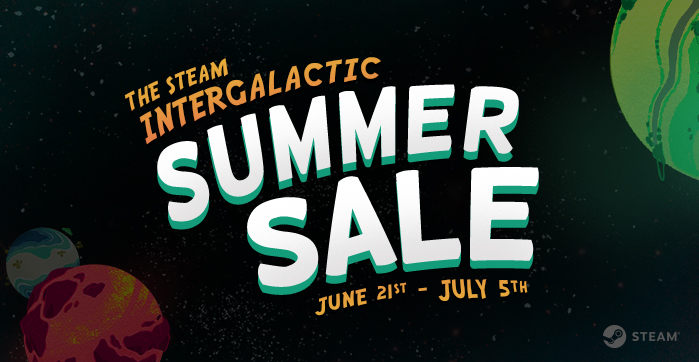
Steam Intergalactic Summer Sale Day 2

The Steam Intergalactic Summer Sale continues! For the next thirteen days, take advantage of huge savings throughout our store on over ten thousand games. You can also help unlock free games by playing our Summer Saliens Game.

Today’s Featured Deals include:

Tom Clancy’s The Division – 80% off
Prey – 50% off
Warhammer: Vermintide 2 – 34% off
Planet Coaster – 55% off
Just Cause 3 – 85% off
Sudden Strike 4 – 65% off
Undertale – 50% off
Marvel’s Guardians of the Galaxy: The Telltale Series – 50% off
and many more

Along with the sale is the Summer Saliens Game. Team up with other Saliens to fight The Duldrumz on different planets and free the abducted games. Gain XP as you battle, level up, unlock new abilities, and win cosmetic items to deck out your Salien. Plus, get Summer Sale Trading Cards just for playing.

Choose to battle on a planet that piques your interest and you’ll automatically be entered for a chance to win one of its rewards when it’s conquered. The longer your Salien spends on a planet the higher your chances of winning! The groups with the most tiles when a planet is taken will get to plant their flag as conquerors, undoubtedly gaining Saliverse-wide fame in the process.

The Steam Intergalactic Summer Sale will run until 10 AM Pacific, July 5th. Complete information can be found HERE.

Posted on Leave a comment

Try before you buy with these free game demos!

06.22.18

Nintendo Switch

Mario Tennis Aces smashes onto the court!

Mario and his friends are ready to take center court in the Mario Tennis Aces game! Unleash a volley of fun by challenging your friends and family locally or by hopping online to take on the world. In Adventure mode, experience a new flavor of tennis gameplay, with a variety of missions, boss battles and more. Intense matches await! Read More

Mario and his friends are ready to take center court in the Mario Tennis Aces game! Unleash a volley of fun by challenging your friends and family locally or by hopping online to take on the world. In Adventure mode, experience a new flavor of tennis gameplay, with a variety of missions, boss battles and more. Intense matches await! Read More