Posted on Leave a comment

Welcome the new school year with some brain-teasing games

08.31.18

General

Nintendo Power Podcast episode 8

In Episode 8, host Chris Slate (previously editor-in-chief of the Nintendo Power magazine) is joined by Toph, a competitive Super Smash Bros.TM player and commentator, and JC Rodrigo from Nintendo Treehouse to discuss recent Super Smash Bros. Ultimate announcements, the competitive scene and their favorite fighting games. Read More

In Episode 8, host Chris Slate (previously editor-in-chief of the Nintendo Power magazine) is joined by Toph, a competitive Super Smash Bros.TM player and commentator, and JC Rodrigo from Nintendo Treehouse to discuss recent Super Smash Bros. Ultimate announcements, the competitive scene and their favorite fighting games. Read More

Posted on Leave a comment

Daily Deal – Life is Feudal: Your Own, 50% Off

It’s been a few months since we talked about how we want to approach shipping games with controversial content. In that blog post we talked about some of the tools we felt we needed to build and we thought it would be good to give you an update on where we are. We’ve done a number of things since that post, some which may seem unrelated, but if we are going to maintain an open view of what gets onto the Store, then you’ll need good tools to find the games you want, as well as avoid the things you don’t.

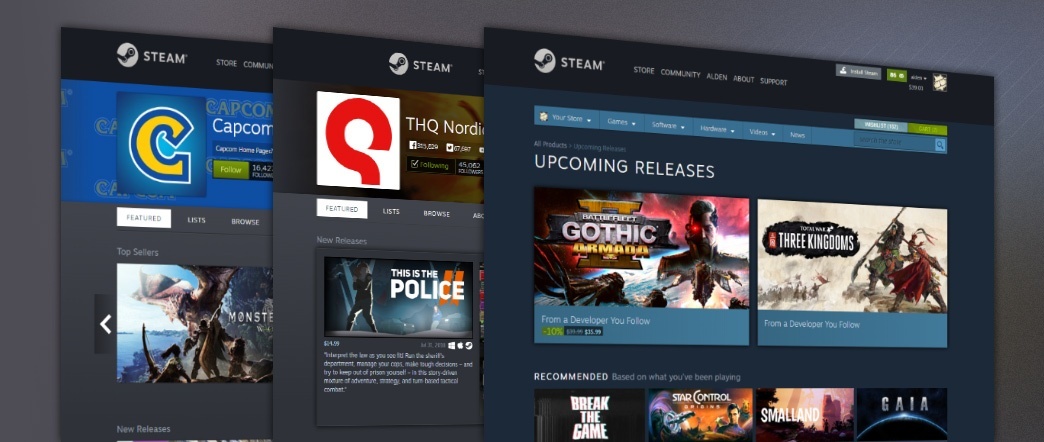
The first set of our changes focused on improving how you can find new games. We’ve added Developer & Publisher homepages so you can easily get from a game you love to others made by the same creators, or follow them if you want to be notified whenever they say or make something. We significantly reworked how our Upcoming Games Lists functioned, so they’re much better at showing you upcoming games that you might be interested in, or upcoming extra content for a game you’ve been playing a bunch.

A second set of changes was focused on improving how you can ignore things you’re not interested in. In the past you’ve been able to ignore individual games or product types (like VR, or Early Access) you didn’t want to see again. But now we’ve added ways for you to also easily ignore individual developers, publishers, and curators.

We’ve also improved the game tag filters on your account preferences. Previously, it was a list of 3 game tags that you wanted to see less of. We’ve now increased the number of tags you can list to 10, and made them into a harder filter – in short, the Store now assumes you want to ignore all the games that feature any of those tags in their most popular tags, instead of just using them as suggestions to our recommendation engine.

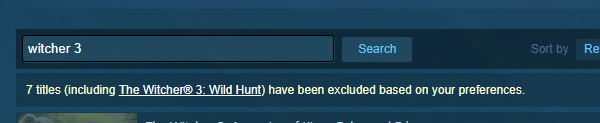
We did our best to ensure you can safely ignore swaths of games in the store, but still find them if you look directly via the search tool. If the game that we think you’re searching for is hidden due to your mature content settings, we identify that and let you know in a safe way. For example, if you have your preferences set to hide mature games with violence, but you search for The Witcher 3, you’ll see this:

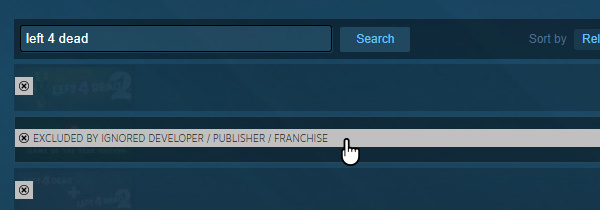
If there are games that your search should contain that you’re ignoring for other reasons (due to its developer, or game tags, for instance), we’ll still include it in the list, but we’ll blur it out and when you hover over it you can see why it is darkened. For example, if you’ve chosen to ignore games by Valve, and then search for Left 4 Dead, you’ll see this:

A third set of changes focused on allowing you to have better control over the kinds of mature content you see. So far, the Store has allowed you to filter out games that feature Frequent Violence/Gore or Nudity/Sexual Content. After looking at the mature content in submissions we’re receiving, and at some games that are already in the Store, we’ve added two more options. The first is a general Mature Content filter. We often see developers who tell us their game contains mature content, but not sex or violence, and you can now filter those games out if you wish. The second is an Adults Only filter, which allows you to filter out games that feature explicit sexual content.

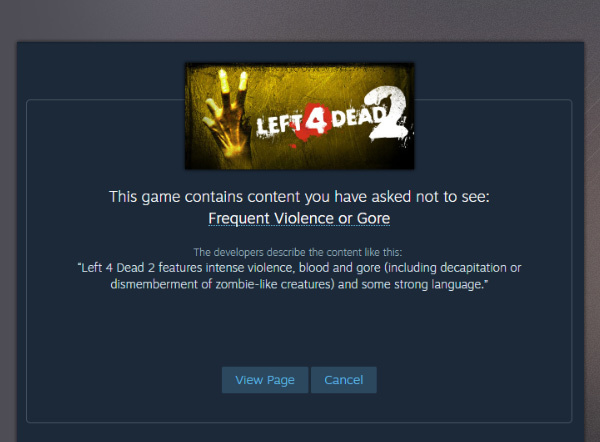
We’re also now requiring developers of games with violent or sexual content to describe the content of their game, and we’re using that information to help you decide whether a game is something you’re comfortable with. We think the context of how content is presented is important and giving a developer a place to describe and explain what’s in their game gives you even more information when browsing and considering a purchase. When you’re looking at the store page of a game with mature content, we’ll display that developer-written description to you. We’re also displaying it on the interstitial page we show you if you ever follow a direct link from outside steam to a game that should be filtered for you:

Finally, we’ve continued our efforts in removing bad actors from the Store. Last year we made changes to Trading Cards to address the ways a small set of developers were producing ‘games’ that generated revenue without anyone actually buying and playing them. Recently we made more changes to address other ways these bad actors were continuing to do it. We’ve also permanently banned several developers of games that we felt fit the “straight up trolling” description of games we’re not going to allow onto the Store. There’s actually a surprisingly small number of individuals behind almost all of these games, and their bans have been a straightforward series of decisions, thus far. You can read more about the shorthand of “straight up trolling,” and the process of making those decisions in the Q&A below.

With these sets of changes, we hope you have a better sense of how we’re approaching building a store that works for all developers and players. There’s still plenty of work to do. In our previous post we identified a range of things, from parental controls to tools for developers to manage their communities. In addition, some of the changes described in this post will require more options when we see new kinds of content in game submissions. Going forward, we aim to continue this strategy of shipping features as they’re finished, and posting periodic updates as to the nuts and bolts and the thinking behind their development.

Q&A

Q: What about games that are already in the store that include mature content?

A: Every developer will be encouraged to update their game with the customer-facing descriptions outlined above but in most cases Valve moderators will going back through the catalog and making sure games are complying with the new requirements.

Q: What do you mean, in practice, when you say you won’t ship games that are “outright trolling?” That seems vague.

A: It is vague and we’ll tell you why. You’re a denizen of the internet so you know that trolls come in all forms. On Steam, some are simply trying to rile people up with something we call “a game shaped object” (ie: a crudely made piece of software that technically and just barely passes our bar as a functioning video game but isn’t what 99.9% of folks would say is “good”). Some trolls are trying to scam folks out of their Steam inventory items, others are looking for a way to generate a small amount of money off Steam through a series of schemes that revolve around how we let developers use Steam keys. Others are just trying to incite and sow discord. Trolls are figuring out new ways to be loathsome as we write this. But the thing these folks have in common is that they aren’t actually interested in good faith efforts to make and sell games to you or anyone. When a developer’s motives aren’t that, they’re probably a troll.

Our review of something that may be “a troll game” is a deep assessment that actually begins with the developer. We investigate who this developer is, what they’ve done in the past, their behavior on Steam as a developer, as a customer, their banking information, developers they associate with, and more. All of this is done to answer the question “who are we partnering with and why do they want to sell this game?” We get as much context around the creation and creator of the game and then make an assessment. A trend we’re seeing is that we often ban these people from Steam altogether instead of cherry-picking through their individual game submissions. In the words of someone here in the office: “it really does seem like bad games are made by bad people.”

This doesn’t mean there aren’t some crude or lower quality games on Steam, but it does mean we believe the developers behind them aren’t out to do anything more than sell a game they hope some folks will want to play.

Q: Sometimes I see blurred out games on my Store front page. Why is that?

A: There are a number of sections on the front page that we fill with games, and to ensure the servers behind it don’t melt down as everyone tries to use it, we do a lot of data caching. This works great for data sets that we can easily pre-compute – so if there’s a game you shouldn’t see due to your mature content filters, you’ll never see it on the front page. But if you’ve chosen to do some more personal filtering of particular developers, or specific games, we can’t do that pre-computation as easily. As a result, it’s possible you’ll see a blurred out game on the front page because your personal filters should cause it to be hidden. In practice, though, this will only happen if you’ve filtered out so many games that it can’t find enough to fill a section of the front page, and again, like the search results, we’ll blur that game out and tell you why.

Q: Why do you KEEP asking my damn age throughout the store?

A: We’re with you on this. Unfortunately, many rating agencies have rules that stipulate that we cannot save your age for longer than a single browsing session. It’s frustrating, but know we’re filling out those age gates too.

Posted on Leave a comment

Blog: Why academics can no longer compete in game AI competitions

The following blog post, unless otherwise noted, was written by a member of Gamasutra’s community.
The thoughts and opinions expressed are those of the writer and not Gamasutra or its parent company.


UC Berkeley’s Overmind winning the first StarCraft AI Competition

OpenAI Five is a huge step forward for AI, but it’s also really intimidating for AI researchers. Never before has there been so many open tools for building AI systems, but it also feels like the barrier to entry for academics has actually increased over recent years. I posted an open call for any interested parties to build the best StarCraft AI possible back in 2009, and it was open to anyone interested in AI. Now, it seems like you need to have access to closed APIs, massive compute power, and historic training data to make advances in AI.

I’m putting this argument out there as a devil’s advocate, hoping that I can be proven wrong. I’d like to see more open competitions, and area’s where researchers without massive compute resources can continue to make advances in AI. Here’s some of the main issues I’ve seen with recent advances.

Closed APIs

OpenAI, to my knowledge, is using an API to build and train bots that is not available to academic researchers. If you’re a grad student that wants to build a bot for Dota2, then you’ll need to wait until the current competition ends and an open source version is eventually made available. For games likes Go, which have seen great progress with deep and reinforcement learning, this issue is not a problem. But if you’re a grad student that wants to work with video games that have large and active player bases your options are extremely limited. The DeepMind API for StarCraft 2 seems like a great option, but you’ll still have other challenges to face.

Dota 2 does provide a scripting interface, enabling bots to be written in Lua. However, this limited interface does not enable bots to communicate with remote processes and save data about games played.

Work Around: Find games with APIs that you can use. I used the Brood War API during grad school to write a bot for the original StarCraft. It was a huge hack and I somehow managed to get it working with Java, but I was extremely lucky that this project was not shut down by Blizzard. It’s great seeing the open source community continue to evolve both BWAPI and the Java version.


Bot debugging from an early BWAPI-Java prototype.

Compute is Expensive

OpenAI is spending massive amounts of compute power to train bots, and efforts by DeepMind to train Go bots were also substantial. This is an issue that OpenAI had addressed in a blog post, but it’s also discouraging for academics. It’s unlikely that students will have massive cloud computing resources available for training bots that perform at professional levels.

Work Around: Find sub-problems that you can solve. This is actually something that OpenAI did previously, by focusing on 1on1 matches and then slowly progressing up to 5v5 by relaxing more and more constraints. I included a tech-restricted matchup in the original StarCraft AI competition, but it wasn’t as popular as the full game option, in part because there weren’t human opponents knowledgeable about this version of the game for participants to train against.


One of the sub-problems in the original StarCraft AI Competition.

Training Data

One of the goals with my dissertation research was to build a StarCraft bot that learns from professional players, but now that some time has passed I realize that a different approach may have been move effective. Instead of showing my bot how to perform, I could have specified a reward function for how the bot should act and then let it self train. But, I didn’t have a good simulation environment, and had to rely on the sparse training data that I could scrape from the web at the time. This is especially a problem when you are working on sub-problems, such as 1on1 in Dota2, where professional replays simply don’t exist.

Work around: Mine data sets from the web, such as professional replays from sites like TeamLiquid. This won’t work for sub problems, but you can always bootstrap the replay collection with your own gameplay to get things rolling. I used third party tools to parse replays and then built an export tool with BWAPI later on.


Exhibition match at the first StarCraft AI Competition.

Next Steps

I’ve provided a pessimistic viewpoint for academics and hobbyists in game AI. It may seem like you need connections and massive compute power to make advances in game AI. It helps, but it doesn’t mean you’ll make progress without some great direction. Here’s some recommendations I have for making AI competitions more open moving forward:

  • Open up APIs for bots to play against human opponents
  • Provide a corpus of replay data
  • Integrate with open source and cloud tooling

It’s now easy to get up and running with deep learning environments thanks to tools such as Keras, and environments like Colaboratory that make it easier to work with other researchers on models.

In a way, my initial call for research on open AI problems failed. It was an open problem, but I didn’t fully encourage participants to be open in their approach to the problem. Now, great tools exist for collaboration and it’s a great time to openly work on AI problems.


Ben Weber is a principal data scientist at Zynga. We are hiring! This post is an opinion based on my experience in academia and does not represent Zynga.


Posted on Leave a comment

iOS Sale Alert: Six Ages & King of Dragon Pass

Six Ages: Ride like the Wind was the long awaited sequel to King of Dragon Pass, one of the most highly regarded narrative strategy games on mobile and PC. If you’ve been a fan of A Sharp and their work over the past decade, you’re in luck – both games are having a discount on iOS.

Now, it’s not going to set the world on fire or save you a ton of money, but both games – which normally retail for £8.99/$9.99 are currently selling for £6.99/$6.99. A modest reduction to be sure, but these games are worth it even at full price.

We’re not sure how long this is going to last so if you have yet to try out these master-pieces in game design, make sure you get stuck in. Despite every writer in the history of Pocket Tactics generally holding KoDP in high regard, we never actually reviewed the game – Six Ages on the other hand took Mr. Thrower by storm. It didn’t manage to secure top marks, but it was well worth the wait.

KoDP is on Android, but unfortunately it’s still selling at full price on Google Play.

Let us know If you pick these up and/or how you’re finding Six Ages since launch.

Posted on Leave a comment

Blog: Here’s how I made my computer write music

The following blog post, unless otherwise noted, was written by a member of Gamasutra’s community.
The thoughts and opinions expressed are those of the writer and not Gamasutra or its parent company.


One of my current hobby projects is creating a procedural music system: a computer program that composes and performs music all by itself. It’s still a work-in-progress in its early stages, but some recent improvements have gotten it to produce quite interesting music already, so I figured it’s about time I share some of my thoughts around how it works. Let’s start with a little video that lets you hear the amount of variation it can currently do:

[embedded content]

Note that this video contains a selection of the nicer pieces, so it isn’t all this good. Most of the other music it currently produces is a bit more boring, or too similar to these fragments. The program is a work-in-progress and it should improve a lot as I spend more time on it.

I started programming this for a rather odd reason: I wanted to practice improvising on my cello over complex chord schemes and figured a program that automatically produces those would do the trick. As usual with this kind of thing, it got out of hand and I’ve so far spent my time making it cooler instead of playing along to its tunes on my cello. I hope I can expand it to the point where it can be a game soundtrack, or a live streaming radio channel on Youtube that constantly produces new music.

My approach to procedural music is mostly based on my own ideas about composition. I’m deliberately steering away from a lot of common composition ‘rules’ since I expect that’s been done already. I think I’ll get something more interesting and more personal if I start from my own ideas instead. While I don’t ignore music theory either, I do try to avoid rules like ending a chord progression with the dominant and then going back to the tonic or anything like that.

Just to be clear: my music generator is not an AI or a self-learning system or anything like that.

The procedural music generator consists of a bunch of elements that together produce the music:

Chords, rhythms and scales

To ‘teach’ my program basic music theory I’ve created a bunch of text files that define a lot of common and less common chords, rhythms and scales. You can see which it’s using in the video: it might for example choose to play a C major chord in 3/4 rhythm.

Structure generators

The first thing needed to create a piece of music, is a basic structure. This part of the program randomly chooses the chord progression, the rhythm and the scales. It also chooses how individual instruments are allowed to deviate from the rhythm, so that there’s some consistency between instruments without requiring them to do the exact same thing.

Instrument layer generators

These generate the notes for specific instruments. Each category of instruments has a role to fulfil and its own specific algorithm for that. For example, the generator for drums is completely different from the generator for bass. Most of these generators are still very basic so there’s plenty of room for improvement there. A lot of the variation in the video above comes from having different combinations of instrument layer generators. For example, some have drums, others do not. I expect that having a lot of layer generators is where my procedural music will get most of its variation. Currently I have five, but I’d like to create at least a dozen. The most important missing layer at the moment is one for actual melodies, which is probably also the most challenging one to get right.

VST instruments

Actually performing the music is done using VST instruments. VST is a standard for digital instruments that is used by a lot of programs on Windows. A VST file is basically just a DLL and I’ve coded a simple music player that can handle them. For each instrument layer I’d like to have several VST instruments that can play that layer, so that I can get different sounds. Currently most of it sounds very digital, so it would be nice to also have VSTs for other types of instruments, like acoustic drums and guitars.

Song structure

This is an element that’s currently completely missing: at the moment all music played by my music generator is simply a loop of 4 to 12 bars. I want to program systems for song structures with verse/chorus/bridge, but also for endlessly progressing music and for music that for example slowly builds up to a climax.

Carefully restricted randomness

All the systems in this generator contain a lot of randomness, but the randomness is limited to specific rules I’ve come up with. If those rules are too free then the result is noise, not music, while if the rules are too strict then the resulting music will always seem same, so carefully balancing the randomness is a big challenge here.

For future improvements I’d like to add more instrument layers and refine the current ones, add song structures and add more VST instruments. Since I’ve recently become a dad I don’t have a whole lot of time to work on this, so I expect progress will be very slow. I hope to include a first basic version of my procedural music generator as a bonus feature in the home edition of Cello Fortress, whenever that’s actually finished.

Let’s conclude with a question: do you know any communities for open source or free VSTs? There are plenty of VSTs that can be downloaded for free, but in many cases they just specify that they’re free to use, not free to distribute with commercial software. I’ve so far had a hard time finding usable instruments or getting into contact with (hobby) instrument programmers who might be willing to allow me to include their instruments. Leave a comment if you’ve got suggestions or are a digital instrument programmer yourself.

For more blogposts on development of Awesomenauts, Swords & Soldiers, Cello Fortress, Proun, my music and any of the other stuff I work on, check my dev blog at www.joostvandongen.com.

Posted on Leave a comment

Blog: Knowing when and how to lore dump in games

The following blog post, unless otherwise noted, was written by a member of Gamasutra’s community.
The thoughts and opinions expressed are those of the writer and not Gamasutra or its parent company.


Lore dumps.’ It’s not an attractive phrase.

Bit of housekeeping first. I want to remember that most games are not written under perfect circumstances where writers see all their work go into the game in a perfectly executed way. Maybe someone wrote a series of dialogues with a companion NPC where the protag carefully teases out the oral history of that NPC’s homeland, and why they’re at war with the player’s homeland, and that serves as a basis for choice-driven relationship development between the NPC and the player… and the setting information seeped invisibly into the game… and then the NPC got cut at the last minute because budget. Now no-one understands anything about the setting history and it’s two months from launch and a big chunk of the plot no longer makes any sense. What are you going to do? well maybe you’re going to wince and add pop-up text screen explaining the whole thing and resign yourself to people groaning ‘UGH LORE DUMP’ for the next five years because it’s the smallest evil.

Nother bit of housekeeping. Some people *like* lore dumps. Technical manuals for film franchises keep on selling. You know your audience and your game better than I do. But you don’t have to put it in everyone’s face. You can leave it in a book on a shelf, where it belongs, and where it won’t annoy the non-dumpthusiasts.

But here are some signs that you’re going to put something in your game that will send your player off to make herself a cup of tea, or alt-tab out to bitch about your game on Twitter.

1. Lore dumps that don’t sound like something a human would say.

Player: tell me about this city.

NPC: Darkburg is the capital of the Kingdom of Gloaming. It attracts merchants from all over the world, although many people here are concerned that the coming war with Shadowville means we’ll see fewer visitors.

Player: tell me about this city.

Alexis: London is the capital of the UK, and of England. It attracts tourists from all over the world. But many people here are concerned that the coming exit from the European Union means we’ll see fewer visitors.

2. Lore dumps that don’t read like something a human would write.

[Letter]: As you know, my lady, the Chancellor is very concerned about the coming war with Shadowville, although she claims in public that it’ll be a triumph that will regenerate our nation…

[Email]: As you know, Lottie, the Prime Minister is very concerned about the coming exit from the European Union, although she claims in public that it’ll be a triumph that will regenerate our nation…

3. Lore dumps that feel like homework.

NPC: the West of Darkburg contains some of our highest-rent districts. In the centre, we have the Temple of the Great Night, the Empress’ Residence and the Museum of Pain. You can find lots of shops in the Brass District. The best way to get around is…

Alexis: the West of London contains some of our highest-rent districts. In the centre, we have St Paul’s Cathedral, the Houses of Parliament and the British Museum. You can find lots of shops in Oxford Street. The best way to get around is…

If you’re thinking ‘here is a big list of all the information about this place: I should put the information into some words, and then the words will go into the player’s head, and so will the information’ then you risk ending up with something like the examples above. It’s okay not to tell players some of those things. It’s okay to tell them things in character. It’s okay not to tell them everything right now. They’re still going to be in your game an hour from now, and if they’re not, you have bigger problems.

4. Lore dumps that could be copy/pasted into another game without anyone noticing.

NPC: Hundreds of years ago, the Dark Lord Alpha seized the power of Beta for himself, and covered all the lands of Gamma in illimitable darkness. At last the wise mage Delta bestowed his finest pupil, Epsilon, with the power of Zeta. Epsilon fought her way to the heart of the dangerous realm of Eta and slew Alpha with the Zeta. Peace reigned over all the lands of Theta. But now we hear dark rumours of dark stirrings in the dark heart of Eta. In the peaceful hamlet of Iota you know nothing of this, yet, but soon you must begin your journey to

Honestly, why bother? ‘Because I’m on a day rate to write a Terry Brooks pastiche for a mid-core mobile game’ is actually a fair answer, but there’s probably something more interesting to be done. Or at least shorter.

5. Lore dumps that are in there out of a sense of mistaken duty

A lot of things in games are there because people kinda thought they ought to do that because isn’t that what people do? This is the same reason that indies write press releases that begin “we’re excited to announce”.


Here are some things you can do to minimise the tea-making and the bitching on Twitter.

0. DON’T WRITE THE LORE IN THE FIRST PLACE.

Some folk write lore because it’s what they love doing, some folk write lore because they need it to fill the technical manual spinoff book, many because isn’t that what you do when you’re making an SFF game? you sit down and invent five nations and write a timeline?

I mean, you can, but the thing about things that everyone does is that those things are then things that people get bored with, because everyone’s done it. I love Tolkien, but he started putting his legendarium together almost a hundred years ago now, and he doesn’t need to be the default model to follow. More along these lines here: https://www.gamesindustry.biz/articles/2017-02-02-against-worldbuilding

If there are five nations in your world and the player is only ever going to visit one and they’re not involved in politics anyway, maybe only write up two nations.

If you need a third nation, then you can invent it later! And if you haven’t given the player a tour-guide talk on the Wheat Wars between Cerea and Gluta, then when you cut the Wheat Wars from your plan, you’ll have fewer continuity issues.

I’m being a bit glib. Planning helps. But it’s okay to leave room to invent or change stuff later. You don’t need to show the player all your draft setting notes.

1. Keep the information to an absolute minimum.

Here’s the lore dump I put at the beginning of Sunless Sea.

"Three decades ago, in the reign of Victoria, London was stolen by bats. Now it lies a mile below the surface. It was dreadfully inconvenient for everyone. But it opened a vast black ocean to you. Welcome to the Unterzee.

There is a lot of Fallen London lore. This doesn’t mention nine-tenths of the setting info. The first draft was like five paras. But I realised very quickly that most of it is just so much blah to new players, and so much yeah I know to people who’d played Fallen London.

So this says (a) you are in Victorian London but (b) it’s weird and (c) underground, nevertheless (d) people are used to it now and, btw, (e) the Unterzee is the thing in front of you. That’s actually all you need at this point.

The awful clanging obvious expository sections in everything that seem utterly crass? Big chunks of the audience demand them and get upset when they’re not there.


— Mode 7 – Paul Kilduff-Taylor (@mode7games) July 18, 2018

That’s the tweet that kicked off this blog post. Paul’s right (I think ‘a big chunk’ is ‘about 5%’, but with an audience in the hundreds of thousands that’s still thousands of players). But you know what? Let ’em. No game is universally beloved, and it’s better to frustrate the impatient than to bore the attentive. A minority of people have complained for ten years that Fallen London needs a codex or an opening cutscene or something. But the vast majority of people are there to get the lore nugget by delicious nugget. And a lot of the frustrated folk come around in the end.

Every time an interviewer says “how could game narrative improve” my answer is “actually it’s very often very good these days. But we could all do with respecting our players’ intelligence more.”

2. Give the player a reason to be curious.

NPC: For a thousand years the Moon Queen ruled over Selentia, and her werewolves were everywhere. Theirs was the power of the Moonplague! Finally she was imprisoned, but only with the use of…. [dramatic pause]

Player: WHERE’S THE SKILL TRAINER

Player: Something bit me!

NPC: Lo, the dread bite of one of Selentia’s werewolves!

Player: Okay. Cure Disease, pls

NPC: For a thousand years the Moon Queen ruled over Selentia, and her werewolves were everywhere. Theirs was the power of the Moonplague! Finally she was imprisoned, but only with the use of… [dramatic pause]

Player: CURE DISEASE PLS

Player: Something bit me!

NPC: Lo, the dread bite of one of Selentia’s werewolves! which drives mo –

Player: I’ve got an Intelligence drain? it looks permanent?

NPC: drives mortals mad!!

Player: CURE DISEASE PLS I AM A MAGE I CANNOT AFFORD THIS SHIT RN

NPC:  For a thousand years the Moon Queen ruled over Selentia, and her werewolves were everywhere. Theirs was the power of the Moonplague! Finally she was imprisoned, but only with the use of… [dramatic pause]

Player: DID I STUTTER. CURE DISEASE

Player: Something bit me!

NPC: was it, like, a big silver wolf? Do you feel your wits grow weak and

Player:  yes! intelligence drain! fix!

NPC: I don’t know much about big silver wolfs, but is there anywhere around here that looks like it has to do with big silver wolf magic?

Player: oh God I don’t know unless maybe well there’s that white marble place with the silver glow over in the Moonwood haaaang on a sec

NPC: the palace of the Moon Queen? yes, that sounds like a good place to start looking for a cure! 

Player: ta. I hadn’t realised this was a game where setting and mechanic worked harmoniously together, so I’d written it off as scenery. back in a sec

NPC: how did your weapons work against that big silver wolf?

Player: it had some pretty serious phys resistances, actually

NPC: Mm.

Player: What do you mean, ‘Mm’?

NPC: Oh nothing it’s probably just a silly story

Player: No, go on, we burnt through all our potions fighting just one of those things, and if there’s a plot weapon somewhere I’d like to know

NPC: For a thousand years the Moon Queen ruled over Selentia, and her werewolves were everywhere. Theirs was the power of the Moonplague! Finally she was imprisoned, but only with the use of… [dramatic pause]

Player: TELL ME WHAT DEFEATED THE MOON QUEEN ALREADY

Okay, I’m exaggerating for effect, and actually the player has prolly kept reloading until they managed not to get bitten, and then gone online to complain that the intelligence draining wolfs make mages unplayable unless you keep reloading, but yswim.

3. Write it extremely good

“The Dwarves tell no tale; but even as mithril was the foundation of their wealth, so also it was their destruction: they delved too greedily and too deep, and disturbed that from which they fled, Durin’s Bane.”

If you write it so evocatively that people recognise the quote seventy years later and TV Tropes names the trope page after your lore dump, you’re allowed to do it. that’s official. if anyone asks, tell them AK sent you. tell them he says it’s okay not to capitalise sentence starts if you’re writing online and wanting to sound urgent and conversational, too.

NB though that part of the reason it’s evocative is that he was writing about an endgame boss coming up from the bottom of a dungeon thirty years before D&D was even thought on. Never copy Tolkien outright.

4. Add a point of view.

Cultist Simulator is pretty much a lore dump redesigned to be playable as a game already, but I jazzed up some of the more expository occult tomes by adding a point of view.

label: “Read this volume of Travelling at Night”,

startdescription: “Illopoly’s disquisitions on fire and the Unburnt God are interrupted by passages of distractingly erotic poetry addressed to ‘Baldomera’.’”,

description: “‘To reach the Stag Door, I believe that all you really need is to want something enough. But I’ve never wanted anything that much, except of course Baldomera, and I’m very much afraid that the knot in the story is this: what Baldomera wants is the Stag Door. But here’s something I learnt in Persia. Perhaps it’ll teach you what you want.’”,

Exposition here (which will probably only make any sense if you’ve played a bit of CS): this book contains Forge-principle lore; the Unburnt God is one way the Forge of Days was worshipped in Persia. Christopher Illopoly is sweet on Baldomera; Baldomera might not reciprocate; the player should use Dream with their Desire to approach the Stag Door. I could just have put that as a list of bullet points, but it was more fun to make it a character moment. It nearly always is.

5. Let the player ask questions about it.

Even if it’s a basic lawnmower dialogue where the player says things like ‘Tell me about the north side of Darkburg’, that’s better than a text crawl. Little bit of call-response to keep them awake is all you need. This is a good way to get a point of view or some character writing or a reason to care in too.

6. Break it up and scatter it through the game. 

If you’ve ever tried to feed vegetables to a small child, you’ll know the principle.

Loading screen messages are great for this. Coincidentally, so are conversations where the player asks questions.

If you do this, the best approach is to approach the same fact multiple times from different angles.

7. Lampshade it.

“We’ve got to sit through this really boring lecture on the Trade Federation blockade, but I’ll sit next to you talking about my backstory and I’ll nudge you in the ribs when the lecturer gets to an important bit.”

Lampshading is generally a technique of last resort, but sometimes you need a last resort.

I had an NPC interrupt like this in Fallen London, actually, when you go to talk to the Lady in Lilac while a performance of the Seventh Letter plays out in the background. There’s some juicy lore in the Seventh Letter, but if you had to sit through me write out the whole thing you’d be bored as balls and I’d be way over deadline.

8. Don’t use words.

Okay, there are words on screen here. But writers can forget there are other ways to convey information.

[embedded content]

Posted on Leave a comment

Dota 2 Update – September 1st, 2018

7.19b:
==

* Buyback respawn time penalty changed from +25% of remaining time to +25s always

* Level 2 XP requirement changed from 200 to 230 (in a scenario where Team A gets 2 melee denies per wave, and team B gets 1 melee deny per wave: Team A wave requirement for level 2 increases from 2 waves to 3 waves. Team B wave requirement remains at 3 waves. Total XP needed for other levels unchanged. )

* Glyph is now on cooldown until the 3 minute timer in-game

* Stout Shield: Damage block for melee heroes increased from 18 to 20
* Ring of Aquila: Bonus damage reduced from 10 to 7
* Mekansm: Heal increased from 250 to 275
* Guardian Greaves: Heal increased from 250 to 275
* Urn of Shadows: Heal rate reduced from 35 to 30
* Spirit Vessel: Heal rate reduced from 35 to 30
* Spirit Vessel: Movement speed bonus reduced from 30 to 20
* Scythe of Vyse: Manacost increased from 100 to 250
* Phase Boots: Speed bonus on ranged heroes reduced from 16% to 13%
* Phase Boots: Instant turn rate is now a melee only feature

* Alchemist: Greevil’s Greed bounty rune multiplier rescaled from 3.5x to 2/2.5/3/3.5x
* Bloodseeker: Bloodrage heal rate reduced from 19/21/23/25% to 16/19/22/25%
* Broodmother: Base agility reduced by 3
* Chen: Penitence duration reduced from 8 to 5/6/7/8
* Clinkz: Base strength reduced by 2
* Crystal Maiden: Crystal Nova manacost increased from 130/140/150/160 to 130/145/160/175
* Dark Willow: Shadow Realm damage reduced from 120/200/280/360 to 90/180/270/360
* Dark Willow: Cursed Crown cast point increased from 0.1 to 0.2
* Drow Ranger: Base agility reduced from 26 to 19 (base damage unchanged)
* Drow Ranger: Agility gain increased from 1.9 to 2.2
* Drow Ranger: Base attack animation time improved from 0.7 to 0.65
* Enchantress: Base movement speed reduced by 15
* Gyrocopter: Base agility reduced by 5 (base damage and armor unchanged)
* Huskar: Base damage reduced from 42-51 to 40-45
* Huskar: Level 10 Talent increased from +175 Health to +225
* Io: Spirits cooldown from 20/18/16/14 to 26/22/18/14
* Io: Level 10 Talent reduced from +25% XP to +20%
* Mirana: Level 15 Talent reduced from +100 Leap Attack Speed to +80
* Nature’s Prophet: Base damage reduced by 3
* Necrophos: Agility rescaled from 15 + 1.2 to 12 + 1.3
* Necrophos: Base movement speed reduced by 5
* Phantom Lancer: Level 25 Talent reduced from -7s Doppelganger CD to -6s
* Silencer: Arcane Curse manacost increased from 75/95/115/135 to 105/115/125/135
* Spectre: Spectral Dagger linger duration reduced from 2 to 1
* Spectre: Dispersion max reflection range reduced from 1000 to 700
* Spectre: Desolate single hero range check increased from 325 to 375
* Tiny: Tree Grab manacost increased from 20/30/40/50 to 50
* Tiny: Avalanche cooldown increased from 20/19/18/17 to 23/21/19/17
* Ursa: Overpower manacost increased from 45/55/65/75 to 75
* Vengeful Spirit: Wave of Terror cooldown increased from 10 to 16/14/12/10
* Weaver: The Swarm manacost increased from 70/80/90/100 to 110
* Wraith King: Wraithfire Blast cooldown increased from 11/10/9/8 to 14/12/10/8

Posted on Leave a comment

Dota 2 Update – August 31st, 2018

Grimstroke
– Phantom’s Embrace: Fixed the phantom latching to invulnerable targets (e.g. Cycloned units and Storm Spirit in Ball Lightning).
– Ink Swell: Fixed caster needing to be alive for the explosion damage and stun to apply
– Soulbind: Fixed its interaction with Witch Doctor’s Cask, Bounty Hunter’s Shuriken Toss, and Legion Commander’s Duel.

Posted on Leave a comment

Video: thatgamecompany shares how devs can build cohesive teams

In this GDC 2015 talk, thatgamecompany’s (the studio behind Journey and Flower) Sunni Pavlovic offers insight on how to hire well for your game dev studio, explaining how you can retain top talent to build the kind of cohesive teams that make great games.

Pavlovic discusses how, far too often, hiring exists as an operational afterthought to game development. Born of necessity, confined to the HR manager, and artlessly executed to mediocre results, she explains how your hiring strategy has as much to say about your studio as your games do.

She also provides lessons learned from the greatest hits and misses from her own hopelessly perfectionist development studio, providing insight on how to build and retain talent. 

It was an informative talk that’s definitely worth watching, so developers shouldn’t miss the opportunity to do so now that it’s freely available on the official GDC YouTube channel!

In addition to this presentation, the GDC Vault and its accompanying YouTube channel offers numerous other free videos, audio recordings, and slides from many of the recent Game Developers Conference events, and the service offers even more members-only content for GDC Vault subscribers.

Those who purchased All Access passes to recent events like GDC or VRDC already have full access to GDC Vault, and interested parties can apply for the individual subscription via a GDC Vault subscription page. Group subscriptions are also available: game-related schools and development studios who sign up for GDC Vault Studio Subscriptions can receive access for their entire office or company by contacting staff via the GDC Vault group subscription page. Finally, current subscribers with access issues can contact GDC Vault technical support.

Gamasutra and GDC are sibling organizations under parent UBM Americas.