Posted on Leave a comment

The Weekender: Vanishing Act Edition

Welcome to the Weekender, your weekly look at the best new games, sales, and updates. It’s a slow week, thanks in part to The Elder Scrolls: Blades slinking away to December.

It’s been a slower week on the site as well, but hopefully we’ve given you some interesting reading none-the-less. We only had one review this week, Evergarden, but we also gave you our thoughts on what the best strategy games to play offline are as well. We also highlighted the (now finished) sale on Six Ages and wrote up a spot of news as well.

Out Now

The Elder Scrolls: Blades (iOS U- oh wait…nevermind)

We thought we were going to be able to talk about The Elder Scrolls: Blades this week, Bethesda Game Studio’s latest foray into mobile games. Blades is to be a first-person RPG based in the popular Elder Scrolls game world, but its App Store release date keeps moving. It was September 1st, then September 7th. Now it is December 1st. Bethesda said the prior dates were never the real release date and the game hasn’t slipped. Apparently, they looked at the September App Store dates as ‘placeholder’ dates used by Apple only. 

SpellKeeper (iOS Universal and Android)

SpellKeeper is a puzzle game where you become a Chosen One. Your job is to free butterflies trapped in magical cocoons using spells. You have limited spells at your disposal, so it’s all about their efficient use to free all the butterflies on each level. SpellKeeper is not particularly challenging, it’s going for more of a relaxing style puzzle game, which is supported by attractive graphics and sound.

[embedded content]

Onitama: The Board Game (iOS Universal and Android)

Asmodee Digital secretly launched another game into their digital catalogue this week – Onitama is a strategy boardgame that resembles Chess. Each side as four warriors and one elder at their disposal, and the aim is to either capture the opponents elder or take their place in the temple arch. Unlike chess, movement is controlled by randomly drawn cards, with the players swapping cards between them as they use them. We haven’t had a chance to play this one, but it’s free-to-play with only a couple of IAPs right now, one of which being for the expansion.

onitama

Final Frontier: A New Journey (iOS Universal and Android)

It’s 3018 and humanity has taken to space. You are a captain of the space fleet and are in charge of finding a new world for our species to inhabit. It’s Reigns in space. Like any Reigns-like the gameplay in Final Frontier: A New Journey is very familiar so it all comes down to the narrative. While the narrative choices aren’t bad, they also aren’t particularly varied or compelling. I’d pass on this one unless you’re in the mood for more Reigns, but space.

Sales

Reiner Knizia’s Money (iOS Universal): $.99

The digital adaptation of Reiner Knizia’s card game Money, where you start with six different kinds of currency and try to concentrate your holdings into just two or three, is on sale for a buck… 

Reiner Knizia’s Kingdoms (iOS Universal): $.99

…As is Kingdoms, a tile-laying strategy card game set in medieval times. Neither game features online multiplayer but are worth consideration if you enjoy solo board gaming on your device. 

Dungeon Rushers (Review) (iOS Universal  and Android): $1.99

Dungeon Rushers isn’t a terribly deep dungeon crawler, but it is entertaining and worth a couple bucks if you’re looking for a new game. It’s got monsters, traps, treasure, loot, skills, crafting, and even an online arena system to battle other players. 

Out There Ω Edition (Review) (iOS Universal and Android): $1.99/$.99

Also just a buck or two, depending on your device, is Mi-Clos Studio’s fantastic sci-fi adventure game Out There: Ω Edition. It’s got a little of everything from interactive fiction, to RPG, to resource and crew management simulation game. If you haven’t played it, this one is worth a go. 

Out There Chronicles Episode – 1 (iOS Universal and Android): $.99
Out There Chronicles Episode – 2 (iOS Universal and Android): $1.99

Mi-Clos also has a discount on their interactive fiction games based in the Out There universe. You can pick up the first episode for a buck and the latest game, episode 2, for $1.99 (on iOS only at this point). 

Templar Battleforce Elite (Review) (iOS Universal and Android): $4.99

XCOM-like, turn-based tactics gem Templar Battleforce is a must-have for fans of the genre. It’s currently half off and is worth it, so much so that’s on our guide to the best offline strategy games on mobile.

Seen anything else you like? Played any of the above? Let us know in the comments!

Posted on Leave a comment

Devs recount the making of Golden Axe: Beast Rider, a crunch-ridden $15M flop

“Unfortunately, [Golden Axe] was a bit shit.”

– Game developer Belinda Heywood, reflecting on her work as a producer on 2008’s Golden Axe: Beast Rider.

Back in 2008 Sega and the now-defunct game studio Secret Level released Golden Axe: Beast Rider, an attempt to revive the Golden Axe franchise (in 3D!) that earned a lukewarm reception from both critics and customers.

Now, nearly a decade later, the folks at Variety have published an interesting feature about the game’s ~$15 million development which includes a lot of eye-opening input from some of the original dev team.

It’s an intriguing read, even if you feel like you’ve heard this tale a few times before: ambitious studio pitches an ambitious project, overscopes, then desperately chops a bunch of stuff out and pours in loads of overtime in an attempt to make something playable in time to ship. 

What really stands out is how much time the devs remember spending in crunch: multiple folks told Variety they remember working overtime seven days a week for months on end, to the point that they would take a break on weekend evenings to go out and party, then come back to the office to sleep it off and continue working.

“We’d work from 10 to 7. Then we’d go out, and drink, then come back and work some more,” said producer Belinda Heywood. “We did it for six months. Everybody did. And Saturday and Sunday as well, seven days a week.”

Deeply troubled, the project reportedly saw a lot of turnover, and Variety’s sources paint a picture of a studio that fostered both enduring camaraderie and progress-killing disputes over seemingly trivial matters like who gets to write the shaders. With less than a year before it was scheduled to release, Dedan Anderson signed on as the new lead designer and was tasked with bringing it all together into a shippable product.

“That was a firefighting exercise,” he told Variety. “There was a lot of crunches. I blocked that out. That was my last crunch project. That took the crunch out of me. I’m not doing crunches anymore.”

Unsurprisingly, crunching didn’t make the game good. However, in an effort to end on an upbeat note Variety’s feature helps shed more light on why teams crunch, and what keeps them going: a feeling of camaraderie and teamwork in solving huge problems.

“I think it’s my best game,” said art director Matthew Butler. “Not in the way of gameplay or anything like that, but just in the team, the situation. The whole team was great. I think I had one of the best times I’ve ever had creating anything. We weren’t satisfied with what we did, but we had the most fun, or I did.”

“The last 13 months were some of the most challenging crunch I’ve ever experienced in my over 10 years in the games industry,” added Boccieri. “I was one of the people that made it a point I needed to leave the office from time to time, but there was a team of at least 20 to 30 core staff that were some of the most dedicated people I’ve ever worked with who brought the game over the line.”

In the end, a game envisioned as what we might now call an open-world RPG replete with multiplayer and a cast of playable character wound up being a pretty linear single-player game starring a scantily-clad woman. The rest of Variety’s story about how that happened is well worth reading in full, as is Gamasutra’s extract of the Beast Rider postmortem published in a 2009 issue of (the also now-defunct) Game Developer Magazine.

Posted on Leave a comment

SNK’s iconic heroines are battling it out in this stylish new fighting game

SNK’s iconic heroines are battling it out in this stylish new fighting game

Play online or with friends in the brand-new 2-vs-2 fighting game, SNK HEROINES Tag Team Frenzy! Choose from a generous roster of female heroines from the SNK universe such as Mai Shiranui, Kula Diamond, and…Terry Bogard?! (Very mysterious, indeed.)

Features:

  • A 2-on-2 tag team fighter with simple controls. Simple controls and one-button specials allow you to perform killer techniques with ease!
  • Make use of special items to change the tide of battle. When your opponent is on the ropes, use your special Dream Finish to claim victory.
  • Customize your heroine with costumes, accessories, and more!
  • Spectate on other battles online, and wage on who you think will win using in-game points.

If you would like to buy the game, or see additional information, please visit https://www.nintendo.com/games/detail/snk-heroines-tag-team-frenzy-switch.


Language
Suggestive Themes
Violence

Posted on Leave a comment

Teaming up with cool Yo-kai!

Teaming up with cool Yo-kai!

In a twist on the YO-KAI WATCH series of games, up to 4 players* can team up for action-packed local and online multiplayer battles. You can train with Sgt. Burly to become the strongest Blasters team there is! As you tackle missions, you can befriend new Yo-kai to amplify your team’s awesomeness. Some missions, bosses, and Yo-kai are exclusive to each version of the game.

Features:

  • More than 400 new and returning Yo-kai to discover and befriend.
  • You can strategize with different battle roles: Attacker, Healer, Ranger, and Tank Yo-kai.
  • You can befriend all friend Yo-kai from all versions of the YO-KAI WATCH 2 game, boss Yo-kai, and the all-new Usapyon and Blizzie.
  • You can uncover new sides to the story as well as new Yo-kai, bosses, and missions with a post-launch software update!

YO-KAI WATCH BLASTERS: Red Cat Corps and YO-KAI WATCH BLASTERS: White Dog Squad are available now for the Nintendo 3DS family of systems.

*Additional games and systems required for multiplayer mode; sold separately.


Comic Mischief
Fantasy Violence

Posted on Leave a comment

New LA Times owner makes big esports investment into Daybreak Games

Los Angeles-based billionaire Dr. Patrick Soon-Shiong has been making waves in Southern California with his recent purchase of the Los Angeles Times, now his company NantWorks is acquiring a controlling interest in a new joint venture with Daybreak Game Company, the maker of Everquest and H1Z1

According to a press release, the new joint venture, named NantG Mobile, will be developing and publishing mobile versions of H1Z1 and Everquest, the former of which saw its survival mode shut down earlier this year. NantG Mobile will also be managing the development of H1Z1 Battle Royale, and working on Z1 Battle Royale, a version of H1Z1: Battle Royale developed specifically for PC. 

This investment doesn’t end at the formation of a new games company however. NantWorks also announced plans to create an LA Times Center next to the new LA Times headquarters which recently opened in El Segundo, CA. Said center appears to merge infrastructure being built for the LA Times HQ with plans for a new esports arena and video production studio for the national newspaper. 

The paper itself, according to a statement from executive editor Norman Pearlstine, will also be expanding its coverage of esports-related events. 


Posted on Leave a comment

Get a job: Spatialand is hiring a Lead Technical Artist

The Gamasutra Job Board is the most diverse, active and established board of its kind for the video game industry!

Here is just one of the many, many positions being advertised right now.

Location: Venice, California

“VR” is an industry buzzword right now. And the majority of the technology that has been created in this space has been focused on the development of hardware and content for spaces such as gaming and entertainment, ignoring the range of possibilities available in retail. At our core, we are merchandisers and storytellers which drives us to believe that virtual reality has the potential to reinvent the consumer experience—with an experience we call contextual commerce.

We are looking for an experienced Lead Technical Artist with a skill set that includes some Unity expertise.  You will be part of an amazing team helping to shape the future of immersive experiences, global V-Commerce, and interactive media. 

This is the opportunity to get in early at a stealth company currently being incubated in Los Angeles by Walmart’s tech incubator, Store No 8.  Spatialand was acquired by Store N° 8, Walmart’s incubation arm for developing capabilities that will transform the future of commerce. At Store N° 8, the Spatialand team will develop and explore new products and uses of VR through immersive, interactive, and hyper-real VR environments. Our new venture is currently operating in stealth mode as we work out of our beautiful Venice, CA office.

In this role, you will: 

  • Work with in-house multidisciplinary teams of artists and engineers to build high-end retail focused real-time experiences for VR
  • Develop tools, pipeline, and workflows for utilizing game engine technology for VR, AR, and other interactive platforms
  • Provide technical supervision and support on multiple projects
  • Use Unity’s framework to create tools to improve asset pipeline and automation
  • Factoring external direction and team feedback into design decisions
  • Work with emerging technologies to create new tools and systems for interactive real-time production
  • Lead a group of 3-6 3D artists, and (at times) multiple contractors. Provide mentorship, advice, and feedback towards final goals

Requirements: 

  • Experience and vast knowledge of real-time graphical and rendering pipelines
  • Advanced knowledge of Unity
  • Keep up to date with the technological advancements
  • Expert proficiency with Maya
  • Experience with shader creation for real-time content
  • Ability to create hard surface and/or organic models with a high level of realism
  • Basic knowledge of programming and scripting languages such as C# and Python
  • Superior eye for lighting, value, color, details, and the ability to use them in creating efficient and impactful visual elements
  • Understanding of performance and optimization requirements and experience diagnosing and profiling content costs
  • Ability to juggle multiple projects simultaneously, work against a deadline, and have a high degree of comfort with constant change
  • Self-motivated and proactive.
  • Exceptional problem-solving skills
  • Excellent interpersonal and communication skills
  • Proven ability to work successfully within and across teams
  • Bachelors in related field or equivalent experience
  • Experience with VR and/or shipped at least one AAA game

Additional Skills (not essential to the position but assists in choosing candidates):

  • Fluent in at least one programming language such as C#
  • Shader programming experience
  • Good 3D mathematical skills
  • Experience with scriptable render pipelines 

Interested? Apply now.

Whether you’re just starting out, looking for something new, or just seeing what’s out there, the Gamasutra Job Board is the place where game developers move ahead in their careers.

Gamasutra’s Job Board is the most diverse, most active, and most established board of its kind in the video game industry, serving companies of all sizes, from indie to triple-A.

Looking for a new job? Get started here. Are you a recruiter looking for talent? Post jobs here.

Posted on Leave a comment

Daily Deal – Wizard of Legend, 20% Off

It’s been a few months since we talked about how we want to approach shipping games with controversial content. In that blog post we talked about some of the tools we felt we needed to build and we thought it would be good to give you an update on where we are. We’ve done a number of things since that post, some which may seem unrelated, but if we are going to maintain an open view of what gets onto the Store, then you’ll need good tools to find the games you want, as well as avoid the things you don’t.

The first set of our changes focused on improving how you can find new games. We’ve added Developer & Publisher homepages so you can easily get from a game you love to others made by the same creators, or follow them if you want to be notified whenever they say or make something. We significantly reworked how our Upcoming Games Lists functioned, so they’re much better at showing you upcoming games that you might be interested in, or upcoming extra content for a game you’ve been playing a bunch.

A second set of changes was focused on improving how you can ignore things you’re not interested in. In the past you’ve been able to ignore individual games or product types (like VR, or Early Access) you didn’t want to see again. But now we’ve added ways for you to also easily ignore individual developers, publishers, and curators.

We’ve also improved the game tag filters on your account preferences. Previously, it was a list of 3 game tags that you wanted to see less of. We’ve now increased the number of tags you can list to 10, and made them into a harder filter – in short, the Store now assumes you want to ignore all the games that feature any of those tags in their most popular tags, instead of just using them as suggestions to our recommendation engine.

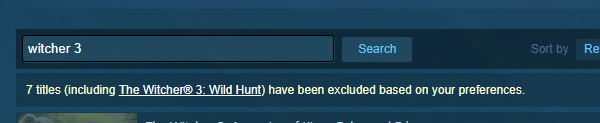
We did our best to ensure you can safely ignore swaths of games in the store, but still find them if you look directly via the search tool. If the game that we think you’re searching for is hidden due to your mature content settings, we identify that and let you know in a safe way. For example, if you have your preferences set to hide mature games with violence, but you search for The Witcher 3, you’ll see this:

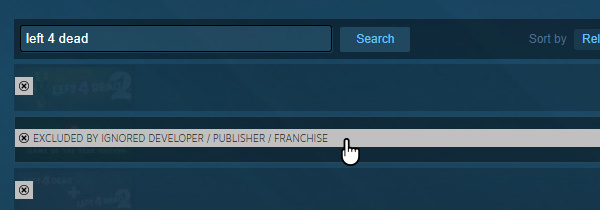
If there are games that your search should contain that you’re ignoring for other reasons (due to its developer, or game tags, for instance), we’ll still include it in the list, but we’ll blur it out and when you hover over it you can see why it is darkened. For example, if you’ve chosen to ignore games by Valve, and then search for Left 4 Dead, you’ll see this:

A third set of changes focused on allowing you to have better control over the kinds of mature content you see. So far, the Store has allowed you to filter out games that feature Frequent Violence/Gore or Nudity/Sexual Content. After looking at the mature content in submissions we’re receiving, and at some games that are already in the Store, we’ve added two more options. The first is a general Mature Content filter. We often see developers who tell us their game contains mature content, but not sex or violence, and you can now filter those games out if you wish. The second is an Adults Only filter, which allows you to filter out games that feature explicit sexual content.

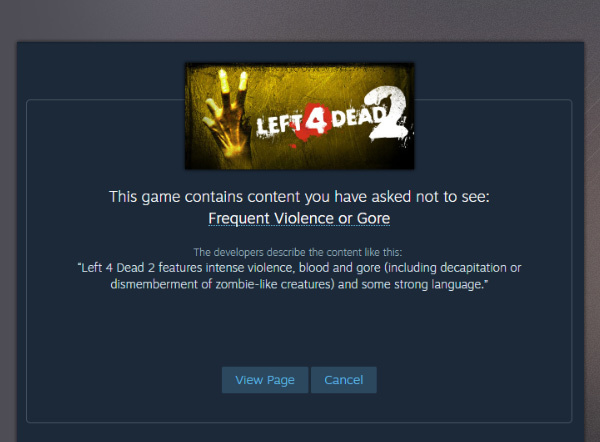
We’re also now requiring developers of games with violent or sexual content to describe the content of their game, and we’re using that information to help you decide whether a game is something you’re comfortable with. We think the context of how content is presented is important and giving a developer a place to describe and explain what’s in their game gives you even more information when browsing and considering a purchase. When you’re looking at the store page of a game with mature content, we’ll display that developer-written description to you. We’re also displaying it on the interstitial page we show you if you ever follow a direct link from outside steam to a game that should be filtered for you:

Finally, we’ve continued our efforts in removing bad actors from the Store. Last year we made changes to Trading Cards to address the ways a small set of developers were producing ‘games’ that generated revenue without anyone actually buying and playing them. Recently we made more changes to address other ways these bad actors were continuing to do it. We’ve also permanently banned several developers of games that we felt fit the “straight up trolling” description of games we’re not going to allow onto the Store. There’s actually a surprisingly small number of individuals behind almost all of these games, and their bans have been a straightforward series of decisions, thus far. You can read more about the shorthand of “straight up trolling,” and the process of making those decisions in the Q&A below.

With these sets of changes, we hope you have a better sense of how we’re approaching building a store that works for all developers and players. There’s still plenty of work to do. In our previous post we identified a range of things, from parental controls to tools for developers to manage their communities. In addition, some of the changes described in this post will require more options when we see new kinds of content in game submissions. Going forward, we aim to continue this strategy of shipping features as they’re finished, and posting periodic updates as to the nuts and bolts and the thinking behind their development.

Q&A

Q: What about games that are already in the store that include mature content?

A: Every developer will be encouraged to update their game with the customer-facing descriptions outlined above but in most cases Valve moderators will going back through the catalog and making sure games are complying with the new requirements.

Q: What do you mean, in practice, when you say you won’t ship games that are “outright trolling?” That seems vague.

A: It is vague and we’ll tell you why. You’re a denizen of the internet so you know that trolls come in all forms. On Steam, some are simply trying to rile people up with something we call “a game shaped object” (ie: a crudely made piece of software that technically and just barely passes our bar as a functioning video game but isn’t what 99.9% of folks would say is “good”). Some trolls are trying to scam folks out of their Steam inventory items, others are looking for a way to generate a small amount of money off Steam through a series of schemes that revolve around how we let developers use Steam keys. Others are just trying to incite and sow discord. Trolls are figuring out new ways to be loathsome as we write this. But the thing these folks have in common is that they aren’t actually interested in good faith efforts to make and sell games to you or anyone. When a developer’s motives aren’t that, they’re probably a troll.

Our review of something that may be “a troll game” is a deep assessment that actually begins with the developer. We investigate who this developer is, what they’ve done in the past, their behavior on Steam as a developer, as a customer, their banking information, developers they associate with, and more. All of this is done to answer the question “who are we partnering with and why do they want to sell this game?” We get as much context around the creation and creator of the game and then make an assessment. A trend we’re seeing is that we often ban these people from Steam altogether instead of cherry-picking through their individual game submissions. In the words of someone here in the office: “it really does seem like bad games are made by bad people.”

This doesn’t mean there aren’t some crude or lower quality games on Steam, but it does mean we believe the developers behind them aren’t out to do anything more than sell a game they hope some folks will want to play.

Q: Sometimes I see blurred out games on my Store front page. Why is that?

A: There are a number of sections on the front page that we fill with games, and to ensure the servers behind it don’t melt down as everyone tries to use it, we do a lot of data caching. This works great for data sets that we can easily pre-compute – so if there’s a game you shouldn’t see due to your mature content filters, you’ll never see it on the front page. But if you’ve chosen to do some more personal filtering of particular developers, or specific games, we can’t do that pre-computation as easily. As a result, it’s possible you’ll see a blurred out game on the front page because your personal filters should cause it to be hidden. In practice, though, this will only happen if you’ve filtered out so many games that it can’t find enough to fill a section of the front page, and again, like the search results, we’ll blur that game out and tell you why.

Q: Why do you KEEP asking my damn age throughout the store?

A: We’re with you on this. Unfortunately, many rating agencies have rules that stipulate that we cannot save your age for longer than a single browsing session. It’s frustrating, but know we’re filling out those age gates too.

Posted on Leave a comment

Review: Evergarden

A gardener’s life is a busy one. There is always weeding, pruning, and dead-heading to be done; not to mention the constant battle against slugs, snails and battalions of other pesky creepy-crawlies. Evergarden is a puzzle game that lets you create glorious floral displays without ever getting soil under your nails or suffering from an aching back.

The aim of Evergarden is to bring life back to the forest by filling the world with impressive displays of flowers. The play area consists of a hexagonal grid and the basic premise is to match like-for-like flowers.  Matching two flowers will produce one of a higher level. You will begin the game with seedlings, which only have a single petal, but drag two adjacent seedlings together and you will create a new plant with two petals. You carry on like this, eventually creating huge six-petal blooms. Flowers of any size can also drop a new seed into an adjoining space. Ending your current turn will give these seeds the opportunity to germinate into seedlings.

EG Early

This all sounds pretty straightforward, if you have ever played Triple Town then you will be on familiar ground. However, dig a little deeper and things begin to get more interesting. A horticulturally-savvy fox-like creature named Fen oversees your progress and will request various patterns of flowers.  Meeting his aesthetic requirements is definitely worth the effort, as the reward is a flower that you can add to your inventory and then place on any space of your choice.  Evergarden has a further trick up its sleeve, in that combining two of the highest-level flowers will create a stone monolith, which will earn you three extra turns. This is a big deal as you initially only have ten turns to amass a high score. Monoliths are extremely useful as they can also be used as wildcards to help complete Fen’s requests, and at the end of the game, each monolith will produce a gemstone.

Between games, you can explore the world of Evergarden, in what is billed as a narrative adventure. This seems to be stretching things a little as it basically amounts to justcollecting additional hidden gems andsolving tangram-style puzzles. It never feels like you are part of an overarching story, but the rewards on offer make up for this minor disappointment. Completing these puzzles will reward you with either sage words of wisdom, which often provide clues to the location of new gems or gramophone records. There are a total of eight records to collect, and they are not only pleasing on the ear but also allow you to add a new special ability to your inventory. The abilities on offer include summoning a falcon to rid you of a garden pest, or you can summon a rainstorm, which improves the levels of all nearby plants. Your inventory is limited to only three items, so with bonus flowers and new records to accommodate, it quickly fills up and requires some careful management.

EG Gramophone

Initially, your choices seem fairly obvious, but after a while, you realise that the game requires more thought than first impressions suggest. Managing your dwindling space is the key concern, especially when you start creating monoliths and creatures begin to invade your garden, taking up even more of your precious space. Some of these pests (I’m looking at you Mr Rabbit) even enjoy munching your flowers. The increasingly complex demands of Fen and tight turn limits will soon have you scratching your head.  Fen’s requests often require quite high levels of spatial awareness and it can be very demanding to cultivate the correct level flowers in the appropriate places. Although the atmosphere always remains chilled-out and relaxing, the game’s challenge is not to be underestimated.

This atmosphere is enhanced by some very pleasing aesthetics. Evergarden’s simple geometric graphics are both very pleasing and very practical. The autumnal colours set the laidback scene and the calming audio feedback and short bonus tunes add to the relaxed feel. The simple controls also work well; dragging the flowers together is intuitive and responsive. All of these factors conspire to make a game that remains stress-free and hardly ever becomes frustrating. Evergarden takes a minimalistic approach to presentation; an air of mystery is maintained by encouraging the player to discover how the game works through actually playing rather than explaining. Some may find this approach a little off-putting. When you start playing you are not really sure what you need to do, but the game is simple enough and everything slowly reveals like a flowering bud.

EG Late Game

One major concern is that each attempt has to be completed in a single sitting. A playthrough can take around twenty minutes, which means that the lack of a save game option could be a problem for gamers on the go.  I also found the game tended to chomp through my battery quicker than slugs through a lettuce patch. The main puzzle game itself is interesting but doesn’t really change from game to game. The initial incentive to keep playing is to unlock the special powers. However, it is a bit disappointing that some of the bonus abilities are obviously more powerful than others. Having to battle away to acquire large amounts of gems to earn an ability that you will probably never use can feel anticlimactic.

Evergarden’s developers estimate that the game will take between four to eight hours to fully explore. After this, it is all about breaking into the global high score tables. Consequently, it is more of a Tetris high score chaser rather than the type of puzzler where you have to pit your wits against increasingly difficult levels. Unlocking all of the game’s secrets does not require particularly high levels of skill, just the persistence to keep playing and adding to your gem collection. The game’s so-called narrative aspect is disappointing, being just a means for acquiring the additional abilities. I didn’t feel that it was really telling a story.  Having said that, I still think that many people are going to enjoy this polished and relaxing puzzler. You don’t need green fingers to create a wonderful floral display, but you will need to apply a fair bit of thought and planning.

Posted on Leave a comment

Now Available on Steam – 428 〜封鎖された渋谷で〜

428 〜封鎖された渋谷で〜 is Now Available on Steam!

渋谷で起こった誘拐事件を中心に、主人公5人の運命が描かれる。5人の主人公それぞれの時間軸が存在し、シナリオを読み進めていく途中で別の主人公の特定時間へ”ジャンプ”できる。各主人公のシナリオに出現する選択肢は、他の主人公のシナリオに影響する場合があるため、慎重な選択が必要となる。

Posted on Leave a comment

Dota 2 Update – September 5th, 2018

It’s been a few months since we talked about how we want to approach shipping games with controversial content. In that blog post we talked about some of the tools we felt we needed to build and we thought it would be good to give you an update on where we are. We’ve done a number of things since that post, some which may seem unrelated, but if we are going to maintain an open view of what gets onto the Store, then you’ll need good tools to find the games you want, as well as avoid the things you don’t.

The first set of our changes focused on improving how you can find new games. We’ve added Developer & Publisher homepages so you can easily get from a game you love to others made by the same creators, or follow them if you want to be notified whenever they say or make something. We significantly reworked how our Upcoming Games Lists functioned, so they’re much better at showing you upcoming games that you might be interested in, or upcoming extra content for a game you’ve been playing a bunch.

A second set of changes was focused on improving how you can ignore things you’re not interested in. In the past you’ve been able to ignore individual games or product types (like VR, or Early Access) you didn’t want to see again. But now we’ve added ways for you to also easily ignore individual developers, publishers, and curators.

We’ve also improved the game tag filters on your account preferences. Previously, it was a list of 3 game tags that you wanted to see less of. We’ve now increased the number of tags you can list to 10, and made them into a harder filter – in short, the Store now assumes you want to ignore all the games that feature any of those tags in their most popular tags, instead of just using them as suggestions to our recommendation engine.

We did our best to ensure you can safely ignore swaths of games in the store, but still find them if you look directly via the search tool. If the game that we think you’re searching for is hidden due to your mature content settings, we identify that and let you know in a safe way. For example, if you have your preferences set to hide mature games with violence, but you search for The Witcher 3, you’ll see this:

If there are games that your search should contain that you’re ignoring for other reasons (due to its developer, or game tags, for instance), we’ll still include it in the list, but we’ll blur it out and when you hover over it you can see why it is darkened. For example, if you’ve chosen to ignore games by Valve, and then search for Left 4 Dead, you’ll see this:

A third set of changes focused on allowing you to have better control over the kinds of mature content you see. So far, the Store has allowed you to filter out games that feature Frequent Violence/Gore or Nudity/Sexual Content. After looking at the mature content in submissions we’re receiving, and at some games that are already in the Store, we’ve added two more options. The first is a general Mature Content filter. We often see developers who tell us their game contains mature content, but not sex or violence, and you can now filter those games out if you wish. The second is an Adults Only filter, which allows you to filter out games that feature explicit sexual content.

We’re also now requiring developers of games with violent or sexual content to describe the content of their game, and we’re using that information to help you decide whether a game is something you’re comfortable with. We think the context of how content is presented is important and giving a developer a place to describe and explain what’s in their game gives you even more information when browsing and considering a purchase. When you’re looking at the store page of a game with mature content, we’ll display that developer-written description to you. We’re also displaying it on the interstitial page we show you if you ever follow a direct link from outside steam to a game that should be filtered for you:

Finally, we’ve continued our efforts in removing bad actors from the Store. Last year we made changes to Trading Cards to address the ways a small set of developers were producing ‘games’ that generated revenue without anyone actually buying and playing them. Recently we made more changes to address other ways these bad actors were continuing to do it. We’ve also permanently banned several developers of games that we felt fit the “straight up trolling” description of games we’re not going to allow onto the Store. There’s actually a surprisingly small number of individuals behind almost all of these games, and their bans have been a straightforward series of decisions, thus far. You can read more about the shorthand of “straight up trolling,” and the process of making those decisions in the Q&A below.

With these sets of changes, we hope you have a better sense of how we’re approaching building a store that works for all developers and players. There’s still plenty of work to do. In our previous post we identified a range of things, from parental controls to tools for developers to manage their communities. In addition, some of the changes described in this post will require more options when we see new kinds of content in game submissions. Going forward, we aim to continue this strategy of shipping features as they’re finished, and posting periodic updates as to the nuts and bolts and the thinking behind their development.

Q&A

Q: What about games that are already in the store that include mature content?

A: Every developer will be encouraged to update their game with the customer-facing descriptions outlined above but in most cases Valve moderators will going back through the catalog and making sure games are complying with the new requirements.

Q: What do you mean, in practice, when you say you won’t ship games that are “outright trolling?” That seems vague.

A: It is vague and we’ll tell you why. You’re a denizen of the internet so you know that trolls come in all forms. On Steam, some are simply trying to rile people up with something we call “a game shaped object” (ie: a crudely made piece of software that technically and just barely passes our bar as a functioning video game but isn’t what 99.9% of folks would say is “good”). Some trolls are trying to scam folks out of their Steam inventory items, others are looking for a way to generate a small amount of money off Steam through a series of schemes that revolve around how we let developers use Steam keys. Others are just trying to incite and sow discord. Trolls are figuring out new ways to be loathsome as we write this. But the thing these folks have in common is that they aren’t actually interested in good faith efforts to make and sell games to you or anyone. When a developer’s motives aren’t that, they’re probably a troll.

Our review of something that may be “a troll game” is a deep assessment that actually begins with the developer. We investigate who this developer is, what they’ve done in the past, their behavior on Steam as a developer, as a customer, their banking information, developers they associate with, and more. All of this is done to answer the question “who are we partnering with and why do they want to sell this game?” We get as much context around the creation and creator of the game and then make an assessment. A trend we’re seeing is that we often ban these people from Steam altogether instead of cherry-picking through their individual game submissions. In the words of someone here in the office: “it really does seem like bad games are made by bad people.”

This doesn’t mean there aren’t some crude or lower quality games on Steam, but it does mean we believe the developers behind them aren’t out to do anything more than sell a game they hope some folks will want to play.

Q: Sometimes I see blurred out games on my Store front page. Why is that?

A: There are a number of sections on the front page that we fill with games, and to ensure the servers behind it don’t melt down as everyone tries to use it, we do a lot of data caching. This works great for data sets that we can easily pre-compute – so if there’s a game you shouldn’t see due to your mature content filters, you’ll never see it on the front page. But if you’ve chosen to do some more personal filtering of particular developers, or specific games, we can’t do that pre-computation as easily. As a result, it’s possible you’ll see a blurred out game on the front page because your personal filters should cause it to be hidden. In practice, though, this will only happen if you’ve filtered out so many games that it can’t find enough to fill a section of the front page, and again, like the search results, we’ll blur that game out and tell you why.

Q: Why do you KEEP asking my damn age throughout the store?

A: We’re with you on this. Unfortunately, many rating agencies have rules that stipulate that we cannot save your age for longer than a single browsing session. It’s frustrating, but know we’re filling out those age gates too.