Posted on Leave a comment

The Best Games Like Diablo for Android & iOS

Diablo. It’s one of the most popular, successful, and beloved gaming franchises in the world. The very first entry came out in 1996 and it and its two successors defined the huge hack-and-slash action-RPG genre that exists today. The franchise is known for its story-driven campaign, fast-paced combat, diverse class options, and deep skill trees. Diablo III is the very model of a comprehensive gear system that allows for some serious min-maxing along with ample end-game content for gamers who don’t mind the grind.

Want to look at mobile RPGS in general? This list might be of interest.

There’s no version of Diablo on Android or iOS, though Diablo III may be headed to the Switch. Close, but no cigar. There are, however, a number of mobile titles that capture parts of what makes Diablo great that fans of the series should definitely check out.

Barbearian (Review)

Developer: Kimmo Lahtinen
Platform: iOS Universal
Price: $8.99

[embedded content]

2018 has seen the release of a couple games that have earned a place on this list and Barbearian is foremost among them. Barbearian features frenetic fights against death-defying odds, a combat style that is very reminiscent of Diablo III. You charge into and through huge hordes of enemies and send their lifeless bodies flying in every direction. These fast-paced battles are about where the similarities end. The game follows a story but is driven by its action and does not have the quest lines associated with standard RPGs. Nevertheless, it’s a heck-of-a-lot-of fun and I got over fifteen hours of entertainment out of completing all of the content. I gave it five stars in my review and recommend you check it out for a lot more on why Barbearian is great. 

Battleheart 2 (Review)

Developer: Mika Mobile
Platform: iOS Universal and Android
Price: $3.99

[embedded content]

Also new this year, Battleheart 2 picks up where the original Battleheart game left off seven years ago. It features real-time combat where you control up to four characters, chosen from a variety of options, in a series of battles to gain loot and experience. As you level up you unlock new skills and talents to enhance those skills. There’s also a variety of gear and four different slots in which to equip it. This creates some opportunity for Diablo-like min-maxing. Battleheart 2, unlike its predecessor, offers a co-operative mode for up to four players along with an Arena mode where you face down wave after wave of enemies to see how far you can get. This is simplified version of Diablo III‘s rift system. An unintentional game mode has also arisen: AFK (away from keyboard) Arena. Astute min-maxers have realized that Cyrus, the necromancer, raises skeletons from the dead that automatically lock onto and attack the nearest enemy without any player intervention. An optimized Cyrus can go deep into the Arena without any help from the player. If that doesn’t speak to the spirit of Diablo III, I’m not sure what does. 

Crashlands (Review)

Developer: Butterscotch Shenanigans
Platform: iOS Universal and Android
Price: $6.99

[embedded content]

Crashlands is a survive/craft/explore game where you play as an intergalactic UPS driver who crashed on an alien world. You must figure out how to survive and get yourself, and your precious packages, off the planet and on your way. What does Crashlands have to do with Diablo? It’s the combat and gear. Pretty much everything you come across is looking to kill you and it is best to wheel around and shake and bake, all the while attacking with your homemade arsenal of weaponry. Even more similar is the game’s surprisingly expansive gear system. Flux, the game’s main character, rocks a primary weapon, four secondary devices (bombs, flamethrowers, freeze rays, that kind of thing), four trinkets that provide various bonuses, and four armor pieces. All of this equipment provides bonuses to damage, critical hits, move speed and more along with providing special abilities like life drain, stunning your target, and a whole lot more. She also has the power of Juicemancy at her disposal, which allows you to optimize your gear by upgrading it and rerolling stats until you get the stats you want. Crashlands is a fantastic game and merges the exploration and crafting of Minecraft with the combat and gear optimization of Diablo III

Titan Quest (Review)

Developer: Dot Emu
Platform: iOS Universal and Android
Price: $6.99

[embedded content]

For those looking for the traditional RPG quests and storyline, Titan Quest is the most Diablo-like you can get on a tablet. It started on the PC as an attempt to replicate the success of Diablo II and was later ported to iOS and Android. Set in the ancient, pre-Roman world it also has solid loot acquisition—there are over 1200 items which can be enhanced with runes. There are also diverse skill trees, called masteries, from which you pick two. The masteries essentially decide your class and provide some great variation, customizability, and high replay value to the game. The mobile version of the game has had plenty of issues—including frame rate and saved game issues—but it is still one of the better Diablo-like titles.

Bastion

Developer: Supergiant Games
Platform: iOS Universal
Price: $4.99

[embedded content]

Action RPGs are frequently known less for story and ambiance than, well, the action. Bastion, the debut title from Supergiant Games, is different. Bastion’s story—set after the Calamity, a devastating event that shattered the city of Caelondia—is amazing. You play as the Kid; a survivor skilled in the ways of the new, violent world. The Kid meets a man named Rucks who directs efforts to collect the cores that once fuelled Caelondia and rebuild a bit of what was lost. Rucks also serves as the game’s outstanding narrator, who gives both play-by-play and color commentary on the Kid’s every action and every mistake. Bastion’s soundtrack is perfect, and its graphics are still impressive after all these years. The action is fast-paced and chaotic very much like the Diablo games. There are various weapons from which to choose, though gear plays a smaller role in Bastion. This is definitely the game for you if you value the action and production values of Diablo over its loot and min/maxability. 

Rogue Wizards (Review)

Developer: Spellbind Studios
Platform: iOS Universal
Price: Free ($5 Gem Drops x 2 IAP recommended)

[embedded content]

If you’re looking for dungeon-delving action and gear optimization of Diablo III without the real-time pressure, Rogue Wizards is the perfect game for you. It features a great deal of variation in gear and slots in which to equip it, a town with upgradeable shops from which to buy and sell, and even a Treasure Goblin. Rogue Wizards feature a strong storyline, but the turn-based combat is king. Once you’ve completed the quests, there’s still plenty to do in the game’s Gauntlet mode, a high-score chasing dungeon where you see just how far you can go. The game is free-to-play and the monetization is easy to ignore if so desired, though I recommend the “Gem Drops x 2” IAP which brings progression in line with the premium Steam version. I’ve already written quite a bit about the Rogue Wizards, and its monetization, and you can check out my five-star review and game guide for more. 

Eternium

Developer: Making Fun, Inc.
Platform: iOS Universal and Android
Price: Free (with IAP)

[embedded content]

One of the closest games to Diablo III on mobile is Eternium. You play as an adventurer—a mage, warrior, or bounty hunter—on a quest to stop Ragadam, an ancient evil, from bringing an apocalyptic plan to fruition. The adventure hops between multiple planets in the universe and you’ll face dragons, aliens and more deadly creatures. You collect companions as you go to help you face the increasingly dangerous foes in your path. Both you and your companions will gain new and varied powers as you level, which you cast by drawing symbols on the battlefield. 

Gear is a huge consideration in Eternium, and there is a ton of it. As in Diablo, you can equip something on nearly every major body part and each piece of gear has several attributes that enhance your abilities. The game also features gems, which can be combined into even better gems and slotted into items for bonuses. Eternium even duplicates Diablo’s features that allow you to add sockets to equipment that doesn’t have it, collect sets of gear, and reroll an attribute for an item.

Eternium is a free-to-play game and uses gems as its primary currency. The game is well balanced, you don’t need to buy gems in order to play but can do so to unlock certain quality-of-life options faster. I spent $5 to get an additional companion slot earlier and more character storage space, for example. You can watch optional ads for more gems and there is a setting to turn them off entirely for those who want to avoid the temptation.

The campaign is extensive and Eternium also includes a series of special “trials”, think rifts from Diablo. Gameplay is good but nowhere near as great as Blizzard’s series. That’s a high bar to clear, however, and Eternium will definitely scratch the itch on your mobile device.

What would your list of favourite Diablo-like games look like? Let us know in the comments!

Posted on Leave a comment

Now Available on Steam – NBA 2K19

Save up to 80% in the Made with GameMaker sale during this week’s Midweek Madness*!

GameMaker Studio 2 is the latest and greatest incarnation of GameMaker! It has everything you need to take your idea from concept to finished game. With no barriers to entry and powerful functionality, GameMaker Studio 2 is the ultimate 2D development environment!

Over 40 games made with GameMaker are on discount during this sale as well as GameMaker Studio 2 at its lowest price ever on Steam! Whether you want to play these amazing games or start making games, check out the deals today!

*Offer ends Friday 10am Pacific Time

Posted on Leave a comment

NBA 2K19 hits the court today

NBA 2K19 hits the court today

NBA 2K celebrates 20 years of redefining what sports gaming can be—continuing to push limits as it brings gaming one step closer to real-life basketball excitement and culture.

Features:

  • TAKE CONTROL WITH TAKEOVER – Harness your MyPLAYER’s full basketball potential with the new Takeover feature. Unlock special moves and abilities never before seen on the court, or activate Team Takeover and unleash the power of your full squad.
  • RUN THE NEIGHBORHOOD – You won’t want to miss a single day in the updated Neighborhood. Make a name for yourself on the court, at the Under Armour Cages, and during live events on the block. Ball until dawn with new day to night transitions, walk on at the Jordan Rec Center, or get the old Crew back together for exciting 3 on 3 streetball action.
  • MyTEAM – Create your very first MyPLAYER card, and ball with LeBron, Kobe, and the rest of your collection in a variety of competitive modes. Introducing the new Unlimited mode, allowing you to pick any five cards from your deck without restrictions and battle against other players online.
  • MyCAREER – From neighborhood legend to global phenomenon. The original career story mode returns with an all-new, immersive narrative charting your journey from China to the G League and eventually the NBA. Featuring an all-star cast, endorsements tied to your popularity, and new team chemistry elements that allow you to dominate the hardwood.

If you would like to purchase the game, please visit https://www.nintendo.com/games/detail/nba-2k19-switch.


Users Interact
In-Game Purchases

Posted on Leave a comment

Video: How Dream Daddy fostered player inclusivity

In this GDC 2018 talk, Game Grumps’ Tyler Hutchison discusses the initial goals of Dream Daddy, and how it managed to become something that made a whole lot of people from different backgrounds very happy.

Hutchison explains how Dream Daddy was critically praised for providing players with inclusive representation, examining how certain options were included and the choices and development hours that were required to include them.

With a little love and potentially a small investment of time, he explains how developers can make their game inclusive and give players more representation in character choices.

It’s an insightful talk that’s definitely worth watching, so developers shouldn’t miss the opportunity to do so now that it’s freely available on the official GDC YouTube channel!

In addition to this presentation, the GDC Vault and its accompanying YouTube channel offers numerous other free videos, audio recordings, and slides from many of the recent Game Developers Conference events, and the service offers even more members-only content for GDC Vault subscribers.

Those who purchased All Access passes to recent events like GDC or VRDC already have full access to GDC Vault, and interested parties can apply for the individual subscription via a GDC Vault subscription page. Group subscriptions are also available: game-related schools and development studios who sign up for GDC Vault Studio Subscriptions can receive access for their entire office or company by contacting staff via the GDC Vault group subscription page. Finally, current subscribers with access issues can contact GDC Vault technical support.

Gamasutra and GDC are sibling organizations under parent UBM Americas.

Posted on Leave a comment

Developing the first mobile Spider-Man game before the App Store

“Obviously I was bluffing, I didn’t have all the money. The goal was to convince them that we had the financial backing and we could do this.”

– Vishal Gondal, a dev on what’s reportedly the first mobile Spider-Man game, speaks to Gadgets 360 about licensing. 

While Spider-Man games have been developed for nearly every console, the superhero’s first mobile game debuted in 2003 thanks to a small studio in India. 

In an interview with Gadgets 360, game designers from Mumbai-based Indiagames discuss development of the first mobile iteration of Spider-Man, which was put together in under a month and nearly shipped with assets taken from Spider-Man: Mysterio’s Menace for the Game Boy Advance.

It’s always interesting to see how mobile games were developed and published before the conception of Google Play and the Android Marketplace, especially for a licensed IP like Marvel’s Spider-Man. 

Before Indiagames went on to develop Spider-Man, the studio was best known for making generic mobile arcade games and was fairly successful, looking to extend its reach beyond India and parts of South East Asia.

“We were at E3 2003 when the idea struck that if we can get a certain amount of revenue on non-branded titles what if can get a big brand? Maybe that could make us a lot of money,” developer Vishal Gondal explains. “On a piece of paper I started writing down the names of every big superhero like Spider-Man and Batman.”

“Coincidentally at E3 itself we met the guy who represented Marvel Comics,” he adds. “In that meeting we said that we’d be interested in licensing Spider-Man.”

“They didn’t know who we were and they never licensed anything like this to a company outside of the US. Before this, no Spider-Man mobile game was made.”

Thus began the licensing talks. Marvel initially licensed the rights to Activision, but since Activision hadn’t developed the game the rights had to come from Activision and not Marvel directly. It had to be structured as a deal involving Marvel Comics, Activision, and Indiagames.

“Even before we got the license, we started making the game,” Gondal says. “Our goal was the day we get the license, in a few weeks we should launch the game.”

“Typically what used to happen was you get the license, you make the game, that takes three to six months and then you launch the whole thing. As we were negotiating the deal with Marvel, the game was already under production so we were ready.”

But the game had a very strict deadline and needed to be released within a tight time frame, and Indiagames was given one month to complete Spider-Man. Their source material was also restricted to the comics, but the studio was given freedom over what kind of game they wanted to develop.

Because of the short deadline, the small team initially took assets from Spider-Man games on Nintendo’s Game Boy Advance as placeholders which nearly made it into the final product. 

The interview was part of a larger conversation around how the very first Spider-Man game on mobile was developed, so be sure to read the entire piece over at Gadgets 360.

Posted on Leave a comment

German org calls on Sony to fix ‘customer-hostile’ terms & conditions

Sony is facing possible legal action in Germany after the Consumer Association of North Rhine-Westphalia (Verbraucherzentrale NRW) issued a complaint regarding the terms and conditions imposed on customers using PlayStation Network. 

This isn’t the first time Sony has been called out for their terms and conditions of PSN, as the Norwegian Consumer Council issued a similar complaint against Sony, Origin, and Steam back in April for violating European consumer protection laws (the complaints were later dropped).

A cease and desist letter reportedly sent to Sony by the NRW claims to have found three sections where the terms and conditions of PSN were “incompatible with the law”.

The first includes a “customer-hostile” policy where prepaid funds uploaded to PSN expire after 24 months should they go unused. 

Secondly, the NRW is criticizing policy governing a customer’s right of withdrawal regarding pre-orders and pre-payments on video games. The group claims it has found no indication that customers must explicitly agree to forgo this right when completing digital purchases.

The last claim attempts to fight back against a clause where Sony is holding parents responsible for any in-game purchases that are made by young children.

The NRW confirmed that it will apply for a court order against Sony if the cease and desist is not heeded.

Posted on Leave a comment

Daily Deal – Transport Fever, 50% Off

It’s been a few months since we talked about how we want to approach shipping games with controversial content. In that blog post we talked about some of the tools we felt we needed to build and we thought it would be good to give you an update on where we are. We’ve done a number of things since that post, some which may seem unrelated, but if we are going to maintain an open view of what gets onto the Store, then you’ll need good tools to find the games you want, as well as avoid the things you don’t.

The first set of our changes focused on improving how you can find new games. We’ve added Developer & Publisher homepages so you can easily get from a game you love to others made by the same creators, or follow them if you want to be notified whenever they say or make something. We significantly reworked how our Upcoming Games Lists functioned, so they’re much better at showing you upcoming games that you might be interested in, or upcoming extra content for a game you’ve been playing a bunch.

A second set of changes was focused on improving how you can ignore things you’re not interested in. In the past you’ve been able to ignore individual games or product types (like VR, or Early Access) you didn’t want to see again. But now we’ve added ways for you to also easily ignore individual developers, publishers, and curators.

We’ve also improved the game tag filters on your account preferences. Previously, it was a list of 3 game tags that you wanted to see less of. We’ve now increased the number of tags you can list to 10, and made them into a harder filter – in short, the Store now assumes you want to ignore all the games that feature any of those tags in their most popular tags, instead of just using them as suggestions to our recommendation engine.

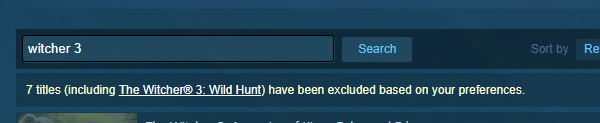
We did our best to ensure you can safely ignore swaths of games in the store, but still find them if you look directly via the search tool. If the game that we think you’re searching for is hidden due to your mature content settings, we identify that and let you know in a safe way. For example, if you have your preferences set to hide mature games with violence, but you search for The Witcher 3, you’ll see this:

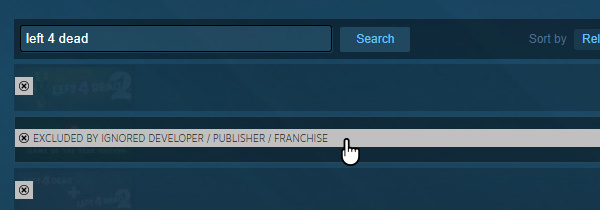
If there are games that your search should contain that you’re ignoring for other reasons (due to its developer, or game tags, for instance), we’ll still include it in the list, but we’ll blur it out and when you hover over it you can see why it is darkened. For example, if you’ve chosen to ignore games by Valve, and then search for Left 4 Dead, you’ll see this:

A third set of changes focused on allowing you to have better control over the kinds of mature content you see. So far, the Store has allowed you to filter out games that feature Frequent Violence/Gore or Nudity/Sexual Content. After looking at the mature content in submissions we’re receiving, and at some games that are already in the Store, we’ve added two more options. The first is a general Mature Content filter. We often see developers who tell us their game contains mature content, but not sex or violence, and you can now filter those games out if you wish. The second is an Adults Only filter, which allows you to filter out games that feature explicit sexual content.

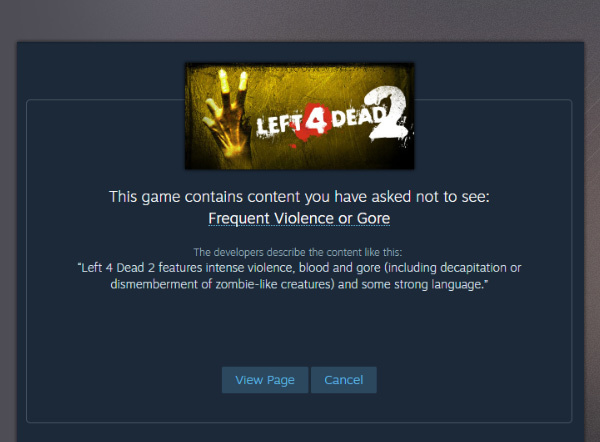
We’re also now requiring developers of games with violent or sexual content to describe the content of their game, and we’re using that information to help you decide whether a game is something you’re comfortable with. We think the context of how content is presented is important and giving a developer a place to describe and explain what’s in their game gives you even more information when browsing and considering a purchase. When you’re looking at the store page of a game with mature content, we’ll display that developer-written description to you. We’re also displaying it on the interstitial page we show you if you ever follow a direct link from outside steam to a game that should be filtered for you:

Finally, we’ve continued our efforts in removing bad actors from the Store. Last year we made changes to Trading Cards to address the ways a small set of developers were producing ‘games’ that generated revenue without anyone actually buying and playing them. Recently we made more changes to address other ways these bad actors were continuing to do it. We’ve also permanently banned several developers of games that we felt fit the “straight up trolling” description of games we’re not going to allow onto the Store. There’s actually a surprisingly small number of individuals behind almost all of these games, and their bans have been a straightforward series of decisions, thus far. You can read more about the shorthand of “straight up trolling,” and the process of making those decisions in the Q&A below.

With these sets of changes, we hope you have a better sense of how we’re approaching building a store that works for all developers and players. There’s still plenty of work to do. In our previous post we identified a range of things, from parental controls to tools for developers to manage their communities. In addition, some of the changes described in this post will require more options when we see new kinds of content in game submissions. Going forward, we aim to continue this strategy of shipping features as they’re finished, and posting periodic updates as to the nuts and bolts and the thinking behind their development.

Q&A

Q: What about games that are already in the store that include mature content?

A: Every developer will be encouraged to update their game with the customer-facing descriptions outlined above but in most cases Valve moderators will going back through the catalog and making sure games are complying with the new requirements.

Q: What do you mean, in practice, when you say you won’t ship games that are “outright trolling?” That seems vague.

A: It is vague and we’ll tell you why. You’re a denizen of the internet so you know that trolls come in all forms. On Steam, some are simply trying to rile people up with something we call “a game shaped object” (ie: a crudely made piece of software that technically and just barely passes our bar as a functioning video game but isn’t what 99.9% of folks would say is “good”). Some trolls are trying to scam folks out of their Steam inventory items, others are looking for a way to generate a small amount of money off Steam through a series of schemes that revolve around how we let developers use Steam keys. Others are just trying to incite and sow discord. Trolls are figuring out new ways to be loathsome as we write this. But the thing these folks have in common is that they aren’t actually interested in good faith efforts to make and sell games to you or anyone. When a developer’s motives aren’t that, they’re probably a troll.

Our review of something that may be “a troll game” is a deep assessment that actually begins with the developer. We investigate who this developer is, what they’ve done in the past, their behavior on Steam as a developer, as a customer, their banking information, developers they associate with, and more. All of this is done to answer the question “who are we partnering with and why do they want to sell this game?” We get as much context around the creation and creator of the game and then make an assessment. A trend we’re seeing is that we often ban these people from Steam altogether instead of cherry-picking through their individual game submissions. In the words of someone here in the office: “it really does seem like bad games are made by bad people.”

This doesn’t mean there aren’t some crude or lower quality games on Steam, but it does mean we believe the developers behind them aren’t out to do anything more than sell a game they hope some folks will want to play.

Q: Sometimes I see blurred out games on my Store front page. Why is that?

A: There are a number of sections on the front page that we fill with games, and to ensure the servers behind it don’t melt down as everyone tries to use it, we do a lot of data caching. This works great for data sets that we can easily pre-compute – so if there’s a game you shouldn’t see due to your mature content filters, you’ll never see it on the front page. But if you’ve chosen to do some more personal filtering of particular developers, or specific games, we can’t do that pre-computation as easily. As a result, it’s possible you’ll see a blurred out game on the front page because your personal filters should cause it to be hidden. In practice, though, this will only happen if you’ve filtered out so many games that it can’t find enough to fill a section of the front page, and again, like the search results, we’ll blur that game out and tell you why.

Q: Why do you KEEP asking my damn age throughout the store?

A: We’re with you on this. Unfortunately, many rating agencies have rules that stipulate that we cannot save your age for longer than a single browsing session. It’s frustrating, but know we’re filling out those age gates too.

Posted on Leave a comment

Review: The Draugr

As far as solitaire board games go, The Draugr stands out as an example of how the iOS can give a game that could easily vanish in the tide of competition some much needed exposure. In some more nuanced ways, it can also be an example of how removing some of the tactile experiences can change how easy it is to comprehend a game, at first.

The titular draugr are a collective force to be reckoned with. Drawn from a pool at the beginning of the game, six of them descend on the town of Stjordal. Their task is simple and cruel – slowly corrupt the people and places of the region with their undead magic. You, a lone revenant hunter, can’t just stand by and let this happen.

The undead menace plays the long game, only slowly compromising prominent people and places in town until they topple to the darkness. You must run from place to person and back, protecting them from harm, and being persistent in your rebuke of these twisted villains. Your only tools of the trade are iron spikes, holy water, and your wits.

Draugr5

If The Draugr does one thing well above all others, it’s translating a sense of tenacious doom. No matter how hard you work, the end always feels like it’s near. The tokens that mark the spread of corruption multiply quickly. The randomness of where they can be spread is sort of a clever chaos. Even when you can prevent the spread in some way, it’s usually only partially, and often at the opportunity cost of re-upping supplies, or taking the fight to the beasts directly.

The randomness can create some inconsistent experiences, though. A random, unseen roll is made to determine where the corruption spreads during the next ‘corruption phase’ and which draugr causes it. They each divide the locations among each other, so you can have a top line look at who can hurt whom. But how much corruption can happen from turn to turn feels completely inconsistent. Sometimes, just one point of interest is affected, other times, the whole row feels like it’s under attack. It feels impossible to really counterplay. That seems like the point here, but if someone’s first game is one of these randomly bad ones, then it almost guarantees that it’ll be their last one.

Draugr7

And for as much personality famed Irish artist Harry Clarke adds to the game’s key art and the pictures of the draugr, the creatures are massively bland mechanically. Each are defined by how many units of spikes and holy water it takes to slay them. A handful of them impose a penalty when they strike, taking some of your resources as well as corrupting places or people. But there isn’t much difference between Ivers and Lord Molton save for their names. It almost doesn’t matter whose name is drawn during the corruption phase, because they all do the same thing.

Each have varying amounts of necessary spikes and water necessary to kill them, so over multiple sessions you develop macro-level strategies. That’s where the game’s real commanding charm reveals itself: through repetition. Any given session can take upwards of 20 minutes, which is no time at all in board game minutes. Learning how to react tactically to a board driven completely by chance is engrossing. It does its best to replicate that you-versus-the-cold-machine vibe well executed in games like Arkham Horror. For what it lacks as far as in depth board game mechanics, The Draugr has a speed running sort of appeal to it that you really only find in roguelike video games these days.

Draugr9

The Draugr holds up as a mobile app, but there are things that aren’t translated well to the digital format. Besides the collectors appeal of having the physical cards on a shelf somewhere, some physical cues are missing that helped pass on some simple mechanics. A single die roll tells you which draugr will attack and where, thanks to the combination of numbers and symbols on the die. In the video game, there is no roll, just some border flashing and a tossing of tokens. It leads to the same end, but a bit less elegantly.

On the other side of that token, this would have been a great opportunity to add visual cues that you couldn’t add in the physical version of the game. For example, The Nunnery and The Foundry are locations that you can choose to forgo gaining resources from in order to protect all townspeople or locations from corruption, respectively. Once you choose the option, turns sort of go by unbothered, and maybe you did stop a person or place from being targeted thanks to your sacrifice. Since you aren’t actually rolling dice and passing out physical markers, and there’s no visual signifier that you’re protecting something this turn, you don’t have the same satisfaction in your sacrifice. It’s a ‘gamefeel’ thing that I didn’t expect to see as a problem until several runs deep.

Draugr3

And the app itself suffers from some minor, but annoying, bugs and glitches. More than once has a draugr flashed, notifying me that it will attack, and then never stop flashing. It’s a cosmetic blunder that always seems to translate into a mechanical one, because that draugr now requires multiple taps to register things that previously only took one or two.

All told, The Draugr is a very clever single player card game in a world where they are few and far between. Finding the physical version may be a challenge, and though there are plenty of pluses to pursuing it versus this digitized version, being able to engage with these simple yet shrewd systems on the train or on a lunch break is handy. It’s imperfect in execution, but it delivers the tension and desperation of a lone peace keeper trying to fend of the imminent and inevitable threat with the best of them.

Posted on Leave a comment

Video Game Deep Cuts: Putting The AR in Artifact?

The following blog post, unless otherwise noted, was written by a member of Gamasutra’s community.
The thoughts and opinions expressed are those of the writer and not Gamasutra or its parent company.


[Video Game Deep Cuts is a weekly newsletter from video game industry ‘watcher’ Simon Carless (GDC, Gamasutra co-runner), rounding up the best longread & standout articles & videos about games, every weekend.

This week’s highlights include an article about Facebook Messenger’s AR microgames, a detailed look at Valve’s upcoming Artifact card game, & lots more besides.

So here’s a cornucopia of good links for the week – spanning all kinds of craziness. And it’s been a pretty busy week or two in terms of new game releases, too – with Marvel’s Spider-Man (linked below!) the talk of the Internets.

And then there’s Dragon Quest XI making it to the West, Two Point Hospital(Theme Hospital++, from some of the original devs!) & SCUM (uh, incredibly dystopic multiplayer shockfest from Devolver & friends) breaking out on Steam. And lots more to come soon…

Until next time…

– Simon, curator.]

——————

The 16 surprising new games that made PAX West an absolute blast (Sam Machkovech / Ars Technica – ARTICLE)
“But as Ars’ sole PAX West attendee, I needed downtime to genuinely process the remainder of what I saw. And after a week to think on it, I’m ready to identify this year’s stand-out games. [SIMON’S NOTE: a useful necessarily subjective round-up, and note the mention of Square/Human Head’s fascinatingly weird The Quiet Man, which mystified many at the show.]”

DOOM: The Fake Outrage (Shaun / YouTube – VIDEO)
“[SIMON’S NOTE: all extremely meta, but this is a well-done video about how an ambiguous joke in the next DOOM game’s trailer about ‘mortally challenged’ demons managed to fuel the outrage machine & magnify the tribalism.]”

A Beginner’s Guide To Pinball Designers (Dennis Kriesel / This Week In Pinball – ARTICLE)
“The most fundamental element in any pinball playing experience is the playfield design itself. Home to the game’s action, playfield design began as the main challenge of creating a good pin and remains a major element even as software aspects have grown in importance. [SIMON’S NOTE: more of a glossary than anything, but this is a majorly underdiscussed area outside of pinball fan circles.]”

15 Types of Hyper Casual and Arbitrage Games (Yaniv Nizan / Soomla – ARTICLE)
“These changes set the ground for the emergence of Arbitrage Games. Some people call them Hyper Casual Games but actually some arbitrage games are just good old casual games and in general the main difference with this trend is not the game genre but actually the business model. [SIMON’S NOTE: you may be grumpy about them, but it’s worth understanding the trend! Found via Kenneth Liu’s ‘Kliuless? Gaming Industry ICYMI’newsletter, which is new & good!]”

Marvel’s Spider-Man – Insomniac’s technology swings to new heights (John Linneman / Digital Foundry / Eurogamer – ARTICLE & VIDEO)
“From a technological standpoint, Marvel’s Spider-Man represents the pinnacle of Insomniac’s prowess, albeit one that shows a clear process of evolution starting from Xbox One exclusive Sunset Overdrive, gaining considerable polish and refinement in 2016’s Ratchet and Clank. [SIMON’S NOTE: it’s doing pretty damn well critically, too – smart of Sony to grab it as a PS4 exclusive.]”

The 25 Games We Can’t Wait To Play This Holiday Season (Staff / The Verge – ARTICLE)
“It’s far too much for any one person to play, so we created this handy guide so you can keep track of the most exciting games and be ready for when they come out. The guide is in chronological order — aside from a few stragglers without specific release dates — to make things as easy as possible. [SIMON’S NOTE: this is pretty useful, yep – and I still think this holiday is a bit LESS packed than normal for AAA due to big publishers wanting to stay away from Red Dead Redemption 2.]”

Game Design Patterns for Building Friendships (Daniel Cook / GDC / YouTube – VIDEO)
“In this 2018 GDC session, Spry Fox’s Daniel Cook explains how to keep human beings from being treated as interchangeable, disposable or abusable when designing multiplayer games. [SIMON’S NOTE: not multiplayer-specific, but Spry Fox’s super cute – and not super F2P exploitative – Alphabear 2 came out this week for mobile!]”

The Weird History Of The Super NES CD-ROM, Nintendo’s Most Notorious Vaporware(Chris Kohler / Kotaku – ARTICLE)
“Nintendo never released a CD-ROM gaming system. But for a while in the early 1990s, it flirted with the idea. That protracted will-they-won’t-they romance produced pages of breathless gossip columns in video game magazines, a mountain of vaporware, some terrible Zelda games, and one priceless prototype.”

Was that a reference to Magritte? Video games: Design/ Play/ Disrupt review (Keza McDonald / The Guardian – ARTICLE)
“But there are no Pong or Pac-Man arcade cabinets, short profiles of technological innovators or glass displays of old PlayStations in the V&A’s Videogames: Design/Play/Disrupt exhibition, opening this week. This is the first such major exhibition to treat games as a modern cultural force, and it begins its examination in the mid-00s.”

How modders are removing enemies from games to create stress-free experiences (Sam Greer / PC Gamer – ARTICLE)
“Mods for games are usually additive. New features, forgotten content… mods are usually about putting more into a game. Yet in recent years we’ve seen the rise of a particular kind of mod that takes things away. Specifically, taking away a game’s enemies or threats.”

‘Golden Axe: Beast Rider:’ Inside a $15 Million Blunder (Matt Paprocki / Variety – ARTICLE)
“After a change in executive leadership in late 2004, Sega sought developers for a number of potential franchise reboots. Sega’s intent was to break into the American marketplace with something appealing to a western audience. Developer Secret Level, having worked with new Sega CEO Simon Jeffrey during his time at LucasArts, chose to pitch their vision of “Golden Axe.””

Cease and Desist – Parodies and Infringement in Video Games (Kurt Kalata / Hardcore Gaming 101 – ARTICLE)
“This article covers a list of games that contain materials that could be considered infringing, and then altered for subsequent re-releases, either in later revisions or in ports down the line. Not every case here actually had legal action brought against them, or were even threatened – in some cases, it seemed like the publisher/developer realized there could be a potential problem and made the changes proactively.”

Exclusive: Valve walks us through Artifact’s new demo (Sam Machkovech / Ars Technica – ARTICLE)
“Garfield may be an experienced and thoughtful game designer, but he’s not a gentle instructor. I have to goad him into describing exactly how the game works. In my first moments playing the game (which I’d briefly sampled at an event in March), he urged me to hit the corpse-lined ground running. [SIMON’S NOTE: I think this game is going to be big – it looked super-slick at PAX West.]”

Defying Gravity games communities outside of London (Jordan Erica Webber / Creative Economy / Medium – ARTICLE)
“Several people I spoke to for this series pointed out that improvements in technology and infrastructure mean that game developers don’t have to locate themselves in London.. But people still want a community, and the UK has several regional organisations and events aimed at bringing together local developers and providing them a sense of group identity, or tempting new talent to relocate from elsewhere.”

Facebook’s next big augmented reality push is multiplayer games (Edgar Alvarez / Engadget – ARTICLE)
“On a recent visit to its Seattle office, where Facebook’s Real Time Communication team is based, we got to take a look at some unreleased AR games for Messenger. The hope, Facebook says, is that these multiplayer experiences can make the app even more popular than it already is.”

Retrohistories: Under the Radar: The Sabotage of SimCopter (Chris Chapman / YouTube – VIDEO)
“This is the story of a ‘bug’ in Maxis’s 1996 open world game SimCopter that wasn’t what it appeared to be, and how it was intertwined with the origin story of one of the world’s most infamous pranksters.”

Three days in the woods with Psychonauts 2 backers (Blake Hester / Polygon – ARTICLE)
“It’s late, approaching 1:00 in the morning. It’s the end of a long weekend of laughter, eating burgers, drinking and celebrating. Collected are families, fans and 40 to 50 employees of the game studio Double Fine. They’re all here for the same reason: to celebrate Double Fine’s upcoming game Psychonauts 2.”

The Cell Structure: How Supercell Turned the Traditional Org-Chart Upside Down (Ilkka Paananen / Supercell / YouTube – VIDEO)
“In this 2018 GDC talk, Supercell’s Ilkka Paananen digs into the management lessons he’s learned as a company founder, sharing his experience from building an unconventional organizational structure for Supercell (Clash Of Clans, Clash Royale, etc.).”

The YouTube stars heading for burnout: ‘The most fun job imaginable became deeply bleak’ (Simon Parkin / The Guardian – ARTICLE)
“For years, YouTubers have believed that they are loved most by their audience when they project a chirpy, grateful image. But what happens when the mask slips? This year there has been a wave of videos by prominent YouTubers talking about their burnout, chronic fatigue and depression. [SIMON’S NOTE: This led to a Hank Green piece, ‘How am I not burned out?’, that I’d recommend everyone who has a job that’s also a passion should read.]”

Watching a real urban planner play SimCity is incredibly satisfying (Mark Wilson / Fast Company – ARTICLE & VIDEO)
“SimCity is one of the greatest video game franchises of all time, if only because it demonstrates something important: Designing a city from scratch is very hard, and it’s impossible to make everyone happy all the time. That’s even more evident thanks to UC Berkeley PhD student Dave Amos, who studies urban planning and whose commentary on the game offers a hilarious criticism of both game design and planning bureaucracy.”


——————

[REMINDER: you can sign up to receive this newsletter every weekend at tinyletter.com/vgdeepcuts – we crosspost to Gamasutra later on Sunday, but get it first via newsletter! Story tips and comments can be emailed to [email protected] MINI-DISCLOSURE: Simon is one of the organizers of GDC and Gamasutra & an advisor to indie publisher No More Robots, so you may sometimes see links from those entities in his picks. Or not!]