Posted on Leave a comment

Get a job: Join Crate Entertainment as a Sr. Tech Artist

The Gamasutra Job Board is the most diverse, active and established board of its kind for the video game industry!

Here is just one of the many, many positions being advertised right now.

Location: Boston, Massachusetts

Crate Entertainment, the creators of Grim Dawn, are looking for a 3D tech artist who will be passionate about working with the team to realize the technical and aesthetic goals of our next games. Primary duty will begin on an unannounced game being developed with Unreal Engine. For that reason, the ideal candidate will have expertise with Unreal Engine and tools that can be leveraged for the benefit of other team members.

We currently have multiple projects in the works using both commercial and proprietary engines. Crate is a small but well funded and independent studio with no need for publishers or investors. Our culture is casual and no-BS but we also pride ourselves in efficiency and working hard. Crate has no physical office and has always operated on a remote, work-from-home model.

Responsibilities

  • Contribute to the creation of 3D art assets on various projects. We do not currently have specific character or environment roles, so you must be willing to work on either or both as needed.
  • Help in setting up tools, workflows and materials / shaders for other content creators.
  • Work with engineers to maintain and optimize game performance.
  • Work with designers and engineers to rapidly iterate and refine gameplay systems and features.

Requirements

  • 4+ years industry experience, with experience working in Unreal Engine.
  • At least one credit on a released PC / Console game.
  • Proficient with 3D Studio Max
  • Mastery of UE4 blueprint, material editor, shader graph, cascade and post processes.
  • Understanding of UE4 art and animation process and pipelines
  • Self-directed, with an ability and initiative to assess your own work and continue to improve it and bring it up to an exceptional level of quality.
  • Ability to collaborate and communicate effectively with team members and potentially handle working on multiple projects simultaneously.
  • Must be living in or willing to relocate to MA, NH, CA, or FL (due to payroll and tax logistics). Crate can assist with relocation costs.

Desired Qualifications

  • Love for RPG and Strategy games.
  • The ability to rig, animate and implement character animations is a big plus.
  • Experience creating effects
  • Enjoy working in a semi-realistic, detailed art style as seen in our existing games.

Interested? Apply now.

Whether you’re just starting out, looking for something new, or just seeing what’s out there, the Gamasutra Job Board is the place where game developers move ahead in their careers.

Gamasutra’s Job Board is the most diverse, most active, and most established board of its kind in the video game industry, serving companies of all sizes, from indie to triple-A.

Looking for a new job? Get started here. Are you a recruiter looking for talent? Post jobs here.

Posted on Leave a comment

Best of 2020: How Jackbox CEO Mike Bilder is grappling with quarantine-driven success

As stay-at-home orders spread across the world in February to March, Chicago-based game developer Jackbox Games found itself in an unusual position.

While it chose to send its developers home to work remotely, players were tuning in from all over the world to play their party games. A lot of players. According to CEO Mike Bilder, the company’s traffic has been at holiday levels every day since about March 13th. 

Through Zoom, Discord, and every other platform you can think of, all kinds of people are playing the Jackbox Party Packs at unprecedented levels. For a company that built its success on fart jokes and digital trivia, unexpected success during a global crisis came as a massive surprise. 

Since we at Gamasutra have ALSO been playing an excessive amount of Jackbox, we reached out to Bilder for a conversation about how this unexpected traffic has impacted its operations, and how it’s grappling with players remotely accessing a game meant to be played around the TV in a living room. 

Just to get started, can you explain how stay-at-home orders have impacted Jackbox’s traffic and sales? 

We’ve definitely seen quite a large uptick in traffic, meaning people just playing the games, but also we’ve had new customers buying games and playing them. It probably happened around the same timeframe that everybody really started the whole shelter in place…in mid-to-late March. I think the 13th of March is when we as a company decided it’s time to go virtual. And so really around that same timeframe is when all that traffic and awareness of our game started to really grow. 

How did the Jackbox team deal with all the new traffic? 

Well, it was because it happened very quickly. It was certainly a little more reactive than proactive. We did have that issue of stability. And I’ll give you just a kind of a comparison–typically the times of year that are really big for us are around the holidays. So, Thanksgiving, Christmas, and New Year’s. People are home, people are playing with friends and family.

First and foremost, our games are designed to play together in the same room, playing on a big screen, everybody takes their phones out and plays. What we’ve seen since we’ve been under this quarantine is every single day is about the [level of] traffic of Thanksgiving–it’s actually higher than Thanksgiving now–and every weekend is as big or bigger than New Year’s Eve, which is typically the biggest night of the year for us.

That’s kind of crazy. So we’ve had to be reactive, we had some stability problems, we basically had to scale overnight to a huge volume of traffic. And we’re used to doing that when we can predict it. But in this case, we had to react to it. So we’ve hired a number of contractors to help us both on the customer support side [and] we had already been planning to hire some server and infrastructure engineers and kind of accelerated the timing of that. We’ve largely triaged that. And things have been stable and working and operating very, very well since then. But yeah, it was a bit of a reaction for us.

We as a company are obviously thrilled that there are so many people playing our games and we are very happy and glad that in this super anxious time that people can laugh and still socialize by playing our game. So we’re proud of that. We’re happy about it, but we also recognize that a ton of new people have been introduced to our products just because of this quarantine. 

So we want to do some good around this. And we actually just announced today that we’re hosting a 10-episode charity event with celebrities and we’re going to be donating $100,000 each event to a COVID-19 charity or some charity that’s either directly helping those that are affected by it or helping first responders. So we’re trying to do some goodwill here too, and give back because we’ve had the fortune of some success recently. But we want to make sure that we’re also taking care of people that are affected by the ongoing crisis.

You mentioned these games were intended to be played in-person, around a TV. How have you adapted to people playing over video calling software like Zoom, or through streaming?

So here’s a little anecdote when we first started this whole game, this phones-as-controllers kind of paradigm. It was back in 2014 when we launched Fibbage and then we quickly launched the first Jackbox Party Pack right after that, and people started playing it over Twitch and Mixer and they were streaming our games, and anyone that was watching would join the game and play.

I guess we anticipated that was something that would happen, but we didn’t anticipate the volume and interest in that happening. And so we quickly embraced that. As more Party Packs released, and on Quiplash’s standalone release, we added a bunch of features. To embrace streamers, we added extended timers for the stream delay, we added some VIP methodology to start the game, and we have [added] a bunch of other features over the years to embrace [remote play].

We’re certainly taking a look at the way people are playing our games now over video conferencing software. And we’re also trying to identify what works best. I mean, there are pros and cons to each of them out there–Teams and Hangouts and Zoom, etc. Some of them work better than others. Some of them share the audio better than others. But some of you have to pay for, and some are free. So we’re trying to compile information and recognize what the best solution is in the near term.

We’ve done an extensive blog post on that to give people some tips and tricks on how to set it up for success. But I do think from a design perspective, we’re paying attention and should this become a new norm, unfortunately, you know, we’ll definitely take some design steps to embrace it and make it a better experience for people. 

Has working remotely impacted your team’s performance at all?

I think it’s like everybody else we can be effective. I mean, we make software so people can be remote and still be effective at doing it. The challenge for us more than anything is we’re a games company and we make five games a year that go under the banner of a single packaged product and there’s just a ton of iteration that happens throughout that.

There’s a lot of impromptu design points, like “hey grab these five people and play the game over lunch. Let’s do some critiques. Let’s hone in on it make some tweaks to it do it again tomorrow.” And we have to do that kind of thing now over scheduled Zoom calls or something, and it’s a little more cumbersome than it is to just pull people all in the same physical space and kind of kick the tires on something. 

But things are on track. We don’t anticipate any real big slippage. We plan to still ship in the fall with our party back. But you know, the same challenges people have being remote, we have similar ones. 

Jackbox isn’t the only company seeing success in this pandemic–but other companies who are doing well, like Netflix, are anticipating a potential drop in customers later in the year, either from a recession or just because success in Q1 eats into the people who can buy your product in Q2. Has that impacted your plans for the company?

I completely anticipate that will happen. I mean, I think from a business perspective there will be some stabilization of the marketplace and there will be just a correction back to a norm. 

What that norm is a little TBD. For us. I personally anticipate the normal to settle at something higher than that. It typically has been for us just because we’ve introduced a whole bunch of new people to our ecosystem. And, you know, we have more than anecdotal data to show that if you play a party pack and you’re a consumer of it, there’s a high likelihood at some point, you’re going to buy another party pack in our catalog. 

So I hope and expect that we’re not going to crash below where we were. But that will level out at least to where we were before and what we were projecting for the year and maybe slightly higher going forward, which would be amazing.

Like, as long as it doesn’t turn into Facebook where it’s not cool anymore because you know, parents and grandparents are playing it, as long as that doesn’t happen, I’m great. 

While Jackbox is doing well with new customers, your website still lists the game on traditional platforms that may only be accessible to people familiar with video games. Have you thought about how that may impact non-traditional game players and how they can buy your games? 

We have had the philosophy for a long time to try and get on as many platforms as we can that’s reasonable or feasible. And at this point, I think we’re on 12 different platforms. So from a consumer’s perspective, if you’re not a console person, but you have a PC, then you know, we’re on PC, Mac, and Linux. If you’re not even a PC gamer, but you’ve got a set-top box like fire TV or Apple TV or even the Comcast XFINITY X1, you can find our games on all those platforms as well. 

And I think we kind of straddle this–we’re not a hardcore game, and we’re not a mobile game. But we fall in this casual realm where those devices in those boxes actually become a meaningful place to find our games for people to actually consume them and play. I think what’s interesting is right now…is we’re seeing a lot of activity in the PC in the Mac space right now for, as you would assume, obvious reasons. That’s where you can do video conferencing and screen sharing the easiest, right? 

You could certainly fire up Zoom on your iPad or your laptop and point the camera at your television, but it’s much easier to just do it as we’re doing this video call right now with screenshare, and have the game natively running on the machine. 

So we’ve seen a lot of purchases geared towards PC and Mac because that is where people’s videoconferencing is. How we change that going forward–there’s no immediate plan for us to make our own platform or have our own service online where you go to it to play the game or something. We’re still embracing these other marketplaces. But are there ways to do better integrations with videoconferencing? Are there better executions to be had? Those are all things that we’re thinking about right now and trying to work on.

Yeah, just for comparison, I’ve been playing on my Switch, running it through our Teams streaming software. But I’d bought the games on my Switch so I could cart them around the country during the holidays! 

You’re technologically savvy, right? The easiest platform right now has been Zoom. Zoom has a way to when you share the screen, there’s a checkbox to say share [the computer’s] audio as well. And that actually works pretty well. So if you’re running a Zoom client on Mac or PC and you’re running a native game on Mac or PC, that seems to be the best [tool]. The challenge with that is Zoom becomes a paid service, right? Then it’s just dealing with the 40-minute limit for the free service and then you have to pay.

We’d love to find one platform we can advise everyone to use, that’s both free and solves the audio problem and allows video transfer. 

What would you say to developers who think now is the best time to jump into making digital party games? (Besides, “stay out, this is our turf?”)

(laughs) …If you’re looking to get into space, the party game genre is kind of an odd genre. I’ve been in the game space for over 20 years now. At one point, you probably would associate [digital “party games” with] things like Rock Band and Guitar Hero and these giant party games that swept the nation at one point–even some of the karaoke games [like] SingStar. There’s not a ton happening, at least in the console space, in the marketplace in the party game space. 

There’s a lot of indie stuff that happens, and there’s a lot of mobile stuff. There’s a lot of Steam indie games, there’s a lot of things along those lines. So, check out what’s out there and see [if] you’ve got a cool game idea that’s not identical to one that’s out there, and see what you can do, but do it better. 

Posted on Leave a comment

Cyberpunk 2077 sales climb to 13 million copies despite launch issues

Following a rough launch fraught with bugs, digital storefront drama, and reports of borderline mutiny within a crunch-laden studio, CD Projekt Red announced a staggering 13 million units sold of Cyberpunk 2077, the company said Tuesday.

The latest figures represent numbers as of December 20, or 10 days after launch and put the game in the upper echelon of successful game releases when it comes to sales.

The 13 million figure is up from the 8 million preorders the company announced earlier this year, and includes physical and digital refunds of the game, which were prompted by issues players encountered soon after launch.

CDPR’s statement said it disclosed the latest milestone “due to its potential impact on investment-related decisions,” showing the company is keen to point out the game’s financial success to investors thus far.

Since the game’s launch, the CDPR has had to address the game’s bugs, performance issues (particularly on ubiquitous last-gen consoles), and navigate its relationship with Sony, which pulled the game from the digital PlayStation Store post-launch, in an unprecedented move.

Posted on Leave a comment

Who’s playing what on PlayStation 5?

<!– –> Gamasutra: Simon Carless’s Blog – Who’s playing what on PlayStation 5?

Gamasutra is part of the Informa Tech Division of Informa PLC

This site is operated by a business or businesses owned by Informa PLC and all copyright resides with them. Informa PLC’s registered office is 5 Howick Place, London SW1P 1WG. Registered in England and Wales. Number 8860726.

Gamasutra: The Art & Business of Making Gamesspacer

<!–

–>

If you enjoy reading this site, you might also want to check out these UBM Tech sites:


Share on Twitter    RSS

The following blog post, unless otherwise noted, was written by a member of Gamasutra’s community.
The thoughts and opinions expressed are those of the writer and not Gamasutra or its parent company.


[The GameDiscoverCo game discovery newsletter is written by ‘how people find your game’ expert & GameDiscoverCo founder Simon Carless, and is a regular look at how people discover and buy video games in the 2020s.]

Welcome to the final GameDiscoverCo newsletter before the holidays! It’s been a bit of a crazy year, huh? Looks like there’s a lot to get through in this edition. (Though we’ll still have at least one newsletter before the end of 2020.)

We should probably get to it, huh? Let’s go:

A PlayStation 5 playtime primer

So, it’s not the biggest sample size in the world, but I’ve been keeping an eye on the PS Time Tracker website recently. It allows players to add a bot as a friend on PSN, and then has the bot keep a track of the games you’re playing. (Don’t shut this down, Sony – it’s interesting!)

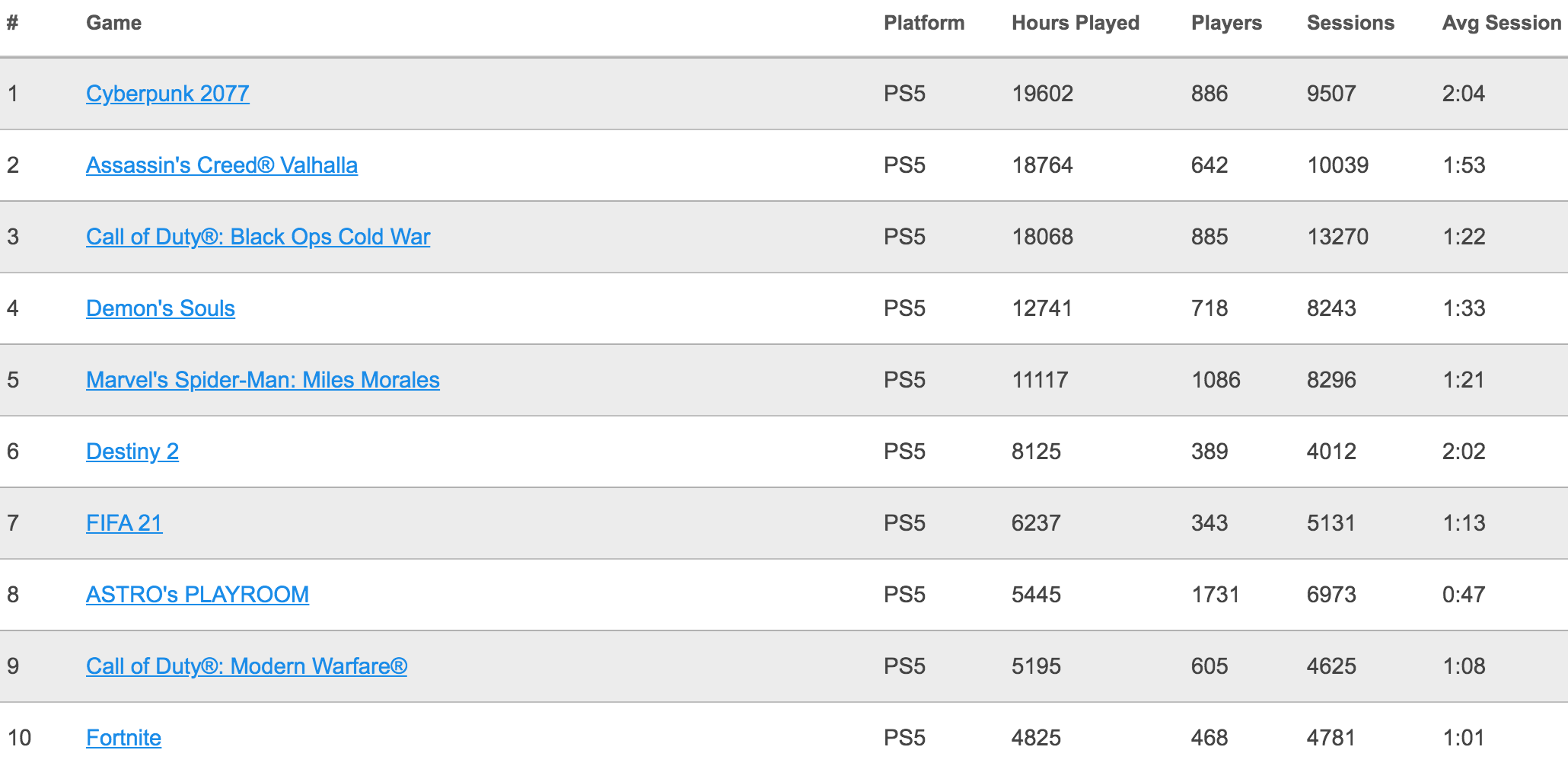
In the above image, there’s the Top 10 PlayStation 5 games played over the last 30 days, with number of sessions and average playtimes, from a sample size of 3,018 active players. (Presumably mostly English language & more ‘core’ gamers!) The top 100 is listed here.

Not surprising to see Cyberpunk 2077 atop the list (despite not having been out for 30 days!) But I did think it notable that Assassin’s Creed Valhalla is doing so well playtime-wise (averaging 30 hours per player?) And the Demon’s Souls remake has been the standout PS5 exclusive from a playtime perspective right now.

The other obvious lesson? People are still playing plenty of previously released titles (like FIFA 21, Destiny 2, and Fortnite), with varying degrees of graphical upgrade, just because they’re great titles that are frequently updated. While ‘only on PS5’ works in a few cases, it’s really the cross-gen sell that cements the deal for prospective buyers.

Briefly, the site also does have PlayStation 4 Top 100 playtime stats. And wow, Grand Theft Auto V is still doing so well (partly because of its GTA Online GaaS elements, I’m sure!) And there’s lots of GaaS-y stuff in the Top 50, as you’d expect, since this is all about playtime. Anyhow, poke around, and hopefully learn some things you didn’t know!

Follow-ups: eShop discounts, ‘Growth stocks’

A couple of recent GameDiscoverCo newsletters have seen more widespread feedback, so here’s a couple of follow-ups:

First, the newsletter discussing the eShop’s crackdown on extreme discounting ended up getting pretty popular, including a re-report by Polygon citing GameDiscoverCo. There were some skeptics on the ‘$1.99 minimum for North American eShop’ report, because there are still a handful of games that show up cheaper.

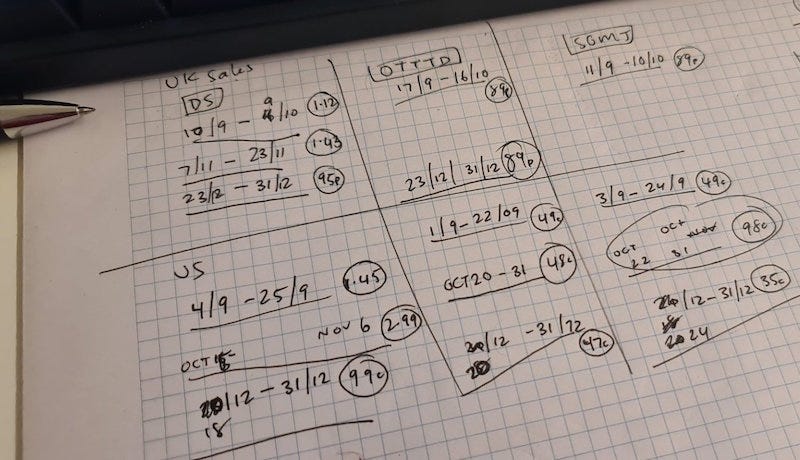
But it turns out this is due to some devs (like SMG Studio of Death Squared fame, ahem) setting their discounts months and months ahead, before the rule changed:

Relatedly, it was pointed out as a follow-up that the Japanese eShop has capped the maximum sale price to 100 yen (~1 USD). But due to the more, uhh, ‘orderly’ approach to Switch in Japan, there’s been less crazy discounting in general for Switch in Japan. Which really can’t be said for North America or Europe, haha.

(Though Martin Lindell does note that he “imagines there will be more games releasing as IARC is now approved, meaning no CERO certificate required for the JP eShop.” This is a good point, as CERO was a bit of a nightmare(tm).)

Secondly, the opinion piece on game company acquisitions and ‘the growth stock bubble’ had an excellent reply from Edo Salvesen at Finstock Capital, a London-based company that specializes in video game financing.

Edo makes the fair point that it’s not just company execs that are hot on making acquisitions, it’s also their shareholders: “Those games companies which are listed [on public stock exchanges] (Team 17/Keywords etc) and are already generating profit are being questioned by investors what they are doing with the excess cash they are producing.

They have a number of options available to them. They could return it to shareholders [as dividends], but it’s in management’s interest to keep hold of it and prove that they can hit long term incentives. By returning to shareholders they are limiting their own growth plans – so they would argue that by investing in Company A/B or C, they are generating better returns.”

So ‘game companies are profitable, nothing else to do but buy more companies, since your investors insist on it’ seems to be the reality for public firms, in this growth-centric ecosystem. Not a massive fan of this infinite roll-up scenario, but that’s where we are at.

Thanks for supporting GameDiscoverCo in 2020!

Before we get to the round-ups, wanted to thank all of you for reading and supporting the GameDiscoverCo newsletter – and the company – in 2020! Consulting clients like No More RobotsDotemuAkupara Games & a number of others I can’t talk about have made it a rewarding and fun time for us so far.

And I definitely want to thank those who supported the GameDiscoverCo Plus newsletter and data tier when it launched – it’s already one of the top 10 paid technology newsletters on the Substack platform, after just a month or so, woo.

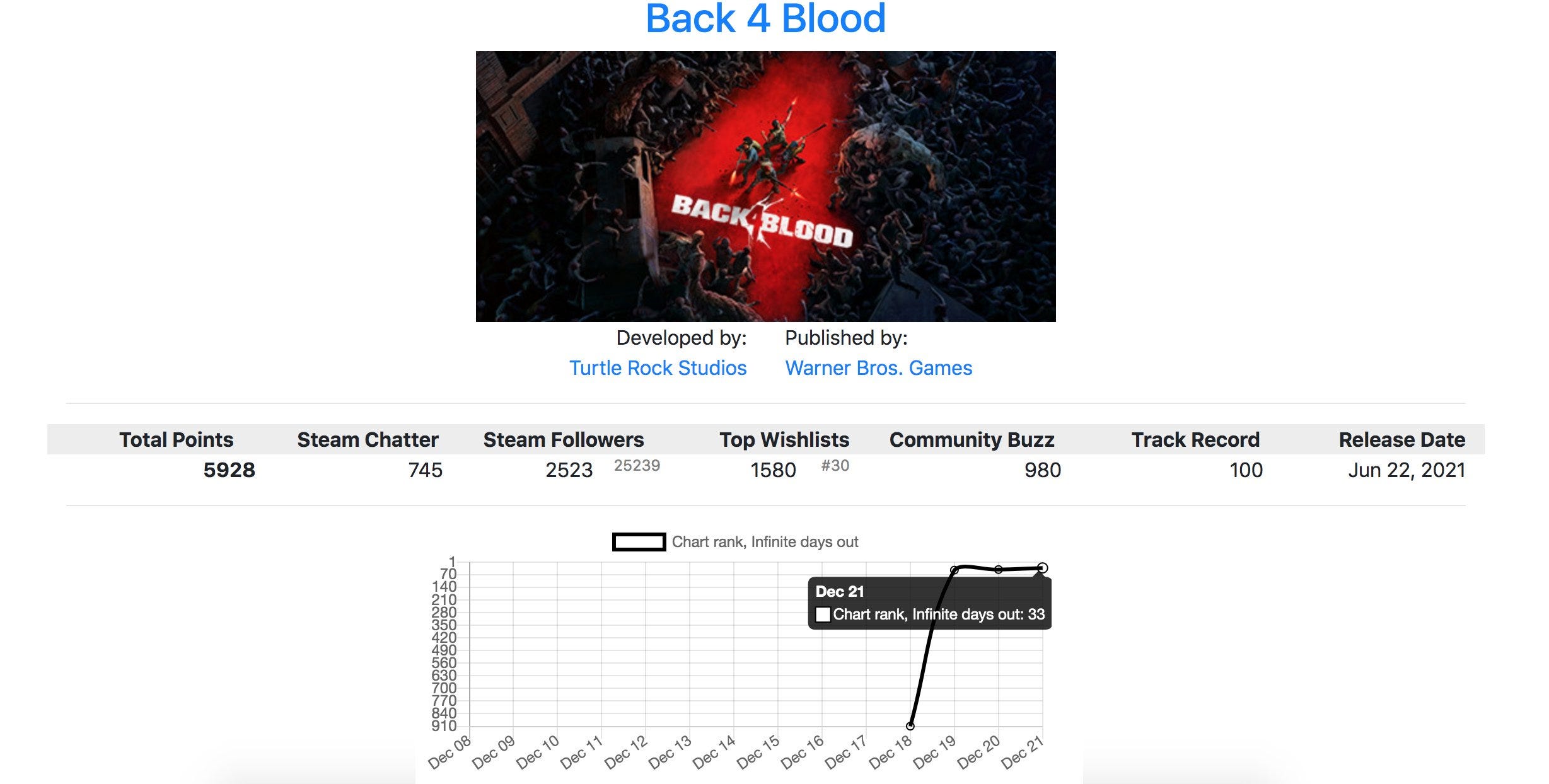
While I’m here, a quick note about enhancements for GameDiscoverCo Plus subscribers. We recently added Steam Hype scores on our Plus back-end details page for every single unreleased Steam game, updated daily & browsable on demand. (I showcased this on Twitter, re: Back 4 Blood’s swift rise to a near-Top 30 Hype score as one of the most anticipated Steam games. And did you know that Party Animals is now #1 on the GameDiscoverCo Steam Hype list, after Cyberpunk’s release?)

We’re not planning to make GameDiscoverCo a ‘data coming out of our ears’ Newzoo or EEDAR competitor. But we will continue augmenting our Plus-exclusive newsletters with interesting data, AMAs, Discord conversations and analyses you can’t get elsewhere – so sign up & help us keep up the good work!

The game discovery news round-up..

Since the last newsletter didn’t have any round-up elements, we’re backed up with just a few billion links here. So let’s bust ‘em all out at once and dissolve your brain into gelatinous material:

  • Some of you may remember this from last year, but Facepunch Studios (Rust, Garry’s Mod) is very, very transparent – so much so that its 2020 year in review blog posted its lifetime revenue for both games. Comparing it to 2019’s post, looks like Rust sold 530,000 copies during 2020, and grossed another $43 million during the year (wow – it’s $40, and has DLC and an item store.) And Garry’s Mod did $11 million gross and 1.7 million extra copies. Pocket change, then.

  • Lots of Steam stuff: the Valve team published a retrospective on the Autumn Sale noting that “just shy of a million players bought a game or made a microtransaction on Steam for the very first time (a 33% increase over the same timeframe in 2019)”; the Top Steam releases of November 2020 include a lot of Early Access => full releases, and are worth perusing at length; the latest Steam weekly charts are still headed by Cyberpunk, duh.

  • Google has rolled out Google Stadia on iOS devices, and “as expected, the company is using a web app to access the service.” Seems fairly easy, but the adoption will clearly not be as good as a dedicated app due to the extra steps: “Head over to stadia.google.com from your iOS device. Log in to your Google account, add a shortcut to your home screen and open the web app.”

  • I was a little surprised to find that the Epic Games Store has added Spotify as an app, but as The Verge says: “With the Epic Game Store’s growing user base, developer-friendly fee structure, and the fact that it now hosts one of the most popular apps in the world, Epic seems to be making the case that non-gaming developers should consider its distribution platform as a viable alternative to other app stores.” Or is this partly an ‘Apple lawsuit buddies’ type thing?

  • Looks like China is rolling out a new video game ratings system, via the government-backed China Audio-Video and Digital Publishing Association (CADPA): “The new standard divides games into three age categories: eight, 12 and 16 and older, represented by green, blue and yellow labels respectively.” Chinese industry watcher Daniel Camilo has a Twitter thread on it where he notes: “Obviously social/politically sensitive content will still prevent some games to enter China, but [higher age] ratings could (maybe) mean that more gory/violent elements will be allowed.” We’re still at the speculation stage, though…

  • Chris Zukowski at HowToMarketAGame has a useful case study on a game that increased its base wishlists (something I’ve been talking a LOT about!) by changing, uhh, pretty much everything about itself – release date, name, tags, screenshots. (I quibble that some of the micro-changes can be graphed down to very specific days. But the ‘best practices’ approach to getting natural discoverability up is 100% correct – kudos.)

  • Microlinks: The Independent Games Festival is looking for judges (I recommend it if you’re not planning to enter, it’s a lot of fun!); this piece on HybridCasual games in the mobile space is a window on a whooole other fascinating world; GamesIndustry.biz has an absolutely gigantic infographic about this year in video game numbers.

  • Microlinks Pt.2: Google Stadia licensed Cthulhu Saves Christmas as a special holiday game, which is a super cute idea; crowdfunding game service Fig is still just about going, but its latest game has just 17 backers; follow the GameDiscoverCo Twitter feed to discover stuff like the hot new U.S. Switch eShop games right now – they’re Moi Rai/Team17’s Monster Sanctuary, Peachy Keen Games & WhiteThorn Games’ Calico, and Terry Cavanagh & Distractionware’s Dicey Dungeons, for the record.

[Happy holidays! We’re GameDiscoverCo, a new agency based around one simple issue: how do players find, buy and enjoy your premium PC or console game. You can now subscribe to GameDiscoverCo Plus to get access to exclusive newsletters, interactive daily rankings of every unreleased Steam game, and lots more besides!]


Related Jobs

Remedy Entertainment

Remedy Entertainment

Remedy Entertainment

Remedy Entertainment


<!–

Extra Div –>