Posted on Leave a comment

Don’t Miss: A Postmortem of Double Fine’s seminal classic Psychonauts

Ten years ago, the most mind-bending action platformer ever devised was released. Psychonauts, which let players explore the mindscapes of an array of bizarre characters, featured some of the most inspired writing and level design in the history of the medium. Caroline Esmurdoc, who was the executive producer on the game, provided a detailed postmortem for the August 2005 issue of GDMag. To celebrate the game’s tenth anniversary, we’re running that entire article online for the first time ever. Enjoy! (Just beware of the Milkman…)

GAME DATA
RELEASE DATE April 2005 
PUBLISHER Majesco Entertainment 
GENRE Third-Person Action/Adventure/ Platformer 
PLATFORMS Xbox; later ported to PC (internally), and PS2 (by Budcat Creations) 
PROJECT BUDGET $11.8 million 
PROJECT LENGTH 4.5 years 
LINES OF CODE Game: 166,781 lines in 381 files in C++. Game Script: 332,650 lines in 2,433 files in Lua. Tools: 81,260 lines in 445 files in C++/C#; 11,318 lines in 51 files in Python. 
PEAK TEAM SIZE 42 full-time developers, 5 contractors. 
HARDWARE USED Xbox dev kit, Dual Xeon 2.66 GHz, 1GB RAM, Nvidia GeForce 6800GT 
SOFTWARE USED Maya, Photoshop, Premiere, Lua, Python, Emacs, Visual SlickEdit, XACT authoring tools, Perforce, Visual Studio.Net, MoinMoin Wiki, Bugzilla, Bink Video SDK, Microsoft Xbox XDK

Double Fine was born to develop original, genre-defining games based on the imaginative outpourings from the mind of its founder, Tim Schafer—the first of which was Psychonauts. Double Fine did many things right, such as boundlessly tolerating creative risk and exploiting the strengths of the company in its product. But the company also suffered perilous setbacks that threatened its survival. With no precedent to guide us through the problems that arose, we relied on our prior experiences and a collective desire to be successful. Some times, however, our successes during the game’s production seemed like they could be defined as “repeatedly snatching victory from the jaws of certain defeat.” 

In 2001, during the dot-com boom, the only San Francisco work space we could afford was a warehouse on Clara Street. There was a rough and ready start-up vibe to the place; it was really great for parties, and big enough that we could actually drive our cars into the warehouse and park next to our desks. 

But the neighborhood was not the safest. Cars were broken into repeatedly. One night, a woman from the transient hotel next door jumped out a fifth floor window and landed on our roof, breaking her leg and knocking a hole in our ceiling. Another day, there was a dead body in the doorway across the street, apparently the victim of an overdose. Inside, there was no heat (space heaters would blow the circuit breakers). Rats made themselves comfortable in our offices, and even worse, on rainy days the sewers under the office would expel through the latrines, onto the floors, and through the halls. What started as punk-rock charm soon became depressing, disgusting, and dangerous. 

By July 2003, office space had become affordable again—outrageously cheap, in fact. So we packed up and moved into our current climate-controlled, industrial, loft-like space. 

As if deplorable office conditions weren’t enough, we also faced impossible deadlines. One early publisher milestone required that we demonstrate multi-pass effects before the renderer was completed. In another case, it was only after a milestone had been submitted that we learned of content that was required before the delivery would be approved and a payment released. Eventually, our schedule began to slip as well. 

Just prior to our office move, we amended our publishing agreement to move out the ship date. The new contract stipulated that within three months we hire a producer and develop a build of the game that demonstrated the fun factor of the finished product—or risk cancellation. I joined the team as executive producer in the middle of this trial in the summer of 2003. 

With new management in place, and everyone focused on one game section for three intense do-or-die months, the Black Velvetopia level emerged as one of the most innovative expressions of the Psychonauts gameplay experience. It was well received by our publisher who renewed its green-light decision. We spent the next several months developing multiple levels of the game concurrently at an unprecedented pace. 

In February 2004, at what seemed to be our peak productivity, a time when we felt most confident about shipping on schedule, Microsoft decided to discontinue its development of Psychonauts. Microsoft had funded years of mistakes, course corrections, and learning curves, but it drew the line at underwriting the remaining game development now that Double Fine was finally on track. When Ed Fries departed Microsoft, the new management seemed to think that we were expensive and late. The assessment was accurate, though it did not reflect the progress we were finally making toward shipping the game and recovering the development investment. 

It took all of our savings, careful money management, and a little help from our friends to survive the cancellation. We continued to work hard on milestone builds, though we had no publisher to submit them to. Tim and I focused on securing new funding. 

Psychonauts was met with resistance from some publishers and faced internal political struggles in getting green-lighted by others. It was a demoralizing time, compounded by the stress of being completely honest with the team while still motivating them to continue to meet scheduled deadlines. After several trying months, and with our coffers running dry, we prepared the team for the worst. Though it was hard for them to hold out hope, they continued to toil. Our determination finally paid off. In July 2004, Majesco offered us a publishing deal. 

The new publishing terms meant foregoing additional planned hires without the benefit of scaling back the design. The convergence of these factors led to the most insane crunch I have ever witnessed. We all worked ourselves beyond what was reasonable and humane—yet the team remained loyal and steadfast. In March 2005, Psychonauts went gold. We had managed to dodge a hundred bullets without compromising the quality of the game, losing ownership of the company, or missing a single day of payroll. Through a series of setbacks and disappointments that would have decimated other groups, the Double Fine crew displayed an unshakable spirit, resulting in the creation of one of the most cohesive teams I’ve ever seen. Solidarity like that is not something that can be recruited, but only forged in fire. It is because of them (and their patient, tolerant, and supportive families) that I can write this postmortem. 

WHAT WENT RIGHT 

1) STRONG GAME VISION AND UNCOMPROMISING QUALITY 
Since the company’s inception, Tim had an idea to make a psychic action/adventure game whose levels were located in a character’s mind, locales where the surreal visuals would immerse players in the mental state and back story of that character. 

In his inimitable style, Tim crafted a storyline that weaved together the relationships between a collection of psychic children and their camp leaders with the minds of the misfits, monsters, and madmen that held the clues to saving the world from total annihilation. The environments were fantastical, the characters were memorable, the gameplay was inspired. The use of psychic powers as the tools by which the player progressed in the world was an innovative and uncontrived scheme in these settings. Each piece of the high concept fit together to make a cohesive whole, which survived intact through the project’s entire development. 

An oft-uttered mantra at Double Fine is “God is in the details.” Psychonauts is a shining example of a game that got the details right. So many design ideas that at first seemed like they’d be insignificant to the player—or elements that would be easy to cut if time ran out, or other things not worth the performance or memory hit—turned out to be the features that make Psychonauts so appealing and memorable. Each detail presents itself as a beautiful little discovery, and collectively, they make the game much deeper. Details are one of the hallmarks of a Tim Schafer title, and Psychonauts is no exception. 

2) RASM 
Early in development, a strike team called RASM was formed. RASM stands for Raz Action Status Meeting, but eventually it meant something more concrete: a concentrated collection of team members tasked with ensuring that the main character’s core movements and actions felt exactly right. 

RASM was successful because of the composition of the strike team and the frequency with which the meetings were held. The cross-functional group included at least one participant from each discipline on the team. At RASM, the designer described how he would use the action element in the level. The animator discussed how to exaggerate the character’s movement. The programmer demonstrated new functionality and tweaked the implementation in response to group feedback at the meeting. A test level containing each of the action elements was created to assess the look and feel of each movement. Each bi-weekly meeting was dedicated to one action element, with some movements requiring multiple discussions. Over the course of development, Raz’s full complement of core movements emerged. The feel of the main character is important in any game genre, but is especially important in a platformer. The RASM team did character movement in Psychonauts especially right. 

3) TOOLS, TOOLS, TOOLS
Three noteworthy tools had profound effect on the development of Psychonauts

Dougie and the Debug Interface. We chose to use an off-theshelf scripting environment to write much of the high-level game code, wanting fast feedback without having to compile the game and an easy debug interface where we could enter commands and inspect in-game object states. We selected Lua for its small memory footprint, fast performance, and flexible environment that allowed us to add features such as class inheritance and cooperative multi-threading without digging deep into the language runtime. We wrote a remote native debugger, Dougie (named after a neighborhood homeless conspiracy theorist we befriended), to be able to inspect and use the features we wrote on top of the Lua language. In addition to traditional debugging features (e.g. break points, single stepping, and stepping over functions), we added object watch windows, profiling tools, hot script reloading, custom scripting buttons, and a command line console interface to the game. We wrote the platform-agnostic Debug Interface to standardize the user interface and facilitate the extraction of debug information, allowing automated control of the game by other proprietary tools and the flexibility to embed connections to it in other third-party tools, such as Maya, Python, and Emacs. It was fortuitous that we developed such powerful tools even before we knew just how much of the game we would be custom crafting in Lua. 

Automated Build Process. Our automated build process (ABP) made a build of all SKUs of the game along with some of our tools. The ABP released automated builds at least daily, freeing the programmers from having to build and post versions of the game for the team regularly. It ran a test build in a clean environment based only on code that was checked into source control, provided immediate feedback to the programmers about changes included in the build, and reported any compile errors that resulted from the build (which were fixed immediately). The ABP saved countless hours of programmer time, especially as the team size expanded. 

Cutscene Editor. Psychonauts has a colossal number of ingame cutscenes. Prior to the creation of this tool, the Gameplay Programmers (GPPs) would hand-craft each of the cutscenes. Needing a less cumbersome approach, we created the Cutscene Editor, which made scene creation much easier. The Cutscene Editor displayed a visual timeline, divided into columns of dialog lines and setup/cleanup sections, as well as rows of “actors” for each scene. In each actor, you could place an action at a specific time to play animations, place and orient a camera or actor, set actor properties, or even call Lua functions. Placement information could be read directly from the game running on the Xbox, and the cutscene could be previewed at any time. The Cutscene Editor rightfully put control of the scripting in the hands of the programmers and put control of the cinematography in the hands of the animators—and it saved countless hours or work. 

Posted on Leave a comment

Nintendo notes COVID-19 is delaying Switch production, might hit game development

According to a printout from the company’s investor call covering the company’s fourth quarter, Nintendo president Shuntaro Furukawa has formally stated that the spread of COVID-19 has begun to delay Switch and game production due to a multiple of factors impacting the company at different levels. 

First, there’s the matter of physical production. Furukawa stated that a pause in Chinese manufacturing in February delayed shipments of the Nintendo Switch intended for Japan, but that apparently was a “minor” interruption. 

Furukawa expressed concern that the global spread of COVID-19 will now hit the full supply chain for Nintendo’s portable console. With the inability to acquire some parts essential to the Switch’s production, Nintendo is apparently not able to “produce the full quantity of units we actually want to produce.”

It does appear that this challenge won’t last long for Nintendo. “There are signs of gradual improvement, and so we anticipate that the impact of COVID-19 on production will subside to some degree by summer and that the volume we will be able to produce throughout the year will aligin with our sales forecast units for this fiscal year,” Furukawa stated. 

Meanwhile, a shift to at-home game development may impact Nintendo’s timelines for shipping new titles. However, Furkawa said that for the moment, it’s sharing its financial projections with the idea that these games will launch on schedule. 

Posted on Leave a comment

Blog: Steam’s wishlist-to-sales %: thoughts & a call for data!

The following blog post, unless otherwise noted, was written by a member of Gamasutra’s community.
The thoughts and opinions expressed are those of the writer and not Gamasutra or its parent company.


[Hi, I’m Simon Carless, and you’re reading the Game Discoverability Now! newsletter, a regular look at how people find – and buy – your video games. Or don’t.]

After the last – slightly lighter, fluffier – newsletter, we’re back to hard data land. And I’m focusing on a subject that’s important and beloved (?) to many:

‘If you have X wishlists at Steam launch, how many copies of your game will you sell?’

Partly, this newsletter has been prompted by my realization that the quality of Steam wishlists vary more wildly than I ever presumed. (I thought there were ‘slightly bad’ and ‘slightly good’ wishlists. But now I think there’s ‘very bad and ‘very good’ ones.)

So, the sometimes cited – & correctly calculated by Jake Birkett – ‘0.5-ish average sales per wishlist in first week’ isn’t wrong, as such. It’s just… part of a way wider range than many folks think.

More (Anecdotal) Data On Wishlist Outliers

Specifically, since I sent out the last newsletter, I’ve been chatting to someone whose game launched in mid 2019 with almost 20,000 wishlists. However, this game did something similar to the much-discussed WarriOrb, and limped along to around 600 units by the end of the first week (that’s just 0.03 sales per wishlist).

The game doesn’t look bad to me, per se – it’s a pixel-y retro Metroidvania with a publisher. It’s perhaps not a game I would have expected to have 20,000 wishlists at launch, based on my personal experience. (And actually, WarriOrb wasn’t either.)

One thing the dev suggested, based on his comparisons with friends who had better – or similar – wishlist to sales ratios, is simply this.

If almost all of your wishlists are generated internally via Steam, it’s because you’ve had a Steam page for a long time, or you got in an ‘upcoming games’ feature. Those wishlists may be much lower-converting, especially if your off-Steam visibility (community, streamers, etc) is negligible.

But if you have good wishlist numbers and an interested community, streamers already enthusiastic about the game ahead of launch, and press ready to go, then many of your wishlists may be much higher quality – from people genuinely enthused about the game.

You Don’t See What You Can’t See?

Part of the reason I was confused about this was that most of the data I’d seen was from indie publisher No More Robots, which I help out with. And that data has been showing numbers that were – well, way higher.

Of the games NMR has released onto Steam that weren’t Early Access from 2018 to 2020, we’ve had the following results, in randomized order:

Game A: 0.55x sales per wishlist (in first week)
Game B: 0.72x sales per wishlist (in first week)
Game C: 1.19x sales per wishlist (in first week)
Game D: 0.76x sales per wishlist (in first week)

For context, three of these games launched on Steam between 8,000 and 20,000 wishlists. And one of them launched with towards 80,000 wishlists, as NMR supremo Mike Rose revealed on Twitter a little while back.

(Sorry to be a little coy, just for anonymity reasons. Oh, and when discussing this, I always use ‘Wishlist Balance’, not ‘Wishlist Additions’ as the real number. I presume y’all are too. And ‘at launch’ means the day before launch, since wishlists shoot up as soon as the game goes on sale.)

The Answer Was Already In The Data

Now, I freely admit that No More Robots titles are carefully picked to be streamer-friendly, have more established communities, and very robustly promoted by the whole team. So their ‘sales per wishlist’ number was always going to be on the high side.

And, an additional complication – this semi-mythical ‘sales per wishlist’ number, as noted in Jake’s original article, is a compilation of two separate stats – ‘wishlist conversion % in week 1’ and ‘organic sales added in week one’. So it’s possible one of those could be amazing and the other one lousy.

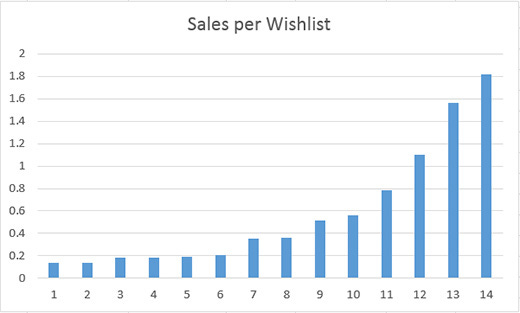
But overall, if you look at Jake’s original graph of the 14 games he got data for, for ‘sales per wishlist’, you’ll see a much bigger range than I previously remembered:

Even though the average is 0.58 sales per wishlist and the median is 0.36, as Jake explicitly notes, the range is from 0.14 sales to 1.8 sales. And six of the fourteen surveyed games are 0.2 sales per wishlist or less, looking at the graph!

That’s a biiig range. Jake’s survey also noted that wishlist conversion % on its own in first week – without organic sales added in – varied between 2% and 32%. That’s another huge range. And things may have changed further since 2018, with thousands more games on Steam.

The Question is – what are your first-week stats?

So, here comes the ask. I’d like to put together an updated 2020 version of the ‘1-week sales per wishlist’ data, completely anonymously, using readers of this newsletter.

I’ve set up a short, completely anonymous questionnaire for you to fill in if you’ve released a game on SteamPlease complete it some time before Friday, May 22ndI don’t mind if your game sold 500 copies or 500,000 in its first week, we’re just looking for more data here.

There are obviously more variables than we can possibly imagine. And things like ‘being in a hot genre’ or ‘massive YouTubers picking you up after release’ can’t be easily encapsulated in a short survey. (We’ll talk about ‘one year revenue is 4-5x one week revenue’ at another juncture!)

But I feel confident that we can get some useful, current data. And I’ll obviously share all of it with the readers of this newsletter as soon as I get it and numbercrunch it. Thanks in advance! (You can fill it in once for each game, if you have multiple games to share data on.)

Posted on Leave a comment

Sumo Group acquires UK work-for-hire studio Lab42

Sumo Group has acquired work-for-hire development studio Lab42 for an undisclosed fee. 

Based in Leamington Spa, Lab42 has worked on a wide range of projects for clients like Sega Publishing Europe, Klei Entertainment, Aspyr, and Ripstone, including titles such as Yakuza 0, Sonic Mania, and Terratech

The studio also holds the exclusive license to the World Snooker Tour brand, and was the sole-developer on sports sim Snooker 19

Sumo already owns a number of studios including Everybody’s Gone to the Rapture developer The Chinese Room, LittleBigPlanet 3 maker Sumo Digital, and God of War: Remastered co-developer Red Kite Games. 

It explained the addition of Lab42 will strengthen its presence in Leamington Spa, where Sumo Digital currently has an office, while also bolstering its development team.

“The opportunity to buy Lab42, a business that is highly respected in the industry and well known to key members of our team, was both timely and compelling,” commented Sumo Group chief exec Carl Cavers.

“The addition of a 29 strong, established, proven and talented team will help keep our organic growth ambitions on track, through the COVID-19 pandemic, which, as previously reported, has created some recruitment challenges.”

Posted on Leave a comment

Blog: How Niantic’s response to COVID-19 has protected Pokemon GO

The following blog post, unless otherwise noted, was written by a member of Gamasutra’s community.
The thoughts and opinions expressed are those of the writer and not Gamasutra or its parent company.


Pokémon GO tends to perform in peaks and troughs, which reflects in the update cycles of the game. According to Priori Data, it saw a decline of 19.61% in net revenue in 1Q20, compared with 4Q19, across Apple App Store and Google Play combined. This is not unusual for the first quarter, given seasonality and the high consumer spending associated with the fourth quarter across most markets. Pokémon GO had a similar net revenue decline of 22.8% in 1Q19 versus 4Q18.

In fact, the game appears largely untouched by the COVID-19-induced lockdown so far, with healthy net revenue and continuous growth throughout 1Q20. What’s more, the game hit peak monthly active users (MAUs) for the year so far in March, at 16.9m, which suggests that users are increasingly unfazed by quarantine regulations. Despite a marginal dip in April, net revenue is set to reach its 2020 peak in May at just shy of $50m.

In early March, Niantic announced changes to its location-based AR games, including Pokémon GO and Wizards Unite, which would make them easier to play from home. For Pokémon GO, these measures included:

  • Distances needed to walk to hatch an egg were halved, Pokéstops dropped gifts more frequently, and the wild Pokémon spawn rate was increased
  • Players could purchase Pokémon-attracting incense more cheaply, and it would last for twice as long
  • The PvP feature Go Battle League no longer required players to walk, or pay, to enter
  • Players could organise their own tournaments without needing to physically scan each other’s QR codes

 If any game category was at risk from the COVID-19 pandemic, it was the location-based AR genre. This demonstrates the importance of flexibility, and of responding quickly to potentially game-changing events. User engagement with the games sector more broadly has benefitted considerably from lockdown.

The US and Japan are the most substantial markets for Pokémon GO, with the combined territories accounting for 65% of app store net revenue in 1Q20. The virus only started gaining traction in these countries later in the quarter. As a result, the measures taken to enable at-home play will likely offset any notable decline in engagement through 2Q20.

Posted on Leave a comment

Dead by Daylight Mobile celebrates three million downloads by letting you play as LeatherFace

Behaviour Interactive has announced that Dead by Daylight Mobile, the port of its horror hack n’ slash survival game, has been downloaded three million times on Android and iOS. If you consider that it launched just under a month ago, this is a very impressive feat. Behaviour is celebrating this achievement by giving mobile players a new killer to use; The Cannibal. This chainsaw wielding mad-man, also known as LeatherFace, became famous for appearing in the 1974 film, Texas Chainsaw Massacre.

In Dead by Daylight Mobile he comes equipped with three perks; Knock Out, Barbecue & Chilli, and Franklin’s Demise. He’s also decked out with his iconic chainsaw, and a trusty sledgehammer – just in case you want a change of pace when murdering.

For those who don’t know, Dead by Daylight is a bit of a who’s who of iconic horror killers. You are dropped into a map with other players and have to evade a killer – controlled by another player – while completing a series of tasks in order to escape without getting murdered. It’s wonderful, albeit terrifying fun.

Behaviour made a variety of smart changes to Dead by Daylight to optimise it for mobile, including a visual cue for heartbeats, to put less focus on the game’s audio aspects.

[embedded content]

Alongside LeatherFace, a new update introduces a revamped XP system, linking it to individual characters, and a new outfit, the Treacherous Waters Collection. All of this will drop alongside quality of life changes and bug fixes.

Dead by Daylight Mobile was pretty well received, generally praised as a good port of the original; check out Glen’s Dead by Daylight Mobile review if you don’t believe us. If you’re a horror fan, or feel like hunting your friends like animals, you can find Dead by Deadlight on Google Play, or the App Store.

Also if you want some advice on how best to out-fox bloodthirsty opponents, see our Dead by Daylight Mobile guide. We also have tonnes of advice on which killers and survivors to pick in our painstakingly detailed list of Dead by Daylight Mobile characters.

Posted on Leave a comment

Humble Launch Indie Publisher Humble Games

Humble, famous for the Humble Bundle deals, have just launched an indie game developer focused publisher Humble Games.  Humble have already worked with a number of developers to bring games such as Void Bastards and Slay the Spire to market.  In celebration of the Humble Games launch, they are also running a “Make Your Own Bundle sale” featuring games they have published.

Reasons to publish with Humble Games include:

BRAND

Humble Bundle has done right by millions of gamers and thousands of industry partners – Humble Games is no different.

IP OWNERSHIP

Our Humble terms allow you to own your IP.

MARKETING

We will help you market your game with a dedicated team of experienced publishing marketers.

12M CUSTOMERS

As part of the Humble family, Humble Games will help you connect with customers across Bundles, Store, and Choice.

FINANCING

We give you money upfront so you don’t need to starve to finish your game.

CREATIVE CONTROL

We look for developers and games we believe in. We want you to be able to build the game of your dreams.

PRODUCTION

You’ll receive a dedicated producer to help you with all technical milestones, processes, and challenges you may encounter.

CROSS PLATFORM

We will help you succeed not just on the Humble Store, but on Steam, Xbox, PlayStation, Nintendo Switch, and more.

If you are interested in applying, the form is available here.  You can learn more in the video below.

[embedded content]

GameDev News


<!–

–>

Posted on Leave a comment

Get a job: Join Heart Machine as a Quality Assurance Manager

The Gamasutra Job Board is the most diverse, active and established board of its kind for the video game industry!

Here is just one of the many, many positions being advertised right now.

Location: Culver City, California

We’re looking for a QA Manager who has a passion for shipping games and an eye for detail. Your responsibility will be to organize and track the team’s QA process, including playtesting feedback, bug tracking, localization & platform certification.

We’re looking for someone who can catch and address problems quickly and effectively, can communicate with anyone on the team to get results, and has a deep understanding of our production process. Come help us build better things!

Your Role

  • Consistently playtesting our levels and helping keep builds updated and maintained
  • Organizing external playtests and tracking resulting bugs and feedback
  • Working with remote QA teams and managing bug-tracking software
  • Managing & tracking localization & platform certification tasks
  • Communicating with project leads to address the QA task backlog
  • Creating and managing tasks while also identifying, tracking and addressing risks
  • Work with the publisher to ship the game on multiple platforms

Requirements

  • Experience with bug-tracking systems (such as DevTrack, JIRA or BugZilla)
  • Experience shipping at least one game on PC and/or console
  • Experience with localization & platform cert processes
  • Previous QA experience on games – at least 2 years on PC or console
  • Experience with milestone tracking
  • Knowledge and familiarity with Agile and Scrum development framework
  • Strong reading, writing and spelling skills
  • Strong technical aptitude
  • A passion for games – third person action and platformer games particularly
  • Ample experience with current generation of gaming consoles
  • Excellent organizational skills
  • Independently motivated
  • Excellent communication skills and assertive attitude
  • Authorized to work in the US
  • Currently local to the Los Angeles area, or willing relocate

Bonus

  • QA experience in a large team environment
  • Any additional and related skills in games (illustration, modeling, writing, production)
  • Experience with Unreal 4

Interested? Apply now.

Whether you’re just starting out, looking for something new, or just seeing what’s out there, the Gamasutra Job Board is the place where game developers move ahead in their careers.

Gamasutra’s Job Board is the most diverse, most active, and most established board of its kind in the video game industry, serving companies of all sizes, from indie to triple-A.

Looking for a new job? Get started here. Are you a recruiter looking for talent? Post jobs here.

Posted on Leave a comment

Humble’s indie game publishing biz is now Humble Games

Humble is doing a bit of a makeover on its publishing branch, and unveiled Humble Games today as a dedicated, cross platform game publishing division focused on working alongside indie teams.

If Humble as a indie publisher sounds a bit familiar, its because the company previously took aim at supporting independent game development through its Humble Original endeavors. That first stab started funding games to be featured Humble Monthly game bundles, a subscription service that has since been rebooted as Humble Choice.

Humble Games takes a wider approach than Original. As Humble Games, the company is looking to once again work with indie developers and leverage its platform and expertise to help them to launch and beyond, on PC as well as consoles. At the onset, Humble is offering up marketing help, financing, and assistance with milestones while promising partner devs will retain both creative control and IP ownership throughout the process.  

“With a dedication to gamers and developers alike, Humble Games is a publisher willing to challenge the norm that has been expected of its predecessors. More Games. Better Games. Fairer Deals. All while prioritizing social impact and social good,” explains the Humble team.

Game developers curious about the company’s latest publishing push can find more info over on the new Humble Games site.

Posted on Leave a comment

Former Xbox exec J Allard is now Intellivision’s global managing director

J Allard, one of the key figures behind the early days of Xbox, has joined up with Intellivision Entertainment ahead of the company’s big Intellivision Amico launch later this year.

The new position sees Allard as Intellivision’s global managing director, a role Intellivision tells VentureBeat will task him with supporting the upcoming retro console debut by managing a number of operations critical to that launch, including UX, developer support, and more.

“This week has me back on the field and not just cheering from the stands — it’s a great feeling,” Allard tells VentureBeat. “There’s a need, an opportunity, and a terrific, scrappy team committed to take it on.”