Posted on Leave a comment

Itch.io Bundle For Racial Justice And Equality

Itch.io are currently running a charity bundle containing hundreds of indie games, projects and even game development assets, all in support the the #BlackLivesMatter movement.

The following is the announcement tweet by Itch.io:

image

The bundle runs until June 16th and can be had for as little as $5 USD, with proceeds split 50/50 between NAACP Legal Defense and Educational Fund and Community Bail Fund.  From a game development perspective, there are dozens of gamedev specific assets, including:

64px Textures/Tilesheet 8bit Overworld Tileset Anime RPG Tile Pack - Vol.1 School [PIXEL OF LIFE] BearFX Explosions | Pixel VFX Pack CanariPack 1BIT TopDown CanariPack 8BIT TopDown Dungeon Tileset - Top Down RPG Essential Pool Billiards Table Asset Pack - VR/AR Hitboxes and Hurtboxes HPS Cartography Kit Kenney Game Assets 1 Lil' Dragon - Pixel Art Tileset Lo-Fi Stellar Skirmish Low Poly 3D City Builder Low Poly Auto Racing Car Pack - Devils Work.shop Multi Platformer Tileset Old Man Character Sound Effects Pixel art Forest Pixel Art Infinite Runner - Pack Pixel Art Medieval Fantasy Characters Pack Pixel Plebes Digital Card Deck SC: Monster Pack 1 - DELUXE EDITION Snapshot Shaders Pro (Unity) Sprite Pack - Fantasy Female Mage Sprite Pack - Fantasy Male Mage Tiny Adventure Pack Plus Top-Down - Interior Tileset Voxel Currency

You can learn more about the bundle, specifically the game development content in the video below.  You can support a great cause while absolutely loading up on indie games and game development assets!

GameDev News


Posted on Leave a comment

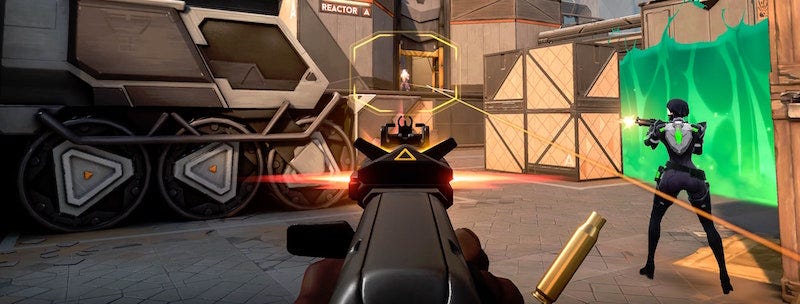
Video Game Deep Cuts: Valorant Rants, Skelattack… Attacks?

The following blog post, unless otherwise noted, was written by a member of Gamasutra’s community.
The thoughts and opinions expressed are those of the writer and not Gamasutra or its parent company.


[I like the sorta ‘spooky Castle Crashers’ vibe of Skelattack’s art direction, FWIW.]

Yes, this is another Video Game Deep Cuts newsletter on Substack. Yes, I hope you are directly donating to support Black communities & Black Lives Matter, as many game creators now are. And yes, I hope you are thinking about ways to provide long-term systemic support, in addition to short-term support. That’s all.

– Simon, curator

The Current: New Games To Consider

The Culture: Game Culture & Deep Dives

The Past: Game History

The Other Goodness

Thanks again for reading, and see you next week,
Simon.

Posted on Leave a comment

Valve delays Steam Summer Game Festival, offering no reason

Valve has announced that the Steam Summer Game Festival has been delayed from June 9th to June 16th. The festival, which was originally set to run through the 14th, will now run through the 22nd. 

This news came to Gamasutra by way of an e-mail from Valve, which contained exactly one line. “The Steam Game Festival has been rescheduled for Tuesday, June 16th thru June 22nd.” That’s it, that’s the e-mail. 

The delay of the Summer Game Festival itself isn’t surprising. Every other event that was set to replace the usual E3 preview ensemble has announced its postponement, most of them crediting the current Black Lives Matter protests, and a need to prioritize justice over video game hype. 

However, Valve has not given such a reason. Nor has Valve made any statement about the Black Lives Matter protests. The latter fact would normally not be cause for such extreme concern if so many other developers had not already spoken out and made donations to organizations working to advance racial justice. 

Valve also has faced criticism for the propogation of hate groups and a lax approach to moderating racial slurs on Steam. Team Fortress 2 players have apparently been facing a flood of racist in-game bots in the last two months as well. 

It’s a little unusual to see Valve’s tight-lipedness suddenly be applied to a cause that has found support among game developers big and small. 

GI.Biz’s Rebekah Valentine has spoken to some developers included in the Festival, who’ve said they’re in favor of the delay but only found out in the same window that the press did. 

Gamasutra has reached out to Valve for further comment. We will update this story when it responds. 

Posted on Leave a comment

Get a job: Game Closure needs a Backend Engineer

The Gamasutra Job Board is the most diverse, active and established board of its kind for the video game industry!

Here is just one of the many, many positions being advertised right now.

Location: Mountain View, CA

Game Closure is on the hunt for backend / systems engineers to help us build the services and infrastructure that power our social games that are played by millions of people every day on Facebook, Viber, Line and other messaging platforms. We are a growing team with offices in Mountain View and San Francisco, California, Tokyo, Japan and some possibilities for remote work. If you want to join us to make great games on our cutting edge technology and truly make an impact, then we want to talk to you!

As a Systems Engineer at Game Closure, you will play a pivotal role in creating a platform to revolutionize the instant games development industry. Our engineers are generally amazing at something and great at everything else. We write scalable backend systems, cross-compilers, JavaScript / TypeScript game APIs and tools, and whatever else it takes. No matter what you work on each day, you will work with the best engineers in the world; we have top talent in every part of our stack.

The Role:

  • Be a key member of a high performing software engineering team.
  • Architect and code sophisticated client/server systems for instant gaming.
  • Play a critical role in day-to-day coding, performance profiling, optimization, and general troubleshooting.
  • Collaborate with design, engineering, and production teams to devise optimal engineering solutions to game requirements.
  • Learn from and mentor other engineers on your team.
  • Take ownership of your projects to make them the best they can possibly be.
  • Provide valuable input on the company’s long-term engineering roadmap and help identify areas of opportunity for improvement.
  • Define the cutting edge of social gaming!

Desired Skills:

  • Bachelor’s degree in Computer Science or related field, or equivalent experience.
  • 3+ years of professional software engineering experience.
  • Experience writing clean, testable, high-quality code and designing highly scalable systems in production.
  • Solid familiarity with deployment on cloud environments (AWS, GCP, Azure, etc.).
  • Strong Computer Science fundamentals in software systems design, algorithms, and data structures.
  • Ability to interact with peers in a constructive and productive style.
  • Familiarity with git, svn, or other VCS.
  • Good communication skills and the ability to work effectively on shared projects with designers, artists, testers, product managers, and other developers.
  • Strong team player with a positive attitude.

Bonus:

  • Expert knowledge of NodeJS and ES6 / TypeScript.
  • DevOps experience — setting up CI/CD environments, orchestrating deployments, creating monitoring dashboards, anything that makes the development process easier, more enjoyable and more accountable.
  • Experience in game development and shipped titles.

GC Perks:

  • Medical, Dental, & Vision: Top quality insurance options with 100% of premiums covered
  • Social Events: Weekly team dinners, quarterly team excursions, game nights, karaoke, and more
  • Commuter Pass + Free Parking: Your commute and parking to the office is on us!
  • PTO: Unlimited vacation policy
  • Meals: Free daily lunches, well stocked kitchen, healthy snacks and drinks
  • Pet-Friendly Office: Bring your pets to work to foster a friendlier and happier workplace
  • Fitness: Free onsite yoga classes

Interested? Apply now.

Whether you’re just starting out, looking for something new, or just seeing what’s out there, the Gamasutra Job Board is the place where game developers move ahead in their careers.

Gamasutra’s Job Board is the most diverse, most active, and most established board of its kind in the video game industry, serving companies of all sizes, from indie to triple-A.

Looking for a new job? Get started here. Are you a recruiter looking for talent? Post jobs here.

Posted on Leave a comment

Don’t Miss: A postmortem of Tom Clancy’s Splinter Cell

I started my career in game industry with Ubi Soft’s Shanghai studio in 1998 as a producer. During my five-year adventure with Ubi Soft, I’ve worked on a number of different games, but Splinter Cell for the PS2 was the most challenging one. The technical breakthroughs we needed to achieve and the tight project schedule we faced were almost overwhelming. When we set the schedule in November 2002, almost no one believed we would make it. To add even more pressure, the success of the Xbox port of the game made everyone realize that there was no way to make just average-quality PS2 port of Splinter Cell. We had to match that quality.

Fortunately, we achieved satisfactory results. The port of Splinter Cell to the PS2 certainly wasn’t an ideal project (especially in terms of cost effectiveness), but it’s a good example of applying extra resources to hit milestones.

The project was your typical porting job. With the success of Splinter Cell for the Xbox, we had a solid starting point and a very clear vision of what we had to achieve. Thus the challenges were technical and schedule-related, and weren’t related to content creation.

As producer on the project, I mainly focused primarily on planning, personnel management, risk management, team coaching, and establishing good working processes. In this postmortem, I’ll share my experience as it relates to these aspects of the project:

  • Prototyping and pre-production
  • Personnel management on a huge and multi-cultured development team
  • Planning and production management
  • Quality assurance

We started working on the port of Splinter Cell in April 2002, with a small team that focused on prototyping and technical research. The full production began from the second week of October. Between that time and February 2003, when Sony Computer Entertainment Europe (SCEE) approved the first master, the team grew to around 90 people. People from other Ubi Soft studios joined the project at different phases, including some developers of the original Xbox version from Canada. We also had developers from France and Italy.

What Went Right

1. A prototype that helped determine resources and scheduling. Compared to the full production team, our prototype team was tiny. We started with five people, comprising two engineers, one level designer, a 3D artist and myself. We added four more engineers and an animator two months later.

Besides proving to upper management that we are able to solve the technical issues of porting, the prototype we first worked on was supposed to provide a solid base for production. By August 2002, we were quite confident of the outcome: The systems for generating Splinter Cell‘s lighting and shadows on PS2 were integrated into the engine, as were other special effects. What made us even more confident was that we had to create these systems from scratch; it wasn’t possible to re-use this code from Xbox version.

We studied how best to allocate hardware resources between the CPU, GPU and memory under the Unreal engine. By the time we completed the prototype, our team had a detailed list of how much memory was allocated to each part of the game (map data, character/animation, engine, UI, textures, and so on), and understood how to work with the constraints of the map data to ensure the good frame rate. We tried to be pessimistic while setting those constraints, which turned out to be a good decision — later on we encountered some bad surprises related to system resources, but because of our earlier estimates, we had built in a sufficient margin of error to deal with them.

The prototype also proved crucial for organizing the production schedule and estimating the necessary project resources. The effort required to port one map was split into several steps, and we used our experience creating the prototype to accurately define the data flow between steps and estimate the overall resource costs.

Here is an example of how we defined the data flow:

After this chart was created, we could estimate how long each step would take for 1 person, from which we could generate accurate plans that took into account the schedule and quantity of maps. That would in turn help us determine how many people we needed on the project.

2. Pre-production documentation and staffing decisions. The pre-production phase started three months before the production. It was during this stage that we formed the team, trained people, set up the production model, and made project schedule.

One of the most important steps we took during the pre-production stage was to create Technical Design Documents (TDD), into which we poured all the knowledge we gleaned from our prototype. It wasn’t easy to create the TDDs, though. The prototype development team was so busy that nobody had time to document what we were learning. Ultimately I had to force the team to devote time to creating the TDDs by asking people stop their work for 1-2 days to concentrate on writing it. It proved to be a worthwhile exercise, though, since it saved us even more time later on in the project. The TDDs were used to train new people who just joined the team, and helped everyone understand the major technical issues.

The TDDs also included a detailed analysis of all the maps in the original Xbox version of Splinter Cell. The level design team, which had grown to seven people during pre-production, took the in-progress Xbox map data and rehearsed how we’d port them over to the PS2, given what we knew about the process and constraints after working on the prototype. At the same time, level designers made an optimization plan for each map. With those rehearsals and documentation, the workflow between teams and the production workload was better understood before we started on the real production. We even had a good idea of which maps would be more challenging to optimize, which enabled us to allocate the appropriate resources to them. The most difficult tasks were assigned to the most skilled developers to try to prevent bottlenecks in process.

On the personnel management side, besides adding more people to the team, we also made adjustments to the team leader’s position. When we established the prototype team, we expected those team members to later become the leaders of the functional teams in the main production stage. With their knowledge of the project and experience working on the prototype, they were expected to be good coaches for the rest of the team. What we didn’t foresee was that the production team would eventually turn into the biggest team ever in Ubi Soft’s history, requiring some team leaders to manage 20-30 people. As such, management skills were actually more valuable than technical skills and experience, so we appointed new leaders for some teams. These people weren’t on the original prototype team, but they were experienced team managers. That let the supplanted team leaders focus on technical issues, rather than spending time on administrative tasks.

3. Emphasis on accurate scheduling. The production of Splinter Cell for the PS2 took no more than four months. We didn’t have much say when it came to setting the due date for master; Ubi Soft was adamant that the game be released by the end of its 2003 fiscal year. Yet we couldn’t start production early, since the Xbox version was still under development.

A four-month production cycle is obviously very short for a game, which is expected to be of AAA caliber and up to the standards set by the Xbox version. Our milestones were naturally aggressive to satisfy these constraints. Here’s what our schedule looked like:

  • From beginning of production to Alpha: 9 weeks
  • From Alpha to Beta: 5 weeks
  • From Beta to Master: 4 weeks

This schedule appeared very unrealistic, yet we tried to be extremely realistic when we were considering what it would take to achieve it.

Everyone understood that the objective of the project was to make the game by a specified date and of a given quality. To achieve this, we had much more freedom to get the required resources than “normal” projects – the company was willing to dedicate people and spend money to gain time. From the beginning, everyone understood this strategy.

Prior to the start of production, we worked hard to round up the resources we knew we’d need for the project. The Shanghai studio made Splinter Cell its primary focus on by allocating many experienced developers to the game and recruiting new people. In addition, Ubi Soft’s studios in France and Italy also sent development teams to Shanghai.

We could have had those teams stay in their respective countries and work remotely on Splinter Cell, but we gave up this idea. We decided it would be difficult to manage multiple teams across several countries – it added big risks to the project, and we didn’t have enough time in our schedule to accommodate that. Having people come to China was obviously more expensive, but it was absolutely necessary to minimize our scheduling risks.

We tried our best to make the production plans as detailed and as accurate as possible, but we realized that the schedule was apt to change for unforeseen reasons. So we regularly followed up on our schedule and made adjustments to it as necessary to ensure we always had an up-to-date “vision” of the project. We had project status meeting every two weeks in which we discussed our current major problems and analyzed their effects on the schedule. We also explored actions we could take to offset these problems.

Before each important milestone, we re-checked the schedule using a system that focused on the critical path to reach the target. For example, say there are 10 tasks to complete to reach the Alpha, and of those the 10, five tasks can be done in parallel. The other five tasks must be done in a specific order, and assigning more people to those tasks won’t necessarily save much time. In this example, these five tasks are the critical path to reach Alpha. Estimating how long those five tasks will take helps us know if we have a scheduling problem.

4. Matrix management, frequent personnel evaluations. Splinter Cell for the PS2 had the shortest development schedule in Ubi Soft Shanghai’s history, not only because we had the biggest team, but also because the team was the most efficient. The development team was made up of six functional teams: engine, gameplay programming, animation, graphics, level design and sound. We also had a data manager who was dedicated to database management.

The graphic artists and level designers had to work closely on data production. So inter-team groups were established in a matrix-management fashion. Each group consisted of a level designer and two or three artists, and each group was responsible for the maps they worked on, and the individuals were physically located close to each other in our office to ensure good communication.

The graphics team was the biggest team, made up of over 20 people. Besides the team leader, we had a graphics technical director to ensure the whole team’s technical skill and he is also responsible for communication with other team on technical issue.

Team leaders were given the full responsibility of his team and reported to producer. To bolster the efficiency and morale of the whole team, we conducted evaluations of team members frequently throughout the production cycle. The evaluation was result-oriented, which means we evaluated people only according to the outcome of his/her work. The result-oriented evaluation has two advantages over a traditional personnel evaluation:

  • It is simple. There’s less to consider since the evaluations are so frequent. It was possible to do evaluations very rapidly – every two weeks.
  • The evaluation helps the managers keep track of the project’s progress.

People with good evaluation results were rewarded by monthly bonus. Management talked to those who received bad evaluations, to apply the appropriate pressure. In the middle of the production, there was so much pressure on us that we considered setting a more severe work policy, in which each team had to assign the “improvement needed” rank to at least one person during each evaluation period. We also we talked about punishing people who continually received this rank. While harsh, the goal of these rules was to spur people to improve their work no matter how good their team was. By having to single out at least one person on each team, everyone would be under pressure to improve to avoid being that person. In the end, though, we never implemented these rules – we knew it would adversely affect morale, and we preferred more positive atmosphere for the project.

Throughout the whole production schedule, the team worked very hard, and the team leaders played an important role in ensuring the best performance from their teams. For project with huge teams, it is critical to choose good team leaders from the beginning.

5. QA management. The Xbox version of Splinter Cell provided a benchmark for how good the PS2 version should be. Yet it was a challenge to ensure game quality with more than 70 developers working under such a tight schedule.

Our regular team evaluations helped us to closely track our quality, and in addition to those, we also had more formal evaluations that served as a quality check-up prior to milestones like Alpha and Beta. These milestone meetings usually took two or three days and were split into two parts: engine evaluation and data evaluation.

During the game data evaluation meetings, we arranged a meeting room and gathered all the team leaders. We checked each map with the level designer and artist who worked on this map. We generally checked four aspects of the map:

  • Memory use
  • Frame rate
  • Gameplay
  • Graphics

These topics covered the major risks that concern game quality. If certain map was below the quality standard, the team working on that map might be asked to re-work it, using overtime. Another evaluation would be arranged shortly thereafter to check it again.

Engine evaluation was not so straightforward. Since many engine features cannot be visualized, we had the game’s lead programmer and the studio’s programming director (the latter of whom wasn’t working on the project and could provide an objective opinion) to check the quality and progress of each programmer’s work.

We also appointed an art director after we reached the Alpha stage, who was responsible for ensuring that all the maps had the same artistic style – the Splinter Cell style. We realized that with lots of people working on their own maps, we might get some maps that looked like another game, and this promoted artistic consistency.

Prior to the Beta stage, we found it difficult to control the quality and stability of the game. We had a huge team with people operating at different skill levels. The quality improvements became so detailed that team leaders had to spend more time supervising team members. When we started debugging, the situation deteriorated even more, as less-skilled developers sometimes introduced new bugs as they tried to fix existing ones. To remedy the situation, we started the “SWAT team” organization.

SWAT team is a concept we picked up from the Splinter Cell Xbox development team. The idea is to reduce the team size after a certain stage of production. Only the best people continue to work on the project, and their expertise is fully leveraged. A side effect of this is that it’s also easier for managers to control quality; they don’t have to deal with lots of people at different skill levels.

This organization was implemented with the graphics team (the biggest team with approximately 30 people). The SWAT team was made of the six best artists who worked closely with art director and technical director to improve the quality of the graphics.

During the final debugging stage, when the reported bugs were small in quantity but very complicated to fix, the whole graphics team was reduced to just two people-the graphics team leader and the technical director – to minimize the risk of generating more bugs.

Posted on Leave a comment

EMBERGEN Real-Time Fluid Simulation

Embergen, by JangaFX is a real-time fluid simulation software for creating fire and smoke effects for game and film projects.  You can create and modify fluid simulations in real-time on consumer class graphics hardware and export your results in flipbook or image sequence formats for use in games, or export in OpenVDB format, an open standard Blender 2.83 just acquired the ability to import.

Details from the 0.5.3 release:

  • Improved the fidelity and simulations of ALL presets and added 9 new presets.
  • Pressure solver improvements:
    • Improve base pressure solver accuracy and performance.
    • Slight memory reduction.
    • Expose more pressure solver controls.
    • Increasing the parameters will improve the accuracy and produce better motion, but are more expensive.
  • Volume masking/Simulation post-processing (only visual, not affecting the simulation): Motion blur, Sharpening, Dilate, Stylized.
  • Basic navigation gizmo in the lower left corner to show orientation.
  • Fixed crashes and freezes when previewing some output modes.
  • Fixed the Simulation upscaling parameters being incorrect when loading from a preset.
  • Improved tooltips.
  • Sixpoint and normals fixed for upscaling.
  • Improved background color with transparency.
  • General rendering improvements and speedup.
  • Simulation looping:
    • No longer cuts on the first loop wraparound.
    • Fixed an off-by-one error where later loop iterations did not sync properly.
    • Fixed parameters not animating correctly.
  • Improved accuracy of turbulence advection.
  • Made the ExportVDB node work similar to the ExportImage node. Certain widgets will “multicast” when multiple nodes are selected, e.g. timing controls and export masks.
  • Displays tick in the timeline indicating which frames will be exported.
  • Automatic frame timings when looping.
  • Fixed colors and forces when using multiple emitters and shapes for colored smoke.
  • Fixed a difference in lighting between the basic mode and combustion.
  • UI Improvements: Informational text displayed when necessary per node, e.g. if the license or trial is expired.
  • Disabled buttons now have a red border.
  • Fixed bug preventing timeline key editing.
  • Small visual tweaks to the timeline for user experience and consistency.
  • Stop sliders from keeping focus after submitting.
  • Tooltips no longer display when their respective UI element is occluded.
  • Fix incorrect behavior for color picker widgets.
  • The color picker will no longer lock up and become unresponsive.
  • A bunch of smaller bug fixes.
  • Miscellaneous Improvements: Lots of refactoring and delicious code cleanup.

Embergen has a fully functional 2 week trial available here as well as several free OpenVDB datasets to start with.  You can learn more and see Embergen in action in the video below.

GameDev News Art


Posted on Leave a comment

I Expect You To Die scores $2 million in revenue on Oculus Quest

Schell Games has annoucned that its James Bond-themed virtual reality title I Expect You To Die has earned $2 million in revenue on Oculus Quest. 

Over on its company blog, the Pittsburgh-based developer also annoucned that it’s sold over 100,000 copies of the game on Oculus’ PC-free platform. These two thresholds are huge markers for Schell Games and the VR business at large. I Expect You To Die was originally developed for the main Oculus Rift platform. 

Its success on the Quest is both a tribute to Schell Games’ work and demand on the platform for unique, interesting titles. 

Posted on Leave a comment

Balancing the stealth AI in Splinter Cell: Blacklist

The following blog post, unless otherwise noted, was written by a member of Gamasutra’s community.
The thoughts and opinions expressed are those of the writer and not Gamasutra or its parent company.

‘AI and Games’ is a crowdfunded YouTube series that explores research and applications of artificial intelligence in video games.  You can support this work by visiting my Patreon page.


One of the most challenging and unforgiving genres for artificial intelligence in video games is stealth. Players are tasked with sneaking into locations and conducting their business, be it to steal items of interest or eliminate targets all the while adapting to new threats and exploiting opportunities as they arise. There is an expectation that stealth games provide a real challenge – especially on the highest of difficulty levels – but all the while providing small areas of opportunity for players to exploit. This presents a lot of challenges for developers when creating enemy opponents. They need to be smart and react to the world, communicate their thought processes such that player can compensate but ultimately provide a fair and balanced experience as best as possible. In this blog let’s look at how to build balance in stealth games by exploring the inner workings of Splinter Cell: Blacklist.

The Challenge of Stealth AI

Blacklist, developed by Ubisoft Toronto and released in 2013 is the seventh entry in the long running Tom Clancy’s Splinter Cell franchise. The game is a marriage of previous entries in the series in that it allows for players to take different approaches towards completing each level. Balancing the stealth puzzles of the series roots alongside the more action focussed gameplay exhibited by 2010’s Splinter Cell Conviction. As you take charge of Sam Fisher in Blacklist, you can decided how bombastic or otherwise you want to tackle each new locale.

This presents a massive challenge for level design, game pacing and the design and development of AI characters, since this effectively creates two games in one and the games systems need to effectively manage the transition from the stealth into the combat game if the player makes a mess but also switch back when things die down. Stealth AI is already a challenging problem to solve. Given enemy non-player characters must satisfy several criteria.

First of all the AI characters need to be consistent in their response: NPCs should recognise the world is changing around them and go into a heightened state of alertness. These responses need to be consistent across the gameplay experience such that you can rely on specific tactics to lure enemies into positions that either compromise the security of the patrol routes established or their personal safety.

Secondly there is the issue of communication and feedback: if a character notes something is not right, or spots the player from far away, not only must they act in response, but they must effectively communicate what their intentions are. This includes their animations, talking aloud to themselves or communicating with other NPCs in proximity. Given the player needs to know what they’re thinking and doing in order to get themselves out of the current situation.

Lastly, there is the issue of predictability vs novelty. Ultimately you want the responses and feedback to be consistent to a point of predictable. That said, predictability means the game can become repetitive and in-turn stale after several hours of play, largely because players are unpredictable and difficult to account for. Hence there is a need to maintain novelty where NPCs might do something a little different the next time around, or new enemy archetypes are introduced that force players to approach problems differently.

All of this comes under the umbrella term of ‘fairness’: you want players to develop their own idea of how the games systems will operate such that they can exploit it to their advantage. The more you play the game, the stronger your understanding becomes as new concepts are introduced and prior knowledge is reinforced. Hence playing through the game on that first playthrough versus the second or even the tenth is a different experience and higher difficulties put that knowledge to the test. That said, this isn’t something that will work for everyone, as fairness is entirely subjective and may differ from player to player.

The Four Pillars of Stealth AI

When discussing how AI systems need to support fairness Martin Walsh – Blacklist‘s lead AI developer – had this to say at the 2014 Game Developers Conference:

“If your opponents feel dumb then you get no real satisfaction in beating them. But you know what’s interesting is not being dumb doesn’t necessarily mean being smart. And what it actually means is always being plausible.”

“It’s interesting to note that there’s often a conflict that exists between fairness, consistency and intelligence and that’s something that’s important to be aware of.”

Martin Walsh, “Modeling Perception and Awareness in Splinter Cell: Blacklist”, Game Developers Conference (GDC) 2014.

These ideas are core to the design of the Splinter Cell franchise, not just Blacklist specifically and as Walsh explained in his GDC talk, there are four key pillars of enemy AI design that need to be balanced in order Splinter Cell – or any stealth game for that matter to work effectively.

  • The Visual Perception of the Non-Player Characters: How do friendly and enemy AI see the world around them and spot the player if they’re exposed.
  • Environmental Awarness: Meaning does the character have some understanding of the local geometry. Do they notice when doors or windows have been opened or closed. Or when things go loud do they know good cover or chokepoints to establish.
  • Auditory Perception: Meaning how do we model the NPCs ability to hear noises or more critically, what the player thinks NPC should hear.
  • Social and Contextual Awareness: Recognising what’s happening in the world around them as the player eliminates their comrades, and even just having realistic conversation between guards as they’re waiting for the player to come in ando their business.

These principles hold not just across Splinter Cell and stealth games, but a variety of genres. In fact we recently explored the sensory systems of the xenomorph as we revisited the AI of Alien: Isolation and as you’ll see there is a lot of overlap between the systems in Creative Assembly’s horror game and what I am about to cover. And this makes sense, given a lot of what I’m exploring in this episode isn’t new, but has went through years of iteration and refinement within game development. So let’s take a look at how the four pillars are managed in Splinter Cell: Blacklist.

Vision

First up let’s look at the Visual Perception of AI characters and how to balance this for stealth games. Vision systems are built to allow for AI characters to recognise objects within defined fields of view, typically through use of view cones: where a cone (or a triangle if it’s a 2D environment) of a fixed radius and height is projected from the front of the non-player character. If an object intersects with the shape, it registers a signal that says that object is ‘seen’ by the AI. Typically the longer an object stays within the cone the signal becomes stronger over time. Hence this is used to ensure that you’re not spotted immediately upon intersecting the view cone, as an AI will typically wait until the signal is strong enough to recognise you.

Image Credit: Walsh (2014)

Now view cones are a well-known and commonly used technique, but they’re fundamentally flawed, because that’s not how human eyesight works. A view cone is often a fixed angle and distance ahead of the character, whereas humans have close to 180 degrees of vision. So one solution is to make the view cone wider, but this presents another inconsistency, given our eyes are built to allow us to focus on specific areas, making what we see sharper and more clear. But in the process of doing so makes everything else in our peripheral vision blur.

Image Credit: Walsh (2015)

Hence Blacklist, like many other games, adopts multiple view cones to represent different types of vision and the detection thresholds and rates of signal increase vary depending on whether they’re designed to model close or distant vision. But the thing that Splinter Cell does to stand out is that view cone isn’t a cone-shaped, it actually looks a lot more like a coffin. This ensures the NPC maintains clarity of vision in front but also prevents them from having strong peripheral vision at longer distances, making it more realistic. In addition, the size and shape of each cone is tweaked for each difficulty setting, allowing for more blind spots on lower difficulties, but giving expert player a run for their money.

Plus for spotting the player, there is an additional suite of sight checks that are made given the player is more or less exposed depending on the stance they are currently in. Sam Fisher can be in a variety of different poses, with some – like being in cover – designed to conceal your position. Hence in order for a the vision code to detect the player as seen, they not only have to be within the cone itself, but also the character has to successfully run multiple sight tests on the player to see how much of their body is exposed. The NPC runs a raycast from its eyes to eight of the bones in Fisher’s skeleton. The more of these bones that are visible without anything in the way means the character is more exposed. Depending on the stance the player is in, the enemy NPC needs to succesfully see a minimum number of these bones before it will recognise your presence. Hence standing in the open versus crouched behind cover have different rates of detection.

Image Credt: Walsh (2015)

But despite this more nuanced system, there are still special cases where, irrespective of an AI characters vision, designers wanted more control over how exposed a player is in certain locations. Hence there is a special custom cover point system that allows for designers to tweak the players visibility at specific cover points, allowing for more control over gameplay in each mission.

Environmental Awareness

Next up, let’s look at environmental awareness, which encompasses all of the knowledge that a given AI character can have about the world and the ways in which it can reason about that information once it has been gathered.

This is driven by what is known as TEAS: the tactical environment awareness system that – like many of the AI tools in Blacklist – was originally built for Splinter Cell: Conviction. It contains a variety of information about the topoggraphy of the local environment as well as what objects are in the local area that the NPC should be aware. TEAS was expanded upon in Blacklist to provide a variety of useful features, not just for environmental but also in cases of auditory perception and contextual knowledge which we’ll see in a minute.

Image Credit: Walsh, (2015)

TEAS stores a series of positional nodes that are autogenerated from designer annotations within the map. This collection of nodes creates represents the areas within which AI and the player can go into cover, areas that they can reach by moving around the environment as well as chokepoints that appear within the environment. Hence guards can patrol and guard chokepoints more effectively and make it more difficult for the player to sneak past, given they have explicit knowledge of the importance of a particular doorway or similar entry point.

In addition to TEAS, in Blacklist objects that the player can interact with such as doors, windows and lighting to maintain history of their state. So when a light switch is turned on or off, we know how long it has been since the action occurred and a lifetime within which that action might be deemed suspicious. When a guard is out on patrol, it can query whether the state of the lights has changed and whether that is something it should be worried about. Hence if the lights are now off, but they were on when the guard looked at it 5 seconds ago, that could be suspicious and merit invesitgation. But conversely, they’re not going to walk into a room and go into an alert phase immediately because someone turned the lights off 5 minutes ago and it’s only now noticed.

Auditory Perception

The third pillar is auditory perception, or put simply, sound. The ability for an AI to hear a noise nearby and recognise whether that noise is nearby and should be investigated. Typically in games if we want an AI to hear something, we trigger an ‘event’ in the game. Each event will have a distance from the character that heard it as well as a priority. It’s useful to have both, rather than prioritising sound solely by distance, otherwise a guard might lose their mind and start opening fire at a tea cup falling over while a gunfight 50 meters away is completely ignored. For stealth games its important that sounds are captured and reported to non-player characters correctly, but also in a manner that seems fair to the player.

So first up, how do you ensure a guard hears distant sounds that they should be able to hear while ensuring sounds they shouldn’t be able to hear are ignored. A straight line distance from the point of the sound to the guards ear might work fine if the sound was made in the same room. But if the sound was in another room, it’s highly dependant on the layout of the environment whether the guard should still hear it. And sadly measuring real-world acoustics is kinda expensive to do, so why not fudge it to within some approximation?

This where Blacklist is able to exploit the previously established TEAS system. Given it provides an abstract mark-up of the environment, including the chokepoints, the distance of a sound can be calculated as the sum of straight line distances of the point of origin, moving through the chokepoints back to the guard. Hence we can more accurately measure a sound that travels 50 meters to reach a guard, despite the object that made the sound only being 10 meters away.

But despite that, it can still feel unfair. Especially as a player as learning an environment and the guards behaviours. Hence to provide some balance for gameplay, the hearing of NPCs in Blacklist is weaker if they’re not on screen. It doesn’t make them deaf, but they just don’t hear quite as well when the camera isn’t looking at them. And naturally their hearing becomes sharper on higher difficulties.

And of course, we need to consider how audio can be used as part of the feedback system to players. Characters should be communicating what they’re doing as a result of having seen or heard something nearby.
Blacklist, like many other Splinter Cell games, has a bark system whereby AI characters will run lines of dialogue when executing actions. This is again a common tactic for action games with games as early as Call of Duty 2 pushing this concept. But stealth games require a lot of context and information. Hence the bark system has tiers to it that range from generic information such as saying ‘I saw something’ to ‘I saw the light go out over there’. It helps provide more direct feedback to the player, allows them to better understand how their actions are recognised and what guard NPCs are doing in response.

Social & Contextual Knowledge

The last pillar of stealth is establishing social and contextual knowledge for AI characters in games. Given this is the last of the four, it is arguably the one that receives the least attention in stealth games, but is arguably the one that really helps reinforce the gameplay and can elevate a stealth game from good to great. This pillar revolves around the ability for AI characters to act like they’re in the moment and reinforce the performance theatre of the game. This includes showing an understanding of which characters they are interacting with, but also a richer understanding of how the world is changing around them. This pillar is also the last on because it leans heavily on the others, given the collection of sensory and knowledge systems helps a character understand the world.

First of all there’s social context. Typically in games, managing multiple AI characters at the same time is difficulty. Especially if they’re capable of acting independently and together. The usual solution is to have a separate system manage any co-operative behaviour while the NPCs themselves don’t know that each other exists. This works well in shooters such as FEAR and Halo, but for stealth games, where one of you going missing is kind of a big deal, it needs something more nuanced. In Blacklist, when groups of NPCs are hanging out and talking to each other, they’re actively aware of one another in the space and on occasion will communicate. Hence if you listen in carefully, guards reinforce the audio pillar by having conversations that take greater consideration into current context. If one hears a noise, the other might agree or dismiss it as something else. Plus tying back into the environmental awareness, while doors being opened can be a red-flag, noticing your group of 4 is now 3 is arguably more important. Hence there is a stronger understanding of changes in the environment and dialogue that matches this. Either to highlight their understanding of what is happening or sharing useful information in combat, such as when the player is shooting at them from a position they can’t reach on foot.

In addition, there is a stronger understanding of when things are going wrong. Should the character hear gunfire or another character yelling or find a dead body, they will move into an alert state and either search or start combat if the player is exposed. But critically, they won’t lower themselves from this raised awareness state once it has entered it. This is an important feature that many games miss and when they do, it looks awkward. If a guard finds his buddy dead, naturally they’ll go into a heightened state of awareness, maybe investigate the body or search the area, but they shouldn’t go back into an idle state afterwards, all the while ignoring their buddy still lying dead on the floor.

Closing

Providing a sense of fairness in gameplay is always a challenge. Depending on the type of game you’re making and the systems within it, how you communicate those inner workings to players while maintaining balance and novelty is a new problem with each new project. And with stealth games you’re arguably playing on a higher difficulty level, given the communication of the systems becomes a core dynamic. If players recognise their actions have consequence and that the games response feel fair in that context, then you’re on the right track to building balance for play.

References

Posted on Leave a comment

Chinese game company NetEase has opened a new studio in Japan

Chinese game company NetEase has opened a next generation game development studio in Tokyo, Japan. 

Niko Partners senior analyst Daniel Ahmad highlighted the news on Twitter, and said the new ‘Sakura Studio’ branch will be focused on creating console titles — although it’ll be hiring folks with experience working across console, PC, and mobile platforms. 

It’s notable to see NetEase funneling recourses into the console space, with the Chinese company having largely focused on developing and publishing PC and mobile titles. 

For those unfamiliar with the name, NetEase is one of the biggest players in the Asian market, and has partnered with Blizzard, CCP Games, and Mojang to bring popular titles like Diablo Immortal, EVE Online, and Minecraft to China. 

The company has also recently invested in other developers including Bossa Studios and Behaviour Interactive, and last year opened an R&D division in Canada to further its ambition of becoming a global business.

Posted on Leave a comment

Tales of Crestoria’s release date has been delayed

June 5, 2020 Tales of Crestoria has been delayed to allow the team to make final adjustments.

You’ll have to wait a little bit longer to get your hands on Tales of Crestoria. Developer Bandai Namco took to Twitter to update fans that it would need a bit more time to get the RPG ready for launch. A new Tales of Crestoria release date hasn’t been given just yet.

“We are currently making the final adjustments, and fixing any issues found during the beta test,” Tagawa explains. “This is taking longer than we initially predicted. Development has continued with the release date of early June in mind, but we still need more time. We are deeply sorry to have to share this news, especially after the last update on the release date.”

If you haven’t heard of Tales of Crestoria, it’s a mobile-exclusive entry in the long-running JRPG series. It tells the story of Kanata, a criminal striving to atone for his wrongdoings. Cue an adventure across a brand new world full of original characters to meet, alongside your favourite heroes from previous entries. That includes Cress, Luke, Velvet, and more. It wouldn’t be a Tales gacha RPG without the ability to create your dream team.

What doesn’t make the transition is the traditional Tales battle system, which has been swapped out in favour of turn-based combat. There are plenty of flashy special effects though, as well as trademark Tales skills and mystic arts, which allow you to dish out insane damage numbers.

There are also plenty of skits, which are a recurring feature in the series. This time around they take the form of face chat conversations though. There are also additional character episodes to play through, which allow you to learn more about their individual backstories.

[embedded content]

If you haven’t already, you can still pre-register for it right now on the App Store or Google Play. You can also venture over to the official site to learn more.