Posted on Leave a comment

A new Metal Slug game called Code: J has just been revealed

A new Metal Slug game dubbed Metal Slug Code: J has been revealed at the annual Tencent Games Conference. The game is currently being developed by TiMi Studios, the subsidiary of Tencent Games, in close association with SNK. During the presentation, we got to see a trailer and some gameplay showing the series’ classic run-and-gun formula.

We’ve known for a while that new Metal Slug Games were coming, and that one of those games was being developed by TiMi Studios, but we didn’t know its title or much else about it. Metal Slug Code: J is initially launching in China, and during the presentation, a Code J website was linked with details on how to pre-register, meaning launch shouldn’t be too far off. Hopefully after that, we might hear some details about it launching in the west.

For those that don’t know, Metal Slug is a classic series of bullet-toting run-and-gun games that originally launched in the 90s, but have since moved onto console and mobile, and spawned a good number of sequels and spin-offs.

You can see the trailer for Metal Slug Code: J below:

[embedded content]

The gameplay for Metal Slug Code: J seems to channel the classic experience of the original series, but with a few fun little additions, like the ability to freeze enemies, and some cool looking 3D sections. It also shows off some pretty fancy mechanised bosses – such as that giant armoured tank-crab.

That’s all we know for now, however! We’ll be sure to update the story if we find out anything else. In the meantime, why not check out some of the best Android games, or best iOS games to tide you over?

Posted on Leave a comment

Report: Ubisoft has suspended two executives accused of sexual and physical abuse

According Bloomberg’s Jason Schreier, Ubisoft has taken action after a week of employees coming forward about allegations of sexual abuse and misconduct. The company has reportedly suspended two high-level executives, editorial vice presidents Tommy François and Maxime Béland, after accusations that they both abused employees and covered up for bad behavior. 

Yesterday, Ubisoft responded to Gamasutra queries about Béland and other accused employees with a form statement released on its website. Ubisoft spokesperson Stephanie Magnier told Bloomberg that “These [employees] are under investigation, so we are not commenting further at this time.”

Earlier this week, Assassin’s Creed: Valhalla director Ashraf Ismail stepped down after facing allegations of predatory behavior as well. 

Whatever punishment François and Béland face, it remains to be seen if their ouster (temporary or permanent) represents systemic change at the company, or if they and other abusive employees face punishment while less high-profile names skate by without consequences. 

Multiple accounts from former and current Ubisoft employees pointed out in their accusations that while individuals may abuse and harm their fellow Ubisoft employees, a culture of silence and retaliation is what has allowed that behavior to continue uninhibited. 

Update: According to Schreier, Ubisoft has engaged “outside law firms” to investigate allegations, Per his Twitter account, “[Ubisoft] is setting up an internal group ‘to come up with better solutions and tools to detect, report and resolve any incident or serious problem without delay'”

Posted on Leave a comment

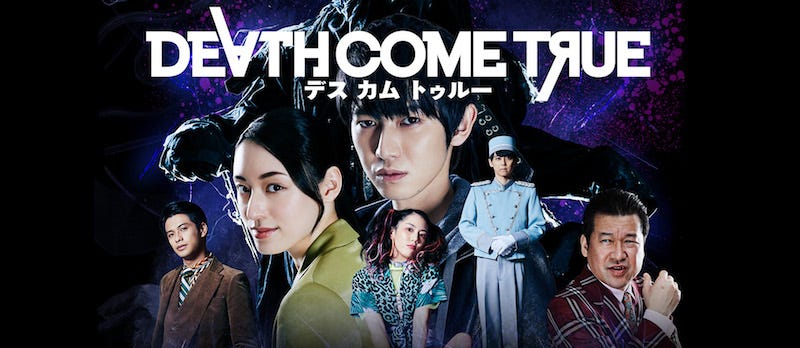
Video Game Deep Cuts: SpongeBob’s Death Come True

The following blog post, unless otherwise noted, was written by a member of Gamasutra’s community.
The thoughts and opinions expressed are those of the writer and not Gamasutra or its parent company.


[Yes, this is what Hylics 2 really looks like. Any more questions?]

It’s Friday, and it’s definitely time for Video Game Deep Cuts on Substack, folks. It’s interesting – I can feel the newsletter morphing beneath my feet, as it moves more towards ‘things of interest’ than longform writing.

Though it has both, now! Has it attained its final form? Only time will tell.

– Simon, curator

The Current: New Games To Consider

The Culture: Game Culture & Deep Dives

The Past: Game History

The Other Goodness

Posted on Leave a comment

Get a job: Klang Games GmbH is hiring a Technical Producer

The Gamasutra Job Board is the most diverse, active and established board of its kind for the video game industry!

Here is just one of the many, many positions being advertised right now.

Location: Berlin, Germany

At the heart of Klang is Seed, a large-scale, persistent virtual world that we believe will redefine the MMO landscape and have a positive impact on our species.

We aspire to bring people together through engaging media experiences and by building strong communities.

We are looking for a Technical Producer who enjoys a collaborative and creative work environment to join us in one of the most exciting cities on the planet! If you have an engineering background and are interested in moving into Production for an ambitious and ground-breaking project, we have an amazing opportunity for you.

Requirements

  • Be a major part of the production team facilitating dedicated game developers
  • Work with the engineering team to breakdown design specifications and identifying technical requirements
  • Support the approval process for technical designs and best practices
  • Work closely with engineering to plan and define work, risks, dependencies, opportunities and production improvements
  • Provide Production feedback on technical designs for all high-risk/high-impact systems
  • Work with the CTO and Lead Engineers shape and drive the future technical roadmap
  • Facilitate the sharing of technical knowledge and learnings across the studio’s development teams
  • Stay up to date nf global technology advancements to identify opportunities to progress qualitative standards
  • Coordinate internal and external teams as required
  • Assist other team members with technical questions
  • Manage activities include planning, managing, documenting and tracking project schedules and workflows, managing trade-offs and eliminating blockers

What we look for in you:

  • Thinking critically, and applying analytical skills to solve complex issues
  • Planning work to create realistic deliverables
  • Being adaptable, helping nurture the engineering teams culture within the studio
  • Becoming Production’s champion for development standards and best practices across all engineering teams within the studio 

Who We Think Will Be A Great Fit:

  • A bachelor’s degree in Computer Science, Engineering or equivalent experience
  • 3+ years as a senior programmer, a programming generalist who’s self-motivated, a team player who takes the lead facilitating breakdown of complex tasks
  • Experience with C#, or similar programming languages
  • Experience managing engineers and discussing estimations
  • Understand data structures, along with performance-minded development and optimisation skills
  • Good knowledge in game systems programming and development
  • Experience with modern commercial games engines such as Unity
  • Able to work independently and have a high degree of initiative
  • Someone who is comfortable communicating technical subjects to other disciplines
  • An appreciation of the roles, responsibilities and challenges within other disciplines
  • Excellent communication skills, both verbally and written
  • Experience working with Microsoft Office tools and Jira

Bonus, but not mandatory:

  • Experience with back-end and devops technologies (e.g. SQL, GCE, K8S, .NetCore, etc.)

Benefits

  • An opportunity to work on a groundbreaking project from its inception with a lot of room for professional and personal development
  • Our own cafeteria serving free lunches daily
  • Competitive salary and 27 days of paid vacation
  • Flexible office hours (with core hours)
  • Monthly public transport travel pass
  • Monthly company co-contributions to private pensions
  • Free and discounted memberships with Urban Sports Club
  • Monthly team events and activities
  • A dog-friendly office, adjustable standing desks, and mobile aircon units for hot summers
  • Relocation assistance and visa support 

We explicitly encourage applications from applicants from groups underrepresented in games/tech spaces. We value all kinds of backgrounds and walks of life.

Interested? Apply now.

Whether you’re just starting out, looking for something new, or just seeing what’s out there, the Gamasutra Job Board is the place where game developers move ahead in their careers.

Gamasutra’s Job Board is the most diverse, most active, and most established board of its kind in the video game industry, serving companies of all sizes, from indie to triple-A.

Looking for a new job? Get started here. Are you a recruiter looking for talent? Post jobs here.

Posted on Leave a comment

Don’t Miss: The evolution of CD Projekt’s quest design for Cyberpunk: 2077

The Witcher 3 is known for its great quest design, but developer CD Projekt Red promises to evolve this tried and true approach in its next game, Cyberpunk 2077.

At E3 2019, quest director Mateusz Tomaskiewicz​ told us about what he’s learned directing the quests of Cyberpunk 2077, and the challenges of designing a more nonlinear RPG. 

A lot has changed, I moved in from Thronebreaker: The Witcher Tales, and I had to get up to speed with everything going on and what we have, assumptions, goals, and so on. And what’s really special for me about this project specifically compared to The Witcher 3, for example, is that no longer are we only trying to combine a rich branching narrative with an open world – this time around we would like to add a layer of nonlinearity, which is gameplay nonlinearity.

So, we’re adding this whole layer related to the skills that you choose as you play, to the life paths you choose as you create your character. We implement all of that within the range of the missions. 

You saw that this year we focused on showing this specific thing. That’s why we spent so much time in the mall, so we showed you guys what are the different ways of solving these missions. You can stealth your way through, you can shoot your way through if you choose so.

There’re different paths you can unlock based on the skills you’ve invested in your time in. There are different dialogue options based on the skills you’ve invested your time in, and the life path that you’ve chosen. And this impacted our design.

First of all, it’s a big shift in how we’re thinking about quests and how we’re approaching guiding players, and how we’re implementing these missions. Specifically, not only do we now have to think about the possible paths the players take in terms of the story – which is what we focused on in The Witcher 3 – now we have to think about how to build these encounters and sequences that provide interesting, divergent paths for different skillsets that players decide to go with. This isn’t something we did in The Witcher 3.

For example, in The Witcher 3, combat sequences were like black boxes that you inserted. You just spawned NPCs, and the rest was just happening there. It was just fighting them with swords, signs, or bombs, but the outcome was the same. 

This time around, it’s more interconnected with other departments – the level designers or the encounter designers of gameplay. In terms of what kinds of devices can we use, [we consider] how we can build the level so it’s interesting and [clear] about what kind of paths you can take, and how to combine this with the narrative, and how to make it work in a way that you don’t break the game’s story. 

I think the most challenging thing about this is that these teams have to start working together really closely. In The Witcher, the quest designer was an owner of a chunk of a game. They implemented almost everything in that section. They could own it – not many people could impact us. If the whole level changed for artistic reasons, this impacted their work, but gameplay designers wouldn’t break it often for them.

If you do this very close cooperation where the work overlaps, so in this case the mall in the demo shown today, [that] was worked on by a quest designer, encounter designers, and level designers. So whenever each of them do their part of the job, if they don’t communicate properly, they create issues for each other. 

So I think the biggest challenge here is proper communication in coming together and creating this part of the game together, and to not break each other’s work. It might sound basic or simple but in reality, it’s not. It requires a lot of effort from all the teams involved to get it done and get it done properly.

We tried a few different ways to approach this. Daily standups were one of the ways that our strike teams were doing this. Then I think at some point we decided not to do the daily ones because it was too many meetings. Another thing we did was to put the people from strike teams together in the same room so it’s easier to communicate with each other.

We have weekly meetings where people talk to us [about] what are the problems they encounter, is there anything global that needs to be fixed between the teams, so I can help people with that. Aside from that, we encourage people and organize playthroughs of these missions for the strike teams. 

So they sit together in one room, and they play this whole thing and talk about issues and what they would like to do and so on. These are some measures we have taken. The most important one is day-to-day communication between them – putting this thought in people’s minds that anytime you change anything, it might impact other people. Inform them, even if – worst case scenario, it won’t be important to them. Best case scenario, they might see something that might be problematic or important to them.

And again, it sounds obvious, but it’s not. There’s a lot of tendencies in people’s mindsets to believe that something is obvious for other people, or something might not be important for other people because they don’t see the cascade of consequences. But when they start talking to other people, it becomes clear “oh, this changes a lot, it’s super important to let people know.”

This was a rule for us in all of our projects. We always had this rule in the main storyline – we never fail the quest based on choices. We treat those things as outcomes. The only way to fail them is if the player dies.

It’s quite limiting when you think about it when you start designing. What comes out of it is something pretty interesting. The game feels more organic – we have to think about all these different possibilities and outcomes. It doesn’t feel limited, it feels like it gives players more freedom in what they’re doing. It creates this impression that the world reacts to what you’re doing instead of saying “oh no you shouldn’t do that, it’s not the right way to do that.”

In the side missions, we can let players fail them, but again we can do it as an outcome. So it’s not the case that you failed it and now you have to restart, it’s more like “you fucked up.” Say you were supposed to escort someone, and they died, and it has consequences. It makes the game feel more organic, and makes the player say “yeah that’s how it would have went if this was pen and paper.” The GM wouldn’t say “yeah you killed a main NPC you have to restart the adventure.” They’re trying to go with it, and see how it would continue. 

There are multiple ways. There is of course, through the dialogue, this is the most obvious one. There are different problems in the game as you interact with different quests and go through them. You can have a stance on those problems.

Some of them are flavor, so choices, some of them are meaningful decisions that impact different things. Another guideline we have for quest design in our company is to make the distinction between the two as blurred as possible. So you should be asking “is this decision a flavor or will this have far-reaching consequences?” If you do it like this in our observation, people tend to pay more attention to all of the choices because people don’t know which ones are the important ones and which ones are the cosmetic ones. 

That’s one thing. The second thing is – this isn’t quest design per se, but it’s the possibility to customize your character as you play through the game. As I mentioned, this time around we have this other layer, we added this thing we called the life path. It’s like the origin of your character. At the beginning of the game when you create your character – are you a street kid, are you a corpo, or are you a loner? 

These life paths give you different advantages and disadvantages throughout the game. For example, when you interact with corpos, you know how they operate, you know how to talk to them to gain an advantage over them. On the streets, as a corpo you don’t have many advantages. 

The concept of cyberspace itself is pretty interesting in our game, because the general idea is that everyone who interacts with cyberspace sees it differently. You might imagine that the thing you saw in the demo is how V – the player character – sees cyberspace. But some other character like Brigitte, she sees cyberspace totally differently. 

The general idea is that cyberspace is such a vast amount of data that your brain, in order to not go mad, to make some sense out of it, it uses known symbols, its own knowledge and references to create some kind of sense out of it. This is one way. We have multiple threads in quests that touch upon different facets of transhumanism.

And of course a lot of it we show through the dialogue. We show it through environmental storytelling, throughout the city, throughout different stories about different characters and how they cross certain boundaries, and how they move forward with transcending what it means to be human, so to speak.

The setting of cyberpunk itself is different in this regard in that a lot of things that would be quite alien or bizarre to us today – the ease with which people can replace their legs or hands or other body parts with cybernetics is totally normalized in this society. This is a subject we put a lot of attention to as well throughout the whole game.

To do this, we do it in the standard narrative in different stories. We also have video content that touches heavily upon this subject to tell you how this society works and how normalized these things are. And of course the commercials, the ads in the game that you might find, you saw many of them in the demo in Pacifica. We have produced a lot of content to show this message to players. 

Yeah, yeah. 

Of course. It’s a very sensitive and important subject I believe. We have put a lot of thought into this. One of the things we want to do in the final game – which we couldn’t show in the demo yet, because as you mentioned it’s a work in progress – is to give the players as many options of customization in the beginning of the game as we can. 

For example, we want to do this thing where, as you create your character after you choose the body type, you can, for example, use physical traits as you build your face that could be assigned to a man or a woman. 

Or nonbinary. The idea is to mix all of those up, to give them to the players, as they would like to build it. Same goes for the voice. We wanted to separate this out, so the players can choose it freely. This is something we are still working on. It’s not as easy as it sounds. 

This is one part of it. In terms of how we depict the characters within the setting itself, of course, yes, we are paying a lot of attention to it. We do not want anyone to feel like we are neglecting this, or treating it wrongly. 

I personally get inspired mostly by other works of fiction. I watch loads of movies and I play a lot of games, board games, etc. That’s where most of my inspirations come from. Sometimes real life is much weirder than the fictional situations that we come up in. Many times I’ve had situations in my life where “if I proposed this as a quest in our game, I would be laughed out of the room.”

People would tell me “that doesn’t make any sense,” or “that situation could not occur.” Sometimes these things are nice snippets you can use to build up a bigger story out of them. My preferred way of working about these things with the designers is to give them the opportunity to do these short pitches, in which you’re looking for a glimpse of something interesting, something we can build upon. It doesn’t have to be a huge long story, but it needs to be something memorable, something we can put in the game. 

It’s less of a specific inspiration, more like a method of inspiration. 

Posted on Leave a comment

Microsoft exiting the retail store business, closing 83 locations

Microsoft has announced that it’s closing 83 of its Microsoft stores across the world, marking an exit from the retail space from the Windows (and Xbox) developer. 

According to a press release, this permanent closure follows a temporary one that began with the spread of COVID-19. With reopenings coming to a screeching halt across the country, it doesn’t appear that Microsoft’s sleek, first-party-focused storefronts will be able to make a return. The company will keep four locations open in London, New York, Sydney, and its Redmond Campus. 

For those interested in Microsoft’s quarterly financials, “the closing of Microsoft Store physical locations will result in a pre-tax charge of approximately $450M, or $0.05 per share, to be recorded in the current quarter ending June 30, 2020,” according to the release. 

Microsoft’s release somewhat addresses what will happen to the employees of its stores. It describes a series of “retail teams” that have moved to virtual work and run workshops and sold technology online to firms dealing with the pandemic, and that those teams “will serve consumers, small-business, education, and enterprise customers while building a pipeline of talent with transferable skills.”

However in the release, Microsoft doesn’t fully commit to retaining 100% of former retail employees, or fully delineate the difference between teams built from retail employees with the corporate Microsoft Store team.

The company states that Microsoft.com, as well as digitial storefronts based on its Xbox and Windows platforms, would take over the workshops, support, and workshops that were key aspects of the physical stores in malls and shopping centers across the world. 

We’ve reached out to Microsoft for clarification on its plans to retain Microsoft Store employees, and will update this story when they get back to us. 

Update: A Microsoft spokesperson told Gamasutra that “All employees will have the opportunity to stay with Microsoft.” 

Photo by Wpcpey.

Posted on Leave a comment

Sonic the Hedgehog film producer snaps up Disco Elysium screen rights

In a move some might call “very disco, man,” production company dj2, which co-produced the film Sonic the Hedgehog, has announced it’s secured the rights for a television series based on ZA/UM’s Disco Elysium. 

The 2019 game, which racked up prize after prize during last year’s award season, tells the story of a drunken detective stumbling through a murder mystery that threatens to set a small town ablaze in a fictional universe inspired by Robert Kurvitz’s 2013 novel “Sacred and Terrible Air.” 

It’s been widely praised for its use of text and irreverent humor to stand out in the narrative storytelling space. 

For its part, dj2 has been creeping around the world of video game adaptations for a few years. It’s secured the rights to adapt games ranging from Skulls of the Shogun to Dontnod’s Life is Strange and Vampyr

Today’s announcement does not come with any attached writers or distribution studios, meaning the project still has a long way to go before it hits the small screen. 

If adapted, the show would feature 100% more “sorry cops” than real police do, as they have lately committed to showing how not sorry they generally are. 

Posted on Leave a comment

NeoAxis Engine Open Sourced

The NeoAxis Engine just released the source code, although it’s technically not “open source” according to OSI compliant licenses.  You can now access the source code on GitHub.

Here is the license:

  • 1. When publishing your product, you must add “Made with NeoAxis Engine (www.neoaxis.com)” with the product information and in its credits.
  • 2. You can distribute the NeoAxis editor with your product. When you do it the window title of the editor must be:

    “Your project name – NeoAxis Engine 2020.3 (www.neoaxis.com)”.

    Or if you made engine modification:

    “Your project name – Modified version of NeoAxis Engine 2020.3 (www.neoaxis.com)”

    This can be done by changing the value of the ModifiedVersionOfNeoAxisEngine field in the Sources\Engine\NeoAxis.Core\Utility\EngineInfo.cs file.

  • 3. You can distribute the source code of the NeoAxis Engine. In the case of publishing any part of the modified source code, for example, by means of creating a fork or other distribution method, you automatically become the contributor of the NeoAxis Engine. This means that the NeoAxis Group Ltd reserves the right to use your modified source code at its discretion, for example, to improve the original version of the NeoAxis Engine. Copyright for modified code is saved to you.

To me that certainly sounds like something an existing OSI license should cover.  You can learn more about NeoAxis making the source available in the video below.

GameDev News


Posted on Leave a comment

Get inspired at GDC Summer’s Experimental Gameplay Workshop

Game Developers Conference organizers are excited to confirm that a perennial GDC favorite, the Experimental Gameplay Workshop, will take place this August during the all-digital GDC Summer!

Part of the GDC Summer Design track of talks, the Experimental Gameplay Workshop is a fast-paced, game-packed session in which panelists showcase a selection of intriguing prototypes made by innovation-minded game developers from all over the world.

By demonstrating games that defy conventions and traditions in search of new genres and ideas, this session aims to ignite the imagination of all game makers. Come see what’s happening in the world of experimental gameplay, and be inspired!

This talk promises new perspective on the process of designing games in the hyper-popular match-3 genre, and you can see it and many more by registering for GDC Summer!

For more details on GDC Summer, scheduled to take place virtually August 4th through the 6th, visit the show’s official website, or subscribe to regular updates via Facebook, Twitter, or RSS.

Gamasutra and GDC are sibling organizations under parent company Informa Tech

Posted on Leave a comment

What are Steam Points? What were Summer Festival’s lessons?

The following blog post, unless otherwise noted, was written by a member of Gamasutra’s community.
The thoughts and opinions expressed are those of the writer and not Gamasutra or its parent company.


[Hi, I’m Simon Carless, and you’re reading the Game Discoverability Now! newsletter, which you can subscribe to now, a regular look at how people find – and buy – your video games. Or don’t.]

Well, the Steam Summer Sale has just gone live. It coincided with a new, unexpected feature roll-out that’s made me change my lead story for this week’s Tales From Discoverabilityland round-up. So let’s go for it!

What the heck are Steam Points?

Just before the Steam Summer Sale went live today, my No More Robots colleague Mike Rose spotted a new ‘Award’ button next to all user reviews on Steam:

This confused us for fully 7 minutes (lol), before the complete Steam update launched. At this point, we were able to work out that the Steam Points Shop was now live:

Fitting all the details into a single Twitter post is not the easiest. So, expanding on that:

  • This is a ‘spend money to get Steam Points, then redeem them for cute cosmetic items’ feature. It doesn’t fundamentally change anything about Steam’s monetization. It’s a permanent extension of similar Sale-only point experiments.

  • Specifically, the things you are buying with Steam Points are either Valve-created generic cosmetics for your Steam profile and Steam chat, or “emoticons and profile backgrounds associated with the games you own”.

  • Many of these game-specific items already exist as part of Steam Trading Cards rewards (example), and “…can now be directly acquired by using Steam Points. Don’t worry, you can still use the Steam card crafting to get those items if you wish.”

  • No, this new feature doesn’t replace Steam Trading Cards (there’s a FAQ at the bottom of this page which notes “We know people enjoy collecting Steam Trading Cards and crafting badges, so we have no plans to remove them at this time.”)

  • Why did Valve add this feature? I see it as some fun gamification that ultimately should help with Steam user retention. It’s also intended as a bit of a positive feedback loop – note you can only select ‘nice’ awards, that’s cute.

I see a bunch of people on social media saying ‘how is this going to mess things up?’. And I freely admit that any large userbase can unexpectedly abuse systems at any time, haha. But it seems like a benign and incremental addition to me so far*. (*Famous last words.)

[Lars Doucet did a step-by-step ‘awarding reviews’ walkthrough with screenshots if you want to see more, btw.]

Steam Summer Game Festival – results?

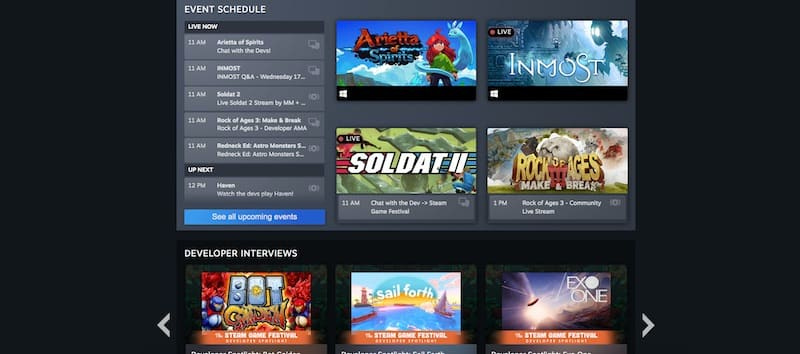
Ugh, I really wish (for my brain’s sake) that Steam hadn’t put the word ‘Summer’ in two very different promotions that ran sequentially. This section is about the ‘demos of over 900 yet to be released Steam’ games event that ran until June 22nd.

I’ve gathered – both on and off the record, and via social media – some of the wishlist and demo download numbers. Here goes:

Non-featured SummerFest demos

If your game demo wasn’t one of the ‘Featured’ ones that appeared as default on the Festival homepage, and was generally lower-profile, you tended to pick up 500 to 1000 wishlists.

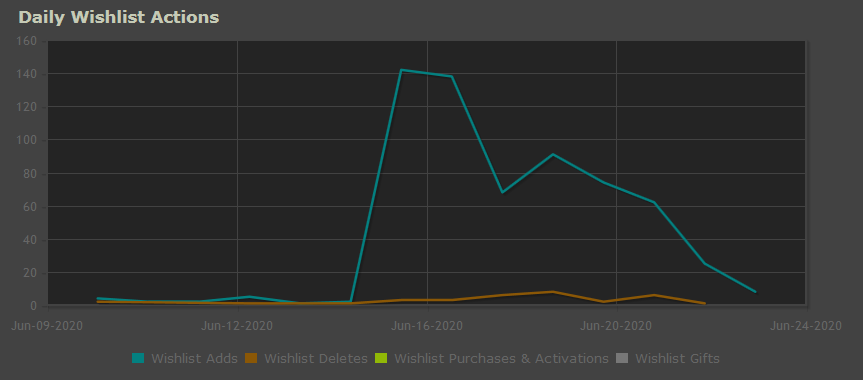
Eldritch Zookeeper dev Matt Luard was kind enough to send me his wishlist stats across the Festival:

So that’s 600 new wishlists in total. It was quite a boost from the daily wishlists additions before the Summer Festival, too, if you look closely.

Further dataon this is provided by Do Not Buy This Game dev Roee Amar, who tagged me on Twitter with a series of stats, including 497 new wishlists, as well as 668 demo downloads.

One other example here – Victor Burgo, the dev of Neko Ghost, Jump has a very detailed Reddit thread revealing he ended up getting 191 wishlists and 271 demo downloads during the Festival.

Featured SummerFest demos

Obviously, those games that were ‘featured’ by Valve did better in the Festival. Though in most cases, they likely had a bigger fanbase in the first place, and some were adding significant wishlists even before the Festival. But the Festival really boosted things!

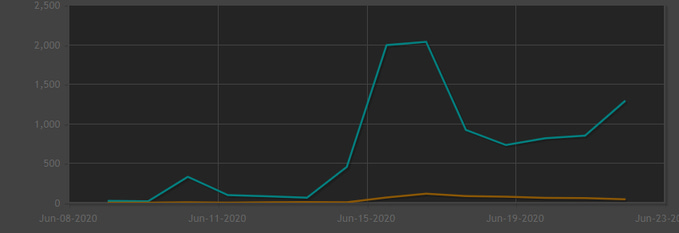
A great example is turn-based tactical RPG The Last Spell, which has a detailed Twitter thread about its results from Hegor. Here’s the wishlist info:

So The Last Spell added around 8,600 wishlists during the Steam Festival, though it already had about 14,000 beforehand. In addition, about 6,000 people downloaded the demo.

Elsewhere, according to Twitter, tactical RPG Shores Unknown – which was featured – got 4,200 extra wishlists, when previously the game “was getting 20-30 WLs on a good day”. And 3,600 people added the game’s demo, though around 2,000 actually downloaded it.

And wine-making sim Hundred Days, which was both featured and additionally highlighted by Valve in a spotlight video, ended up adding over 5,000 wishlists in the first two days – actually even better than their LudoNarraCon wishlist additions. (So I presume they ended up between 10k and 20k extra.)

Finally, you can go look at the SteamDB graphs for a game (in this case, Iron Harvest, the Festival’s most-wishlisted game when it all started) to see how Followers were boosted. Looks like Iron Harvest added 6,000 followers, which could be… 35,000 to 40,000 extra wishlists? (Depending on the conversion from followers to wishlists.)

So that’s the answer on how games did – anywhere from 200 to 40,000 extra wishlists! From what I’ve seen, though, pretty much everyone who participated in the Festival thought it was worth doing. You might have wanted more wishlists, but you appreciated the ones you got.

‘Not-E3’ Showcases – Some Handy Updates

Finally, I already did a bunch of analysis on the ‘not-E3’ streaming game showcase events in that earlier round-up. But there’s two or three new things to note here:

New events! I particularly wanted to link to the Double Fine & iam8bit’s Day Of The Devs showcase, Pt. 1 at Summer Game Fest (full video, don’t miss the ALF appearance just before it, cos ?!?) – one of my favorite showcases so far.

Thought this was a really well put-together & well-paced set of games, overall – though it possibly got incrementally less buzz because a) there’s showcase burnout b) they were a little artsier than other showcases. Here’s most of the DoTD v1 trailers in one place, which is handy. Bias disclaimer: we partner with Day Of The Devs for GDC, haha!

Aggregated trailers! Only just became aware of this, but the E3 2020 Recap page has all of the ‘not E3’ game trailers, sorted by showcase and chronological order, and well categorized. What a great thing.

It includes trailers from the Japanese-centric New Game+ Expo (full video), which happened since the last round-up and I also dug. It was well-focused, in that it got most of the high-profile Japanese mid-tier devs together in one place.

Upcoming attractions! Day Of The Devs has opened submissions for its second virtual event on July 20th, and the deadline to submit is June 29th. So go ahead and put something forward, if you think you’ve got a game that could fit in with their vibe.

Overall, we’re done with most of the showcases now until GamesCom, unless you count things like virtual GDC, which is more conference-y. But there’s still others like BitSummit Gaiden to come (full list, also Thomas Reisenegger notes other showcases you can apply to).

Thanks to everyone who showcased their game in one of these virtual smorgasbords so far. You did good. And that’s it for this week’s roundups. More soon!