Companies to collaborate on new cloud-based solutions for gaming experiences and AI solutions
Kenichiro Yoshida, President and CEO, Sony Corporation (left), and Satya Nadella, CEO, Microsoft
TOKYO and REDMOND, Wash.— May 16, 2019 — Sony Corporation (Sony) and Microsoft Corp. (Microsoft) announced on Thursday that the two companies will partner on new innovations to enhance customer experiences in their direct-to-consumer entertainment platforms and AI solutions.
Under the memorandum of understanding signed by the parties, the two companies will explore joint development of future cloud solutions in Microsoft Azure to support their respective game and content-streaming services. In addition, the two companies will explore the use of current Microsoft Azure datacenter-based solutions for Sony’s game and content-streaming services. By working together, the companies aim to deliver more enhanced entertainment experiences for their worldwide customers. These efforts will also include building better development platforms for the content creator community.
As part of the memorandum of understanding, Sony and Microsoft will also explore collaboration in the areas of semiconductors and AI. For semiconductors, this includes potential joint development of new intelligent image sensor solutions. By integrating Sony’s cutting-edge image sensors with Microsoft’s Azure AI technology in a hybrid manner across cloud and edge, as well as solutions that leverage Sony’s semiconductors and Microsoft cloud technology, the companies aim to provide enhanced capabilities for enterprise customers. In terms of AI, the parties will explore incorporation of Microsoft’s advanced AI platform and tools in Sony consumer products, to provide highly intuitive and user-friendly AI experiences.
“Sony is a creative entertainment company with a solid foundation of technology. We collaborate closely with a multitude of content creators that capture the imagination of people around the world, and through our cutting-edge technology, we provide the tools to bring their dreams and vision to reality,” said Kenichiro Yoshida, president and CEO of Sony. “PlayStation® itself came about through the integration of creativity and technology. Our mission is to seamlessly evolve this platform as one that continues to deliver the best and most immersive entertainment experiences, together with a cloud environment that ensures the best possible experience, anytime, anywhere. For many years, Microsoft has been a key business partner for us, though of course the two companies have also been competing in some areas. I believe that our joint development of future cloud solutions will contribute greatly to the advancement of interactive content. Additionally, I hope that in the areas of semiconductors and AI, leveraging each company’s cutting-edge technology in a mutually complementary way will lead to the creation of new value for society.”
“Sony has always been a leader in both entertainment and technology, and the collaboration we announced today builds on this history of innovation,” said Satya Nadella, CEO of Microsoft. “Our partnership brings the power of Azure and Azure AI to Sony to deliver new gaming and entertainment experiences for customers.”
Going forward, the two companies will share additional information when available.
About Sony Corporation
Sony Corporation is a creative entertainment company with a solid foundation of technology. From game and network services to music, pictures, electronics, semiconductors and financial services — Sony’s purpose is to fill the world with emotion through the power of creativity and technology. For more information, visit: http://www.sony.net/.
About Microsoft
Microsoft (Nasdaq “MSFT” @microsoft) enables digital transformation for the era of an intelligent cloud and intelligent edge. Its mission is to empower every person and every organization on the planet to achieve more.
For more information, press only:
Microsoft Media Relations, WE Communications for Microsoft, (425) 638-7777, rrt@we-worldwide.com
Sony Corporation, Corporate Communications & CSR Department, Sony.Pressroom@sony.co.jp
Note to editors: For more information, news and perspectives from Microsoft, please visit the Microsoft News Center at http://news.microsoft.com. Web links, telephone numbers and titles were correct at time of publication, but may have changed. For additional assistance, journalists and analysts may contact Microsoft’s Rapid Response Team or other appropriate contacts listed at http://news.microsoft.com/microsoft-public-relations-contacts.
In today’s classroom, diversity is the new normal. Teachers don their superhero capes every day, going to extraordinary lengths to reach every one of their students, from creating inclusive curriculum in core subjects like reading, writing, and math, to enabling every student to have a voice. We’re honoring their work, and highlighting some tools to help, in this month’s episode of What’s New in EDU.
At Microsoft Education, we work to support teachers in their mission to create an inclusive classroom for all students. Here are 10 ways our tools support learning across unique needs and abilities.
Understand word meanings more easily and improve vocabulary
Seeing a word and attaching meaning to it involves a number of cognitive processes. We’re trying to support students learning to make those connections with Picture Dictionary and Read Aloud in Immersive Reader. Select a word and Picture Dictionary will show you a descriptive image, even providing multiple images for words with more than one meaning. Read Aloud connects the text to students with visual impairments and helps with pronunciation practice. Providing visual and audio inputs gives all students, and especially students with dyslexia, the multi-sensory experiences they need to ingrain that word into their vocabulary.
Try this: Next time you give a vocabulary quiz, try providing the list of vocabulary words in OneNote. Show students that they can click Immersive Reader, then click the vocabulary word to see a picture of what the word means and have it read aloud.
Make it easier to focus on reading
With the media multitudes that surround students, it’s not always easy to prevent distractions online and across devices. Immersive Reader’s flexible text sizing, line focus, and background color options make any document, notebook or web page focus friendly. This is particularly helpful for students with ADD and ADHD as well as for students with dyslexia.
Try this: Next time you assign reading to be done from a device, show students how to select Immersive Reader in OneNote, make the font bigger, and select line focus mode.Learn more about Learning Tools like Immersive Reader!
Improve pronunciation of longer words
We know a time-tested tactic is breaking up words into syllables and sounding them out. Now, students have a tool that will do so automatically, helping them to nail the pronunciation. Students can even check their pronunciation by selecting Read Aloud and seeing how close they were. This is particularly helpful for students with dyslexia who often have trouble matching letters to sounds.
Try this: Next time you assign reading to be done at home, instruct students to break the words into syllables in Immersive Reader or, if they can’t remember how to pronounce them, to use Read Aloud.
Understand grammar and sentence structure more quickly
Understanding parts of speech is critical for developing reading fluency. Immersive Reader can help by labeling or highlighting nouns, verbs, adjectives, and adverbs. This supports all students, especially those with dyslexia, as they develop their ability to find patterns in words.
Try this: Next time you assign grammar practice, let students know they can check their work by selecting the Parts of Speech toggles in Immersive Reader.
Empower students to improve the quality of their writing
When you spend a long time writing, you want to make sure the final work is polished. Read Aloud in Immersive Reader allows you to have the document you’ve written read out loud, so you can more easily catch mistakes. Editor in Word helps students identify misspellings, provides synonyms for those misspelled words, and offers the option to have the suggested spelling correction and synonyms read aloud. This all helps students with dysgraphia who have a hard time reviewing their own written work.
Try this: During the editing and revising process, encourage students to use Read Aloud to listen to their work read back to them. This will help them identify revisions and improve their writing!
Make it easier to start writing, and kick writer’s block
We’ve all stared down an empty page in fear wondering how we’re going to fill it with beautiful writing. With Dictate, in OneNote and Word, students can have their speech turned to on-screen text. This is especially helpful for students with dysgraphia who struggle with writing.
Try this: When students are having trouble getting started, encourage them to turn on Dictate, then brainstorm out loud. Just getting some ideas and words on the page will build momentum and help them conquer the blank page! Check out more ideas for utilizing Dictate in the classroom!
Break down the language barrier
Students can use all the same tools above when they learn their first language—and then when they learn a second language! With document and word translation in Immersive Reader, you could start with a text in Spanish and translate either individual words or the entire document into English. This is helpful for students with dyslexia, who are learning new languages, and ESL learners, who can match the words they know in their first language with their second language more easily than ever before using sounds, pictures and text.
Try this: When you assign passages for reading, put a copy in OneNote and show students they can translate either by word or document in Immersive Reader.
Help students read, understand steps, and show their work in math
Math is all about showing your thought process and the steps you took to get to the answer. Math Solver shows students the steps to solve a math problem, giving a clear model for how to show your work. The Immersive Reader can also read the math equation notation, as well as the step-by-step instructions in Math Solver, aloud for students. This helps students with dyscalculia break down math problems and learn what to do with similar problems next time.
Try this: If a student is having trouble with a particular type of problem, encourage them to use the Math Solver to insert the steps into their OneNote page. They can reference the steps as they work on similar problems, helping them follow the same solution process but applying it to new equations.
Present to students, parents, and your colleagues inclusively
When you give a presentation to students, parents, or other teachers (or when teaching students to present), make sure to turn on live captions and subtitles in PowerPoint. Live captions help students with hearing impairments, or those who speak other languages outside the classroom, to follow along with the presentation.
Meeting remotely? Connect with parents or colleagues online in a Teams meeting, and turn on live captions to make sure no one misses a moment, whether it’s a global PLC meeting or an online parent conference.
Try this: Use PowerPoint live captions and subtitles during your next parent-teacher conference. Those rooms get packed, and parents will appreciate being able to see captions. They can even download the Microsoft Translator app and translate it into the language they use most often.
Build student empathy with Minecraft: Education Edition
Minecraft: Education Edition offers several features that support inclusive learning, from classroom multiplayer for better collaboration, to customizable game settings including a text-to-speech user interface. As New York City special educator and STEM coach Sean Arnold writes in this EdSurgearticle, “chat features are enabled with speech-to-text functionality, which lets struggling readers and writers participate with the community at their own pace.” Minecraft: Education Edition gives students with physical and intellectual disabilities the opportunity to be creative, explore without fear of failure, and feel a sense of autonomy in the classroom. Arnold explains, “my students were no longer confined to wheelchairs or leg braces; they could walk, create and even fly. It’s a world where they are free from ridicule, free from their real-world struggles and free to create a world that they desire.”
We know that better student outcomes, teacher time, school budgets, and IT staff workloads are top of mind for every school district and school leader. That’s why we partnered with Forrester Consulting to do a total economic impact analysis around Microsoft assistive technologies for education. Informed by interviews across four Microsoft 365 (M365) districts using our accessibility tools, the findings pointed to three key benefits: improved student learning, reduced cost and effort, and saved time and increased effectiveness.
This report is available todownload and share in your district. We also have a deeper dive into the data available on our Tech Community blog. With the tools built into the M365 accessible platform, you can help improve learning outcomes for every student while also saving real dollars in your school budget.
And don’t miss next Tuesday’s #MSFTEduChat TweetMeet, where we’ll be discussing inclusive classrooms and accessibility with a global community of educators.
Here is how technology is helping museums get closer to the communities they serve.
Noise-cancelling headphones
We don’t all experience the world in the same way — everyone is different. People with autism, for example, may find certain situations cause a sensory overload.
New York’s Intrepid Sea, Air & Space Museum offers noise-cancelling headphones for people who might have auditory over-stimulation. This museum also helps parents of children with sensory processing disabilities plan their visits by emailing them images and illustrations in advance.
Museums in Chicago (including the Shedd Aquarium, the Field Museum and the Chicago Children’s Museum) also help visitors plan their trips through an app that highlights exhibitions that are sensory friendly.
Tactile displays and audio descriptions can help bring museum experiences to life.
The Smithsonian museums in Washington, D.C., are giving visitors who are blind or with low vision a rich and rewarding experience through their smartphones or smart glasses. Using a video-streaming service, users are connected to an “agent” who provides a bespoke, detailed description of their surroundings.
The use of Braille descriptions has become increasingly common in museums around the world, and one Spanish institution has improved upon that. Madrid’s Prado Museum has made parts of its collection tactile, allowing visitors to be hands-on with the exhibitions.
The Louvre in Paris, and the Guggenheim Museum and the Metropolitan Museum of Art in New York, have all established tactile tours, where visitors can touch the art on display or touch casts of well-known works.
Hearing loops
Tools such as hearing loops — also known as audio induction loops — use wireless signals to transmit audio directly to someone’s hearing aid and can be used in a variety of settings, including museum exhibitions. The Met in New York is just one example of this.
Another New York museum, the Whitney Museum of American Art, has been trying something different. It has developed a series of vlogs, or video blogs, with messages, explanations and exhibition information in sign language.
As well as opening up the museum’s content to visitors with hearing loss and deafness, the museum, on its website, says it hopes to “create a communications laboratory to expand the ASL vocabulary of contemporary art terms,” referring to American Sign Language.
The Dutch Rijksmuseum believes everyone should be able to access information on the art in their own language. It recently launched a video tour in Dutch Sign Language integrated in its app. The tour has been set up in close collaboration with and by deaf entrepreneurs.
Immersive experiences
A few years ago, the Pokémon Go craze took off, introducing many people to the possibilities of augmented reality. By creating immersive experiences, AR and other technology is being used to reimagine the way visitors relate to museums and historic sites.
You can take an AR tour of Pompeii, where a headset will put you right in the heart of the vibrant Roman city that was destroyed by the catastrophic eruption of Mount Vesuvius in A.D. 79.
Visitors to Bone Hall, in the Smithsonian National Museum of Natural History in Washington, D.C., meanwhile, can use AR to view the exhibits in a new light seeing the skeletons appear as living creatures.
The Petersen Automotive Museum in Los Angeles is using technology to bring cars from Hollywood alive with a mixed reality exhibition using Microsoft’s HoloLens technology. The “Worlds Reimagined” experience explores classic and futuristic cars from films and video games, including “Back to the Future” and the video game franchise “Halo.”
Other museums are using this technology to bring new experiences to their patrons including the Intrepid Sea, Air and Space Museum in New York with “Defying Gravity”; and the Museum of Flight’s mobile VR experiences in Washington state. The Musée des Plans-Reliefs in Paris used AI to create a digital twin of the historic Mont-Saint- Michel, which had to be captured from every angle.
In 1962, President John F. Kennedy captured the Space Race zeitgeist, when he said: “We choose to go to the moon in this decade and do the other things, not because they are easy, but because they are hard.” The Kennedy Space Center in Florida uses immersive technologies to recapture that energy, excitement and enthusiasm. At its “Heroes & Legends” exhibition, visitors can experience spacewalks, look inside space capsules and feel close to the action.
By bringing the past to life in a way that adds richness and depth, and, of course, accessibility, technology is helping museums reach a wider audience.
While working side-by-side with a robot may seem like science fiction, cobotics (collaborative robotics) is already happening in high-end manufacturing. Rather than reading an article about how cobots support people to do their best work; let us sing it to you.
Barwick composed five movements within an overall soundscape that reflect the constantly changing nature of the sky throughout the day, each with its own background of bass, synthesizer and vocal lines that weave in and out. For each “event,” identified by Microsoft AI, she then created six synthesized and six vocal sounds for the generative audio program to choose from – for example, 60 different musical options a day for every time an airplane passes above. The sounds are an expression of Barwick’s emotions in response to each stimulus.
“I didn’t want it to be too literal,” she says. “I could have made it sound ‘raindroppy,’ but it’s more about the attitude of the event. An airplane is a lot different than the moon, so it has more of a metallic sound than a warm sun sound or a quiet ‘moony’ kind of feeling. I wanted people who listen to it to be curious and wonder what that sound meant, what’s going across the sky right now.”
Barwick has never been afraid of technology, even if she didn’t have access to it. She recorded her first album in 2007 using a guitar pedal to form vocal loops on a cassette tape. “I didn’t even have a computer then,” she remembers. “I took my bag of tapes in somewhere to get mastered to produce the CD.”
Now she relies on technology to compose, record and perform her multilayered, ambient music. She uses effects on everything, including her voice. There’s no such thing as an unplugged Julianna Barwick set. Still, she says, “Before I was approached to do this project, the only thing I knew about artificial intelligence was from the movies. I’d never seen an application of it in my daily life.”
So as she began exploring sounds, Barwick grappled not only with what AI was and could do, but also with what her role would be in comparison to its. Who was the actual composer – she or the program? Was AI a partner or a tool?
“I contemplated how the project would play out in my absence and realized that I can make all the sounds, but I’m not going to be there to detect all the events — you have to rely on the AI to do that,” Barwick says. “And that’s such an important part of the score; it’s almost like it’s a 50-50 deal. And that’s what makes this project interesting. It almost brings in another collaborator, and the possibilities are endless. It’s opened up a new world of thinking and approaching future compositions and scores.”
A camera sends live images to a Microsoft Azure computer vision tool, which assigns tags such as “clouds” or “sun.” Those are fed into the system that technologists programmed after analyzing Barwick’s compositions and distilling them into an algorithm, which then chooses which tracks to play together.
He’s still working on films – including the next iteration of “Dune” – but games are also coming his way. But now, instead of getting concept art from someone else and building models based on sketches, he’s now on the front end doing the concept art.
“I know how to get it done, so while I’m designing it, I’m taking that into consideration because I can take it from idea to completed product,” Wertz says. “I have much more of an appreciation for the front end because of the work I’ve done on the back end, and vice versa.”
Now he hands off to his “old me” who builds the ideas he sketches. One of the most challenging assignments he’s had in his new role was working on the recent “Bumblebee” film, building a big, sophisticated Transformer from the ground up. And one of his most satisfying projects was working on “Galaxy Quest” and building a digital version of the ship on his computer, to help out guys he worshipped – guys who built the intricate physical model ships in the movie. Both of their ships made it into the final cut.
Wertz’s creativity flows a lot from his travels, which include airbases. He takes pictures of the planes’ surfaces and how light behaves on them. He likes to feel them and even smell them – in order to get the full experience.
“You never know what you need to pull from,” he says. “When I was standing next to this thing, I remember this is what it felt like. And if I’m not feeling that when I look at it on the screen, I gotta get back to that.”
While he looks at his works in progress on his computer and mobile screens, he usually doesn’t watch the movies he’s worked on – with the exception of the “Return of the Jedi” re-release, which was the first one he worked on. For him, it’s always about the process, rarely about the finished product.
“Before, I used to hold a model of an airplane, but I didn’t know who designed it. It was just a shape. Now I can come up with something and give it to someone else, the way I would pick up someone else’s design and I can work with them. We build it together,” he says. “It’s that same feeling when the hair on the back of your neck stands up because you’re having a really good time.”
Announcing the May 21 TweetMeet on ‘Inclusive classrooms and accessibility.’
Change starts with awareness. Every third Tuesday of May is Global Accessibility Awareness Day (GAAD). The purpose of GAAD is to get everyone talking, thinking and learning about people with different abilities and their accessibility and inclusion in a digital world.
Our mission is to empower every student on the planet to achieve more, which stems from the belief that every student deserves the opportunity to fulfill their potential.
In this edition of our monthly global and multilingual Twitter conversations, we’ll discuss ways in which educators around the world make inclusion and accessibility an integrated part of their classrooms.
Keep reading for detailed information about this TweetMeet.
Language tracks and SuperSway
We offer seven simultaneous language tracks this month: English, French, Spanish, Italian, Polish, Swedish and Vietnamese. The new SuperSway offers a TweetMeet Invitation in each of these languages.
For each language track, we have one or more hosts to post the translated questions and respond to educators. As always, we’re super grateful to all current and former hosts who are collaborating closely to provide this service.
The #TweetMeetXX hashtags for non-English languages are to be used together with #MSFTEduChat so that everyone can find the conversations back in their own language. For example: Spanish-speaking people should use both #TweetMeetES #MSFTEduChat. English-speaking educators may use #MSFTEduChat on its own.
TweetMeet Fan? Show it off on your Twitter profile!
Every month more and more people discover the unique flow and characteristics of the TweetMeet events and become excited to participate.
Show your passion for the TweetMeets right from your own Twitter page by uploading this month’s#MSFTEduChat Twitter Header Photo to the top of your own Twitter profile.
In the same file folder, the Twitter Header Photo is available in many other languages and time zones.
Looking back on the April TweetMeet on ‘Teaching Happiness’
The April #MSFTEduChat TweetMeet inspired educators around the world to share ideas, insights and resources. We captured highlights from this Twitter conversation in this @MicrosoftEDU Twitter Moment.
Why join the #MSFTEduChat TweetMeets?
TweetMeets are monthly recurring Twitter conversations about themes relevant to educators, facilitated by Microsoft Education. The purpose of these events is to help professionals in education to learn from each other and inspire their students while they are preparing for their future. The TweetMeets also nurture personal learning networks among educators from across the globe.
We’re grateful to have a support group made up exclusively of former TweetMeet hosts, who volunteer to translate communication and check the quality of our questions and promotional materials. They also help identify the best candidates for future events, provide relevant resources, promote the events among their networks and, in general, cheer everybody on.
When and how can I join?
Join us Tuesday, May 21 from 10 a.m. to 11 a.m. PDT on Twitter using the hashtags #MSFTEduChat, #inclusion,#accessibility and #MicrosoftEDU(which you can always use to stay in touch with us). Be sure to double-check your own local event time. You can find the event time for 215 countries with this time zone announcer.
Our next recommendation for you is to set up Twitter dashboard TweetDeck and add a column for the hashtag #MSFTEduChat. If you are new to TweetDeck, then check out this brief TweetDeck video tutorial by Marjolein Hoekstra.
When a tweet appears that you want to respond to, press the retweet button and type your comments. Great news is that Twitter now supports adding images, animated GIFs and videos to your comment retweets.
Additional tips are offered in this animated GIF that you’re most welcome to share with newcomers:
Too busy to join at event time? No problem!
From our monthly surveys we know that you may be in class at event time, busy doing other things or may even be asleep–well, no problem! All educators are welcome to join any time after the event. Simply look at the questions below and respond to these at a day and time that suit you best.
You can also schedule your tweets in advance. In that case, be sure to include the entire question in your tweet and mention the hashtag #MSFTEduChat so that everyone knows to which question in which conversation you are responding.
The exact question timings are in this helpful graphic:
Resources to help prepare for the TweetMeet
Microsoft Education offers a wide range of tools, professional-development courses and learning paths about inclusion and accessibility. These resources are tailored for educators and they are all free. Good places to start are:
Wakelet is a useful web service to bookmark, curate and annotate resources, images, tweets and other content. Mike Tholfsen just created this Wakelet Collection as a handy reference. It currently has 40+ pointers:
Catherine Dourmousi @CatDourmousi (EFL teacher, Hellenic American Union examiner for Michigan University English-language exams, Microsoft Certified Educator, author, supporter of empathy, mindfulness, and growth mindset in teaching – Athens, Greece)
Elisabetta Nanni @Bettananni (Music teacher and teacher trainer about ICT, MIE Expert, eTwinning Ambassador with expertise in Microsoft Learning Tools – Trento, Italy)
Elsbeth Seymour @TeachinEls (MIE Expert, Secondary Special Ed Teacher, using a passion for tech & gaming to connect, support and facilitate learning for neurodivergent students – California, USA)
Fabrice Marrou @FabMarrou (French and History teacher in a vocational school, former Microsoft Learning Consultant, ICT trainer – Perpignan, France)
Huong Quynh @Quynhth9 (EFL teacher, teacher trainer, passion for exploring ICT in language education – Hanoi, Vietnam)
Iwona Cugier @icugier (Teacher and trainer with a focus on ICT and programming, passionate about digitalization in education – Leszno, Poland)
Joe Brazier @ManvDadHood (Former Special Educator and EdTech Integration Trainer, Business Strategy Lead at Microsoft focused on the K12 Modern Classroom Experience and Inclusive Education – Kirkland WA, USA)
José Carlos Sancho @72Joseca (History teacher, MIE Expert, teacher trainer, ICT coordinator at FEC (Fundación Educación Católica) and passionate about Microsoft Learning Tools – Zaragoza, Spain)
Kelli Suding @ksuding (Indiana statewide PATINS specialist of autism, Specific Learning Disabilities (SLD), Chrome accessibility, Accessible Educational Materials (AEM) & assistive technology integration – Indianapolis IN, USA)
Martin Howe @Martin_Howe (Teacher with passion for helping students with special needs to develop and reach their goals, preferably using digital tools – Borlänge, Sweden)
Mike Marotta @mmatp (Inclusive-tech evangelist, 2017 ISTE Inclusive Learning Network Outstanding Educator, Raspberry Pi Certified Educator, co-moderator of the #ATchat weekly Twitter chat – New Jersey NJ, USA)
Rachel Berger @rachelmberger (Decoding Dyslexia Minnesota President, educational advocate for students with LD, accessibility & AT evangelist, Microsoft Learning Tools specialist, company founder of I Am Dyslexia – Minneapolis, MN USA)
Shelley Ardis @Shelleypa (Technology Director at Florida School for the Deaf and the Blind; previously, a statewide consultant supporting schools serving Deaf students – St. Augustine, Florida, USA)
Every month Microsoft Education organizes social events on Twitter targeted at educators globally. The hashtag we use is #MSFTEduChat. A team of topic specialists and international MIE Expert teachers prepare and host these TweetMeets together. Our team of educator hosts first crafts several questions around a certain topic. Then, before the event, they share these questions on social media. Combined with a range of resources, a blog post and background information about the events, this allows all participants to prepare themselves to the full. Afterwards we make an archive available of the most notable tweets and resources shared during the event.
It was almost three decades ago that Microsoft opened its first offices in Africa. In this time, we’ve witnessed incredible growth on the continent – more internet connectivity, more digital capability and more innovation. Africans have expanded the applications of technology, changing the way communities bank, farm and even access healthcare.
At Microsoft, we’re very fortunate to have played a part in realising this potential, building strong partnerships to accelerate digital transformation and create sustained societal impact. A big milestone for this investment came earlier this year, as we opened Africa’s first hyper-scale datacentres in South Africa, promoting business innovation in the cloud.
[embedded content]
As the next step on our journey in Africa, and to better understand a continent rapidly adopting technology in the cloud, and at the edge, Microsoft today launched its first Africa Development Centre (ADC). With two initial sites in Nairobi, Kenya and Lagos, Nigeria, the ADC will serve as a premier centre of engineering for Microsoft, where world-class African talent can create solutions for local and global impact.
The ADC will be unlike any other existing investment on the continent. It will help us better listen to our customers, develop locally and scale for global impact. Beyond that, it’s an opportunity to engage further with partners, academia, governments and developers – driving impact in sectors important to the continent, such as FinTech, AgriTech and OffGrid energy.
Phil Spencer, executive sponsor of the ADC and executive vice president at Microsoft
Local innovation, global impact
Africa is poised for innovation at the intelligent edge. To staff the ADC, we are seeking engineering talent from across the continent to fuel AI, machine learning and mixed reality innovation. Engineers have already started working, and we intend to recruit 100 full-time engineers by the end of the year – expanding to 500 across the two sites by 2023. Those interested can visit the ADC website
Cynthia Wasonga, software engineer, Microsoft
To build our talent pipeline, we’re also partnering with local universities to create a modern intelligent edge and cloud curriculum, totally unique to Africa. Graduates will have access to the ADC to build a relevant and meaningful career in data science, AI, mixed reality, application development and many more.
Our desire is to recruit exceptional engineering talent across the continent that will build innovative solutions for global impact. This also creates opportunities for engineers to do meaningful work from their home countries and be plugged into a global engineering and development organisation
Michael Fortin, corporate vice president at Microsoft and the lead in establishing the first ADC engineering team in Nairobi
Innovation at the edge Microsoft is already empowering many innovations at the edge with partners like Interswitch, SunCulture and M-KOPA. Through the ADC, we intend to invest in more cutting-edge solutions suitable for Kenya, Nigeria and the rest of the world.
Our Microsoft Cognition team and Windows team will be kick-starting our ADC efforts, focusing on AI-enabled cloud services, mixed reality experiences and rich applications that power the intelligent edge without disruption.
A long-term investment
The ADC supports Microsoft’s mission to empower every person and organisation on the planet to achieve more. The ADC is the first Global Development Centre in Africa with a combined expected investment of US $100 million over the first five years of operation.
For the past eight years, Microsoft has brought together people from different parts of the company at the Ability Summit. This year’s gathering is taking place May 30 to 31 at Microsoft’s headquarters in Redmond, Wash.
The summit, designed to empower all people – including the more than one billion people with disabilities–has been a place for accessibility innovation. In 2015 it helped give way to the Xbox Adaptive Controller.
Artificial intelligence is bringing descriptive detail to people in the form of an app, Microsoft’s Seeing AI.
Seeing AI is designed for people who are blind or with low vision. It augments the world around the user with audio descriptions. And it reads short bursts of text and scans product barcodes. Documents can be photographed and their content readback. Seeing AI alsoscans and reads handwritten notes
[Like this article? Subscribe to Microsoft on The Issues for more on the topics that matter most.]
Soundscape
[embedded content]
MicrosoftSoundscape goes beyond immediate proximity to build a 3–D sound map of the user’s world.
It uses data andsound to add layers of information and context. In short, it helps users feel more comfortable when making their way around. Landmarks, road intersections and the places regularly visited can all be allocated a sound beacon so they can be clearly detected upon approach.
Soundscape’s synthesized binaural audio adds realism to directions, taking the map on a user’s phone and, effectively, creating an audio version.
Translation and captioning
Douglas Adams’s“The Hitchhiker’s Guide to the Galaxy“ described the“Babel Fish.”These clever creatures, once inserted into someone’s ear,would translate any language.
Being able to participate in multilingual conversations is no longer the preserve of fiction.
Microsoft Translator acts as a real-time translation hub sitting between people speaking different languages and translating onthefly. It can do this when multiple languages are being spoken at the same time.It can also be set English to English and provide real-time captioning for people who are deaf or hard–of–hearing.
Gaming gets serious
The global gaming market isa multibillion–dollar industry. To help make gaming more accessible, Microsoft introduced the Xbox Adaptive Controller, a product of the company’s Hackathon in 2015.This controller has large, programmable buttons and can be connected to a range of external devices. The combination of large and customizable switches, buttons, mounts and joysticks empower all gamers.
Code you can hold in your hands
[embedded content]
Microsoft Code Jumper is the physical manifestation of a programming language that’s helping children who are blind or with low vision learnto code. Code Jumper is made of a series of programmable, tactile plastic switches, or pods. Each pod is an instruction, and can be joined together to create a line of code.
It means all children studying coding as part of their school curriculum can benefit. Childrencan learn about sequence, iteration, selectionand variables. And they learn how to solve a problem by thinking algorithmically — breaking a process down into its constituent parts and looking for different routes to the best solution.
The May 23-26 European Parliament elections are fast approaching, and in the run up to these critical elections, many questions have been raised over security, foreign election interference and the role of technology in the process. Canada’s cyber security agency recently found that half of all developed countries holding elections in 2018 reported some form of cyber threat to their democratic processes, a threefold increase since 2015.
Such threats have created concerns around the targeting of digital components of elections, as detailed in previous Microsoft blogs. As a result, some governments have scaled back the use of technology in their election systems, even though many of the high-profile digital attacks have focused on the spread of disinformation on social media rather than targeting the actual election infrastructure.
Governments can respond to election-related cyber threats in a way that embraces technology and creates a system which commands public trust. Estonia implemented the EU’s first country-wide internet voting (i-voting) system in 2005. Two years later, a denial-of-service cyberattack targeted both private and public sector websites. It happened after a Soviet-era statue was relocated, and hit media outlets, banks and government bodies. Estonians could not use cash machines or online banking. Newspapers and broadcasters were unable to reach their audiences.
The scare could have prompted Estonia to roll back on its electronic innovations, but instead it chose to, apply lessons learned, lean into technology, opting for good cybersecurity and technological advancement as the best defense.
Estonia’s i-voting success story is now world renown, with hundreds of foreign delegations visiting to see the system in practice. It serves as a model for governments on how online voting can be done securely and increase trust in the election process. Estonia also demonstrated leadership on election security by co-chairing the group that prepared the Compendium on the Cybersecurity of Election technology that set baseline for the European Commission’s package on Securing Free and Fair European Elections. Tarvi Martens, Chairman of the Estonian Electronic Voting Committee, spoke to Microsoft about the benefits of their system, challenges for the future, and advice to other EU countries.
When and why did Estonia introduce internet voting?
The government began the legislative process in 2001 and introduced the new voting system in 2005. By 2002, Estonia had also introduced an ID card system and by 2005 almost 80% of the electorate had this ID card. At the time, Estonians were saying they did everything with their computer – their banking, taxes, signing documents – and asked: “why not voting?”
Could you talk us through the process of casting a vote online?
The process is actually pretty simple. The voter goes to the elections webpage and downloads an application to cast their vote. Next, the voter identifies his or herself using their ID card inserted into smart card reader or their mobile phone. Once the voter is authenticated with a PIN code it would say “welcome, here is your candidate list.” The voter can then cast their vote for their preferred candidate. The whole process takes around 40 seconds – unless you take more time to decide which candidate to vote for!
How is the internet voting process secured?
Securing the internet voting process is similar to the way we secure other high importance information systems such as banking and critical infrastructure. The trick is to guarantee the secrecy of the votes.
To do this, the ballots are immediately encrypted on the computer when you vote, and they are decrypted centrally by the election commission only once they are anonymized. There is no tag of who voted how, so that’s how we can maintain secrecy and privacy. Our system is like using a double envelope system for a ballot, where we can only count – or decrypt – anonymous votes.
The voter can also check whether his or her vote has arrived at the election commission server properly using a secondary device. After the voter casts their vote online, they can then use an application on their smartphone to scan a QR code from the computer. The QR code enables your device to communicate to the state election servers to show the voter how he or she voted without compromising the privacy of the vote cast.
Finally, there are additional mechanisms to preserve the integrity of the electronic ballot box. Votes are registered with a third party –an accredited trust service provider who issues a timestamp. These timestamps, collected from the trust service provider logs, are later compared with the electronic ballot box to make sure they coincide. That ensures that the administrator of the electronic ballot box cannot delete votes at random or produce extra votes.
What about people’s sense of the integrity of the election? Do people feel safe in Estonia voting on the internet?
Trust in the system is rising continuously. Before this year we had three elections with around 31% of people voting on the internet. During the last elections in March we had a significant increase to 44% of voters using the online system. That is the highest proportion yet of people using i-voting in Estonia.
The further away a voter lives, the more likely they are to vote from home. Also, if you are between the ages of 25 and 45, you are more likely to vote online because young people are more familiar with technology.
Who benefits most from an i-voting system?
There is a correlation between i-voting and how far a voter lives from a polling station. The further away a voter lives, the more likely they are to vote from home. Also, if you are between the ages of 25 and 45, you are more likely to vote online because young people are more familiar with technology. I-voting is also helpful for people with disabilities. While Estonia has long supported making the voting process accessible for people with disabilities through paper-based voting from home, they can now also vote online. And of course, i-voting is pretty much the only option for people travelling or residing out of the country for a longer period.
What about cost? Is an i-voting system cheaper than a paper voting system?
Initially, there are additional costs. For example, as we introduced this additional voting method, we still had to maintain the paper-based voting infrastructure. But once it is set up, it is significantly cheaper. After the fourth election using i-voting, we calculated the costs and found out that the electronic vote is about half the price of a paper vote.
Is the i-voting process easier to manage?
Yes, because it is centralized. We can do things very fast and conveniently.
Have many government delegations come to Estonia to learn about your system?
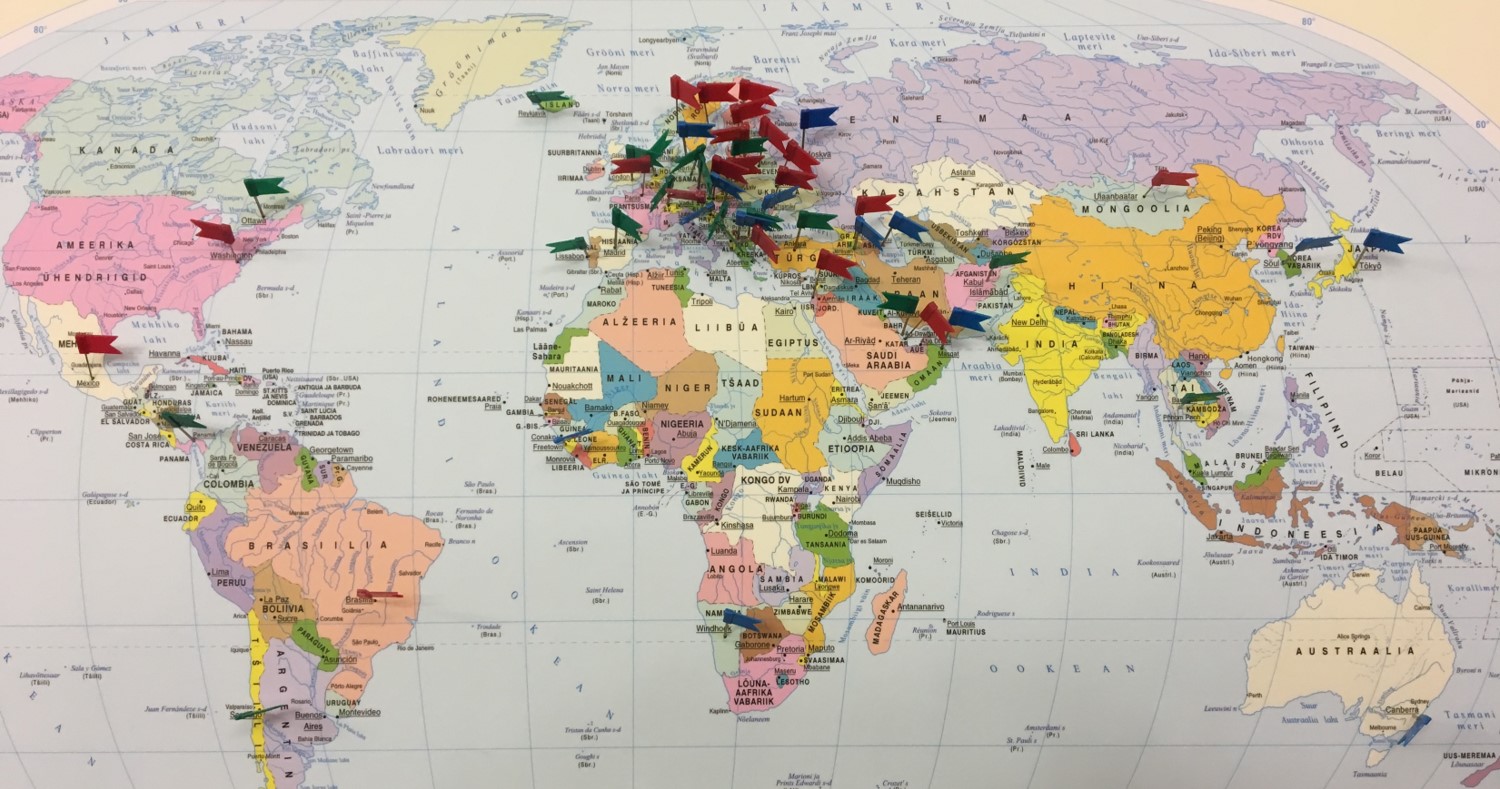
There is a map of the world in our office, and we have put a pin in every country which has sent a delegation to visit. It’s hard to find a country without a pin in it! During the last election in March, we had over 100 foreign officials visiting Estonia from 30 countries around the world.
Flags representing foreign missions to the Estonian state electoral office.
Among these government delegations, what are the most common concerns about online voting?
We see a general fear of the unknown. It takes two things to introduce internet voting in a country: First, a kind of ID card or mobile ID – an electronic identity infrastructure.
Second, it takes political will. Politicians are most interested in getting re-elected. They don’t want to mess with the electoral system and the average politician doesn’t know much about the internet and security, so they would say, “let’s not mess with that.” So, it takes courage to start the process.
What advice would you give other EU countries regarding the adoption of technology?
You just have to make a start, at least at a research level. Introducing a new voting method is a wide, society-embracing topic and might take long time. Just have in mind that at some point internet voting will be inevitable.
Has there been interference or targeting of the online platforms in Estonia?
The elections have never been targeted specifically. The cyberattack of 2007 thankfully happened two months after the elections. That attack was regarded as the first countrywide cyberattack targeting all the sectors, both private sector and public sector. But I think our information security was high and we handled it well. There was one and a half days of disturbance and then it was contained.
What did you learn from that experience?
It was a very good exercise. Now we can teach others how to defend against those kinds of attacks. Those attacks and our ability to counter them led to the opening of the NATO Cooperative Cyber Defence Centre of Excellence in Estonia which has been one of the preeminent organizations leading the world’s discussions on the application of international law in cyberspace.
Are there any more technological innovations that you’re planning to implement in future elections?
There have been discussions about introducing voting on mobile devices, but we currently use the mobile device to verify the computer-based vote. If we move to voting from mobile devices, what do we use as second device for verification of the correct behavior of the mobile device? That’s the main challenge that we are thinking through right now. We are analyzing this, and after the European Parliament elections we will systematically research this issue. Overall, I would say that so far, we are proud of what we have achieved.


 As part of the memorandum of understanding, Sony and Microsoft will also explore collaboration in the areas of semiconductors and AI. For semiconductors, this includes potential joint development of new intelligent image sensor solutions. By integrating Sony’s cutting-edge image sensors with Microsoft’s Azure AI technology in a hybrid manner across cloud and edge, as well as solutions that leverage Sony’s semiconductors and Microsoft cloud technology, the companies aim to provide enhanced capabilities for enterprise customers. In terms of AI, the parties will explore incorporation of Microsoft’s advanced AI platform and tools in Sony consumer products, to provide highly intuitive and user-friendly AI experiences.