Posted on Leave a comment

Safari still leads in mobile browser share, but Facebook’s browser is on the rise


A new study shows Safari and Chrome are still dominant on mobile devices, but Facebook is coming on strong to try to claim the mobile crown.

Safari

According to a new study from analytics firm Mixpanel, Facebook’s in-app web browser now accounts for an average of 7.6 percent of mobile browser market share in the United States. This places Facebook behind only Apple’s Safari with 58.4 percent and Google’s Chrome at 33.3 percent.

The most recent measure of domestic browser market share, by Statcounter last month, placed Safari in first place with 49.4 percent, followed by Chrome with 43.1 percent. Facebook was not listed in those rankings.

In terms of overall platform use, Mixpanel found that 65.5 percent of Americans use iOS, compared to 34.5 percent using Android. As for carriers, the study said, 28.6 percent of users use Verizon, with 27.1 percent using AT&T.

Counterpoint, as of May, listed the iPhone at 42 percent U.S. market share. The study also splits off the market share numbers by state, and reports that Safari is the top mobile web browser in each of the 50 states.

Mixpanel’s study surveyed 20,000-plus of the firm’s customers, covering 3 billion individual events.

The numbers show that while Safari maintains its dominant position, more and more users are reaching the web through Facebook’s ecosystem. This represents a change in users’ consumption of content, as they’re at the mercy of Facebook’s algorithm, and all of its notable shortcomings.

Posted on Leave a comment

Review: Awair and your iPhone help you understand what’s in the air you breathe

The air quality within your home can affect many aspects of your health, which is why it is important to understand the quality of what you breathe. Awair aims to do just that while looking striking in the process.

[embedded content]

The second-generation Awair is an air quality sensor that excels in two areas —it looks better than most, and it works better than most. Even with lack of HomeKit, it easily earns a spot on our shelf.

Let’s dig into why.

Lookin’ fine

Awair Air Quality Sensor

Unlike most other smart home gear, Awair puts a priority on looks. It isn’t meant to hide in the background, but instead stand out and be noticed. The exterior is a nice American walnut frame, which fits easily into most modern home decors. If you don’t want to always view metrics on the screen, it can display a clock.

Awair Air Quality Sensor

A pair of buttons and the power port are on the back. An air intake hole and a series of perforations are are on the front.

Awair is powered through USB-C, which is something we were quite happy about. USB-C is the way the industry is heading, if perhaps a bit slower than Apple might like, so it is only appropriate that any new product opts for that over micro USB. Bonus points for this.

Awair Air Quality Sensor

Behind some of those perforations are LEDs, used to make this into a display. By default, a series of bars representing the various measurements are shown with the overall score in the top right-hand corner.

Tapping the top button on the back allows you to cycle through individual metrics or to display the time.

What it measures

There are five primary measurements that the Awair can sample: Fine dust, CO2, humidity, temperature, and volatile organic compounds (VOC). The Awair explains what each of these are, what they can cause, and how to fix them if they hit unhealthy levels.

Awair Air Quality Sensor

Awair’s software is also proactive in giving you tips on these metrics, a difference that distinguishes it from other air sensors. If enabled, Awair will also send you alerts when your metrics are awry and when they get back into spec, whether at home or on the go.

Viewing measurements

To get these measurements, users can glance at the integrated display, view them in the Awair app. or query Google Assistant, Amazon Alexa, or Nest.

Awair Air Quality Sensor

The in-app experience is nice, with a simple and straightforward design that looks great. Right when you launch it you are brought to the overall score. The Awair score is a summary of your air quality in one single value.

Below it is a bar graph of each of the five individual measurements you can easily view. Additional tabs have tips, trends, integrations, and notifications. In our time testing, it has been really helpful in understanding our air quality.

HomeKit?

For us, the biggest detractor was the lack of HomeKit support.

There is support for Amazon Alexa and Google Assistant, but Apple’s Home app is still not supported here. This is something we’d like to see change in the future.

With HomeKit, we’d be able to enable an air purifier when the quality drops down and turn if off when it goes to normal. We’d be able to ramp up the dehumidifier when the humidity levels get too high. Unfortunately, we can’t do that as it stands.

Other sensors like the Eve Room are capable of doing this at a lower price, but they don’t look quite as nice and are limited in other regards.

Is it for you?

Air isn’t something you can easily see, which makes it difficult to spend some substantial money for something that helps you “optimize” it.

Awair Air Quality Sensor

We’ve tested out a whole host of different air quality sensors, and they just didn’t seem to work quite as well as Awair did, nor did they report quite as many metrics. Let alone let us know how to correct them.

This year, pollutants in the air have been high, with allergies really getting to people, and even their pets.

Awair let us know that VOC was too hight for comfort, and PM2.5 was elevated as well, that other sensors weren’t warning us about. We made a few changes and after we did, we saw a noticeable difference in us, as well as our dogs’ health.

Awair Air Quality Sensor

It’s not lost on me that I could have just made those the changes because of the allergies, and not require the Awair to scream about it. What I like is that Awair does things proactively, alerting me to make corrections before they become an issue, and not after we get a biological effect from the pollen.

Awair is all around excellent, with the only mark against it being the lack of HomeKit support. Awair promises to help you understand what is in the air you breathe, and it does just that. Air quality has the potential to improve allergies, asthma, focus, sleep, skin health and your overall health.

Rating: 4 out of 5

Where to buy

To pick up the second-generation Awair air quality sensor, you can find it on Amazon for $198. It is a bit more than other air quality sensors, but it is made out of higher quality materials, provides better insights and actionable tips, and measures better, which we think makes it worth it.

Posted on Leave a comment

15-inch 2018 MacBook Pro compared – which upgrades are worth it?

The changes in the 2018 15-inch MacBook Pro prompts comparisons between the models from potential customers. AppleInsider compares the low, mid-range, and high-end options in a series of benchmarks, to see if it’s worth paying more for the better-specification models.

[embedded content]

For the 2018 15-inch MacBook Pro refresh, Apple has made a number of improvements to performance, such as using faster DDR4 RAM that allows for configurations of up to 32 gigabytes, faster graphics with higher base memory, and using Intel’s new 8th-generation 6-core processors.

The changes mean that, once again, users are tasked with choosing the notebook that can meet their performance requirements, as well as their budgets. To help those deciding which to acquire, we have put the refreshed models through a variety of benchmarks that simulate 3D rendering, gaming and overall system performance, along with video and photo editing.

Three models were used for the tests, starting with the base model 2.2GHz Core i7 CPU at the low end, complete with Radeon Pro 4GB 555X graphics, 16 gigabytes of RAM and a 256-gigabyte SSD, priced at $2,399. In the middle is the 2.6GHz Core i7 model with Radeon Pro 4GB 560X graphics and 16GB of DDR4 memory, costing $2,799. On the plus side, that model also comes with a 512-gigabyte SSD, doubling the storage capacity compared to the lowest specification model.

The highest-specification 15-inch MacBook Pro used in this test cost $3,499, packing the 2.9GHz Core i9 processor, Radeon Pro 4GB 560X graphics and 32 gigabytes of DDR4 memory. While it is only equipped with the 512 gigabyte SSD, since all SSD versions are incredibly fast, this should make no real impact on performance for any of these tests.

Standard Benchmarks

Starting with Geekbench 4’s CPU test, all models have impressive scores, but the difference between them isn’t huge. The i9 reached about 10-percent higher scores in single-core and 8-percent higher in multi-core compared to the base model.

2.2GHz i7 / 555X / 16GB 2.6GHz i7 / 560X / 16GB 2.9 GHz i9 / 560X / 32GB
Geekbench 4 Single-core 5031 5118 5582
Geekbench 4 Multi-core 22400 22400 24226

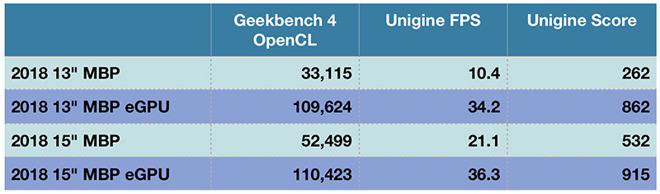
In Geekbench 4’s OpenCL graphics test, the results between the three laptops are minor. Switching to the Metal test shows a much bigger difference, with the 560X GPU models scoring about 20-percent higher than the 555X in the base model.

2.2GHz i7 / 555X / 16GB 2.6GHz i7 / 560X / 16GB 2.9 GHz i9 / 560X / 32GB
Geekbench 4 OpenCL 49229 50801 52499
Geekbench 4 Metal 49398 59592 59560

Unigine’s Heaven using the extreme preset was employed to put a gaming workload on the test group. Here, we observed an 18-percent higher average frame rate between the 555X GPU model and the 560X models, a hefty performance increase which can be had for only $100 more.

2.2GHz i7 / 555X / 16GB 2.6GHz i7 / 560X / 16GB 2.9 GHz i9 / 560X / 32GB
Unigine Heaven FPS 17.8 21.1 21.1
Unigine Heaven Score 450 531 532

Moving onto Cinebench R15, a rendering benchmark that runs the processor under full load, we ran 5 back-to-back tests on each system. Despite the specification differences, we only saw performance vary by an average of 2 percent between the base 2.2GHz i7 and the top spec 2.9 Ghz i9, which is a $400 upgrade.

Starting from an idling temperature and only running the test once, the i9 will score around 50 points higher, but only because the test finishes before the processor has a chance to heat up.

Shortly after the first run, the processors in these new MacBooks thermal throttle so much that all three run at very similar speeds. There was an average speed of 3.05GHz for the base model, 3.1Ghz for the mid and 3.15GHz for the i9.

Since some 2D and 3D renders can take hours, all three processors have similar performance for extensive graphics-demanding tasks.

2.2GHz i7 / 555X / 16GB 2.6GHz i7 / 560X / 16GB 2.9 GHz i9 / 560X / 32GB
Cinebench 5 run average 991 1001 1011
Cinebench 5 Average GHz 3.05 3.1 3.15

Image Editing

For the photo editing test, the latest version of Adobe Lightroom Classic was used to edit 42-megapixel RAW images. We saw no speed or smoothness differences while color-correcting and retouching within the develop module.

However, while exporting 99 edited 42-megapixel RAW images to JPEG, the Core i9 model was around 17% faster than the other two, which finished at exactly the same time.

Looking closer,, all three models ran at about the same speed, at around 3.0Ghz throughout the export. While processor usage was close to 100 percent in all cases, the onboard graphics were effectively left unused.

For RAM usage, the top model used more than 18GB of memory, while the other two 16GB-packing models had to cut into the SSD using file-swapping. For the most part, the performance difference is actually coming from the amount of RAM available to use.

2.2GHz i7 / 555X / 16GB 2.6GHz i7 / 560X / 16GB 2.9 GHz i9 / 560X / 32GB
Lightroom export 7:01 7:02 5:59

Video Editing

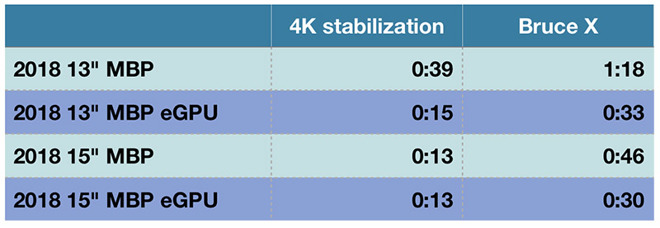
The video tests using Final Cut Pro X started with the 5K Bruce X benchmark, which resulted in similar times across the board. Stabilizing a 20-second 4K clip also results in nearly identical speeds.

2.2GHz i7 / 555X / 16GB 2.6GHz i7 / 560X / 16GB 2.9 GHz i9 / 560X / 32GB
Bruce X (seconds) 46 45 46
Stabilization (seconds) 14 14 13

Moving on to a 5-minute 4K h.264 project with color corrections and effects, the mid-range and top models took 3 min and 44 seconds to render and encode, while the base model was slightly slower at 4 min and 11 seconds. This shows that the lower-end GPU was the actual bottleneck in this case.

As far as the editing itself, all three models have no problem playing back the timeline at a full 4K resolution, with background rendering turned off.

Taking a look at a similar project, except using 4K HEVC files, the results were practically the same. While the 555X graphics card was close to capacity, the 560X still had about 30 percent of its potential performance still available.

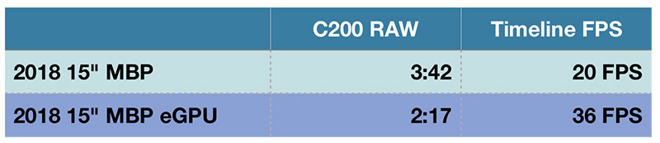
Testing ProRes RAW and Canon Cinema RAW lite codecs, both with color corrections and effects, the results come out the same. The base model, again, is slower while the mid and top-spec MacBooks are very close in performance. Once again, the graphics card is the limitation.

One noticeable difference is that all three models have no issues playing back the 4K ProRes RAW, while the Canon RAW stutters on all three machines, taking much longer to render.

2.2GHz i7 / 555X / 16GB 2.6GHz i7 / 560X / 16GB 2.9 GHz i9 / 560X / 32GB
HEVC to HEVC 49 47 49
ProRes RAW to h.264 59 47 47
Canon RAW to h.264 4:58 3:48 3:42

Finishing off testing with 4.5K RED RAW files, the results were close, but unexpectedly the i9 model was actually the slowest, even with repeated testing. The i9 ran at just 2.4GHz after stabilizing, even though its base clock speed is rated at 2.9GHz, while the base 2.2GHz and mid 2.6GHz models ran at 2.7GHz and 2.8GHz respectively.

Our RED RAW project pushed both the processor and graphics, causing the best GPU and CPU combination to thermal throttle slightly more than the other configurations.

2.2GHz i7 / 555X / 16GB 2.6GHz i7 / 560X / 16GB 2.9 GHz i9 / 560X / 32GB
RED .R3D RAW 2.11 2.08 2.22
CPU Speed (GHz) 2.7 2.8 2.4

We do want to point out that most of our video editing projects are short, and we tested without having other programs running in the background, so differences in RAM don’t really make any impact. If you edit long 4K projects, especially while having other programs or many browser tabs open, we would suggest upgrading to 32GB of RAM.

Summary

As far as the other components, the 560X graphics chip is well worth the extra $100 for everyone but photo editors. If you’re running long and intensive tasks that need more than a short burst of high speed, upgrading the CPU to the i9 isn’t really worth it. If you don’t push your machine hard in any way, you won’t need the extra short term performance. If you do, the performance difference can be negligible because of thermal throttling.

If you need to buy a Mac right now, the mid-spec $2,799 model, which is kept in stock at most retailers, will be a good choice. If you don’t mind waiting for a MacBook Pro order, going for the base model with the i7 2.2GHz CPU, Radeon 560X graphics, and 32 gigabytes of RAM will give you the best bang for your buck.

Save $100 on every 2018 15-inch MacBook Pro

Apple authorized reseller Adorama is knocking $100 off every 2018 15-inch MacBook Pro with promo code APINSIDER when used with this shopping link or the pricing links in our MacBook Pro Price Guide.

Adorama also will not collect sales tax on orders shipped outside NY and NJ, and each system ships for free within the contiguous U.S. With the exclusive discount, many shoppers outside those two states can save up to $635 compared to buying from Apple, a significant cost difference for the brand-new models.

Those looking to finance the purchase can also take advantage of no interest financing when paid in full within 12 months using the Adorama Credit Card. For help redeeming the coupon code, please see the step-by-step instructions found in this guide.

Posted on Leave a comment

Apple once more accepting Red Cross donations, this time for California wild fires


As wildfires in California continue to take their toll, Apple has reactivated iTunes donations to help support the American Red Cross relief efforts for those affected.

Apple this week updated its official homepage and iTunes landing page with American Red Cross banners and links that direct to a contribution page dedicated to California wildfire relief. The site includes quick payment options that allow users to contribute $5, $10, $25, $50, $100 or $200 toward ongoing relief efforts with just a couple taps.

Customers who donate through iTunes will see 100 percent of proceeds go directly to Red Cross. The organization is unable to further acknowledge donations as Apple does not share personal user information with outside entities.

Apple has held similar donation drives in the past, often providing prominent placement on its official website and within the iTunes Store and App Store on iPhones and iPads.

The brutal Carr Fire has affected Shasta County, as well as the town of Redding, and is now ranked as the sixth most destructive fire in California’s history. With California’s dry weather, fires have become more common and have caused some serious damage. More than 125,000 acres and 1,500 homes have been destroyed or severely damaged so far, with six deaths blamed on the blaze.

In the past, Apple has activated the iTunes donation mechanism for wildfires, floods, and other natural disasters.

Those who wish to donate can do so directly the iTunes Store and App Store on their iPhone or iPad or can redcross.org.

Posted on Leave a comment

Here are all of the Apple retail store openings, moves, and remodels in 2018

With few setbacks, Apple is almost continuously expanding and updating its global retail chain, now over 500 locations. Here’s the company’s evolution in 2018 so far, updated on Aug. 2 with more information about Apple’s Tower Theatre restoration in Los Angeles.

applestore-stonestown

Aug. 2

An official mockup of Apple's renovation plans.

An official mockup of Apple’s renovation plans.

Apple has revealed more about its plans for Tower Theatre in Los Angeles. The company’s senior director of retail design, B.J. Siegel, told the Los Angeles Times it will be “in the upper echelon” of the company’s stores, different from anything else in the city, retaining some of its theatrical design touches and hosting events meant to draw hundreds of people. The place where the theater’s movie screen used to be will play home to a video wall.

The shop should become a “mecca” for talks by experts in movies, TV, and music, Siegel added, taking advantage of Los Angeles’ role as an epicenter of mainstream commercialized culture.

July 18

Tower Theatre

By way of city work permits, Apple has confirmed plans to restore and convert the well-known — but long abandoned — Tower Theatre in downtown Los Angeles, according to Curbed. The structure was originally built in 1927 and was the first L.A. theater to be wired for sound, but is now known only as a landmark thanks to its period architectural details.

Apple is set to replace the gallery mezzanine, as well as retrofit the building to better withstand earthquakes. It’s unknown when Apple might be ready to open a store.

July 17

Apple’s relocated Walnut Creek, Calif. store will open on July 28 at 10 a.m local time. The new shop is based in Broadway Plaza, at the location of a former California Pizza Kitchen. Architecturally it should resemble the likes of Apple’s Michigan Avenue, with a flat roof and glass walls that blend the store with its surroundings.

July 14

apple-store-piazza-liberty

Apple Piazza Liberty in Milan will officially throw open its doors on July 26, retail head Angela Ahrendts told Io Donna. The shop will be open 24 hours a day, the same as the Apple Fifth Avenue location in New York City.

July 4

One of Apple's renderings of the proposed Stockholm location.

One of Apple’s renderings of the proposed Stockholm location.

Through Sept. 12, the Swedish public has been given a chance to see and comment on Apple’s draft proposal for a shop bordering Stockholm’s Kungstradgarden. Also looking at the proposal are 24 regional organizations, and a consultation meeting is set for Aug. 23.

The shop’s look would take after Apple’s more recent buildings, such as its Michigan Avenue store in Chicago, or the Visitor Center in Cupertino. This includes a low, flat roof, curved glass, and wood planking for the ceiling.

Another Apple render

Apple has been working towards the Kungstradgarden shop since early 2016, but has encountered resistance from some members of the public concerned about commercializing a historic location, even if Apple’s store would simply be replacing a TGI Fridays. The company’s architects did tone down the original design, which could help it blend into surroundings.

June 28

Apple Cotai Central in Macau, opening June 29, has been revealed has having a millimeter-thick stone “curtain,” as well as a bamboo grove.

June 27

Tower Theater

A DTLA Rising report resuscitated rumors that Apple may take over Los Angeles’ famous Tower Theater. Tenants in exterior stalls have been told to vacate by the end of June, and one source claims that Apple is hoping to “encase the entire Tower Theater in a glass cube,” though more likely is a restoration given the Tower Theater’s historical significance.

June 26

Apple has confirmed that its updated University Village store in Seattle will open at 9:30 a.m. local time on June 30. Replacing the old outlet, the new one has more interior space including a Forum and video wall for hosting Today at Apple events. The space also focuses on the use of natural light, through both the facade and a skylight.

[embedded content]

The company’s renovated Palo Alto, Calif. location on University Avenue is set to reopen on the same day at 10 a.m. Pacific time.

June 25

Apple Piazza Liberty

Apple’s upcoming flagship in Milan, Italy should open in late July, possibly as soon as July 18 according to Corriere della Sera, though the company doesn’t typically open stores midweek. The shop was allegedly going to open in December 2017, then this February, but was delayed by the discovery of asbestos in walls and pipes.

June 13

Apple’s first Israeli store could potentially open in Tel Aviv’s Azrieli Sarona Tower. At the moment, though, the Azrieli Mall Group is in “preliminary negotiations,” according to Globes. Another publication, Yediot Achronot, indicated that talks have been in progress for “several” months.

June 12

The company confirmed that its second store in Macau, Apple Cotai Central, will throw open its doors on June 29. Its name stems from the nearby Sands Cotai Central casino resort.

June 11

applestore-coventgarden

Two of Apple’s bigger stores — Covent Garden in London, and Wangfujing in Beijing —were announced as closing for renovations later in the month.

May 25

applestore-thepier

In a rare announcement, Apple said it would permanently shutter its Pier store in Atlantic City, N.J. without opening a replacement. 52 people were affected, forced to either find new jobs with Apple or a different employer.

May 13

applewatch-isetan-japan

The last dedicated Apple Watch pop-up outlet, located in Tokyo’s Shinjuku ward, finally reached an end.

May 4

Apple’s first flagship-level store for Latin America is reportedly under construction at Antara Fashion Hall in Ciudad de Mexico’s (CDMX) upscale Polanco district. It should be a single-story structure, but have the trappings of any flagship, such as a boardroom for business clients.

Apr. 29

The company’s Lehigh Valley Mall in Whitehall, Pa. was revealed to be relocating to a bigger space in September.

Apr. 26

Apple was sued for $15,000 over injuries caused during an “active shooter” drill at the Florida Mall Apple Store.

Apr. 12

The crush of battery replacement demands forced Apple to stretch its workforce to cope.

Apr. 7

Apple Shinjuku opened in the Japanese capital of Tokyo, not far from Shinjuku Station.

Apr. 2

Apple’s Westchester mall store in White Plains, N.Y. closed for renovations.

March 24

Apple’s Bluewater outlet in the U.K. reopened after nine months of renovations.

March 20

The landlord behind Apple’s flagship Michigan Avenue store in Chicago put the space up for sale, though Apple itself is liable to stay put.

March 6

A New Orleans police officer was accused of stealing AirPods from Apple Lakeside Shopping Center — while still in uniform.

Feb. 24

applestore-vienna

Apple’s first Austrian store opened on Vienna’s Kaerntner Strasse.

Feb. 5

Apple Southlake Town Square in Dallas-Fort Worth was announced as closing for renovations on March 4. It was later revealed that changes would include an expansion and various external improvements.

Feb 2

Two Apple workers were hospitalized after a battery rupture at a shop in Hong Kong.

Jan. 29

Plans were made to close its stores in Green Hills, Nashville and Alderwood Mall in Lynnwood for renovations.

Jan. 27

applestore-seoul

Apple opened its first South Korean store in Seoul.

Jan. 19

Apple began hunting down a workforce for its Carnegie Library store in Washington, D.C.

Jan. 11

The company’s discounted battery replacement program — started in the wake of Apple admitting it was throttling iPhones — caused a rush on supplies, particularly for the iPhone 6 Plus.

Jan. 10

Yet another iPhone battery fire, this time at the Calle Colon store in Valencia, Spain.

Jan. 9

An iPhone battery fire forced the evacuation of a store in Zurich, Switzerland.

Jan. 4

applestore-freespeech

Apple sued the activist organization Attac for staging protests at its French stores, claiming the group “put the security of our customers and employees at risk.” Attac has accused Apple of exploiting tax loopholes at the expense of the public, depriving social services of billions in funding.

Rumors meanwhile emerged of a new store in Toronto, Canada at the corner of Yonge and Bloor, not far from Queen’s Park and the Royal Ontario Museum.

Jan. 3

applestore-michigan-gaffenue

An embarassment for the company’s high-profile Michigan Avenue store in Chicago was the need to rope off the surrounding area to cope with falling ice and snow. While some initially blamed poor architecture, failing to account for Chicago winters, Apple insisted that the problem was a result of glitches in the rooftop heating system.

Last updated Aug. 2, 2018

Posted on Leave a comment

Lisa Brennan-Jobs shares memories of her father in memoir

In “Small Fry,” set for publication in September, the eldest daughter of Steve Jobs tells stories about the late Apple cofounder, and her life.

Small Fry by Lisa Brennan-Jobs

In the mythology of Apple history, Lisa Brennan-Jobs’ name is well-known. She’s the oldest child of Steve Jobs and his first serious girlfriend Chrisann Brennan. At the same time he was publicly denying paternity of her, Jobs made the decision to name an early Apple computer the Lisa. Later, the two reconciled, and Lisa went on to a career as a journalist.

Lisa Brennan-Jobs’ past has been detailed in various biographies of her father over the years, but the now 40-year-old Brennan-Jobs is stepping into the spotlight to tell her side of the story in a new memoir called “Small Fry.” The book, which was announced in March, is set for release in September, and Vanity Fair published an excerpt Wednesday. The excerpt implies that the question of whether or not the Lisa computer was named for Brennan-Jobs will loom large over the book.

In the excerpt, Brennan-Jobs shares that after she was born, Jobs denied his paternity from the start, even though he had agreed to visit her and her mother at the farm in Oregon where she had been born. But she didn’t see Jobs again until she was three years old.

She goes on to tell her side of the court battle over Jobs’ paternity, sharing that Apple went public — bringing Jobs’ net worth to over $200 million — just days after that legal case was finalized.

The Lisa Computer

Even after Jobs admitted paternity and the two started to spend more time together, Jobs was distant with her. “By that time I knew he was not generous with money, or food, or words,” she said of a time he visited her in San Francisco.

As she got older, Lisa would tell her friends “a secret,” that her father was Steve Jobs, even though most elementary school students in the mid-1980s likely didn’t know Jobs by name. She would even brag that her father had named a computer after her, although later in life, it started to bother her that the failed computer had had her name.

“By then the idea that he’d named the failed computer after me was woven in with my sense of self, even if he did not confirm it, and I used this story to bolster myself when, near him, I felt like nothing,” Brennan-Jobs writes. “I didn’t care about computers—they were made of fixed metal parts and chips with glinting lines inside plastic cases—but I liked the idea that I was connected to him in this way. It would mean I’d been chosen and had a place, despite the fact that he was aloof or absent.”

Then, as a high school student, she finally asked Jobs if the computer had been named after her. His answer? “Nope. Sorry, kid.”

However, years later, on a yacht trip with her father, Lisa found herself spending time with the long Apple-adjacent rock star Bono. As Jobs and Bono talked about their respective experience, Bono asked Jobs if the Lisa computer had, in fact, been named for his daughter. “Yeah, it was,” Jobs replied.

The excerpt also includes a personal retelling of Jobs’ final days before his death in 2011. Jobs died at the age of 56 after a long battle with cancer.

Posted on Leave a comment

Over 4 million people participate in Apple’s software beta programs


Apple CEO Tim Cook reveals that an extraordinarily large number of people are taking part in the company’s beta program, which covers early versions of iOS, macOS and the company’s other major operating systems.

Apple WWDC 2018

In an investor conference call following Apple’s release of fiscal quarter three earnings on Thursday, Cook said some four million people are running beta software on their iPhone, iPad, Mac, Apple Watch and Apple TV devices.

“In June, we hosted an extremely successful developers conference that previewed many major advances coming this fall to our four operating systems: iOS, macOS, watchOS and tvOS,” Cook said. “Developer and customer reaction has been very positive and we have over four million users participating in our new OS beta programs.”

The number of beta program participants is not something that Apple typically releases, so it’s unclear how that number compares to past years. Also unknown is how the participation statistics break down by operating system, and whether developers are included in the number.

Apple frequently touts both the growth of the App Store and its contributions to the app development profession as a whole, so it’s a good guess that the four million figure for software beta participants in one year is among the largest ever for Apple, if not for the history of computing altogether.

At WWDC, Apple unveiled iOS 12, Mac OS 10.14, watchOS 5 and TV OS 12, and has periodically released beta editions of each in the weeks since. The full releases are scheduled for this fall.

Posted on Leave a comment

Apple hires developer of virtual reality painting app amid push into AR/VR


Adding to a growing stable of virtual reality experts, Apple recently hired developer Sterling Crispin, whose app “Cyber Paint” was among the first to take advantage of burgeoning mobile VR headset technology.

Spotted by Variety on Monday, Crispin’s LinkedIn profile notes the developer joined Apple in May as a prototyping researcher. While further details are left unreported, it can be assumed that Crispin is continuing work in AR and VR, having served as the sole designer and developer at his eponymous software company since early 2017.

Previously an employee DAQRI, a Los Angeles-based company focusing on industrial AR applications, Crispin is behind popular VR painting app “Cyber Paint.” Similar to Google’s Tilt Brush, Cyber Paint taps into mobile VR headset technology like Oculus Go, Daydream, GearVR and Vive Focus to allow users to paint 2D artwork on a canvas or in 360-degree space.

Aside from first-party software projects, Crispin also served as a consultant for a variety of AR startups, including “significant SDK development for a head mounted augmented reality device,” his LinkedIn profile reads.

[embedded content]

Apple’s new hire falls in line with rumors that claim the company is working on its own branded VR headset, codenamed T288, and “rOS” operating system. Backed by major investments in a growing team of hardware and software engineers, the rumored VR solution represents a departure from Apple’s core product line.

Details are scarce, but previous reports claim Apple is looking to integrate a bevy of cutting edge technology in T288, including high resolution 8K eyepieces and a separate computing unit that connects wirelessly via WiGig. Users could control the unit with Siri voice commands, head gestures and a touch panel, though exact specifications remain fluid ahead of an expected 2020 launch date.

Posted on Leave a comment

Alleged dummy models of 6.1- & 6.5-inch iPhones show former with single-lens camera


Though Apple may be making its next “budget” iPhone a 6.1-inch LCD model, one tradeoff will be the lack of a dual-lens camera, the latest leak suggests.

2018 iPhone dummies

The detail can be seen in a supposed “dummy” phone shared by well-known leak source Ben Geskin. The unit lacks any Apple logo, but mostly resembles current iPhone designs except for the placement of the flash below the lens instead of to the side, more akin to the dual-lens iPhone X than the iPhone 8.

A 6.5-inch iPhone dummy seen in the same leak is almost exactly the same as the 5.8-inch iPhone X except for its bigger size. Geskin refers to the device as the “iPhone X Plus,” a common nickname for the rumored product.

Apple uses dual-lens cameras on the iPhone 7 Plus, 8 Plus, and X to provide 2x optical zoom, as well as a “Portrait” mode which simulates the bokeh (blurred backgrounds) created by professional lenses. Assuming the 6.1-inch dummy is authentic, the company is likely sticking to a single lens to keep prices down.

Unseen in the leak is the expected direct successor to the iPhone X, which should keep the same dimensions but see upgraded internals like a faster processor.

The new 5.8- and 6.5-inch phones are anticipated to use OLED displays, and cost $800-900 and $999+, respectively. Mostly because of LCD, the 6.1-inch model is forecast to cost around $600-700.

The OLED hardware should ship in September or October, but the 6.1-inch iPhone has been rumored as arriving later.

Posted on Leave a comment

Autodesk dropping support for Alias and VRED in macOS Mojave over OpenGL deprecation


Autodesk has published a support document announcing that it is stopping development of its Alias and VRED vertical market packages, and that older versions will not work on Mojave due to Apple’s OpenGL deprecation.

Autodesk VRED

According to a note posted on Autodesk’s support website, while older Alias versions can run on High Sierra or earlier, “no versions of VRED will run on that operating system due to the OpenGL deprecation.” The change, according to the Autodesk note, “allows Autodesk development teams to focus on bringing innovations to market faster, and allows for more frequent software updates.”

“In the end, the entire Alias and VRED community will benefit from this streamlined approach,” wrote the company.

This follows the announcement by Apple in June at WWDC that Mojave will require graphics hardware to support Metal, and that active development has ceased for OpenGL and OpenCL on the Mac.

It isn’t clear why Autodesk made the declaration that OpenGL’s deprecation was responsible for the applications not working in Mojave. Deprecation does not mean removed, and the existing OpenGL implementation in High Sierra remains in Mojave.

The move at present does not appear to affect the core AutoDesk product. Alias is used for automotive and industrial design, while VRED is 3D visualization software. Neither Mac version has been updated recently.

According to the company, Mac users have multiple options. Users can switch to the Windows version and use a Boot Camp workaround, or they can remain on High Sierra or other Mac versions without upgrading to Mojave.

AppleInsider has reached out to Autodesk for comment.