Posted on Leave a comment

Apple supplier’s sales forecast suggests holiday iPhone shipments on pace to meet 2017 levels


Apple supplier Broadcom on Thursday said it expects strong seasonal sales to drive a 25 percent sequential rise in wireless revenue for the fourth quarter of 2018, echoing statements made during the lead up to last year’s iPhone 8 and iPhone X launch.

iPhone X

Speaking with analysts in a post-earnings conference call covering the third quarter of 2018, Broadcom CEO Hock Tan said he expects a “seasonal uptick” in wireless parts orders to drive current quarter revenue forecasts, reports Broadcom.

The 25 percent boost is in large part thanks to a ramp in manufacturing at a “North American customer,” believed by analysts to be Apple. Broadcom supplies a number of components used in iPhone devices, including the touchscreen and wireless charging controllers found in iPhone 8 and iPhone X.

While wireless revenue is expected to jump on a sequential basis, the forecast is down in single-digit percentage from a year ago, the report said.

Tan offered a nearly identical outlook in the second quarter of 2017, saying at the time that wireless revenues were expected to increase in the “mid-20 percent” range as Broadcom’s North American customer ramped up production of its next-generation phone.

If Apple is relying on Broadcom to supply similar components for this year’s iPhone lineup, today’s forecast suggests Apple is expecting demand for this year’s slate of iPhone products to be largely on par with that of iPhone 8 and iPhone X.

Though iPhone shipments were down on a year-over-year basis during the 2017 holiday quarter, Apple managed to sell 77.3 million units at a record average selling price of approximately $796.42. The performance netted the company its best quarter ever in terms of revenue, which hit $88.3 billion.

Apple is set to debut a refreshed iPhone lineup at a special event next week. In addition to an iPhone X successor, the company is widely rumored to launch a larger OLED variant of its popular handset, as well as a mid-tier 6.1-inch LCD model with Face ID. New Apple Watch models are also anticipated for unveiling.

AppleInsider will be covering the event live on Sept. 12.

Posted on Leave a comment

Apple seen hunting movie acquisitions at festival


The company, which has mostly focused its content plans on television, is reportedly eying movie buys at the Toronto International Film Festival.

Toronto International Film Festival

According to a report by Variety Wednesday, two top executives for Apple’s nascent entertainment content effort are heading to the Toronto International Film Festival (TIFF) this week, with an eye towards acquiring films.

Jamie Erlicht and Zack Van Amburg, the heads of programming for Apple’s content operation, are headed to Toronto “checkbooks in hand as they look to make potential acquisitions that could fill out the content pipeline for the company’s still-under-wraps entertainment service,” Variety said.

At TIFF and major film festivals like it, acclaimed films often premiere, and then are given lucrative distribution deals. Amazon and Netflix, in recent years, have joined more traditional Hollywood players in competing for top movies. Amazon’s movie operation, Variety said, is also headed to Toronto with a similar mission in mind.

Apple’s participation is significant because nearly all of its high-profile media deals so far have involved television and not movies, and TIFF is a film festival. Apple was reported in June to be pushing to acquire an animated feature film from Cartoon Saloon, but no such deal was ever announced.

If Apple were to acquire a major film out of Toronto, it’s unclear what distribution scheme it would use for it. Amazon Studios in recent years has acquired films and distributed them, often with partners, in theaters before placing them on the Amazon Prime service. Netflix has done the same with some festival-acquired titles, while bringing others direct to its streaming service.

Apple, of course, has not yet announced or launched its content platform, although an analyst note from Morgan Stanley Wednesday predicted its video business will rival Netflix by 2025.

Posted on Leave a comment

Skype users can now record calls on Mac and iOS


Microsoft on Tuesday added call recording functionality to its Skype voice and video calling service, an oft-requested feature that will add platform value for a wide swath of users, from professionals to on-the-go podcasters.

With the latest version of Skype for iOS and Mac, users have the ability to capture and share calls for the first time since the ubiquitous chat service launched in 2003.

A cloud-based solution, recordings are initiated by clicking the “+” icon at the bottom of Skype’s user interface and selecting “Start recording.” A banner appears on the screens of all users in the voice or video chat, notifying them that the call is being recorded.

During video calls, all user video is recorded, as is content from shared screens. The latter feature could prove useful when collaborating with colleagues.

When a call concludes, recorded content is made available in all users’ chat timelines for 30 days. Participants can save the recording to local storage, including mobile devices where the clip will download as an MP4 file, or forward it to other Skype users.

Unfortunately for podcasters and audio professionals looking for a quality mobile recording solution, voice tracks appear to be combined automatically by Skype’s backend. Whether the service intends to offer split tracks in the future is unknown.

Interestingly, call recording is available on all platforms except for Microsoft’s own Windows 10, though Skype said support is due to arrive in the coming weeks.

Owners of iOS devices can download Skype for free from the App Store, while Mac users can get the app from Skype’s website.

Posted on Leave a comment

Renders reveal purported 2018 iPad Pro with edge-to-edge display, iPhone-like antenna lines


Computer renders based on leaked CAD images could offer a first look at Apple’s next-generation 12.9-inch iPad Pro, complete with edge-to-edge display, iPhone-esque antenna “lines” and an angular chassis reminiscent of the iPhone 4 series.

Shared by OnLeaks’ Steve Hemmerstoffer in a post to Twitter on Monday, the high-resolution renders, created in conjunction with tech blog MySmartPrice, claim to reveal a vastly redesigned iPad Pro model widely expected to debut this fall.

The images are polished versions of CAD schematics first aired by OnLeaks last week and show an iPad device that departs from Apple’s current aesthetic. Gone are the soft edges of iPad’s rounded chassis, replaced with an angular case design featuring chamfered edges and breaks along the circumference to accommodate radio-transparent material. A similar architecture defined the iPhone 4 in 2013.

As seen in a set of CAD images supposedly showing off an 11-inch iPad Pro last month, today’s renders feature two rows of speaker vents flanking a centrally-located Lightning port at the bottom of the device, a design mirrored on the tablet’s top edge. Two microphone ports are also in view up top, sitting above a TrueDepth camera system embedded in iPad’s bezel.

Button positioning appears to remain unchanged from existing iPad models, though the familiar home button has been removed to make way for more screen real estate. Also deprecated is iPad’s headphone jack, a modification that would bring the device family in line with iPhone.

More dubious is a repositioned Smart Connector that supposedly lives on the back of the tablet directly above its Lightning Connector. MySmartPrice believes the positioning is a concession for Face ID, incorrectly stating that Apple’s facial recognition feature is unlikely to work while iPad is in landscape mode. Code discovered in past iOS 12 beta versions have revealed Face ID will indeed accommodate landscape operation in future devices, with iPad thought to be a prime candidate for inclusion.

Whether the renders, and indeed the CAD from which they are based, are legitimate is unknown. Hemmerstoffer himself hedges on the renders’ veracity, saying in a tweet, “I can’t confirm this one is 100% accurate.”

Rumored for release this fall, Apple’s next-generation iPad Pro models are speculated to boast a smaller footprint while retaining screen dimensions thanks to the deletion of Touch ID. According to analyst Ming-Chi Kuo, the shift to an edge-to-edge design will allow Apple to squeeze an 11-inch display into the existing form factor, initially designed to house a 10.5-inch screen. Apple is also anticipated to carry over the jumbo-size 12.9-inch model that ushered in “iPad Pro” branding in 2015.

Apple is scheduled to hold a special media event at its Apple Park headquarters on Sept. 12, where the company is widely expected to launch this year’s iPhone lineup. Whether the smartphones will share stage time with a revamped iPad Pro is unclear.

Posted on Leave a comment

What it was like to give up my Apple Watch after three years of constant use

After three years of daily use, I’ve decided to give up my Apple Watch for a week to prove to myself how useful and important it really is —or maybe, it isn’t.

[embedded content]

I’ve been using Apple’s wearable since it debuted and for the most part, I’ve been a vocal fan.

Soon, Apple is expected to debut their latest ‘Series 4’ Apple Watch. Before I jump in head-first and upgrade yet again, I wanted to test myself and see if I truly did need my Apple Watch. Is this something I can’t live without, or have I just fallen for my own hype?

Before I ditched the watch for a week, there were a few things I wanted to sort out. What did I use my watch for most, and what — if anything — would be the replacement.

Considering my replacement

After closely studying my habits, there are a few things I identified as relying on most frequently.

I have a bad history of not paying attention to my phone, and my Apple Watch notifications help make sure I don’t miss anything. So, that’s high on the list.

The Apple Watch has truly helped me stay active. Whether it is making sure I’m not lounging too long on the couch or making sure I head to the gym on a regular interval. Each day I make an honest effort to fill my rings.

Possibly most importantly, I’m a Type 1 diabetic and use my Dexcom CGM to view my glucose levels on my Apple Watch. It is useful to see on my watch, but luckily I can still view it directly on my phone.

There are plenty of other ancillary tasks I rely on my Apple Watch for such as Siri, hands-free phone calls, heart rate monitoring, HomeKit control, Wallet/Apple Pay, quick access to weather, and more. Though these are all to a lesser extent than the three above.

I considered a lot of options for my possible Apple Watch replacement, and I came to the conclusion that I couldn’t ditch a wearable completely. I still needed something — however minimal — to help with at least a couple of my frequent tasks.

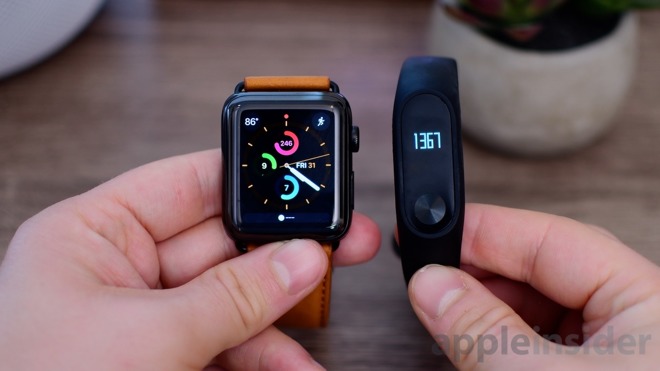
Mi Band 2

That’s why when I shed my Apple Watch, I went with a super cheap fitness tracker that I had reviewed in the past — the Mi Band 2. It has a surprisingly large number of features and I was able to pick it up for less than $30 bucks.

Starting the week

Heading into the week, I was getting along just fine with the Mi Band 2. I got notifications for social media, texts, and phone calls. Idle alerts made sure I never sat around too long. It was also easily capable of tracking steps, calories, distance, and workouts throughout the day. It also didn’t need charged the entire week, though I plugged it in once just to top it off.

My iPhone and HomePod served as suitable replacements for many frequent tasks. Granted, it was ever so slightly less convenient, but I was starting to gain confidence in my ability to forgo Apple’s wearable.

Comparing the heart rate tracking to my Polar heart monitor also was confidence boosting, with the numbers falling very close to one another and appearing very accurate for such a small and cheap band.

Eventually, though, things started to turn.

Missing my old friend

Around day three I started to really yearn for my Apple Watch.

Without my Apple Watch I found myself using my iPhone more than in the past. The new Screen Time digital health features in iOS 12 even confirmed that. Since I had to pull my iPhone out for so many tasks, I ended up diving into other apps and wasting more time there than I normally would have.

I also missed my Siri Watch face. Sports are just kicking into gear and I missed being able to glance down at the watchOS 5 Siri face and see the score of the Buckeyes, Browns, or Indians game without having to actually launch any apps. I miss having my frequent HomeKit scenes presented before I need to think about them.

Leaving to take the dogs for a run/walk was also a bummer. I love heading out, locking the door with my Apple Watch, turning on my Apple Music playlist with my AirPods, and starting a workout. Cellular connectivity means I also am able to get security alerts from HomeKit or my security cameras while I’m away. Mi Band wasn’t up for any of this.

I went without music once and another time I tried to bring my iPhone but it was super uncomfortable to keep in my workout shorts while running. When I was without my phone, I had a bit of a sense of worry knowing I couldn’t be reached and that I couldn’t watch after my home.

Paying for things was more difficult having to always pull my phone out. When going through the drive-through at Starbucks, I had to unplug my iPhone from CarPlay to scan my Starbucks card rather than being able to have it scanned off my Apple Watch. Minor annoyances, but they add up and ultimately what gives Apple Watch the better user experience.

Workouts also provided much less information and Mi Band lacked any of the social aspects found in the Apple Watch. I’ve several friends using Apple Watch where we compete and challenge one another in our workouts and the Mi Band made me feel a bit left out, and less motivated.

Apple Watch unlock Mac

Another thing I noticed right away was that the Apple Watch is a great way to unlock your Mac. It is almost instant whereas even using Touch ID feels like it lags. I forgot about this feature until I no longer had it to rely on.

Choosing one or the other

Apple Watch is a personal device. Everyone uses it differently. On the surface, it seemed I could easily replace the Apple Watch with a cheaper, more minimalistic device and get the same outcome. But Apple’s blend of features and excellent design make that a lot harder to pull off than I imagined.

The Mi Band 2 was a great device. It was a fantastic fitness tracker that is significantly more cost effective than Apple Watch or even a Fitbit. I actually preferred the Mi Band 2 over any of the Fitbit models I’ve used in the past.

Sleep tracking was also something that I’ve been very interested in and have yet to find an excellent option with the Apple Watch. I’ve used Pillow, Auto Track, SleepScore (and SleepScore Max) and others but it was nice that the Mi Band 2 had this automatically built in.

Apple’s Health app syncs with Mi Band so I was able to somewhat keep track of my activity versus others, but it wasn’t quite the same.

There is one area that I really loved when not having my Apple Watch. I had the opportunity once more to wear other watches. I’ve quite a few watches I’ve gotten over the years myself or as gifts and it was a struggle for me to keep my Apple Watch activity streak and to get the chance to sport one of my other timepieces.

Looking to the future

Apple Watch vs Mi Band 2

I always knew I was going back to my Apple Watch. I haven’t worn it nearly every day for the past three years for fun.

I’m still glad I tried this experiment, though. It reinforced my love of my Apple Watch and helped me put everything into perspective. What I love is that I don’t have to force the Apple Watch into my life. It fits and offers me many things from peace of mind, to more workout notification, and lots of convenience.

Apple Watch isn’t just a simple fitness tracker, but it unlocks your computer, controls your home, finds your phone, acts as a flashlight, and so much more.

Right now, the Series 4 Apple Watch looks great. I’m very excited to try out the new complication-dense watch face that got leaked ahead of time because glanceable information is some of the most useful.

I can’t say with certainty I will be upgrading to the Series 4, but I can say without a doubt I love my Apple Watch.

Posted on Leave a comment

These watchOS 5 features make the Apple Watch even better

Apple’s watchOS 5 release is just around the corner, and it’s packing a bunch of awesome new features that have convinced me to preorder the Apple Watch Series 4 as soon as it’s available. So let’s run through some of those exciting new features and why they’ll make the Apple Watch experience better than ever before.

[embedded content]

First, some bad news to owners of the original Apple Watch, sometimes called the Series 0, as they will not be able to use watchOS 5 on their devices. The operating system is only supported on the Series 1 and newer models, including the anticipated Apple Watch Series 4.

Podcasts and Audio

The feature I’m most excited for is the Podcast app, which is finally coming to Apple’s wearable device. If you own a pair of AirPods, the listening experience will be even better, especially since you can adjust your AirPods volume with the crown.

The best thing about Podcasts is that your favorite shows are constantly being updated with new episodes, and you can even stream them over LTE if your Apple Watch supports it. You can easily skip back and forward and change the playback speed, just like you can on your iPhone.

Podcasts also comes with its own complication, so you can get into the app straight from your watch face.

There’s also a new feature for developers that allows music and audiobooks from apps like Pandora and Audible to be synced to your Apple Watch for offline playback, without needing your iPhone nearby.

Siri can even be used to search for any show on Podcasts, which leads us to the next awesome watchOS 5 feature.

Raise to Speak and Siri

Say goodbye to saying “Hey Siri,” because now you can just raise your wrist and tell Siri to start a 30 minute outdoor run without the vocal prompt.

This is handy for anyone who doesn’t want to obviously show themselves to be talking to their digital assistant in public, and for those who want to get into the feature they want as quickly as possible.

The Siri watch face now learns what you do throughout your day, proactively suggesting relevant content and shortcuts at the right time and place throughout the day, and it works with your favorite third-party apps as well.

You can even get live scores for your favorite sports team, right on your Siri Watch face.

Fitness

What if you’re the kind of person that constantly forgets to start your workout? WatchOS 5 has you covered, with the new automatic workout detection feature that senses when you’re moving and alert you to start the workout.

It’ll even give you credit for any exercise you performed before actually starting the workout on the Apple Watch.

For the more competitive, the new Activity Competitions feature allows you to invite friends to a 7-day workout competition. After your friend accepts your invitation, both users will gain points depending on the percentage of their rings they close each day.

You can see the competition progress at any time, and receive alerts when you’re falling behind. When the contest finishes, you’ll even get an award.

Apple has also added a couple more workout modes like Yoga and Hiking, which is pretty cool because I enjoy hiking, and the Apple Watch Series 3’s barometric altimeter shows you how high you’ve climbed.

Rounding out the workout additions, Pace Alerts advise when you are behind or ahead of a target pace, while the new rolling mile pace metric will show runners their current pace and average pace per mile.

Walkie-Talkie

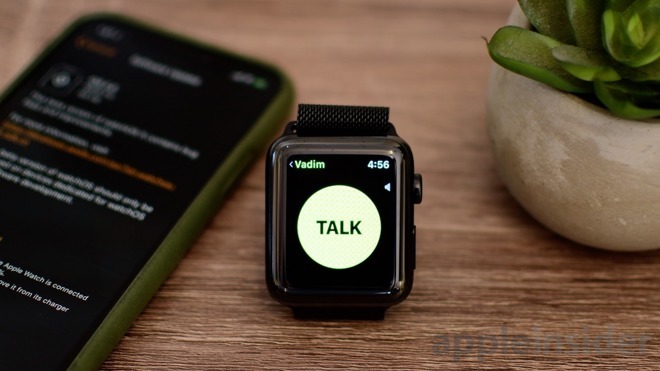
I don’t know about you, but sometimes I’m way too busy to call or text someone, especially with the fuss of calling and waiting for them to answer. That’s where the new Walkie-Talkie feature comes in.

Simply press the button, say a quick message, and release when you’re done. The message is instantly played out through the target Apple Watch.

To get started, open the app, choose a contact and send them an invitation. Once they accept, you’re ready to start sending and receiving audio messages, and it even works with LTE.

You can also keep your conversation private by using AirPods or other Bluetooth headphones. We tested this out, and found it worked incredibly well, even in beta.

Other Siri Improvements

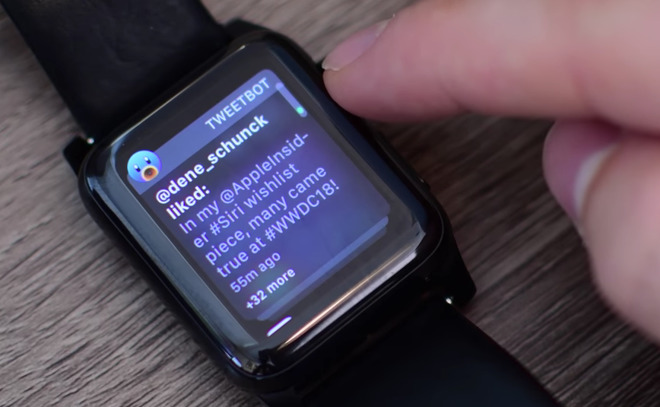
With watchOS 5, you can now respond to notifications without having to open up the relevant app. This makes it a lot easier to do quick tasks, like checking in to your flight.

Siri got quite the overhaul in watchOS 5, and you can learn more about that AppleInsider’s standalone piece.

One of the biggest features coming to iOS 12 is grouped notifications, and that same feature is coming to the Apple Watch. Instead of seeing a massive list of message notifications, they are grouped into one notification, which you can clear or open to view in more detail.

Apple has also added WebKit to watchOS 5, so if you receive a message containing a website link, you can now see a preview of that website right on your Apple Watch. You can even do some limited web browsing if you send yourself a link to a site or your preferred search engine.

If the Apple Watch Series 4 has a larger display, as rumors suggest, previewing websites should be a lot nicer on the new models.

Speaking of the rumored Series 4 Apple Watch, Apple seems to have inadvertently leaked images of the forthcoming wearable. In the leaked image, we see a brand new watch face full of complications —nine to be exact. This new face will likely be exclusive to the Series 4, but it does give users access to much more information at once.

With WatchOS 5, it’s a lot easier to use the Do Not Disturb mode. You can now schedule it to turn on for a certain amount of time, or until you leave your location, which is perfect for business meetings.

Along with these major new features that are coming with watchOS 5, there are also a bunch of small little changes and feature additions Apple has added, which AppleInsider has previously examined.

AppleInsider will also be getting its hands on the new Apple Watch Series 4 as soon as it’s released, so expect a hands-on shortly after its release.

Posted on Leave a comment

Apple begins logic board replacements for iPhone 8, claiming ‘very small percentage’ of defects


Apple on Friday initiated a free logic board replacement program for some owners of the iPhone 8, admitting that “a very small percentage” of units were shipped out with a manufacturing defect.

Apple iPhone 8

Impacted devices were sold between September and March in Australia, China (including Hong Kong and Macau), India, Japan, New Zealand, and the U.S. The company has put up a search tool through which people can screen their phone’s serial number.

The issue doesn’t affect the iPhone 8 Plus, Apple noted.

Assuming an iPhone is listed as affected, people must then make an appointment at an Apple store or authorized service provider. Alternately owners can contact Apple support directly and arrange for a mail-in, but all three methods involve iPhones being sent to a distant repair center. It’s critical to backup a device to iCloud or iTunes before handing it over.

iPhones with the faulty boards may freeze, reboot, or outright fail to turn on.

Posted on Leave a comment

Judge dismisses motion to halt Qualcomm’s potential iPhone import ban


Plaintiffs in a class action lawsuit against Qualcomm had sought to stop the chipmaker from getting a theoretical import ban on Intel-equipped iPhones, but perennial Apple judge Lucy Koh has denied the motion.

Qualcomm

Judge Koh on Wednesday denied a motion by plaintiffs in a class action suit to prevent Qualcomm from obtaining a U.S. International Trade Commission exclusion order that would affect the import of iPhones with Intel modems, reports FOSS Patents.

“At bottom, Plaintiffs cannot sustain their request for a preliminary injunction because their asserted harm relies on a speculative and attenuated inferential chain, which centrally includes intervening decisions by multiple independent decisionmakers,” Judge Koh wrote.

The motion was dismissed “without prejudice,” meaning that it can be brought again in the future.

The plaintiffs, who are suing Qualcomm for antitrust violations, filed the motion in June concerning Qualcomm’s separate proceeding before the ITC, in which Qualcomm seeks to “prevent importation of certain Apple devices into the United States.” The issue Koh ruled on this week was the plaintiffs’ motion for a preliminary injunction, which sought to “enjoin Qualcomm from enforcing any exclusion or cease-and-desist order that the ITC may issue in that action.”

The motion was brought by plaintiffs who believe that Qualcomm’s ITC complaint represents an anti-competitive action.

Judge Koh, for jurisdictional reasons, often presides over cases related to Apple and other Silicon Valley-based companies, including the recent trial between Apple and Samsung.

Posted on Leave a comment

Apple buys AR headset lens maker Akonia Holographics, fuels ‘Apple Glasses’ rumors

Apple on Wednesday confirmed the purchase of Colorado-based Akonia Holographics, a startup focused on the development and production of specialized lenses used in augmented reality headsets.

Magic Leap AR headset.

Terms of the acquisition are unknown, though Apple issued its usual non-confirmation confirmation on the reported purchase to Reuters.

“Apple buys smaller companies from time to time, and we generally don’t discuss our purpose or plans,” Apple said in a statement.

According to an AR industry executive, the team at Akonia became “very quiet” over the past six months, suggesting Apple completed the purchase sometime this year.

Founded in 2012, Akonia’s initial goal was to develop holographic data storage solutions, but the firm quickly transitioned to making displays for AR glasses. The company’s flagship product, called HoloMirror, uses “proprietary volume holographic media and know-how to uniquely enable thin, transparent smart glass lenses that display vibrant, full-color, wide field-of-view images,” according to its website.

Akonia claims its technology “will revolutionize” the smart glass display industry, offering manufacturers “ultra-clear, full-color performance” in thin and light headsets. Unlike similar solutions from the likes of Magic Leap, which use waveguides to funnel graphical information to multiple display planes positioned in front of a user’s eyes, HoloMirror utilizes a single layer of media. The method not only reduces system complexity, but allows for integration into small form factors like common glasses.

The company holds a cache of more than 200 patents relating to holographic systems and materials, though it is not clear how many cover AR wearables.

Perhaps more importantly, Akonia says it “defined the technology” that will pave the way for improvements including greater field-of-view. In respect to AR, FOV is a key ingredient in AR immersion. Using a low-FOV AR device overlays computer generated graphics atop real-world objects, but the illusion ends abruptly at the edges of each display. High-FOV devices are, ostensibly, more immersive, extending the CGI field to the outer reaches of a user’s vision.

For example, critics of Magic Leap’s just released mixed reality headset say the system suffers from relatively low FOV, and thus pulls them out of the AR experience.

The acquisition provides insight into Apple’s rumored “Apple Glasses,” an in-house designed AR headset expected to ship in the next few years. A report last year claimed the tech giant is developing its own display and processor for the project, a route expected to require substantial assets in both hardware and software engineering.

Reports earlier this year claim the device, referred to internally as “T288,” currently employs ultra high-resolution 8K displays and a separate processing unit to overlay virtual images over real-world objects present in a user’s field of vision. If Apple intends to slim down the package and release it as an aesthetically appealing product, said displays would necessitate extremely thin and transparent lenses. Akonia’s technology could provide such a solution.

Posted on Leave a comment

Huawei again estimated to have overtaken Apple as world’s No. 2 smartphone vendor


New market research further solidifies previous estimates that Apple has ceded its spot as the world’s second-largest smartphone vendor to Chinese upstart Huawei, at least for now.

Huawei

According to the latest numbers from Gartner, Huawei ended the second quarter of 2018 with 49.8 million devices sold, good enough for a 13.3 percent share of the global smartphone market, reports TechCrunch. Huawei’s numbers are up from the year-ago quarter, which saw the firm ship about 36 million units for a 9.8 percent marketshare.

The performance lands the Chinese smartphone maker ahead of Apple, which sold 41.3 million iPhones during the same period of 2018. Gartner places Apple’s marketshare at 11.9 percent, a dip from 12.1 percent recorded during the same time last year.

“Huawei continues to bring innovative features into its smartphones and expand its smartphone portfolio to cover larger consumer segments,” said Gartner research director Anshul Gupta. “Its investment into channels, brand building and positioning of the Honor devices helped drive sales. Huawei is shipping its Honor smartphones into 70 markets worldwide and is emerging as Huawei’s key growth driver.”

Samsung topped the chart with 72.3 million smartphones shipped in quarter two, but also saw a decline in year-over-year performance. The Korean tech giant’s marketshare dipped from 22.6 percent in 2017 to 19.3 percent during the most recent quarter.

Two more Chinese brands, Xiaomi and Oppo, finished fourth and fifth, respectively. Xiaomi, a blatant Apple ripoff artist, shipped 32.8 million units for an 8.8 percent marketshare, while Oppo managed 28.5 million shipments for a 7.6 percent slice of the pie.

Gartner’s figures align with findings from market research firms IDC, Canalys and IHS Markit, all of which saw Huawei outperform Apple in the second quarter. Previous estimates were less conservative, putting Huawei’s shipments closer to 54 million units for the three-month period.

Gupta warned of soft iPhone X demand, an oft-repeated analyst worry that Apple has continuously refuted.

“Demand for the iPhone X has started to slow down much earlier than when other new models were introduced,” Gupta said.

Apple last month reported its best June quarter ever, recording $53.3 billion in revenue on the back of largely flat iPhone sales. Despite slowing sales, Apple’s iPhone revenue surged 20 percent year-over-year on a stronger mix of premium priced handsets like iPhone X. Indeed, it was Apple’s most expensive phone that maintained its position as the company’s best performer, helping drive average selling price to $724, up from $606 a year ago.

The top-five vendor list is likely to reshuffle at the end of the year. Apple is widely expected to release a trio of new iPhones in September that will undoubtedly result in a sales spike during the last calendar quarter. The company is anticipated to launch two high-end OLED models and a mid-tier LCD version that could be priced between $600 and $700.