Posted on Leave a comment

Apple stock threatened by growing backlash against App Store revenue cut


Rumblings against Apple’s sizable take from App Store revenues could have an impact on the company’s stock, given the new focus on Services revenue, an analyst said on Friday.

Netflix on iPhone

“While the services segment grew 18 percent in the December quarter, we’ve now started to get investor questions worrying about whether the App Store will be the next shoe to drop,” wrote AB Bernstein’s Toni Sacconaghi in a note seen by AppleInsider. Specifically, he cited a series of headlines indicating that Spotify and Netflix have stopped offering in-app subscriptions, and that others like Fortnite developer Epic Games have threatened similar actions.

Apple claims 30 percent from the majority of App Store transactions, which Spotify and others have complained can force them to hike prices or take a major financial hit. For some time Spotify charged $3 extra to in-app Premium subscribers, ultimately deciding to end the discrepancy and direct iPhone and iPad owners to its website.

Apple’s revenue cut does shrink to 15 percent for subscriptions over a year long, but this doesn’t seem to have appeased developers.

“Unsurprisingly, this 30 percent cut has transformed the App Store into the largest single driver of Apple Services, accounting for about 40 percent of all Services growth in the last three years by our estimates,” Sacconaghi continued. “In recent years, however, discontent over this ‘Apple tax’ has been brewing among several major iOS app developers.”

The analyst cited Netflix’s action as the trigger for investor concerns. Apple Chief Financial Officer Luca Maestri has argued that Netflix represented “less than 0.3 percent of total services revenue” in 2018.

Sacconaghi also pointed out, however, that an ongoing U.S. case is weighing whether App Store practices constitute a monopoly. The App Store is the only place developers are normally allowed to sell iOS apps, and losing the case could break the company’s revenue streams. Developers on macOS, Windows, and Android are free to use third-party storefronts or their own.

However, Sacconaghi doesn’t seem to put any weight on any services that Apple will debut in the future, such as the expected video streaming service. Nor, does he seem to note that Services is more than the App Store, as Apple Music, AppleCare, and iCloud are all part of the revenue stream as well.

Posted on Leave a comment

Apple Watch could get more hands-free tilt controls in future watchOS update

The Apple Watch could include more gestures similar to Raise to Speak in the future, after the revelation Apple has explored the possibility of producing more hands-free ways to interact with wearable devices and other hardware.

Apple Watch

Apple Watch

Apple introduced Raise to Speak as part of a raft of updates in watchOS 5 last year. The gesture, where the user raises their wrist up and prepares to speak to the Apple Watch, is automatically treated as an intention to issue a command to Siri, all without saying the “Hey Siri” prompt beforehand.

The gesture is useful for more than dismissing the need for a verbal prompt, as it is a way of interacting with the Apple Watch without needing to use both hands. Most actions still require the use of the free hand, such as by touching the screen or turning the digital crown, and while voice commands are also useful, it may not be a desirable time to use them while the user’s hands are occupied with other tasks.

A patent application from Apple published by the U.S. Patent and Trademark Office on Thursday for “interacting with an electronic device through physical movement” describes how an Apple Watch could be controlled in a more elaborate manner than currently offered, just by tilting the wrist.

The concept relies on the Apple Watch detecting the user raising their wrist, in a similar way to the current Raise to Speak gesture, but the bulk of the filing details what the users do after the detected raise. By rotating their wrist or tilting their arm, it is suggested the user can select one from multiple different actions presented to them on the display.

While this could be used to prompt actions, it is more likely that such a system would be needed for when a user needs to respond to a notification, without needing to use both of their hands. One example offered is to either accept or reject an incoming call to the Apple Watch.

In one interpretation, the display has a three pronged image that works in a similar fashion to ball-in-maze puzzles. One prong of the M-shaped maze contains an indicator that can be moved to other two lanes, with each representing the response to answer the call or to hang up.

An example of the simple tilt maze used to answer calls in the proposed patent application

An example of the simple tilt maze used to answer calls in the proposed patent application

By rotating the wrist back, the user can shift the indicator in the relevant direction, then tilt to determine which operation they wish to perform, and then rotate the wrist back for a specific period of time to bring the indicator all the way along the path, to confirm the action.

In another way, a single-path lane with two corners can provide two different responses, such as muting a call and hanging up while in a call, with the duration appearing in the middle of the U-shaped path. The indicator can be kept between the two corners while the call is made, but can be tilted and made to reach one of the path’s ends if the user requires one of the two actions to be performed.

The two corner U-shaped path variant in the Apple Watch tilt control patent application

The two corner U-shaped path variant in the Apple Watch tilt control patent application

The concept can also be extended to allow for calls to be answered without the user even needing to see the screen.

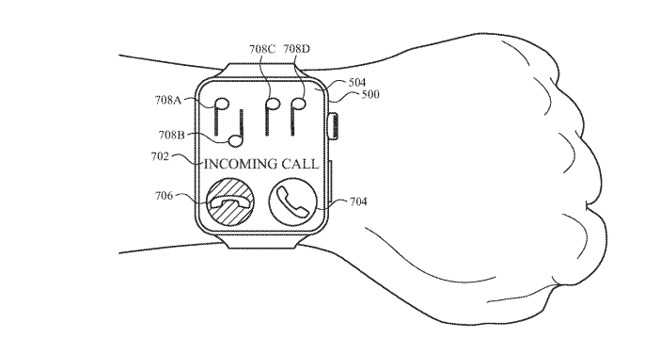
When a call is received, the Apple Watch could play a special ringtone consisting of high and low notes in a specific short sequence, potentially for a specific user. To answer the call, the user could perform a series of rotating “flick” movements that matches the ringtone’s notes, rolling away from their face for a high note, and towards for a low note.

An example of the musical notes tilt-cue ringtone concept from the patent application

An example of the musical notes tilt-cue ringtone concept from the patent application

The lifting and rotating mechanic could be employed for selecting and sending pre-made instant messages to contacts. Once the right response is highlighted, the user could keep their wrist still for a few seconds to confirm they wish the message to be sent.

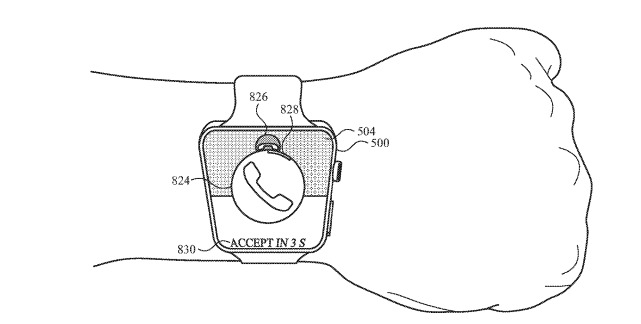
A further tilt mechanic could be used to answer calls by tilting towards the user and holding in place for a few seconds to start the conversation, or away and holding to reject. The same can also be performed by tilting the wrist forward or back, then holding to confirm.

Tilting and holding could be used to answer and reject calls on the Apple Watch

Tilting and holding could be used to answer and reject calls on the Apple Watch

While Apple does produce a large number of patent filings and applications on a weekly basis, their existence isn’t a guarantee that the concepts described will make their way into future products or services. They do however serve as an indication of areas where Apple has shown interest.

For this patent application, employing any of the ideas is plausible for Apple, as it would require only software changes made to watchOS. Since the Apple Watch has tilt sensors and accelerometers for fitness tracking and the aforementioned Raise to Speak, it already has the hardware required to implement such features in the future, if Apple decides to use them.

The application is the latest in a number of other filings where Apple has examined alternative ways for users to interact with devices. For the HomePod, it suggested the creation of a depth map for a room to detect a user’s hands, in order to perform gestures from anywhere in the room.

Gestures have also been considered as a way to control a self-driving vehicle, with actions performed within a designated “interaction zone” able to order a vehicle to do one of a selection of maneuvers. More recently, Apple has looked into force-sensing gloves, which could allow gestures to be performed without a touch-sensitive surface or cameras monitoring the hand itself.

This is also not the first time Apple has considered using wrist gestures with the Apple Watch. Dating back to October 2016, one idea involved adding detectors to the band to detect changes in wrist position and hand shape that alter the stress on the band, rather than using tilt sensors.

Posted on Leave a comment

AirPower reference spotted in Malaysian iPhone Smart Battery Case website


Potentially keeping hope that the AirPower is still alive, Apple’s Malaysian website makes a reference to the charging mat in relation to its new Smart Battery Cases.

Apple AirPower

“The Smart Battery Case is compatible with AirPower Wireless Charging Mat and other Qi-certified chargers,” a Malaysian product page reads as of Wednesday morning Eastern time. On Apple’s U.S. site, the equivalent page says simply that the case is “compatible with Qi-certified chargers.”

The reason for the discrepancy is uncertain, but the culprit may be older marketing copy, in which case Apple was apparently expecting AirPower to already be available or ship alongside the new cases.

Apple first teased the AirPower at a fall 2017 press event, intending it to complement its newfound Qi support in the iPhone 8 and X. The company even gave the press hands-on time with the accessory, promising a 2018 launch.

As the year progressed though the company said virtually nothing about the product, sometimes outright refusing to comment to media outlets, AppleInsider among them. By the time the iPhone XS and XR were revealed Apple had practically wiped all mention from its website, fueling speculation that the company couldn’t make the technology work and was simply abandoning it.

The iPhone XS did ship with mention of the AirPower in its user guide however, and by mid-January manufacturing partner Luxshare Precision was reported to be going into production. Luxshare also produces some of Apple’s AirPods and USB-C cables.

Apple may have been held up by heat, mechanical, and interference problems, such as interdevice connections to communicate battery level, and its use of up to 24 power coils. The same rumor pointed to a spring 2019 release date at the earliest.

Posted on Leave a comment

Apple Business Chat continues expanding with auto dealer platform Gubagoo


The newest company to adopt Apple Business Chat is Gubagoo, which specializes in setting up 24/7 chat for auto dealerships and manufacturers.

Gubagoo Apple Business Chat

Business Chat brings a “Chat with Messages” button to dealer sites, and tapping on it will connect with Gubagoo chat crews via the iOS Messages app. From there a person can browse car inventory, ask questions, and book appointments such as repairs or test drives.

Tapping on a vehicle in chat will pop up a range of tools and details, such as a payment calculator, trade-in options, tech features, and performance specs. People can even go through early application stages, finishing up in person if and when they decide to buy.

While the average person may not know Gubagoo the company claims over 4,000 dealerships as clients, making it likely that online car shoppers have run into the company’s platform. Until now that platform has been linked exclusively to the Web and Facebook.

Apple Business Chat expands on normal Messages functions so companies can support or sell to customers on iPhones and iPads. For Apple, at least part of the point is probably deflecting people away from Facebook Messenger, which not only offers similar services but is one of the world’s most popular chat platforms in general, with the advantage of being cross-platform. Messages is only on iOS, watchOS, and macOS.

Also on Tuesday, brokerage firm TD Ameritrade began offering both Business Chat and Apple Pay, letting people transfer up to $10,000 per day to their accounts for immediate use. Previously clients had to conduct wire transfers or wait several days for money to process.

Posted on Leave a comment

Samsung has a long history of mocking Apple before copying it

Stop us if you’ve heard this one. Apple makes some change to its iPhones, Samsung’s PR company mocks the very idea —and finally Samsung copies it. Sometimes the company keeps a low profile, sometimes it shouts about Apple’s missteps, but always, always Samsung then goes the same way.

Samsung logo with an Apple-style bite taken out of it

Samsung logo with an Apple-style bite taken out of it

We’re not going to critcize Samsung phones here. Let’s not even get into the argument that Android copied iOS —partly because yes, of course it did, but mostly because we want to specifically examine Samsung.

The company usually makes a case that its technology is ahead of Apple’s and while you can regularly dispute that, it is often quite true. Samsung’s phones were waterproof before the iPhone was, for instance, and later in 2019 it’s highly likely that they will release 5G-capable phones and Apple won’t.

What we can’t get over is how Samsung’s PR department keeps hammering on this same nail. As part of all this, it regularly lampoons people who buy iPhones as being deaf to Samsung’s alleged technology superiority —but it treats its own users as being blind. Where Apple users sometimes get called sheep, Samsung is always hoping that its own users have goldfish memories.

The latest case is of course to do with the notch in the iPhone X range which naturally features far more prominently in Samsung’s advertising than it does in Apple’s own.

Yet this all goes back a long way. If it’s usually in such a specific sequence that you could predict when Samsung will mock and how many months later it will copy, there are occasions when its PR company is just wilfully ignoring the facts in order to take a shot at Apple.

Such as with Apple Stores. This one took a long time as Apple Stores opened in 2001 and it was late 2018 when Samsung ran a series of ads spoofing them.

[youtube https://www.youtube.com/watch?v=7trMPJNBV20&w=560&h=315]

That was part of Samsung’s series of ads called Ingenius which are all set in a mockup of Apple Stores and use, well, mockups of Apple Genius staff.

To be fair, Samsung could’ve done much the same thing with Microsoft Stores and would there have saved some money by not having to hire so many extras as customers.

Yet they could also have used their own stores. There are Samsung Experience Stores and there have been since they were introduced in 2013. It’s easier to find the website for them than it is an actual store, though. And that’s in part because of the last line on the page. “Finding a Samsung Store inside Best Buy near you is easy. Just enter your zip code.”

We added the emphasis but we didn’t enter our zip code—because there’s nowhere to type it. We do hope that this is a fluke, some temporary hiccup, because each time we try, we see only this the page.

Surely this usually works

Surely this usually works

It’s a gorgeously-designed page in the sense of how it looks but it doesn’t actually work.

Lightning fast

So Samsung is mocking the Apple Store experience when you didn’t even know that there was a Samsung Experience Store. Shortly before it opened these shelves inside Best Buy, Samsung also ripped Apple apart for how the company changed from a 30-pin dock to a Lightning cable.

[youtube https://www.youtube.com/watch?v=5-LeWDPkwnY&w=560&h=315]

This was 2012 and when we’re reminded that Apple made this change at all, it is startling to realise it was so long ago now. Samsung was right that it was happening and Samsung had a point about how big a change it was. To this day, you will find 30-pin connectors on devices in hotels, for instance.

However, there was also this: when Samsung released that ad, several websites pointed out this third-party product which you can still buy today.

What was that about changing from 30-pin to Lightning?

What was that about changing from 30-pin to Lightning?

That’s apparently the fistful of different cables that you needed to charge all the variations of Samsung phones. In 2012, it was being sold as a 17-in-1 set and today it’s an 18-in-1 set so either the makers missed one or Samsung’s done it again —without Apple mocking them.

Blatant

Call us idealistic, but we do credit customers with noticing things like this. We’re idealistic but also practical, though, so we wouldn’t assume that absolutely everybody would recognize a copy six years after the original. We do expect industry people too, however.

This one is Apple’s version in 2007. Call it Before.

[youtube https://www.youtube.com/watch?v=MicECONdno0&w=560&h=315]

And in 2013, Samsung’s After.

[youtube https://www.youtube.com/watch?v=azouIjsZrds&w=560&h=315]

Innovation

In that case, Samsung used Apple’s advertising skill. In the cause of speed and efficiency, it skipped the bit where it first mocked Apple, it just went straight to using the ideas. This isn’t the only time it’s done that —see if you can spot any Apple-esque elements in this ad —but from around 2013, it kept quiet. For a while.

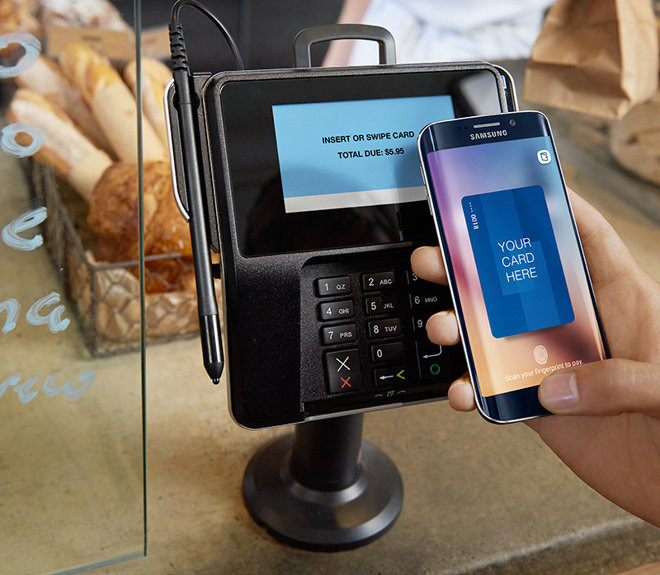
It’s as if it believes both industry experts and its own customers are so siloed that they won’t recognize a copy. They might well have a point there as usually Android advertising passes us by but we did pick up on Samsung’s great online payment innovation.

Samsung Pay innovation

Samsung Pay innovation

Apple Pay launched in 2014 and Samsung Pay was announced about a year later in 2015.

And Samsung couldn’t stop itself. While its advertising claimed that Samsung Pay was more widely accepted than any other system at all, it only showed an Apple Pay transaction failing. That claim about wide acceptance is qualified, by the way, with a little footnote saying “Refers to service coverage”.

[youtube https://www.youtube.com/watch?v=QDyHeQ–USQ&w=560&h=315]

We’re sure they’re right and the fact that it initially only worked with then then new Galaxy S6 Edge+ and Note 5 is just a detail. And actually, Samsung Pay does have an advantage over its rivals in that can work with old-style payment machines where you had to swipe your card.

Maybe that gag about failed Apple Pay transaction emboldened Samsung’s PR department, because it’s since then that they’ve gone all out to ridicule their Cupertino rival.

You don’t know jack

Civilization ended in 2016. That was when Apple dropped the headphone jack with the introduction of the iPhone 7. It was such a cataclysmic event that it may have taken you until 2018 to get over it —only to have another of Samsung’s Ingenius ads revive the trauma.

[youtube https://www.youtube.com/watch?v=-O_MjXbX3VA&w=560&h=315]

Take a guess what’s happening now. It appears that Samsung’s Galaxy A8S hasn’t got a headphone jack either. We’ll see what happens with the S10.

One notch

Someone at Samsung’s PR department is clearly spotting genuine issues with Apple’s iPhones, or at least things that could be genuine issues to some people. That dropping of the headphone jack was mildly inconvenient and it did mean we all have headphones lying around that we can’t use any more. It was definitely a valid point.

We’re just amused that nobody in Samsung’s PR department talked to Samsung itself. Fortunately, though, they would never make that mistake twice.

Or at least not twice in the same ad campaign.

Throttling

In 2018, both Apple and Samsung were fined for allegedly throttling the speed of their older phones, intentionally slowing them down in order to make you buy new ones.

Italy’s anti-trust body fined Apple the equivalent of $11.4 million and Samsung only $5.7 million so maybe Samsung could claim a little higher moral ground. Except it didn’t, it carried right on mocking how Apple iPhones slow down.

[youtube https://www.youtube.com/watch?v=3qhW1sDPHYI&w=560&h=315]

That’s enough now

Then riddled throughout the whole series of Ingenious ads, there are also decreasingly subtle digs at Apple and at Apple fans for that notch introduced in the iPhone X.

There’s no disputing that it detracts from the otherwise edge to edge display on the iPhone X, XS, XS Max and XR. You might not mind it, but you know that it would be nicer if it weren’t there. That said, you also know that it’s necessary. The notch is where Apple puts its TrueDepth technology which powers the Face ID system.

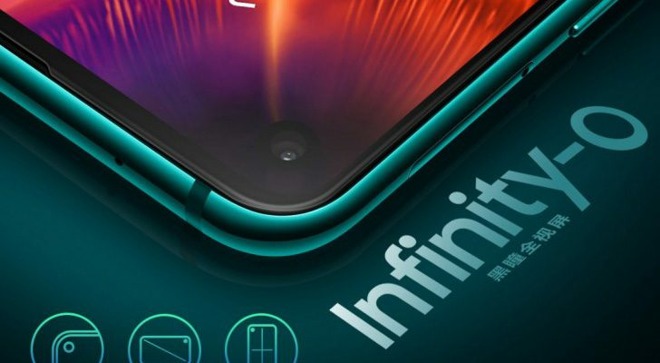
Samsung can’t let Apple be the only one with working Face ID so its new phones are set to have the same idea, at least to an extent. And in the case of the Samsung A8S, that same idea is going to feature what looks like a hole punch in the display.

It's not a notch, you've got to give them that

It’s not a notch, you’ve got to give them that

It’s up to you, it’s up to each of us, whether we find that more distracting than a notch but the same thing applies. The display would be better without it.

And there’s one other thing that you know applies. Apple is not going to mock Samsung’s hole punch in its advertising.

Classy

We’re going to say that, yes, Apple is too classy to hammer on Samsung in its major advertising campaigns. However, it’s also smarter. Possibly it’s also more arrogant, but it’s definitely smarter.

All phone manufacturers copy from —are inspired by —each other and, again, Samsung has legitimately beaten Apple to certain features.

Yet, the way that Samsung keeps on going through same loop of derision and copying leaves us feeling that it’s an also-ran. That’s wrong, Samsung makes some great phones yet this pummelling away at Apple is dangerous.

And having your ad agency insult the buyers of your rival’s products doesn’t feel like a winner, either. Maybe it is, maybe this is why Samsung is doing so well compared to all other Android makers.

Except of course that it’s now copying Apple’s China woes.

Keep up with AppleInsider by downloading the AppleInsider app for iOS, and follow us on YouTube, Twitter @appleinsider and Facebook for live, late-breaking coverage. You can also check out our official Instagram account for exclusive photos.

Posted on Leave a comment

Exploring what you can, and can’t do with HomeKit for TVs

HomeKit and AirPlay 2 will unlock a host of new functionality thanks to integration into many leading manufacturer’s television sets, including Samsung, Vizio, and LG. AppleInsider examines what that will look like, and what you’ll be able to do, when the features are available.

Arguably the biggest news out of CES 2019 was Apple’s surprise embrace of the TV industry with four major manufacturers announcing the integration of key Apple features into their sets. LG, Vizio, Sony, and Samsung all announced support for AirPlay 2 and Siri on some recent TVs while all but the last introducing support for HomeKit.

Immediately after the news emerged, social media was rife with potential customers evaluating the purchase of a new model —even before solid information was available about what HomeKit can and can’t do. So, while we await software updates, and the release of the promised new models, let’s talk about it.

A new category is introduced

TVs are now an entirely new category in HomeKit, which means they don’t show as solely as a simple speaker or Apple TV. They have their own properties and characteristics exposed to HomeKit.

Speakers, for instance, you can just turn up/down as well as play/pause. Alternatively, TVs have many more options within HomeKit.

To start, you can turn your set on or off or adjust the volume all the means you interface with HomeKit now, including Siri. Changing the input, controlling the brightness, and setting the picture mode or media state is all possible through HomeKit as well. This opens up so much more, especially if can be integrated into scenes.

Taking things even further, normal remote functions can be carried out through HomeKit with key simulation. So if there is something the TV needs to do unique, it is possible to expose those keys for use, negating the need to ever grab the manufacturer’s remote ever again.

This is possible with the Apple TV now —to some extent. There is limited HDMI-CEC information transmittal back to a television through the HDMI cable to a compatible television, but the implementation is spotty.

Integration into scenes

Speakers, as mentioned, really only can have their volume and media state controlled through HomeKit. They can’t be integrated into scenes like other accessories. This is very limiting to users and high on our wish list for June.

TVs, on the other hand, have many more properties that could make more sense in scenes —but, as of yet, specific information on what can be done is limited, and vendors at CES itself weren’t talking about it.

But for now, your bedtime scene now doesn’t just turn off the lights, lock the doors, close the garage, shut the blinds, and turn down the temperature. It should be able to do all that plus shut off your TV without relying on a HomeKit socket.

Maybe a “movie time” scene will be able to dim the lights and turn on the TV. A “Night mode” scene may be able to turn on the TV and turn the volume to a less wall-shaking decibel out of respect for others. “Game time” could turn on the TV, set a cool color backlight with the Hue Play, turn up the volume, and switch the input to your PS4.

Inevitable limitations

Naturally, there are going to be limitations here on what you can do. The biggest is that this won’t act as an Apple TV replacement. Samsung’s implementation isn’t getting HomeKit —but is getting the iTunes movies and TV store. Also, the Vizio and LG versions don’t have iTunes, and are limited to just AirPlay 2 and HomeKit. The full tvOS experience and all that entails still remains exclusive to the Apple TV.

The new TVs also won’t act as a Home Hub. You still need an Apple TV, a plugged-in iPad, or a HomePod for this. Having a Home Hub gives external secure access to any HomeKit accessories like lights or locks.

Start playing

These new TVs and updates will be available soon in a variety of sizes and price points. If you’re in the market, these would be excellent to consider, whether or not you already have an Apple TV. And, it’s worthwhile to see what can be found refurbished from Vizio, given that the company will roll out support for some supporting models back to 2016.

Apple has compiled a list on its website to see which models may be getting the update and which new ones are on the way.

Posted on Leave a comment

Qualcomm pushed for iPhone exclusivity in response to $1B incentive payment demand, CEO says


Qualcomm CEO Steve Mollenkopf took the stand to defend his company at a trial with the Federal Communication Commission on Friday, saying the chipmaker pushed for exclusivity on iPhone because Apple demanded a $1 billion “incentive payment” to secure the deal.

Qualcomm CEO

Qualcomm CEO Steve Mollenkopf speaks at the Brainstorm Tech conference in 2017. | Source: Fortune

According to Mollenknopf, Apple said the payment would be used to cover technical costs to transition from communications hardware made by Infineon to comparable components manufactured by Qualcomm, reports Reuters.

Qualcomm agreed to Apple’s request, at least in part, as the firm rendered an undisclosed sum to Apple in the form of a rebate starting in 2011. As described by Mollenkopf, Apple received the rebate on chips and licensing as long as Qualcomm remained the sole supplier of iPhone modems.

The deal, which was renewed in 2013, put Qualcomm in a precarious position as it did not specify the number of chips Apple would be obligated to buy. Qualcomm sought an exclusivity arrangement to offset the inherent financial risk, Mollenkopf testified.

“The risk was, what would the volume be? Would we get everything we wanted, given that we paid so much in incentive?” Mollenkopf said on the stand.

The testimony adds a wrinkle to the FTC case, which alleges Qualcomm participates in anticompetitive business practices to the detriment of industry competitors like Intel. Both Apple and Intel assisted antitrust regulators in bringing the case against Qualcomm to court, saying the chipmaker abuses FRAND (fair, reasonable and non-discriminatory) patent licensing commitments to maintain a stranglehold on the market.

Mollenkopf’s statements contrast testimony offered by Apple supply chain executive Tony Blevins earlier in the day.

Apple typically attempts to diversify its supply chain by securing at least two manufacturers for each iPhone component, Blevins said, adding that Qualcomm’s rebate made it “very unattractive” to seek a secondary chip supplier.

“We think competition and market forces are very important to us to achieve the best leverage,” Blevins said, according to CNET. “With exclusivity, there would be no competition.”

Apple is involved in its own legal struggle with Qualcomm over licensing, patents and alleged nefarious business practices. Apple fired first with a $1 billion suit in January 2017, claiming the chipmaker abused its “monopoly power” of the wireless modem industry to demand excessive royalties. Qualcomm has since filed multiple countersuits claiming Apple is in breach of contract.

Most recently, Qualcomm won two key rulings in China and Germany, where courts issued a sales ban on certain iPhone models for infringing on Qualcomm patents. Apple is appealing both cases, though Qualcomm this month posted a $1.52 billion bond in Germany to take all iPhones save for iPhone XS and XR off store shelves.

Posted on Leave a comment

IMDB and Amazon shifts into free video streaming with ad-supported Freedive


Amazon is expanding its video streaming horizons by launching a new service IMDB Freedive, an advertising-supported on-demand service that provides access to movies and TV shows that is separate from its existing subscription and paid Prime Video offering.

Logo for IMDB Freedive

Launched in the United States, IMDB Freedive provides access to a selection of over 130 movies and 29 TV shows at no charge. Rather than paying a subscription or for individual shows or films, users are instead interrupted with commercials while viewing the content.

While short, the initial list of content is varied and consists of relatively well-known programming, including “Heroes,” two seasons of “The Bachelor,” “Gilligan’s Island,” and “Kitchen Nightmares,” reports Variety. For films, the selection ranges from “The Last Samurai” and “Memento” to “Run Lola Run” and “Foxcatcher.”

The service also offers a selection of IMDB short-form originals, including “The IMDB Show” and “Casting Calls,” alongside trailers and interviews. More content is also planned to be added in the future.

Taking some cues from Amazon’s own Prime Video service, IMDB Freedive taps into the retailer’s X-Ray function, providing facts and trivia about a movie or TV show’s cast and the current scene when a video is paused. IMDB is a source for the data used in the Prime version of X-Ray, making it a logical inclusion for IMDB’s own video service.

The service is initially being made available through the IMDB website, as well as via Fire TV set-top boxes. Mobile app versions, including one for iOS, are also in the works, though it is unclear if it will be made available on the Apple TV at the same time.

Freedive has been rumored for some time, with reports of negotiations with content distributors surfacing in August 2018. It is also an experiment for Amazon, which has previously offered content to Prime subscribers as well as the option to buy videos outright, while free content may also help drive some sales of the Fire TV range for customers who aren’t already using Prime.

The addition of IMDB makes the video streaming market even more crowded for Apple, which is currently developing its own roster of original content. The first wave of shows from the iPhone producer is tipped for release in early 2019, but it remains unclear if it will be as part of a streaming service or if it will be provided free to owners of Apple devices alongside other channel subscriptions.

Posted on Leave a comment

Apple assembly partner Foxconn says December revenues down, blames ‘consumer category products’


Apple’s primary assembly partner, Foxconn, said on Thursday that it saw revenues for the month of December drop 8.3 percent year-over-year, likely a reflection of weak iPhone demand.

Foxconn iPhone assembly

Revenues slid to $20.12 billion versus $21.91 billion in 2017, Reuters reported. It’s the first such decline since last February.

“The main reason is that the fall for consumer category products was rather big,” a Foxconn representative said, without providing detail on which clients or products were the culprits.

Foxconn is heavily dependent on Apple orders, and the iPhone in turn is Apple’s biggest product. Manufacturing is usually most intense in late summer and the fall as the two companies prepare to launch new models then cope with holiday demand.

Apple CEO Tim Cook confessed to soft iPhone sales earlier this month, pointing his finger mostly at the Chinese market. He put lesser blame on other markets, as well as factors like “foreign exchange headwinds,” fewer carrier subsidies, and even discounted battery replacements, which some have called an admission that Apple depends on degraded batteries to spur upgrades.

In a recent interview Cook denied suggestions that the iPhone XR has been a flop, saying it has been the bestselling iPhone model since its launch. That may simply be bad news, however, for the iPhone XS and XS Max.

All three phones have come under fire for being too expensive. An XR starts at $749, $100 more than Apple’s once-standard pricetag. An XS is at least $999, and an XS Max is $1,099 — especially rich shoppers can spend as much as $1,449, more than some Macs.

Posted on Leave a comment

AT&T lying to customers by showing ‘5G E’ on devices, under fire from other carriers


AT&T has been criticized by rival carriers Verizon, Sprint, and T-Mobile for attempting to mislead customers by marketing some smartphones as using “5G Evolution” technology and displaying a “5G E” connectivity logo on the screen, despite the devices involved being incapable of connecting to a 5G network.

AT&T carrier van

AT&T has come under fire on social media and in statements following the revelation the carrier has started to update some of the devices it sells with a new connectivity icon. Owners of some Samsung and LG smartphones are starting to see a connectivity icon reading as “5G E,” indicating the device is connected to AT&T’s “5G Evolution” network.

The name seemingly references the upcoming 5G connectivity that carriers are slowly building into their networks, but does not in fact mean 5G. In the case of 5G Evolution, AT&T uses the name to refer to its existing 4G (LTE-A) technology improvements that it has rolled out in hundreds of markets, and has done so for some time.

The change to start displaying “5G E” on some devices is misleading to consumers, as they may expect to connect to an actual 5G network, rather than one that is actually just fast 4G. AT&T is slowly rolling out a genuine 5G network, but currently it requires customers to connect to it using the Netgear Nighthawk Mobile 5G Hotspot.

The move has received some criticism from AT&T’s rivals. T-Mobile opted to mock AT&T’s decision on social media, releasing a video updating an iPhone to “9G” by attaching a piece of a sticky note over the visible LTE connectivity icon.

A blog post by Verizon CTO Kyle Malady that was also used as a full-page advertisement in a number of newspapers called out the issue without directly naming AT&T. In the post, Malady advises Verizon is committed to “labelling something 5G only if new device hardware is connecting to the network using new radio technology to deliver new capabilities.”

Malady goes on to more directly allude to AT&T’s activity, insisting “We won’t take an old phone and just change the software to turn the 4 in the status bar into a 5. We will not call our 4G network a 5G network if customers don’t experience a performance or capability upgrade that only 5G can deliver.”

“Doing so would break an enduring and simple promise we’ve made to our customers: that each new wireless generation makes new things possible,” continued the CTO.

In a statement to Engadget, Sprint made a more direct accusation. “AT&T is blatantly misleading consumers – 5GE is not real 5G,” Sprint CTO Dr. John Saw proclaimed.

“Sprint will launch and market real 5G that is standards-based in the first half of 2019,” advised the carrier. “We’re designing our mobile 5G footprint at launch to cover the downtown metro areas of 9 top cities, with sights on providing our customers with contiguous coverage using the first 5G smartphone in the U.S.”

Regardless of when actual 5G networks go live for smartphones in the United States, it is unlikely that Apple will take advantage of the high-speed communications technology for some time, with reports suggesting the first iPhones supporting 5G won’t ship until 2020 at the earliest. Android-based smartphones are more likely to offer 5G sooner, possibly by the end of this year.