
Adobe has issued a statement agreeing to pay a hefty fine after years of customers complaining about a lack of transparency in its billing agreements — but it still doesn’t think it did anything wrong.
Adobe has announced that it has finalized a settlement agreement with the U.S. Department of Justice. It officially marks the end of the more than two-year long saga surrounding its much maligned cancellation practices.
Of the $150 million Adobe has agreed to pay, $75 million will go directly to affected customers in the form of complimentary services. The remaining $75 will go directly to the Department of Justice to settle the lawsuit.
While Adobe agreed to pay the fee, it hasn’t admitted any wrongdoing. In fact, the company says, “While we disagree with the government’s claims and deny any wrongdoing, we are pleased to resolve this matter.”
To be clear, Adobe isn’t fixing the abhorrent cancellation fees – it’s just now required to be significantly more transparent about them.
To understand why this shook out the way it did, you’ll need to understand how Adobe handles subscriptions. And, if you’ve never seen this before, I apologize ahead of time for how confusing it is.
Starving artists need not subscribe
When a user subscribes to something Adobe offers, they’re given three options to pay: monthly; annual, paid monthly; or annual, paid upfront. Here’s what each of those options means.
None of the subscriptions, by the way, are terribly cheap. If you’re an independent artist who needs Adobe products, that can account for a large portion of your monthly overhead.
Monthly subscription: The most expensive option, Adobe’s monthly subscriptions are often twice the cost of the other subscription options. However, if a user needs to cancel the subscription, Adobe does not charge a fee.
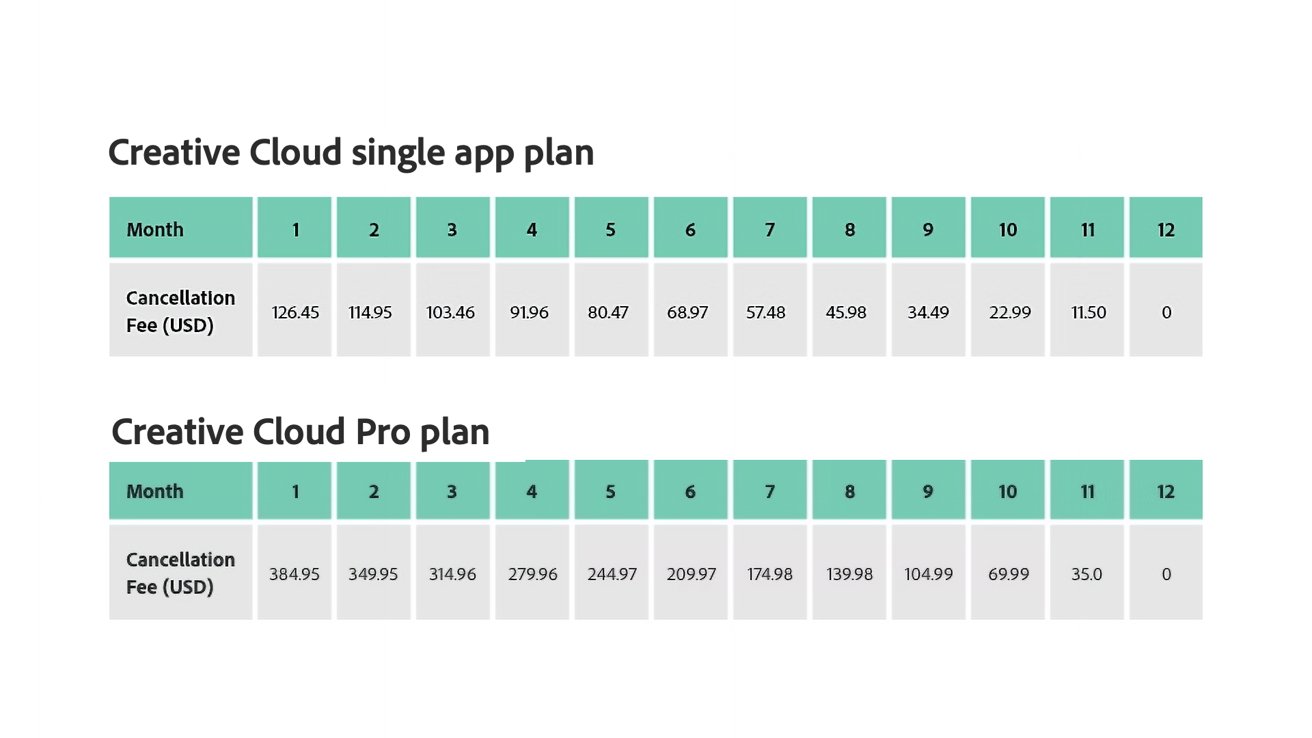
Annual subscription, paid monthly: Typically half the price of the standard monthly subscription, Adobe allows users to subscribe at the yearly price while still paying monthly. The downside is that Adobe will charge 50% of the remaining contract if canceled.
Annual subscription, paid upfront: Users may also choose to pay upfront for a full year of service. While this has advantages, such as preventing surprise billing, Adobe warns users that there are absolutely no refunds on this plan after the first 14 days.
Image credit: Adobe
The outcry came when Adobe hid its cancellation terms and conditions in the fine print. This meant that anyone who suddenly couldn’t justify — or afford — paying $69.99 per month for the all apps plan could be hit with up to a $384.95 cancellation fee if they cancelled between day 15 and day 30 of the first month.
Even if a user cancelled in the seventh month, they’d still be forced to pay nearly $175. Which, again, for many individual users isn’t just inconvenient — they might not be able to afford it at all.
So, the high cancellation fees remain, but Adobe at least now discloses them a bit more clearly.
Interestingly enough, if you poke around the Adobe site, you’ll find that this cancellation fee varies from location to location. South Korean users only pay 10 percent of the annual commitment as a cancellation fee.
Adobe subscribers in Brazil only pay 20% if they choose to terminate the contract early.